1) Describe the guidelines to be used in determining (a) what constitutes an operating
segment, and (b) whether a specific operating segment is a significant segment.
2) Polly, Inc. owns 80% of Saffron, Inc. During 2014, Polly sold goods with a 40%
gross profit to Saffron. Saffron sold all of these goods in 2014. For 2014 consolidated
financial statements, how should the summation of Polly and Saffron income statement
items be adjusted?
a.Sales and cost of goods sold should be reduced by the intercompany sales
b.Sales and cost of goods sold should be reduced by 80% of the intercompany sales
c.Net income should be reduced by 80% of the gross profit on intercompany sales
d.No adjustment is necessary
The bonus and goodwill methods of recording the admission of a new partner will
produce the same result if the:3) 1>new partners profit-sharing ratio equals his capital
interest
2>old partners profit-sharing ratio in the new partnership is the same relatively as it was
in the old partnership.
a.1
b.2
c.both 1 and 2 are met

d.none of these
4) On January 1, 2013, P Corporation purchased 75% of S Corporation for $500,000. Ss
stockholders equity on that date was equal to $600,000 and S had 40,000 shares issued
and outstanding on that date. S Corporation sold an additional 8,000 shares of
previously unissued stock on December 31, 2013.
Assume that P Corporation purchased the additional shares what would be their current
percentage ownership on December 31, 2013?
a.62 1/2%
b.75%
c.79 1/6%
d.100%
5) Fixed assets and noncurrent liabilities are accounted for in the records of
a.governmental funds
b.expendable funds
c.proprietary funds
d.both governmental and expendable funds
6) The purchase by a subsidiary of some of its shares from the noncontrolling
stockholders results in an increase in the parents percentage interest in the subsidiary.
The parent companys share of the subsidiarys net assets will increase if the shares are
purchased:
a.at a price equal to book value
b.at a price below book value
c.at a price above book value
d.will not show an increase
On November 1, 2014, American Company sold inventory to a foreign customer. The
account will be settled on March 1 with the receipt of $450,000 foreign currency units

(FCU). On November 1, American also entered into a forward contract to hedge the
exposed asset. The forward rate is $0.70 per unit of foreign currency. American has a
December 31 fiscal year-end. Spot rates on relevant dates were:7) Per Unit of
DateForeign Currency
November 1$0.73
December 310.71
March 10.74
What will be the adjusted balance in the Accounts Receivable account on December 31,
and how much gain or loss was recorded as a result of the adjustment?
Receivable BalanceGain/Loss Recorded
a.$319,500$9,000 gain
b.$319,500$9,000 loss
c.$333,000$4,500 gain
d.$333,000$18,000 gain
8) P Company purchased the net assets of S Company for $225,000. On the date of P’s
purchase, S Company had no investments in marketable securities and $30,000 (book
and fair value) of liabilities. The fair values of S Company’s assets, when acquired,
were
Current assets$ 120,000
Noncurrent assets 180,000
Total$300,000
How should the $45,000 difference between the fair value of the net assets acquired
($270,000) and the consideration paid ($225,000) be accounted for by P Company?
a.The noncurrent assets should be recorded at $ 135,000
b.The $45,000 difference should be credited to retained earnings
c.The current assets should be recorded at $102,000, and the noncurrent assets should be
recorded at $153,000
d.An ordinary gain of $45,000 should be recorded. I would edit as D become B
9) From the viewpoint of a U.S. company, a foreign currency transaction is a
transaction:
a.measured in a foreign currency

b.denominated in a foreign currency
c.measured in U.S. currency
d.denominated in U.S. currency
10) An indirect exchange rate quotation is one in which the exchange rate is quoted:
a.in terms of how many units of the domestic currency can be converted into one unit of
foreign currency
b.for the immediate delivery of currencies exchanged
c.in terms of how many units of the foreign currency can be converted into one unit of
domestic currency
d.for the future delivery of currencies exchanged
11) Statement of cash flows
a.1 and 3
b.2 and 3
c.1 and 2
d.1, 2, and 3
12) Which of the following funds would account for operations that are financed and
operated in a manner similar to private business enterprises?
a.Debt Service Fund
b.Enterprise Fund
c.Internal Service Fund
d.Special Revenue Fund
13) The view that consolidated financial statements represent those of a single
economic entity with several classes of stockholder interest is consistent with the
a.parent company concept
b.current practice concept
c.historical cost company concept
d.economic unit concept

14) Prince Company owns 104,000 of the 130,000 shares outstanding of Serf
Corporation. Serf Corporation sold equipment to Prince Company on January 1, 2014
for $740,000. The equipment was originally purchased by Serf Corporation on January
1, 2013 for $1,280,000 and at that time its estimated depreciable life was 8 years. The
equipment is estimated to have a remaining useful life of four years on January 1, 2014.
Both companies use the straight-line method to depreciate equipment. In 2015Prince
Company reported net income from its independent operations of $3,270,000, and Serf
Corporation reported net income of $820,000 and declared dividends of $60,000. Prince
Company uses the cost method to record the investment in Serf Company.
Required:
A.Prepare, in general journal form, the workpaper entries relating to the intercompany
sale of equipment that are necessary in the December 31, 2015 consolidated financial
statements workpapers.
B.Calculate the amount of noncontrolling interest to be deducted from consolidated net
income in the consolidated income statement for 2015.
C.Calculate controlling interest in consolidated net income for 2015.
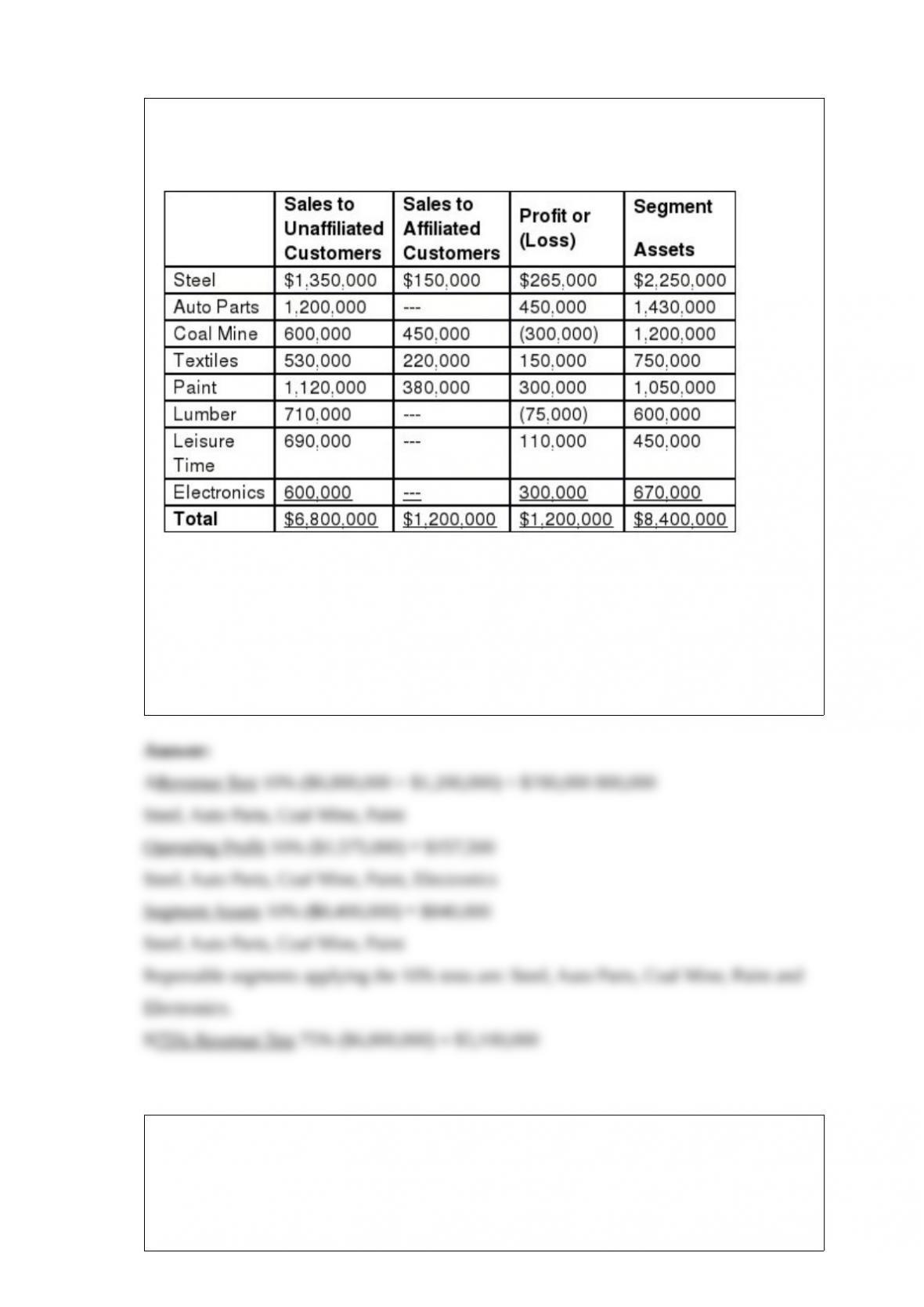
15) XYZ Corporation has eight industry segments with sales, operating profit and loss,
and identifiable assets at and for the year ended December 31, 2014, as follows:
Required:
A.Identify the segments, which are reportable segments under one or more of the 10
percent revenue, operating profit, or assets tests.
B.After reportable segments are determined under the 10 percent tests, they must be
reevaluated under a 75 percent revenue test before a final determination of reportable
segments can be made. Under this 75 percent test, identify if any other segments may
have to be reported.
16) The parent company records its share of a subsidiarys income by
a.crediting Investment in S Company under the partial equity method
b.crediting Equity in Subsidiary Income under both the cost and partial equity methods
c.debiting Equity in Subsidiary Income under the cost method
d.none of these
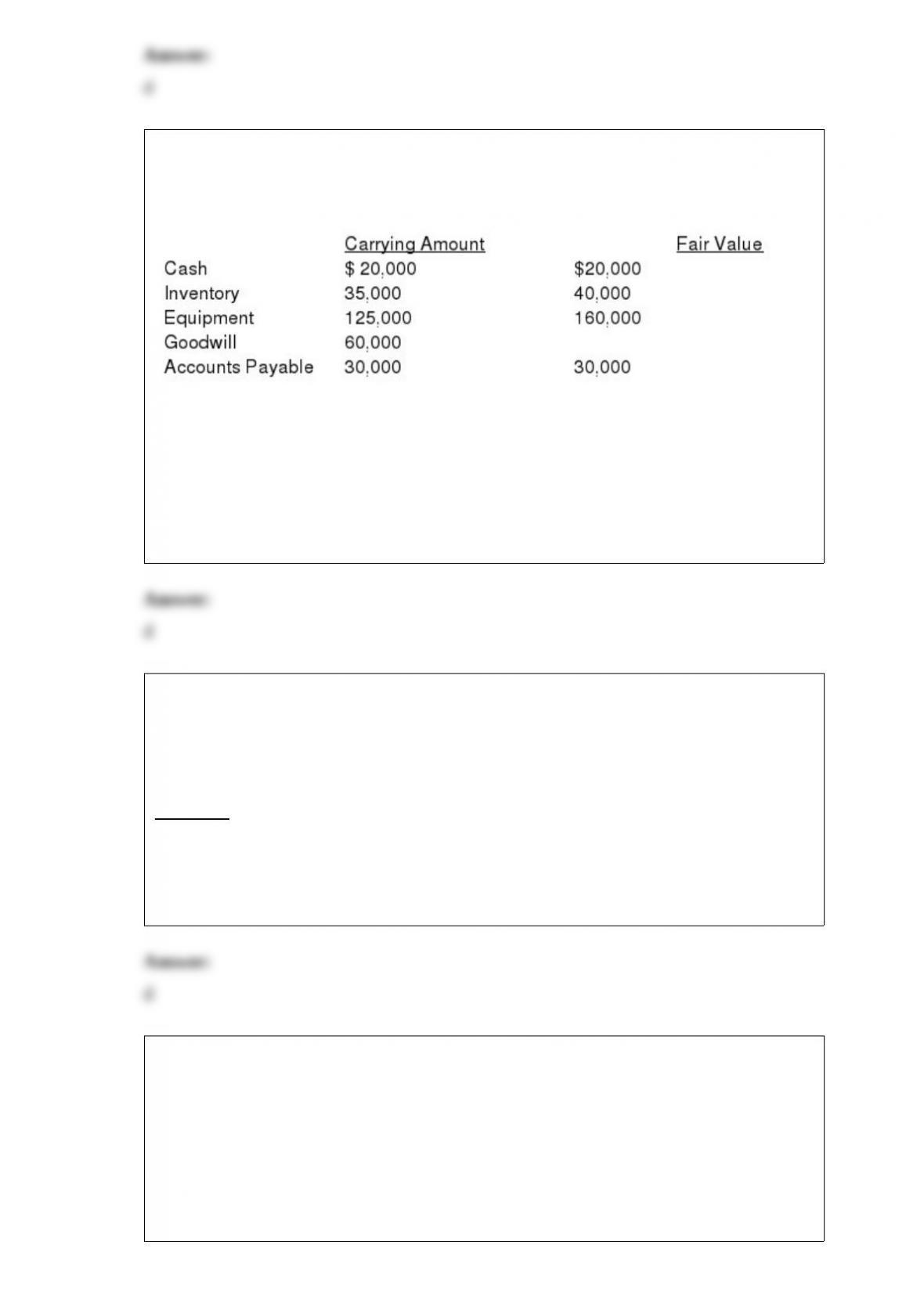
17) Following its acquisition of the net assets of Burnt Company, PrimroseCompany
assigned goodwill of $60,000 to one of the reporting divisions. Information for this
division follows:
Based on the preceding information, what amount of goodwill will be reported for this
division if its fair value is determined to be $200,000?
a.$0
b.$60,000
c.$30,000
d.$10,000
18) Petunia Corporation owns 100% of Stone Companys common stock. On January 1,
2014, Petunia sold equipment with a book value of $210,000 to Stone for $300,000.
Stone is depreciating the equipment over a ten-year life by the straight-line method. The
net adjustments to compute 2014 and 2015 consolidated income would be an increase
(decrease) of
20142015
a.($90,000)$0
b.($90,000)$9,000
c.($81,000)$0
d.($81,000)$9,000
19) On January 1, 2013, P Corporation sold equipment with a 3-year remaining life and
a book value of $40,000 to its 70% owned subsidiary for a price of $46,000. In the
consolidated workpapers for the year ended December 31, 2014, an elimination entry
for this transaction will include a:
a.debit to Equipment for $6,000
b.debit to Gain on Sale of Equipment for $6,000
c.credit to Depreciation Expense for $6,000
d.debit to Accumulated Depreciation for $4,000

20) Under the partial equity method, the workpaper entry that reverses the effect of
subsidiary income for the year includes a:
1>credit to Equity in Subsidiary Income
2>debit to Subsidiary Income Sold
3>debit to Equity in Subsidiary Income
a.1
b.2
c.3
d.both 1 and 2
21) On January 1, 2014, Perch Company purchased an 80% interest in the capital stock
of Salmon Company for $3,400,000. At that time, Salmon Company had common stock
of $2,200,000 and retained earnings of $620,000. Perch Company uses the cost method
to record its investment in Salmon Company. Differences between the fair value and the
book value of the identifiable assets of Salmon Company were as follows:
Fair Value in Excess of Book Value
Equipment$400,000
Land200,000
Inventory80,000
The book values of all other assets and liabilities of Salmon Company were equal to
their fair values on January 1, 2014. The equipment had a remaining life of five years
on January 1, 2014; the inventory was sold in 2014.
Salmon Companys net income and dividends declared in 2014 were as follows:
Year 2014 Net Income of $400,000; Dividends Declared of $100,000
Required:
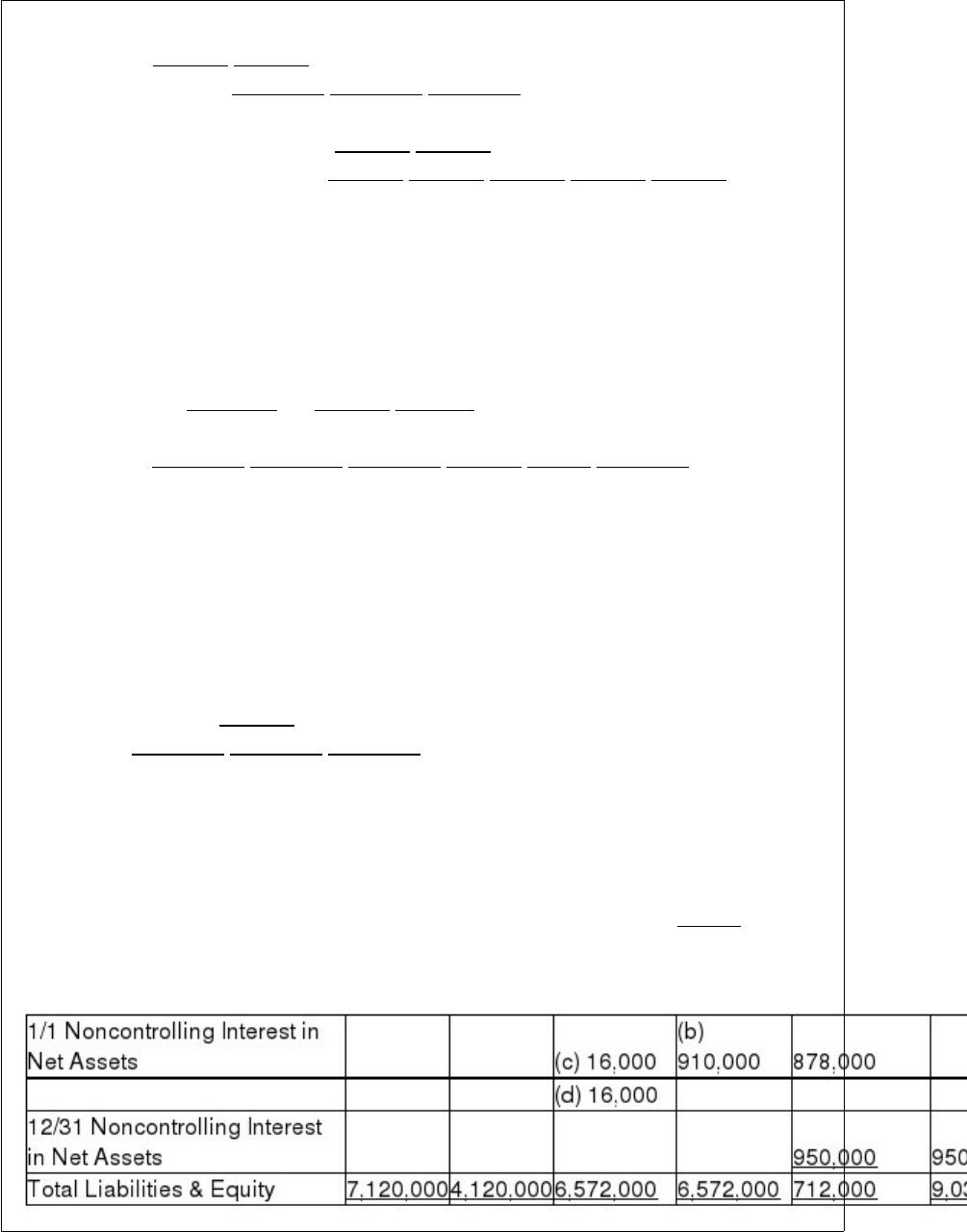
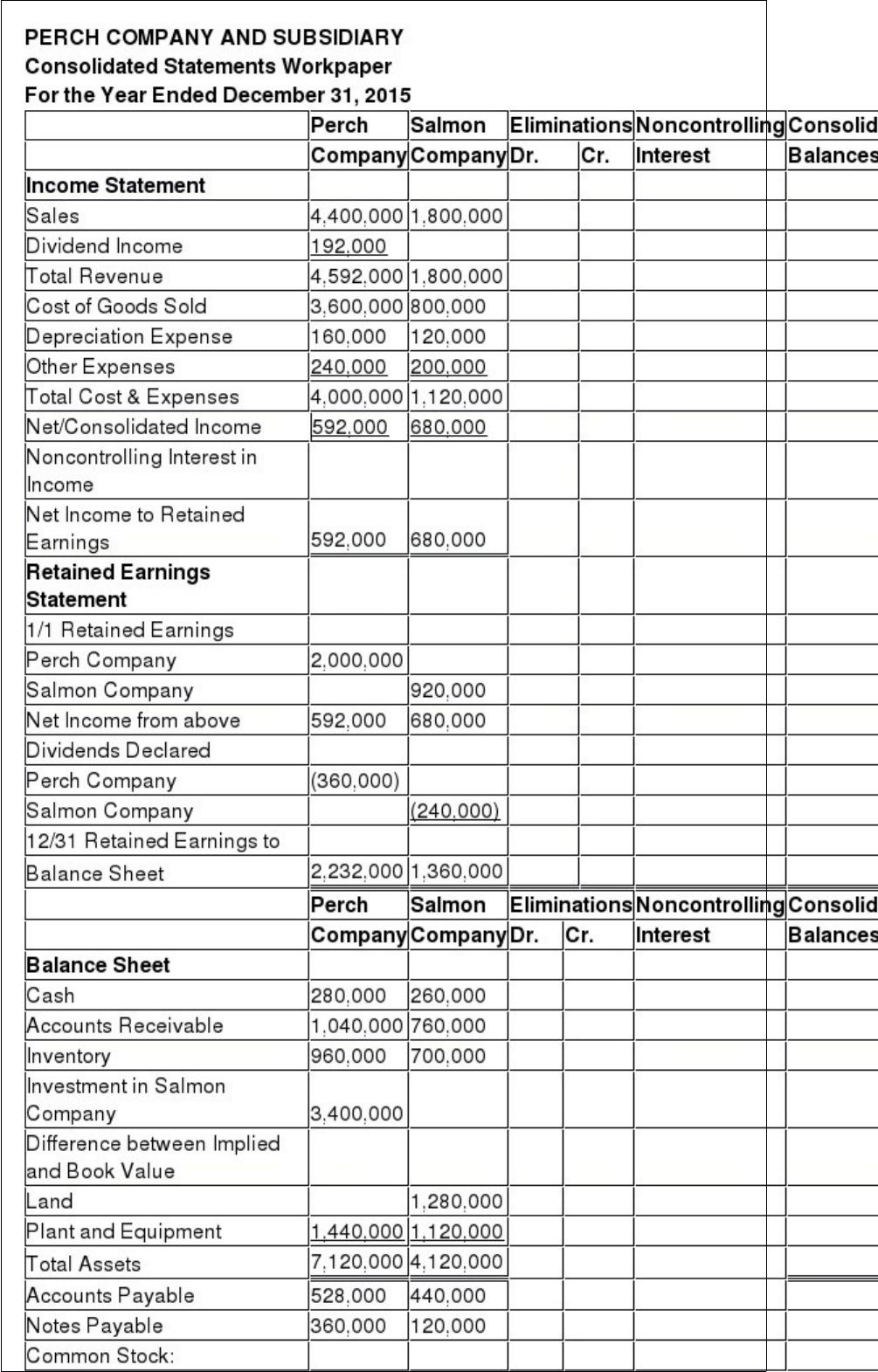
Prepare a consolidated statements workpaper for the year ended December 31, 2015
using the partially completed worksheet.
PERCH COMPANY AND SUBSIDIARY
Consolidated Statements Workpaper
For the Year Ended December 31, 2015
Perch Salmon Eliminations Noncontrolling Consolidated
Company Company Dr. Cr. Interest Balances
Income Statement
Sales 4,400,000 1,800,000 6,200,000
Dividend Income 192,000 (a) 192,000 —-
Total Revenue 4,592,000 1,800,000 6,200,000
Cost of Goods Sold 3,600,000 800,000 4,400,000
Depreciation Expense 160,000 120,000 (d) 80,000 360,000
Other expense 240,000 20,0000 440,000
Total Cost & Expenses 4,000,000 1,120,000 5,200,000
Net/Consolidated Income 592,000 680,000 1,000,000
Noncontrolling Interest in Income 120,000 120,000
Net Income to Retained Earnings 592,000 680,000 272,000 120,000 880,000
Statement of Retained Earnings
1/1 Retained Earnings
Perch Company 2,000,000 (c) 64,000 (d) 64,000 (e) 240,000 2,112,000
Salmon Company 920,000 (b) 920,000
Net Income from above 592,000 680,000 272,000 120,000 880,000
Dividends Declared
Perch Company (360,000) (360,000)
Salmon Company (240,000) (a) 192,000 (48,000)
12/31 Retained Earnings to
Balance Sheet 2,232,000 1,360,000 1,320,000 432,000 72,000 2,632,000
Balance Sheet
Cash 280,000 260,000 540,000
Accounts Receivable 1,040,000 760,000 1,800,000
Inventory 960,000 700,000 1,660,000
Investment in Salmon Company 3,400,000 (e) 240,000 (b)3,640,000 —
Difference between Implied and Book Value (b) 1,430,000 (c)1,430,000
Land 1,280,000 (c) 200,000 1,480,000
Plant and Equipment 1,440,000 1,120,000 (c) 400,000 (d) 160,000 2,800,000
Goodwill (c) 750,000 750,000
Total Assets 7,120,000 4,120,000 9,030,000
Accounts Payable 528,000 440,000 968,000
Notes Payable 360,000 120,000 480,000
Common Stock:
Perch Company 4,000,000 4,000,000
Salmon Company 2,200,000 (b) 2,200,000
Retained Earnings from above 2,232,000 1,360,000 1,320,000 432,000 72,000
2,632,000
22) Which one of the following describes a difference in how the equity method is
applied under GAAP than under IFRS?
a.the equity method is generally applied to limited partnerships under IFRS for
investments of more than 3 to 5%, whereas GAAP adopts a significant influence
principle
b.IFRS requires uniform accounting policies, whereas GAAP does not
c.significant influence is presumed if the investor has 20% or more of the voting rights
in a corporate investee under GAAP, whereas IFRS adopts a facts and circumstances
approach that looks beyond the voting rights percentage
d.GAAP requires consideration of potential voting rights on currently exercisable of
convertible instruments, whereas IFRS does not
23) When a business becomes insolvent, it generally has three possible courses of
action. Which of the following is not one of the three possible courses of action?
a.The debtor and its creditors may enter into a contractual agreement, outside of formal
bankruptcy proceedings
b.The debtor continues operating the business in the normal course of the day-to-day
operations
c.The debtor or its creditors may file a bankruptcy petition, after which the debtor is
liquidated under Chapter 7
d.The debtor or its creditors may file a petition for reorganization under Chapter 11

24) Repayments from the funds responsible for a particular expenditure to the funds
that initially paid for them are interfund
a.loans
b.services provided and used
c.transfers
d.reimbursements
25) The fair value of net identifiable assets exclusive of goodwill of a reporting unit of
X Company is $300,000. On X Company’s books, the carrying value of this reporting
unit’s net assets is $350,000, including $60,000 goodwill. If the fair value of the
reporting unit is $335,000, what amount of goodwill impairment will be recognized for
this unit?
a.$0
b.$10,000
c.$25,000
d.$35,000
26) On January 1, 2014, Panda Company purchased 25 % of Skill Companys common
stock; no goodwill resulted from the acquisition. Panda Company appropriately carries
the investment using the equity method of accounting and the balance in Pandas
investment account was $190,000 on December 31, 2014. Skill reported net income of
$120,000 for the year ended December 31, 2014 and paid dividends on its common
stock totaling $48,000 during 2014. How much did Panda pay for its 25% interest in
Skill?
a.$172,000
b.$202,000
c.$208,000
d.$232,000
27) A bankruptcy petition filed by a firm is a:
a.chapter petition
b.involuntary petition
c.voluntary petition
d.chapter 11 petition

28) North Company issued 24,000 shares of its $20 par value common stock for the net
assets of Prairie Company in business combination under which Prairie Company will
be merged into North Company. On the date of the combination, North Company
common stock had a fair value of $30 per share. Balance sheets for North Company and
Prairie Company immediately prior to the combination were as follows:
North Prairie
Current Assets$1,314,000$192,000
Plant and Equipment (net) 1,725,000 408,000
Total$3,039,000$600,000
Liabilities$ 900,000$150,000
Common Stock, $20 par value 1,650,000 240,000
Other Contributed Capital 218,000 60,000
Retained Earnings 271,000 150,000
Total$3,039,000$600,000
If the business combination is treated as an acquisition and Prairie Companys net assets
have a fair value of $686,400, North Companys balance sheet immediately after the
combination will include goodwill of
a.$30,600
b.$38,400
c.$33,600
d.$56,400
29) Which type of fund entities are used to account for the activities of nonbusiness
organizations that are similar to those of business enterprises?
a.Expendable fund entities
b.Proprietary fund entities
c.Budgetary fund entities
d.Restricted fund entities
30) What aspects of control must exist before a subsidiary is consolidated?
31) How should a transaction gain or loss be reported that is related to an unsettled
receivable recorded when the firms inventory was exported?
32) The FASB classifies forward contracts as those acquired for the purpose of hedging
and those acquired for the purpose of speculation. What main differences are there in
accounting for these two classifications?
33) Identify three different types of endowment funds and explain how they differ.
34) What is the purpose of interim financial reporting?
35) Define: Consolidated net income; consolidated retained earnings.
36) How are unexpected costs such as liquidation expenses, disposal costs, or
unrecorded liabilities covered in the safe distribution schedule?
37) Define the controlling interest in consolidatednet income using the t-account
approach.
38) There are a number of business situations in which a firm may acquire a forward
exchange contract. Identify three common situations in which a forward exchange
contract can be used as a hedge.
39) In what order must partnership assets be distributed?