If the unit selling price is $40, the volume of sales is $3,000,000, sales at the break-even
point amount to $2,500,000, and the maximum possible sales are $3,300,000, the
margin of safety is 14,500 units.
Answer:
The format and number of specialized journals that a business uses depends upon the
legal organization of the business.
Answer:
Yield measures the ratio of the materials output quantity to the materials input quantity.
Answer:
The journal includes both debit and credit accounts for each transaction.

Answer:
Revising depreciation estimates does affect the amounts of depreciation expense
recorded in past periods.
Answer:
Cash paid to acquire treasury stock should be shown on the statement of cash flows
from investing activities.
Answer:
The budget procedures used by a large manufacturer of automobiles would probably not
differ from those used by a small manufacturer of paper products.

Answer:
About 90% of the businesses in the United States are organized as corporations.
Answer:
The variance from standard for factory overhead resulting from incurring a total amount
of factory overhead cost that is greater or less than the amount budgeted for the level of
operations achieved is termed controllable variance.
Answer:
A process whereby the effect of fluctuations in the level of activity is built into the
budgeting system is referred to as flexible budgeting.
Answer:

The revenue recognition concept states that revenue should be recorded in the same
period as the cash is received.
Answer:
If 100 shares of treasury stock were purchased for $50 per share and then sold at $60
per share, $1,000 of income is reported in the income statement.
Answer:
A 10% stock dividend will increase the number of shares outstanding but the book
value per share will decrease.
Answer:

The process cost system is appropriate where few products are manufactured and each
product is made to customers’ specifications.
Answer:
The retained earnings statement may be combined with the income statement.
Answer:
A present value index can be used to rank competing capital investment proposals when
the net present value method is used.
Answer:

A practical approach which is frequently used by managers when setting normal
long-run prices is the cost-plus approach.
Answer:
The master budget of a small manufacturer would normally include all necessary
component budgets except the budgeted balance sheet.
Answer:
If the market rate of interest is 8% and a corporation’s bonds bear interest at 7%, the
bonds will sell at a premium.
Answer:
If income from operations for a division is $6,000, invested assets are $25,000, and
sales are $30,000, the profit margin is 20%.

Answer:
Adjusting entries are made at the end of an accounting period to adjust accounts on the
balance sheet.
Answer:
Currently attainable standards do not allow for reasonable production difficulties.
Answer:
During periods of decreasing costs the use of the LIFO method of costing inventory
will result in a lower amount of net income than would result from the use of the FIFO
method.

Answer:
Manufacturers must conform to the Robinson-Patman Act which prohibits price
discrimination within the United States unless differences in prices can be justified by
different costs of serving different customers.
Answer:
Merchandise is sold for $3,600, terms FOB destination, 2/10, n/30, with prepaid freight
costs of $150. If $500 of the merchandise is returned prior to payment and the invoice is
paid within the discount period, the amount of the sales discount is $65.
Answer:
The cost of a manufactured product generally consists of direct materials cost, direct
labor cost, and factory overhead cost.

Answer:
Residual value is not incorporated in the initial calculations for
double-declining-balance depreciation.
Answer:
Accounts are records of increases and decreases in individual financial statement items.
Answer:
Journalizing eliminates fraud.
Answer:

A receiving report is prepared when purchased materials are first received by the
manufacturing department.
Answer:
In applying the first-in, first-out method of costing inventories, if 8,000 units which are
30% completed are in process at June 1, 28,000 units are completed during June, and
4,000 units were 80% completed at June 30, the number of equivalent units of
production for June was 28,600.
Answer:
Another name for the quick ratio is
A.quick cash ratio
B.current ratio
C.working capital ratio
D.acid-test ratio

Answer:
Income tax was $175,000 for the year. Income tax payable was $30,000 and $40,000 at
the beginning and end of the year. Cash payments for income tax reported on the cash
flow statement using the direct method is
A.$175,000
B.$165,000
C.$205,000
D.$215,000
Answer:
In which section of the financial statements would Paid-In Capital from Sale of
Treasury Stock be reported?
A.other expense on income statement
B.intangible asset on balance sheet
C.stockholders’ equity on balance sheet
D.other income on income statement
Answer:
Prepare entries to record the following:
(a) Issued 1,000 shares of $10 par common stock at $56 for cash.
(b) Issued 1,400 shares of common stock in exchange for equipment with a fair market
price of $21,000.
(c) Purchased 100 shares of treasury stock at $25.
(d) Sold 100 shares of treasury stock at $30.
Answer:

Segment data:
A.can be used for vertical, but not horizontal analysis.
B.is gathered from invoice data.
C.is only useful by product line.
D.analysis is required by GAAP.
Answer:
Prepare entries to record the following:
(a) Issued 1,000 shares of $15 par common stock at $54 for cash.
(b) Issued 1,400 shares of no-par common stock in exchange for equipment with a fair
market price of $24,000.
(c) Purchased 100 shares of treasury stock at $26.
(d) Sold 100 shares of treasury stock purchased in (c) at $29.
Answer:

Which of the following is not an essential part of the accounting records?
A.The journal
B.The ledger
C.The chart of accounts
D.The work sheet
Answer:
Cash was paid by Ari’s Alarm Service to creditors on account. Which of the following
entries for Ari’s Alarm Service records this transaction?
A.Cash, debit; Ari Fleish, Capital, credit
B.Accounts Payable, debit; Cash, credit
C.Accounts Receivable, debit; Cash, credit
D.Accounts Payable, debit; Account Receivable, credit
Answer:

Consider the following budget information: materials to be used totals $64,750; direct
labor totals $198,400; factory overhead totals $394,800; work in process inventory
January 1, 2012, was expected to be $189,100; and work in progress inventory on
December 31, 2012, is expected to be $197,600. What is the budgeted cost of goods
manufactured?
A.$649,450
B.$657,950
C.$197,600
D.$1,044,650
Answer:
Materials must have which two qualities in order to be classified as direct materials?
A.They must be classified as both prime costs and conversion costs.
B.They must be introduced into the process in both work-in-process inventories and
finished goods inventories.
C.They must be an integral part of the finished product, but can be an insignificant
portion of the total product cost.
D.They must be an integral part of the finished product and be a significant portion of
the total product cost.
Answer:

Which of the following accounts would be increased with a credit?
A.Land, Accounts Payable, Drawing
B.Accounts Payable, Unearned revenue, Collins Capital
C.Collins Capital, Accounts Receivable, Unearned Revenue
D.Cash, Accounts Receivable, Collins Capital
Answer:
A corporation issues for cash $9,000,000 of 8%, 25-year bonds, interest payable
semiannually. The amount received for the bonds will be
A.present value of 50 semiannual interest payments of $360,000, plus present value of
$9,000,000 to be repaid in 25 years
B.present value of 25 annual interest payments of $720,000
C.present value of 25 annual interest payments of $720,000, plus present value of
$9,000,000 to be repaid in 25 years
D.present value of $9,000,000 to be repaid in 25 years, less present value of 50
semiannual interest payments of $360,000
Answer:
Any unamortized premium should be reported on the balance sheet of the issuing
corporation as
A.a direct deduction from the face amount of the bonds in the liability section
B.as paid-in capital
C.a direct deduction from retained earnings
D.an addition to the face amount of the bonds in the liability section
Answer:
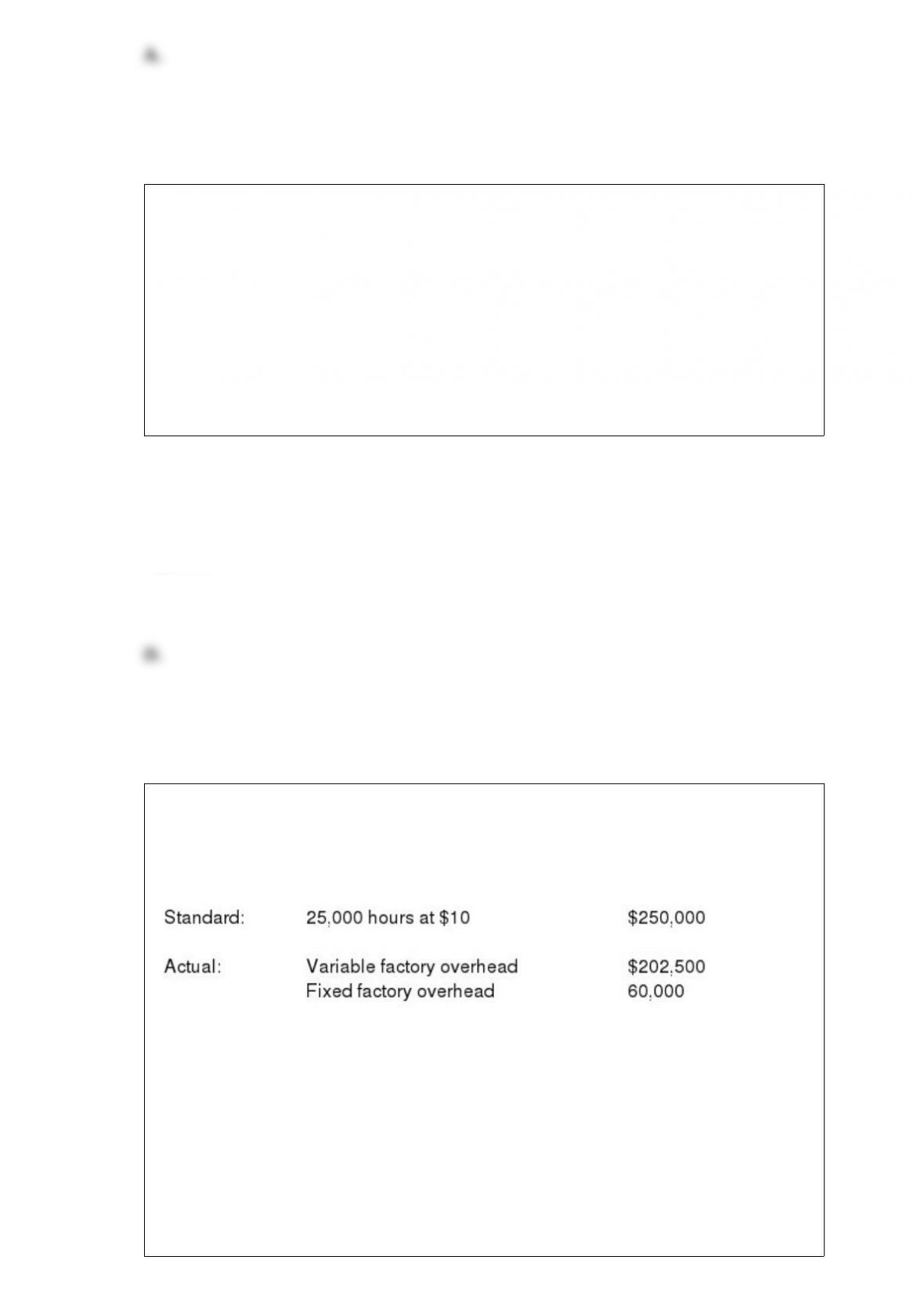
The standard factory overhead rate is $10 per direct labor hour ($8 for variable factory
overhead and $2 for fixed factory overhead) based on 100% capacity of 30,000 direct
labor hours. The standard cost and the actual cost of factory overhead for the production
of 5,000 units during May were as follows:
What is the amount of the factory overhead volume variance?
A.$12,500 favorable
B.$10,000 unfavorable
C.$12,500 unfavorable

D.$10,000 favorable
Answer:
A company had net income of $252,000. Depreciation expense is $26,000. During the
year, Accounts Receivable and Inventory increased by $15,000 and $40,000,
respectively. Prepaid Expenses and Accounts Payable decreased by $2,000 and $4,000,
respectively. There was also a loss on the sale of equipment of $3,000. How much cash
was provided by operating activities?
A.$217,000.
B.$224,000.
C.$284,000.
D.$305,000.
Answer:
Selected accounts with some debits and credits omitted are presented as follows:
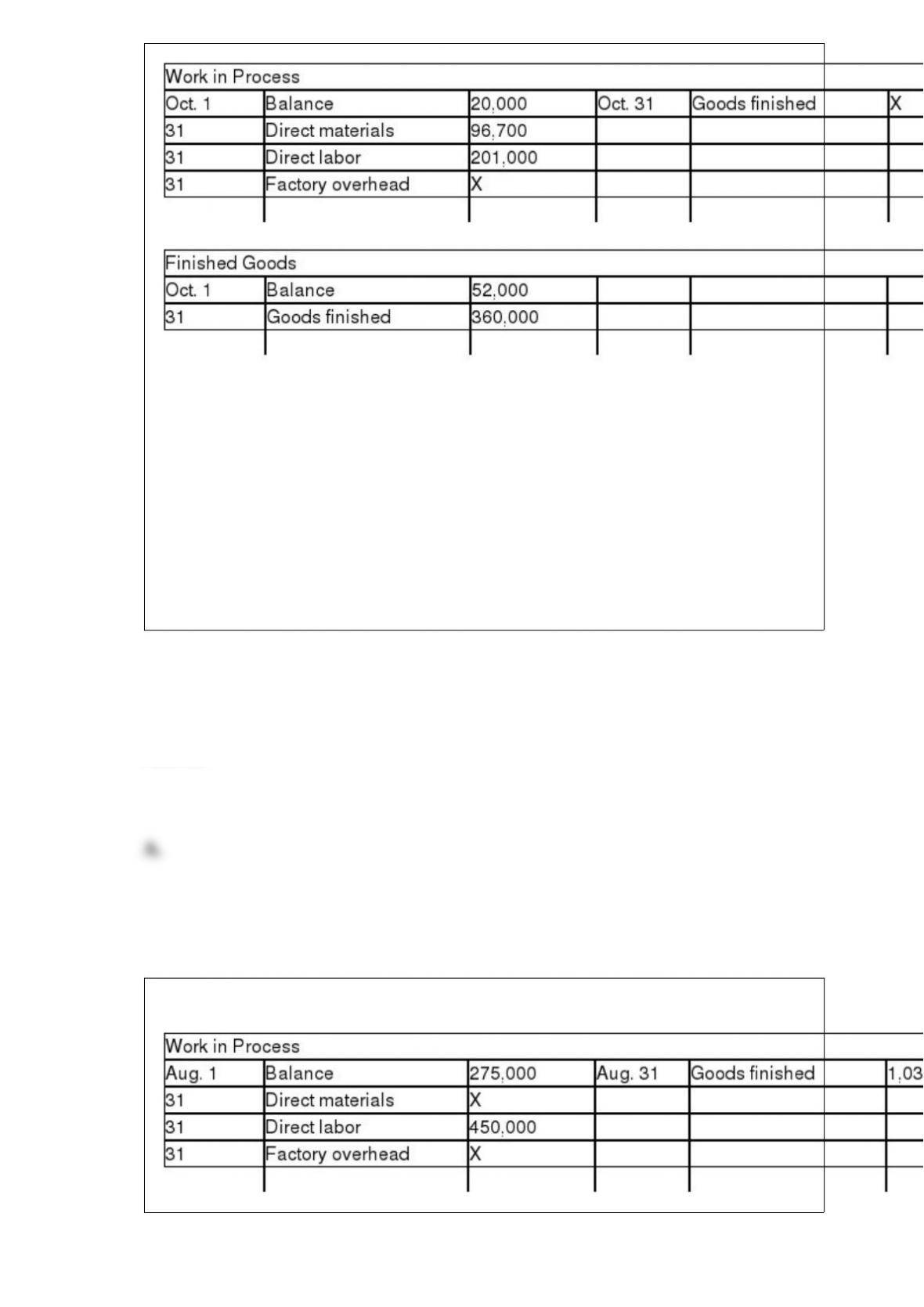
If the balance of Work in Process at October 31 is $21,000, what was the amount of
factory overhead applied in October?
A.$63,300
B.$21,300
C.$42,300
D.$11,300
Answer:
Selected accounts with some debits and credits omitted are presented as follows:
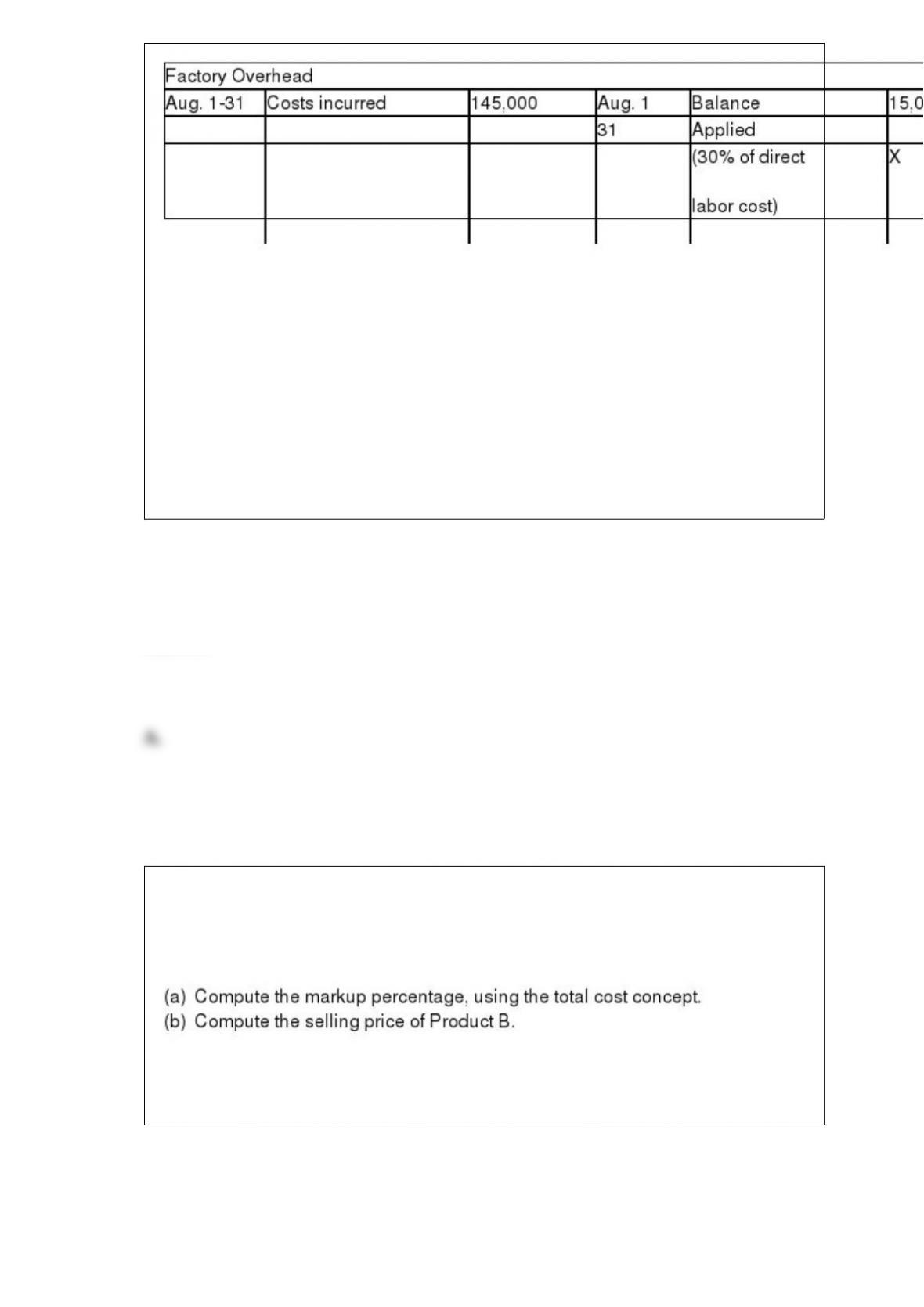
If the balance of Work in Process at August 31 is $220,000, what was the amount
debited to Work in Process for direct materials in August?
A.$390,000
B.$170,000
C.$525,000
D.$580,000
Answer:
Falcon Inc. manufactures Product B, incurring variable costs of $15.00 per unit and
fixed costs of $70,000. Falcon desires a profit equal to a 12% rate of return on assets,
$785,000 of assets are devoted to producing Product B, and 100,000 units are expected
to be produced and sold.
Round your intermediate calculations and final answer to two decimal places.
Answer:
On the first day of the fiscal year, a new walk-in cooler with a list price of $58,000 was
acquired in exchange for an old cooler and $44,000 cash. The old cooler had a cost of
$25,000 and accumulated depreciation of $16,000.
Assume the transaction has commercial substance.
Answer:
Which of the following statements is not true about liabilities?
A.Liabilities are debts owed to outsiders.
B.Account titles of liabilities often include the term “payable”.
C.Cash received before services are performed are considered to be liabilities.
D.Liabilities do not include wages owed to employees of the company.
Answer:

The form of income statement that derives its name from the fact that the total of all
expenses is deducted from the total of all revenues is called a
A.multiple-step statement
B.revenue statement
C.report-form statement
D.single-step statement
Answer:
Department B had 3,000 units in Work in Process that were 25% completed at the
beginning of the period at a cost of $12,500. 13,700 units of direct materials were added
during the period at a cost of $28,700. 15,000 units were completed during the period,
and 1,700 units were 95% completed at the end of the period. All materials are added at
the beginning of the process. Direct labor was $32,450 and factory overhead was
$18,710.
The number of equivalent units of production for the period for materials if the first-in,
first-out method is used to cost inventories was:
A.16,700
B.12,000
C.1,700
D.13,700
Answer:
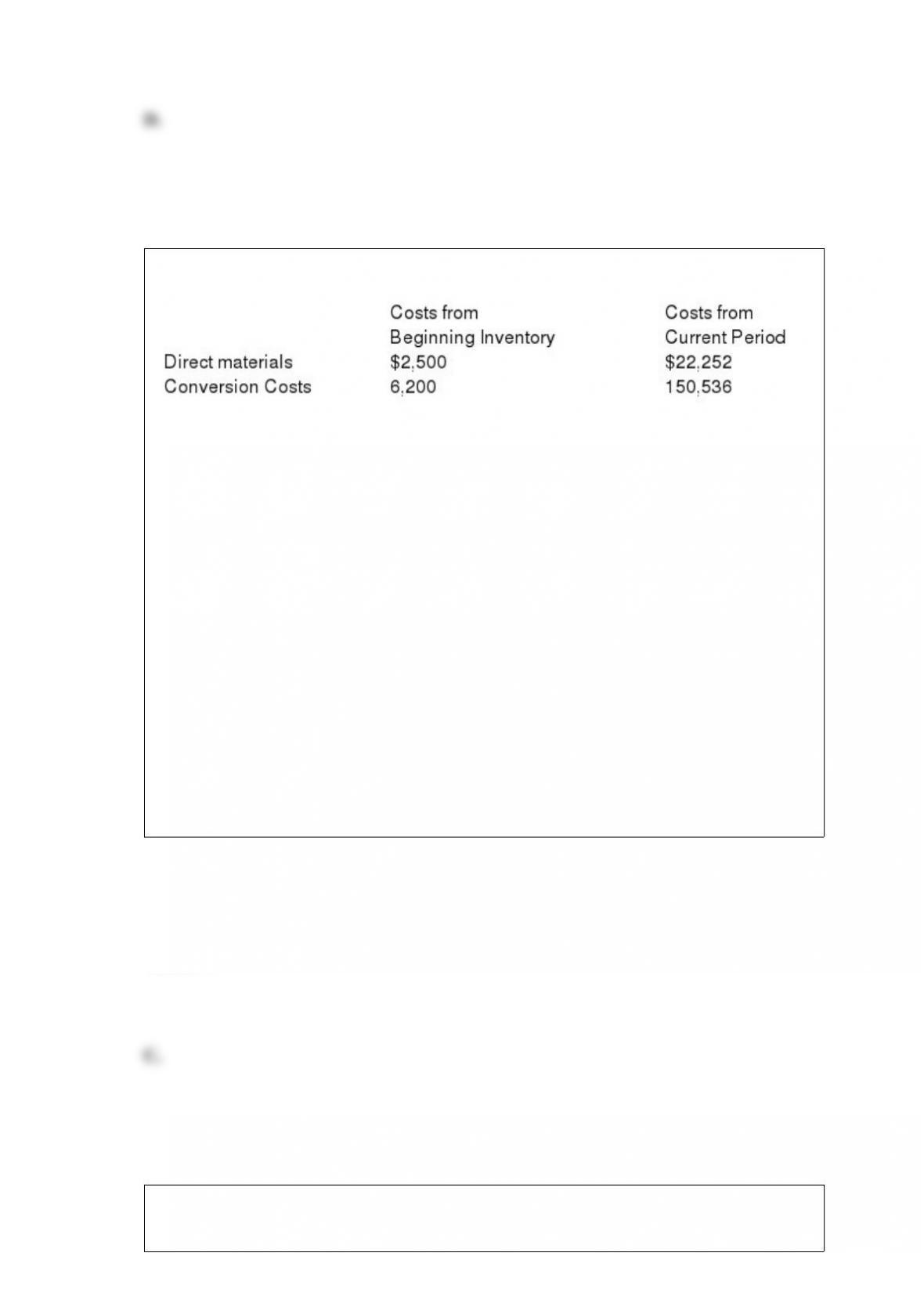
Carmelita Inc., has the following information available:
At the beginning of the period, there were 500 units in process that were 60 percent
complete as to conversion costs and 100 percent complete as to direct materials costs.
During the period 4,500 units were started and completed. Ending inventory contained
340 units that were 30 percent complete as to conversion costs and 100 percent
complete as to materials costs. (Assume that the company uses the FIFO process cost
method.)
The cost of completing a unit during the current period was
A.$36.19
B.$34.88
C.$35.95
D.$35.89
Answer:
Which intangible assets are amortized over their useful life?

A.trademarks
B.goodwill
C.patents
D.all of the above
Answer:
The benefits of comparing actual performance of the operations against planned goals
include all of the following except:
A.providing prompt feedback to employees about their performance relative to the goal
B.preventing unplanned expenditures
C.helping to establish spending priorities
D.determining how managers are performing against prior years’ actual operating
results
Answer:
A disadvantage of static budgets is that they:
A.are dependent on previous year’s actual results
B.cannot be used by service companies
C.do not show possible changes in underlying activity levels
D.show the expected results of a responsibility center for several levels of activity
Answer:
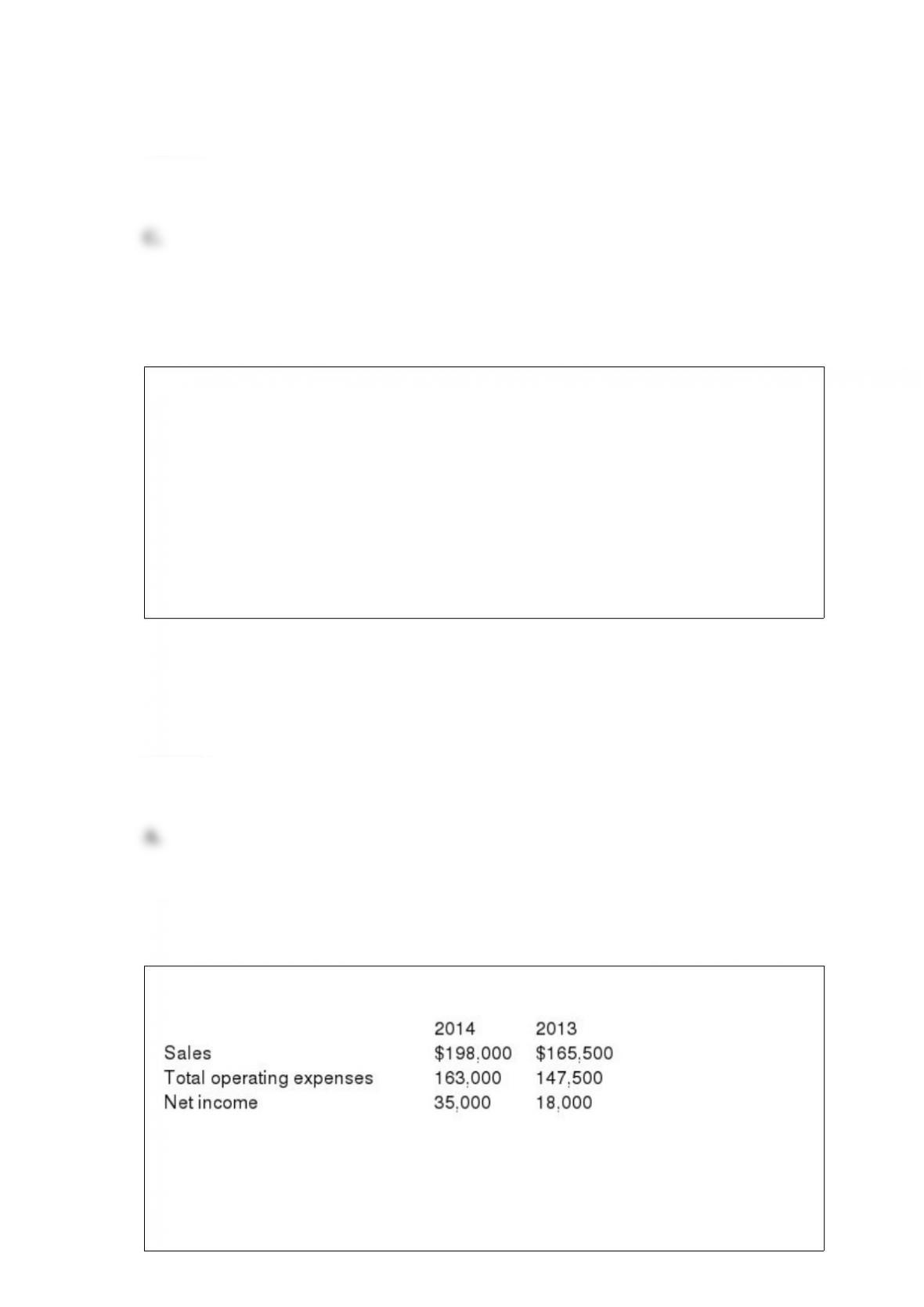
The following selected account balances appeared on the financial statements of the
Washington Company:
The Washington Company uses the direct method to calculate net cash flow from
operating activities.
Cash collections from customers are
A.$56,000
B.$52,000
C.$60,000
D.$45,000
Answer:
Nexis Corp. issues 1,000 shares of $15 par value common stock at $22 per share. When
the transaction is recorded, credits are made to:
A.Common Stock $15,000 and Paid-in Capital in Excess of Par Value $7,000.
B.Common Stock $22,000 and Retained Earnings $15,000.
C.Common Stock $7,000 and Paid-in Capital in Excess of Stated Value $15,000.
D.Common Stock $22,000.
Answer:
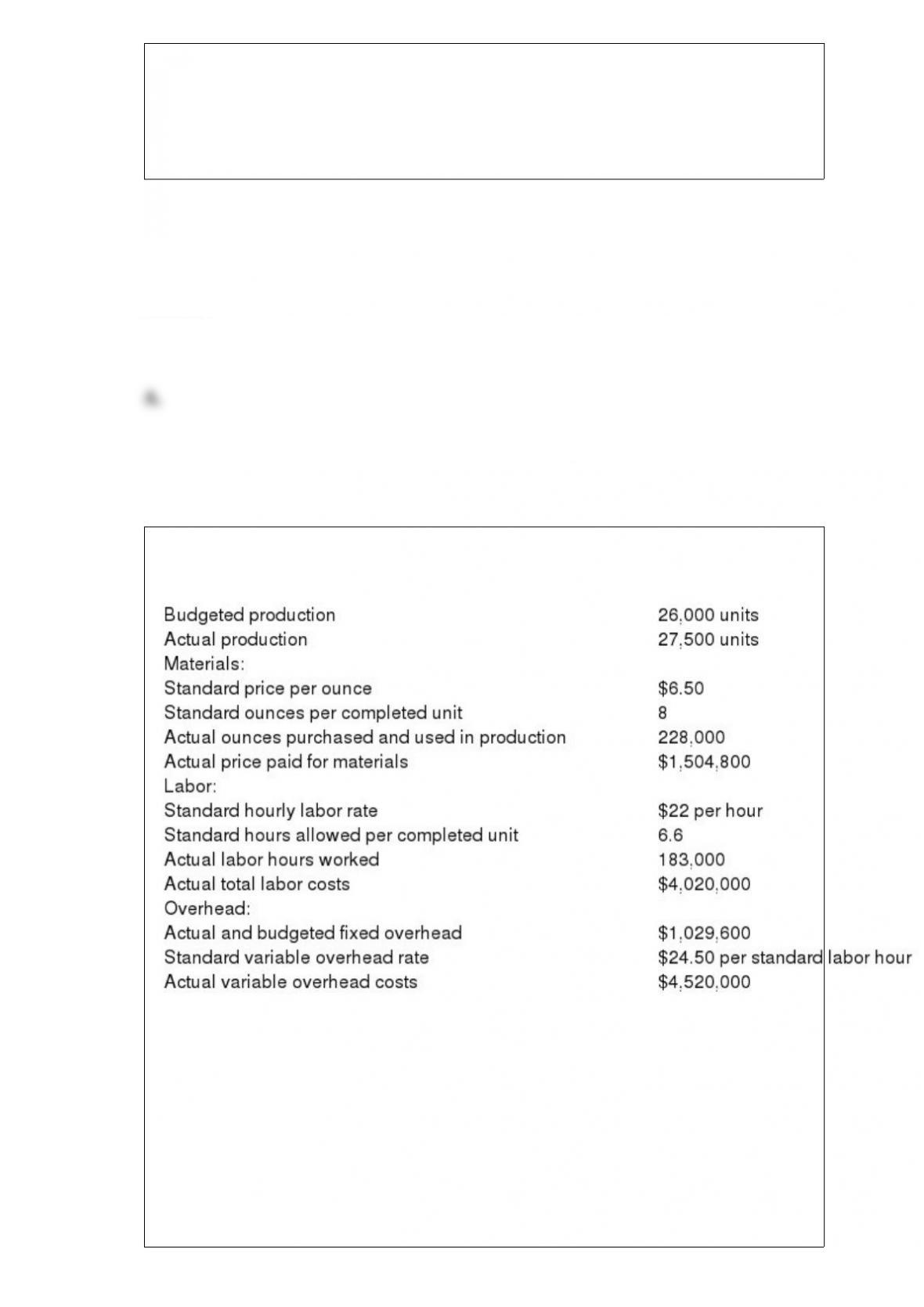
McMann Company has a condensed income statement as shown::
Using horizontal analysis, calculate the amount and percent change for Sales. Round to
one decimal place.
A.$32,500, 19.6%
B.$18,000, 10.9%
C.$35,000, 17.7%
D.$17,000, 9.4%
Answer:
The following data is given for the Stringer Company:
Overhead is applied on standard labor hours.
The direct material price variance is:
A.22,800U
B.22,800F
C.52,000U
D.52,000F
Answer:
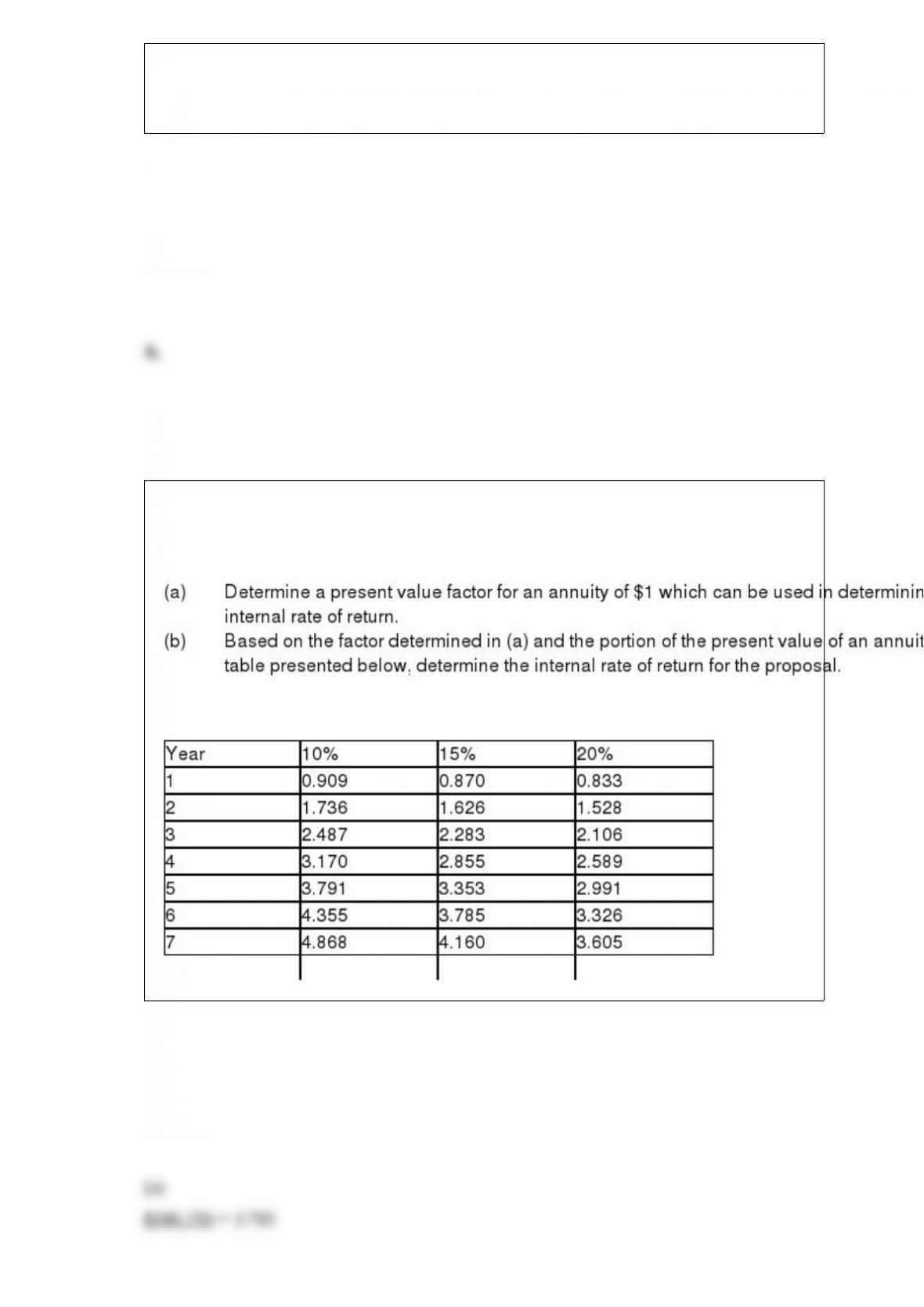
The internal rate of return method is used to analyze a $946,250 capital investment
proposal with annual net cash flows of $250,000 for each of the six years of its useful
life.
Answer:

The account type and normal balance of Unearned Revenue is
A.revenue, credit
B.expense, debit
C.liability, credit
D.asset, debit
Answer:
Gallant Company reported net income of $2,500,000. The income statement included
one extraordinary item: a $500,000 gain from condemnation of land and a $200,000
loss on discontinued operations, both after applicable income tax.
There were 100,000 shares of $10 par common stock and 40,000 shares 4% preferred
stock of $100 par outstanding throughout the current year.
Prepare the earnings per share section of Gallant Company’s income statement.
Answer:
Determine the average rate of return for a project that is estimated to yield total income
of $400,000 over four years, cost $720,000, and has a $70,000 residual value. Round
answers in percentage to one decimal place.
Answer:
On the first day of the fiscal year, a company issues a $500,000, 8%, 10 year bond that
pays semi-annual interest of $20,000 ($500,000 x 8% x 1/2), receiving cash of
$530,000. Journalize the entry to record the issuance of the bonds.
Answer:
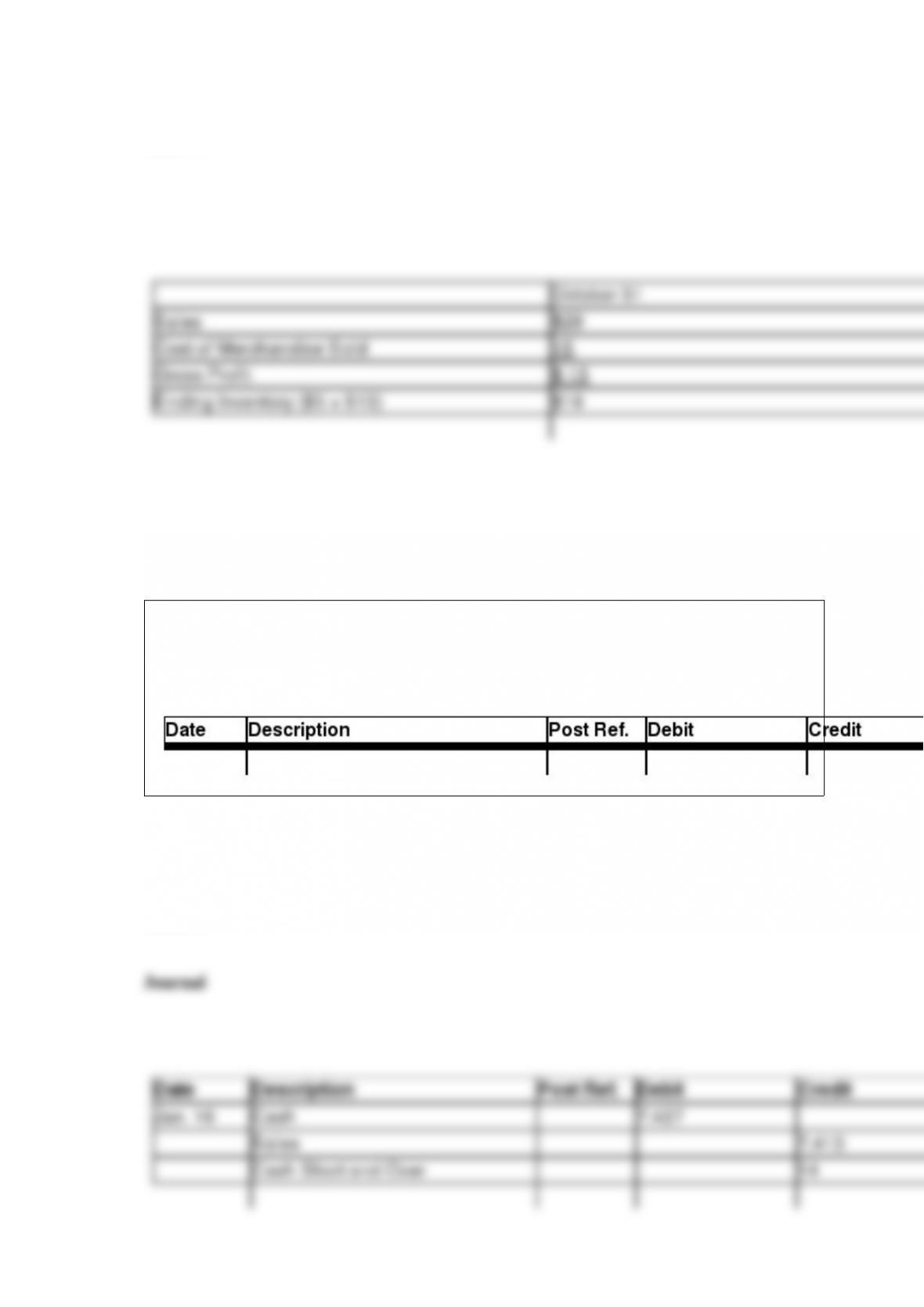
Assume that three identical units of merchandise are purchased during October, as
follows:
Assume one unit is sold on October 31 for $28. Determine Cost of Merchandise Sold,
Gross Profit, and Ending Inventory under the LIFO method.
Answer:
The actual cash received during the week ended January 16 for cash sales was $7,427
and the amount indicated by the cash register total was $7,413. Journalize the entry to
record the cash receipts and cash sales.
Journal
Answer:
On April 1, 10,000 shares of $5 par common stock were issued at $22, and on April 7,
5,000 shares of $50 par preferred stock were issued at $104. Journalize the entries for
April 1 and 7.
Answer:
Match the following types of journal transactions with the journal in which it would be
entered.
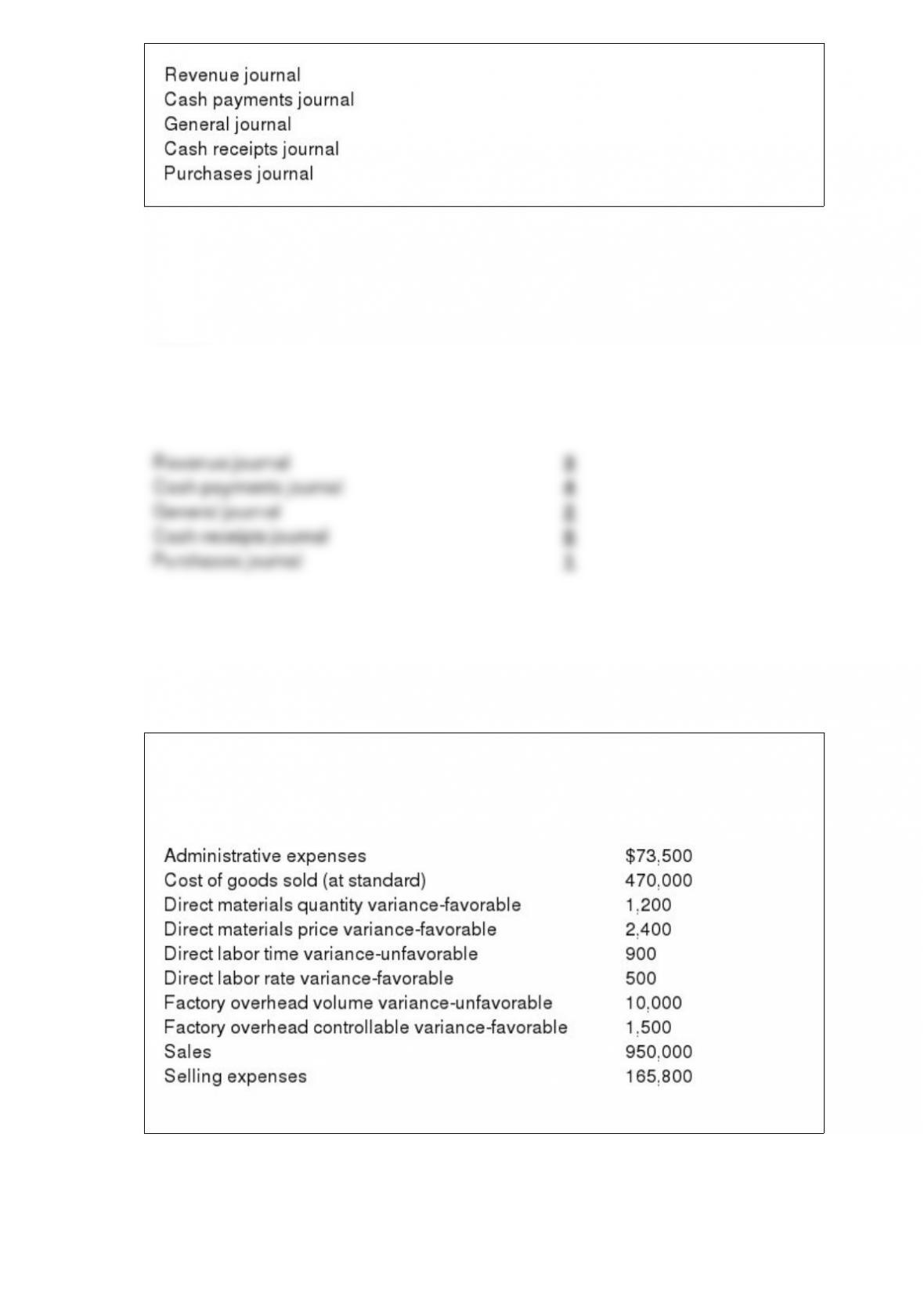
Answer:
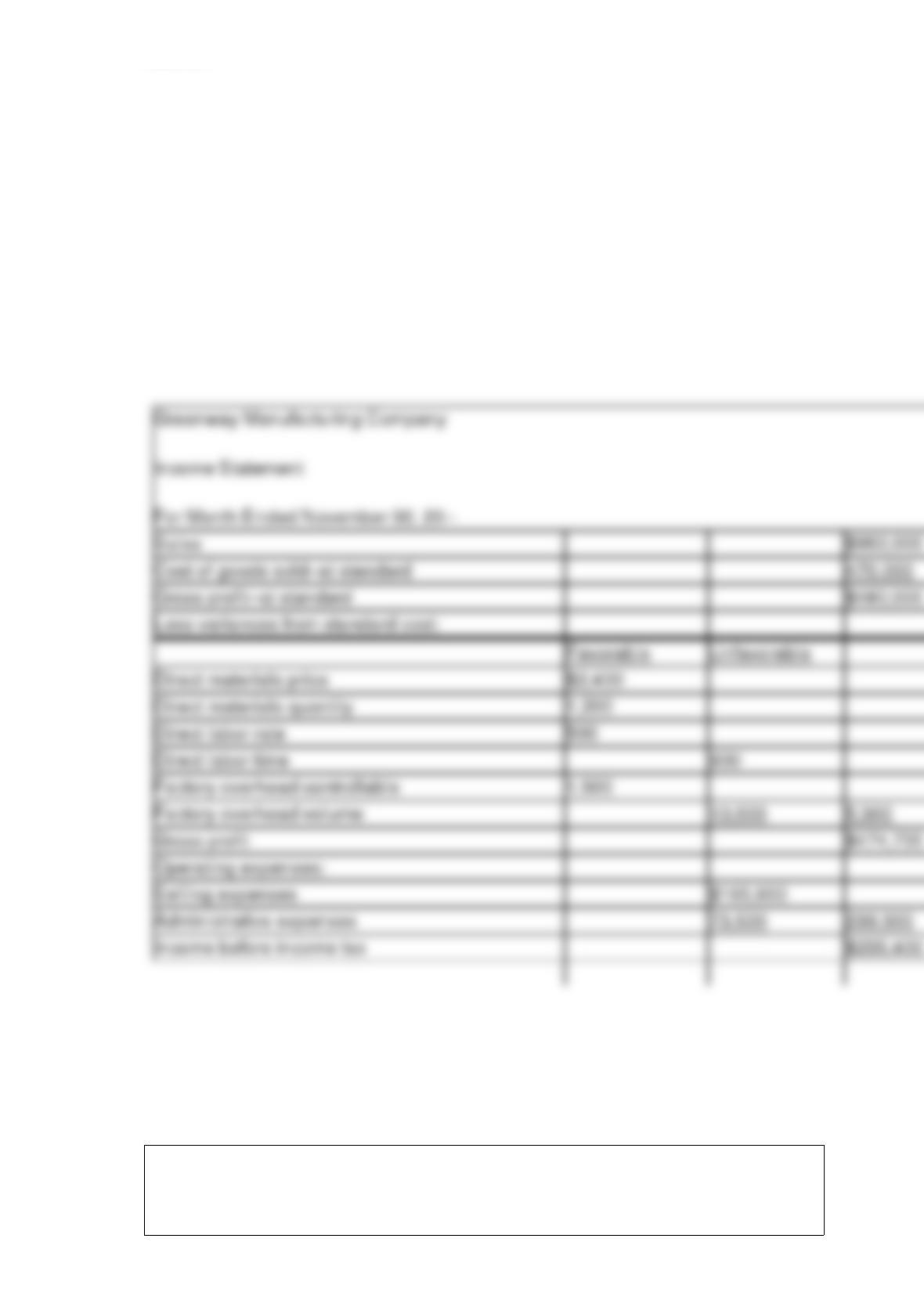
Prepare an income statement (through income before income tax) for presentation to
management, using the following data from the records of Greenway Manufacturing
Company for November of the current year:
Answer:
Cuisine Inc. manufactures flatware sets. The budgeted production is for 80,000 sets in
2012. Each set requires 2.5 hours to polish the material. If polishing labor costs $15.00
per hour, determine the direct labor budget for 2012.
Answer:
Ramiro Company purchased 40% of the outstanding stock of Marco Company on
January 1, 2015. Marco reported net income of $95,000 and declared dividends of
$35,000 during 2015. How much would Ramiro adjust their investment in Marco
Company under the equity method?
Answer:
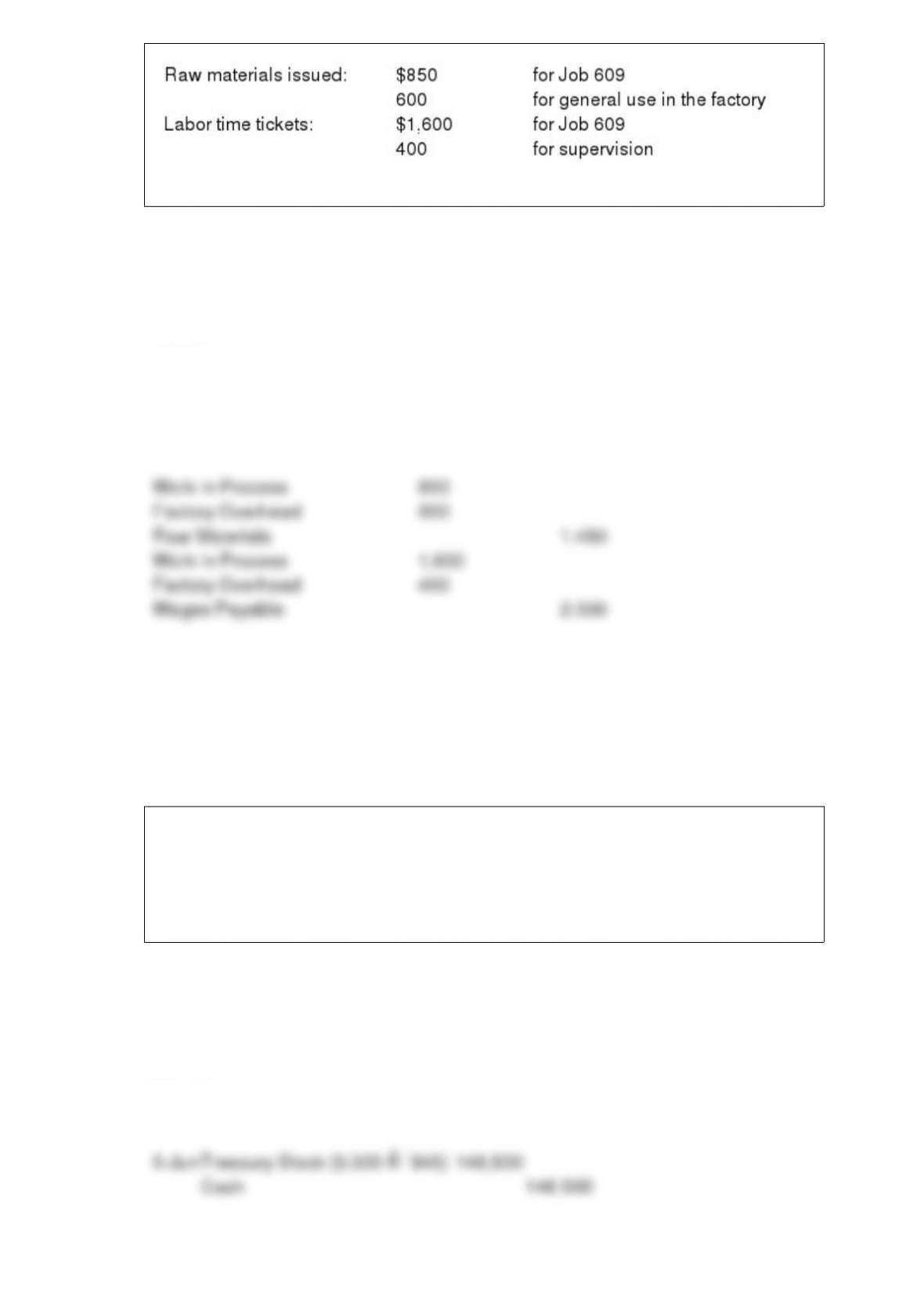
Prepare the journal entry for materials and labor, based on the following:
Answer:
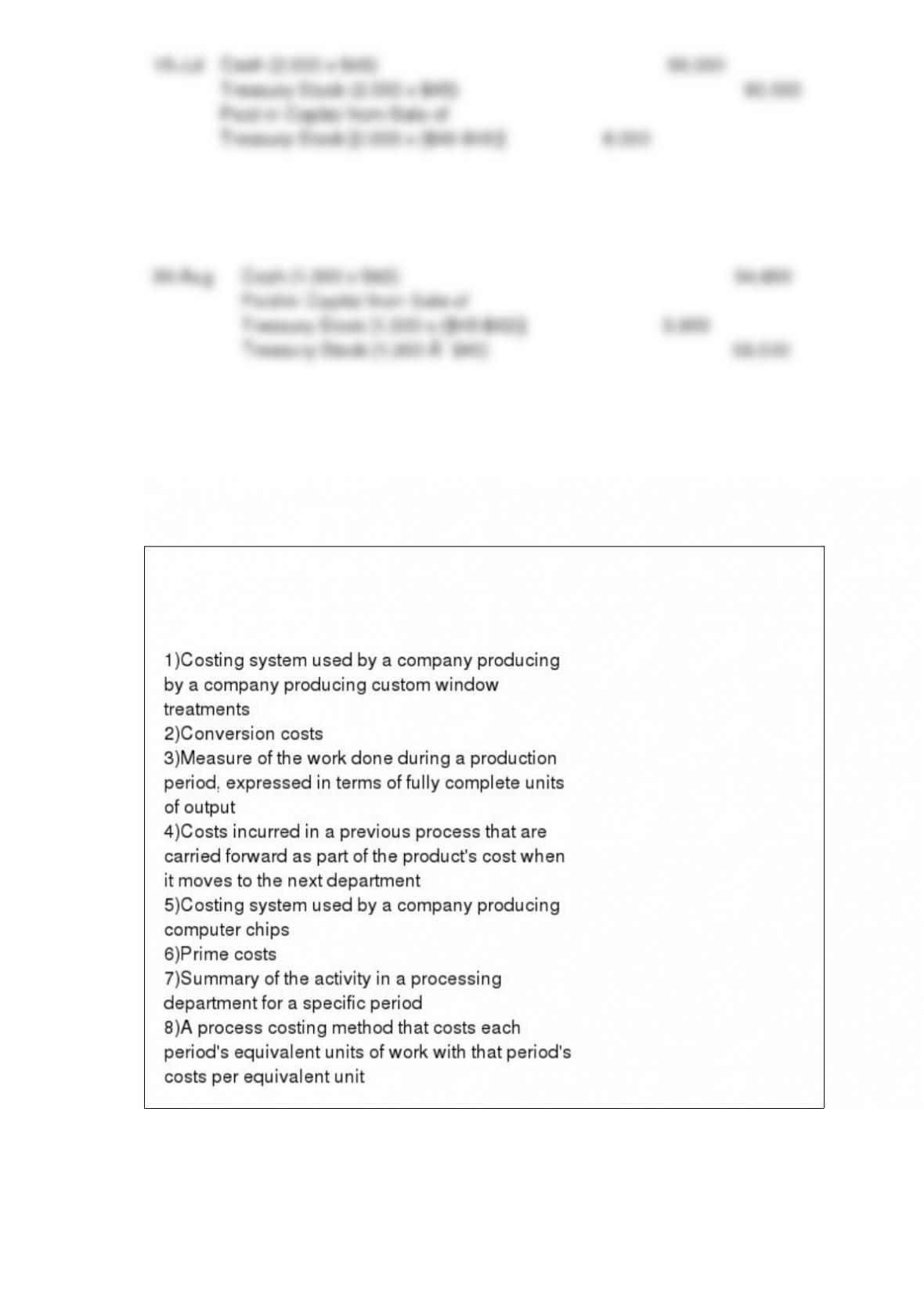
On June 5, Belen Corporation reacquired 3,300 shares of its common stock at $45 per
share. On July 15, Belen sold 2,000 of the reacquired shares at $48 per share. On
August 30, Belen sold the remaining shares at $42 per share.
Journalize the transactions of June 5, July 15, and August 30.
Answer:
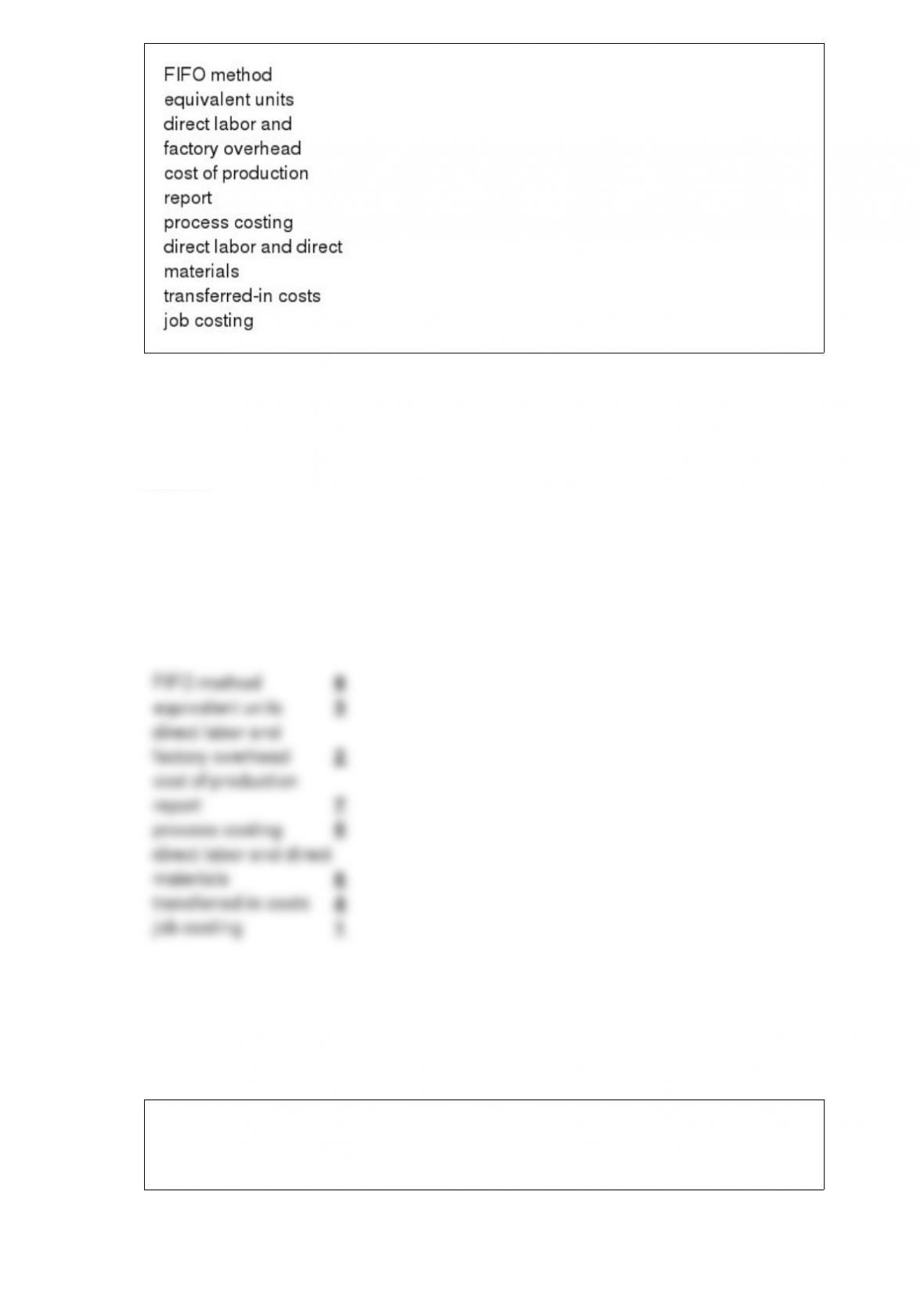
Match the correct term with the statement that describes it.
Answer:
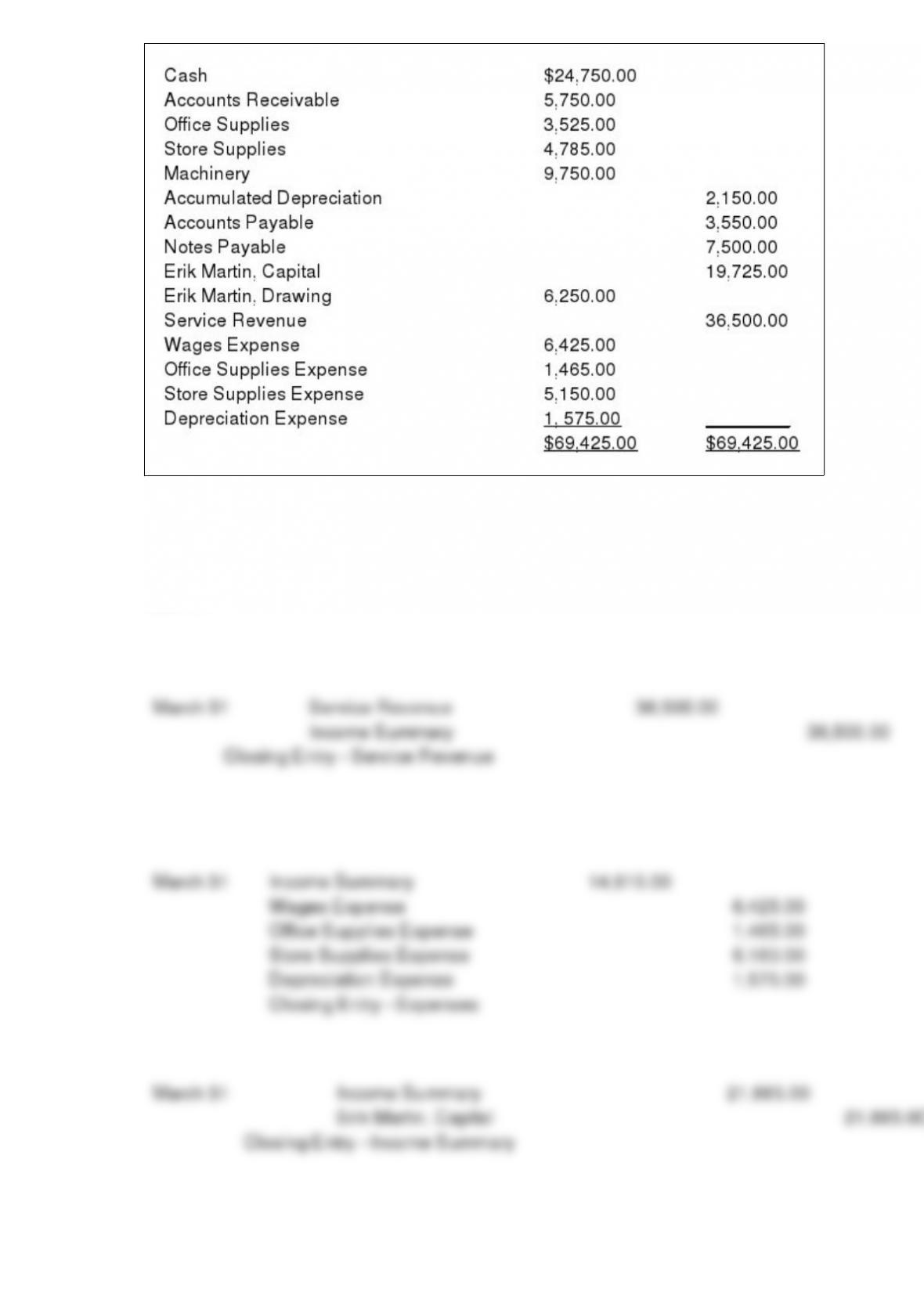
The following adjusted trial balance is the result of the adjustments made at the end of
the month of March for Erik Martin Company. Utilize these adjusted values to perform
the closing entries for Erik Martin Company.
Answer:
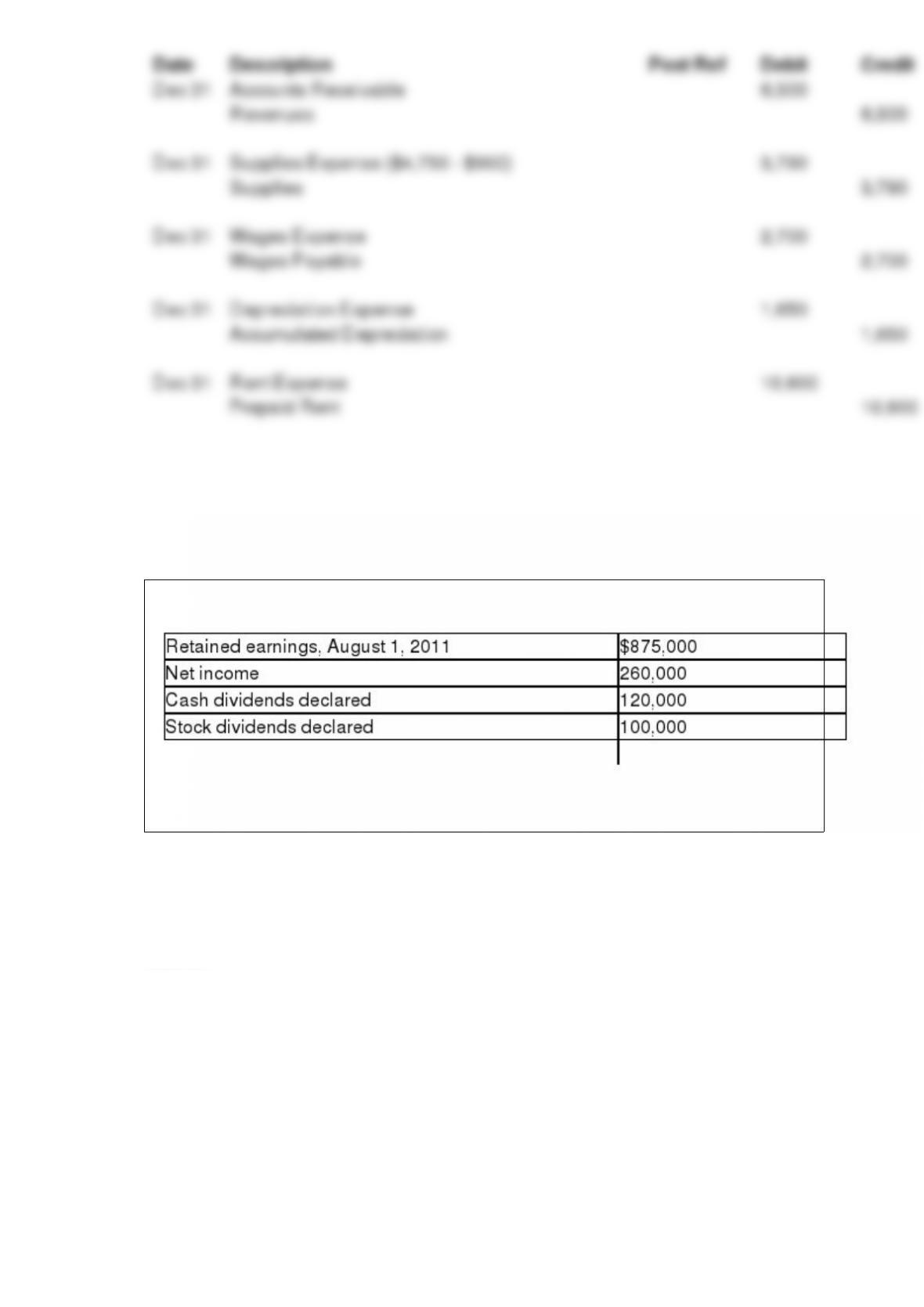
Prepare the December 31 adjusting entries for the following transactions. Omit
explanations.
1) Fees accrued but unbilled total $6,300.
2) The supplies account balance on December 31 is $4,750. Supplies on hand are $960.
3) Wages accrued but not paid are $2,700.
4) Depreciation of office equipment is $1,650.
5) Rent expired during year, $10,800.
Answer:
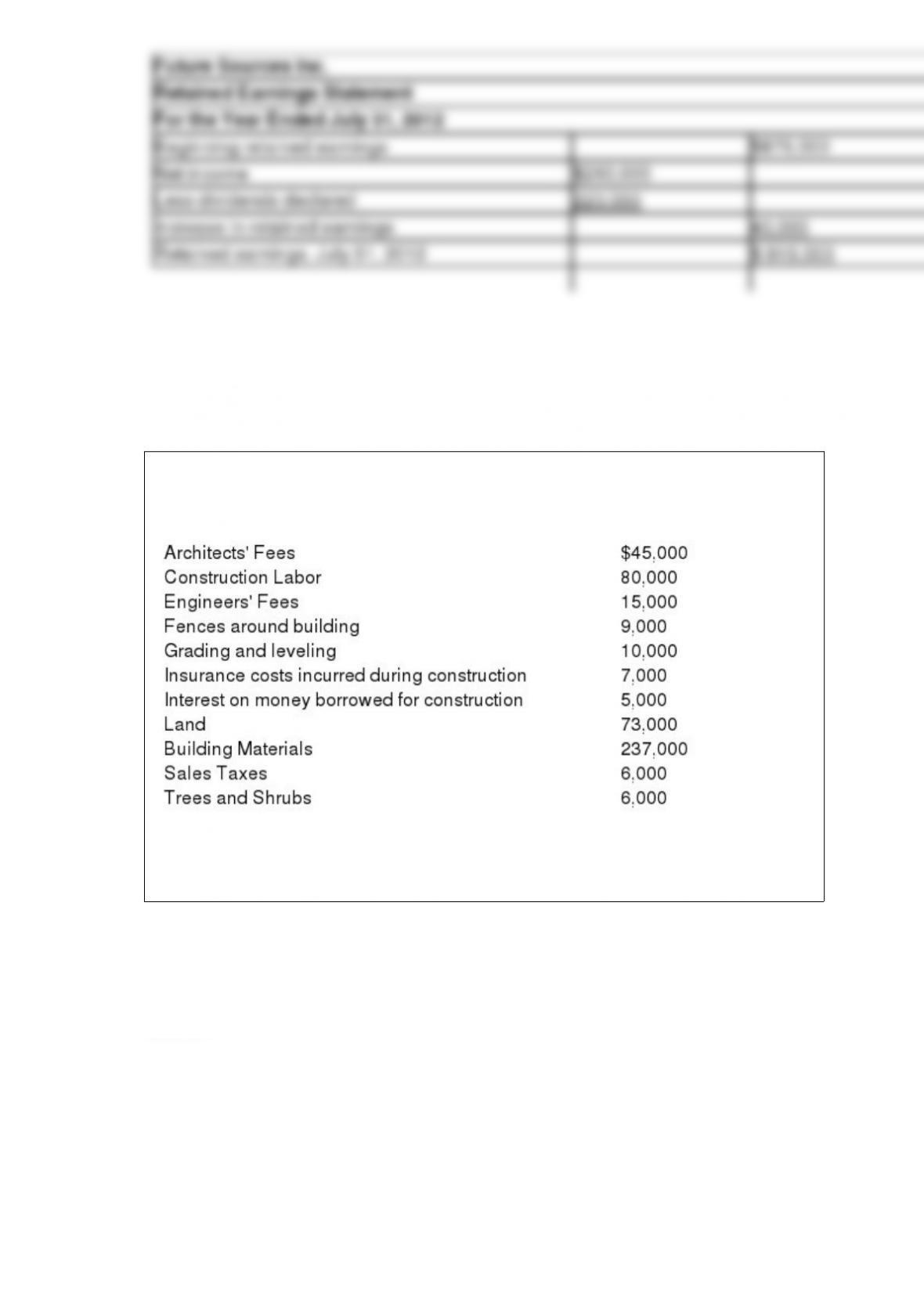
Future Sources, Inc. reported the following results for the year ending July 31, 2012:
Prepare a retained earnings statement for the fiscal year ended July 31,
Answer:
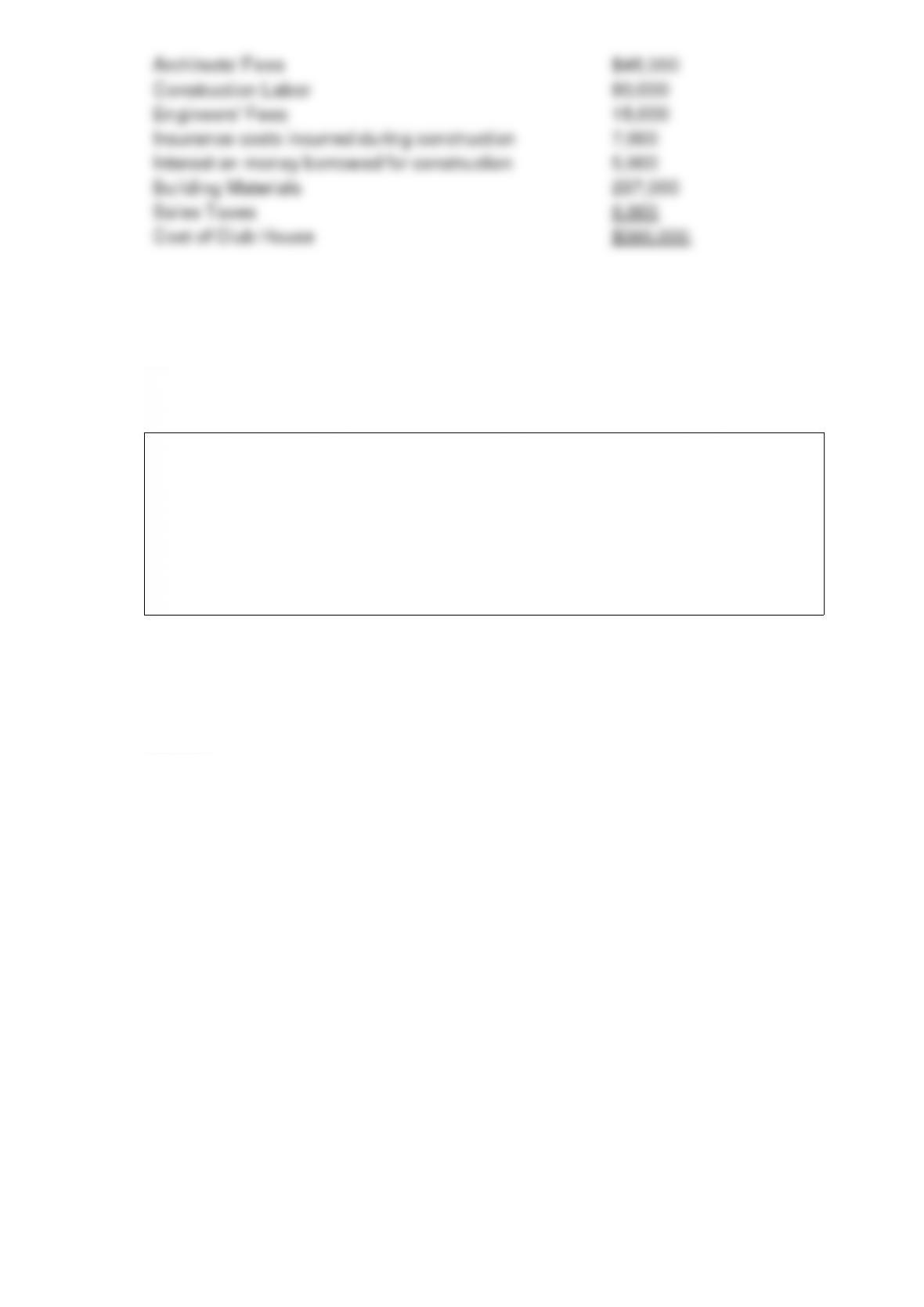
Eagle Country Club has acquired a lot to construct a clubhouse. Eagle had the following
costs related to the construction:
Determine the cost of the Club House to be reported on the balance sheet.
Answer:
Warmfeet manufactures comforters. Assume the estimated inventories on January 1,
2012, for finished goods, work in process, and materials were $51,000, $28,000 and
$33,000 respectively. Also assume the desired inventories on December 31, 2012, for
finished goods, work in process, and materials were $48,000, $35,000 and $29,000
respectively. Direct material purchases were $555,000. Direct labor was $252,000 for
the year. Factory overhead was $176,000. Prepare a cost of goods sold budget for
Warmfeet, Inc.
Answer: