A capital investment decision is essentially a decision to exchange current cash
outflows for future cash inflows.
Unlike manufacturers, service companies do not have an inventory of products.
In a process cost system, costs are accumulated by department.
A benefit of using a standard cost system is that it can boost morale and motivate
employees, if properly maintained.
How does the Sarbanes-Oxley Act of 2002 affect the responsibilities of the managers of
publicly held US corporations?
Costs that can be traced to a cost object in a cost-effective way are called direct costs.
The accuracy of managerial accounting information usually is more important than
timeliness.
Most companies initially record the cost of materials acquired in the raw materials
account.
While horizontal analysis examines one item over many time periods, vertical analysis
examines many items in the same interval of time.
When using the indirect method, the amount of net cash flow from operations will be
higher than it would be if the direct method were used.
Sometimes, several types of costs are accumulated into a single total for the purpose of
cost allocation. This single total is referred to as a joint cost.
Skymont Company wants an ending inventory each month equal to 30% of that month’s
cost of goods sold. Cost of goods sold for February is projected at $45,000. Ending

inventory at the end of January was $12,000. Based on this information, purchases for
February would be:
A. $31,500.
B. $46,500.
C. $43,500.
D. $33,000.
Which of the following budgets needs to be prepared prior to preparing a purchases
budget?
A. Selling and administrative expense budget
B. Sales budget
C. Cash budget
D. All of these answers are correct.
Columbus Industries makes a product that sells for $25 a unit. The product has a $5 per
unit variable cost and total fixed costs of $9,000. At budgeted sales of 2,000 units, the
margin of safety ratio is:
A. 22.5%.
B. 10%.

C. 77.5%.
D. None of these.
Which of the following is an example of a prevention cost?
A. Downtime
B. Inventory inspection
C. Product design
D. Repair and rework
Select the incorrect statement regarding service companies.
A. Service companies do not maintain a finished goods account.
B. Service companies accumulate their service costs in a work in process account
similar to manufacturers.
C. Service companies may have raw material costs.
D. Understanding the cost of providing a service is just as important as knowing the
cost of making a product.

Achieving the sales volume in the master budget is known as:
A. making the numbers.
B. lowballing.
C. cooking the books.
D. budget slack.
Milton Company makes t-shirts. The shirts move through two departments during the
production process. First, fabric is cut in the Cutting Department. The fabric pieces are
then transferred to the Sewing Department where the shirts are assembled. The shirts
are then sold to retail chains such as Wal-Mart and K-Mart. The following transactions
apply to the company’s operations during its first year, 2014:
(a) Issued stock to shareholders for cash, $90,000.
(b) Purchased $30,000 of direct raw materials.
(c) Direct materials issued to the cutting and sewing departments, $10,000 and $2,000,
respectively.
(d) Paid labor cost of $24,400. Direct labor usage for the cutting and assembly
departments was $14,000 and $8,000, respectively. Indirect labor costs amounted to
$2,400.
(e) Paid other overhead costs, $4,000.
(f) Applied overhead to production in both departments using the predetermined
overhead rate of $0.30 per direct labor dollar.
(g) Transferred $21,000 of inventory from the Cutting Department to the Sewing
Department.
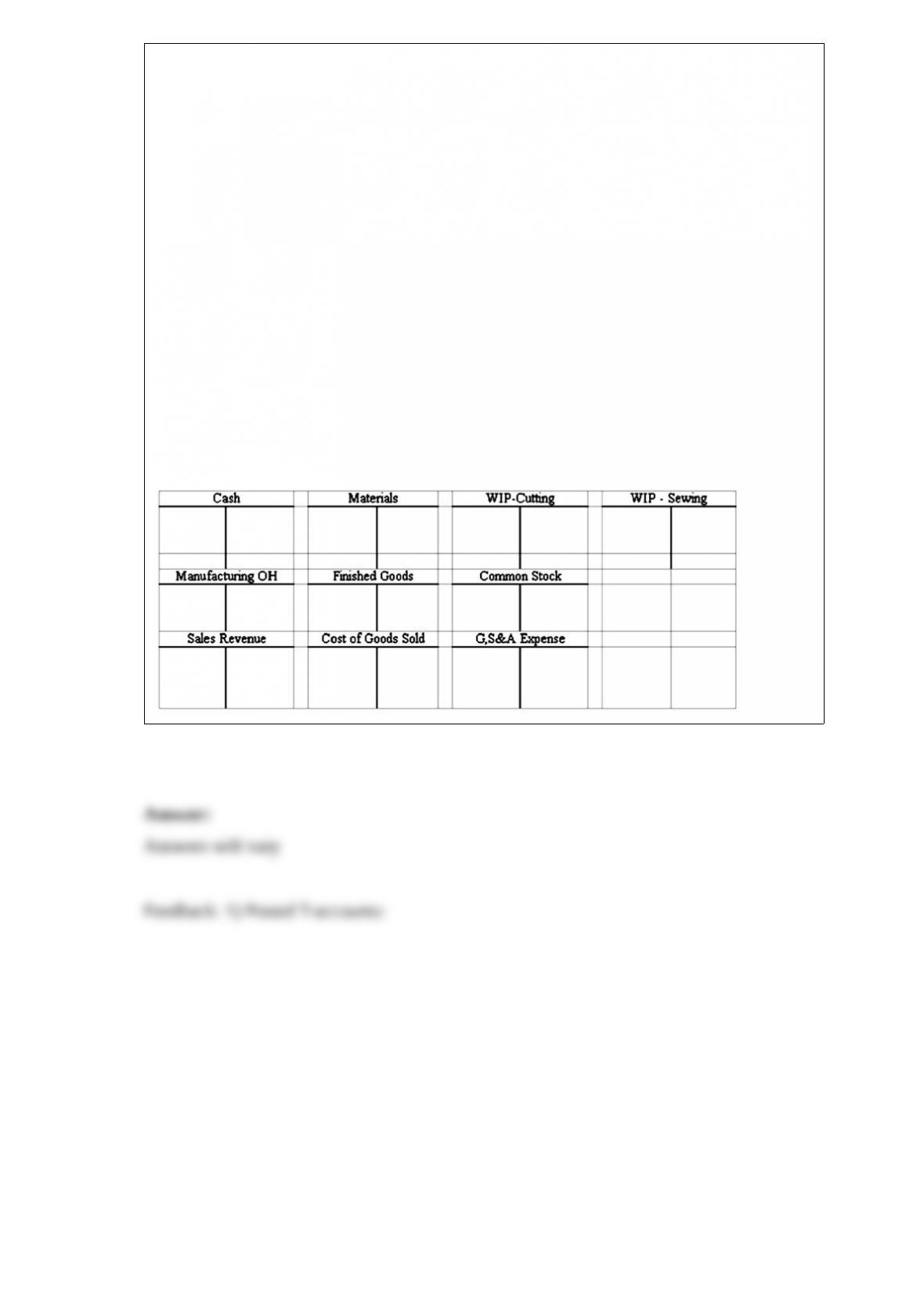
(h) Transferred $30,400 of inventory from the Sewing Department to Finished Goods.
(i) Sold inventory costing $16,000 for $25,000 cash.
(j) Paid selling and administrative expenses, $5,000.
(k) Disposed of any over-or-under-applied overhead.
Assume that all transactions are for cash unless otherwise stated.
Required:
1) Record the transactions in the T-accounts provided.
2) Prepare a schedule of cost of goods manufactured and sold.
3) Compute the amount of gross margin that will be reported on the firm’s year-end
income statement.

Mug Shots operates a chain of coffee shops. The company pays rent of $15,000 per
year for each shop. Supplies (napkins, bags and condiments) are purchased as needed.
The managers of each shop are paid a salary of $2,500 per month and all other
employees are paid on an hourly basis. The cost of rent relative to the number of
customers in a particular shop and relative to the number of customers in the entire
chain of shops is which kind of cost, respectively?
A. Variable cost/fixed cost
B. Fixed cost/fixed cost
C. Fixed cost/variable cost
D. Variable cost/variable cost
Which of the following items would be reported directly on the income statement as a
period cost?
A. Selling and administrative salaries
B. Cost of lubricant for oiling machinery
C. Wages paid to machine operators
D. All of these.
A process cost system would be appropriate for all of the following except:

A. Production of gasoline.
B. Manufacture of smart phones.
C. Services provided by public accounting firm.
D. Manufacture of granola bars.
Which of the following is a volume-based cost driver?
A. Machine hours
B. Material cost
C. Direct labor hours
D. All of these answers are correct.
A systematic problem-solving philosophy that encourages front line workers to achieve
zero defects is known as:
A. just-in-time (JIT).
B. total quality management (TQM).
C. activity based management (ABM).
D. None of these.
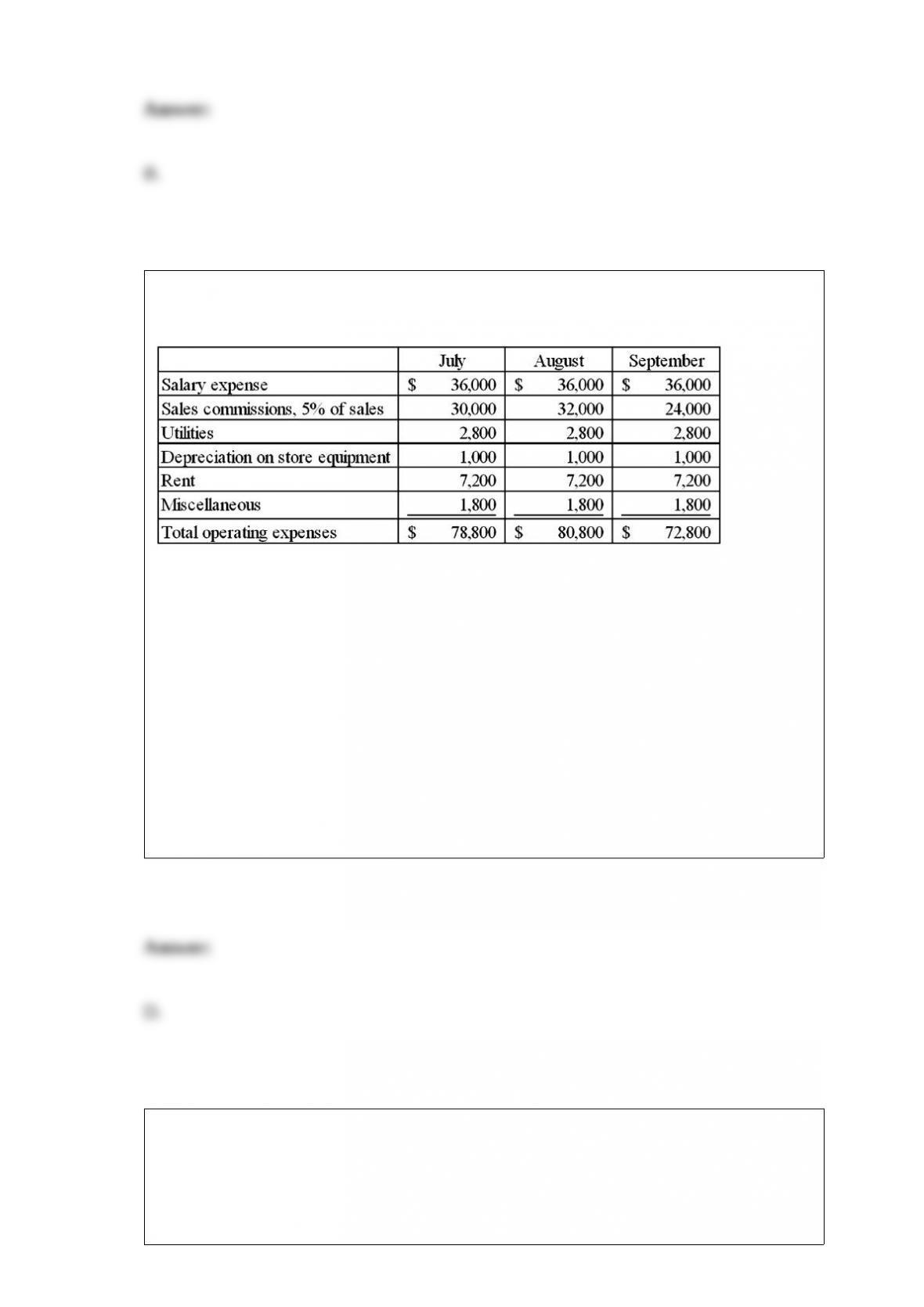
Scranton Company expects to begin operating on July 1, 2014. The company’s master
budget contained the following operating expense budget:
Sales commissions are paid in cash in the month following the month in which the
expense is recognized. All other expense items requiring cash payment are paid in the
month in which they are recognized. The amount of commissions payable that would
appear on the company’s September 30, 2012 pro forma balance sheet is:
A. $32,000.
B. $30,000.
C. $36,000.
D. $24,000.
Southport Company is considering the purchase of a piece of equipment that costs
$100,000. The equipment would be depreciated on a straight-line basis to its expected
salvage value of $10,000 over its 10-year useful life. Assuming a tax rate of 40%, what
is the annual amount of the depreciation tax shield provided by this investment?

A. $4,000
B. $9,000
C. $3,600
D. None of these answers is correct.
During 2014, the Abbot Company had the following changes in account balances:
1) The accumulated depreciation account had a beginning balance of $25,000 and an
ending balance of $35,000. The increase was due to depreciation expense.
2) The long-term notes payable account had a beginning balance of $40,000 and an
ending balance of $15,000. The decrease was due to repayment of debt.
3) The accounts receivable account had a beginning balance of $60,000 and an ending
balance of $50,000.
4) The equipment account had a beginning balance of $25,000 and an ending balance of
$92,500. The increase was due to the purchase of equipment for cash.
5) The long term investments account (marketable securities) had a beginning balance
of $18,000 and an ending balance of $12,500. The decrease was due to the sale of
investments at cost.
6) The amount of cash dividends declared and paid during the year was $22,000.
7) The interest payable account had a beginning balance of $2,250 and an ending
balance of $1,250.
If cash from operations was $12,000, cash from investing activities was ($24,000) and
the net change in cash was $24,000, what was cash from financing activities?
A. $36,000
B. $12,000
C. $24,000
D. ($36,000)
Which of the following is not a major cash inflow from a capital investment?
A. Incremental revenue
B. Increase in working capital
C. Cost savings
D. Salvage value
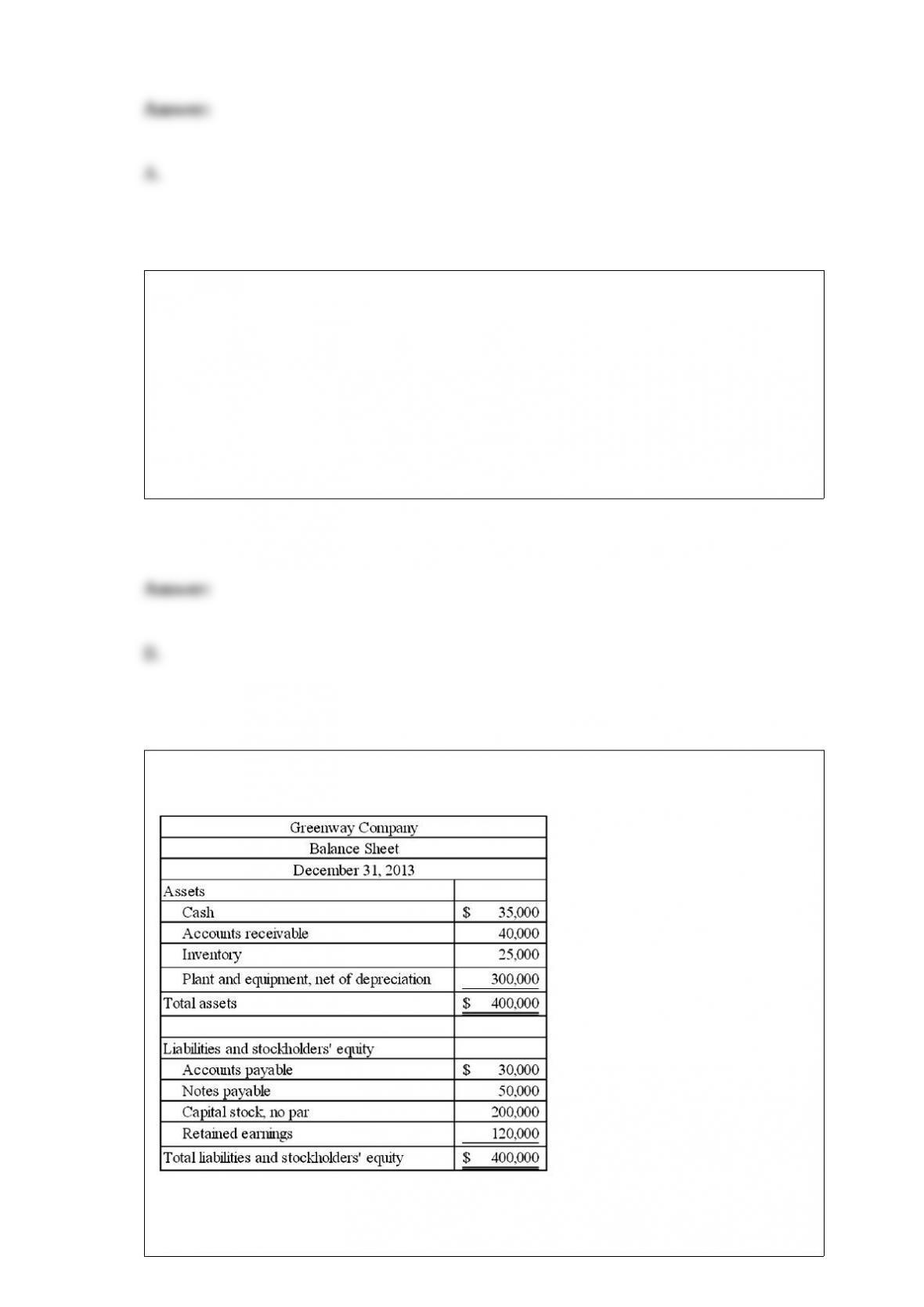
Greenhill Company’s balance sheet as of December 31, 2013 is provided below:
In anticipation of preparing the company’s operating budget for the upcoming period,
the company’s accountant has gathered the following information:

(a) December 2013 sales were $220,000. Sales are expected to grow at a rate of 8% per
month. Half of all sales are for cash and half are on account.
(b) Inventory purchases are expected to total $100,000 during January and the inventory
account is expected to have a $28,000 balance at January 31, 2014. All inventory
purchases are on account.
(c) Selling and administrative expenses for January, 2014 are budgeted at $60,000
(exclusive of depreciation) plus 10% of sales. Selling and administrative expenses are
paid in cash. Depreciation is budgeted at $3,000 for the month.
(d) The notes payable will be paid in January, 2014. The amount due will be $50,500.
The $500 represents January’s interest expense.
(e) The company expects to purchase a new machine during January, 2014 at a cost of
$5,000.Required:
Prepare a budgeted income statement for the month of January 2014. Use the traditional
income statement format and ignore income taxes.
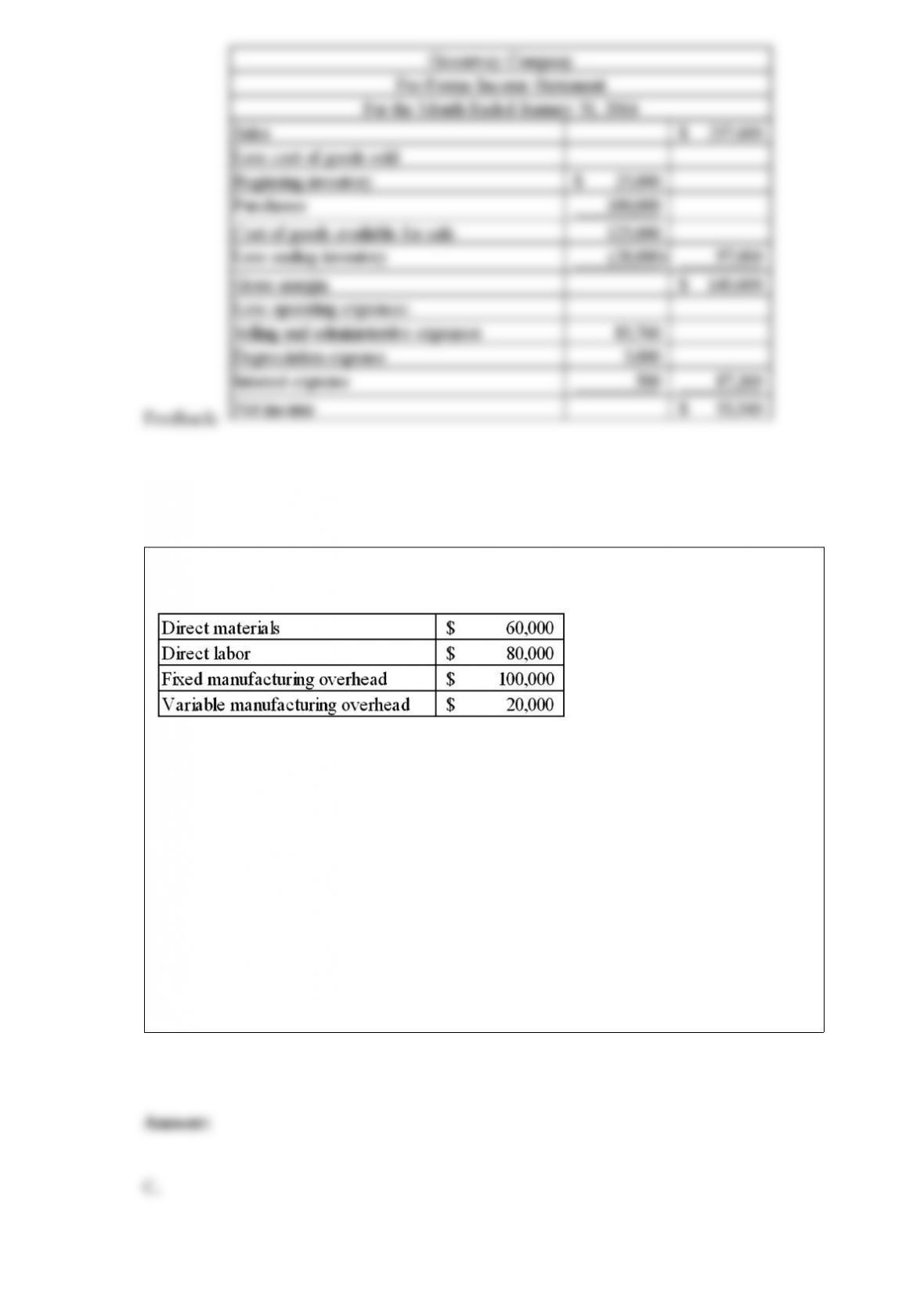
The accounting records for Moss Manufacturing Company disclosed the following cost
information for 2014:
Assume the company produced 10,000 units of inventory, sold 6,000 of these units in
2014 for $196,000, and that there was no beginning finished goods inventory. What
amount of ending finished goods inventory will be reported on the balance sheet under
variable costing?
A. $100,000
B. $96,000
C. $64,000
D. None of these.
Great Outdoors Company operates a store in downtown Denver that has five
departments including a fishing department. If the fishing department is closed, the
store manager’s position will not be affected, but if the entire store is closed, the
manager will be terminated. Which of the following lessons should be learned from this
example?
A. Opportunity costs are always present.
B. Sunk costs cannot be avoided.
C. Relevance of costs is context sensitive.
D. Information does not have to be precisely accurate in order to be relevant.
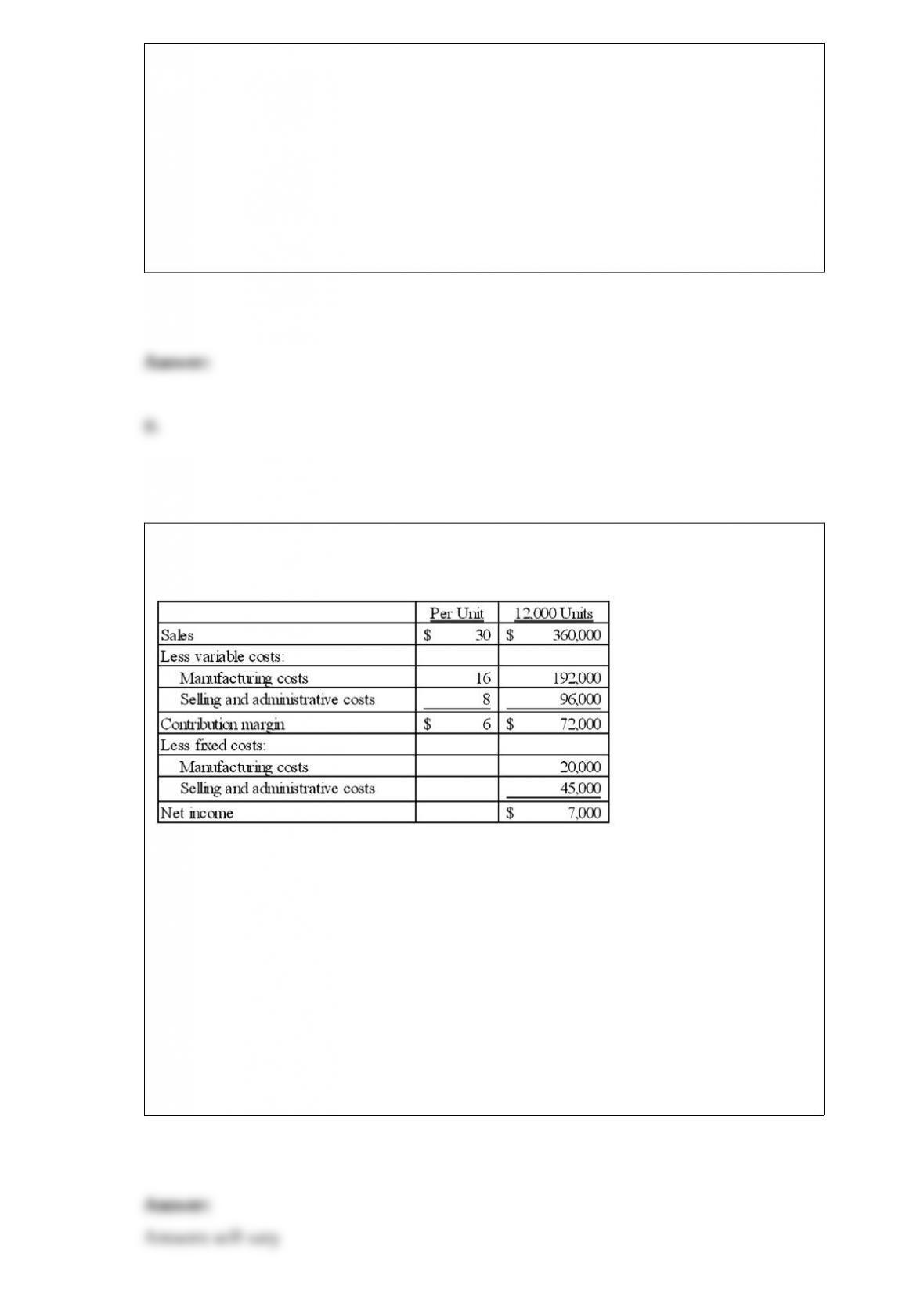
Bruce Company recently reduced its advertising budget. All other costs and revenues
were unchanged. Select the response that indicates the impact of the advertising cuts on
the company’s break-even point and margin of safety.
A. A.
B. B.
C. C.
D. D.
In a manufacturing business, the cost of direct materials being used is recorded in:
A. supplies inventory.
B. work in process inventory.
C. raw materials inventory.
D. manufacturing overhead.
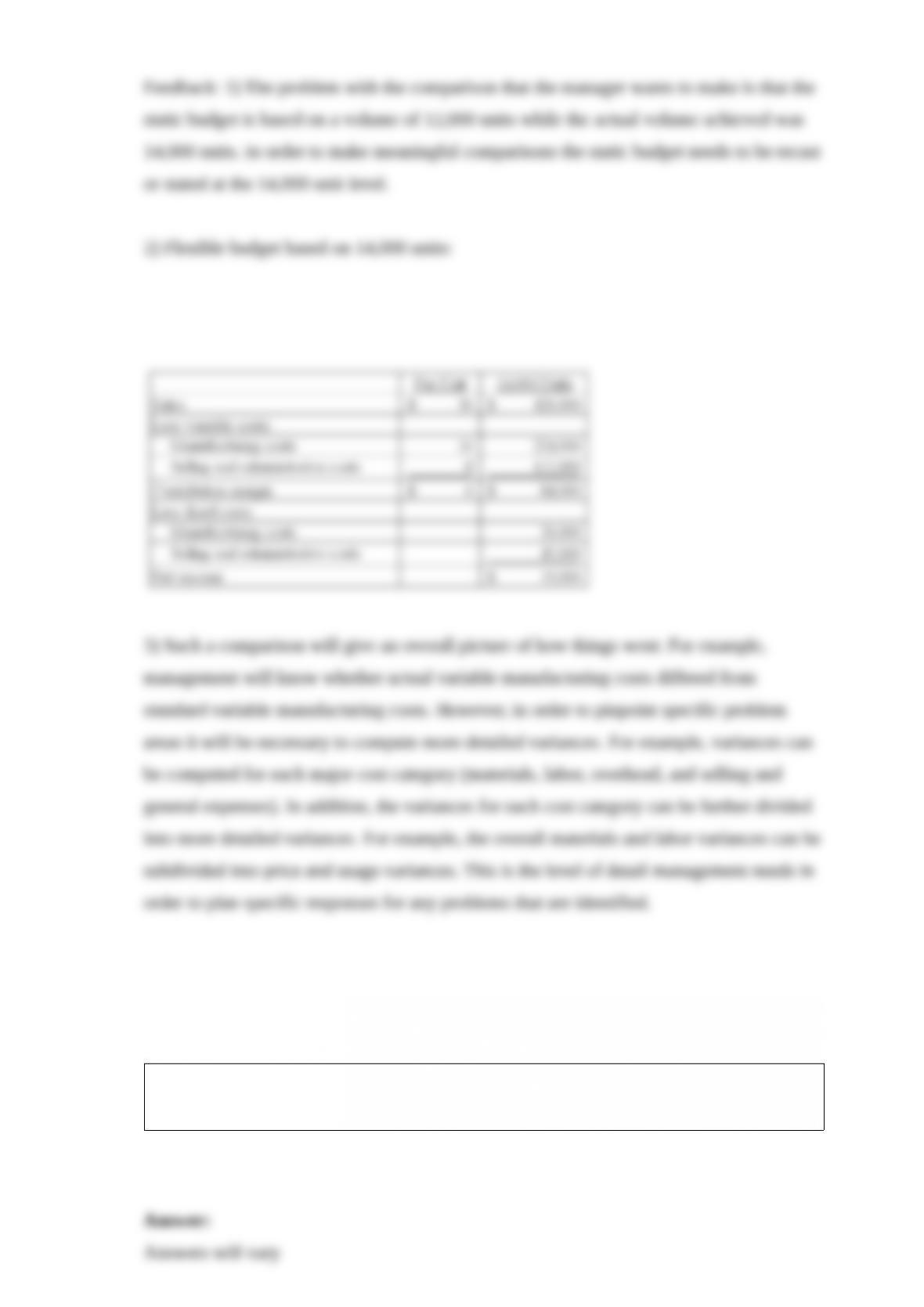
Canton Company estimates sales of 12,000 units for the upcoming period. At this sales
volume its budgeted income is as follows:
During the period the company actually produced and sold 14,000 units.
Required:
1) The manager now wants to evaluate the company’s performance by comparing actual
costs and revenues to those shown above but you have advised against it. Explain your
reasoning.
2) Prepare a flexible budget based on 14,000 units.
3) If management compares actual revenues and costs to the appropriate flexible
budget, will they be able to fully understand what went right and what went wrong with
the operation during the period? Why or why not?
Would you recommend that a business employ a participative approach to budgeting?
Why or why not?
How does the level of aggregation differ between financial accounting information and
managerial accounting information?
What source documents would be used in preparing a job cost sheet?
Indicate whether each of the following statements is true or false.
The direct costs for a manufacturing company are direct materials and direct labor.
To assign direct costs to its products, a manufacturer uses a predetermined overhead
rate.
To calculate a predetermined overhead rate, a company must select an appropriate
allocation base.
The predetermined overhead rate is calculated by dividing the expected level of the
allocation base by the expected amount of manufacturing overhead costs.
Calculation and use of a predetermined overhead rate is applicable to service companies
as well as manufacturing companies.
What is a postaudit of a capital investment decision, and how should the postaudit be
conducted?
Winken, Blinken, and Nod is a law firm specializing in real estate litigation. In addition
to the three partners, the firm employs nine associates who work directly with clients.
The average budgeted compensation for the twelve professionals is $240,000. Each
lawyer is budgeted at 1,500 billable hours per year. All professional labor costs are
included in a single direct cost pool and are traced to jobs on a per-hour basis. All
non-professional labor costs are included in a single overhead cost pool and are
allocated to jobs using professional labor hours as the allocation base. Budgeted
overhead costs total $1,800,000. The firm is considering bidding on some work with a
local university. The job is expected to require 100 hours of professional
labor.Required:
1) Compute the budgeted direct cost rate per hour of professional labor.
2) Compute the budgeted overhead cost rate per hour of professional labor.
3) Compute the budgeted cost for the university job.
Indicate whether each of the following statements is true or false.
A company’s variable overhead cost represents such inputs as rent and depreciation.
The variable overhead cost pool is normally assigned to products using many different
allocation rates.
Variable overhead and fixed overhead variances are calculated using the same basic
formulas.
Many companies choose not to calculate price and usage variances for variable
overhead costs.
How would a company use target pricing to identify the desired cost for a product or
service?