1) In a periodic inventory system, beginning inventory plus net purchases minus freight
in equals cost of goods sold.
2) In provinces with PST, businesses must pay the tax when they are the final consumer
of the goods.
3) The column total for other accounts in the cash payments journal is not posted to the
general ledger.
4) Property, plant and equipment are shown before current assets on a classified balance
sheet.
5) Bad-debt expense is a contra asset account.
6) When accruing interest on notes receivable that are outstanding at the end of the
year, it is not necessary to do any proration.
7) Capital, expenses, and withdrawals are all closed to the income summary account.
8) There are more acceptable inventory costing methods under international financial
reporting rules (IFRS) than there are under accounting standards for private enterprise
(ASPE).
9) When a prepaid expense is recorded initially as an expense, the adjusting entry
transfers the unused portion of the expense to the asset account.
10) Total debits must always equal total credits.
11) An inventory count should be done at least once per year.
12) The rate of provincial sales taxes is the same in every province.
13) Encouraging operational efficiency is one aspect of internal control.
14) Under a periodic inventory system, which accounts would be closed to income
summary with credits?
A) Sales Returns and Allowances, Sales Revenue, and Inventory
B) Sales Discounts, Sales Returns and Allowances, and Purchases
C) Sales Revenue and Cost of Goods Sold
D) Sales Returns and Allowances and Sales Revenue
15) Indicate how the following columns are posted from the sales journal, cash
payments journal, and the cash receipts journal. Use the following letters to indicate
your answer:
a) In total only
b) Individually only
c) In total and individually
1>Sales discounts debit column of the sales journal________
2>Cost of goods sold debit and inventory credit column of the
sales journal________
3>Accounts receivable credit column of the cash receipts journal________
4>Accounts receivable debit and sales revenue credit column of
the sales journal________
5>Cash credit column of the cash payments journal________
6>Cash debit column of the cash receipts journal________
7>Inventory debit column of the cash payments journal________
8>Other accounts credit column of the cash receipts Journal________
9>Accounts payable debit column of the cash payments journal________
10>Other accounts debit column of the cash payments journal________
16) Table 9-2
The Maderite Furniture Company has an allowance for doubtful accounts account with
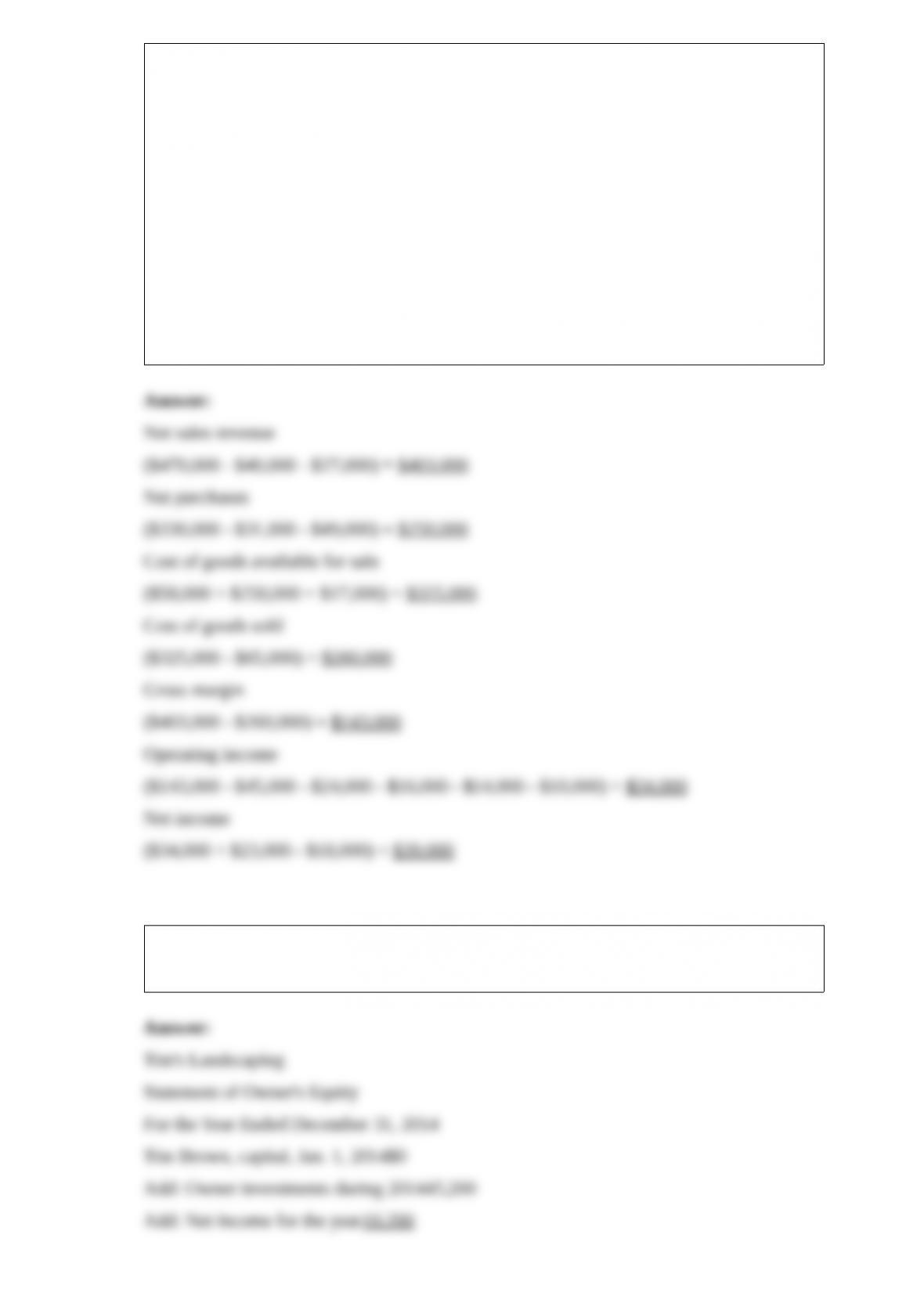
a $300 debit balance. Net credit sales for the period were $160,000. An aging process
shows that $5,400 of the accounts receivable probably will be uncollectible. In addition,
Maderite Furniture believes that 4% of all net credit sales are uncollectible. The
percent-of-sales method is used to account for uncollectibles.
Referring to Table 9-2, if the aging approach is used to account for uncollectible
accounts, what will be the balance in allowance for doubtful accounts after the
adjusting entry is made?
A) $5,400
B) $5,100
C) $5,700
D) $1,000
17) Table 10-1
On January 1, 2013, Bark Manufacturing Company Ltd. purchased a machine for
$27,500, and expects to use the machine a total of 32,000 hours over the next four
years. Bark set the residual value on the machine at $3,500. Bark used the machine
6,000 hours in 2013 and 7,200 hours in 2014 .
Referring to Table 10-1, what is the amortization expense in 2014 if Bark uses
double-declining-balance amortization?
A) $6,875
B) $6,000
C) $13,750
D) $12,000
18) Inventory held by a business is a(n) ________ and when sold becomes a(n)
________.
A) liability, withdrawal
B) asset, expense
C) liability, asset
D) asset, contra asset
19) On December 31, 2013, the unadjusted trial balance of Tarzwell Services showed
the following balances:
Accounts receivable $200,000
Allowance for doubtful accounts1,000Cr.
Sales700,000
The business has given up trying to collect $5,000 of its accounts receivable but has not
yet recorded the write-off entry. The firm uses the allowance method to estimate
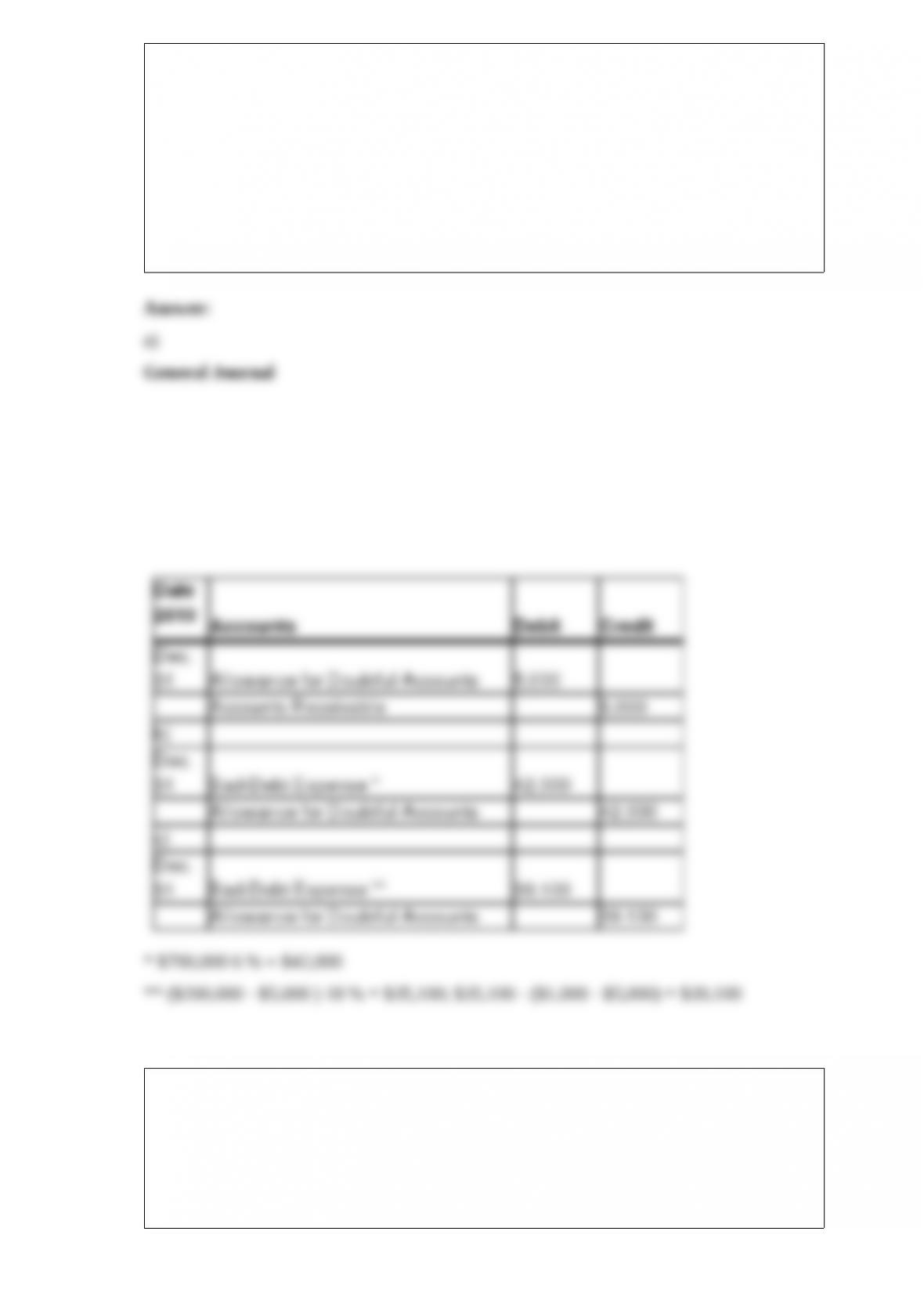
bad-debt expense.
a)Provide the entry for the write-off.
b)If the firm uses the percent-of-sales allowance method for recording bad-debt
expense, and has experienced an average 6% rate of non-collection based on sales,
provide the entry to record bad-debt expense for 2013.
c)Assume that after the firm recorded the $5,000 of write-offs, it determined that 18%
of its remaining accounts receivable will be uncollectible under the aging method.
Provide the entry to record bad-debt expense.
20) A cheque for the cash purchase of supplies for $329 was recorded on the books as
$239. On a bank reconciliation, this will appear as a(n):
A) addition to the book balance
B) deduction from the book balance
C) addition to the bank balance
D) deduction from the bank balance
21) Using the gross margin method, find the ending inventory value when purchases
were $105,000, net sales revenue was $128,000, beginning inventory was $31,000 and
cost of goods sold historically runs 58% of net sales revenue.
A) $82,240
B) $61,760
C) $23,000
D) $54,000
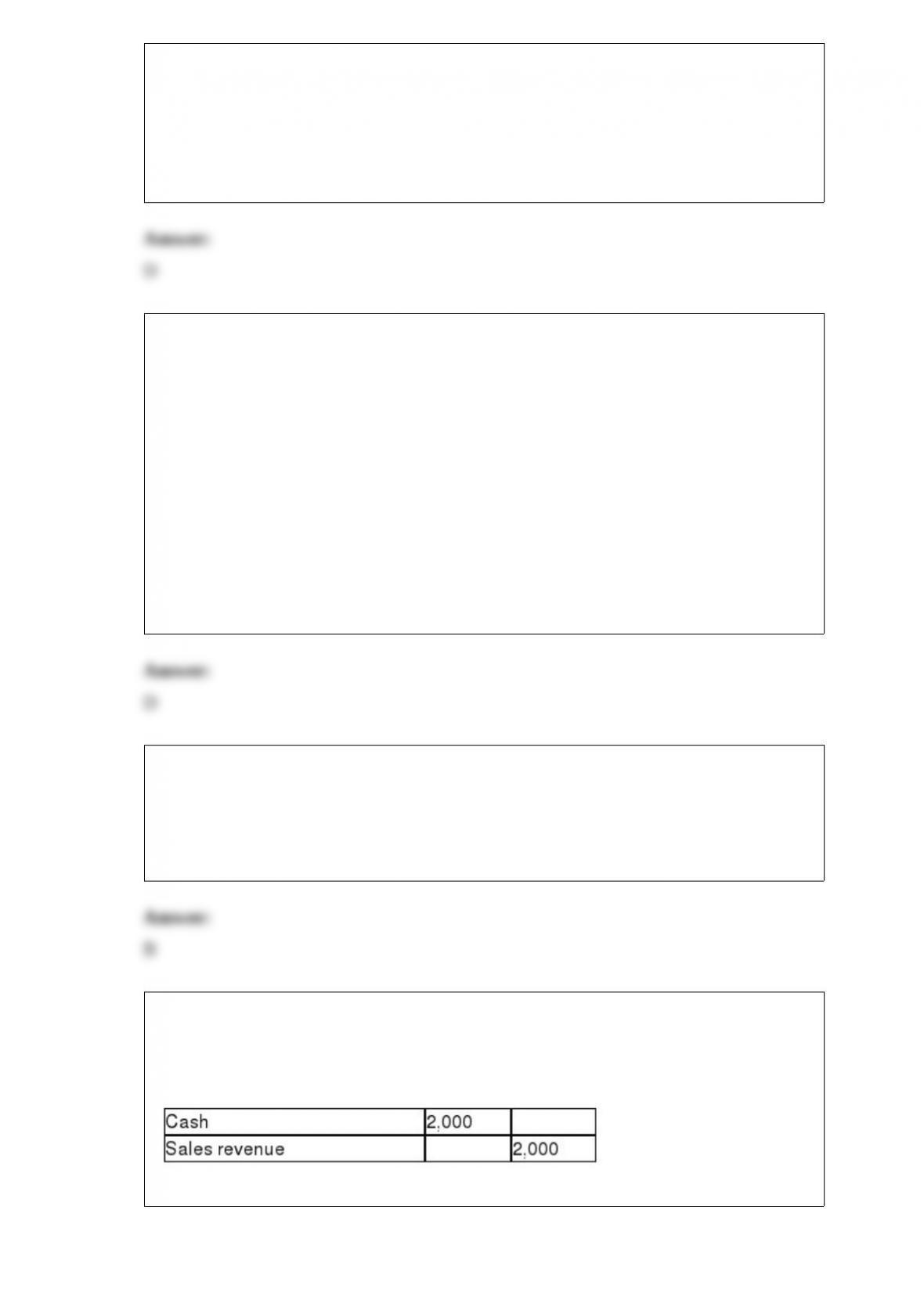
22) Table 5-5
The following items were taken from the December 31, 2013 records of Speedy Boat
Company, which uses a periodic inventory system:
Refer to Table 5-5. Cost of goods sold for Speedy Boat Company is:
A) $170,000
B) $180,000
C) $330,000
D) $220,000
23) When an unearned revenue is initially recorded as a revenue, the adjusting entry has
the following effect on the financial statements:
A) net income increases and assets decrease
B) revenue increases and liabilities decrease
C) net income increases and owner’s equity increases
D) revenue decreases and owner’s equity decreases
24) Table 10-5
On January 1, 2013, Button Manufacturing Company purchased a machine for $39,980,
and expects to use the machine a total of 32,000 hours over the next four years. Button
set the residual value on the machine at $3,500. Button used the machine 6,000 hours in
2013 and 7,200 hours in 2014 .
Referring to Table 10-5, what is the amortization expense in 2014 if Button uses
straight-line amortization?
A) $6,875
B) $13,750
C) $12,000
D) $9,120
25) The purchase of a building by signing a note payable would:
A) increase owner’s equity
B) increase total liabilities
C) decrease owner’s equity
D) decrease total assets
26) XYZ Co. accepted a non-bank credit card in payment for a $2,000 purchase by a
customer. The credit card company charges a 2% fee. The journal entry to record the
sale would be as follows.
A)
B)
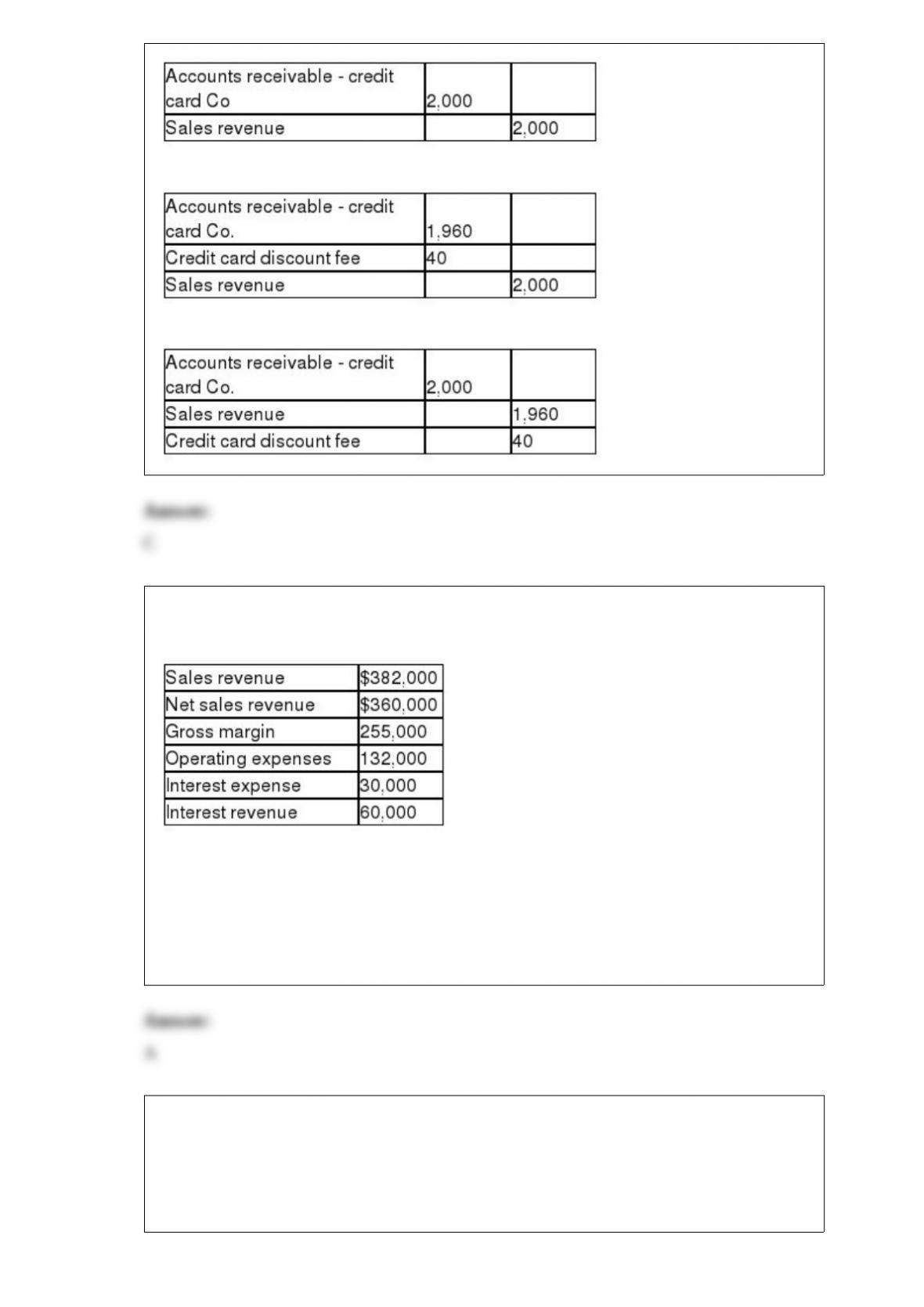
C)
D)
27) Table 5-2
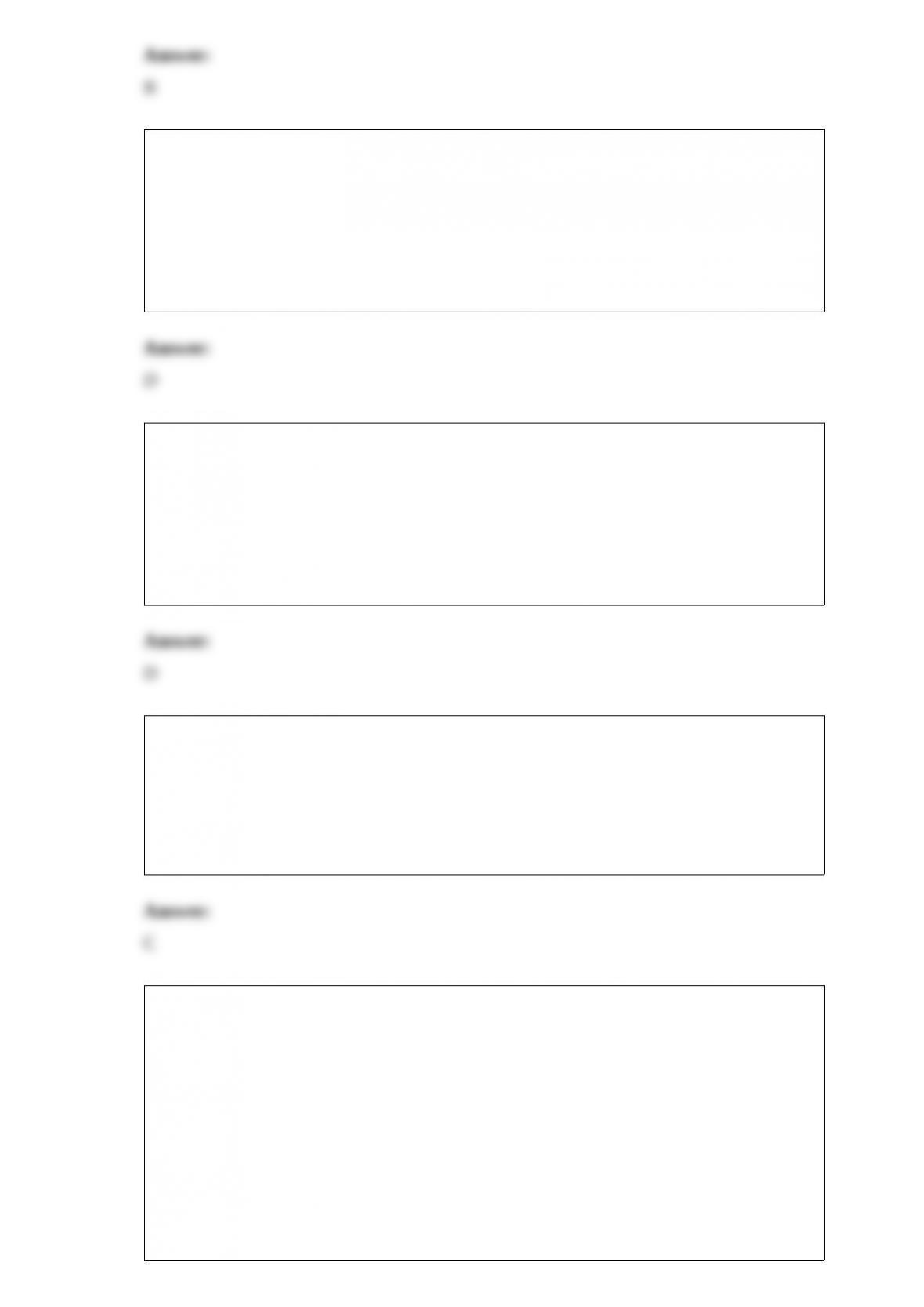
Referring to Table 5-2, if sales discounts amount to $15,000, the balance in Sales
Returns and Allowances must be:
A) $7,000
B) $29,000
C) $22,000
D) $8,000
28) Net income for the current period is closed:
A) to the owner’s withdrawals account
B) to the owner’s capital account
C) to the cash account
D) to the income summary account
29) The Calder Company received a bank statement showing a balance of $60,300.
Reconciling items included outstanding cheques of $1,450 and a deposit in transit of
$8,500. What is the company’s adjusted bank balance?
A) $60,300
B) $58,850
C) $68,800
D) $67,350
30) Canadian companies following International Financial Reporting Standards (IFRS)
are required to classify their balance sheets:
A) on the equity and liability side in the order of equity, long-term liabilities, current
liabilities
B) on the asset side long-term assets followed by current assets
C) in the same manner as ASPE
D) using IFRS presentation or the traditional presentation
31) If the direct write-off method is used for uncollectible receivables, what account is
debited when writing off a customer’s account?
A) accounts receivable
B) allowance for doubtful accounts
C) bad-debt expense
D) sales returns and allowances
32) Match the following.
A) straight-line method
B) estimated useful life
C) carrying value
D) residual value
E) units-of-production method
F) repair
G) amortizable cost
H) accumulated amortization
I) double-declining-balance method
J) betterment
1> Expenditure that increases the capacity or efficiency of an asset or extends its useful
life
2> The cumulative sum of all amortization expense from the date of acquiring a
property, plant, and equipment asset
3> Expenditure that merely maintains an asset in its existing condition or restores the
asset to good working order
4> An amortization method that writes off a relatively larger amount of the asset’s cost
nearer the start of its useful life than does the straight-line method
5> Length of the service that a business expects to get from an asset
6> The cost of a property, plant, and equipment asset minus its estimated residual value
7> Expected cash value of an asset at the end of its useful life
8> Amortization method in which an equal amount of amortization is assigned to each
year of an asset’s use
9> Amortization method by which a fixed amount of amortization is assigned to each
measure of the asset’s output
10> Book value
33) In a bank reconciliation, an EFT cash payment is:
A) added to the bank balance
B) deducted from the bank balance
C) added to the book balance
D) deducted from the book balance
34) Answer the following questions briefly and concisely.
a)Why is it important for a company to separate the current portion of long-term debt
from the long-term debt?
b)How would the under accrual of warranty expense affect a company’s financial
statements?
c)What is the difference between a liability and a contingent liability?
d)What are contingent gains and how are they treated?
35) Table 10-6
On January 1, 2013, Grant Transport purchased a $120,000 truck for hauling cattle
across the border. Grant plans on driving the truck for eight years or 400,000
kilometres. Expected residual value for the truck is $30,000.
Referring to Table 10-6, the 2015 amortization expense using the straight-line method
is:
A) $11,250
B) $16,875
C) $28,125
D) $15,000
36) Sabrina’s Fabric Land bought $5,000 of equipment at the beginning of 2015 .
Amortization expense on the 2015 income statement is $400. What is the balance in
accumulated amortization on December 31, 2015?
A) $5,000
B) $400
C) $4,600
D) $0
37) Which of the following is not addressed by rules of professional conduct?
A) competence
B) confidentiality
C) number of clients
D) compliance with professional standards
38) Given the following transactions in the month of July for Kootenay Outdoor
Adventures, prepare journal entries; and, a trial balance and balance sheet as of July 31,
2013 .
a) Owner, Bill Thompson invested $35,000 cash and equipment with a value of $67,500
into the business.
b) Purchased supplies on account, $250.
c) Rented office space paying one month’s rent, $950.
d) Performed guide service on account, $4,500.
e) Purchased a truck by paying $4,000 cash and signing a promissory note for the
balance of $29,800.
f) Performed guiding service and immediately collected $2,900 cash.
g) Owner, Bill Thompson withdrew $900 for personal use.
39) When the seller is liable for the shipping costs, the payment for the freight in the
seller’s accounts is recorded with a debit to:
A) Delivery Expense or Freight Out
B) Freight In
C) Inventory
D) Cash
40) The entry to reimburse the petty cash fund includes a:
A) credit to Petty Cash
B) debit to Cash in Bank
C) debit to various expenses and assets
D) debit to Petty Cash
41) Match the following terms and definitions:
A) account receivable
B) proprietorship
C) earnings estimate
D) transaction
E) generally accepted accounting principles
F) corporation
G) asset
H) expense
I) accounting
J) liability
K) limited-liability partnership
L) revenue
M) capital
The system that measures business activities and processes information into reports
42) Table 10-9 Sandu Trucking
On July 1, 2013, Sandu Trucking bought a truck for $42,000 cash. It has estimated
residual value of $6,000, and an estimated life of 4 years, or 300,000 kilometres. The
truck drove 80,000 kilometres in 2013, 90,000 kilometres in 2014, 100,000 kilometres
in 2015, and 50,000 kilometres in 2016. Sandu Trucking has a December 31st year end.
Refer to Table 10-9. Prepare the journal entry to record the sale of the truck on March
31, 2015 for $21,000 assuming that Sandu Trucking uses straight-line amortization up
to the point of sale.
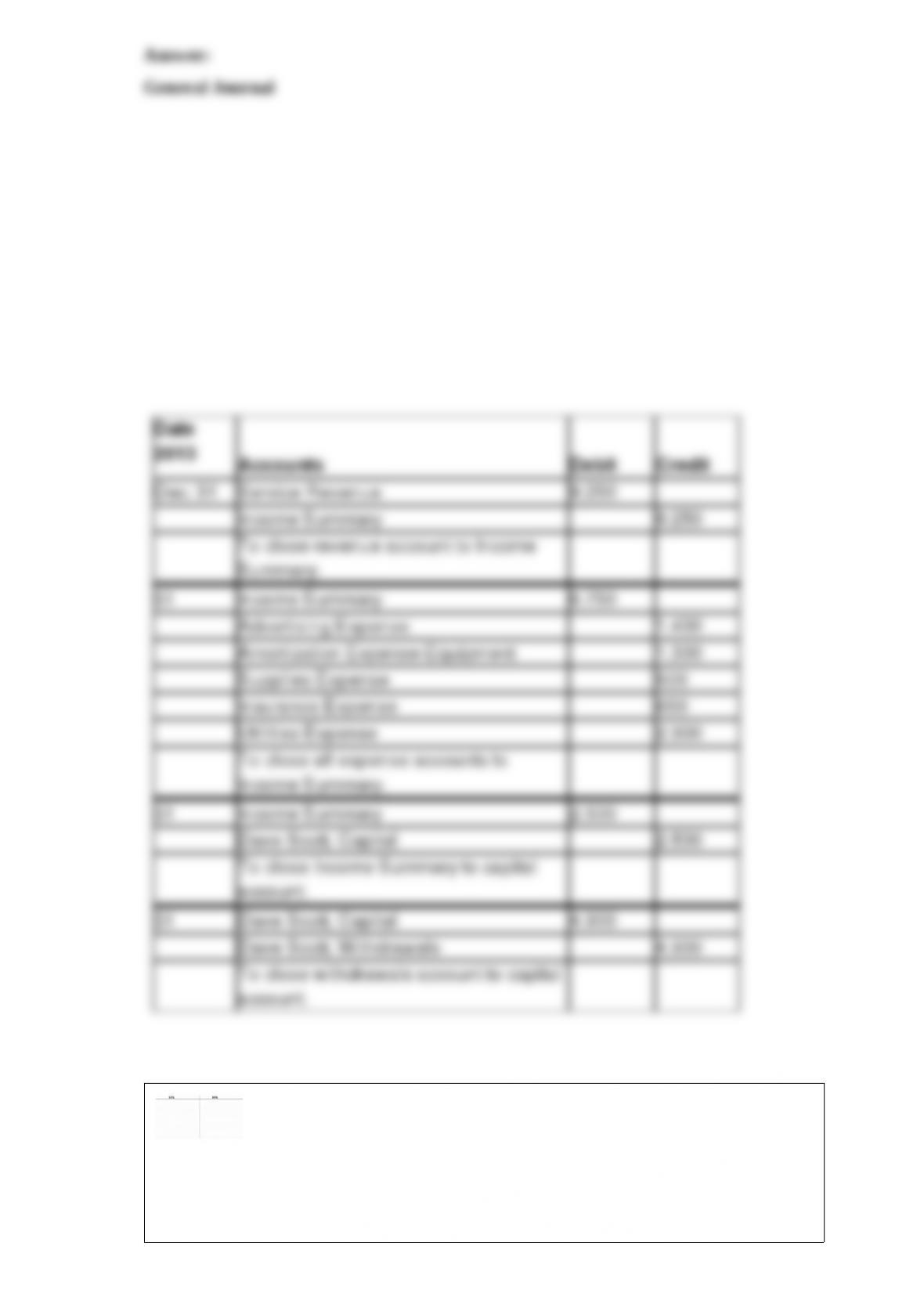
43) Based on the following adjusted trial balance, prepare the closing entries for Dave
Scott and Associates (a proprietorship) on December 31, 2013 .
Dave Scott and Associates
Adjusted Trial Balance
December 31, 2013
DebitCredit
Cash$ 13,600
Accounts receivable2,000
Office supplies700
Prepaid insurance1,200
Equipment15,600
Accum. amort.-equipment$ 3,900
Accounts payable6,800
Salary payable1,100
Unearned service revenue800
Dave Scott, Capital22,900
Dave Scott, Withdrawals4,900
Service revenue9,250
Advertising expense1,400
Amort. expense-equipment1,300
Supplies expense500
Insurance expense650
Utilities expense 2,900_______
Total$44,750$44,750
44) Table 10-7
On January 1, 2013, Brazeau Transport purchased a $165,000 truck for hauling cattle
across the border. Brazeau plans on driving the truck for four years or 450,000
kilometres. Expected residual value for the truck is $35,000. On June 30, 2016, after
having driven the truck 44,000 kilometres, the truck had an accident on the highway
and was totalled. The insurance proceeds for the truck was $42,000 cash.
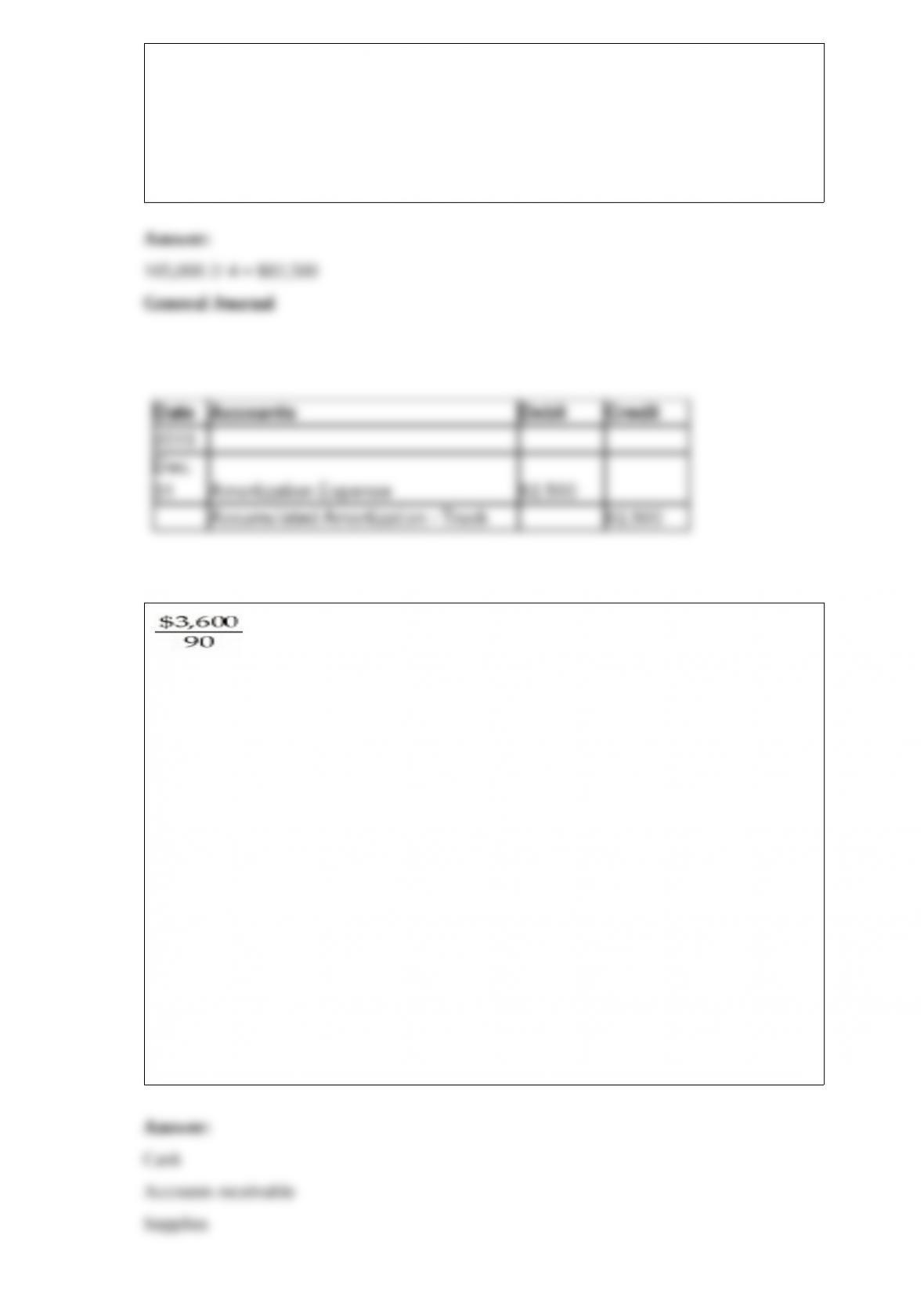
Refer to Table 10-7. Calculate and record the amortization expense for the truck for the
year 2013 using the double-declining-balance method.
45) Table 7-3
Accounts payable
Accounts receivable
Accumulated amortization
Cash
Equipment
Gasoline expense
Martin Mann, Capital
Martin Mann, Withdrawals
Notes payable
Salary payable
Service revenue
Supplies
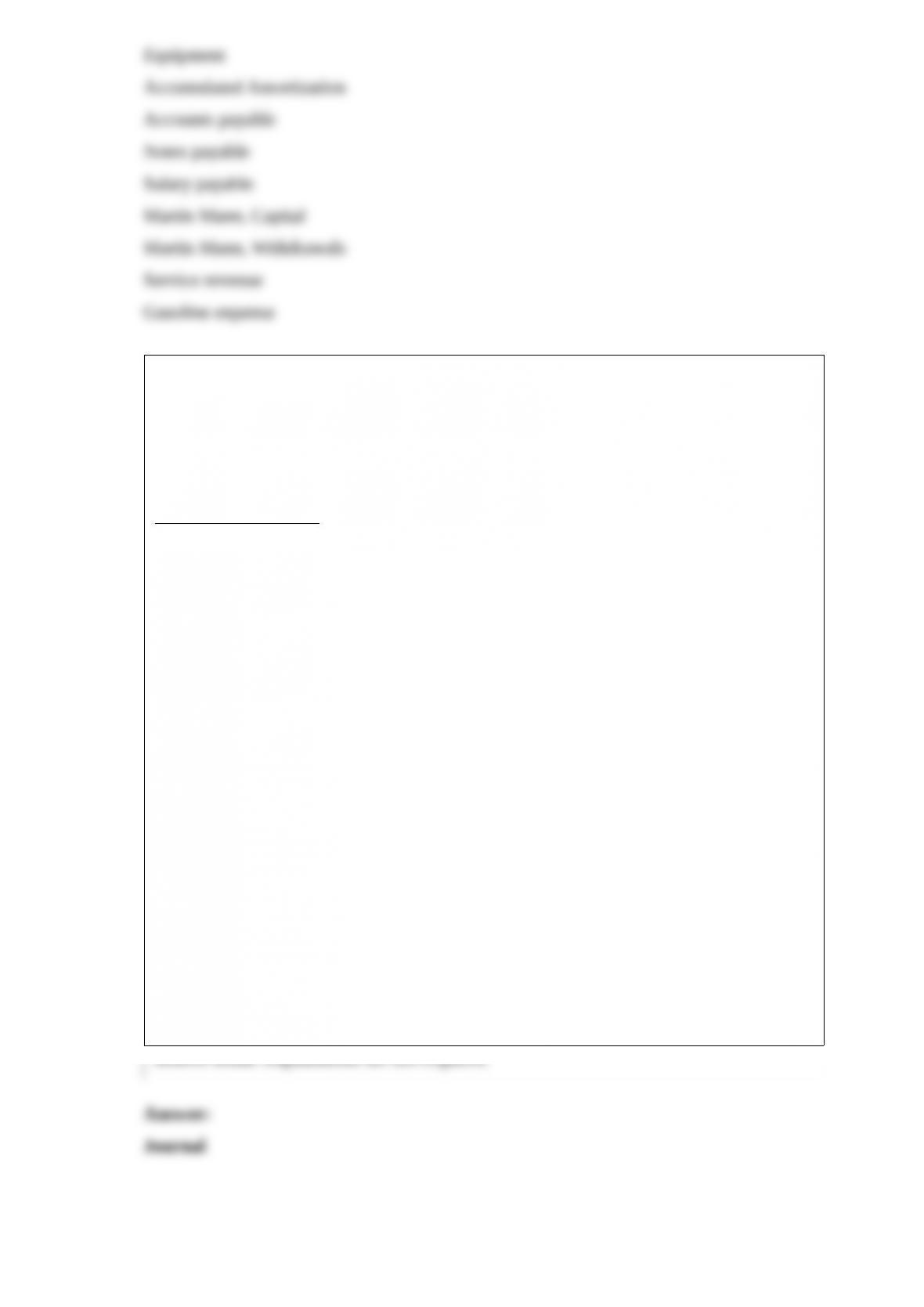
Refer to Table 7-3.
Put the accounts in the proper order for the chart of accounts, starting with the most
liquid assets.
46) Durham Bike Shop Ltd.’s year end is December 31 . Some of the company’s
transactions are as follows:
March 1Paid $190,000 cash to purchase the following assets:
MarketEst. Useful Est. Residual
AssetValueLifeValue
Land$ 88,000- –
Building 132,00025 years$14,000
Durham Bike Shop Ltd. plans to use the straight-line amortization
method for the building.
April 15Purchased a used pickup truck for $10,500 cash. The truck sells for
$15,900 when new. The truck is expected to be used for eight years and
driven 120,000 km. The estimated salvage value is $3,900. It will be
amortized using the units-of-production method.
April 16Installed heavy-duty racks costing $1,400 that will enable the truck to
carry several bicycles.
June 30Paid John’s garage for an oil change ($35) and the replacement of a
muffler ($425).
Dec. 31Recorded amortization on the assets. The truck was driven
9,000 kilometres since it was purchased.
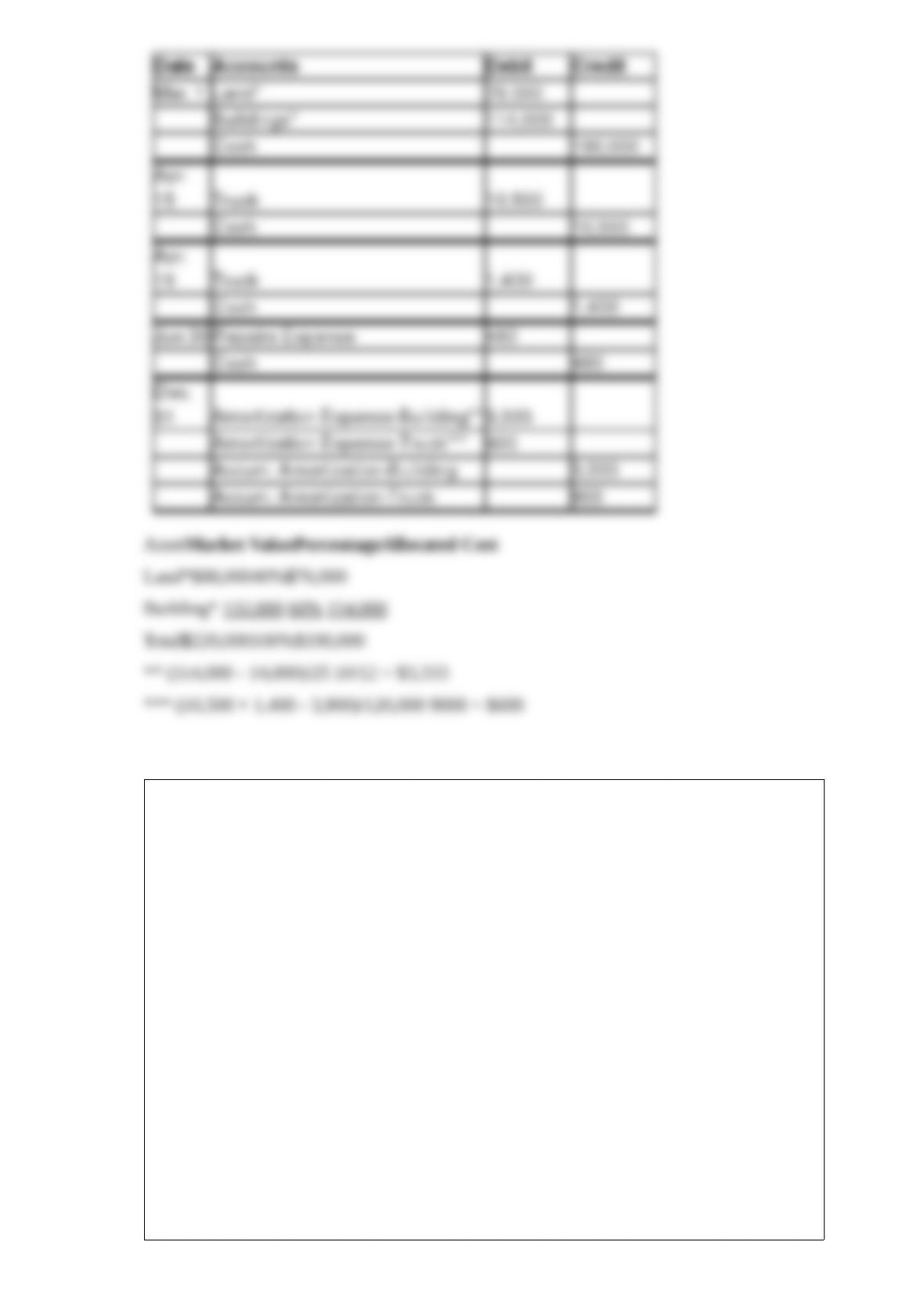
Record the above transactions of Durham Bike Shop Ltd. Round all amounts to the
nearest dollar. Explanations are not required.
47) Following is a random list of some of the accounts and their December 31, 2014,
balances for Milita Merchandising. Milita Merchandising uses a periodic inventory
system and all account balances are normal.
Purchases $330,000
Sales revenue470,000
Interest revenue 23,000
Salary expense45,000
Freight in 17,000
Purchase discounts 31,000
Sales returns and allowances 40,000
Interest expense 18,000
Delivery expense 24,000
Sales discounts 27,000
Insurance expense 16,000
Purchase returns and allowances 49,000
R. Milita, Capital 35,000
Utilities expense14,000
Amortization expense-equipment10,000
R. Milita, Withdrawals 18,000
The beginning and ending amounts for inventory are $58,000 and $65,000, respectively.
Calculate the following for Milita Merchandising:
Net sales revenue$__________
Net purchases $__________
Cost of goods available for sale$__________
Cost of goods sold $__________
Gross margin$__________
Operating income $__________
Net income$__________
48) Refer to Table 1-2. Prepare a statement of owner’s equity for Tim’s Landscaping for
the year ending December 31, 2014, the end of its first year of operations.