
Which of the following statements is true concerning the fixed component of power
cost?
A.This would be categorized as a unit level activity.
B.This is a cost that would be incurred regardless of the level of output.
C.This would be categorized as a facility-related cost.
D.both “b” and “c”
Which of the following is false regardingnormal costing?
A.Normal costing assigns to products actual direct material and direct labor costs plus
an amount representing “normal” manufacturing overhead.
B.Under normal costing, a firm derives a rate for applying overhead to units produced
before the production period begins.
C.Under normal costing, a firm uses a predetermined overhead rate in applying
overhead to each unit as the firm produces it throughout the year.
D.Under normal costing, a firm uses the actual overhead costs incurred because this is
the “normal” procedure in the United States.
Which statement is true concerning direct materials?
A.are materials traceable to individual units produced.
B.costs are almost always variable.

C.costs are almost always fixed.
D.”a” and “b”
How does linear programming optimize the use of scarce resources?
A.by finding the product mix that will maximize profits given the constraints.
B.by providing opportunity costs of constraints.
C.by allowing for sensitivity analysis.
D.All of the answers are correct.
The international standards that promote the importance of accounting for
environmental costs (such as hazardous waste disposal, waste treatment, and periodic
environmental inspections), and communicating these costs to management and people
outside the organization are
A.ISO 4000.
B.ISO 9000.
C.ISO 14000.
D.ISO 24000.
Why do firms collect costs by job?
A.For performance evaluation
B.To provide information for cost control
C.To compare actual with estimated costs for pricing future jobs
D.All of the answers are correct.
The second step in Activity-based costing (ABC) is to identify the cost driver(s)
associated with each activity. Cost drivers usually relate to
A.volume of production.
B.hours used in production.
C.marketing process.
D.All of the answers are correct.
Which of these is a common type of fraud on financial statements?
A.improper revenue recognition.
B.improper expense recognition.
C.understating inventory.
D.miscounting cash
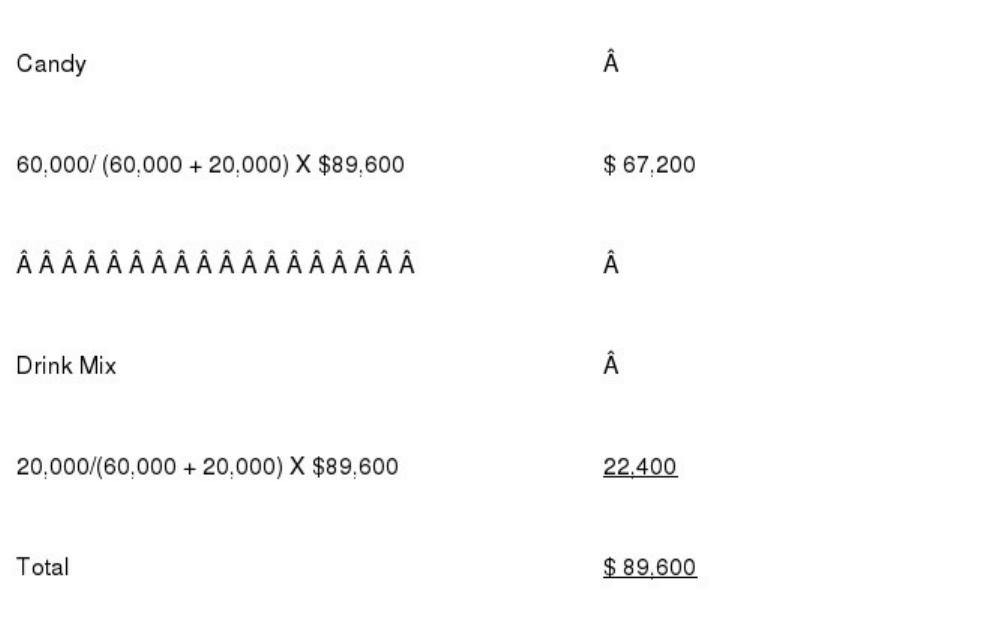
Formula, Inc., processes sugar into candy and powdered drink mix. The sugar costs
$61,000 per load. The process involves mixing the sugar for 2 hours, producing 60,000
packs of candy with a market value of $25,000, and 20,000 packs of drink mix with a
market value of $100,000. The joint cost of the mixing process is $28,600.
Required:
a. If the sugar and the mixing process costs are to be allocated on the basis of units of
output, what cost is assigned to each product?
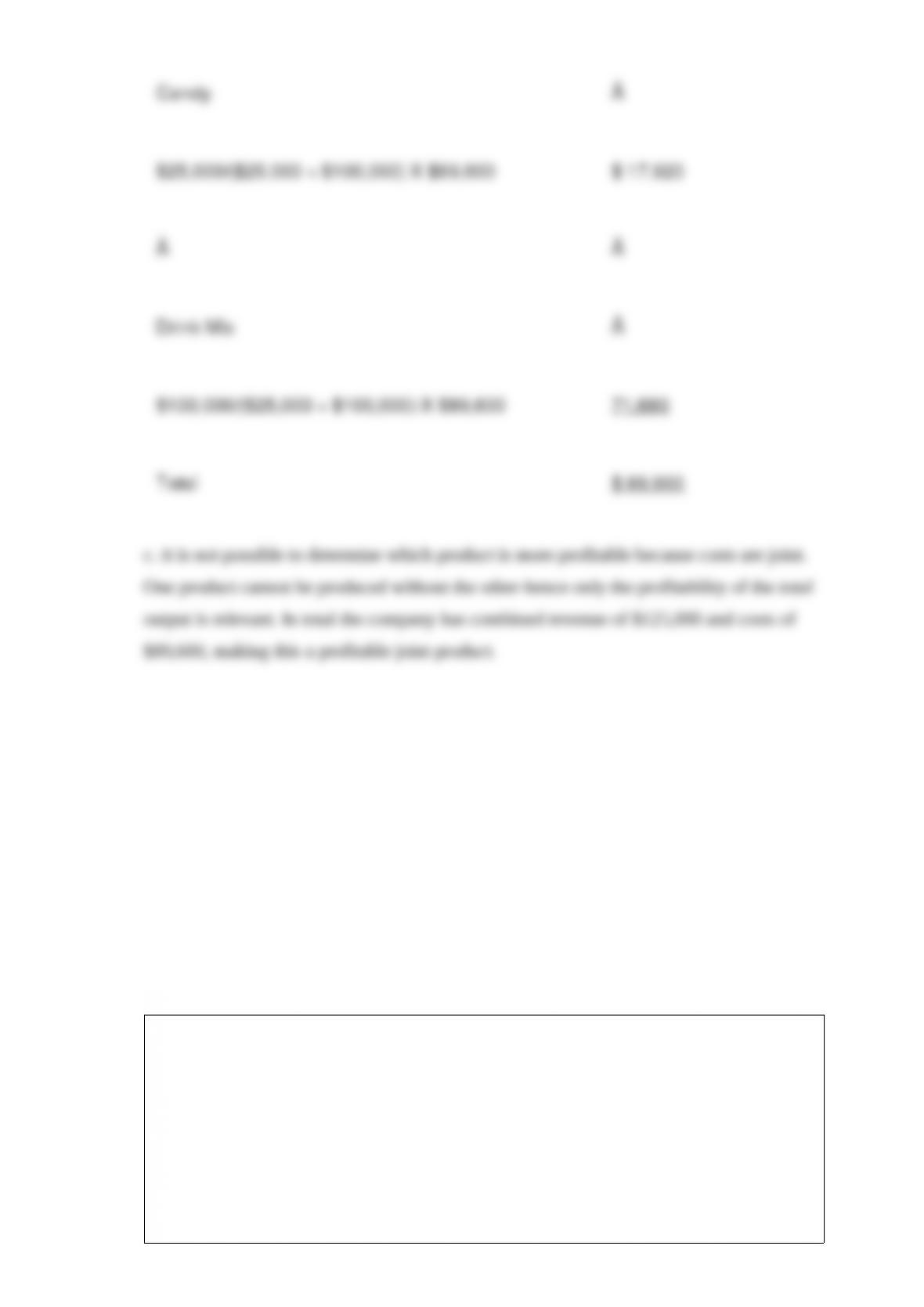
b. If the sugar and the mixing process costs are allocated on the basis of the net
realizable value, what cost is assigned to each product?
c. How much profit or loss does the candy product provide using the data in this
problem and your analysis in requirement (a)? Is it really possible to determine which
product is more profitable? Explain why or why not.
When multiple inputs are used to produce the output, the efficiency variance can be
broken down into which of the following?
A.mix and match variances.
B.mix and yield variances.
C.profit and yield variances.
D.benefit and match variances.
Accounting in a JIT environment charges all costs directly to Cost of Goods Sold and
charges them to Inventory accounts when needed using which of the following costing
methods?
A.job order costing.
B.process costing.
C.hybrid costing.
D.backflush costing.
What does the experience curve function show?
A.The amount of time required to perform a task goes up per unit as the number of
units increases.
B.The amount of time required to perform a task goes up per unit as the number of units
decreases.
C.The amount of time required to perform a task goes down per unit as the number of
units increases.
D.The amount of time required to perform a task goes down per unit as the number of
units decreases.
When can using full costs for pricing decisions be justified?

A.when a firm enters into a long-term contractual relationship to supply a product.
B.when a firm enters into a short-term contractual relationship to supply a product.
C.for development and production of standardized commercial products.
D.when setting short-term market prices.
Which is the best stage in the Value Chain to deal with unhappy customers?
A.Customer Service
B.Marketing
C.Distribution
D.Research & Development