1) What is the calculation to determine the number of outstanding shares of stock?
A) number of treasury stock shares plus number of issued shares
B) number of authorized shares minus number of issued shares
C) number of issued shares minus number of treasury shares
D) number of authorized shares minus treasury shares
2) Following are key terms relating to notes receivable, as well as a list of definitions.
A.Creditor
B.Debtor
C.Interest
D.Maturity date
E.Maturity value
F.Principal
G.Term
1>The amount of money borrowed by the debtor
2>Another term for the lender
3>The cost of borrowing money stated as an annual percentage rate
4>The length of time from when the note was signed to when the note must be paid
5>The maker of the note
6>The date on which the debtor must pay the note
7>The sum of the principal and the interest on the note
Required: Place the appropriate letter (A-G) on the line in front of the statement
describing the term.
3) On January 1, 2014, Gardner Corporation purchased 25% of the common stock
outstanding of Lance Corporation for $260,000. During 2014, Lance Corporation
reported net income of $80,000 and paid cash dividends of $40,000. The balance of the
Equity-Method Investment account at December 31, 2014 is:
A) $260,000
B) $270,000
C) $280,000
D) $290,000
4) Andy Company had a Cash balance on May 1 of $27,000 At the end of May, the
Cash balance had increased to $28,000 During the month of May, Andy received cash
of $46,000 from various sources Based on this information, cash payments for the
month of May were:
A) $27,000
B) $28,000
C) $45,000
D) $55,000
5) Long-term available-for-sale securities can be:
A) bonds held to maturity
B) bonds not held to maturity, but held for more than one year
C) stocks other than trading securities and equity-method securities
D) B and C
6) Following IFRS, the lower-of-cost-or-market rule requires a company to report
inventories at the lower of:
A) historical cost or current sales price
B) historical cost or net realizable value
C) current replacement cost or historical cost
D) FIFO cost or LIFO cost
7) The net income shown on the income statement also appears on the:
A) balance sheet and operations statement
B) statement of retained earnings
C) statement of cash flows, using the indirect method
D) B and C
8) Ending inventory for the year ended December 31, 2015, is understated by $8,000.
How will this affect net income for 2015 and 2016?
A) Net income will be understated by $8,000 in 2015 and 2016
B) Net income will be overstated by $8,000 in 2015 and 2016
C) Net income will be understated by $8,000 in 2015 and overstated by $8,000 in 2016
D) Net income will be overstated by $8,000 in 2015 and understated by $8,000 in 2016
9) Receiving a payment from a customer on account:
A) increases stockholders’ equity
B) has no effect on total assets
C) decreases stockholders’ equity
D) decreases liabilities
10) Which of the liability accounts below is usually NOT an accrued liability:
A) interest payable
B) wages payable
C) taxes payable
D) notes payable
11) Net Cash Provided by Operating Activities that are consistently lower than net
income may imply that:
A) a dividend has not been issued in a long time
B) the common stock should be split
C) the company may be facing a cash shortage
D) working capital has decreased
12) The entity assumption does NOT apply to a:
A) proprietorship
B) limited liability partnership
C) limited-liability company
D) The entity assumption applies to all the above
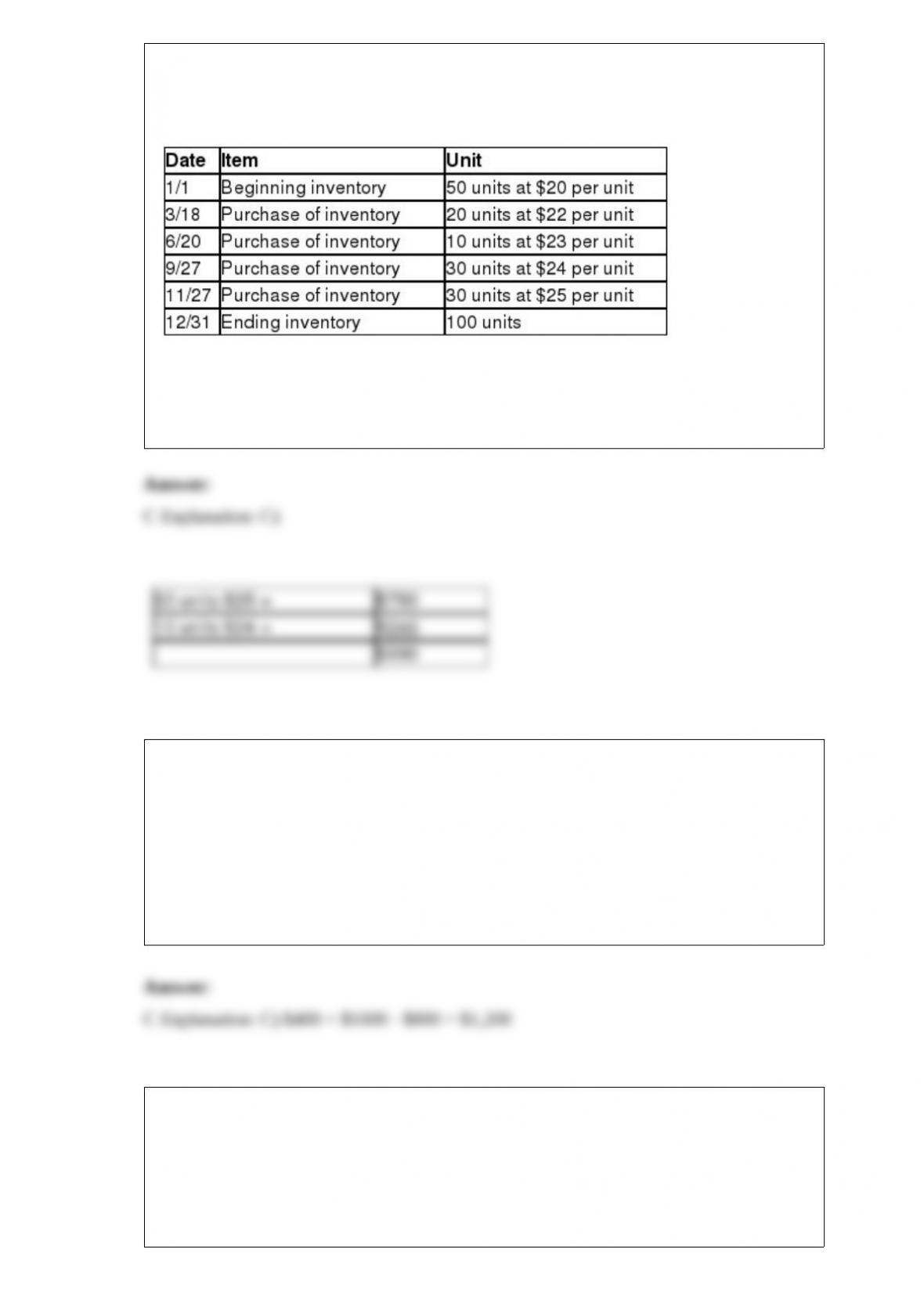
13) Given the following data, calculate the Cost of Goods Sold using the LIFO costing
method.
A) $720
B) $800
C) $990
D) $1,000
14) A company started the year with $400 of supplies. During the year the company
purchased additional supplies costing $1,600. There were $800 of supplies on hand at
the end of the year. An adjusted trial balance prepared at the end of the accounting
period will show the following balance in Supplies Expense:
A) $600
B) $800
C) $1,200
D) $1,600
15) On the statement of cash flows, in which section would the purchase of land with
cash appear?
A) Operating activities
B) Investing activities
C) Financing activities
D) Noncash investing and financing activities
16) In lieu of using the Trial Balance Worksheet to prepare the financial statements, an
accountant can use the:
A) journal
B) ledger
C) prior period financial statements
D) prior period audit report
17) Which statement is TRUE?
A) Most companies use the perpetual inventory system
B) Most companies use the periodic inventory system
C) Most companies use the specific identification method
D) Most companies in the United States follow International Financial Reporting
Standards
18) The Statement of Stockholders’ Equity does NOT have a separate column for:
A) Retained Earnings
B) Accumulated Other Comprehensive Income
C) Treasury Stock
D) Equity-Method Investment
19) A debtor and a creditor record the same note, respectively, as a:
A) note receivable and note payable
B) note receivable and account receivable
C) note payable and note receivable
D) note payable and account payable
20) The direct method of preparing the statement of cash flows is preferred by the
Financial Accounting Standards Board primarily because of the way it reports:
A) operating activities
B) investing activities
C) financing activities
D) noncash activities
21) The loss from the disposal of a segment of a business is called:
A) an extraordinary loss
B) other expense
C) other loss
D) loss on sale of discontinued operations
22) During the year, Lady Liberty Corporation’s treasury stock increased $50,000 from
a cash purchase, cash dividends paid totaled $44,000 and the company reported net
income of $200,000. On the statement of cash flows(indirect method), Net Cash Used
by Financing Activities is:
A) ($94,000)
B) ($106,000)
C) ($150,000)
D) ($156,000)
23) When inventory costs are increasing, the FIFO costing method will generally yield
a cost of goods sold that is:
A) higher than cost of goods sold under the LIFO method
B) lower than cost of goods sold under the LIFO method
C) equal to the gross profit under the LIFO method
D) equal to cost of goods sold under the LIFO method
24) A gross profit percentage of 30% means that:
A) for each dollar of sales, the company has a cost of goods sold of seventy cents
B) for each dollar of sales, the company has a gross profit of thirty cents
C) for each dollar of sales, the company has a cost of goods sold of thirty cents
D) both A and B are true
25) Which of the following would be considered an extraordinary item?
A) Losses from a labor dispute
B) Losses from a natural disaster
C) Writing-down inventory to lower-of-cost or market
D) Losses from the sale of property
26) In 1960, Johnson Company purchased a building for $100,000. In 2013, a real
estate professional says the building has a fair value of $1,000,000. In 2013, a similar
building down the street recently sold for $900,000. What value is reported for the
building on the balance sheet at December 31, 2013?
A) $100,000
B) $550,000
C) $900,000
D) $1,000,000
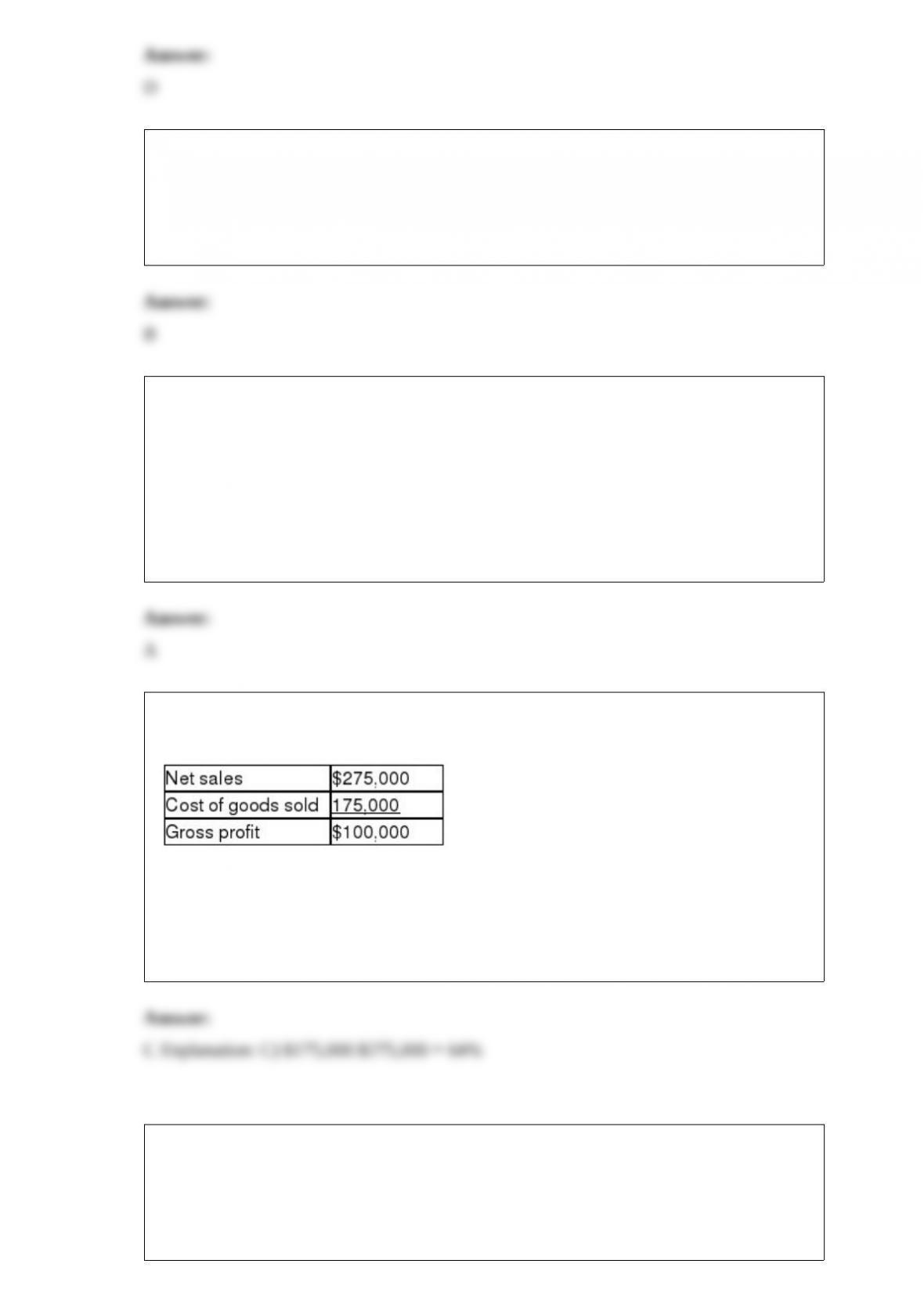
27) Mussa Corporation reports the following data:
In vertical analysis, the cost of goods sold percentage is closest to:
A) 36%
B) 57%
C) 64%
D) 175%
28) Journalize the adjusting entries needed on December 31, 2015 for Kaimann
Industries using the following data. Explanations are not required.
A.The balance in the Supplies account before adjustment is $5,000. A physical count
reveals $2,750 of supplies on hand at December 31.
B.A computer was purchased on January 1, 2015 for $15,000. The computer has a
useful life of 3 years and is depreciated using the straight-line method.
C.A one-year insurance policy costing $6,000 was purchased on November 1, 2015.
D.Employee salaries are owed for 4 days of a regular 5 day work week. Weekly payroll
is $15,000.
E.Unearned Maintenance Revenue has a balance of $22,000 before adjustment. Records
show that $14,000 of that amount has been earned by December 31.
29) Failure to record an accrued liability for wages earned by employees causes a
company to:
A) understate net income
B) overstate assets
C) overstate liabilities
D) overstate stockholders’ equity
30) The primary focus of horizontal analysis is:
A) percentage changes in line items from comparative financial statements
B) the balance sheet only
C) the amount of individual financial statement line items as a percentage of some
related total, such as total assets

D) the income statement only