
A company purchased $1,800 of merchandise on December 5. On December 7, it
returned $200 worth of merchandise. On December 8, it paid the balance in full, taking
a 2% discount. The amount of the cash paid on December 8 equals:
A.$200.
B.$1,564.
C.$1,568.
D.$1,600.
E.$1,800.
A CVP graph presents data on:
A.Profit and loss on a unit basis.
B.Profit, loss, and break-even on a total basis.
C.Profit, loss, and break-even on a unit basis.
D.Only profit and loss on a total basis.
E.Profit and loss on a budget and actual basis.
A source document that an employee uses to record the number of hours at work and
that is used to determine the total labor cost for each pay period is a:
A.Job cost sheet.
B.Hours-of-production sheet.
C.Time ticket.
D.Job order ticket.
E.Clock card.
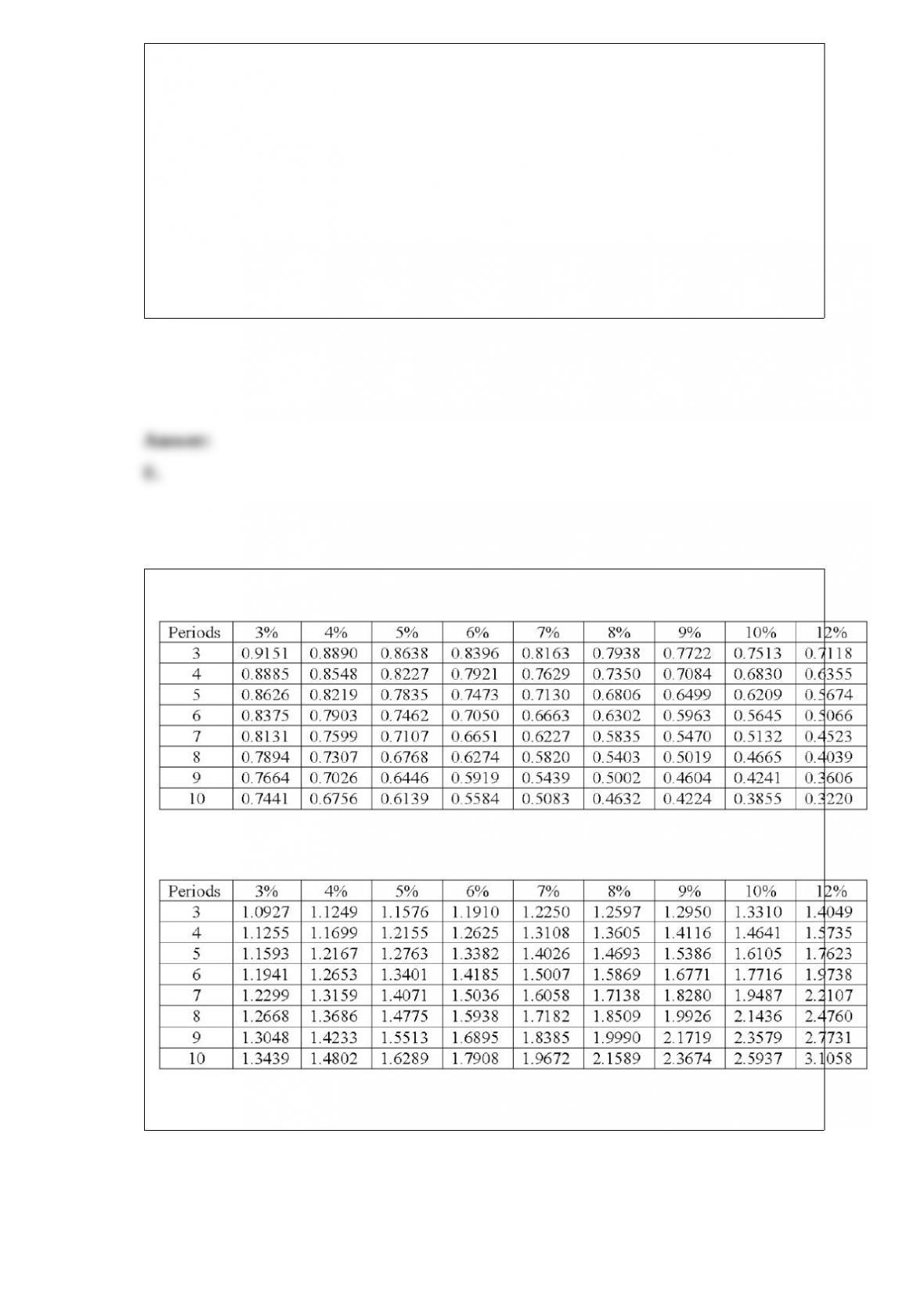
Present Value of 1
Future Value of 1
Present Value of an Annuity of 1
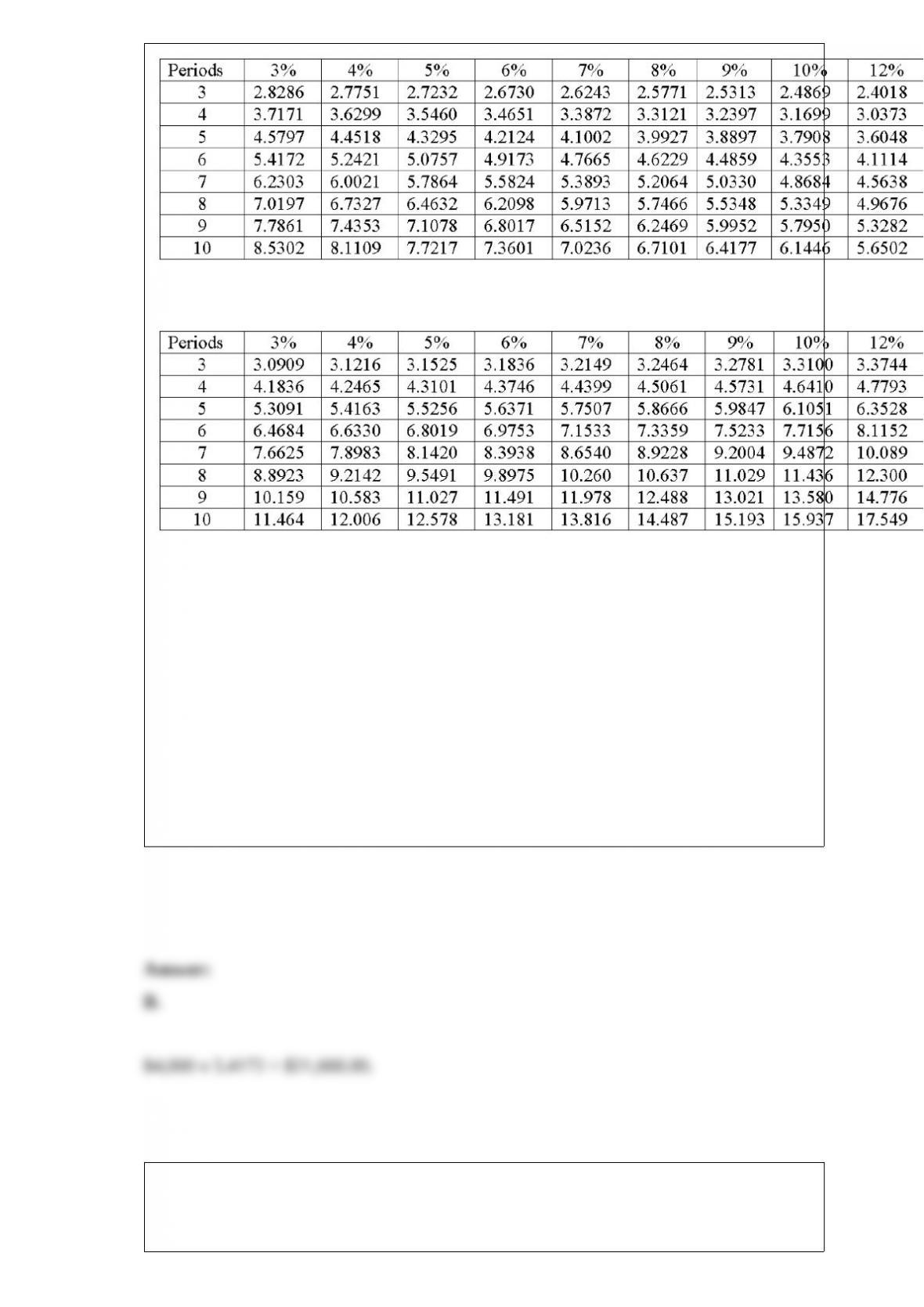
Future Value of an Annuity of 1
What amount can you borrow if you make six quarterly payments of $4,000 at a 12 %
annual rate of interest?
A.$24,838.00.
B.$21,668.80.
C.$31,049.00.
D.$40,000.00.
E.$44,800,00.
Assume that a company using a purchases journal made an error in totaling the journal’s
columns. The error should be discovered:

A.When the purchases journal is posted to the general ledger.
B.When the trial balance is prepared.
C.When the total of the schedule of accounts payable is compared with the balance of
the Accounts Payable account.
D.When the creditors receive their payments.
E.When the financial statements are prepared.
A company had a market price of $37.50 per share, earnings per share of $1.25, and
dividends per share of $0.40. Its price-earnings ratio equals:
A.3.1.
B.30.0.
C.93.8.
D.32.0.
E.3.3.
A basis for allocating the cost of a resource to an activity cost pool or allocating the cost
of an activity cost pool to a cost object is a(n):

A.Direct factor.
B.Indirect factor.
C.Cost driver.
D.Joint cost.
E.Opportunity cost.
Which department is often responsible for the direct materials price variance?
A.The accounting department.
B.The production department.
C.The purchasing department.
D.The finance department.
E.The budgeting department
The document that is an itemized statement of goods prepared by a vendor listing the
customer’s name, items sold, sales prices, and terms of the sale is the
A.Purchase requisition.
B.Purchase order.
C.Invoice.

D.Receiving report.
E.Invoice approval
Horizontal analysis:
A.Is a method used to evaluate changes in financial data across time.
B.Is also called vertical analysis.
C.Is the presentation of financial ratios.
D.Is a tool used to evaluate financial statement items relative to industry statistics.
E.Evaluates financial data across industries.
Patrick Corporation inadvertently produced 10,000 defective personal radios. The
radios cost $8 each to produce. A salvage company will purchase the defective units as
they are for $3 each. Patrick’s production manager reports that the defects can be
corrected for $5 per unit, enabling them to be sold at their regular market price of
$12.50. Patrick should:
A.Sell the radios for $3 per unit.
B.Correct the defects and sell the radios at the regular price.
C.Sell the radios as they are because repairing them will cause their total cost to exceed
their selling price.
D.Sell 5,000 radios to the salvage company and repair the remainder.
E.Throw the radios away.
Cash flows from interest received are reported in the statement of cash flows as part of:
A.Operating activities.
B.Financing activities.
C.Investing activities.
D.Noncash activities.
E.None of these. This is not reported in the statement of cash flows.
A company paid $0.75 in cash dividends per share. Its earnings per share is $3.50, and
its market price per share is $37.50. Its dividend yield equals:
A.11.7%.
B.2.0%.
C.10.9%.

D.21.4%.
E.46.7%.
The appropriate section in the statement of cash flows for reporting the issuance of
common stock for cash is:
A.Operating activities.
B.Financing activities.
C.Investing activities.
D.Schedule of noncash investing or financing activity.
E.None of these. This is not reported on the statement of cash flows.
In preparing financial budgets:
A.The budgeted balance sheet is usually prepared last.
B.The cash budget is usually not prepared.
C.The budgeted income statement is usually not prepared.
D.The capital expenditures budget is usually prepared last.

E.The merchandise purchases budget is the key budget.
Plant assets include:
A.Land.
B.Land improvements.
C.Buildings.
D.Machinery and equipment.
E.All of these.
If the assets of a business increased $89,000 during a period of time and its liabilities
increased $67,000 during the same period, equity in the business must have:
A.Increased $22,000.
B.Decreased $22,000.
C.Increased $89,000.
D.Decreased $156,000.
E.Increased $156,000.
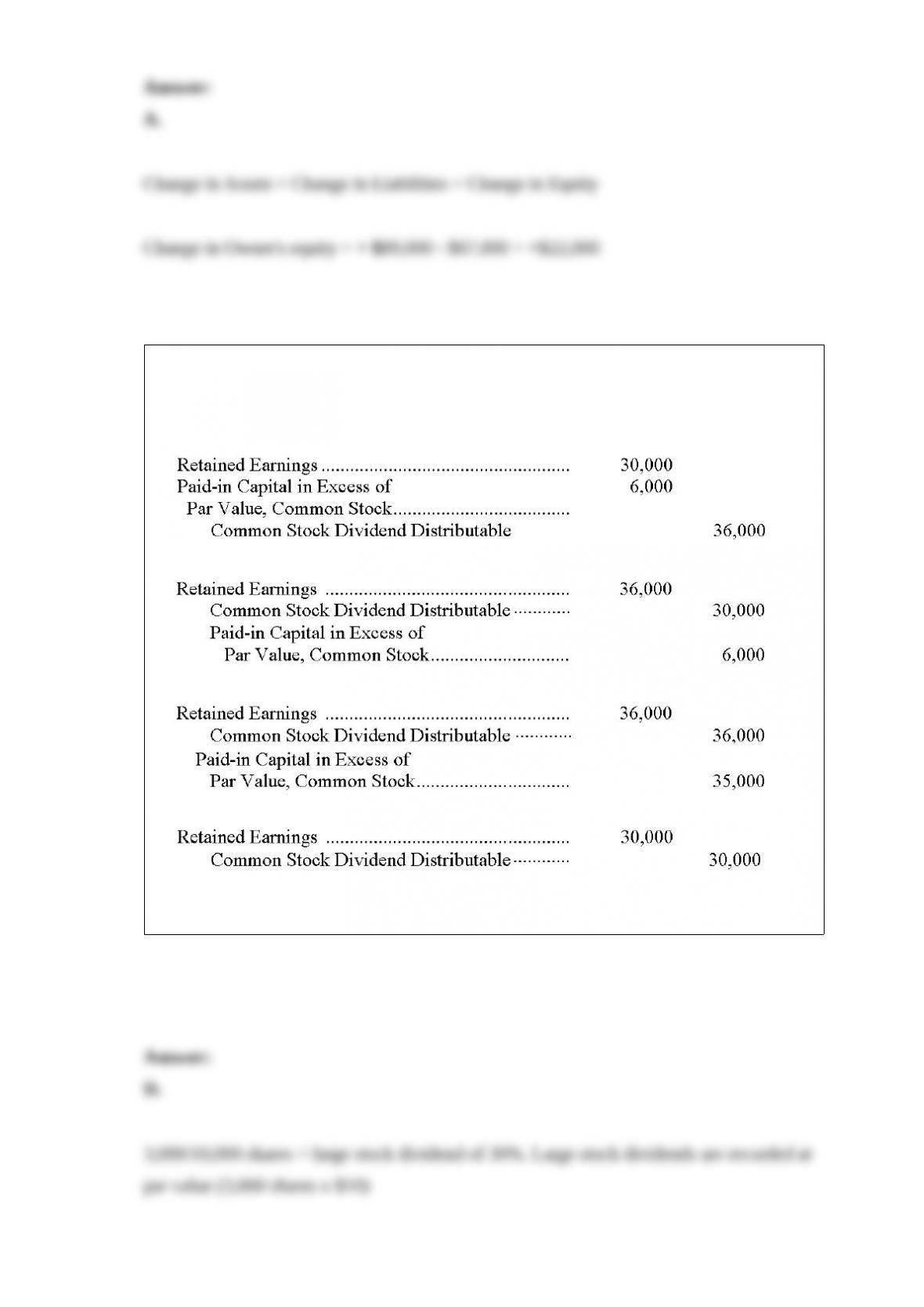
A corporation had 10,000 shares of $10 par value common stock outstanding when the
board of directors declared a stock dividend of 3,000 shares. At the time of the stock
dividend, the market value per share was $12. The entry to record this dividend is:
A.
B.
C.
D.
E.Stock dividends do not require journal entries.
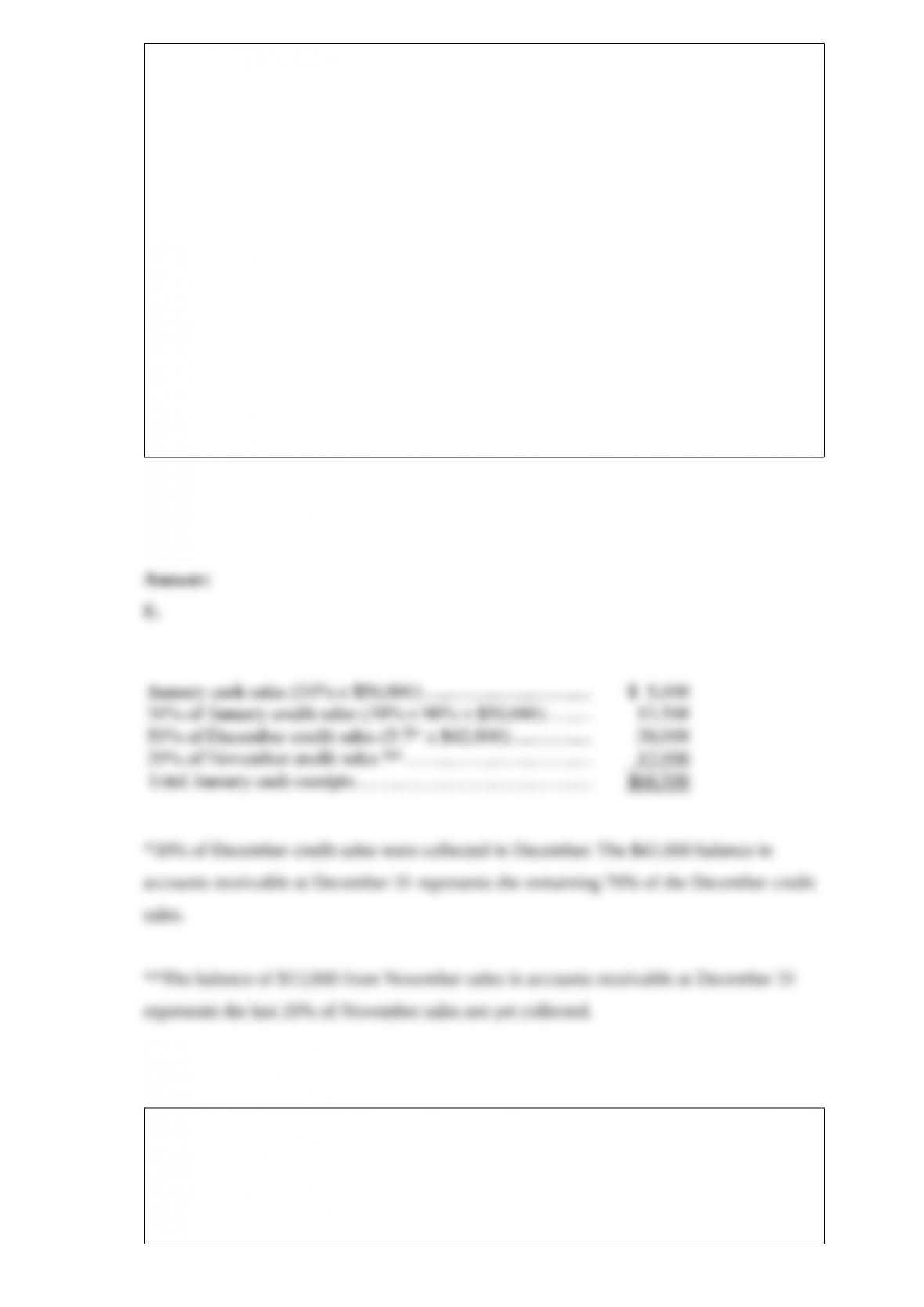
Berkley Co.’s sales are 10% for cash and 90% on credit. Credit sales are collected as
follows: 30% in the month of sale, 50% in the next month, and 20% in the following
month. On December 31, the accounts receivable balance includes $12,000 from
November sales and $42,000 from December sales.
Assume that total sales for January are budgeted to be $50,000. What are the expected
cash receipts for January from the current and past sales?
A.$18,500.
B.$51,500.
C.$51,900.
D.$55,500.
E.$60,500.
The modified accelerated cost recovery system (MACRS):
A.Is included in the U.S. federal income tax rules for depreciating assets.
B.Is an out-dated system that is no longer used by companies.

C.Is required for financial reporting.
D.Is identical to units of production depreciation.
E.All of these.
A company purchased a mineral deposit for $800,000. It expects this property to
produce 1,200,000 tons of ore and to have a salvage value of $50,000. In the current
year, the company mined and sold 90,000 tons of ore. Its depletion expense for the
current period equals:
A.$ 15,000.
B.$ 60,000.
C.$150,000.
D.$ 56,250.
E.$139,500.
The master budget includes:
A.Operating budgets.
B.A capital expenditures budget.

C.A budgeted income statement.
D.A cash budget.
E.All of these.
Match each of the following terms with the appropriate definitions.
1)(i) Price-earnings ratio
2)(f) Proxy
3)(g) Stock split
4) (e) Date of record
5)(d) Appropriated retained earnings
6)(b) Reverse stock split
7)(a) Dividend yield
8)(j) Transfer agent
9)(h) Basic earnings per share
10)(c) Small stock dividend
A) A ratio of the annual amount of cash dividends distributed to common shareholders
relative to the stock’s market value.
B) Occurs when a corporation calls its stock and replaces each share with less than one
new share; increases both the market value per share and the par or stated value per
share.
C)A stock dividend that is 25% or less of the previously outstanding shares.
D) Retained earnings reported separately as a way to inform stockholders of funding
needs.
E)The date specified by directors of a corporation for identifying stockholders to

receive dividends.
F)A document that gives a designated agent the right to vote a stockholder’s stock.
G) Occurs when a corporation calls in its stock and replaces each share with more than
one new share; decreases both the market value per share and the par or stated value per
share.
H)Net income less preferred dividends divided by weighted-average common shares
outstanding.
I) The ratio of a company’s current market value per share to its earnings per share.
J)A bank or trust company that assists with purchases and sales of shares by receiving
and issuing certificates as necessary.
Inadequacy refers to:
A.The insufficient capacity of a company’s plant assets to meet the company’s growing
production demands.
B.An asset that is worn out.
C.An asset that is no longer useful in producing goods and services.
D.The condition where the salvage value is too small to replace the asset.
E.The condition where the asset’s salvage value is less than its cost.

An example of a transaction that must be disclosed as a noncash investing and
financing activity includes:
A.The retirement of debt by issuance of equity.
B.The purchase of long-term assets financed by a cash down payment and a note
payable to the seller for the balance.
C.The leasing of assets in a transaction that qualifies as a capital lease.
D.The purchase of noncash assets in exchange for equity or debt securities.
E.All of these.
Which of the following statements is incorrect?
A.Permanent accounts is another name for nominal accounts.
B.Temporary accounts carry a zero balance at the beginning of each accounting period.
C.The Income Summary account is a temporary account.
D.Real accounts remain open as long as the asset, liability, or equity items recorded in
the accounts continue in existence.
E.The closing process applies only to temporary accounts.
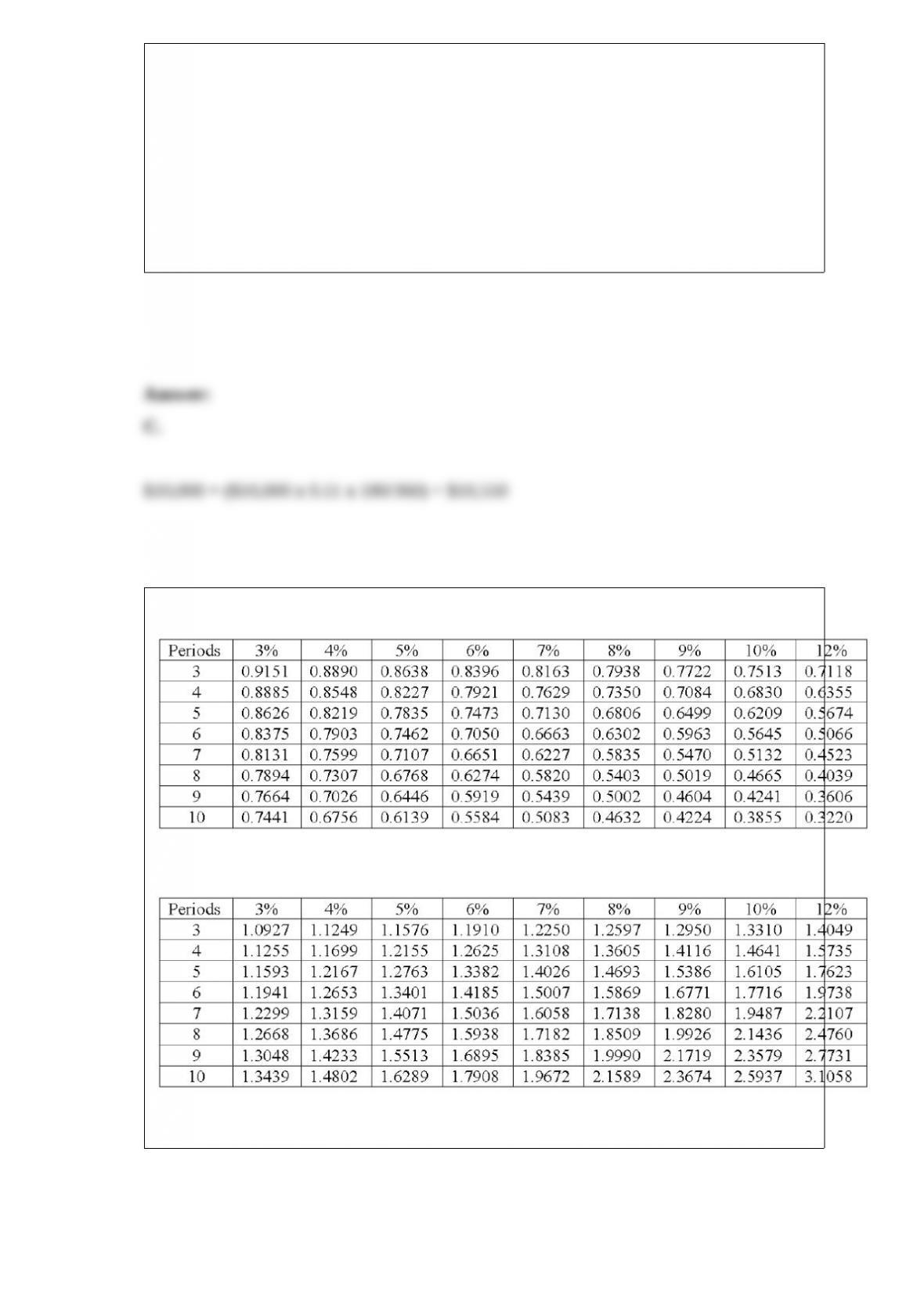
A company borrowed $10,000 by signing a 180-day promissory note at 11%. The
maturity value of the note is:
A.$12,050
B.$12,275
C.$10,550
D.$12,825
E.$13,100
Present Value of 1
Future Value of 1
Present Value of an Annuity of 1
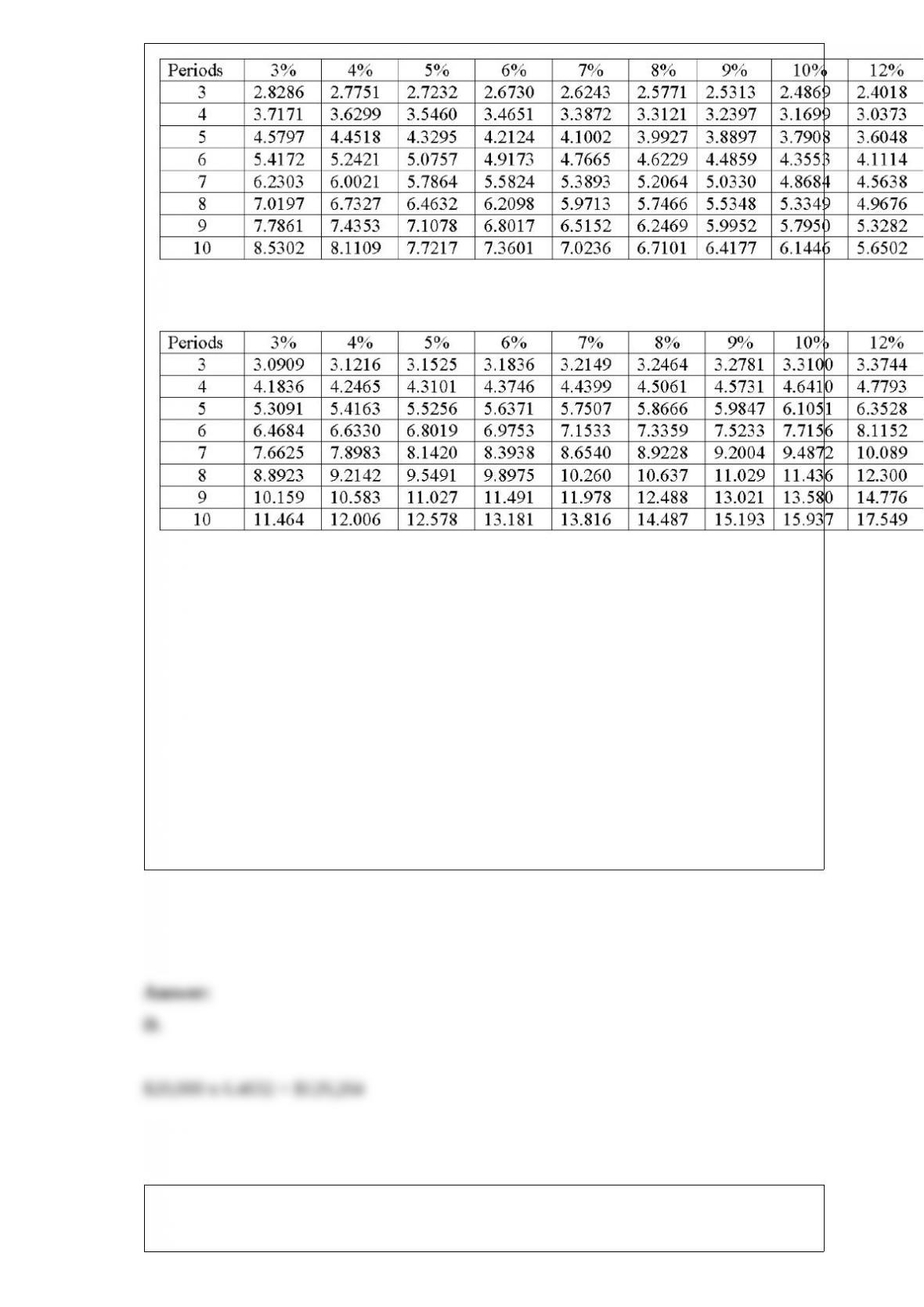
Future Value of an Annuity of 1
A company is considering an investment that will return $20,000 semiannually at the
end of each semiannual period for 4 years. If the company requires an annual return of
10%, what is the maximum amount it is willing to pay for this investment?
A.Not more than $ 63,398.
B.Not more than $126,796.
C.Not more than $ 80,000.
D.Not more than $129,264.
E.Not more than $160,000.
Generally accepted accounting principles require that the inventory of a company be
reported at:

A.Market value.
B.Historical cost.
C.Lower of cost or market.
D.Replacement cost.
E.Retail value.
Which of the following groups of accounts are not balance sheet accounts?
A.Assets.
B.Liabilities.
C.Revenues.
D.Equity accounts.
E.All of these are balance sheet accounts.
Unearned revenues are:
A.Revenues that have been earned and received in cash.
B.Revenues that have been earned but not yet collected in cash.
C.Liabilities created when a customer pays in advance for products or services before

the revenue is earned.
D.Recorded as an asset in the accounting records.
E.Increases to owners’ capital.
Materials that are used in support of the production process but are not clearly
identified with units or batches of product are called:
A.Secondary materials.
B.General materials.
C.Direct materials.
D.Indirect materials.
E.Materials inventory.
A pension plan
A.Is a contractual agreement between an employer and its employees in which the
employer provides benefits to employees after they retire.
B.Can be underfunded if the accumulated benefit obligation is more than the plan
assets.
C.Can include a plan administrator who receives payments from the employer, invests
them in pension assets, and makes benefit payments to pension recipients.

D.Can be a defined benefit plan in which future benefits are set, but the employer’s
contributions vary depending on assumptions about future pension assets and liabilities.
E.All of these.
Liquidity problems are likely to exist when a company’s acid-test ratio:
A.Is less than the current ratio.
B.Is 1 to 1.
C.Is higher than 1 to 1.
D.Is substantially lower than 1 to 1.
E.Is higher than the current ratio.
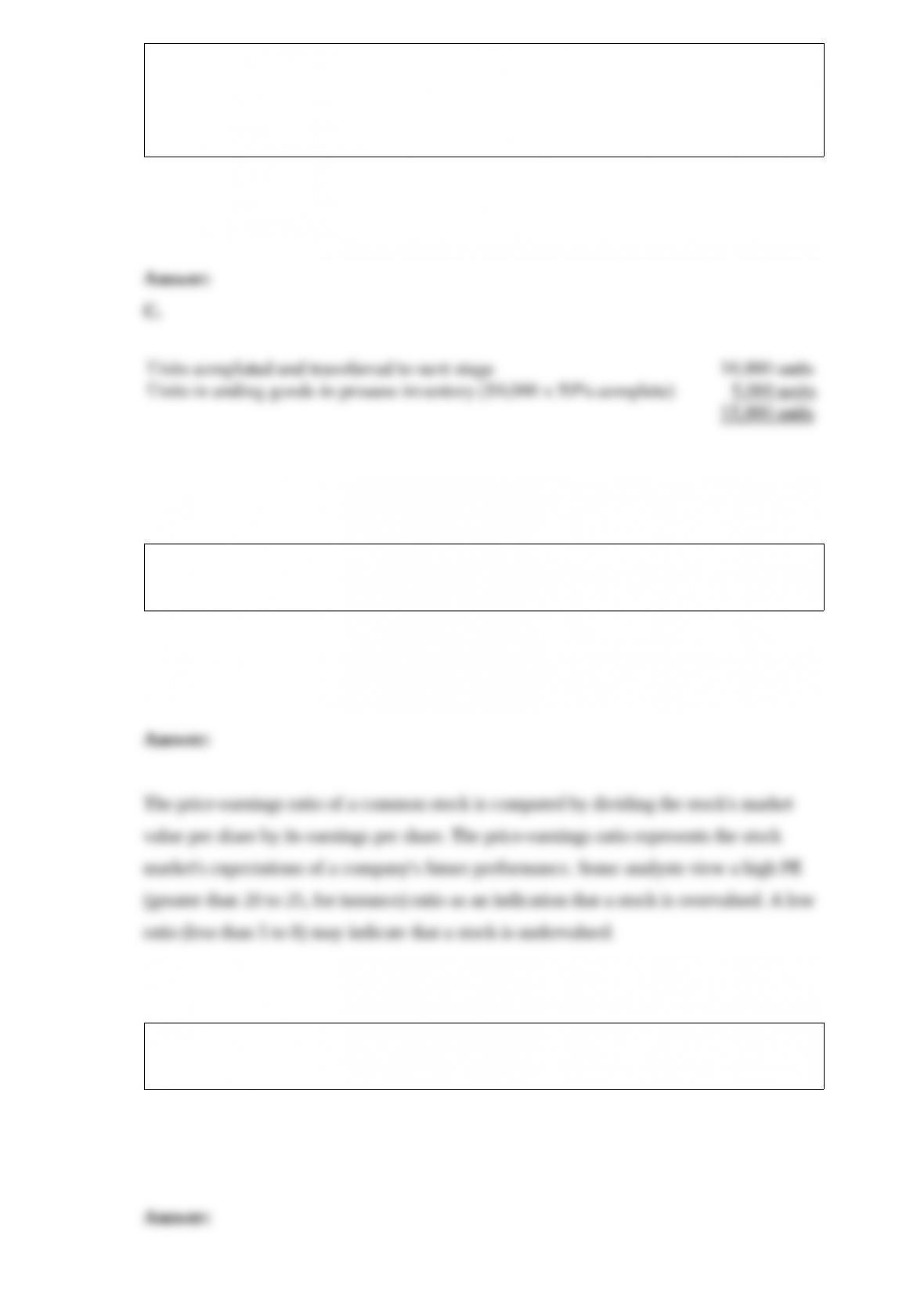
A production department’s output for the most recent month consisted of 10,000 units
completed and transferred to the next stage of production and 10,000 units in ending
goods in process inventory. The units in ending goods in process inventory were 50%
complete with respect to both direct materials and conversion costs. There were 1,000
units in beginning goods in process inventory, and they were 70% complete with
respect to both direct materials and conversion costs. Calculate the equivalent units of
production for the month, assuming the company uses the weighted average method.
A.10,000 units.
B.10,300 units.
C.15,000 units.
D.15,300 units.
E.10,700 units.
Explain how to calculate the price-earnings ratio and describe how it is used in analysis
of a company’s financial condition and performance.
Briefly describe the time value of money. Why is the time value of money important in
capital budgeting?
Explain how to compute dividend yield and discuss how it is used in analysis of a
company’s financial condition.
A ___________ inventory system updates the accounting record for inventory only at
the end of a period.
Thomas Company has total fixed costs of $360,000 and variable costs of $14 per unit.
If the unit sales price is reduced from $24 to $20 and advertising is increased by
$10,000, sales will increase from 40,000 to 65,000 units. Should Thomas reduce it’s per
unit sales price and pay for the additional advertising? (Support your answer with
calculations.)
Discuss how technology based information systems affect accounting.
____________ is a method of analysis used to evaluate individual financial statement
items or groups of items in terms of a specific base amount.
There are at least three different methods to estimate costs. These methods are the
_______________, _______________, and _______________ methods.
Discuss how the principles of internal control apply to cash receipts.
What are the types of adjusting entries used for prepaid expenses, depreciation and
unearned revenues?
The ______________ reports revenues earned and expenses incurred by a business over
a period of time.
The __________________ principle requires that the benefits from an activity in an
accounting information system outweigh the costs of that activity.