The cost of selling goods and administrative costs are reported on the income statement
as expenses when inventory is sold.
Activities that affect a company’s investments in assets other than current operating
assets are called financing activities.
In an activity-based costing system, the benefits of defining more detailed activities will
always outweigh the effort needed to monitor activity performance, and the resulting
potential for error.
When using a standard costing system, the direct materials price variance is recorded at
the time direct materials are transferred to the production floor.
Land is the ultimate liquid asset.
The net present value approach to capital budgeting requires you to calculate the
present value of each cash flow and then add those present values to arrive at the capital
project’s net present value.
The process of classifying all the costs incurred in the production of a product is
referred to as absorption costing.
If practical standards are used, the standard quantity for direct materials should not
include allowances for waste and spoilage in the normal course of manufacturing.
Standard setting is not an exact science, but there are some hard and fast criterion for
proving one standard right and the other one wrong.
An application base is the amount of overhead to be allocated to various jobs.

The direct labor budget calculates
a. The number of direct labor hours required to meet the units in the sales budget.
b. The number of direct and indirect labor hours required to meet the units in the sales
budget.
c. The number of direct labor hours required to meet the budgeted level of production.
d. The number of direct and indirect labor hours required to meet the budgeted level of
production.
At the breakeven point, which of the following is not true?
a. Sales revenue is equal to total costs.
b. Contribution margin is equal to total variable costs.
c. Contribution margin is equal to total fixed costs.
d. Operating income equals zero.

In evaluating the relevance of specific information, the decision maker must know
a. All relevant and irrelevant information
b. The context of the decision.
c. All relevant and irrelevant information and the context of the decision.
d. None of these answer choices are correct.
A stream of equal cash flows received at set time intervals is called a (an)
a. Annuity
b. Present cash flow
c. Discounted cash flow
d. None of these answer choices are correct
Match the following terms to the appropriate statement by placing the letter to the left
of each statement.
a. Committed fixed cost g. Mixed cost
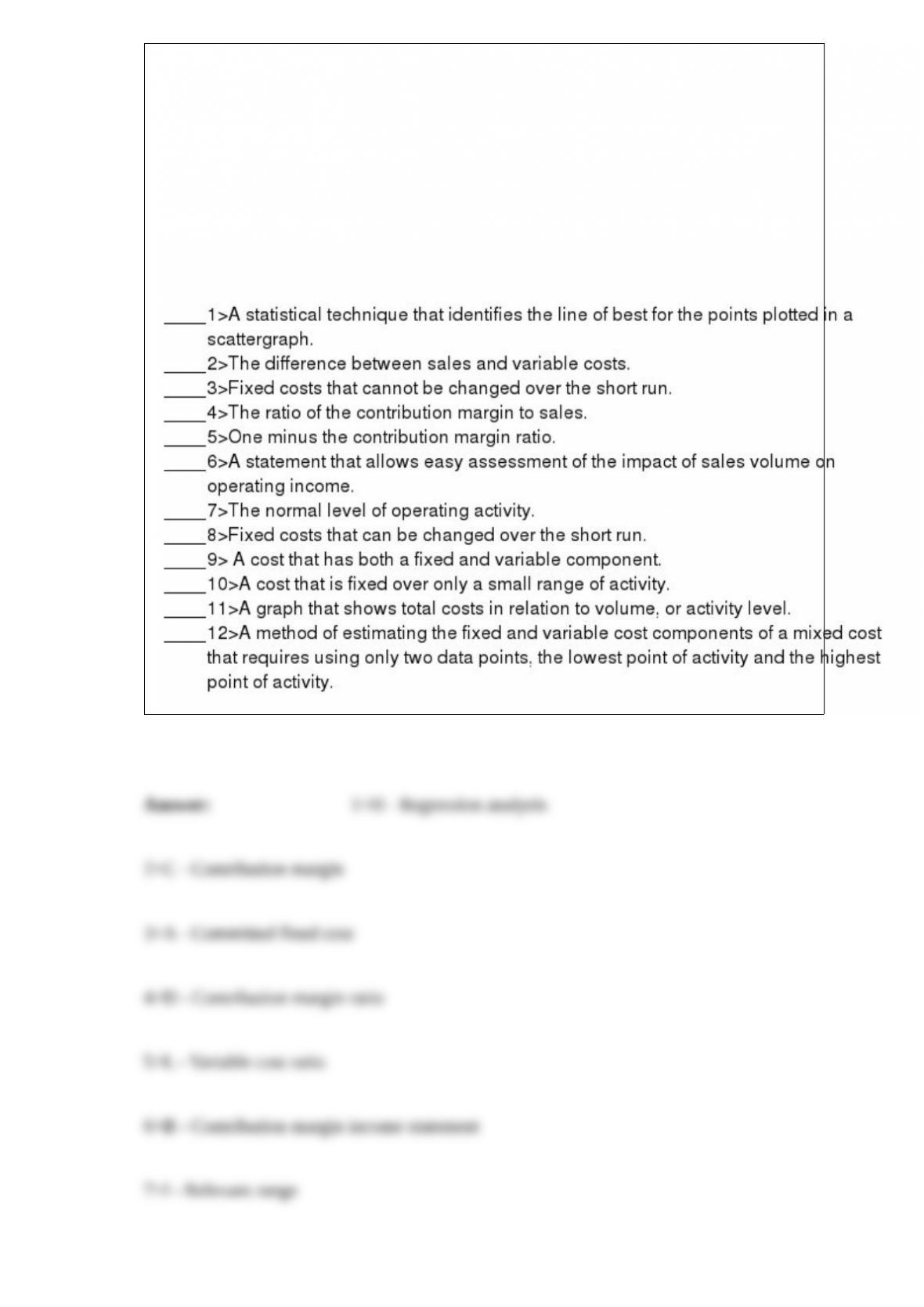
b. Contribution format income statement h. Regression analysis
c. Contribution margin i. Relevant range
d. Contribution margin ratio j. Scattergraph
e. Discretionary fixed cost k. Step cost
f. High-low method l. Variable cost ratio

Hartland Horticulture provides and maintains live plants in office buildings. The
company’s 850 customers are charged $30 per month for this service, which includes
weekly watering visits. The variable cost to service a customer’s location is $18 per
month. The company incurs $2,000 each month to maintain its fleet of four service vans
and $3,000 each month in salaries. Hartland pays a bookkeeping service $2 per
customer each month to handle all invoicing and accounting functions.
Required:
a.Prepare Hartland’s contribution format income statement for the month.
b.What is the expected monthly operating income if 150 customers are added?
c.Mr. Hartland is exploring options to reduce the annual bookkeeping costs.
Option 1:’‚Renegotiate the current contract with the bookkeeping service to pay a flat
fee of $10,200 per year plus $1 per customer per month.
Option 2:’‚Hire a part-time bookkeeper for $18,000 per year to handle the invoicing and
simple accounting. He would need to pay $5,000 per year to have taxes and year-end
financial statements prepared.
Compare the current bookkeeping cost with the two options at customer levels of 850,
1,000, and 1,100.
d.Besides the bookkeeping costs incurred, what should Mr. Hartland consider before he
makes a change in bookkeeping services?
Moving the production of goods from within the organization to a provider outside the
organization is referred to as
a. Transfer pricing.
b. Product diffusion.
c. Segment slicing.
d. Outsourcing.

Traceable fixed costs are the responsibility of
a. Top management only.
b. Managers who control them.
c. Investment center managers only.
d. None of these answer choices are correct.
Which of the following is not a correct statement relating to the balanced scorecard?
a.It was developed in the early 1990s by David Norton and Robert Kaplan.
b.It is a collection of performance measures that track an organization ‘s progress
toward achieving its goals.
c.The selection of performance measures used is driven by the organization ‘s network
of facilities used to produce and deliver its product.
d.It uses both financial and non-financial performance measures.

When a manager is investigating and understanding the cause of the variable overhead
spending variance, he will most likely want to talk to the
a. Controller.
b. Production manager.
c. Purchasing manager.
d. Design engineer.
Which of the following is not a product cost?
a. Direct material
b. Direct labor
c. Selling expenses
d. Manufacturing overhead
A problem with the current and acid test ratios is that, although they provide
information about liquidity, they do not
a. Indicate the dollar amounts of the differences.
b. Indicate the underlying quality of the current assets.
c. Include all the current assets.
d. Include all the liabilities.
Which of the following uses interest expense in its computations?
a. Net present value
b. Internal rate of return
c. Both net present value and internal rate of return
d. Neither net present value nor internal rate of return
Assume total fixed costs of $160,000, variable costs per unit of $6, and contribution
margin per unit of $4. What are the sales dollars required to meet a target operating
income of $50,000?
a. $525,000
b. $315,000
c. $210,000
d. $160,000
Monroe Corporation reported a decrease in inventories of $30,000 and a decrease in
accounts payable of $15,000. Cost of goods sold totaled $110,000. Monroe uses the
direct method to determine the net cash provided by operating activities on the
statement of cash flows. What is the cost of goods sold adjusted to a cash basis?
a. $65,000
b. $105,000
c. $95,000
d. $155,000
When a product is sold to a customer, which of the following inventory accounts is
increased or decreased?
a. Work in Process is decreased and Finished Goods is increased
b. Finished Goods is increased and Cost of Goods Sold is decreased
c. Finished Goods is decreased and Cost of Goods Sold is increased
d. Raw Materials is decreased and Cost of Goods Sold is increased.

Which of the following items is not included in the decision to purchase a new capital
asset to replace an old one?
a. The price of the new machine
b. Shipping
c. The original purchase price of the old machine
d. Installation costs
When using a standard costing system, which of the following should be recorded when
fixed overhead is applied during the period?
a. Debit manufacturing overhead for the actual overhead costs and credit work in
process inventory using a predetermined fixed overhead rate
b. Debit work in process inventory for the actual overhead costs and credit
manufacturing overhead using a predetermined fixed overhead rate
c. Credit work in process inventory for the actual overhead and debit manufacturing
overhead using a predetermined fixed overhead rate
d. Credit manufacturing overhead and debit work in process inventory for the standard
quantity of the application base allowed using a predetermined fixed overhead rate
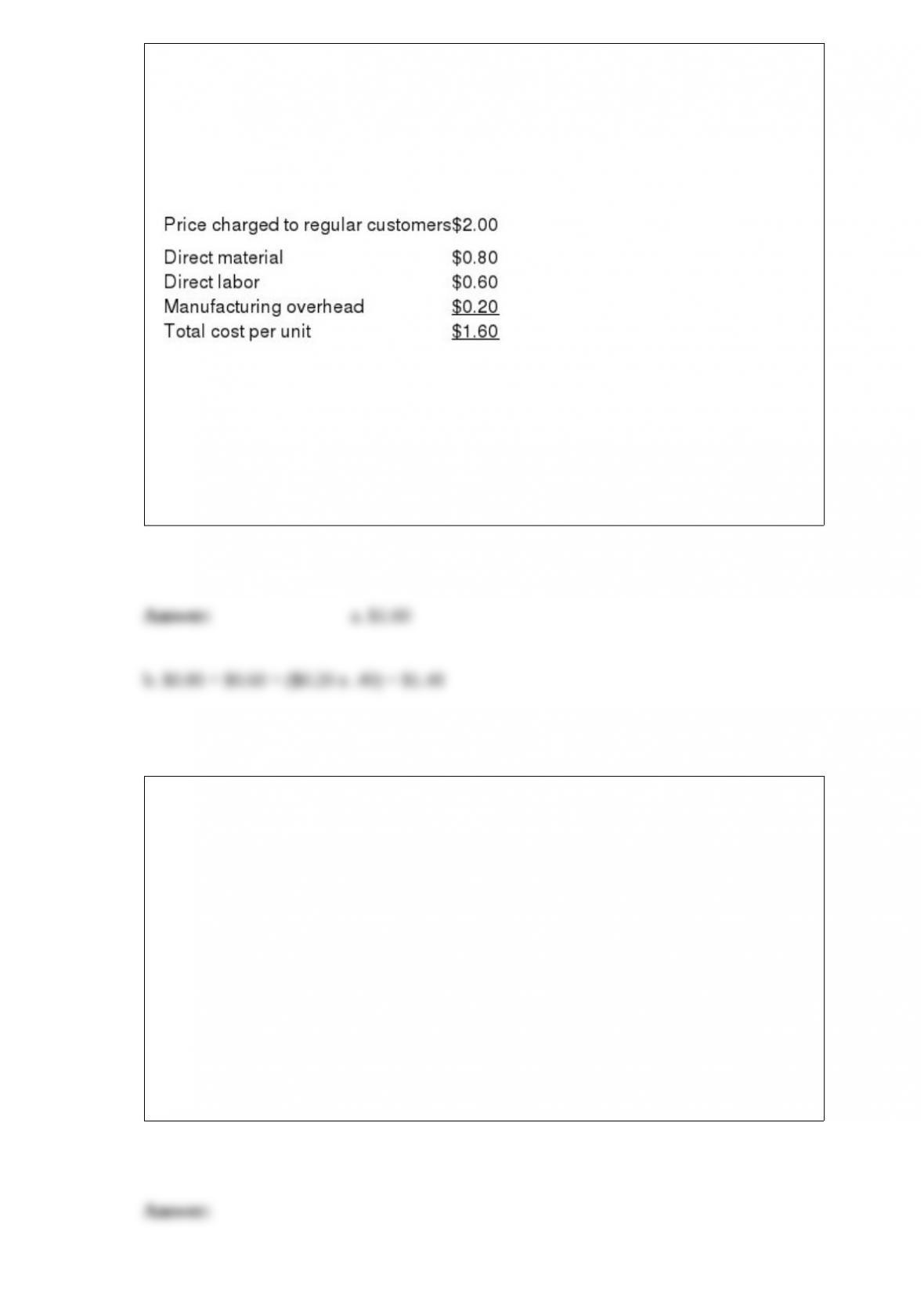
Lakeside Industries ‘ operates as a decentralized organization. Its fishing gear division
manufactures fishing lures. The fiberglass division manufactures one component
needed by the fishing gear division. The fishing gear division has been purchasing the
component from an outside supplier, but top management has suggested that all
purchases be made from another Lakeside division if possible. Detailed unit cost for the
fiberglass component needed to make lures is given below:
The manufacturing overhead is 60% fixed and 40% variable.
Required:
a. What is the transfer price if Lakeside uses the cost-based price?
b. What is the minimum transfer price?
Brandon, Inc. had a $1,000 decrease in accounts receivable during the year. Which of
the following would appear on the statement of cash flows prepared using the indirect
method?
a. Add $1,000 to net income in order to arrive at net cash provided by operating
activities
b. Deduct $1,000 from net income in order to arrive at net cash provided by operating
activities
c. Deduct $1,000 to arrive at net cash flows from investing activities
d. Do not include the $1,000 in the statement of cash flows, but show it in an
accompanying schedule of non-cash transactions
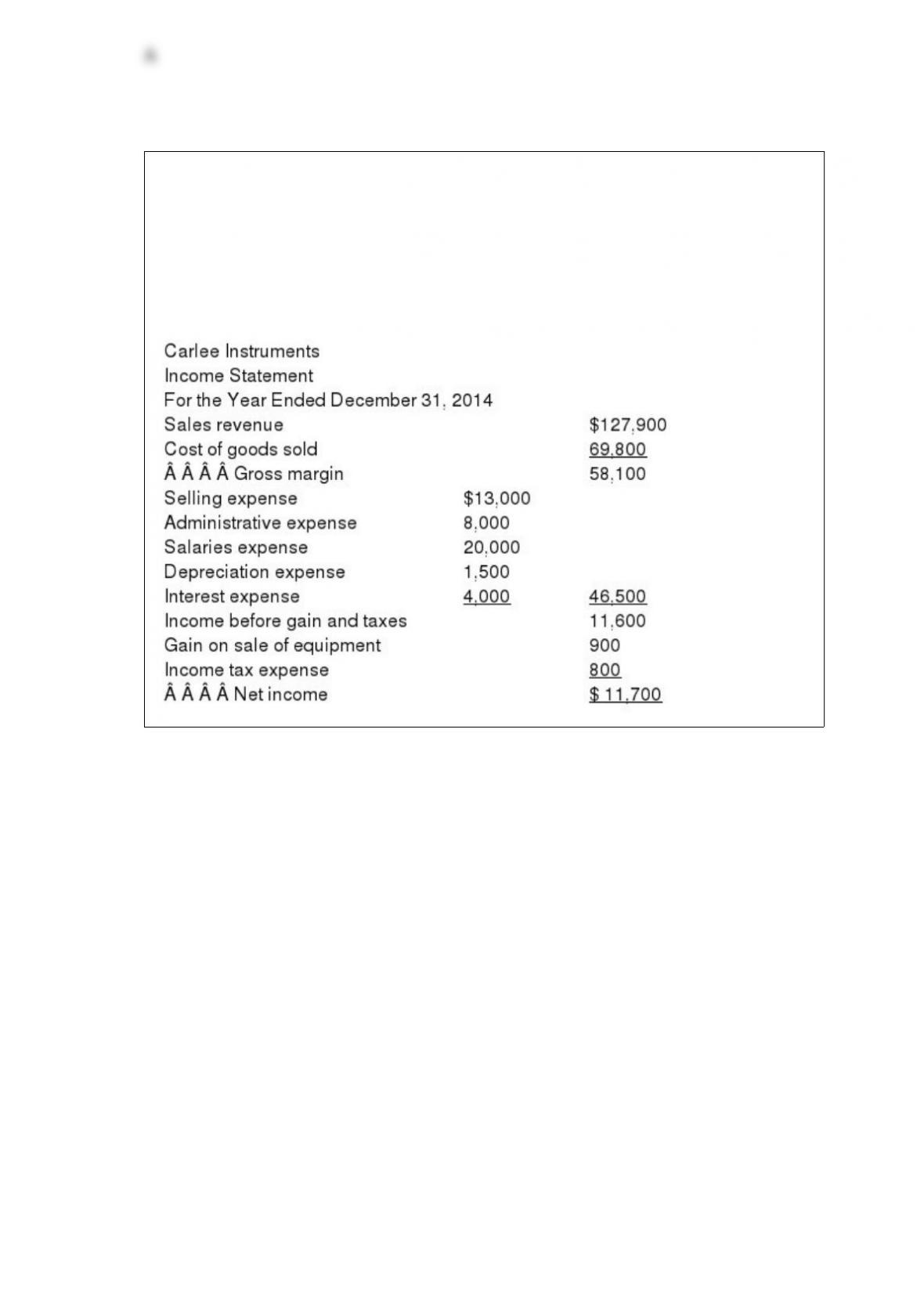
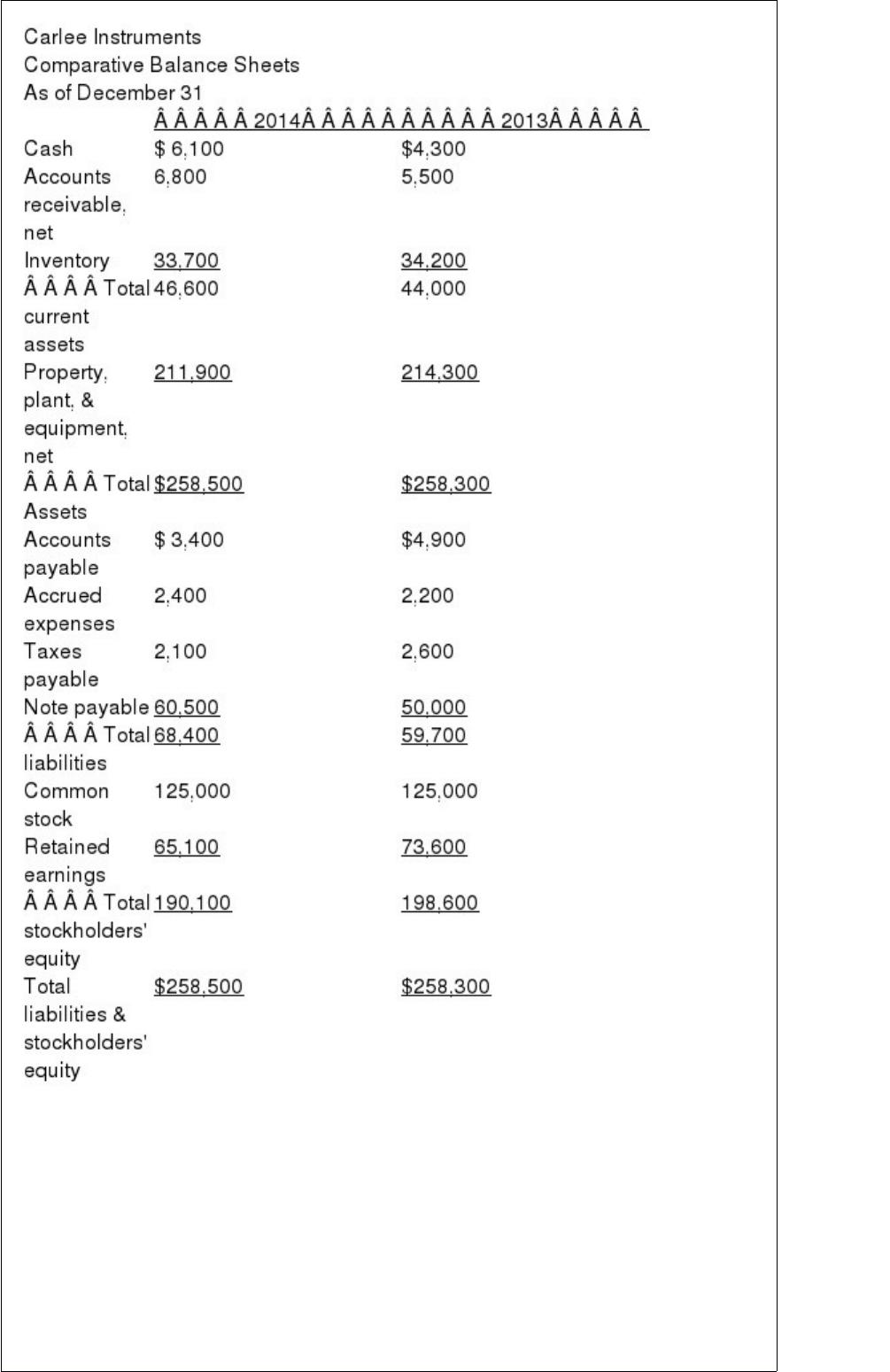
Alma Ortiz prepared Carlee Instruments’ balance sheet and income statement for 2014.
Before she could complete the statement of cash flows, she had to leave town to attend
to a family emergency. Because the full set of statements must be provided to the
auditors today, Carlee’s president, Mike Lymon, has asked you to prepare the statement
of cash flows. Lymon has provided you with the balance sheet and income statement
that Ortiz prepared, as well as some notes she made:
ï€ï€ Equipment with an original cost of $35,000 was sold for $20,300. The book value
of the equipment was $19,400.
ï€ï€ On June 1, 2014, the company purchased new equipment for cash at a cost of
$18,500.
ï€ï€ At the end of the year the company issued notes payable for $10,500 cash. The note
will mature on December 31, 2018.
ï€ï€ The company paid $20,200 in cash dividends for the year.
Required:
Using the indirect method, prepare Carlee Instruments’ statement of cash flows for
2014.
One way to implement activity-based management is to take a fresh look at the
activities performed in an organization to see if a business process can be changed so as
to reduce costs. As part of a team responsible for implementing an activity-based
costing system, you are to investigate business processes for your company and
specifically investigate processes in products that are not profitable. You have been
introduced to the terms Process Improvement and Business Process Reengineering.
Required:
Define activity-based management and list four ways managers use activity-based
costing information and define process improvement and business process engineering.
Explain the difference between traditional product costs and activity-based product
costs.
Answer the following questions related to measures of meeting delivery expectations.
1> What is delivery cycle time?
2> What is manufacturing cycle time?
3> How is manufacturing cycle efficiency calculated and what ratio would perfect
efficiency yield?
Assume sales revenue of $50,000, variable costs of $22,000, and fixed costs of $25,000.
Prepare a contribution format income statement.