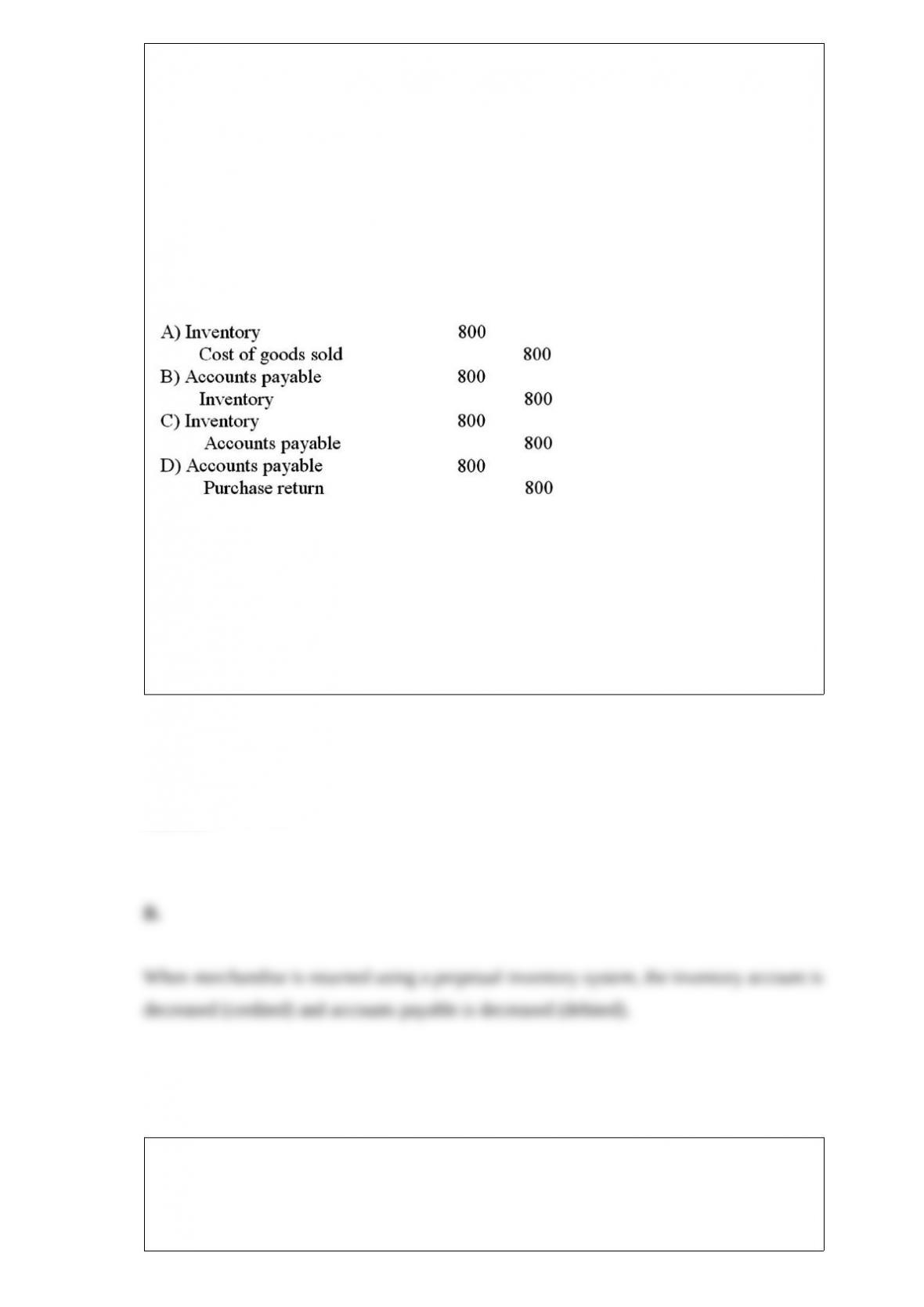
E. Flynn Company uses a perpetual inventory system and had the following
transactions during November:
November 6: Purchased $5,800 of inventory on account, terms 2/10, n/30.
November 8: Returned $800 of defective units and received full credit.
November 15: Paid the amount due.
Use the information above to answer the following question. What is the journal entry
to be recorded by E. Flynn Company on November 8?
A. Option A
B. Option B
C. Option C
D. Option D
Answer:
Choose the appropriate term to match the term and the definition. Not all definitions
will be used.
Term:

_____ 1/ Corporation
_____ 2/ Par value
_____ 3/ Growth investment (stock)
_____ 4/ LLC
_____ 5/ Current dividend preference
_____ 6/ Partnership
_____ 7/ Market value
_____ 8/ Income investment (stock)
_____ 9/ Cumulative dividend preference
_____ 10/ Sole proprietorship
Definition:
A. When preferred stockholders are paid dividends before other stockholders.
B. When stockholders prefer to receive dividends at the end of the year rather than each
quarter.
C. The current stock price.
D. A company that issues stock on one of the major stock exchanges.
E. An unincorporated business that is owned by a single individual.
F. A stock that is currently selling for its original issue price.
G. A company that has a separate legal identity from its owners.
H. When companies are obligated to pay preferred stockholders past dividends not yet
distributed before paying dividends to owners of common stock.
I. The nominal value per share of stock set by the company’s charter.
J. Stock of companies that tend to reinvest earnings to provide for greater future sales
and profits.
K. A company that is like a partnership in nature except that it has limited liability.
L. Stock of companies that tend to pay relatively high dividends compared to the stock
price.
M. An unincorporated business owned by two or more individuals.
Answer:
If a company’s cost of goods sold is $158,000 for the period, beginning and ending
inventory balances are $18,000 and $13,000, respectively, and the beginning and ending
accounts payable balances are $19,000 and $7,500, respectively, the cash paid to
suppliers is:
A. $157,000
B. $163,500
C. $164,500
D. $151,500
Answer:
Company A uses an accelerated depreciation method while Company B uses the
straight-line method. All other things being equal, during the first few years of the
asset’s use, Company B will show which of the following compared to Company A?
A. A smaller fixed asset turnover ratio and a smaller gain on asset disposal.
B. A larger fixed asset turnover ratio and a larger gain on asset disposal.
C. A smaller fixed asset turnover ratio and a larger gain on asset disposal.
D. A larger fixed asset turnover ratio and a smaller gain on asset disposal.
Answer:
Which of the following financial factors is most likely to be a cause of a going-concern
problem?
A. Return on assets is substantially lower than return on equity.
B. Inventory turnover is lower than the industry average.
C. The current ratio exceeds the quick ratio.
D. Fluctuating net income growth.
Answer:
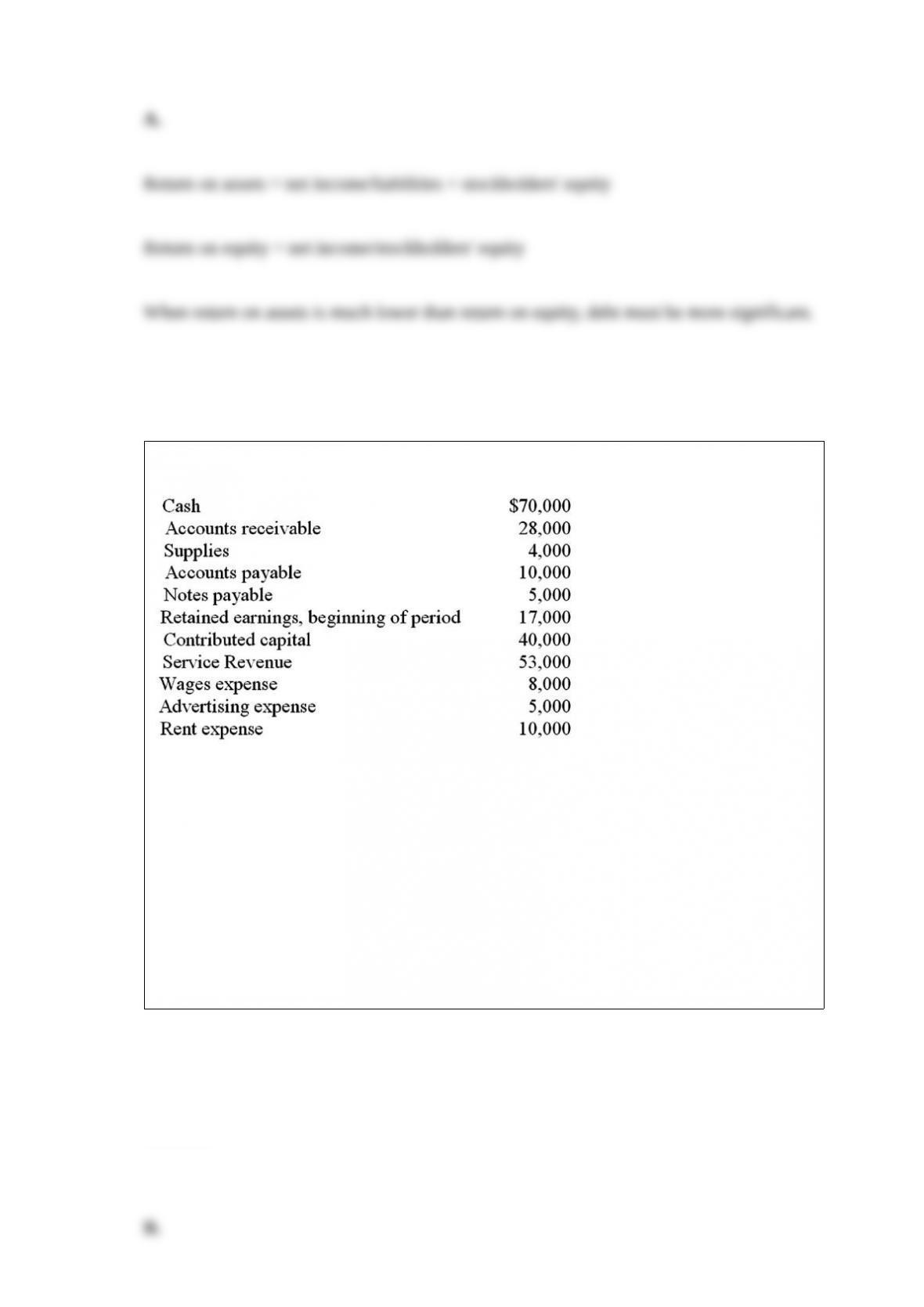
A company’s financial records at the end of the year were as follows:
What is the amount of total assets to be reported on the balance sheet at the end of the
year?
A. $112,000
B. $102,000
C. $119,000
D. $155,000
Answer:
A fixed asset turnover ratio of 4.3 indicates that for every
A. $1 in sales revenue, the firm acquired $4.30 of assets.
B. $1 in fixed assets, the firm earned $4.30 of net income.
C. $1 in assets, the firm paid $4.30 of expenses.
D. $1 in fixed assets, the firm generated $4.30 of net sales.
Answer:
A creditor might look at a company’s financial statements to determine if the:
A. company is likely to have the resources to repay its debts.
B. company’s stock is likely to fall, signaling a good time to sell.
C. company’s stock is likely to rise, signaling a good time to buy.
D. company pays a dividend.
Answer:
An adjustment to ending inventory under the lower of cost or market (LCM) rule would
be least likely to be recorded by a company that sells:
A. a household staple like laundry detergent.
B. a fad product like bathing suits.
C. seasonal items like snow blowers.
D. high-tech goods like Personal Digital Assistants.
Answer:
Depreciation is added back to net income in a statement of cash flows prepared using
the indirect method because it:
A. reduces net income but not cash.
B. is a cash inflow.
C. is a revenue.
D. is a valuation concept.
Answer:
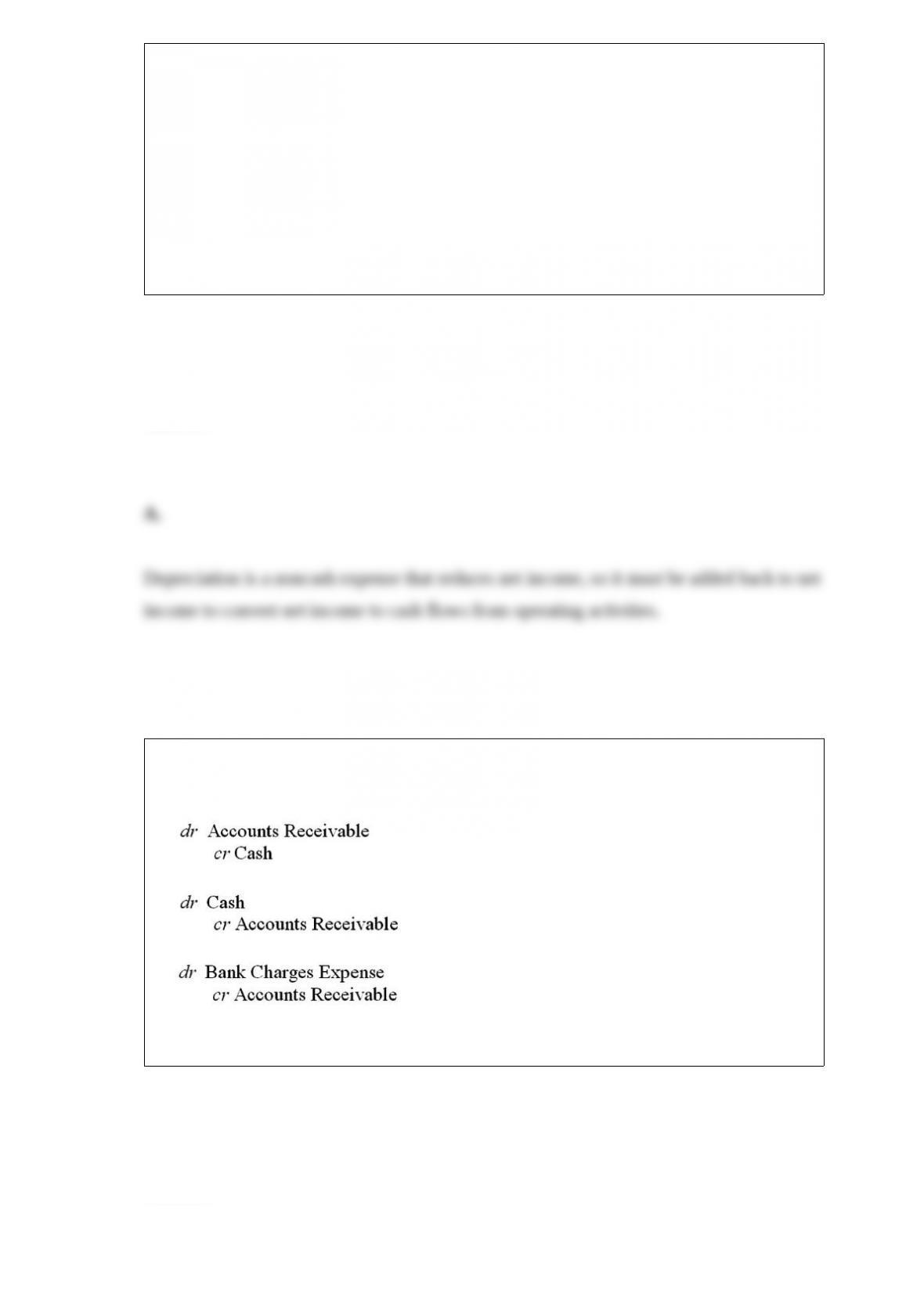
Notification by the bank that a customer’s deposited check was returned NSF requires
that the company make the following adjusting journal entry:
A.
B.
C.
D. No adjusting entry is necessary.
Answer:
An investor might look at a company’s financial statements to determine all of the
following, except:
A. if the company’s earnings are rising or falling.
B. if the company pays a dividend.
C. if the company has positive cash flow.
D. if the company’s owners are financially sound.
Answer:
A company sells a bond with a face value of $10,000 and receives a premium of $800.
Using the Simplified Approach (Effective-interest Method), the company would make
the following journal entry:
A. Debit Cash for $10,800 and credit Bonds Payable, Net for $10,800.
B. Debit Cash for $10,800, credit Bonds Payable, net for $10,000, and credit Premium
on Bond Payable for $800.
C. Debit Cash for $10,000, debit Interest Expense for $800, credit Bonds Payable, net
for $10,000, and credit Premium on Bonds Payable for $800.
D. Debit Cash for $10,000, debit Interest Expense for $800, credit Bonds Payable for
$10,000 and credit Premium on Bonds Payable for $800.
Answer:
Your company orders and receives supplies in January, pays for them in February,
provides services that use those goods up in March and is paid by customers in April.
Using the accrual basis of accounting:
A. expenses are recorded in February and revenues are recorded in April.
B. expenses are recorded in February and revenues are recorded in March.
C. expenses and revenues are recorded in March.
D. expenses are recorded in January and revenues are recorded in April.
Answer:
A company had the same amount of assets at the end of 2014 and 2015, $300,000. In
2015, net income was $40,000 and sales revenue was $390,000. At the end of 2015,
total liabilities are $120,000.
What is the debt-to-assets ratio at the end of 2015?
A. 2.5
B. 0.34
C. 0.40
D. 0.35
Answer:
Your business purchased a certificate of deposit on April 1 that will pay $90 interest
three months from that date. On April 30, which of the following adjusting entries
would be made?
A. Debit Interest Receivable for $90; credit Interest Revenue for $90.
B. Debit Interest Revenue for $30; credit Interest Receivable for $30.
C. Debit Interest Receivable for $30; credit Interest Revenue for $30.
D. Debit Interest Revenue for $90; credit Interest Receivable for $90.
Answer:
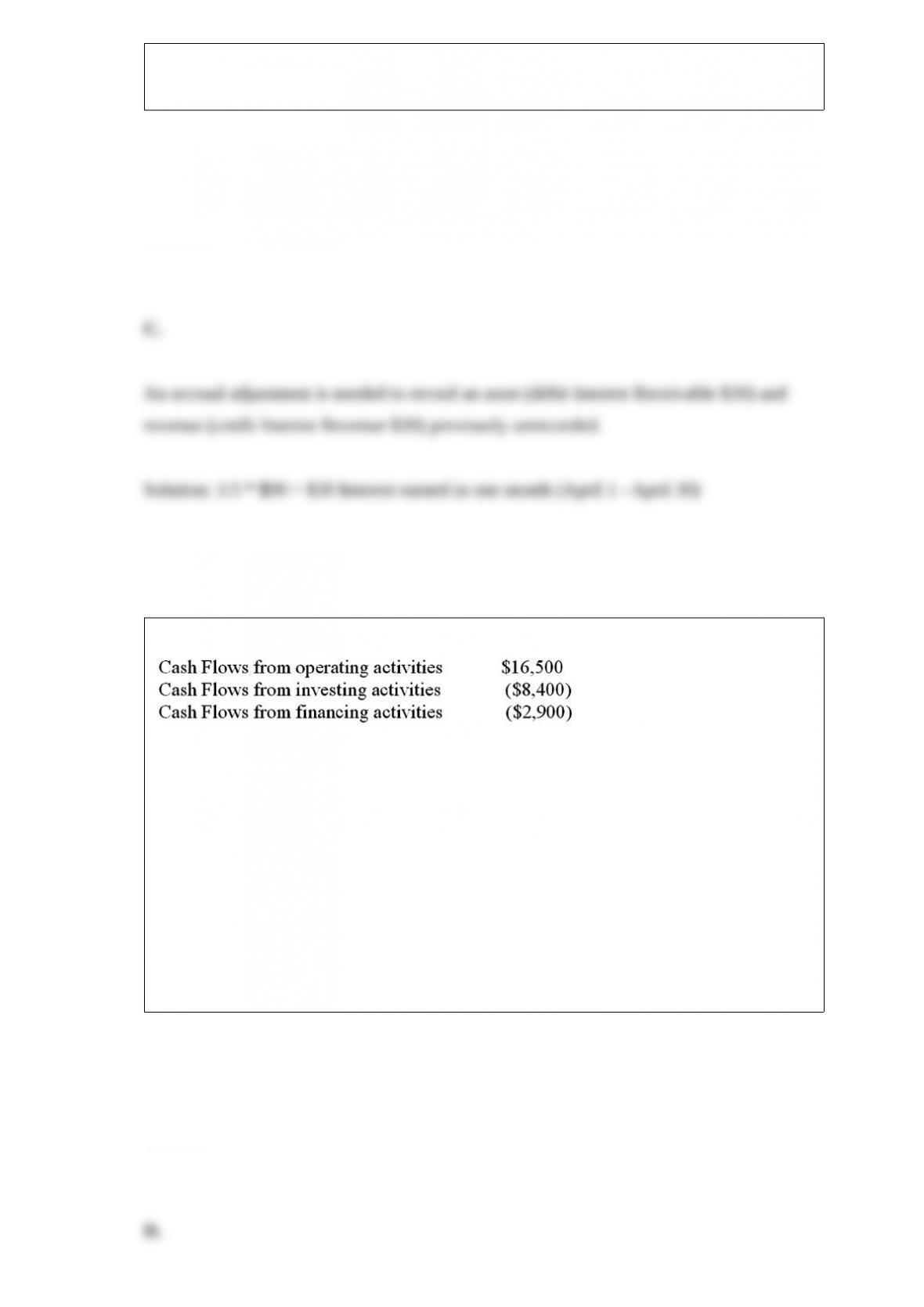
The statement of cash flows shows the following information:
The beginning cash was $14,000.
What is the amount of cash at the end of the period?
A. $41,800
B. $30,500
C. $8,800
D. $19,200
Answer:
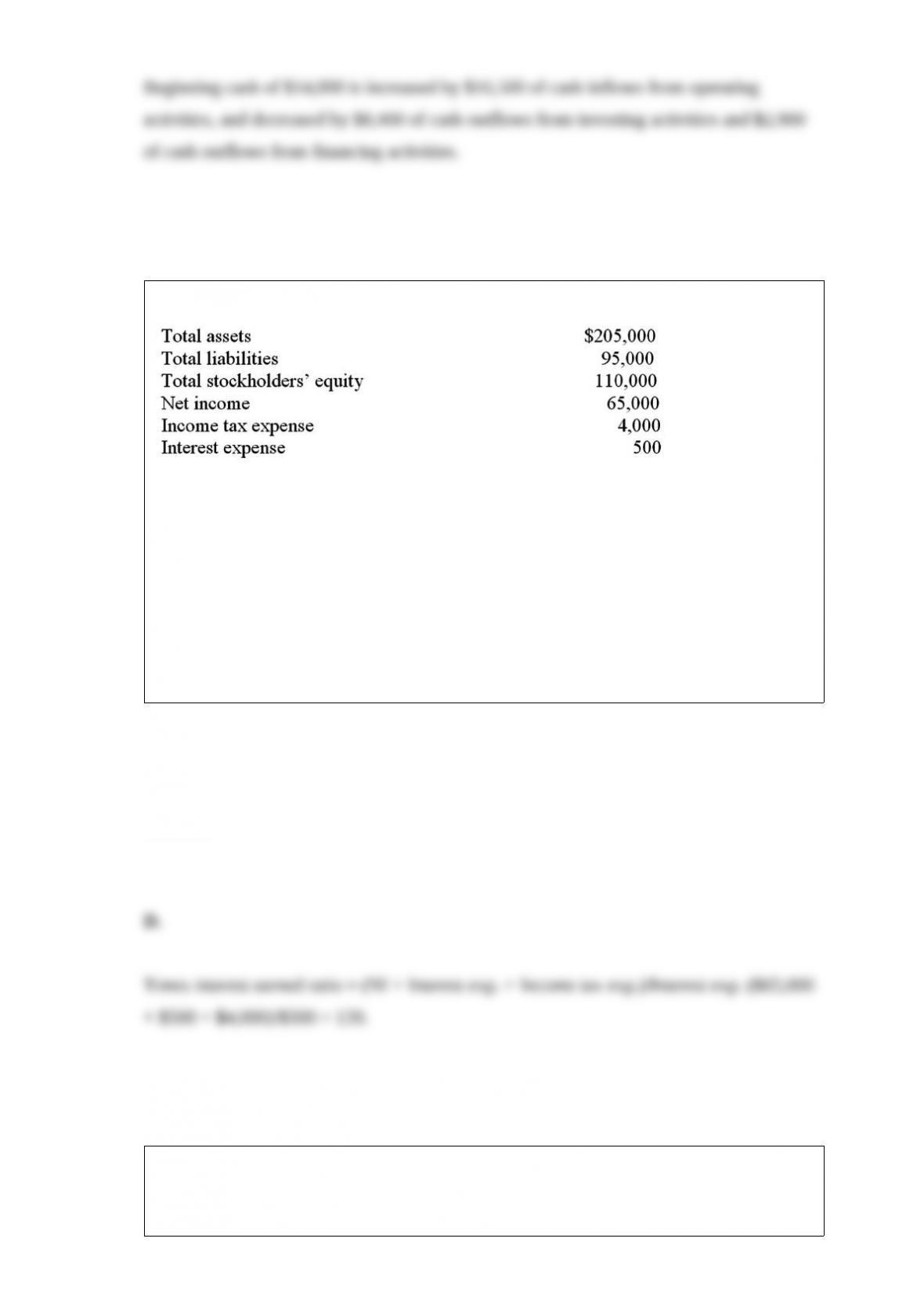
The following data came from the financial statements of a company:
What is the company’s times interest earned ratio?
A. 130
B. 129
C. 122
D. 139
Answer:
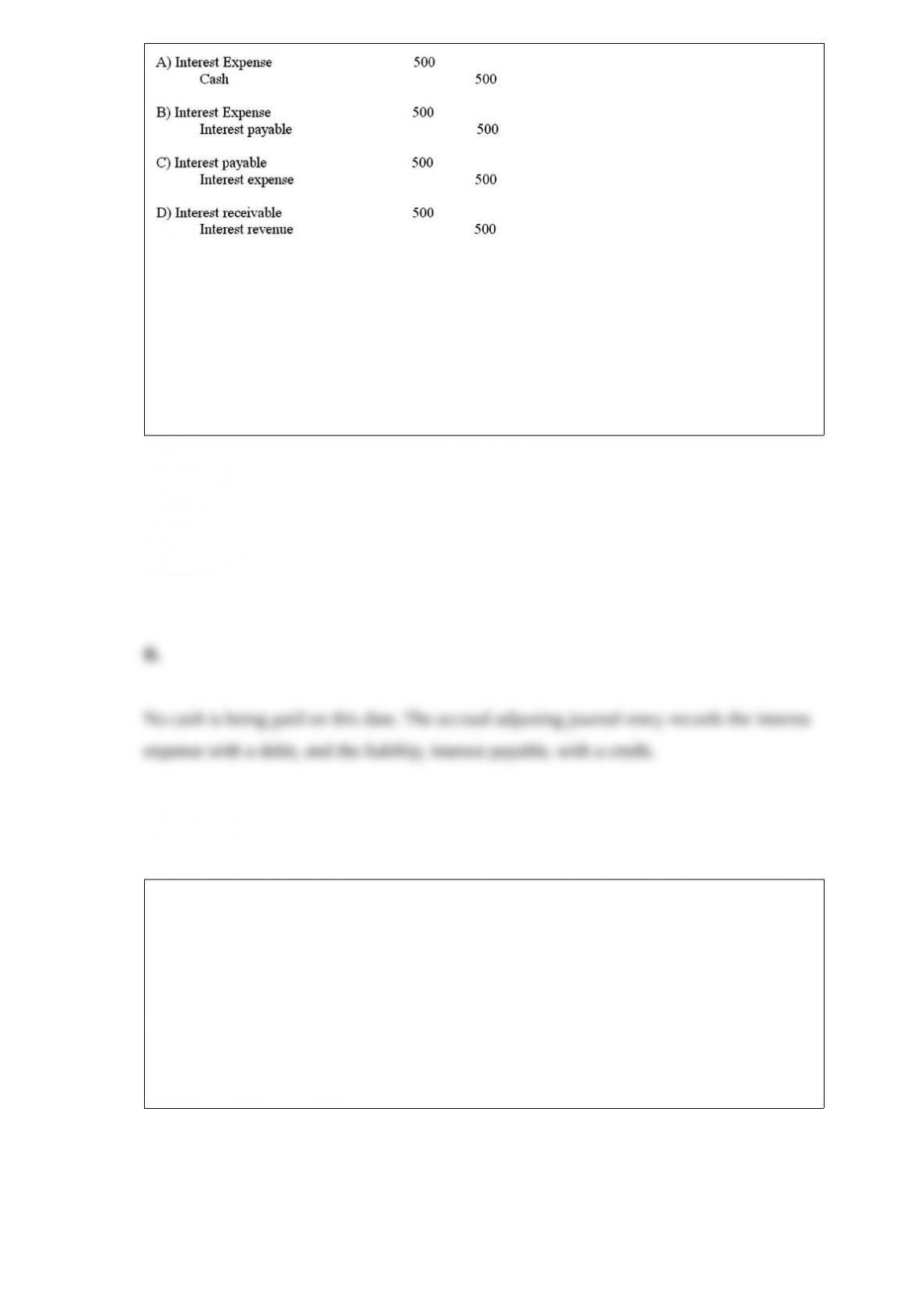
On December 31, 2013, interest of $500 is owed on a bank loan that will not be paid
until June 30, 2014. What is the necessary adjusting journal entry on December 31,
2013?
A. Option A
B. Option B
C. Option C
D. Option D
Answer:
If an uncollectible account, previously written off, is recovered:
A. net accounts receivable increases.
B. net accounts receivable decreases.
C. net accounts receivable stays the same.
D. total revenues increase.
Answer:
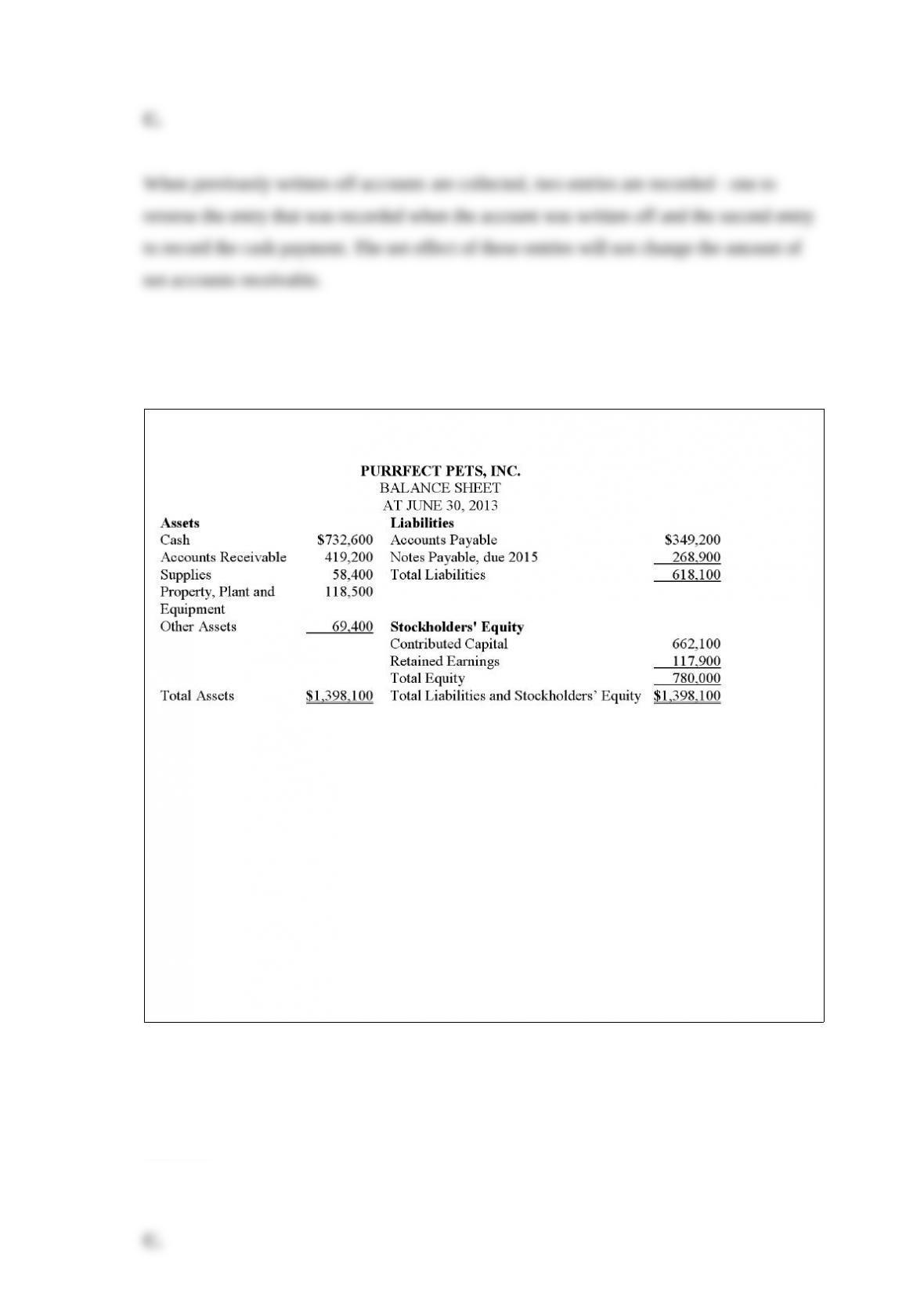
If a company receives $20,000 cash on accounts receivable and uses the cash to pay
$20,000 on accounts payable then:
A. assets would increase by $20,000 while liabilities would decrease by $20,000.
B. liabilities would decrease by $20,000 while stockholders’ equity would increase by
$20,000.
C. assets would decrease by $20,000 while liabilities would decrease by $20,000.
D. liabilities would decrease by $20,000 while stockholders’ equity would decrease by
$20,000.
Answer:

Choose the appropriate letter to match the term and the definition. Not all definitions
will be used.
Term:
_______ 1/ Cash inflow
_______ 2/ Property, plant and equipment
_______ 3/ Comparative balance sheet
_______ 4/ Free cash flow
_______ 5/ Noncash investing and financing activities
_______ 6/ Net income
_______ 7/ Statement of cash flows
_______ 8/ Cash outflow
_______ 9/ Depreciation add-back
Definition:
A. A financial statement that tracks the flow of cash into and out of a company
according to the three types of activities that generate the flows.
B. Cash flows in excess of net income.
C. These are reported in a supplement or in the notes section rather than within the body
of the statement of cash flows.
D. Results from activities such as sales of goods and assets, receipt of dividends and
interest.
E. Cash a company receives that is not subject to income tax.
F. Purchases and sales of this are classified as investing activities.

G. Is the starting point for calculating operating cash flows with the direct method.
H. Positive net cash flows in excess of property, plant and equipment replacement and
dividends.
I. The percent of a company’s net cash flow that comes from investing and financing
activities.
J. An adjustment made when using the indirect method of calculating cash flows from
operating activities.
K. Is the starting point for calculating operating cash flows with the indirect method.
L. Purchases and sales of this are classified as operating activities.
M. A balance sheet that shows the starting and ending balance of the different accounts;
it is used to calculate the net cash flow from operating activities.
N. Results from activities such as purchases of goods and assets, payment of debt,
dividends and taxes.
Answer:
In a perpetual inventory system, paying transportation charges on goods purchased FOB
shipping point would have which of the following effects?
A. decrease operating expenses.
B. increase selling, general, and administrative expenses.
C. decrease cost of goods sold.
D. increase inventory.
Answer:
During April, the Grass is Greener Company buys and pays for a six-month supply of
fertilizer in order to receive a bulk discount. The cost of fertilizer is recorded:
A. immediately as an expense.
B. as a liability, which will later be reduced as the fertilizer used.
C. partially as an expense and partially as a liability.
D. as an asset, which will later be reduced as the fertilizer is used.
Answer: