
Earned but uncollected revenues are recorded during the adjusting process with a credit
to a revenue and a debit to an expense.
Under the perpetual inventory system, the cost of merchandise purchased is recorded in
the Merchandise Inventory account.
Long-term investments in debt securities not classified as held-to-maturity securities are
classified as available-for-sale securities.
In process costing there is never a balance remaining in Factory Overhead that needs to
be closed at period end.

The payback method, unlike the net present value method, does not ignore cash flows
after the point of cost recovery.
The use of an allowance for bad debts is required under the materiality constraint.
When preparing the operating section of the statement of cash flows using the indirect
method, a decrease in accounts receivable is subtracted from net income.

A single-step income statement includes cost of goods sold as another expense, and
shows only one subtotal for total expenses.
Most transactions for merchandising businesses fall into four groups: sales on credit,
purchases on credit, cash receipts, and cash disbursements.
Overapplied overhead is the amount by which actual overhead cost exceeds the
overhead applied to products during the period.
When the actual cost of direct materials used exceeds the standard cost, the company
must have experienced an unfavorable direct materials price variance.

Under the perpetual inventory system, special journals are not required.
The general journal is used for transactions not covered by special journals and for
adjusting, closing, and correcting entries.
A debit balance in retained earnings is often referred to as a retained earnings deficit.

A stock split is the distribution of additional shares of stock to stockholders according
to their percent of ownership.
Cost of goods sold represents the cost of buying and preparing merchandise for sale.
Financial analysis only refers to the communication of relevant financial information to
decision makers.
A useful measure used to evaluate the manager of an investment center is return on total
costs for the investment center.

The Institute of Management Accountants Statement of Ethical Professional Practice
requires that management accountants be competent and act with integrity.
Internal controls include policies to direct operations toward common goals, procedures
to ensure reliable financial reports, safeguards to protect company assets and methods
to achieve compliance with laws and regulations.
A compound journal entry affects no more than two accounts.
On January 1, 2009, a company issued a $500,000, 10%, 8-year bond payable, and
received proceeds of $487,000. Interest is payable each June 30 and December 31. The
company uses the straight-line method to amortize the discount. The amount of interest
expense to be recorded on June 30, 2009 is $25,000.
An employee earnings report is a cumulative record of an employee’s hours worked,
gross earnings, deductions, and net pay.
A company owes its employees $5,000 for the year ended December 31. It will pay
employees on January 6 for the previous two weeks’ salaries. The year-end adjusting on
entry on December 31 will include a debit to Salaries Expense and a credit to Cash.

Sellers always offer a discount to buyers for prompt payment toward purchases made
on credit.
The importance of cash is highlighted by the inclusion of a statement of cash flows in a
complete set of financial statements, which reports on the changes in cash.
Financial statement analysis may be used for personal investment decisions.
Accounting information is communicated to various parties through financial
statements.

Depreciation expense is calculated using estimates of an asset’s salvage value and
useful life.
Raw materials that become part of a product and are identified with specific units or
batches of a product are called direct materials.
A corporation has a $42,000 credit balance in the Income Tax Payable account. Period
end information shows that the actual liability is $50,000. The company should record
an entry to debit Income Tax Expense for $8,000 and credit Income Taxes Payable for
$8,000.

Purchase discounts are the same as trade discounts.
When using the allowance method of accounting for uncollectible accounts, the entry to
record the bad debts expense is a debit to Bad Debts Expense and a credit to Accounts
Receivable.
The purchases journal is used to record cash purchases of merchandise.
Accounting information systems are so accurate that decision makers in practice do not
need a basic knowledge of how the systems work.
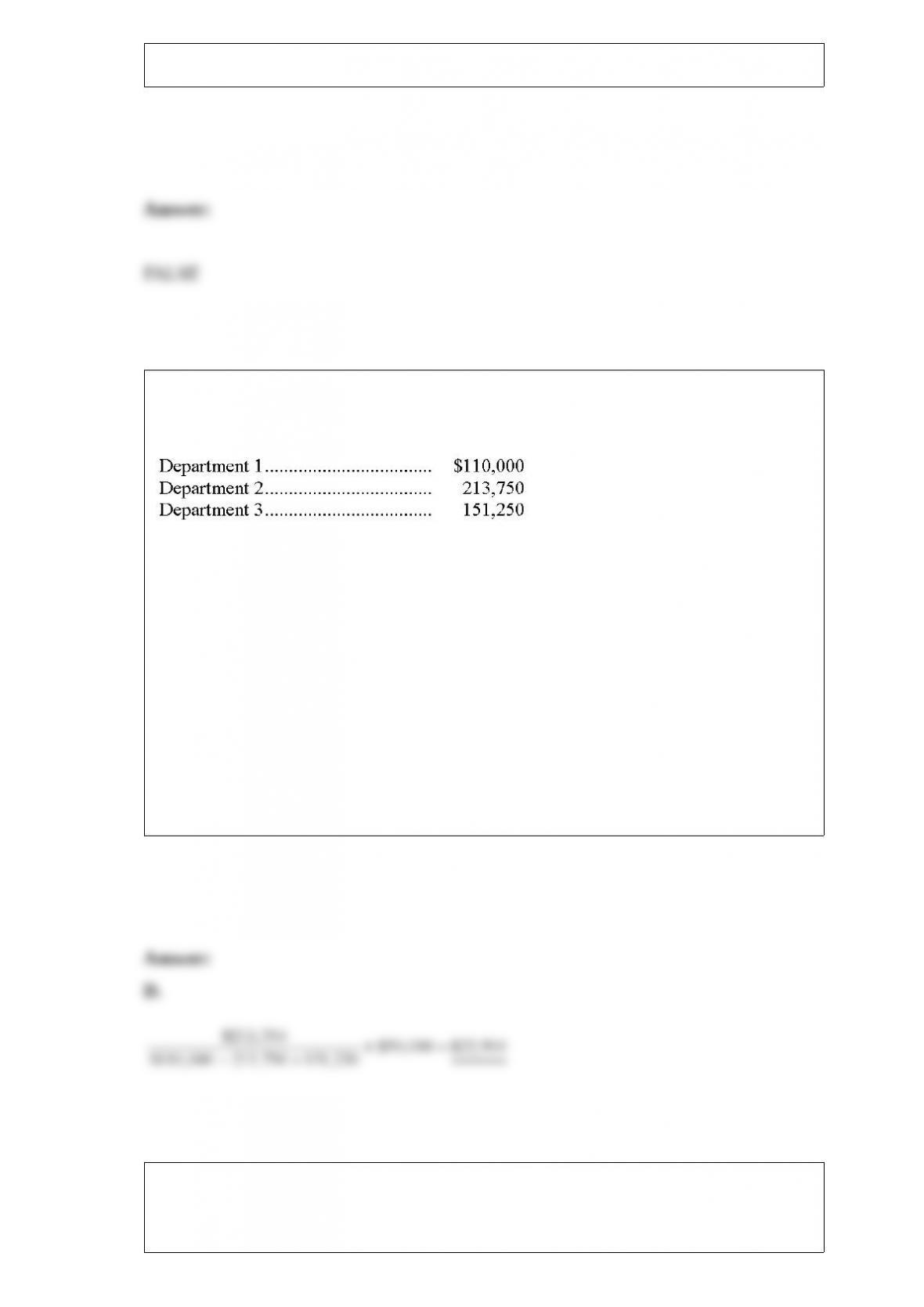
A retail store has three departments, 1, 2, and 3, and does general advertising that
benefits all departments. Advertising expense totaled $50,000 for the year, and
departmental sales were as follows:
How much advertising expense should be allocated to Department 2 if the allocation is
based on departmental sales?
A.$11,000.
B.$14,000.
C.$16,667.
D.$22,500.
E.$50,000.
A change in an accounting estimate is:
A.Reflected in past financial statements.

B.Reflected in future financial statements and also requires modification of past
statements.
C.A change in a calculated amount that is included in current and future years’ financial
statements as a result of new information or subsequent developments and from better
insight or improved judgment.
D.Not allowed under current accounting rules.
E.Considered an error in the financial statements.
Morgan Company purchased 2,000 shares of Asta’s common stock for $143,000 as a
long-term investment. This investment is considered available-for-sale. The par value of
the stock was $1 per share. Morgan paid $375 in commissions on the transaction. The
entry to record the transaction would include a:
A.Credit to Common Stock for $2,000.
B.Credit to Common Stock for $143,000.
C.Credit to Common Stock for $143,375.
D.Debit to Long”Term Investments for $143,000.
E.Debit to Long”Term Investments for $143,375.
The total amount of depreciation recorded against an asset or group of assets during the
entire time the asset or assets have been owned:

A.Is referred to as depreciation expense.
B.Is referred to as accumulated depreciation.
C.Is shown on the income statement of the final period.
D.Is only recorded when the asset is disposed of.
E.Is referred to as an accrued asset.
The price of one currency stated in terms of another currency is called a(n):
A.Foreign exchange rate.
B.Currency transaction.
C.Historical exchange rate.
D.International conversion rate.
E.Currency rate.
Match each of the following terms with the most appropriate definition.
1)Risk
2)Liabilities
3)Net income

4)Expenses
5)Managerial accounting
6)Planning
7)Return on assets
8)Financial accounting
A) A financial ratio useful in evaluating management, analyzing and forecasting profits,
and planning activities.
B) Area of accounting aimed at serving external users.
C) Costs of assets or services used to earn revenues.
D) The uncertainty about the expected return to be earned.
E) Creditor’s claims on a company’s assets.
F) Defining the idea, goals, and actions of an organization.
G) The excess of revenue over expenses
H) Area of accounting aimed at serving the decision making needs of internal users.
Gross profit:
A.Is also called gross margin.
B.Less other operating expenses equals income from operations.
C.Equals net sales less cost of goods sold.
D.Must cover all operating expenses to yield a return for the owner of the business.
E.All of these.
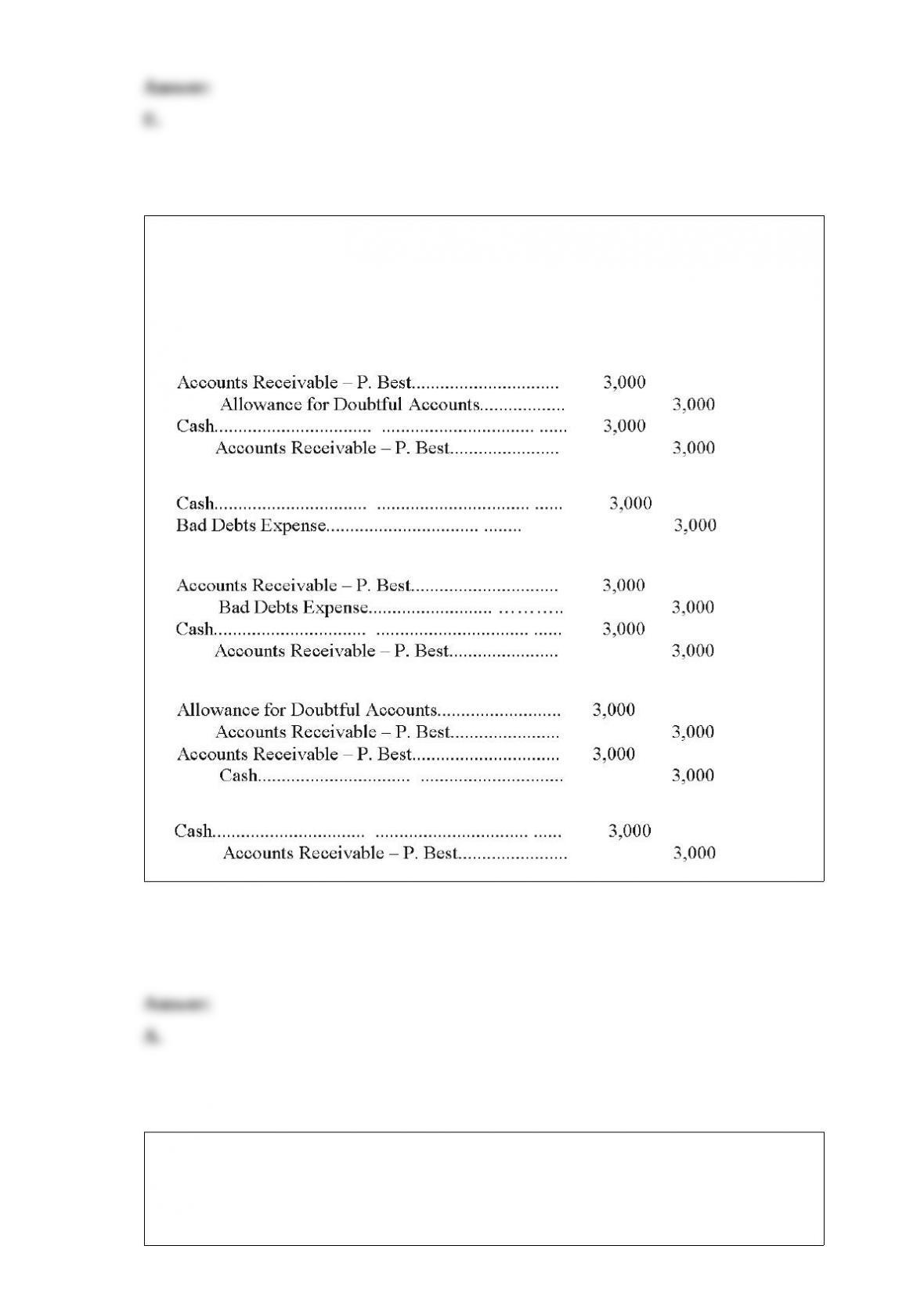
Newton Company uses the allowance method of accounting for uncollectible accounts.
On May 3, the Newton Company wrote off the $3,000 uncollectible account of its
customer, P. Best. On July 10, Newton received a check for the full amount of $3,000
from Best. On July 10, the entry or entries Newton makes to record the recovery of the
bad debt is:
A.
B.
C.
D.
E.
During the month of March, Cooley Computer Services made purchases on account
totaling $43,500. Also during the month of March, Cooley was paid $8,000 by a
customer for services to be provided in the future and paid $36,900 of cash on its
accounts payable balance. If the balance in the accounts payable account at the
beginning of March was $77,300, what is the balance in accounts payable at the end of
March?
A.$83,900.
B.$91,900.
C.$6,600.
D.$75,900.
E.$4,900.
Standards for comparison when interpreting financial statement analysis include
competitor and industry performance data.
A partnership that has two classes of partners, general and limited, where the limited
partners have no personal liability beyond the amounts they invest in the partnership,
and no active role in the partnership, except as specified in the partnership agreement is
a:
A.Mutual agency partnership.
B.Limited partnership.

C.Limited liability partnership.
D.General partnership.
E.Limited liability company.
An employee is dissatisfied with the resolution of an ethical conflict at his place of
employment. According to the Institute of Management Accountants, the employee’s
next step should be to
A.contact the IMA
B.contact the next level of management who is not involved in the ethical conflict
C.make the president of the company aware of the ethical conflict
D.report the incident to the State Board of Accountancy
E.resign from the company
Total manufacturing costs incurred during the year do not include:
A.Direct materials used.
B.Factory supplies used.
C.Goods in process inventory, beginning balance.
D.Direct labor.

E.Depreciation of machinery.
Huffington Company traded in an old delivery truck for a new one. The old truck had a
cost of $75,000 and accumulated depreciation of $60,000. The new truck had an invoice
price of $125,000. Huffington was given a $12,000 trade-in allowance on the old truck,
which meant they paid $113,000 in addition to the old truck to acquire the new truck. If
this transaction has commercial substance, what is the recorded value of the new truck?
A.$15,000
B.$75,000
C.$113,000
D.$125,000
E.$128,000
Another name for a capital expenditure is:

A.Revenue expenditure.
B.Asset expenditure.
C.Long-term expenditure.
D.Contributed capital expenditure.
E.Balance sheet expenditure.
A company purchased an equipment system for $325,000 on January 2, 2008. The
company expects the equipment to last for eight years or 60,000 hours of operation,
with an estimated salvage value of $25,000. During 2008 the equipment was in
operation for 8,000 hours, while in 2009 the equipment was in operation for 8,700
hours. Compute the depreciation expense relating to the equipment for 2008 and 2009
using the following depreciation methods:
a. Straight-line.
b. Double-declining-balance.
c. Units-of-production.

Partnership accounting:
A.Is the same as accounting for a sole proprietorship.
B.Is the same as accounting for a corporation.
C.Is the same as accounting for a sole proprietorship, except that separate capital and
withdrawal accounts are kept for each partner.
D.Is the same as accounting for an S corporation.
E.Is the same as accounting for a corporation, except that retained earnings is used to
keep track of partners’ withdrawals.
An internal report that helps management analyze the difference between actual
performance and budgeted performance based on the actual sales volume (or other level
of activity), and which presents the differences between actual and budgeted amounts as
variances, is called a(n):
A.Sales budget performance report.
B.Flexible budget performance report.
C.Master budget performance report.
D.Static budget performance report.
E.Operating budget performance report.

Which of the following is the best explanation for why it is necessary to calculate
equivalent units of production in a process costing environment?
A.In most manufacturing environments, it is not possible to conduct a physical count of
units.
B.Companies often use a combination of a process costing and job order costing
systems.
C.In most process costing systems, direct materials are added at the beginning of the
process while conversion costs are added evenly throughout the manufacturing process.
D.All of the work to make a unit 100% complete and ready to move to the next stage of
production or to finished goods inventory may not have been completed in a single time
period.
E.In most cases, there is no difference between physical units and equivalent units of
production.
A method that charges the same amount of expense to each period of the asset’s useful
life is called:
A.Accelerated depreciation.
B.Declining-balance depreciation.
C.Straight-line depreciation.
D.Units-of-production depreciation.
E.Modified accelerated cost recovery system (MACRS) depreciation.

Employee vacation benefits:
A.Are estimated liabilities.
B.Are contingent liabilities.
C.Are recorded as an expense when the employee takes a vacation.
D.Are recorded as an expense when the employee retires.
E.Increase net income.
If the liabilities of a business increased $75,000 during a period of time and the owner’s
equity in the business decreased $30,000 during the same period, the assets of the
business must have:
A.Decreased $105,000.
B.Decreased $45,000.
C.Increased $30,000.
D.Increased $45,000.
E.Increased $105,000.

Enterprise resource planning software:
A.Refers to programs that help manage a company’s vital operations.
B.Can include programs that extend from order taking to manufacturing to accounting.
C.Can speed up business decision making and help reduce costs.
D.Can be designed to link every part of a company’s operations.
E.All of these.
Generally accepted accounting principles:
A.Are based on long used accounting practices.
B.Are basic assumptions, concepts, and guidelines in preparing financial statements.
C.Are detailed rules used in reporting on business transactions and events.
D.Arise from the rulings of authoritative bodies.
E.All of these.

Flash had cash inflows from operations $62,500; cash outflows from investing activities
of $47,000; and cash inflows from financing of $25,000. The net change in cash was:
A.$40,500 increase.
B.$40,500 decrease.
C.$134,500 decrease.
D.$134,000 increase.
E.$9,500 increase.
A company made a bank deposit on September 30 that did not appear on the bank
statement dated as of September 30. In preparing the September 30 bank reconciliation,
the company should:
A.Deduct the deposit from the bank statement balance.
B.Send the bank a debit memorandum.
C.Deduct the deposit from the September 30 book balance and add it to the October 1
book balance.
D.Add the deposit to the book balance of cash.
E.Add the deposit to the bank statement balance.
A cost that changes in proportion to changes in volume of activity is a(n):
A.Differential cost.
B.Fixed cost.
C.Incremental cost.
D.Variable cost.
E.Product cost.
Explain how to calculate total asset turnover. Describe what it reveals about a
company’s financial condition, whether a higher or lower ratio is desirable, and how it
is best applied for comparative purposes.
A manufacturer’s inventory that is not completely finished is called
__________________
Adjusting is a three-step process (1) _____________________________, (2)
___________________________, and (3) _____________________________.
A ____________________ helps in preparing financial statements, is useful in
preparing interim statements, and is helpful in showing the effects of proposed
transactions.
An ______________________________ is the potential benefit lost by taking a
specific action when two or more alternative choices are available.
The difference between the unit sales price and the unit variable cost of an item is
defined as the _________________________.
A ________________________ is a potential obligation that depends on a future event
arising from a past transaction or event.
____________________ is the process of monitoring plans and evaluating an
organization’s activities and employees.
_____________________ is the process of analyzing alternative long-term investments
and deciding which assets to acquire or sell.
What is the purpose of closing entries? Describe the closing process.
_______________________ are deposits made and recorded by the depositor but not
yet recorded on the bank statement.
_____________ are the federal income tax rules for depreciating assets.
What are the journal entries recorded for cash dividends on the declaration date, the
date of record, and the payment date?
The focus of managerial accounting is on providing ________________ reports while
the focus of financial accounting is on providing _____________ reports.