
A good system of internal controls requires that the physical custody of assets be
separated from the accounting for those assets. This concept is known as safeguarding
assets and records.
a. True
b. False
The participating feature of stock allows stockholders to sell stock back to the company.
a. True
b. False
The landlord records the security deposit she collects from the tenant as a(n)
a. asset
b. liability
c. contingent liability
d. contra liability

Stanfield Equipment sells new tractors and pays each salesperson a commission of
$1,000 for each tractor sold. During the month of August, a salesperson, Jason, sold 3
new tractors. Stanfield pays Jason on the 10th day of the month following the sale.
Jason operates on the cash basis; the tractor dealer operates on the accrual basis. Which
of the following statements is true?
a. Jason will recognize commission revenue earned in the amount of $3,000 in August.
b. Stanfield will recognize commission expense in the amount of $3,000 in August.
c. Jason will recognize commission expense in the amount of $3,000 in September.
d. Jason will recognize revenue in the same month that the tractor dealer recognizes
expense.
The deferred income taxes for a corporation represent
a. the dollar amount of deductions that a corporation may claim for the year.
b. an additional assessment made by the IRS for underpaid taxes.
c. the estimated amount of next year’s taxes.
d. the dollar amount that arises due to the difference between accounting for financial
statements and accounting for tax purposes.

a. A liability resulting from the signing of a promissory note.
b. A measure of how long it takes to collect receivables.
c. A written promise to repay a definite sum of money on demand or at a fixed or
determinable date in the future.
d. The length of time a note is outstanding, that is, the period of time between the date it
is issued and the date it matures.
e. The party that will receive the money from a promissory note at some future date.
f. The process of selling a promissory note.
g. The date the promissory note is due.
h. The amount of cash the maker is to pay the payee on the maturity date of the note.
i. The difference between the principal amount of the note and its maturity value.
j. An asset resulting from the acceptance of a promissory note from another company.
k. Securities issued by corporations and governmental bodies as a form of borrowing.
l. Securities issued by corporations as a form of ownership in the business.
m. The party that agrees to repay the money for a promissory note at some future date.
n. The amount of cash received, or the fair value of the products or services received,
by the maker when a promissory note is issued.
Maturity value
The comparative balance sheets for Flagler Co. for 2015 and 2014 indicate that
accounts receivable decreased during 2015. Flagler uses the indirect method of
preparing the operating activities section of its statement of cash flows. How will the
decrease in accounts receivable be reported on the statement of cash flows?

a. It will be included in the amount of cash and cash equivalents at the end of 2015.
b. It will be deducted from net income in the operating activities section.
c. It will be added to net income in the operating activities section.
d. It will be reported as a cash outflow in the investing activities section.
When determining the amount of interest to be paid on a bond, which of the following
information is not necessary?
a. The face amount of the bonds
b. The selling price of the bonds
c. The face rate of interest on the bonds
d. The length of the interest period, annually or semiannually
Securities issued by corporations as a form of ownership in the business, such as
common and preferred stock, are called equity securities.
a. True
b. False

Choose from the following list of account titles the one that most accurately fits the des
cription of that account or is an example of that account.An account title may be used m
ore than once or not at all.
a. Cash
b. Prepaid Asset
c. Investments
d. Taxes Payable
e. Preferred Stock
f. Accounts Receivable
g. Land
h. Accounts Payable
i. Retained Earnings
j. Notes Receivable
k. Buildings
l. Notes Payable
m. Common Stock
Ten acres of land used as the site for a factory
Central National Bank recently acquired a new computer system. Which of the
following costs associated with the computer should not be debited to the Equipment

account?
a. Installation of a backup power source required for the computer.
b. Replacement of several circuit boards damaged during installation.
c. System programmer wages for personnel hired to prepare the system for use.
d. Insurance coverage covering the transport period from the manufacturer.
Which one of the following groups is considered an internal user of financial
statements?
a. A bank reviewing a loan application from a corporation.
b. The labor union representing employees of a company that is involved in labor
negotiations
c. The financial analysts for a brokerage firm who are preparing recommendations for
the firm’s brokers on companies in a certain industry,
d. Factory managers that supervise production line workers.
Sales revenue is an inflow of assets.
a. True
b. False

Bartlett Industries Bartlett Industries began operations on January 2, 2015, with an
investment of $50,000 by each of its two stockholders. Net income for its first year of
business was $240,000. Bartlett Industries paid a total of $100,000 in dividends to its
stockholders during the year.
Read the information about Bartlett Industries. If the company’s revenues were
$500,000 for the year ended December 31, 2015, how much were total expenses?
a. $160,000
b. $260,000
c. $640,000
d. $740,000
The International Accounting Standards Board (IASB) was created in order to develop
worldwide accounting standards that must be used for all financial statements prepared
regardless of country.
a. True
b. False
The maker of a note recognizes a note payable on the balance sheet and interest expense
on its income statement.
a. True
b. False
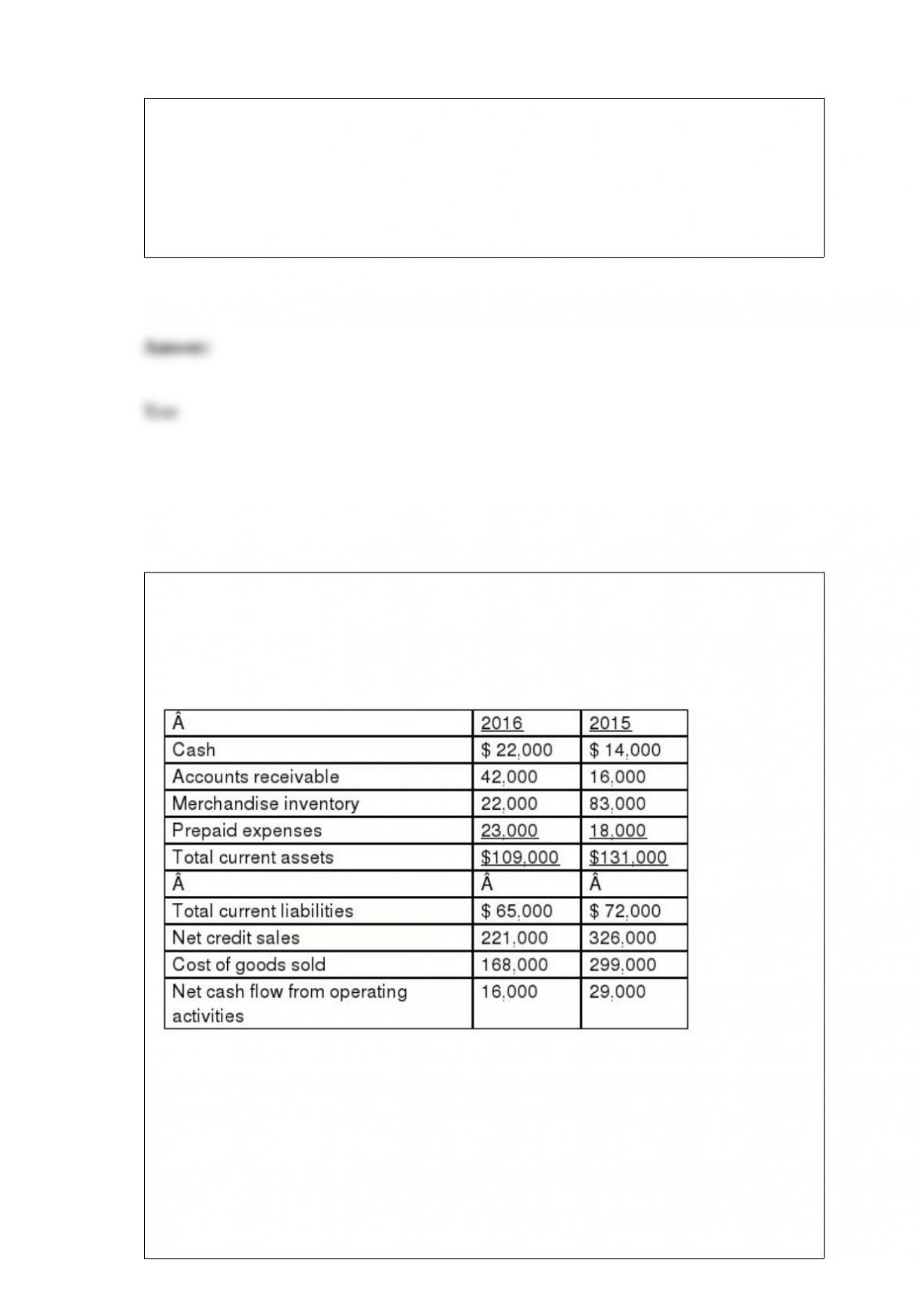
Pinecrest Company
Use the selected data from Pinecrest Company’s financial statements to answer the
following question.
Refer to the data for Pinecrest Company.Competitors in Pinecrest Company’s industry
have an average inventory turnover of 20.8 times. Its inventory turnover for 2016
a. indicates that the company has too little inventory on hand at the end of 2016.
b. indicates that the company is pricing its products too low.
c. is equal to the number of days’ sales in the company’s inventory.
d. indicates that the market may be reacting to problems in the sales department by
reducing demand for the company’s products.
The cost of Fulton’s inventory at the end of the year was $145,000. Due to
obsolescence, the cost to replace the inventory was only $90,000. Net realizable
value-what the inventory could be sold for-is $102,000. REQUIRED:
Determine the amount Fulton should report on its year-end balance sheet for inventory
assuming the company follows (a) U.S. GAAP and (b) IFRS.
Blenham, Inc. sells merchandise on credit. If a customer pays its balance due after the
discount period has passed, what is the effect of the payment on Blenham’s accounting
equation?
a. Assets and stockholders’ equity decrease.
b. Assets and stockholders’ equity increase.
c. Assets decrease and liabilities increase.
d. No net effect.