1) Management accounting can provide information on customer satisfaction.
2) The goal of both job order costing and process costing is accurate product cost.
3) For service organizations, activity-based cost systems clarify appropriate cost
assignments to services and customers and help to identify the profitability of various
products and customers.
4) In make-or-buy decisions, the suppliers’ reputation for quality and service is a
relevant quantitative factor.
5) The amount of decentralization in an organization reflects the organization’s trust in
its employees and other factors.
6) In a service company, marketing and selling costs are customer independent.
7) Nonprofit and government organizations success must be measured by their
effectiveness in providing benefits to constituents.
8) Implementing a just-in-time manufacturing system requires a major cultural change
for an organization.
9) A key element in any organization’s strategy is to identify its target customers and to
deliver what those target customers want.
10) Nonfinancial measures can highlight falling sales and profits in an organization, but
only financial measures can identify why this is occurring.
11) Depreciation expense allocated to a product line is a relevant cost when deciding to
discontinue that product.
12) In lean manufacturing, any resource spending that does not create value for the end
customer is wasteful and must be eliminated.
13) There are two general types of facility designs: process layouts and product layouts.
14) In multiproduct situations when the sales mix shifts toward the product with the
lowest contribution margin per unit, the break-even quantity will decrease.
15) Hierarchical organizations with many layers of management are referred to as flat
organizations.
16) A processing cycle efficiency (PCE) of 18% indicates better efficiency than a PCE
of 50%.
17) Outsourcing is risk-free to the purchaser of a part because the supplier now has the
responsibility of producing the part.

18) Direct labor and overhead are referred to as conversion costs because they convert
direct materials into finished products.
19) Transaction drivers:
A) count the frequency of an activity
B) involve directly charging for the resources used each time an activity is performed
C) are the most expensive and accurate type of cost driver
D) often apply a weighted index approach by estimating the difficulty of the task for
various types of situations
20) The most common incentive compensation plans include all of the following
EXCEPT:
A) extrinsic rewards
B) stock options
C) profit sharing
D) employee stock ownership plans
21) Which of the following descriptors refer to management accounting information?
A) It is only retrospective, reporting and summarizing in financial terms the results of
past decisions and transactions
B) It is driven by rules
C) It is prepared for shareholders
D) It is oriented to meeting the decision making needs of employees and managers
inside the organization
22) Stock-related incentive compensation plans include all of the following EXCEPT:
A) stock options
B) stock appreciation rights
C) participation units
D) merit pay
23) Which of the following best represents the Do step in the Plan-Do-Check-Act
(PDCA) cycle?.
A) Take actions to lower costs, change resource allocations, improve the quality, cycle
time and flexibility of processes, modify the product mix, change customer
relationships, and redesign and introduce new products
B) Measure and monitor ongoing performance and take short-term actions based on the
measured performance
C) Define the organization’s purpose and select the focus and scope of its strategy
D) Implement the chosen course of action
24) All of the following may be implemented to help ensure that an organization attains
goal congruence EXCEPT:
A) performance measures for employees aligned with organizational objectives
B) employee participation in decision making
C) employee self-control
D) a reward system for employees aligned with strategic goals
25) Using too few balanced scorecard measures:
A) will not balance desired outcomes with performance drivers of those outcomes
B) is better than using too many scorecard measures
C) results in a lack of linkage between drivers in the process and learning and growth
.perspectives
D) All of the above are correct
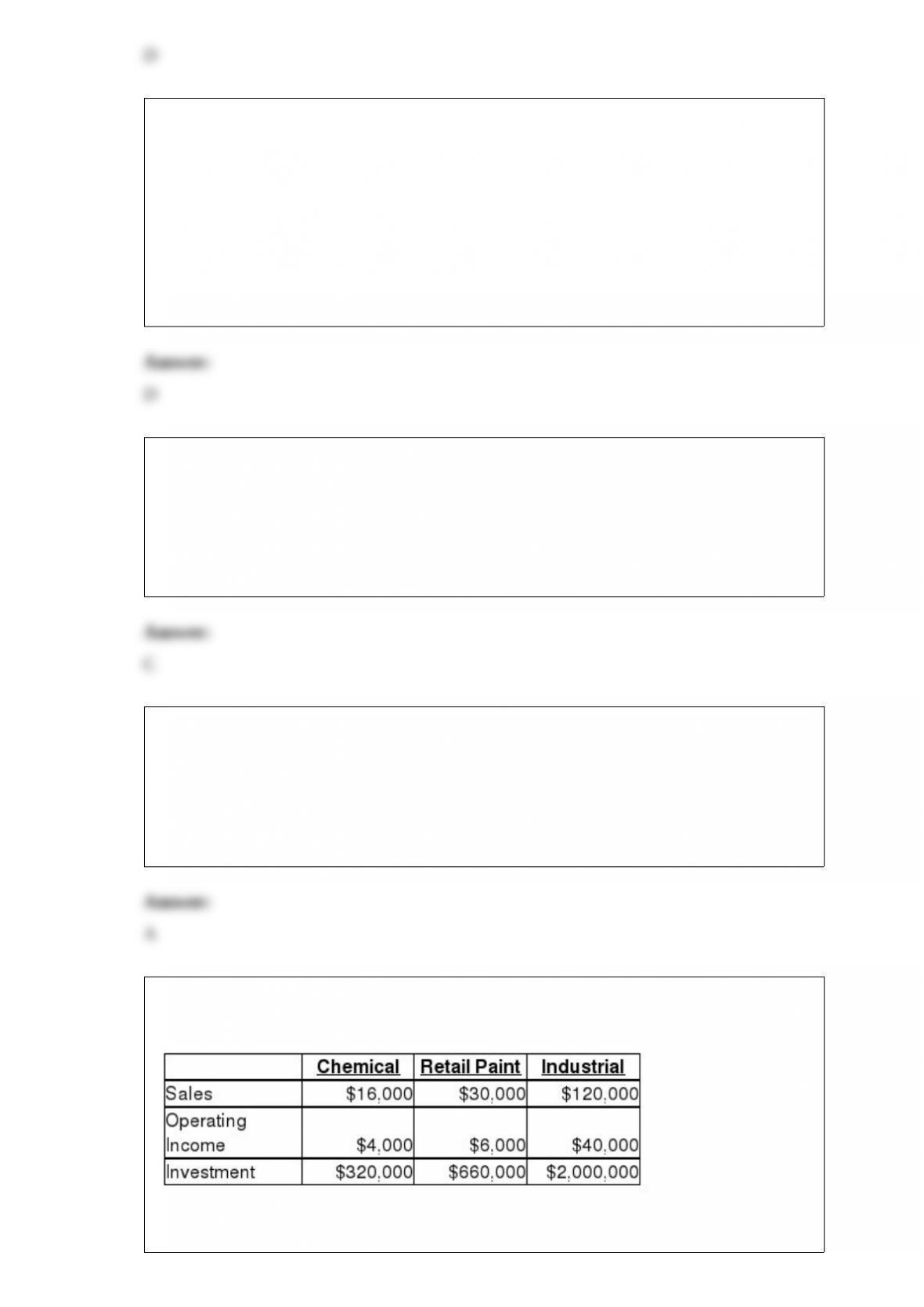
26) The following information pertains to three divisions of Marine Industrial Coatings,
Inc. (amounts in millions):
What is the Return on Sales for the Retail paint division?
A) 2%

B) 4.5%
C) 20%
D) 45%
27) The goal of a properly constructed ABC system is to:
A) have the most accurate cost system
B) identify more indirect overhead costs
C) develop the best cost system for an economically reasonable cost
D) have separate allocation rates for each department
28) A favorable cost variance of significant magnitude:
A) is the result of good planning
B) may lead to improved production methods if it is investigated
C) indicates that management does not need to be concerned about lax standards
D) does not need to be investigated
29) Performance measures for financial control include all of the following EXCEPT:
A) reduced cycle times
B) ROI ( return on investment) and economic value added
C) profit
D) cost
30) Tangipahoa Manufacturing uses departmental cost driver rates to apply
manufacturing overhead costs to products. Manufacturing overhead costs are applied on
the basis of machine hours in the Machining Department and on the basis of direct labor
dollars in the Assembly Department. At the beginning of 2007, the following estimates
were provided for the coming year:
MachiningAssembly
Direct labor hours20,00040,000
Machine hours40,00020,000
Direct labor cost$400,000$920,000
Manufacturing Overhead costs$440,000$460,000
The accounting records of the company show the following data for Product #A273:
MachiningAssembly
Direct labor hours50100
Machine hours20050
Direct material cost$2,100$1,200
Direct labor cost$1,000$2,300
Required:
a. Compute the predetermined manufacturing overhead cost driver rate for each
department.
b. Compute the total cost of Product #A273.
c. Provide possible reasons why Tangipahoa Manufacturing uses two different cost
drivers.
31) Goal congruence in an organization refers to:
A) ensuring that appropriate disciplinary actions can be taken against unethical acts
B) alignment of employee and organizational objectives
C) so that essential tasks get accomplished
D) ensuring that the organization’s ethical code of conduct is enforced
32) Financial accounting:
A) focuses on the future and includes activities such as preparing next year’s operating
budget
B) does not need to comply with GAAP (generally accepted accounting principles)
C) is primarily oriented to external stakeholders, such as investors, creditors, regulators
and tax authorities
D) is prepared for the use of department heads and other employees
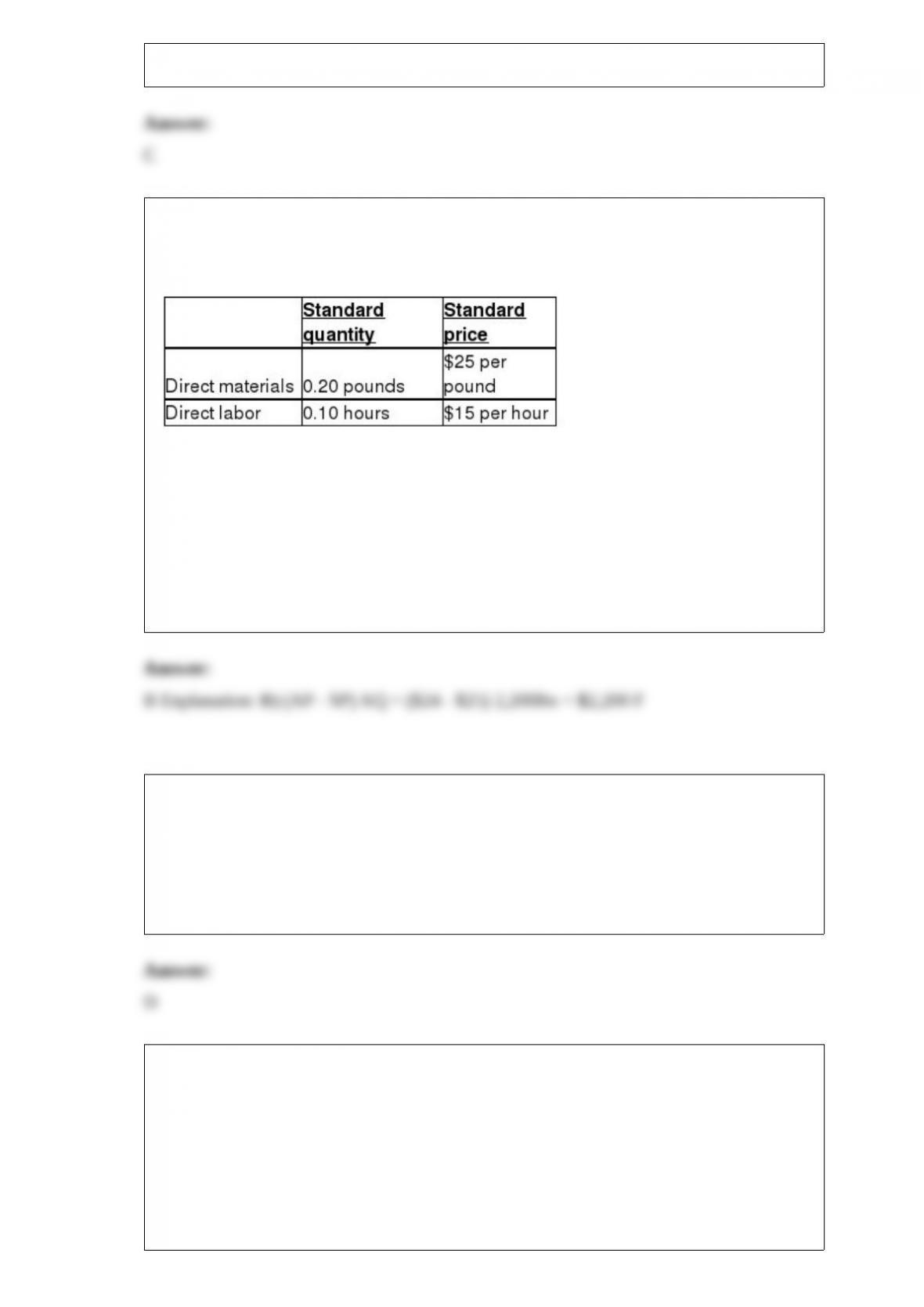
33) Community Manufacturing Inc. developed the following standard costs for direct
material and direct labor for one of their major products, the 30-gallon heavy-duty
plastic container.
During May, Community produced and sold 10,000 containers using 2,200 pounds of
direct materials at an average cost per pound of $24 and 1,050 direct labor hours at an
average wage of $14.75 per hour.
May’s direct material price variance was:
A) $2,800 favorable
B) $2,200 favorable
C) $5,000 unfavorable
D) None of the above is correct
34) Measures of employees’ skills and capabilities are included in the ________
perspective of the Balanced Scorecard.
A) financial
B) internal
C) customer
D) learning and growth perspective
35) Randall Company makes and distributes outdoor play equipment. Last year sales
were $4,800,000, operating income was $1,200,000, and the assets used were
$6,000,000.
Return on sales, the efficiency component of return on investment (ROI), is:
A) 20%
B) 80%
C) 25%
D) 125%
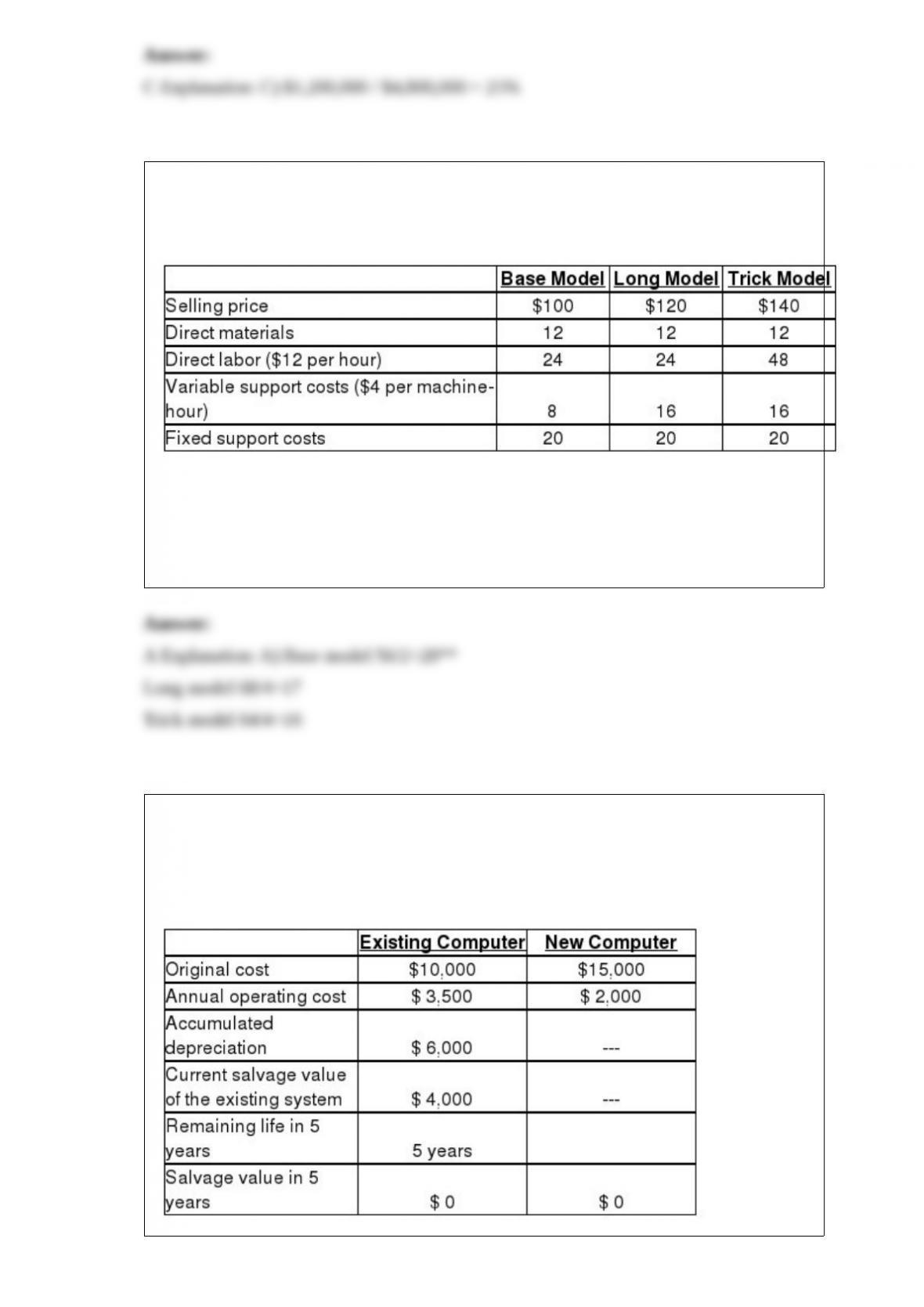
36) Narly Skateboards manufactures three different product lines, Base, Long, and
Trick. Considerable market demand exists for all models. The following per unit data
apply:
Which model has the greatest contribution margin per machine-hour?
A) base model
B) long model
C) trick model
D) both the long model and the trick model
37) Marine Industrial Coatings, Inc. is considering replacing its existing computer
system with a new computer system. The new system can offer considerable savings in
computer processing and inventory management costs. Information about the existing
system and the new system follow:
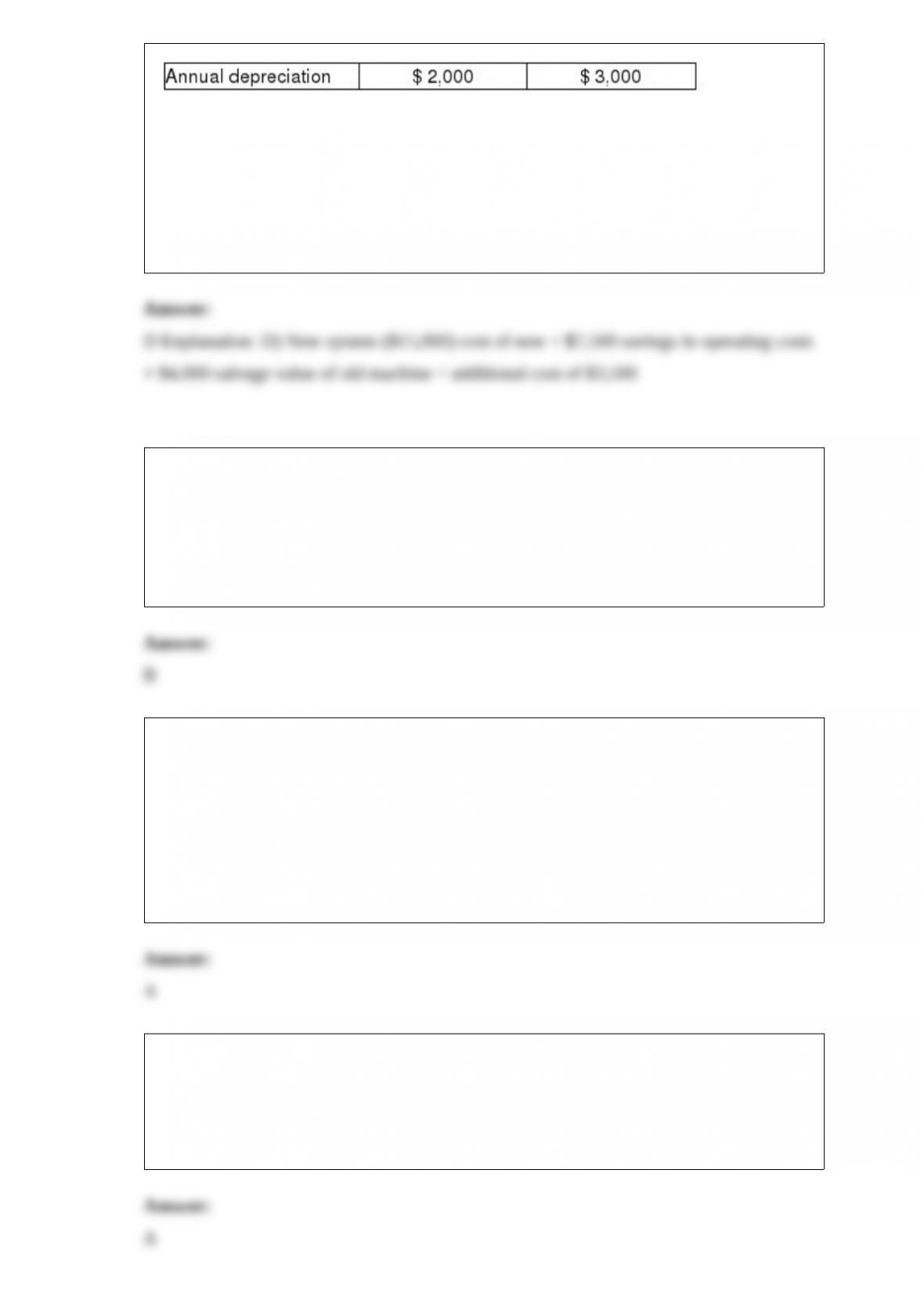
Should Marine Industrial Coatings replace the existing computer system with the new
system? What are the cash flow savings or additional cost over the 5 years? Ignore
income taxes.
A) Yes replace, net savings of $5,000
B) Yes replace, net savings of $15,000
C) No do not replace, additional costs of $5,000
D) No do not replace, additional costs of $3,500
38) Which of the following could be used to measure the objective of anticipating
future customer needs?
A) potential value of projects in the project pipeline
B) number of new projects launched based on customer input
C) number of projects delivered on time
D) number of failures or returns of new products from customers
39) Products M5 and A8 each are assigned $100.00 in overhead costs by a traditional
costing system. An activity analysis revealed that although production requirements are
identical, M5 requires 45 minutes less setup time than A8.
According to an ABC system, A8 is ________ under the traditional cost system.
A) undercosted
B) overcosted
C) fairly costed
D) accurately costed
40) A favorable wage rate variance for direct labor might indicate that:
A) employees were paid less than planned
B) fewer skilled employees are available in the market
C) less skilled and qualified employees are being hired
D) an efficient labor force
41) Repeated or increased purchases of the product or service is known as?
A) profitability
B) customer satisfaction
C) customer loyalty
D) the net promoter score
42) Which BEST describes the purpose of a management accounting and control
system (MACS)?
A) A MACS defines the value chain and identifies nonvalue-added activities for a
business
B) A MACS helps decision makers determine whether strategies and objectives are
being met
C) A MACS offers a system of controls to ensure employees are meeting predetermined
standards
D) A MACS provides a signal for management attention when areas are out-of-control
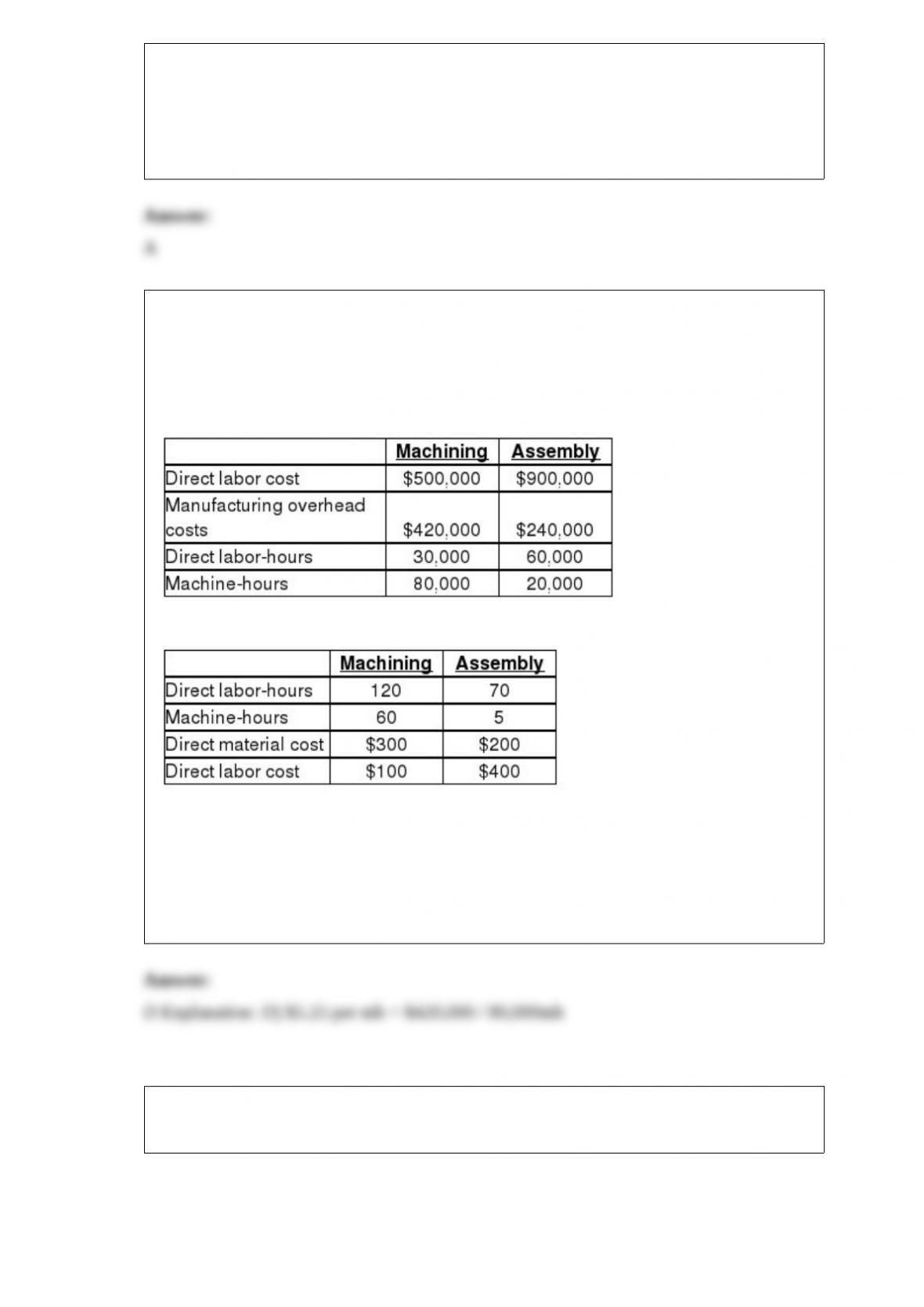
43) The actual information pertains to the month of June. As part of the budgeting
process, Petrified Products Company developed the following master budget for June.
The manager, Pete, is in the process of preparing the flexible budget and understanding
the results.
The flexible budget will report $________ for the capacity-related (fixed) costs.
A) $458,000
B) $450,000
C) $360,000
D) $572,500

44) Misleading product cost numbers are MOST likely the result of misallocating:
A) direct material costs
B) direct manufacturing labor costs
C) overhead costs
D) All of the above are correct
45) When deciding whether to discontinue a segment of a business, managers should
focus on:
A) unavoidable fixed costs
B) reallocation of corporate costs
C) contribution margin and avoidable fixed costs of the segment
D) operating income per unit of the discontinued segment
46) All of the following are reasons that financial control may be an ineffective
scorecard EXCEPT that:
A) it fails to identify the causes or drivers of performance
B) it focuses on financial measures while ignoring other important attributes of
performance
C) it focuses on long-term rather than short-term performance measures
D) it is an aggregate, rather than a detailed measure of performance
47) Which statement below is FALSE?
A) “What gets measured gets managed”
B) People react to measurements
C) Employees spend more attention on those variables that are not getting measured
D) “If I can’t measure it, I can’t manage it”
48) The goal of a properly constructed ABC system is to:
A) develop the best cost system by staying within the economizing constraints (relevant
benefit versus cost tradeoff for the system)
B) have the most accurate cost system
C) clone the ABC model processes
D) adapt the ABC model exactly to the organization
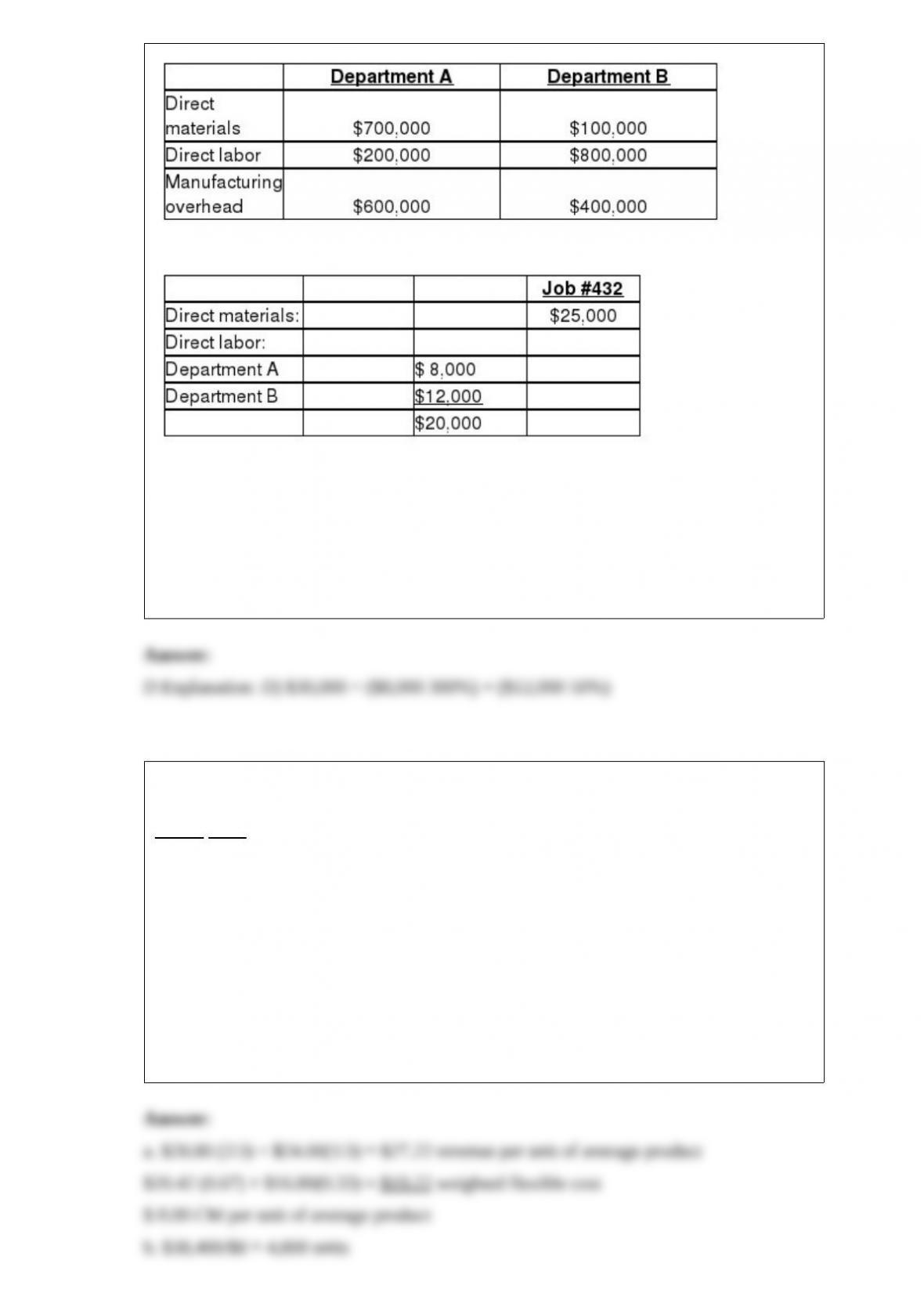
49) Sheppard Manufacturing uses departmental cost driver rates to allocate
manufacturing overhead costs to products. Manufacturing overhead costs are allocated
on the basis of machine hours in the Machining Department and on the basis of direct
labor hours in the Assembly Department. At the beginning of 2011, the following
estimates were provided for the coming year:
The accounting records of the company show the following data for Job #316:
For the Machining Department, what is the annual manufacturing overhead cost driver
rate?
A) $4.00 per machine hour
B) $4.20 per machine hour
C) $4.67 per machine hour
D) $5.25 per machine hour
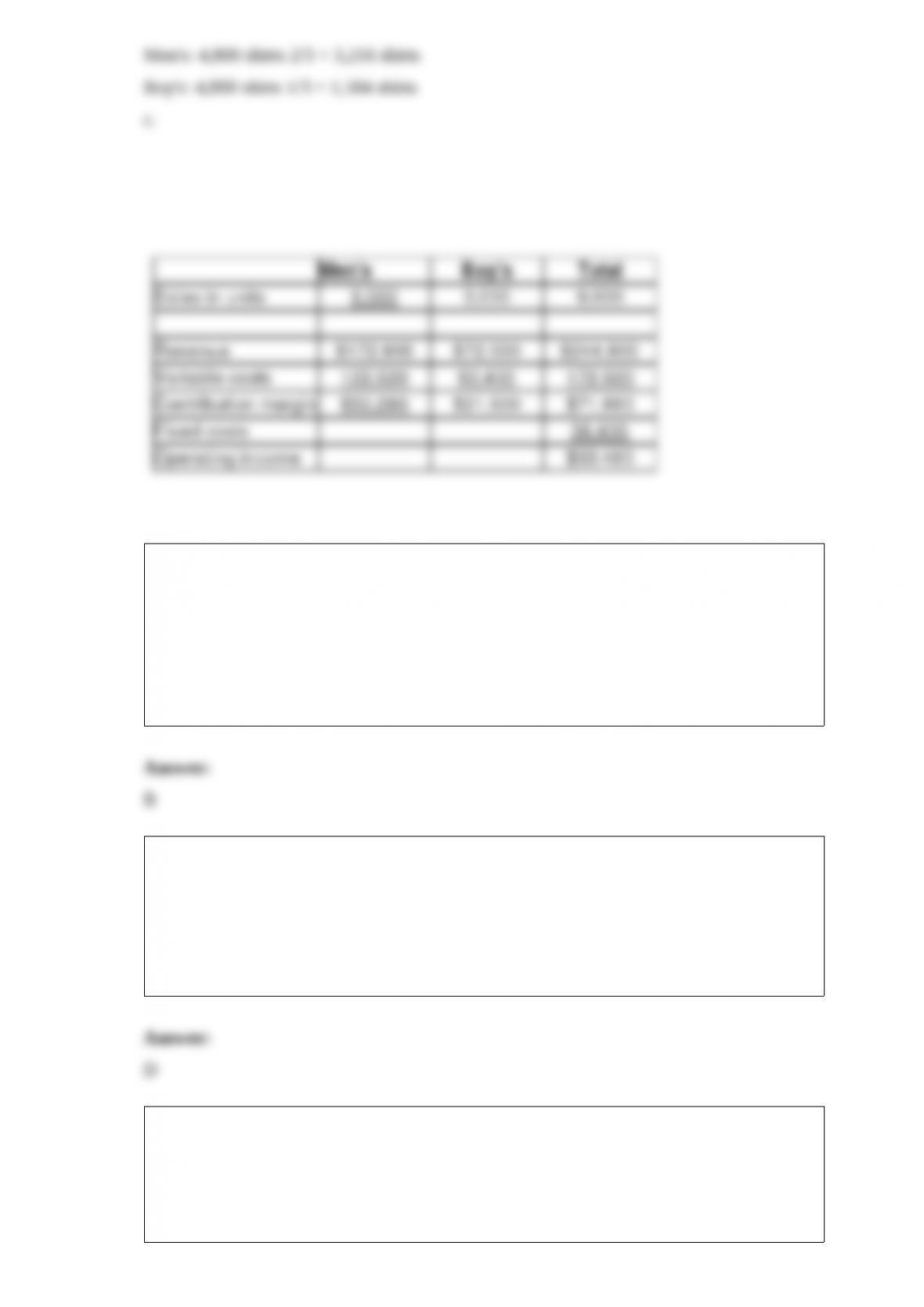
50) Apple Valley Corporation uses a job order cost system and has two production
departments, A and B. Budgeted manufacturing costs for the year are:
The actual material and labor costs charged to Job #432 are as follows:
Apple Valley applies manufacturing overhead costs to jobs on the basis of direct labor
cost using departmental rates determined at the beginning of the year.
Manufacturing overhead costs applied to Job #432 total:
A) $12,000
B) $24,000
C) $36,000
D) None of the above is correct
51) Bob’s Textile Company sells shirts for men and boys. The average selling price and
variable cost for each product are as follows:
Men’s Boys
Selling price $28.80 $24.00
Variable cost $20.42 $16.80
Total fixed costs $38,400
Required:
Assume the sales mix is 2 men’s shirts for each boy’s shirt:
a. What is the weighted revenue per unit of composite average product, the weighted
average variable cost, and the weighted contribution margin per unit of average
product?
b. What is the break-even point in units for each type of shirt?
c. What is the operating income, assuming sales total 9,000 shirts?
52) These questions refer to flexible budget variance formulas with the following
descriptions for the variables: A = Actual; P = Price; Q = Quantity; S = Standard.
The best label for the formula [(AP) (AQ) – (SP) (AQ)] is the:
A) materials quantity variance
B) materials price variance
C) total cost variance for materials
D) labor efficiency variance
53) ________ establish the level of performance or rate of improvement required for a
measure in the Balanced Scorecard.
A) Critical success factors
B) The value proposition
C) The Balanced Scorecard
D) Targets
54) A fully-owned subsidiary of a multinational firm reports return on investment four
times a year. This is an example of:
A) a revenue center
B) a cost center
C) an investment center
D) a profit center
55) The performance measurement system for employees’ compensation should focus
on all facets of performance to:
A) ensure that reporting is complete
B) encourage gaming of the performance indicator
C) provide the highest possible level of internal control
D) ensure that employees do not sacrifice performance on unmeasured elements
56) For each of the following activities, characteristics, and applications, identify
whether they are found in a (C)entralized organization, a (D)ecentralized organization,
or (Both) types of organizations.
(C / D / Both) a. Freedom for managers at lower organizational levels to make
decisions
(C / D / Both) b. Best suited to organizations within stable environments
(C / D / Both) c. Greater responsiveness to users’ needs
(C / D / Both) d. Use the most efficient technologies
(C / D / Both) e. Maximum constraints and minimum freedom for managers at lowest
levels
(C / D / Both) f. Maximization of benefits over costs
(C / D / Both) g. Minimization of duplicate functions
(C / D / Both) h. Standard operating procedures
(C / D / Both) i. Requires trust in employees at all levels
(C / D / Both) j. Primarily task control rather than results control
57) Assume an organization’s cost of capital is 8% and Department A currently has a
12% return on investment (ROI). The manager of Department A, who is evaluated on
ROI, would MOST likely accept an investment that is expected to return:
A) more than 8%
B) more than 12%
C) more than 8% but less than 12%
D) less than 12%
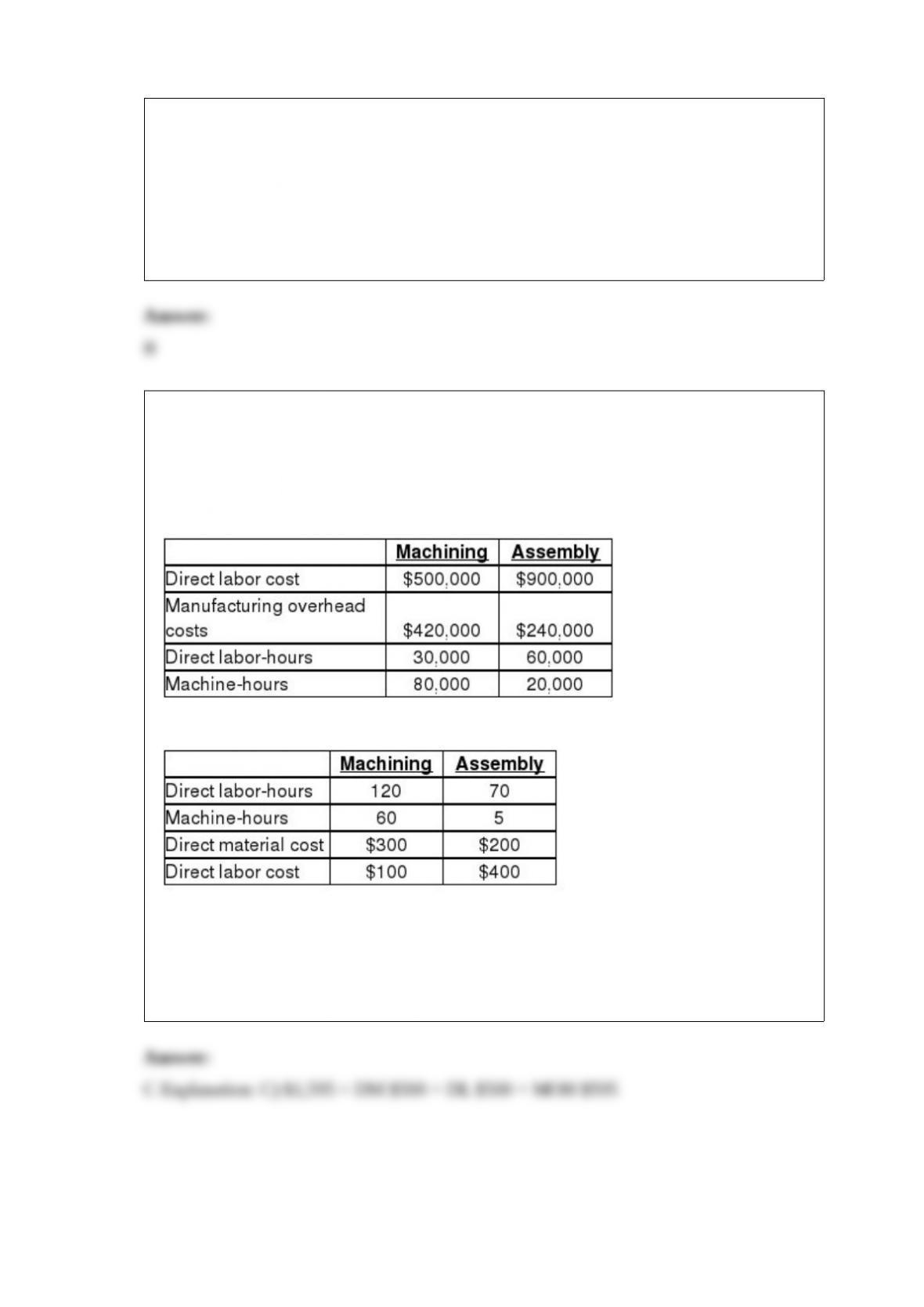
58) Sheppard Manufacturing uses departmental cost driver rates to allocate
manufacturing overhead costs to products. Manufacturing overhead costs are allocated
on the basis of machine hours in the Machining Department and on the basis of direct
labor hours in the Assembly Department. At the beginning of 2011, the following
estimates were provided for the coming year:
The accounting records of the company show the following data for Job #316:
What are the total manufacturing costs of Job #316?
A) $715
B) $880
C) $1,595
D) $1,000