
At the end of the year, overhead applied was $42,000,000. Actual overhead was
$40,300,000. Closing over/under applied overhead into Cost of Goods Sold would
cause net income to
a. increase by $1,700,000
b. decrease by $1,700,000
c. increase by $3,400,000
d. decrease by $3,400,000
Division D of Saunders Company has sales of $350,000, cost of goods sold of
$120,000, operating expenses of $58,000, and invested assets of $150,000.
What is the profit margin for Division D?
a. 42.9%
b. 83.4%
c. 49.1%
d. 65.7%
The transfer price approach that uses a variety of cost concepts is the
a. negotiated price approach
b. standard cost approach
c. cost price approach
d. market price approach
The task of preparing a budget should be the sole task of the most important department
in an organization.
a. True
b. False
Estimated activity-base usage quantities are the total activity-base quantities related to
each product.
a. True
b. False
A company is planning to purchase a machine that will cost $24,000, have a 6-year life,
and have no salvage value. The company expects to sell the machine’s output of 3,000
units evenly throughout each year. Total income over the life of the machine is
estimated to be $12,000. The machine will generate net cash flows per year of $6,000.
The average rate of return for the machine is 16.7%.
a. True
b. False
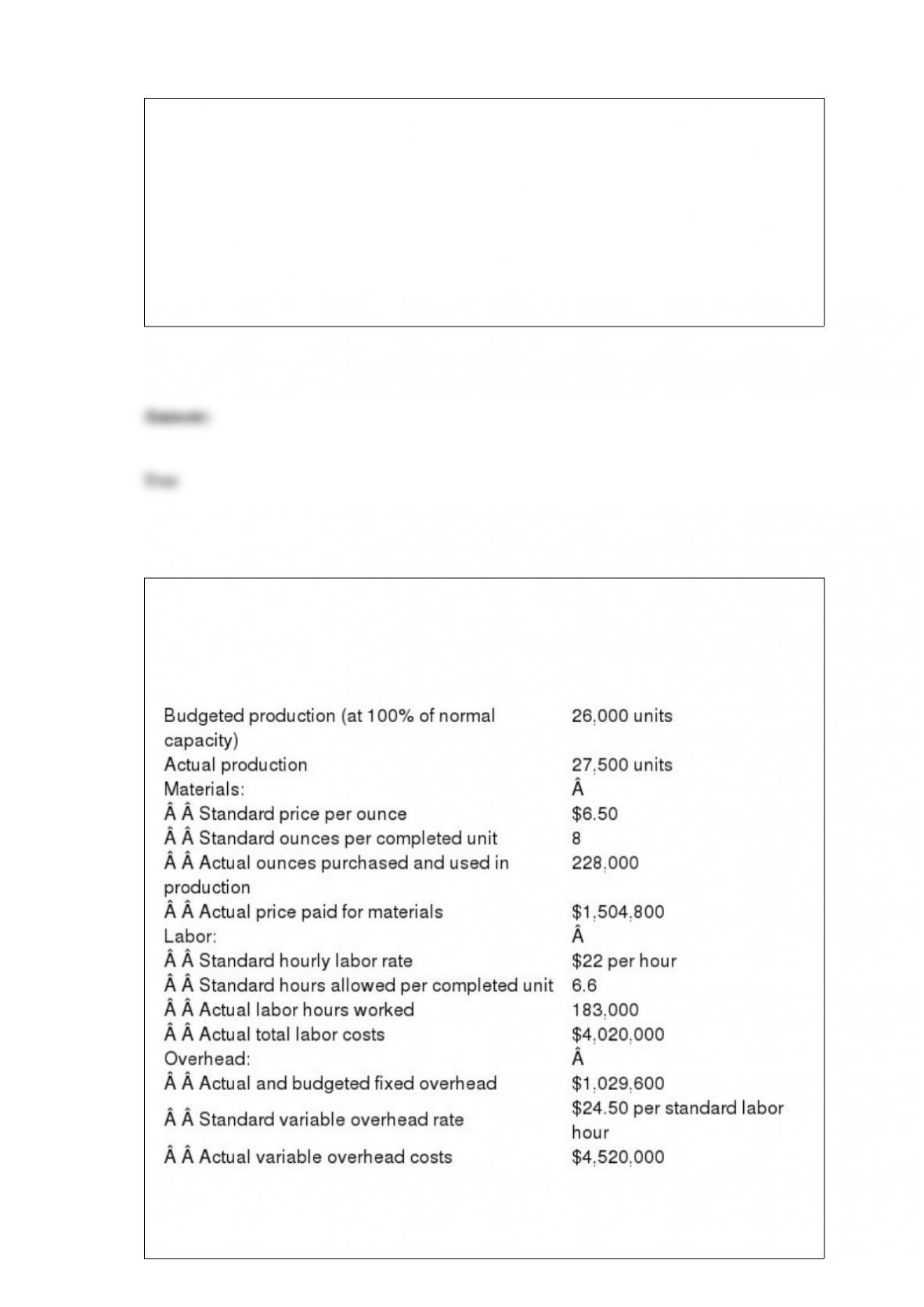
The following data is given for the Zoyza Company:
Overhead is applied on standard labor hours.

The fixed factory overhead controllable variance is
a. $73,250 favorable
b. $73,250 unfavorable
c. $59,400 favorable
d. $59,400 unfavorable
The tendency of the rate earned on stockholders’ equity to vary disproportionately from
the rate earned on total assets is
a. leverage
b. solvency
c. yield
d. quick assets
Which of the following is not a prevention cost?
a. preventive maintenance
b. operator training
c. design engineering
d. testing finished products
Which of the following would be included in the cost of a product manufactured
according to absorption costing?
a. advertising expense
b. sales salaries
c. depreciation expense on factory building
d. office supplies costs
The master budget of a small manufacturer would normally include all necessary
component budgets except the budgeted balance sheet.
a. True
b. False
On a common-sized balance sheet, 100% is
a. total property, plant, and equipment

b. total current assets
c. total liabilities
d. total assets
In a job order cost accounting system, when goods that have been ordered are received,
the receiving department personnel count, inspect the goods, and complete a
a. purchase order
b. sales invoice
c. receiving report
d. purchase requisition
Which of the following is not an example of a cost that varies in total as the number of
units produced changes?
a. electricity per KWH to operate factory equipment
b. direct materials cost
c. straight-line depreciation on factory equipment
d. wages of assembly worker

A company is considering the purchase of a new machine for $48,000. Management
expects that the machine can produce sales of $16,000 each year for the next 10 years.
Expenses are expected to include direct materials, direct labor, and factory overhead
totaling $8,000 per year plus depreciation of $4,000 per year. All revenues and expenses
except depreciation are on a cash basis. The payback period for the machine is 6 years.
a. True
b. False
Next year’s sales forecast shows that 20,000 units of Product A and 22,000 units of
Product B are going to be sold for prices of $10 and $12 per unit, respectively. The
desired ending inventory of Product A is 20% higher than its beginning inventory of
2,000 units. The beginning inventory of Product B is 2,500 units. The desired ending
inventory of B is 3,000 units.
If the expected sales volume for the current period is 9,000 units, the desired ending
inventory is 200 units, and the beginning inventory is 300 units, the number of units set
forth in the production budget, representing total production for the current period, is
a. 9,000
b. 8,900
c. 8,700
d. 9,100
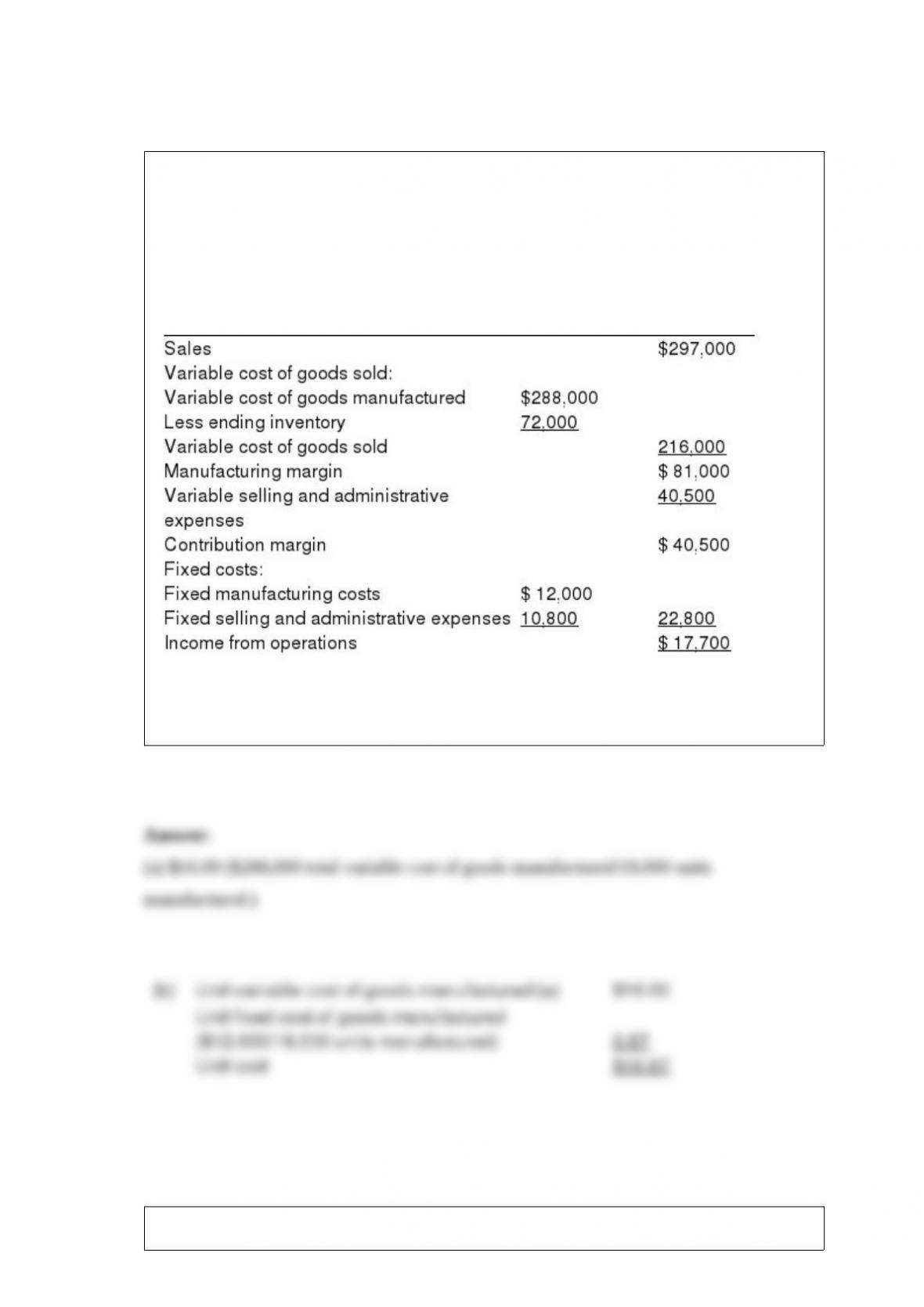
During the first year of operations, 18,000 units were manufactured and 13,500 units
were sold. On August 31, Olympic Inc. prepared the following income statement based
on the variable costing concept:
Olympic Inc.
Variable Costing Income Statement
For Year Ended August 31, 20–
Determine the unit cost of goods manufactured, based on (a) the variable costing
concept and (b) the absorption costing concept.
A low operating leverage is normal for highly automated industries.
a. True
b. False
Accountant salaries
Indicate whether the cost would typically be considered product or period cost for the
cost object given.
a. Product
b. Period
Forde Co. has an operating leverage of 4. Sales are expected to increase by 12% next
year. Operating income is
a. unaffected
b. expected to increase by 3%
c. expected to increase by 48%
d. expected to increase by 4 %
Only includes the costs of manufacturing in product cost per unit
Match the definitions that follow with the term (a’“e) it defines.
a. Demand-based concept
b. Competition-based concept
c. Product cost concept
d. Target costing
e. Production bottleneck
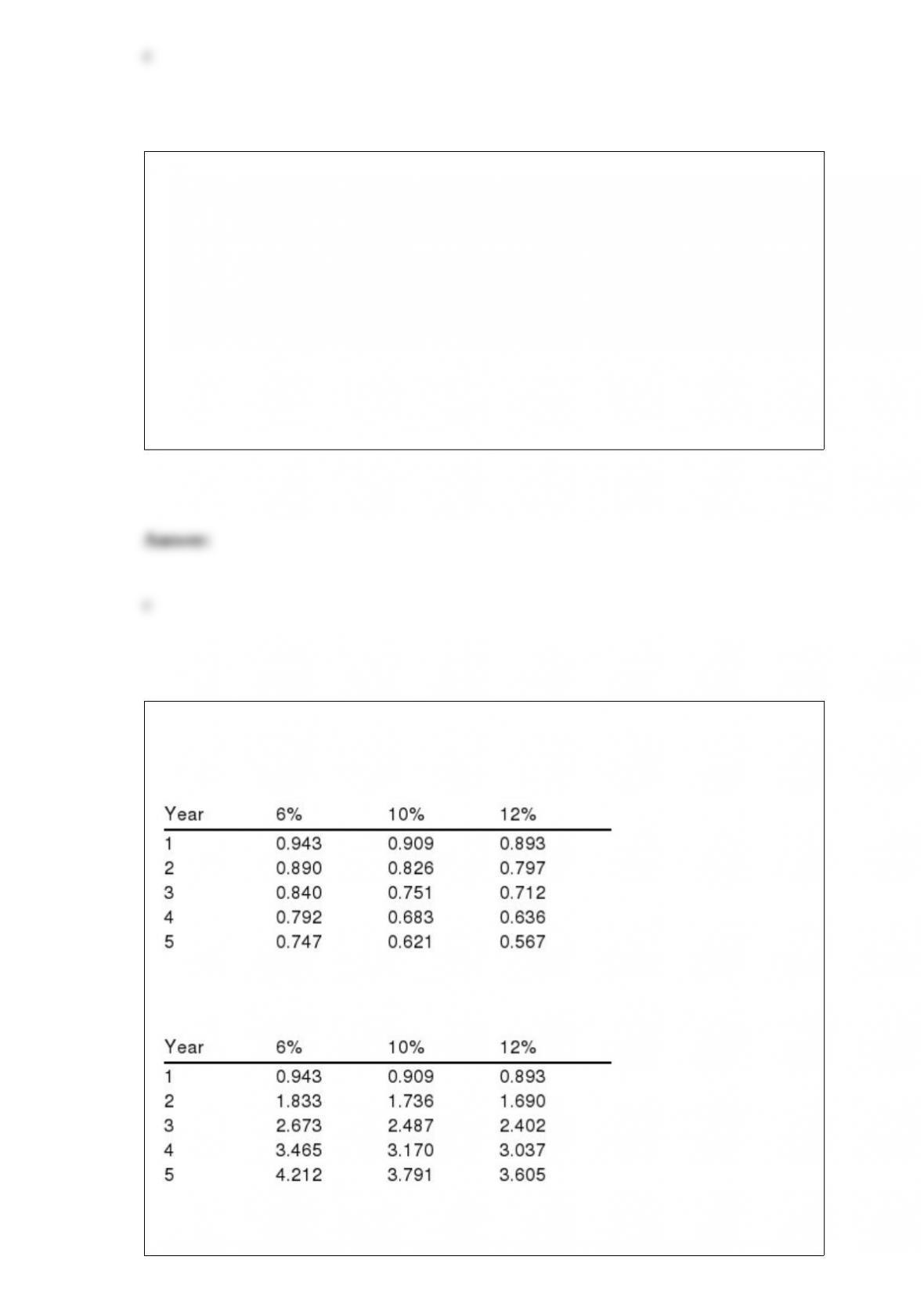
Below is a table for the present value of $1 at compound interest.
Below is a table for the present value of an annuity of $1 at compound interest.
Using the tables above, what would be the present value of $8,000 to be received 1 year

from today, assuming an earnings rate of 12%?
a. $7,544
b. $7,120
c. $7,272
d. $7,144