The payback period is the
A. length of time over which the investment will provide cash inflows.
B. length of time over which the initial investment is recovered.
C. shortest length of time over which an investment may be depreciated.
D. shortest length of time over which the net present value will be positive.
To identify costs that relate to a specific product, an allocation base should be chosen
that
A. does not have a cause-and-effect relationship.
B. has a cause-and-effect relationship.
C. considers variable costs but not fixed costs.
D. considers direct material and direct labor but not manufacturing overhead.
Robertson Company.
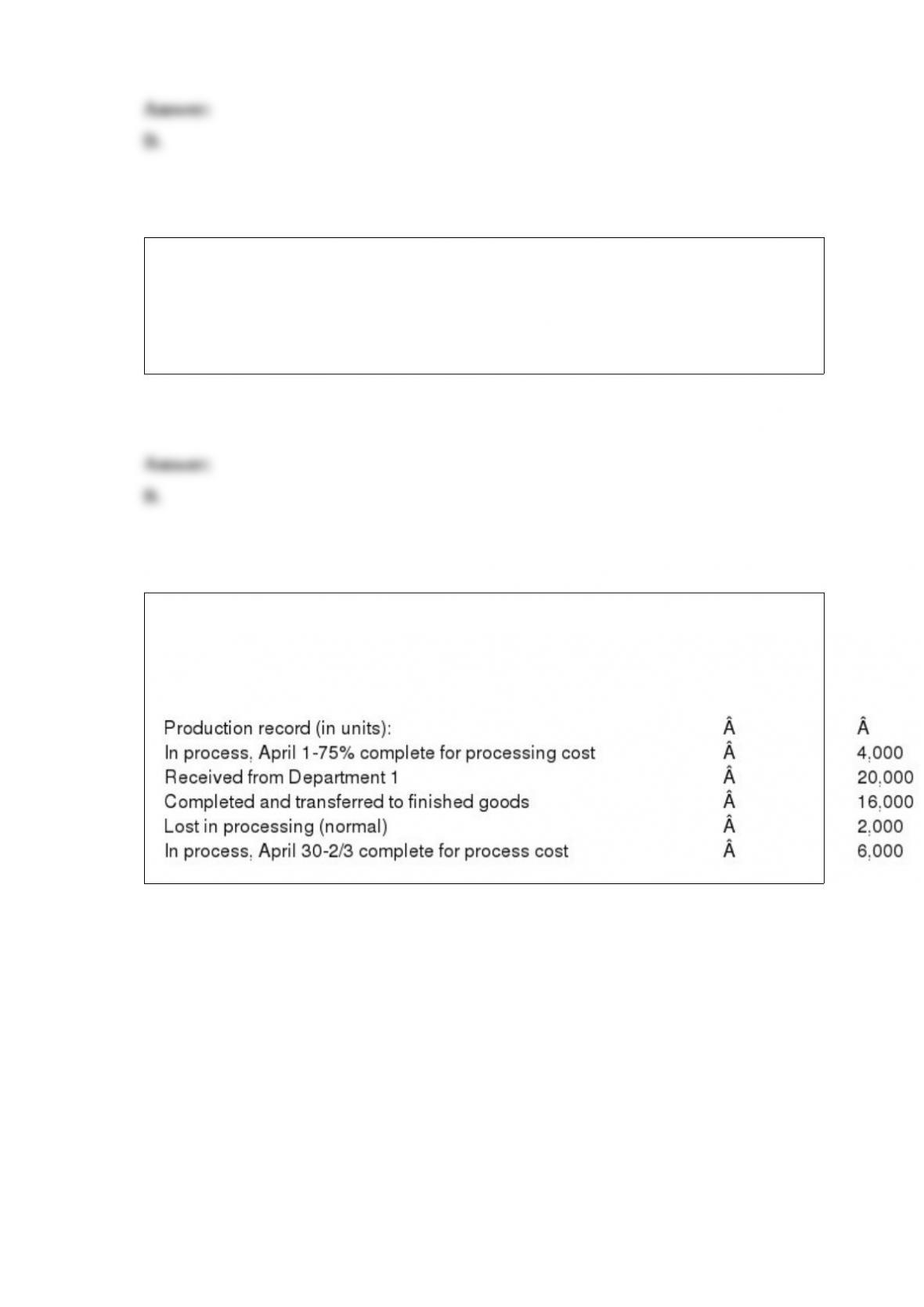
Robertson Company uses a job-order costing system and the following information is
available from its records. The company has three jobs in process: #8, #12, and #15.
Direct material was requisitioned as follows for each job respectively: 25 percent, 30
percent, and 30 percent; the balance of the requisitions was considered indirect. Direct
labor hours per job are 2,800; 3,300; and 4,000; respectively. Indirect labor is $45,000.
Other actual overhead costs totaled $50,000.
Refer to Robertson Company. What is the total amount of overhead applied to Job #12?
A. $23,750
B. $29,450
C. $39,000
D. $39,188
Substantial reductions in product cost can be obtained by
A. decreasing capacity utilization.
B. using focused factory arrangements.
C. using tried and true manufacturing techniques.
D. using product life cycle accounting.
Ewing Company manufactures a specialized product. Department 2 adds new material
to the units received from Department 1 at the end of process. A normal loss occurs
early in processing. Production and cost data for Department 2 for the month of April
are as follows:
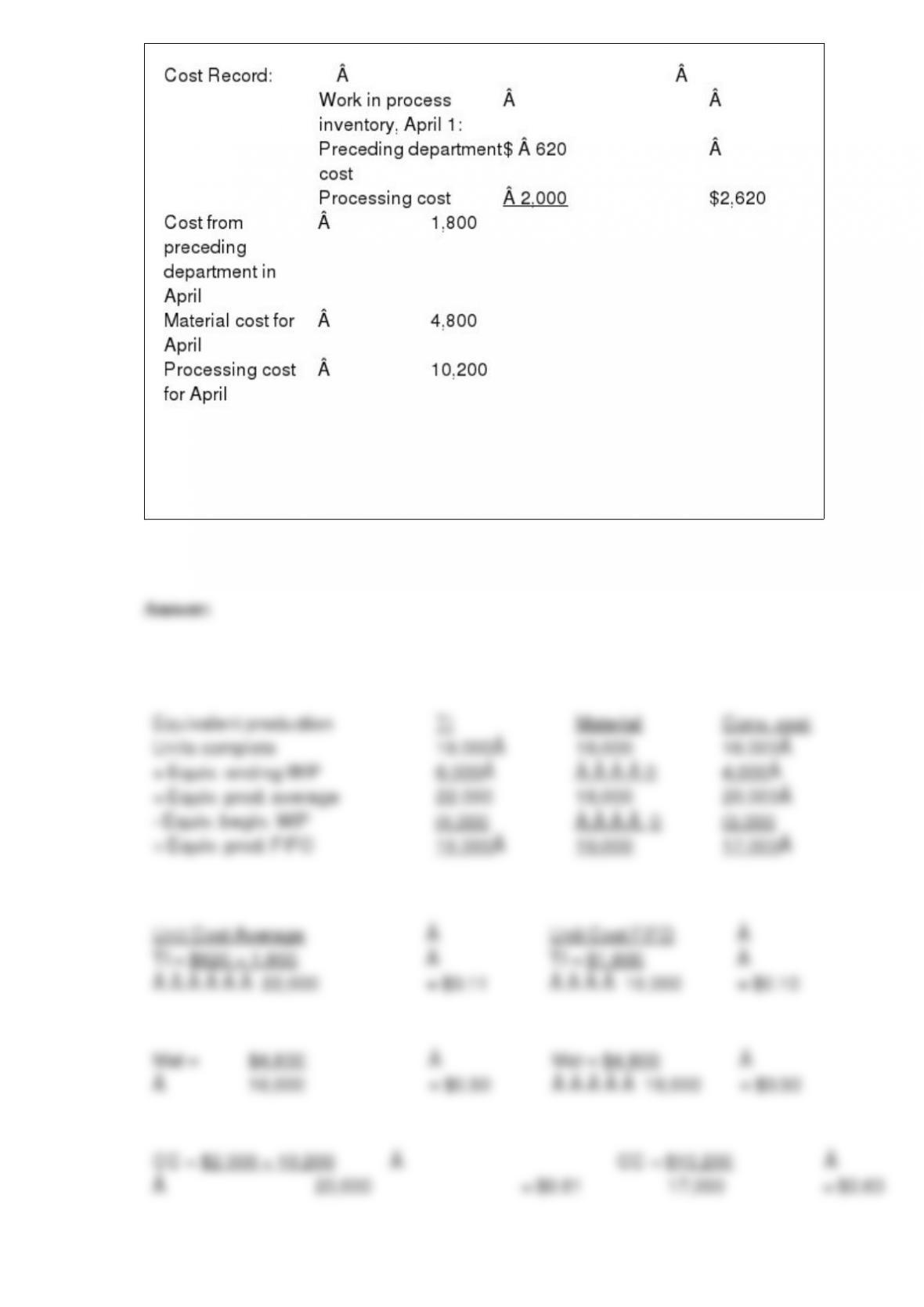
Required: Determine the following for Department 2 under (a) weighted average the
method of costing and (b) the FIFO method of costing: (1) unit costs for each cost
component, (2) cost of production transferred to finished goods, (3) cost of work in
process inventory of April 30.
In the formula y = a + bX, a represents
A. mixed cost.
B. variable cost.
C. total cost.
D. fixed cost.
The maximum allowable expenditure is the
A. appropriation.
B. allowance.
C. allocation.
D. committed fixed cost.
Which of the following items should not be included in a company’s budget manual?
A. sample budgetary forms

B. a statement of desired results of the budget
C. a listing of budgetary activities to be performed
D. financial statements for the upcoming fiscal year
Shrinkage should be treated as
A. defective units.
B. spoiled units.
C. miscellaneous expense.
D. a reduction of overhead.
Which of the following costs would be considered overhead in the production of
chocolate chip cookies?
A. flour
B. chocolate chips
C. sugar
D. oven electricity
McDonald Company
The following information relates to financial projections of McDonald Company:
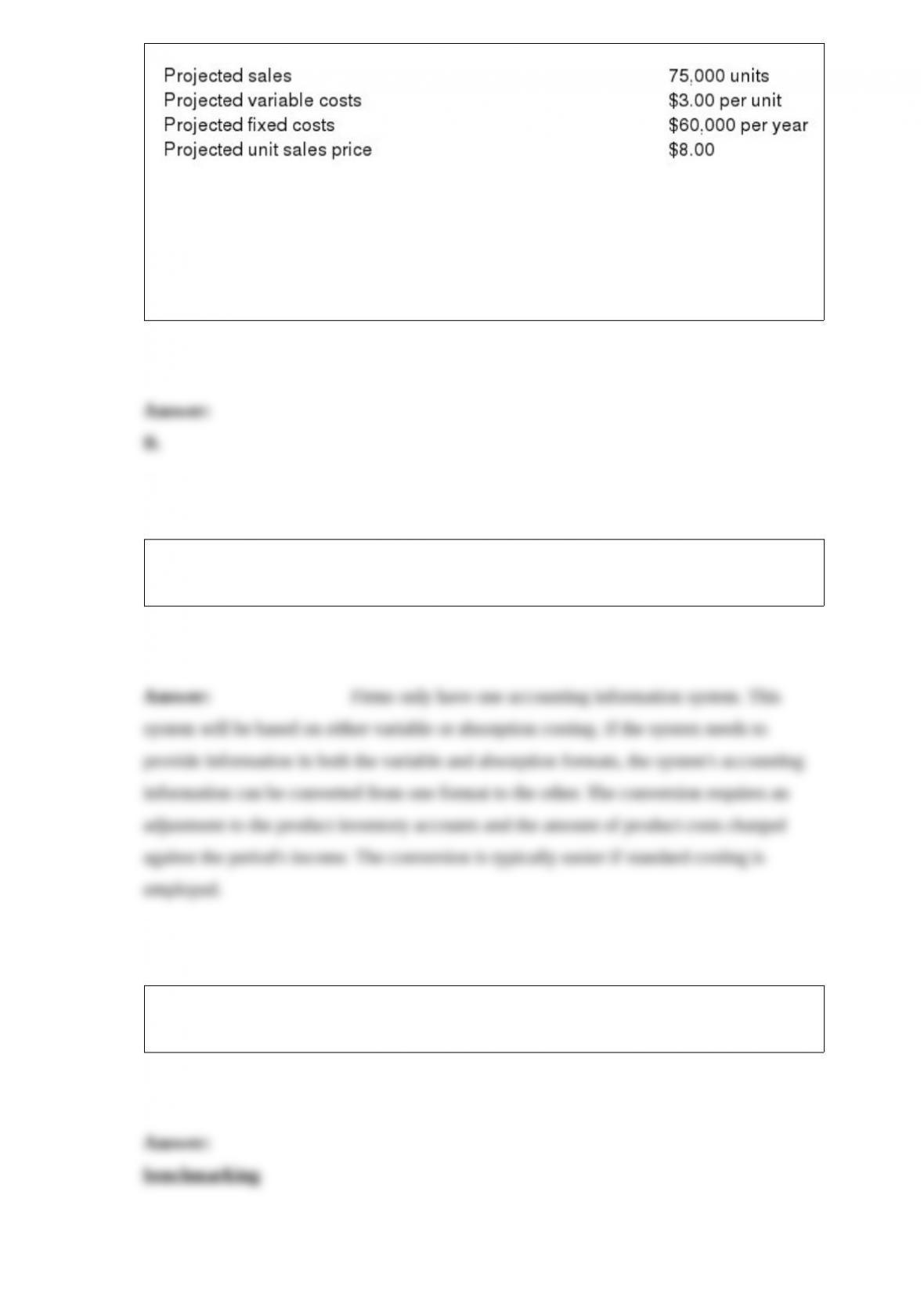
Refer to McDonald Company. If McDonald Company achieves its projections, what
will be its degree of operating leverage?
A. 6.25
B. 1.19
C. 1.68
D. 3.00
How can a company produce both variable and absorption costing information from a
single accounting system?
The process of investigating, comparing, and evaluating a company’s products or
services against those of other companies is referred to as ____________________.
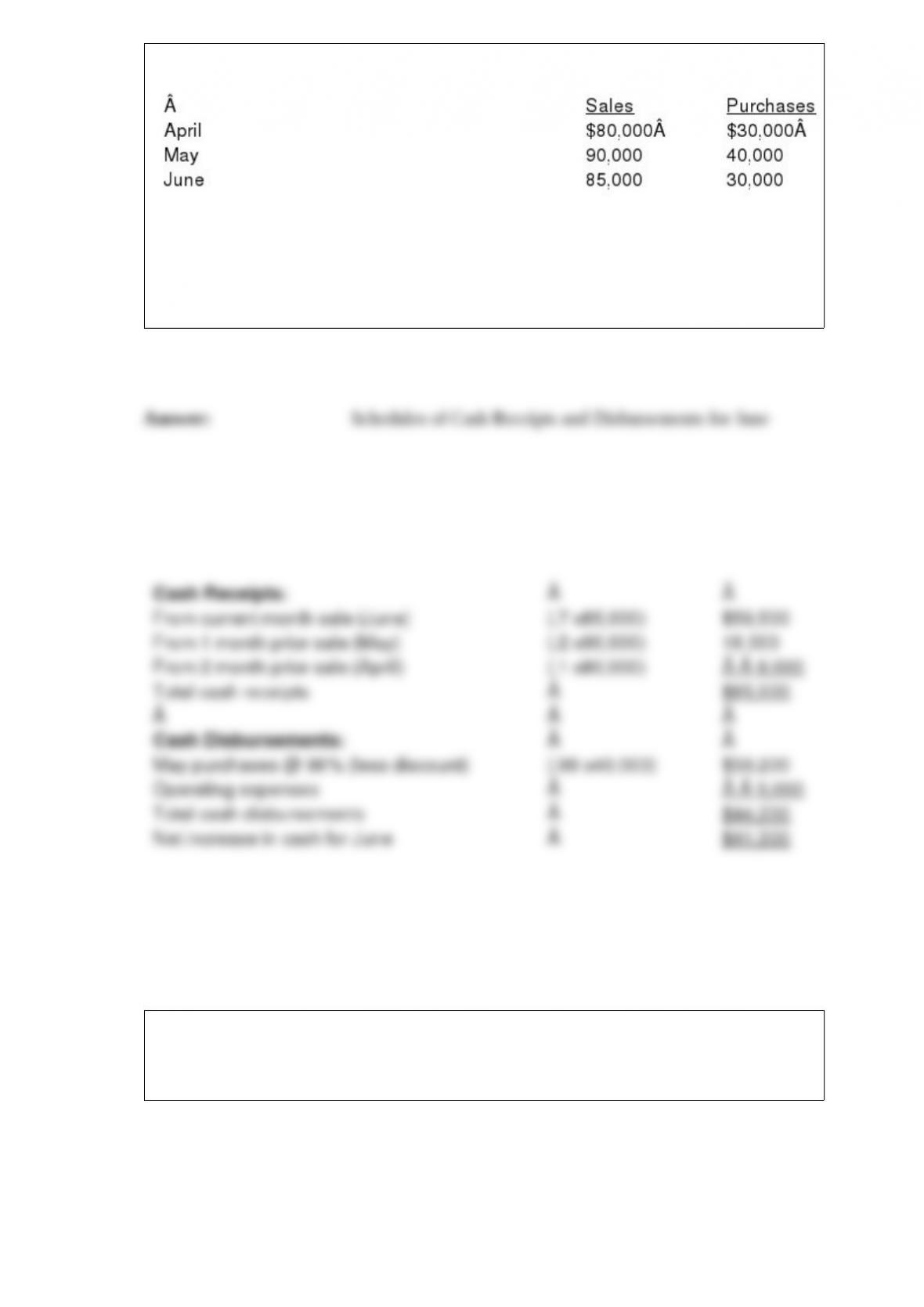
The following are forecasts of sales and purchases for Savannah Company:
All sales are on credit. Records show that 70 percent of the customers pay the month of
the sale, 20 percent pay the month after the sale, and the remaining 10 percent pay the
second month after the sale. Purchases are all paid the following month at a 2 percent
discount. Cash disbursements for operating expenses in June were $5,000.
Required: Prepare a schedule of cash receipts and disbursements for June.
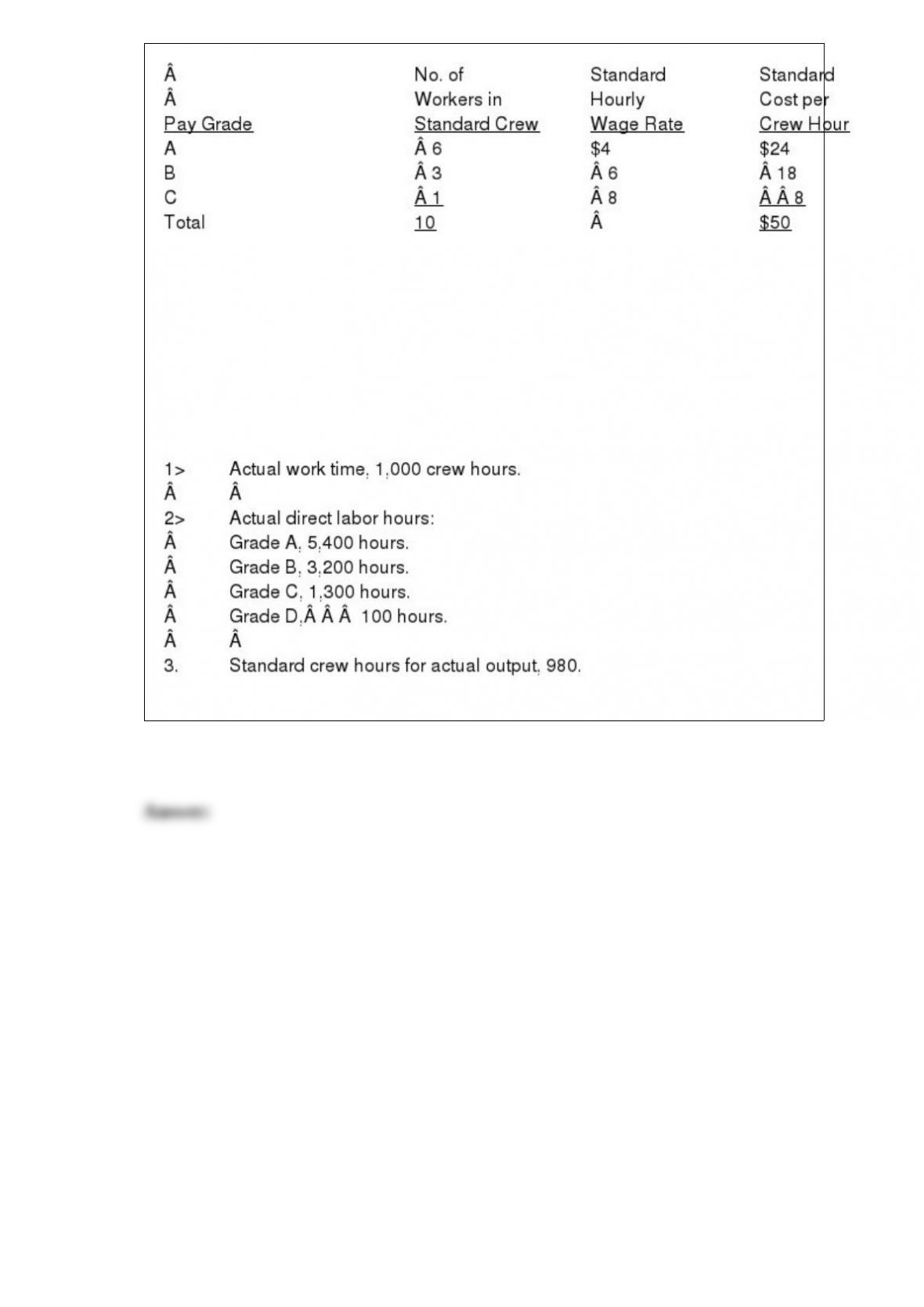
Trump Corporation operates a factory. One of its departments has three kinds of
employees on its direct labor payroll, classified as pay grades A, B, and C. The
employees work in 10-person crews in the following proportions:
The work crews cannot work short-handed. To keep a unit operating when one of the
regular crew members is absent, the head of the department first tries to reassign one of
the department’s other workers from indirect labor operations.
If no one in the department is able to step in, plant management will pull maintenance
department workers off their regular work, if possible, and assign them temporarily to
the department. These maintenance workers are all classified as Grade D employees,
with a standard wage rate of $10 an hour.
The following data relate to the operations of the department during the month of May:
Required: Compute labor rate, mix, and yield variances.
A benchmarking process that is non-industry specific and focuses on how companies
compete is referred to as ___________________________________.
Discuss the rethinking taking place regarding the time frame used in American
business performance systems.
What are the usual sources for cash in an organization?
What are the six primary goals of a cost management system? Illustrate how a CMS
achieves each of these goals.
Seminole Wire Corporation
The Wire Products Division of Seminole Wire Corporation produces “bales” of steel
wire that are used in various commercial applications. The bales sell for an average of
$20 each and The Wire Products Division has the capacity to produce 10,000 bales per
month. The Consumer Products Division of Seminole Wire Corporation uses
approximately 2,000 bales of steel wire each month in its production of various
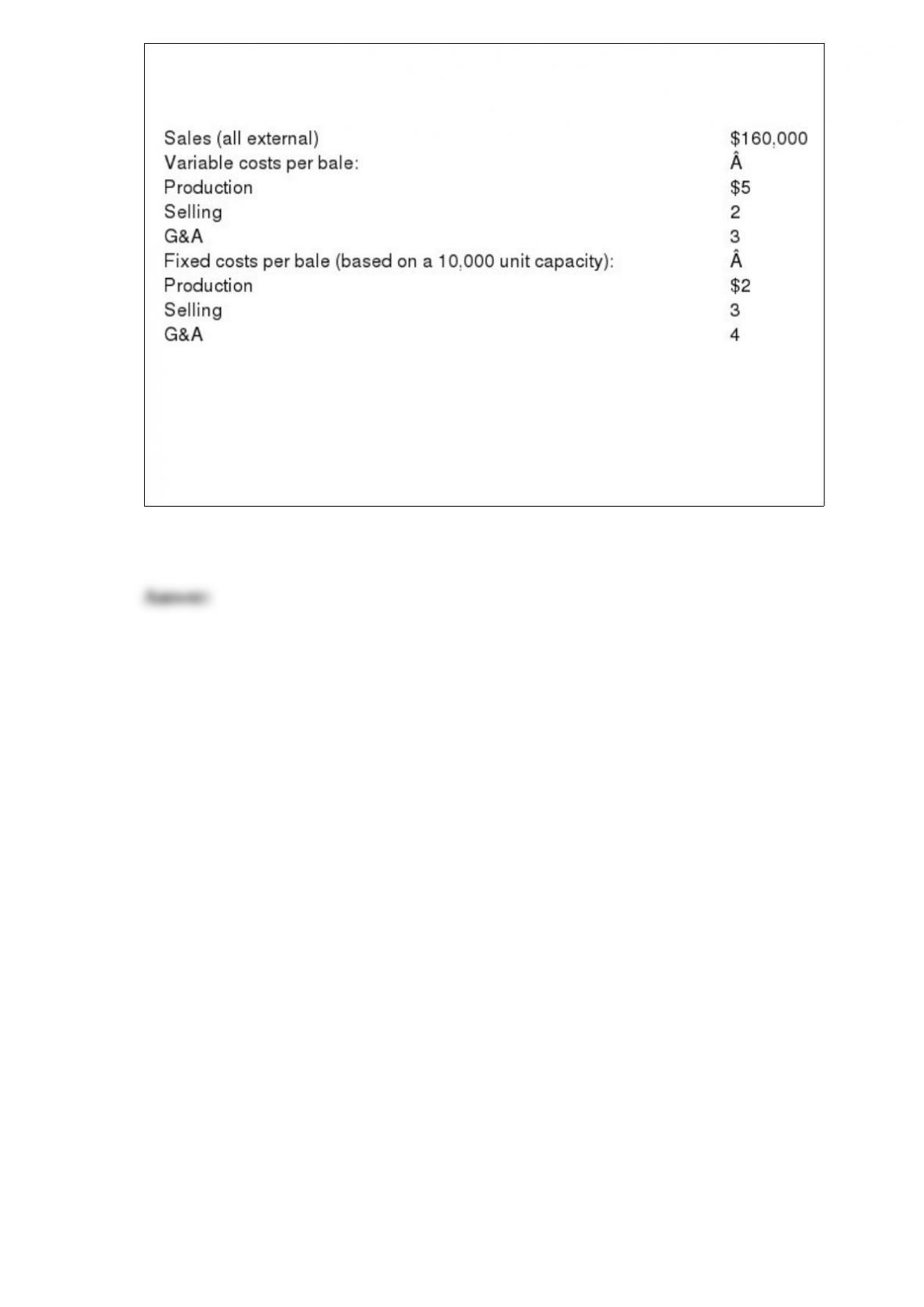
appliances. The operating information for the Wire Products Division at its present level
of operations (8,000 bales per month) follows:
The Consumer Products Division currently pays $15 per bale for wire obtained from its
external supplier.
Refer to Seminole Wire Corporation. For the Wire Products Division to operate at
break-even level, what would it need to charge for the production and transfer of 2,000
bales to the Consumer Products Division? Assume all variable costs indicated will be
incurred by the Wire Products Division.