1) In joint costing, using physical measures at splitoff to allocate costs enables the
accountant to obtain individual product costs and gross margins.
2) To reduce the undesirable incentives to build up inventories that absorption costing
can create, a number of companies use variable costing for internal reporting.
3) Standard costing is NOT possible in a firm that uses process costing.
4) Interactive control systems are informal information systems managers use to focus
the company’s attention and learning on key strategic issues.
5) Joint costs are the costs of a production process that yields multiple products
simultaneously.
6) Wayland Manufacturing uses a normal cost system and had the following data
available for 2010:
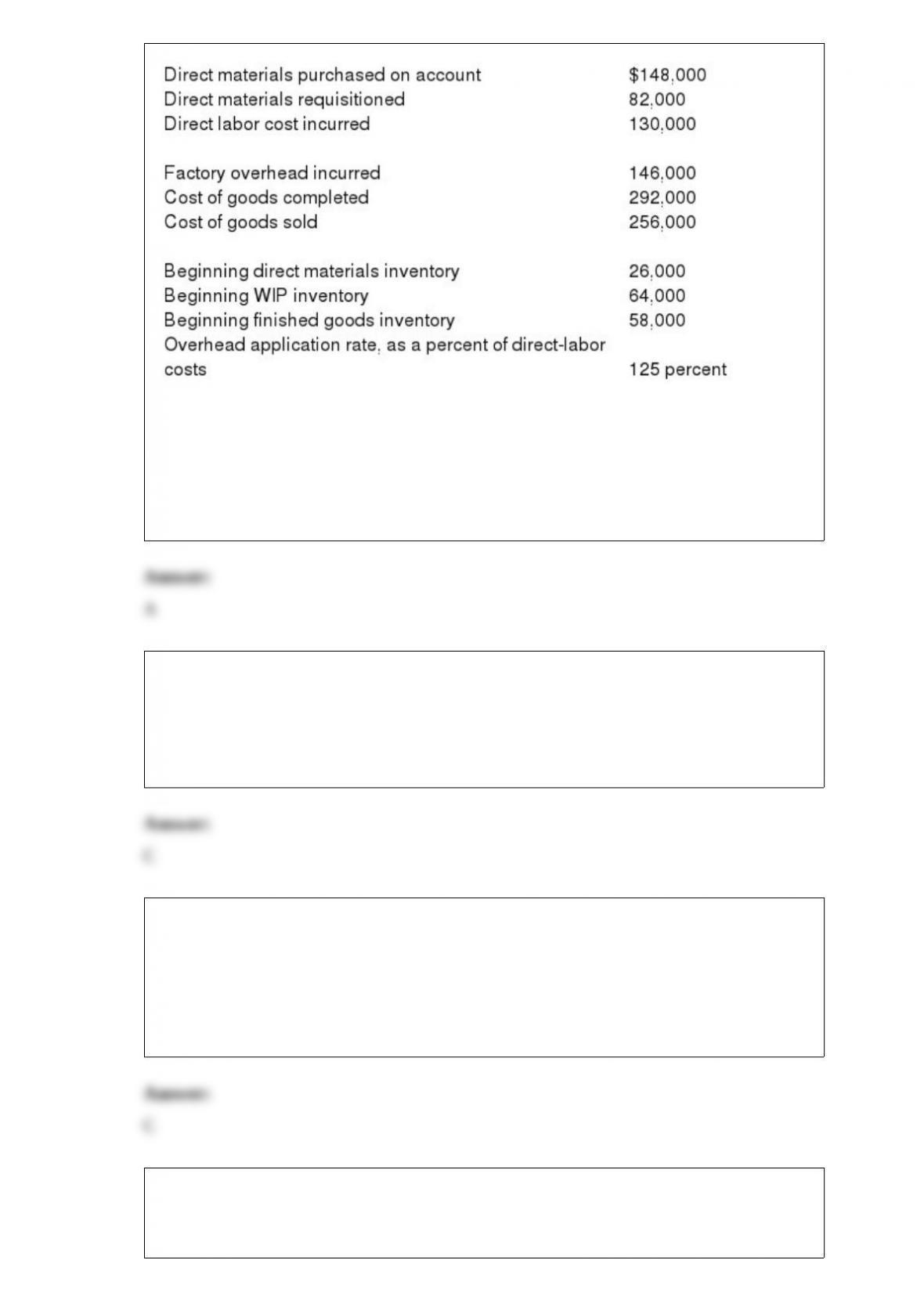
The journal entry to record the materials placed into production would include a
________.
A) credit to Direct Materials Inventory for $82,000
B) debit to Direct Materials Inventory for $148,000
C) credit to WIP Inventory for $82,000
D) debit to WIP Inventory for $148,000
7) The advantage of using normal costing instead of actual costing is ________.
A) indirect costs are assigned at the end of the year when they are known
B) the job cost is more accurate under normal costing
C) indirect costs are assigned to a job on a timely basis
D) normal costing provides a higher gross profit margin
8) Stott Company requires one full-time dock hand for every 500 packages loaded
daily. The wages for these dock hands would be:
A) variable.
B) mixed.
C) step-variable.
D) curvilinear.
9) ________ is subtracted from sales while calculating contribution margin.
A) Direct labor in factory
B) Rent on factory building
C) Rent on the headquarters building
D) Sales commission on incremental sales
10) Which of the following sections of U.S. Internal Revenue Code govern how
multinationals can set transfer prices for tax purposes?
A) Section 328
B) Section 382
C) Section 428
D) Section 482
11) Practical capacity is the denominator-level concept that ________.
A) reduces theoretical capacity for unavoidable operating interruptions
B) is the maximum level of operations at maximum efficiency
C) is based on the level of capacity utilization that satisfies average customer demand
over periods generally longer than one year
D) is based on anticipated levels of capacity utilization for the coming budget period
12) In cost-plus pricing, the markup component ________.
A) is a rigid number
B) is ultimately determined by the market
C) provides a means to calculate the actual selling price
D) is the end rather than the start of pricing decisions
13) Under absorption costing, fixed manufacturing costs ________.
A) are period costs
B) are inventoriable costs
C) are treated as an expense
D) are sunk costs
14) Which of the following statements about net income (NI) is true?
A) NI = operating income plus nonoperating revenue.
B) NI = operating income plus operating costs.
C) NI = operating income less income taxes.
D) NI = operating income less cost of goods sold.
15) Classifying a cost as either direct or indirect depends upon ________.
A) the behavior of the cost in response to volume changes
B) whether the cost is expensed in the period in which it is incurred
C) whether the cost can be easily traced with the cost object
D) whether a cost is fixed or variable
16) LaCrosse Products has a budget of $900,000 in 2015 for prevention costs. If it
decides to automate a portion of its prevention activities, it will save $80,000 in
variable costs. The new method will require $40,000 in training costs and $100,000 in
annual equipment costs. Management is willing to adjust the budget for an amount up
to the cost of the new equipment. The budgeted production level is 150,000 units.
Appraisal costs for the year are budgeted at $600,000. The new prevention procedures
will save appraisal costs of $50,000. Internal failure costs average $15 per failed unit of
finished goods. The internal failure rate is expected to be 3% of all completed items.
The proposed changes will cut the internal failure rate by one-third. Internal failure
units are destroyed. External failure costs average $54 per failed unit. The company’s
average external failures average 3% of units sold. The new proposal will reduce this
rate by 50%. Assume all units produced are sold and there are no ending inventories.
How much do external failure costs change if all changes are as anticipated with the
new prevention procedures? Assume all units produced are sold and there are no ending
inventories.
A) $121,500 decrease
B) $121,500 increase
C) $243,000 decrease
D) None of these answers is correct.
17) Locil Corporation recently purchased a new machine for $415,275 with a nine-year
life. The old equipment has a remaining life of nine years and no disposal value at the
time of replacement. Net cash flows will be $75,000 per year. What is the internal rate
of return?
A) 11%
B) 16%
C) 20%
D) 24%
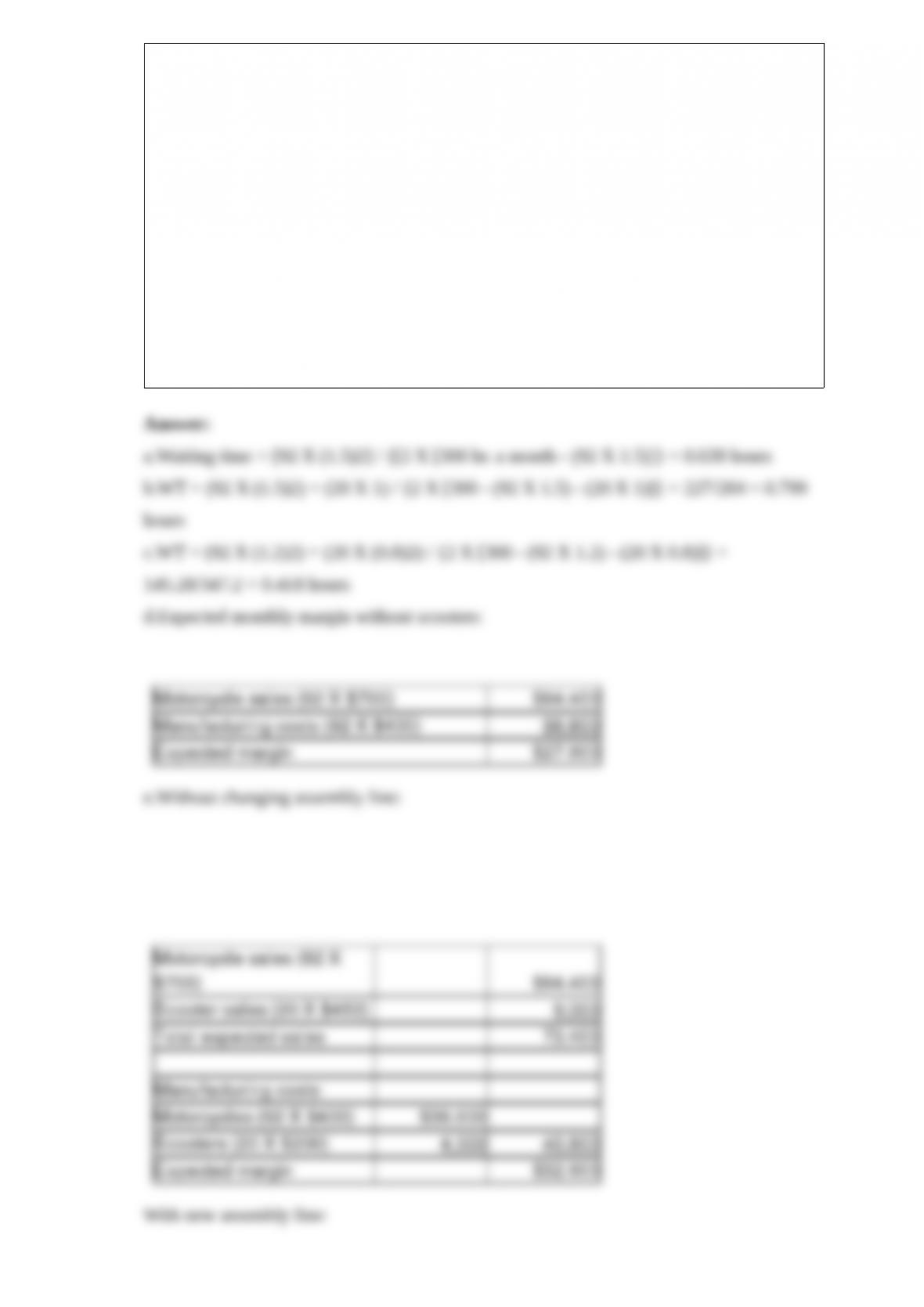
18) Jean Peck’s Furniture’s manufactures tables for hospitality sector. It takes only bulk
orders and each table is sold for $300 after negotiations. In the month of January, it
manufactures 3,000 tables and sells 2,250 tables. Actual fixed costs are the same as the
amount fixed costs budgeted for the month.
The following information is provided for the month of January:
At the end of the month Jean Peck’s Furniture’s has an ending inventory of finished
goods of 750 units. The company also incurs a sales commission of $10 per unit.
What is the gross margin when using absorption costing?
A) $675,000
B) $527,500
C) $270,000
D) $337,500
19) Venlaz Corp makes small motorcycles. The monthly demand ranges from 80 to 100
motorcycles. The average demand is 92 motorcycles. The plant operates 300 hours a
month. Each cycle takes approximately 1.5 hours.
If the company adds a new line of scooters, initial demand will be 20 per month. Each
scooter will take 1 hour to make. To offset approaching production capacity, expanding
the assembly line is possible. This will decrease manufacturing time for all products by
20%. However, this will increase the costs of cycles from $400 to $500 and scooters
from $200 to $240. The change will also cause increases in prices from $700 to $750
for cycles and from $450 to $500 for scooters.
Required:
a.What is the average waiting time for cycles if they are the only item manufactured?
b.What are the average waiting times if both cycles and scooters are produced and the
assembly line is not enlarged?
c.What are the average waiting times if both cycles and scooters are produced and the
assembly line is enlarged?
d.What is the expected monthly margin without scooters if the company sells all 92
cycles it manufactures?
e.What are the expected monthly contribution margins if scooters are made with the
current assembly line and with the new assembly line? Assume average sales and that
sales equal production.
f.What action do you recommend?
20) Aaron Corp’s net income is $25,000. What is the amount of the investment if the
return on investment is 20%?
A) $50,000
B) $100,000
C) $125,000
D) $250,000
21) Among different types of costs associated with inventory, the incoming freight
charges of inventories are ________.
A) purchasing costs
B) ordering costs
C) stockout costs
D) carrying costs
22) ________ are all manufacturing costs that are related to the cost object but cannot
be traced to that cost object.
A) Indirect manufacturing costs
B) Marketing costs incurred
C) Variable manufacturing costs
D) Custom duties paid for the materials
23) Which of the following costs is classified as a prime cost?
Direct materials Indirect materials
A) Yes Yes
B) No No
C) Yes No
D) No Yes
24) Dolph and Evan started the DE Restaurant in 20X3. They rented a building, bought
equipment, and hired two employees to work full time at a fixed monthly salary.
Utilities and other operating charges remain fairly constant during each month.
During the past two years, the business has grown with average sales increasing 1% a
month. This situation pleases both Dolph and Evan, but they do not understand how
sales can grow by 1% a month while profits are increasing at an even faster pace. They
are afraid that one day they will wake up to increasing sales but decreasing profits.
Required:
Explain why the profits have increased at a faster rate than sales. Use the terms variable
costs and fixed costs in your response.
25) What is decentralization and what are its benefits?
26) Describe and discuss the two methods of allocating revenues of a bundled package
to the individual products in that package. Describe any special problems associated
with the method.
27) “Management control systems consist of formal and informal control systems.”
Briefly explain the formal and informal management systems and enlist their
components.
28) Discuss the means by which a company goes about evaluating and installing a new
quality improvement program.
29) Manufacturing cycle times affect both revenues and costs. Explain.
30) Explain capital budgeting and then briefly discuss each of the five stages of a
capital budgeting project?