1) Indicate whether each of the following statements about contingent liabilities is true
or false.
1>If the likelihood of a future obligation from a contingent liability is remote, a
company does not report it on the financial statements or disclose it in the notes to the
financial statements
2>If a company has a contingent liability where the future obligation is deemed
probable but the amount cannot be estimated, the liability should be disclosed in the
footnotes to the financial statements
3>Employees’ vacation pay is a contingent liability that usually should be recognized
on the financial statements
4>If a customer was injured while using a company’s product, the company might need
to disclose a contingent liability
5>If a company has a contingent liability where the future obligation is deemed
possible, the liability should be reported on the balance sheet
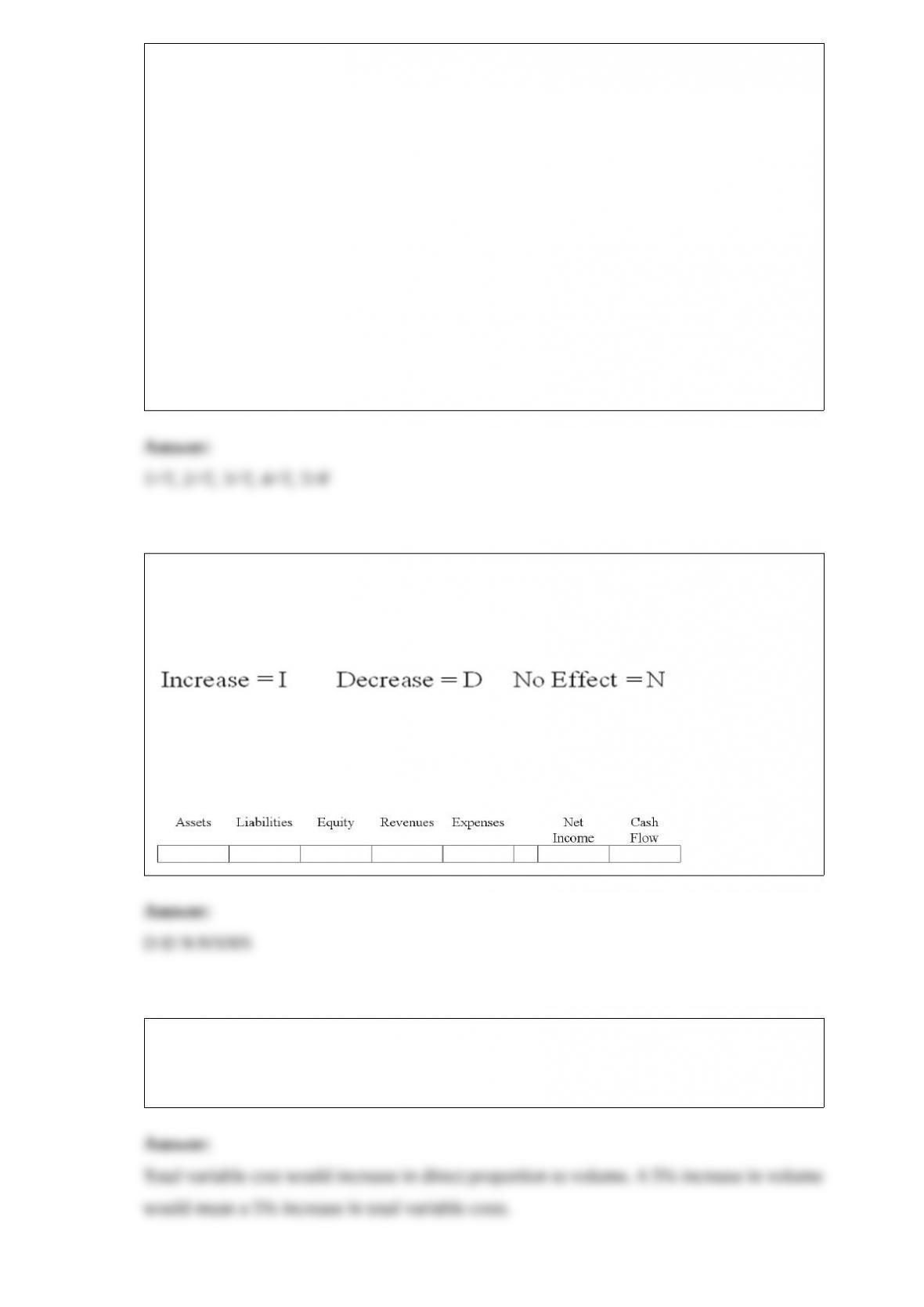
2) Indicate how each event affects the elements of financial statements. Use the
following letters to record your answer in the box shown below each element. You do
not need to enter amounts. Assume use of a perpetual inventory system.
Youkilis Company discovered that a recent shipment of merchandise it had purchased
was not of good quality. The seller agreed to grant Youkilis an allowance of $500.
Youkilis had not yet paid the amount owed for the merchandise. Show how the
transaction would affect Youkilis’s financial statements.
3) Company A has variable costs per unit of $20, fixed costs of $300,000, and a
break-even sales volume of 60,000 units.
How does total variable cost respond when volume increases?
4) If goods are shipped FOB destination, who is responsible for the shipping costs – the
buyer or the seller?
5) Indicate whether each of the following statements about financial statement analysis
is true or false.
1>The asset turnover ratio is calculated by dividing net income by average total assets
2>The use of financial leverage often causes a business’s return on equity to be higher
than its return on investment
3>The asset turnover ratio is likely to be high in an industry in which operations require
a low investment in assets
4>Return on equity measures the wealth generated by the amount of assets invested in a
business
5>A higher value for the return on investment ratio would generally indicate more
effective company management
6) Explain the difference between horizontal analysis and vertical analysis of a
company’s financial statements.
7) What is the importance of date of record when a corporation declares a dividend?

8) What is “Retained Earnings?”
9) What does the internal rate of return tell you about a capital investment?
10) How does the use of standard costs fit with the philosophy of management by
exception?