1) deferred tax amounts that are related to specific assets or liabilities should be
classified as current or noncurrent based on
a.their expected reversal dates
b.their debit or credit balance
c.the length of time the deferred tax amounts will generate future tax deferral benefits
d.the classification of the related asset or liability
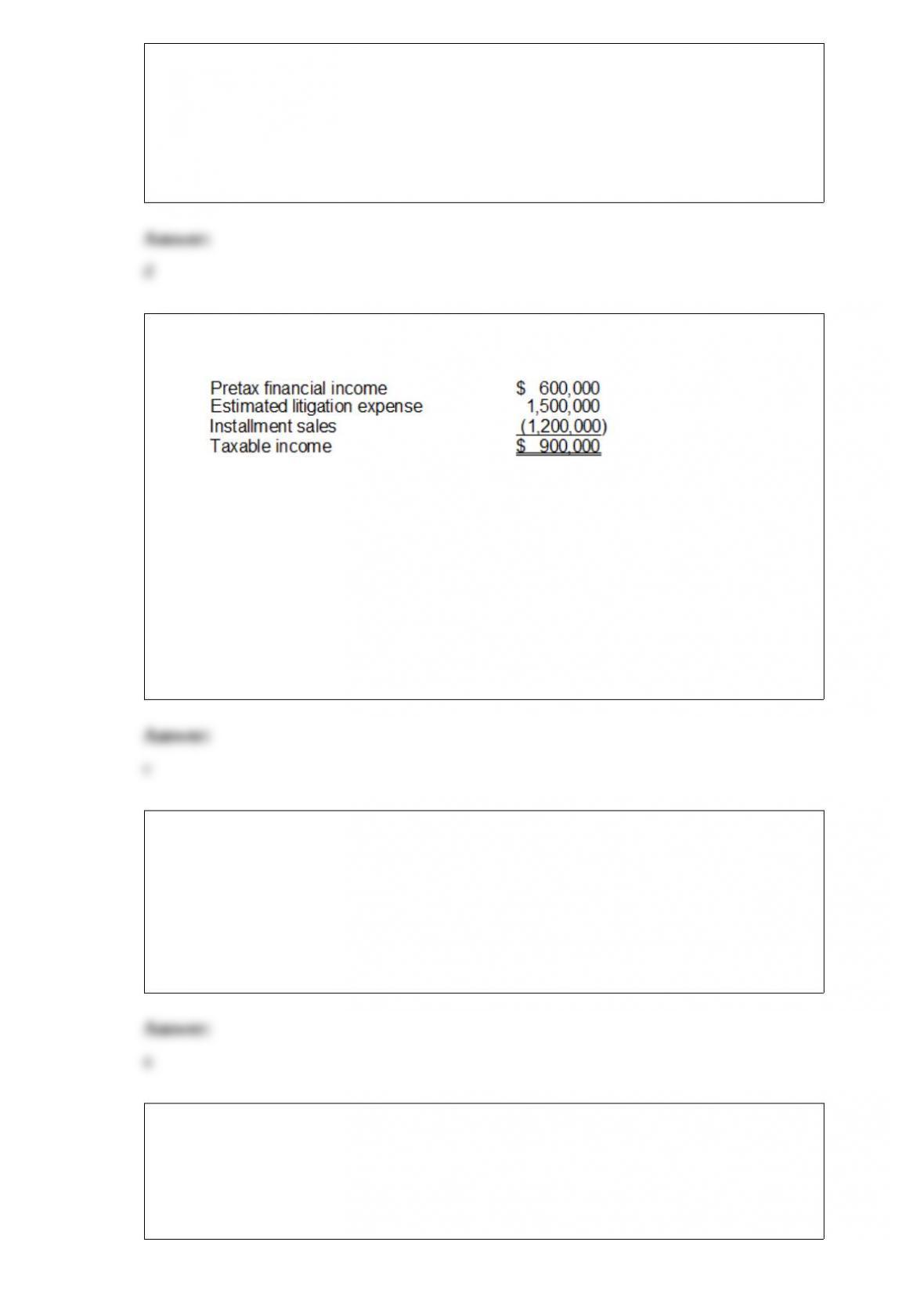
2) mathis co. at the end of 2012, its first year of operations, prepared a reconciliation
between pretax financial income and taxable income as follows:
the estimated litigation expense of $1,500,000 will be deductible in 2014 when it is
expected to be paid. the gross profit from the installment sales will be realized in the
amount of $600,000 in each of the next two years. the estimated liability for litigation is
classified as noncurrent and the installment accounts receivable are classified as
$600,000 current and $600,000 noncurrent. the income tax rate is 30% for all years.
the deferred tax liabilitycurrent to be recognized is
a.$90,000
b.$270,000
c.$180,000
d.$360,000.
3) james leases a ski chalet to his best friend, janet. the lease term is five years with
$16,000 annual payments due at the beginning of each year. what is the present value of
the payments discounted at 8% per annum?
a.$68,994
b.$63,884
c.$61,077
d.$57,990
4) which of the following temporary differences results in a deferred tax asset in the
year the temporary difference originates?
i.accrual for product warranty liability.
ii.subscriptions received in advance.
iii.prepaid insurance expense.
a.i and ii only
b.ii only
c.iii only
d.i and iii only
5) stevenson company purchased a depreciable asset for $350,000 on april 1, 2010. the
estimated salvage value is $35,000, and the estimated useful life is 5 years. the
straight-line method is used for depreciation. what is the balance in accumulated
depreciation on may 1, 2013 when the asset is sold?
a.$126,000
b.$147,000
c.$173,250
d.$194,250
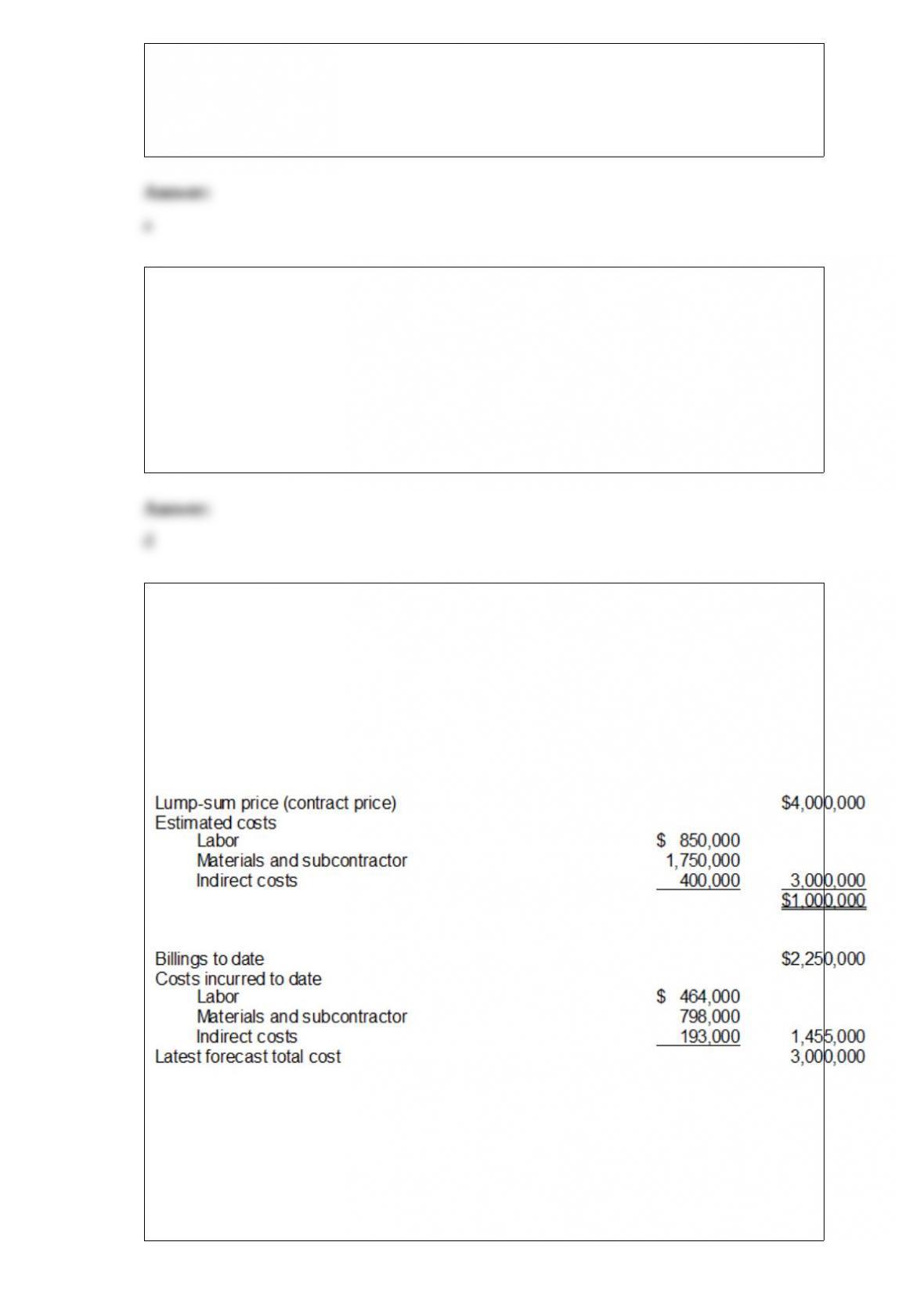
6) dobson construction specializes in the construction of commercial and industrial
buildings. the contractor is experienced in bidding long-term construction projects of
this type, with the typical project lasting fifteen to twenty-four months. the contractor
uses the percentage-of-completion method of revenue recognition since, given the
characteristics of the contractor’s business and contracts, it is the most appropriate
method. progress toward completion is measured on a cost to cost basis. dobson began
work on a lump-sum contract at the beginning of 2013. as bid, the statistics were as
follows:
at the end of the first year, the following was the status of the contract:
it should be noted that included in the above costs incurred to date were standard
electrical and mechanical materials stored on the job site, but not yet installed, costing
$105,000. these costs should not be considered in the costs incurred to date.
instructions
(a)compute the percentage of completion on the contract at the end of 2013.
(b)indicate the amount of gross profit that would be reported on this contract at the end
of 2013.
(c)make the journal entry to record the income (loss) for 2013 on dobson’s books.
(d)indicate the account(s) and the amount(s) that would be shown on the balance sheet
of dobson construction at the end of 2013 related to its construction accounts. also
indicate where these items would be classified on the balance sheet. billings collected
during the year amounted to $1,980,000.
(e)assume the latest forecast on total costs at the end of 2013 was $4,080,000. how
much income (loss) would dobson report for the year 2013?
7) application of the full disclosure principle
a.is theoretically desirable but not practical because the costs of complete disclosure
exceed the benefits
b.is violated when important financial information is buried in the notes to the financial
statements
c.is demonstrated by the use of supplementary information presenting the effects of
changing prices
d.requires that the financial statements be consistent and comparable

8) mordica company will receive $250,000 in 7 years. if the appropriate interest rate is
10%, the present value of the $250,000 receipt is
a.$127,500
b.$128,290
c.$377,500
d.$487,180
9) the cost of a nonmonetary asset acquired in exchange for another nonmonetary asset
and the exchange has commercial substance is usually recorded at
a.the fair value of the asset given up, and a gain or loss is recognized
b.the fair value of the asset given up, and a gain but not a loss may be recognized
c.the fair value of the asset received if it is equally reliable as the fair value of the asset
given up
d.either the fair value of the asset given up or the asset received, whichever one results
in the largest gain (smallest loss) to the company
10) in a period of rising prices which inventory method generally provides the greatest
amount of net income?
a.average cost
b.fifo
c.lifo
d.specific identification
11) in march 2013, an explosion occurred at kirk co.’s plant, causing damage to area
properties. by may 2013, no claims had yet been asserted against kirk. however, kirk’s
management and legal counsel concluded that it was reasonably possible that kirk
would be held responsible for negligence, and that $4,000,000 would be a reasonable
estimate of the damages. kirk’s $5,000,000 comprehensive public liability policy
contains a $400,000 deductible clause. in kirk’s december 31, 2012 financial statements,
for which the auditor’s fieldwork was completed in april 2013, how should this casualty
be reported?
a.as a note disclosing a possible liability of $4,000,000
b.as an accrued liability of $400,000
c.as a note disclosing a possible liability of $400,000.
d.no note disclosure of accrual is required for 2012 because the event occurred in 2013
12) koehn corporation accounts for its investment in the common stock of sells
company under the equity method. koehn corporation should ordinarily record a cash
dividend received from sells as
a.a reduction of the carrying value of the investment
b.additional paid-in capital
c.an addition to the carrying value of the investment
d.dividend income
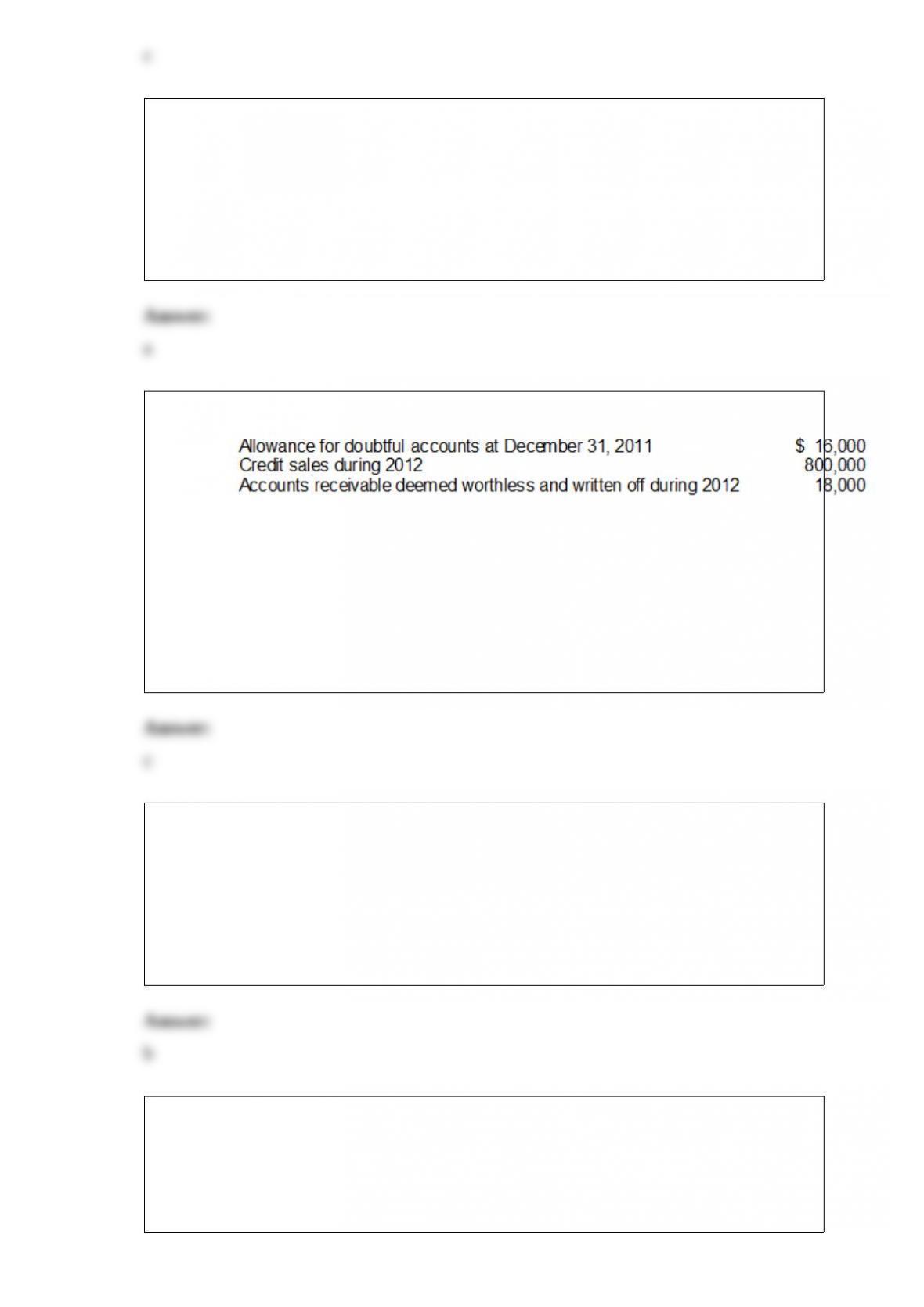
13) the following information is available for murphy company:
as a result of a review and aging of accounts receivable in early january 2013, however,
it has been determined that an allowance for doubtful accounts of $11,000 is needed at
december 31, 2012. what amount should murphy record as “bad debt expense” for the
year ended december 31, 2012?
a.$9,000
b.$11,000
c.$13,000
d.$27,000
14) if a company uses the periodic inventory system, what is the impact on the current
ratio of including goods in transit f.o.b. shipping point in purchases, but not ending
inventory?
a.overstate the current ratio
b.understate the current ratio
c.no effect on the current ratio
d.not sufficient information to determine effect on the current ratio
15) smiley’s net cash used in financing activities for 2013 was
a.$25,000
b.$225,000
c.$450,000
d.$475,000
16) when using dollar-value lifo, if the incremental layer was added last year, it should
be multiplied by
a.last year’s cost ratio and this year’s index
b.this year’s cost ratio and this year’s index
c.last year’s cost ratio and last year’s index
d.this year’s cost ratio and last year’s index
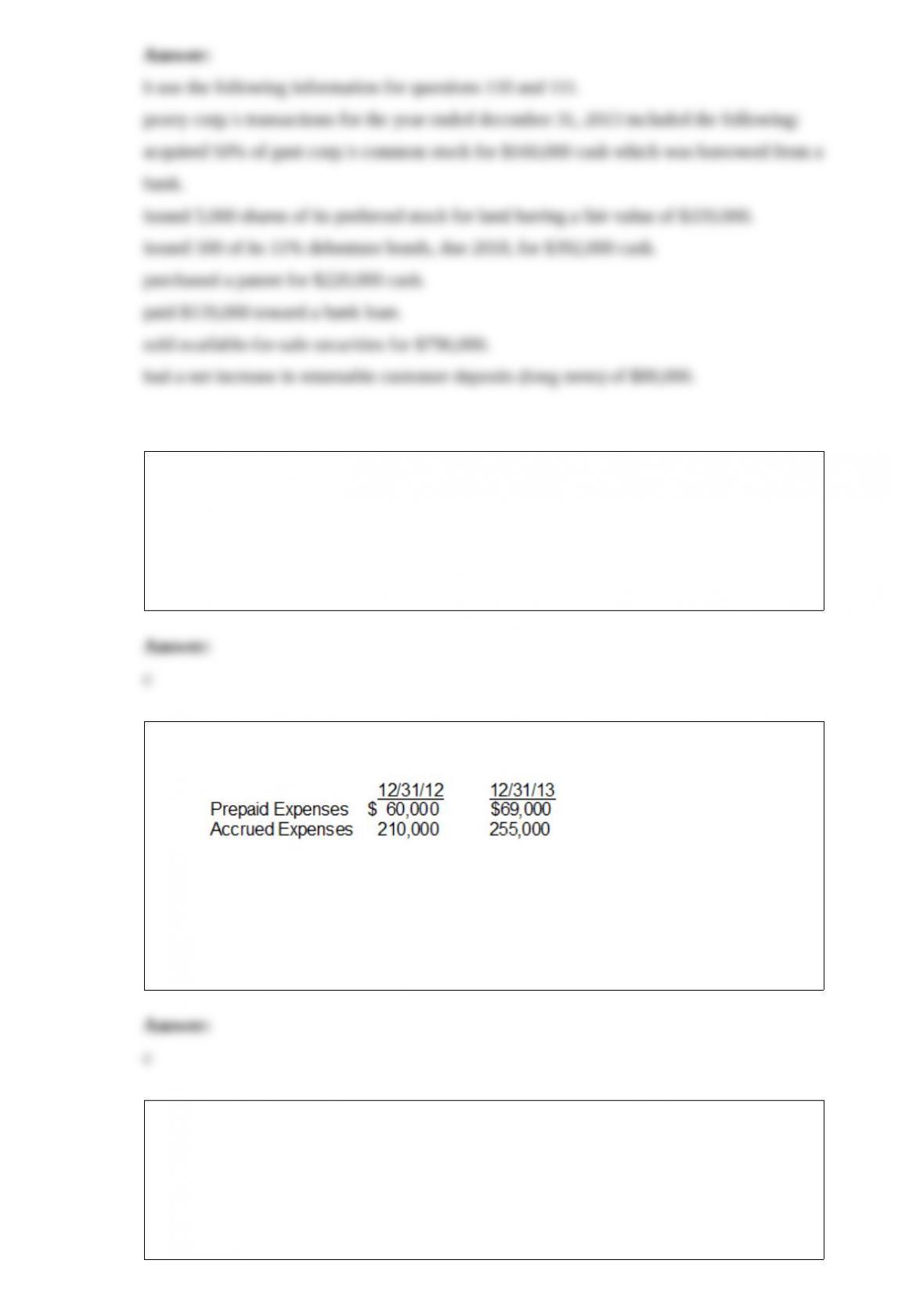
17) donnegan company reported operating expenses of $365,000 for 2013. the
following data were extracted from the companys financial records:
on a statement of cash flows for 2013, using the direct method, cash payments for
operating expenses should be:
a.$419,000
b.$401,000
c.$329,000
d.$311,000
18) maso company recorded journal entries for the issuance of common stock for
$80,000, the payment of $26,000 on accounts payable, and the payment of salaries
expense of $42,000. what net effect do these entries have on owners equity?
a.increase of $80,000
b.increase of $54,000
c.increase of $38,000
d.increase of $12,000
19) sandstrom corporation has an extraordinary loss of $150,000, an unusual gain of
$105,000, and a tax rate of 40%. at what amount should sandstrom report each item?
extraordinary lossunusual gain
a.$(150,000)$105,000
b.(150,000)63,000
c.(90,000)105,000
d.(90,000)63,000
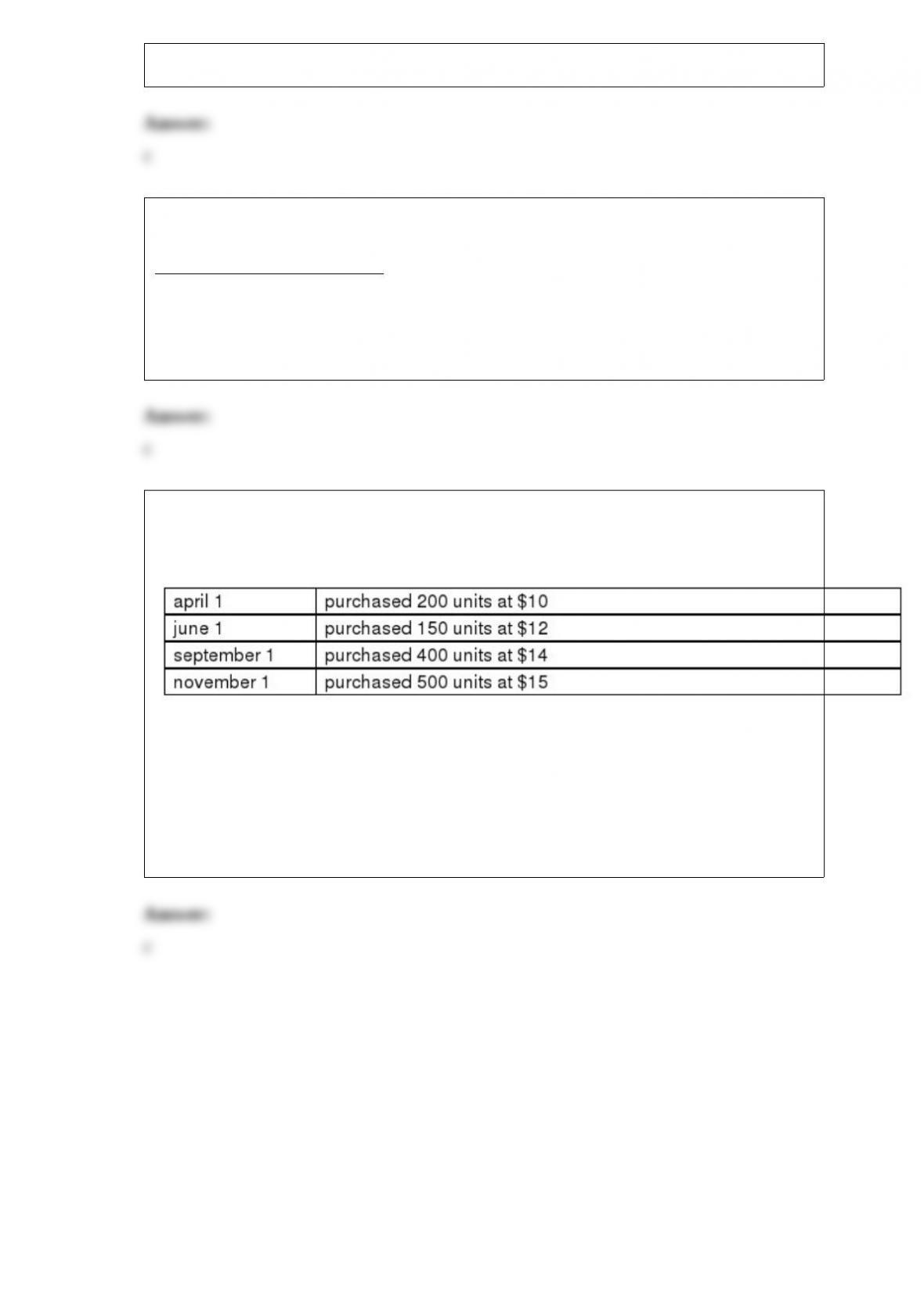
20) barton company uses a periodic inventory system. on january 1, 2012, barton
company had 600 units of inventory on hand at a cost of $8 per unit. during 2012,
barton made the following inventory purchases.
assume barton company sold 1,150 units of inventory during 2012.
if you assume that barton follows ifrs and uses the average-cost method, what is the
ending inventory and cost of goods sold, respectively?
a.ending inventory = $5,800; cost of goods sold = $15,900
b.ending inventory = $8,260; cost of goods sold = $13,440
c.ending inventory = $8,211; cost of goods sold = $13,489
d.ending inventory = $10,300; cost of goods sold = $11,400