
The Winston Company estimates that the factory overhead for the following year will
be $1,250,000. The company has decided that the basis for applying factory overhead
should be machine hours, which is estimated to be 50,000 hours. The total machine
hours for the year was 54,300. The actual factory overhead for the year was $1,375,000.
Determine the over or under applied amount for the year.
A.$17,500 overapplied
B.$17,500 underapplied
C.$118,250 overapplied
D.$118,250 underapplied
Answer:
Using the allowance method of accounting for uncollectible receivables, the entry to
reinstate a specific receivable previously written off would include a
A.credit to Bad Debt Expense
B.credit to Accounts Receivable
C.debit to Allowance for Doubtful Accounts
D.debit to Accounts Receivable
Answer:
The exclusive right to use a certain name or symbol is called a
A.goodwill
B.patent
C.trademark
D.copyright
Answer:
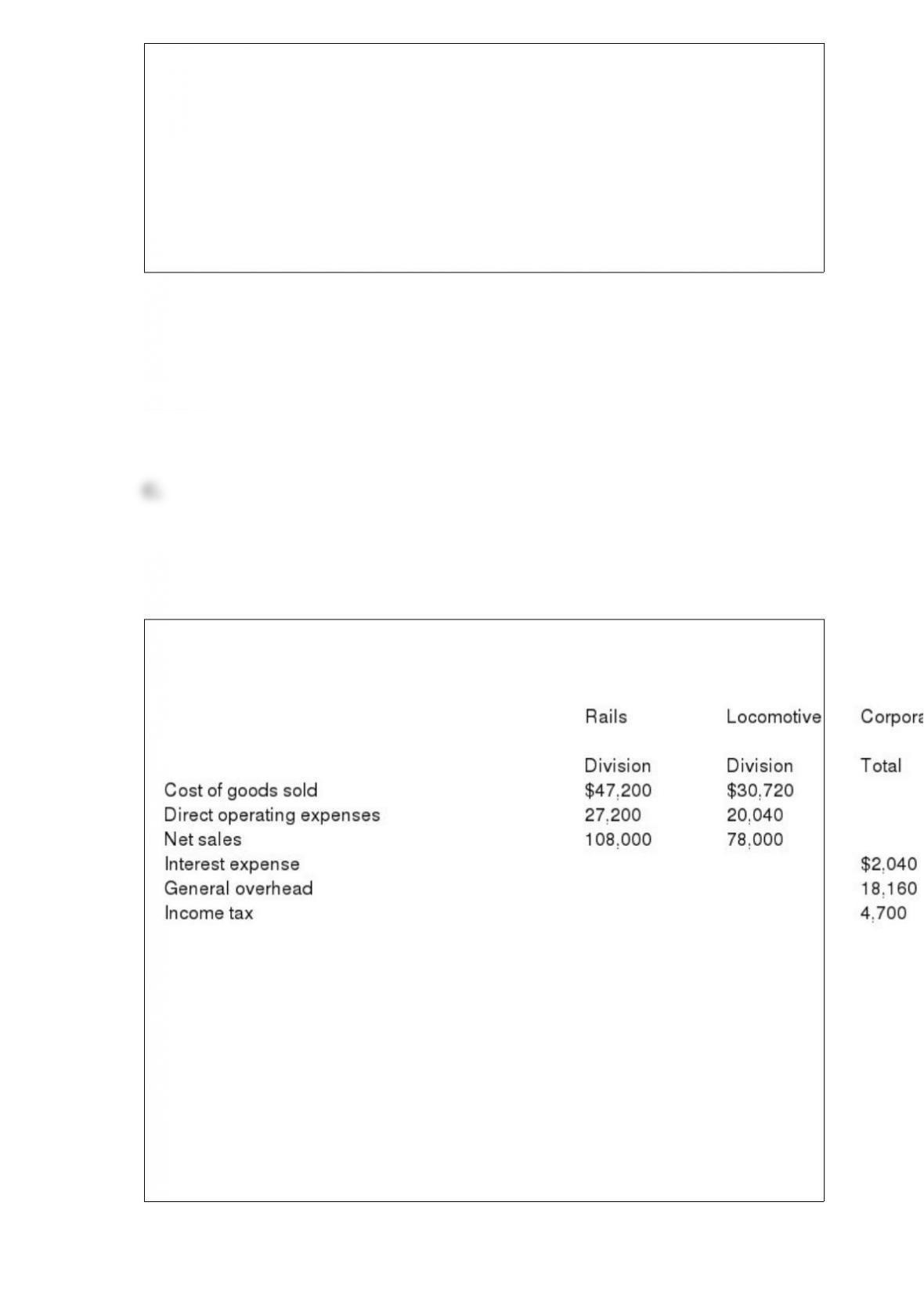
The following financial information was summarized from the accounting records of
Train Corporation for the current year ended December 31:
The income from operations for the Locomotive Division is:
A.$57,960
B.$14,790
C.$27,240
D.$47,280

Answer:
A company with 100,000 authorized shares of $4 par common stock issued 40,000
shares at $8. Subsequently, the company declared a 2% stock dividend on a date when
the market price was $11 a share. What is the amount transferred from the retained
earnings account to paid-in capital accounts as a result of the stock dividend?
A.$3,200
B.$6,400
C.$4,800
D.$8,800
Answer:
At the end of the fiscal year, the balance in Factory Overhead is small. This balance
would normally be:
A.transferred to Work in Process
B.transferred to Cost of Goods Sold
C.transferred to Finished Goods
D.allocated between Work in Process and Finished Goods
Answer:
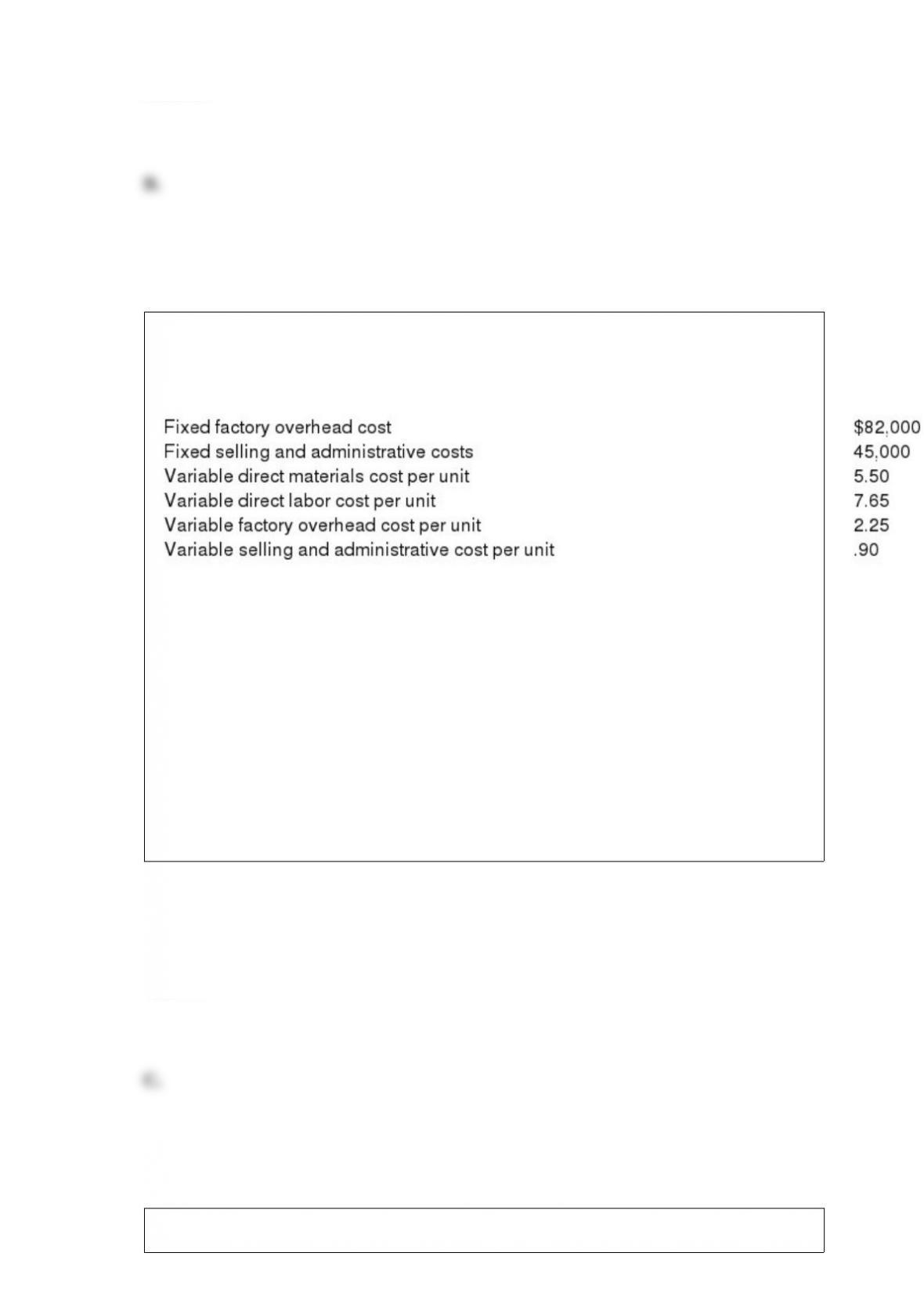
Mallard Corporation uses the product cost concept of product pricing. Below is cost
information for the production and sale of 45,000 units of its sole product. Mallard
desires a profit equal to a 12% rate of return on invested assets of $800,000.
The dollar amount of desired profit from the production and sale of the company’s
product is:
A.$105,840
B.$225,000
C.$96,000
D.$220,500
Answer:
An August sales forecast projects 6,000 units are going to be sold at a price of $11.50

per unit. The desired ending iventory in units is 15% higher than the beginning
inventory of 1,000 units. Total August sales are anticipated to be:
A.$80,500
B.$69,000
C.$60,000
D.$57,500
Answer:
A debit signifies a decrease in
A.assets
B.expenses
C.drawing
D.revenues
Answer:

The excess of sales price of treasury stock over its cost should be credited to
A.Treasury Stock Receivable
B.Premium on Capital Stock
C.Paid-In Capital from Sale of Treasury Stock
D.Income from Sale of Treasury Stock
Answer:
In an investment center, the manager has the responsibility for and the authority to
make decisions that affect:
A.the assets invested in the center, but not costs and revenues
B.costs and assets invested in the center, but not revenues
C.both costs and revenues for the department or division
D.not only costs and revenues, but also assets invested in the center
Answer:

An aid in internal control over payrolls that indicates employee attendance is
A.time card
B.voucher system
C.payroll register
D.employee’s earnings record
Answer:
A corporation has 60,000 shares of $25 par value stock outstanding that has a current
market value of $120. If the corporation issues a 5-for-1 stock split, the number of
shares outstanding will be:
A.60,000
B.10,000
C.300,000
D.30,000
Answer:
When a new partner is admitted to a partnership, there should be a(n)
A.revaluation of assets
B.realization of assets
C.allocation of assets
D.return of assets
Answer:
For the year ending June 30, Island Clinical Services mistakenly omitted adjusting
entries for (1) $1,500 of supplies that were used, (2) unearned revenue of $4,200 that
was earned, and (3) insurance of $5,000 that expired. What is the combined effect of
these errors on (a) revenues, (b) expenses, and (c) net income for the year ending June
30?
Answer:
A series of equal cash flows at fixed intervals is termed a(n):

A.present value index
B.price-level index
C.net cash flow
D.annuity
Answer:
A plant manager’s salary may be referred to as:
A.either a direct cost or an indirect cost since managerial accounting is not restricted by
GAAP
B.a direct cost
C.an indirect cost
D.a period cost
Answer:
E-commerce

A.accounts for less than 1% of all retail sales.
B.only relates to transactions between a company and a consumer
C.can improve the speed and efficiency of transactions.
D.increases paperwork.
Answer:
Xtra Company purchased goodwill from Argus for $96,000. Argus had developed the
goodwill over 12 years. How much would Xtra amortize the goodwill for its first year?
A.$7,000
B.$ 8,000
C.Goodwill is not amortized.
D.Not enough information.
Answer:
The journal entry a company uses to record the estimated accrued product warranty

liability is
A.debit Product Warranty Expense; credit Product Warranty Payable
B.debit Product Warranty Payable; credit Cash
C.debit Product Warranty Expense; credit Cash
D.debit Product Warranty Payable; credit Product Warranty Expense
Answer:
Determining the transfer price as the price at which the product or service transferred
could be sold to outside buyers is known as the:
A.Cost price approach
B.Negotiated price approach
C.Revenue price approach
D.Market price approach
Answer:

Which one of the following would not cause a bank to debit a company’s account?
A.Bank service charge
B.Collection of a note receivable
C.Checks marked NSF
D.Wiring of funds to other locations
Answer:
On December 31, Strike Company has decided to sell one of its batting cages. The
initial cost of the equipment was $310,000 with an accumulated depreciation of
$260,000. Depreciation has been taken up to the end of the year. The company found a
company that is willing to buy the equipment for $55,000. What is the amount of the
gain or loss on this transaction?
A.Cannot be determined
B.No gain or loss
C.Gain of $ 5,000
D.Gain of $55,000
Answer:
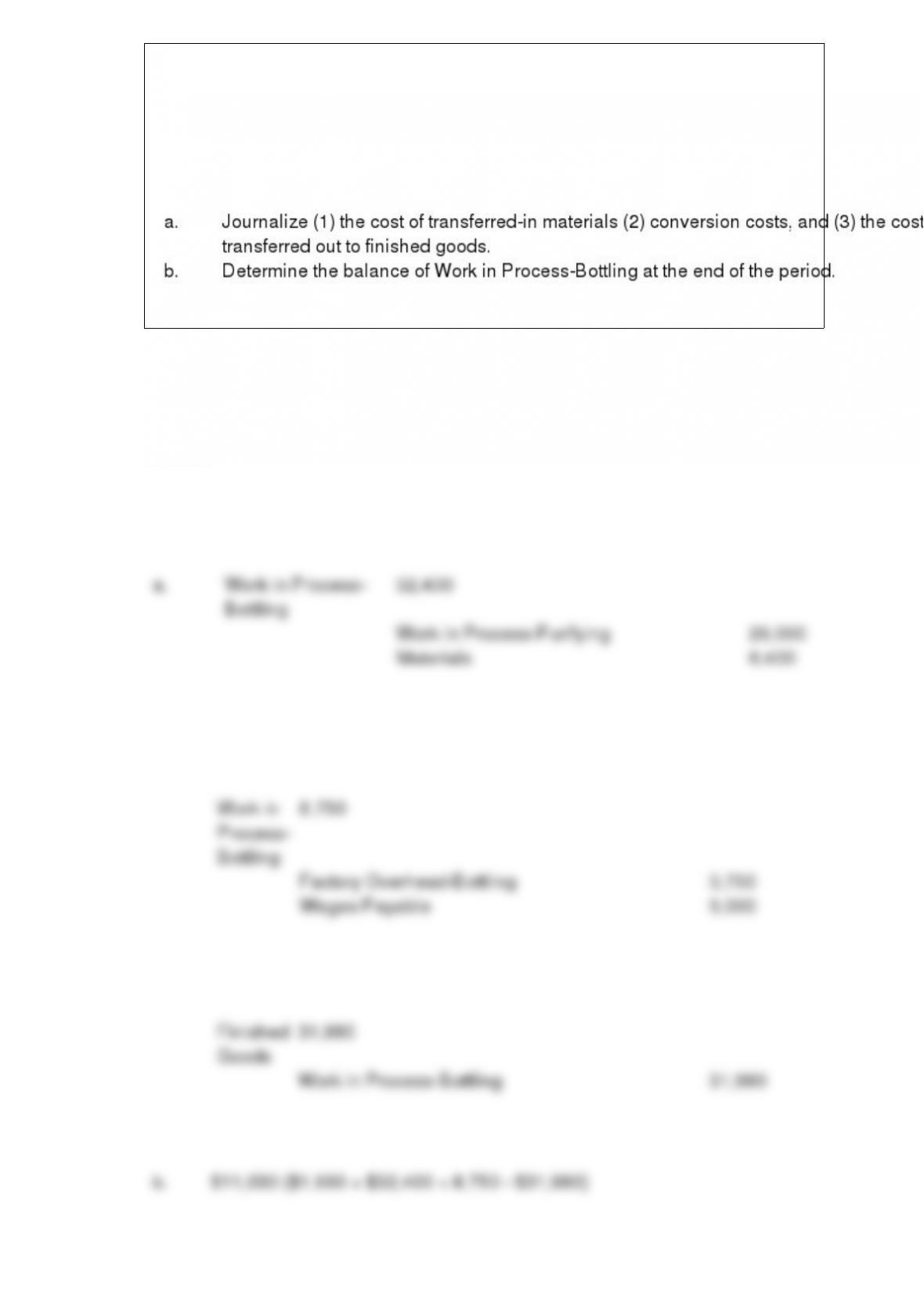
The cost of materials transferred into the Bottling Department of Mountain Springs
Water Company is $32,400, with $26,000 from the Purifying Department, plus
additional $6,400 from the materials storeroom. The conversion cost for the period in
the Bottling Department is $8,750 ($3,750 factory applied and $5,000 direct labor.) The
total costs transferred to finished goods for the period was $31,980. The Bottling
Department had a beginning inventory of $1,860.
Answer:

Yankton Company began the year without an investment portfolio. During the year they
purchased investments classified as available-for-sale securities at a cost of $13,000. At
the end of the year, the market value of the securities was $11,000. The Yankton
Company’s financial statements for the current year should show
A.a loss of $2,000 on the income statement and available-for-sale securities of $13,000
on the balance sheet
B.no loss on the income statement and available-for-sale securities of $13,000 on the
balance sheet
C.no loss on the income statement, available-for-sale securities of $11,000 and an
unrealized loss of $2,000 as a stockholders’ equity adjustment on the balance sheet
D.a loss of $2,000 on the income statement and temporary investments of $11,000 on
the balance sheet
Answer:
Who pays the freight costs when the terms are FOB shipping point?
A.the ultimate customer
B.the buyer
C.the seller
D.either the seller or the buyer
Answer:

State the section(s) of the statement of cash flows prepared by the indirect method
(operating activities, investing activities, financing activities, or not reported) and the
amount that would be reported for each of the following transactions:
(a) Received $120,000 from the sale of land costing $70,000.
(b) Purchased investments for $75,000.
(c) Declared $35,000 cash dividends on stock. $5,000 dividends were payable at the
beginning of the year, and $6,000 were payable at the end of the year.
(d) Acquired equipment for $64,000 cash.
(e) Declared and issued 100 shares of $20 par common stock as a stock dividend, when
the market price of the stock was $32 a share.
(f) Recognized depreciation for the year, $37,000.
(g) Issued 85,000 shares of $10 par common stock for $25 a share, receiving cash.
(h) Issued $500,000 of 20-year, 10% bonds payable at 99.
(i) Borrowed $43,000 from Regional Bank, issuing a 5-year, 8% note for that amount.
Answer:
The remaining cash of a partnership (after creditors have been paid) upon liquidation is
divided among partners according to their
A.capital balances
B.contribution of assets
C.drawing balances
D.income sharing ratio
Answer:
All of the following are normally found in a corporation’s stockholders’ equity section
except
A.Common Stock
B.Paid-In Capital in Excess of Par
C.Dividends in Arrears
D.Retained Earnings
Answer:
The following information pertains to Carlton Company. Assume that all balance sheet
amounts represent both average and ending balance figures. Assume that all sales were
on credit.
Assets
Liabilities and Stockholders’ Equity
Income Statement
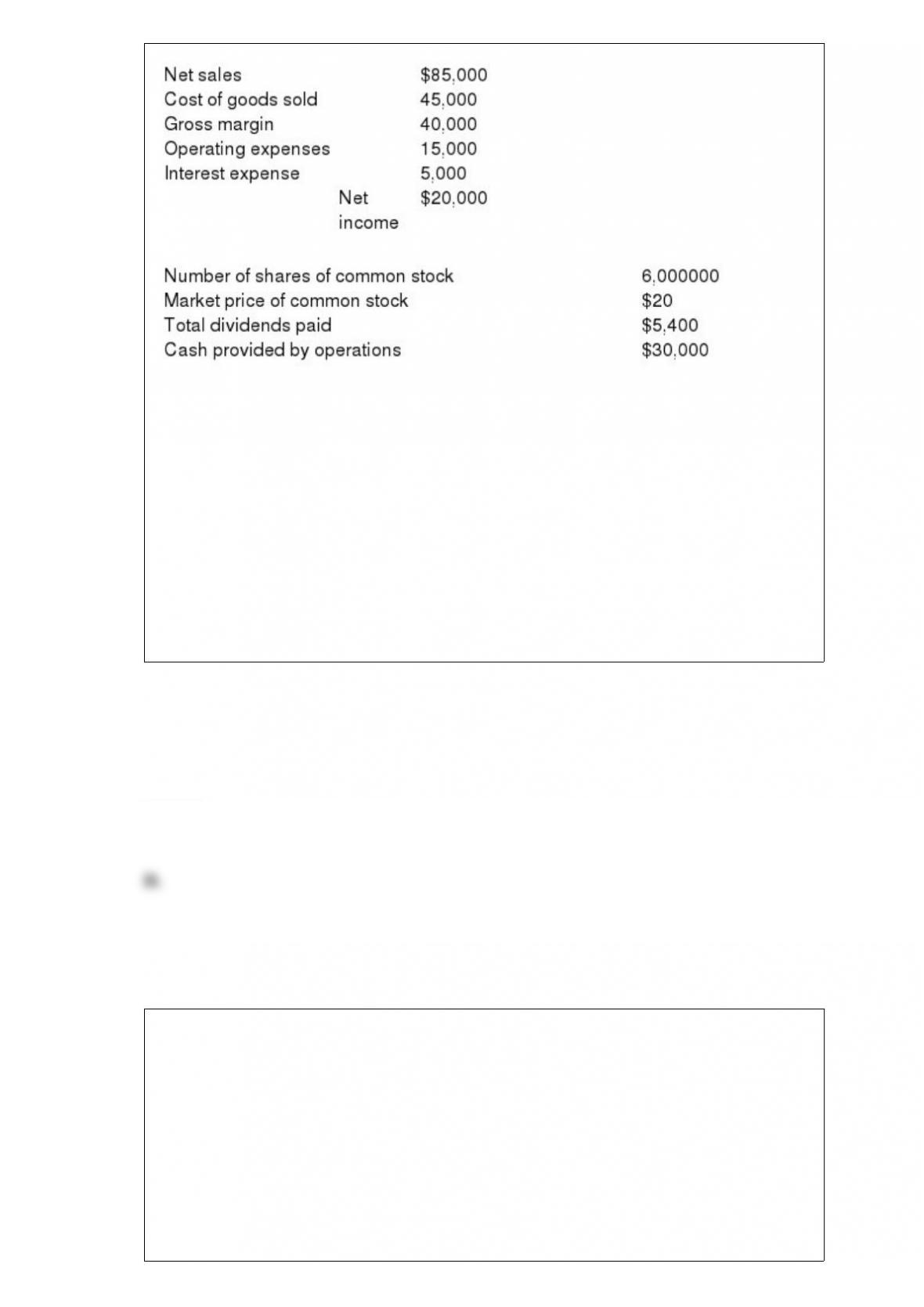
What is the ratio of net sales to total assets for this company? Round your answer to
two decimal points.
A.1.00
B.1.89
C.0.36
D.0.29
Answer:
The capital accounts of Harrison and Marti have balances of $160,000 and $110,000,
respectively, on January 1, 2014, the beginning of the current fiscal year. On April 10,
Harrison invested an additional $20,000. During the year, Harrison and Marti withdrew
$96,000 and $78,000, respectively, and net income for the year was $264,000. The
articles of partnership make no reference to the division of net income.
Based on this information, the statement of partners’ equity for 2014 would show what
amount in the capital account for Marti on December 31, 2014?
A.$216,000
B.$164,000
C.$380,000
D.$52,000
Answer: