Select the incorrect statement regarding net margin.
A. Net margin refers to the average amount of each sales dollar remaining after all
expenses are subtracted.
B. Net margin may be calculated in several ways.
C. The amount of net margin is affected by a company’s choices of accounting
principles.
D. The smaller the net margin the better.
Which of the following statement is incorrect regarding the investing activities section
of the statement of cash flows?
A. Investing activities deal with long-term liabilities (debt) and equity accounts.
B. Increases in long-term asset balances suggest cash outflows to purchase assets.
C. Decreases in long term asset balances suggest cash inflows from selling assets.
D. Investing activities involve cash purchases and cash disposals of long-term assets.
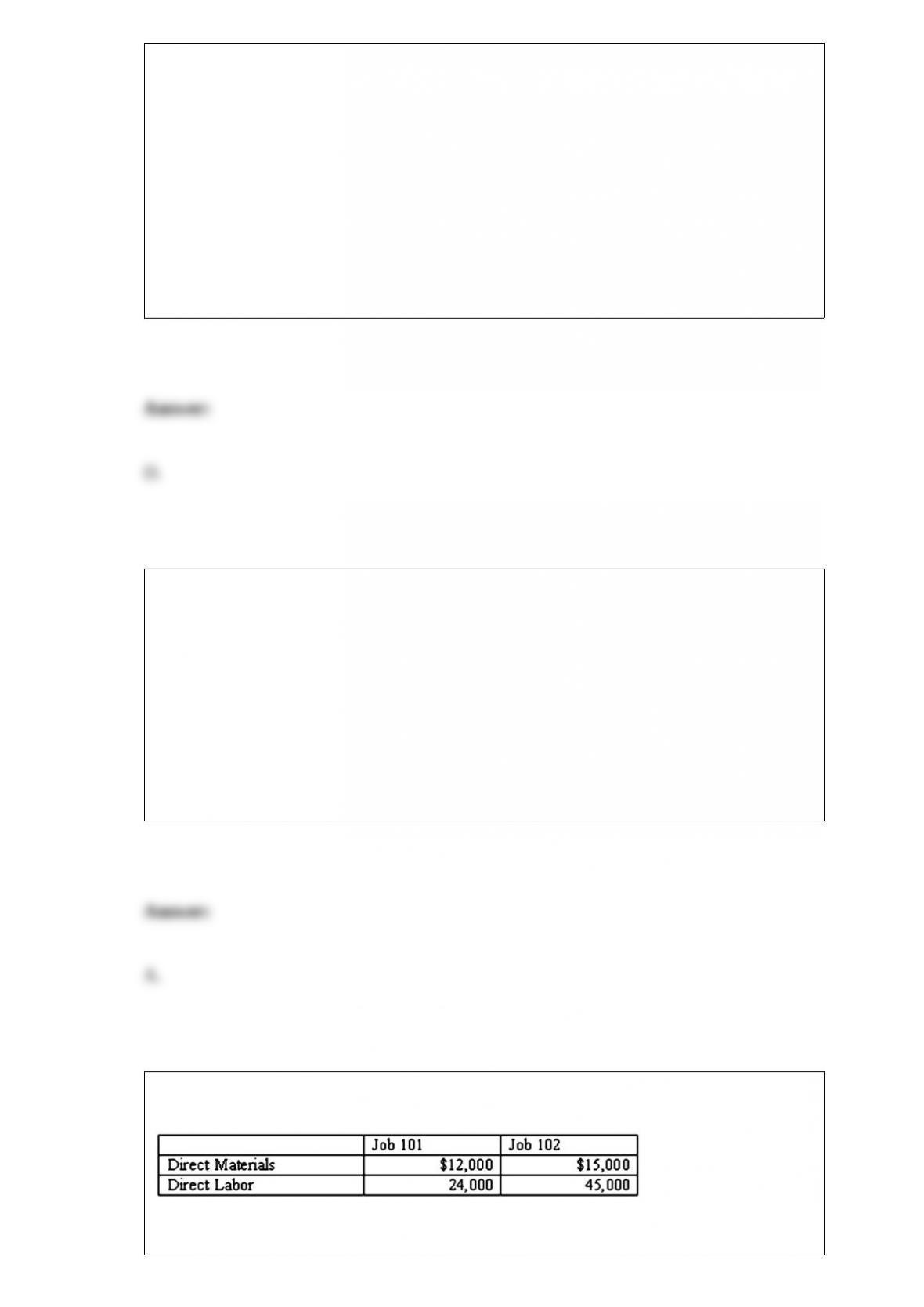
Cooper Manufacturing is currently working on two jobs. The job order cost sheets for
Job 101 and Job 102 showed the following information:
If overhead is applied to jobs at $.80 per direct labor dollar, the total manufacturing cost

for the two jobs would be:
A. $96,000.
B. $55,200.
C. $151,200.
D. $162,000.
When the indirect method is used to prepare the statement of cash flows, what is the
starting point of the operating activities section?
A. Net income as reported on the income statement
B. Total assets as reported on the balance sheet
C. Sales as reported on the income statement
D. Cash collections from customers
Select the correct statement regarding relevant costs and revenues.
A. Sunk costs are relevant for decision-making purposes.
B. Relevant costs are frequently called unavoidable costs.
C. Direct labor is an example of a unit-level cost.
D. Only variable costs are relevant for decision making.
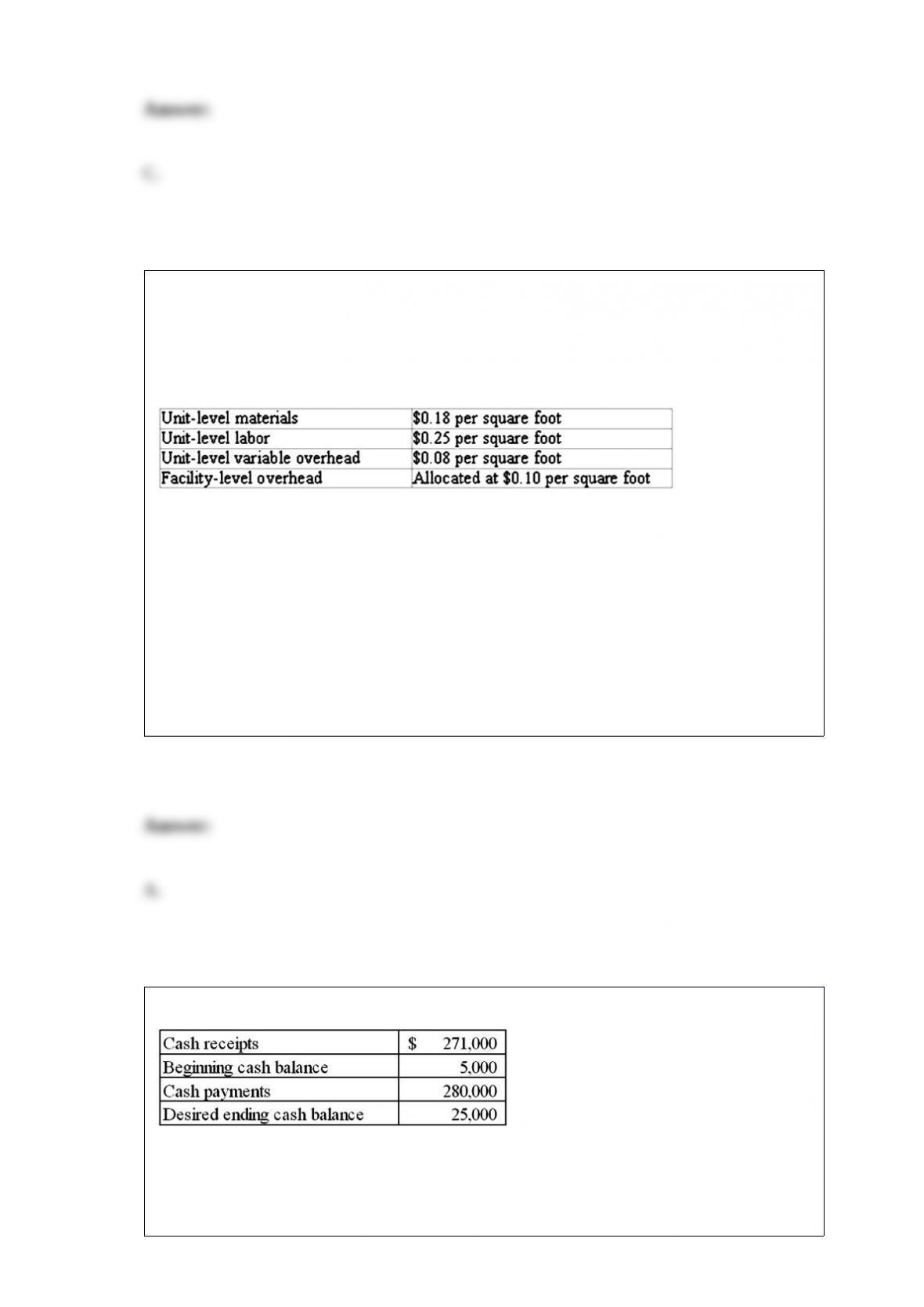
Clean, Inc. cleans and waxes floors for commercial customers. The company is
presently operating at less than capacity with equipment and employees idle at times.
The company recently received an order from a potential customer outside the
company’s normal geographic service region for a price of $4,500. The size of the
proposed job is 11,000 square feet. The company’s normal service costs are as follows:
If the company accepts the special offer:
A. The company will lose $1,110 on the job.
B. The company will lose $2,210 on the job.
C. The company will lose $230 on the job.
D. The company will earn $2,520 on the job.
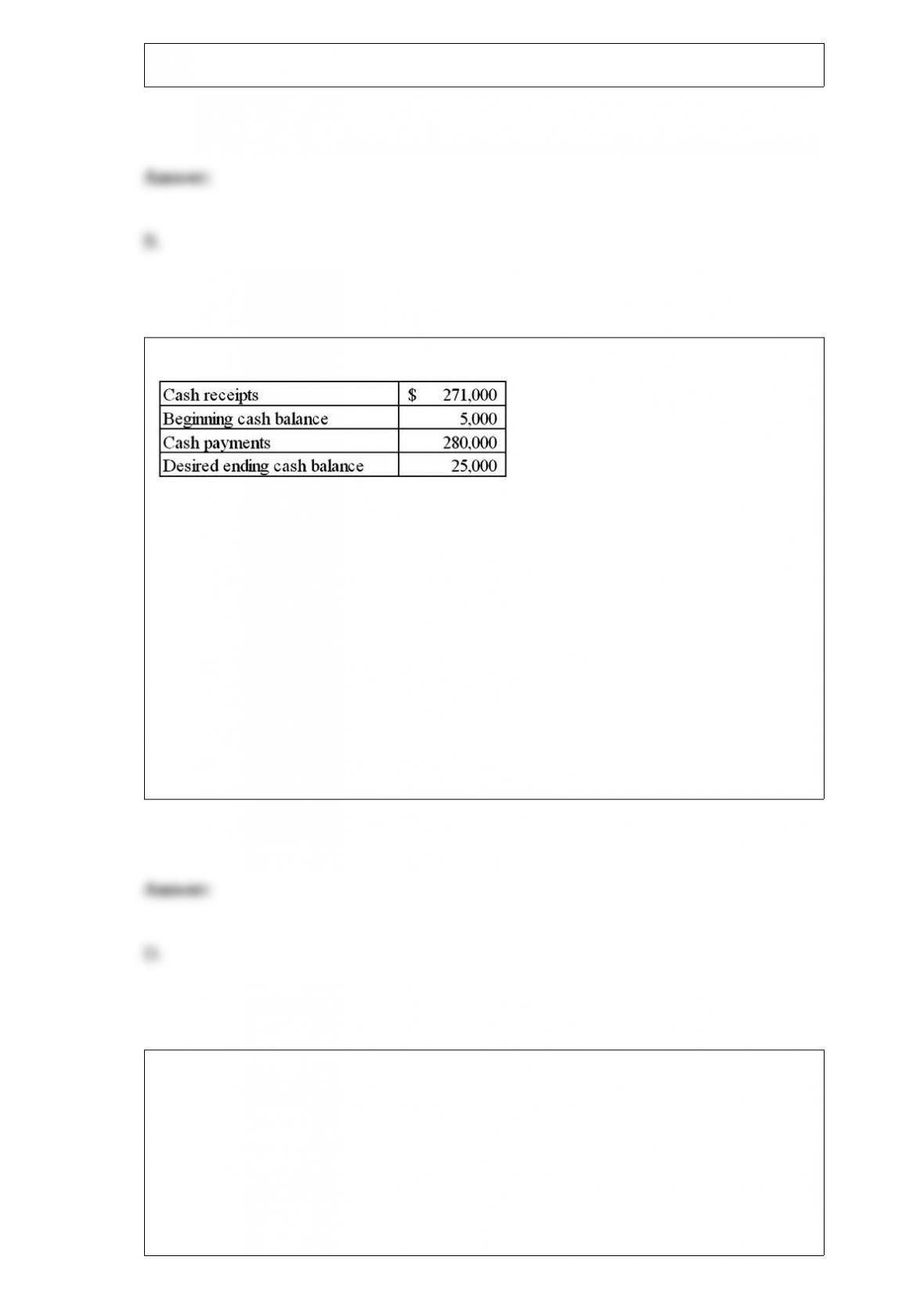
Bantam Industries has budgeted the following information for March:
If there is a cash shortage, the company borrows money from the bank. All cash is
borrowed at the beginning of the month in $1,000 increments and interest is paid
monthly at 1% on the first day of the following month. The company had no debt

before March 1st. The shortage or surplus of cash before considering cash borrowed in
March would be:
A. $25,000 shortage.
B. $29,000 shortage.
C. $29,000 surplus.
D. $4,000 shortage.
Select the correct statement regarding the selling and administrative (S&A) expense
budget.
A. The S&A budget is prepared after the sales budget.
B. The S&A budget is prepared before the cash budget.
C. The S&A budget is prepared before the pro forma income statement.
D. All of these answers are correct.
Which of the following types of labor costs will never flow through the balance sheet?
A. Plant supervision
B. Sales commissions
C. Material handling
D. Assembly labor
Cheyenne Company has budgeted the following information for June:
If there is a cash shortage, the company borrows money from the bank. All cash is
borrowed at the beginning of the month in $1,000 increments and interest is paid
monthly at 1% on the first day of the following month. The company had no debt
before June 1st. The amount of interest paid on July 1 would be:
A. $250.
B. $400.
C. $221.
D. $290.
At the time indirect materials are issued to production:
A. The balance in the manufacturing overhead account will decrease.
B. The balance in the work in process inventory account will increase.
C. The balance in the raw materials inventory account will increase.

D. The balance in the manufacturing overhead account will increase.
Morris Company allocates overhead on the basis of direct labor hours. It allocates
overhead costs of $12,800 to two different jobs as follows:
Job 1: (10 hours) = $6,400; Job 2: (10 hours) = $6,400
The production process for Job 2 was then automated. Now Job 2 requires only two
hours of direct labor but four hours of mechanical processing. As a result, total
overhead increases to $17,000. With the change in the production process for Job 2:
A. The amount of overhead assigned to each product will increase.
B. The amount of overhead assigned to Job 1 will decrease.
C. The amount of overhead assigned to each product will decrease.
D. The amount of overhead assigned to Job 1 will increase.
Which of the following statements about financial statements is incorrect?
A. The net margin ratio is a profitability ratio.
B. The current ratio is a liquidity ratio.
C. The debt to assets ratio is a liquidity ratio.
D. The dividend yield is a stock market ratio.

Select the incorrect statement regarding cost structures.
A. Highly leveraged companies will experience greater profits than companies less
leveraged when sales increase.
B. The more variable cost, the higher the fluctuation in income as sales fluctuate.
C. When sales change, the amount of the corresponding change in income is affected by
the company’s cost structure.
D. Faced with significant uncertainty about future revenues, a low leverage cost
structure is preferable to a high leverage cost structure.
Which of the following costs typically include both fixed and variable components?
A. Direct materials
B. Direct labor
C. Factory overhead
D. None of these
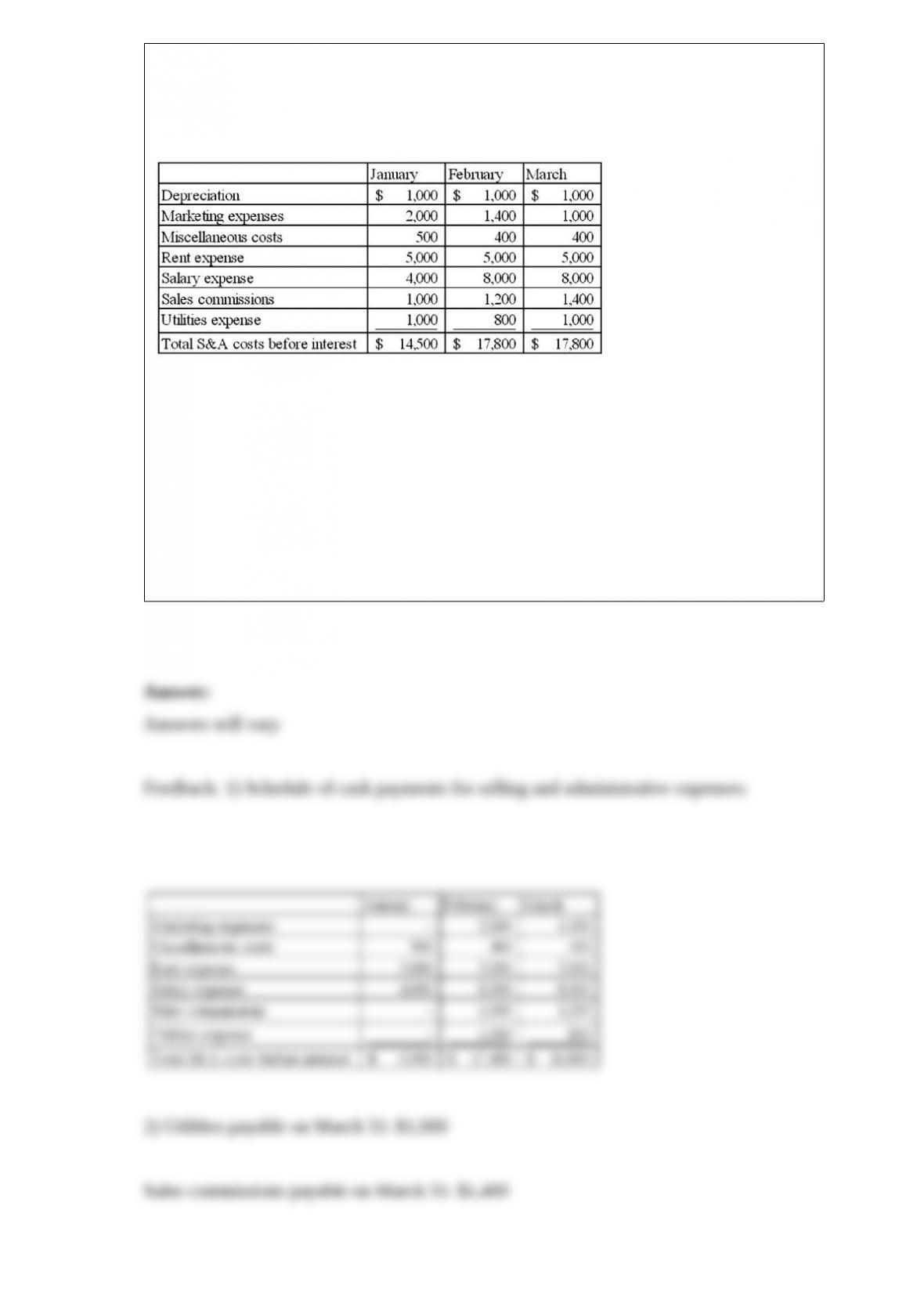
Virginia Jackson is opening Jackson Realty on January 2. For several weeks she has
been busy putting together an operating budget for the first quarter of operation for her
new business. Virginia has estimated her selling and administrative (S&A) costs as
follows:
All selling and administrative costs are paid when incurred except utilities, marketing
expenses, and sales commissions. These items are paid in the month following the
month incurred.Required:
1) Prepare a schedule of cash payments for selling and administrative expenses for
January through March.
2) What liabilities, in what amounts, would be reported on the pro forma balance sheet
as of March 31?
A hybrid cost system contains:
A. Features of a job-order cost system.
B. Features of a process cost system.
C. Features of both variable and absorption cost systems.
D. Features of both job-order and process cost systems.
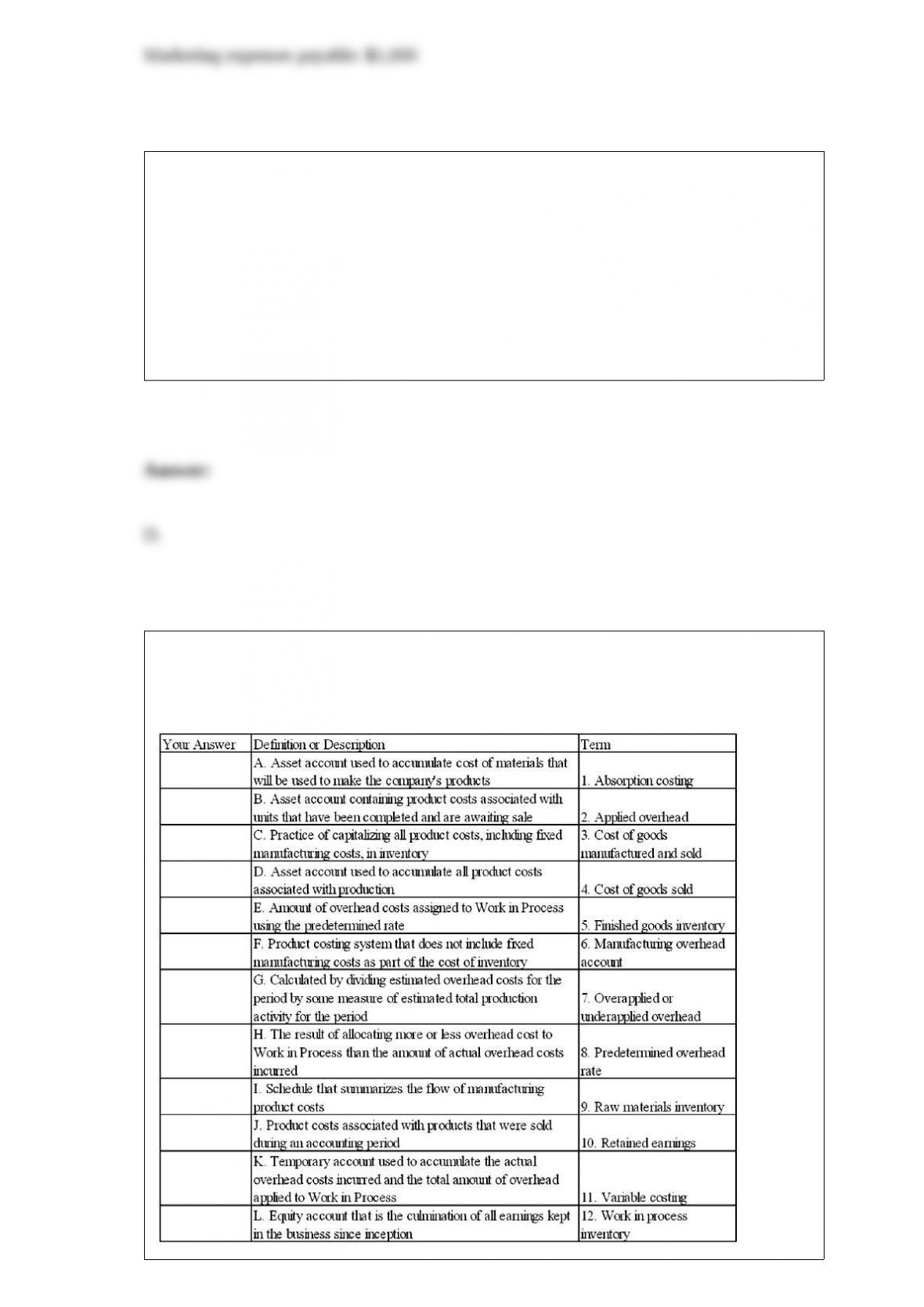
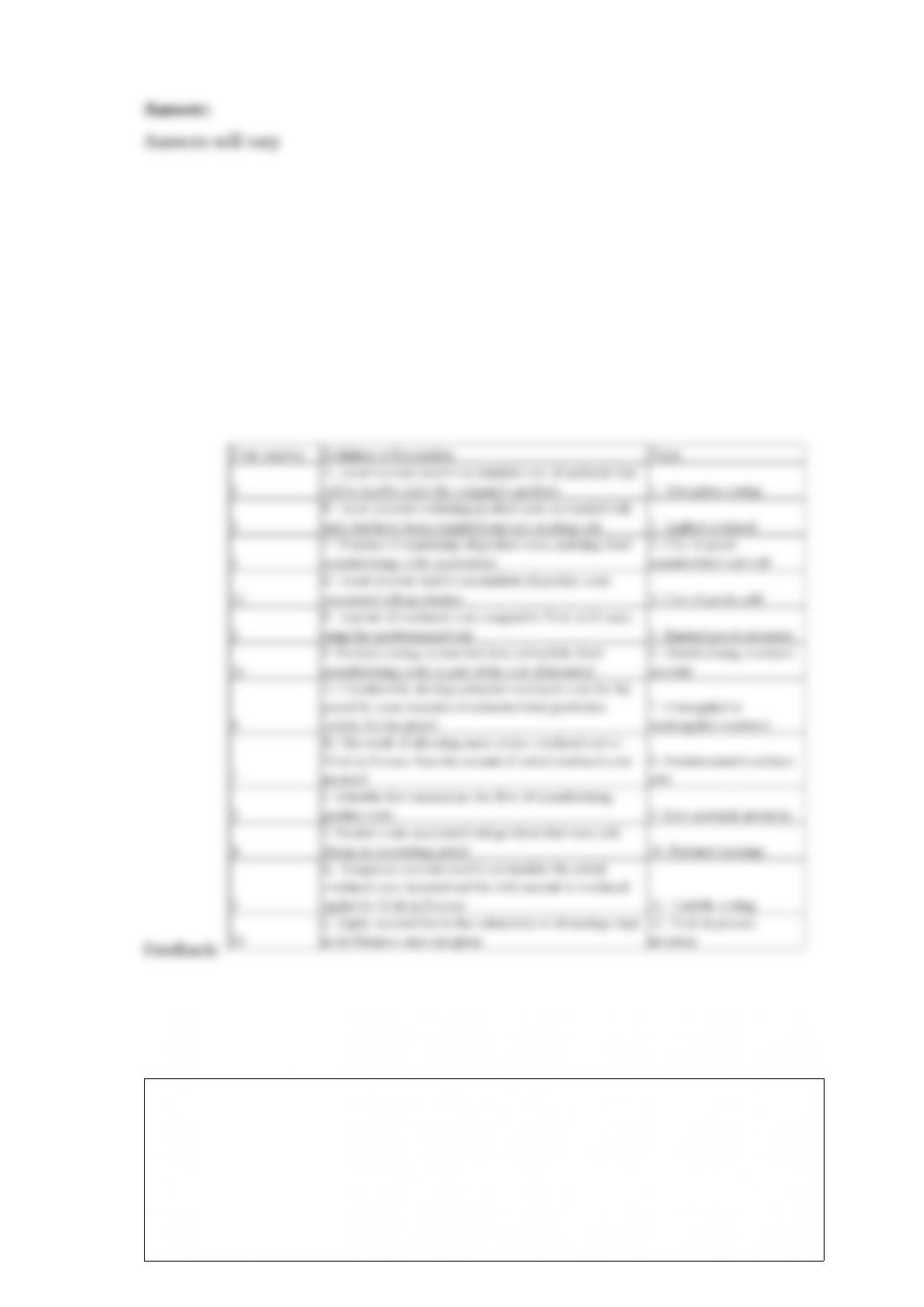
Select the term from the list that best matches the description or definition. Enter the
number of the best answer in “Your Answer” column.
Indicate whether each of the following statements is true or false.
If a company-wide overhead rate undercosts some products, it must overcost others.
Facility-level costs usually decrease when a company decides to eliminate one product.
Many companies do not allocate facility-level costs to products for decision-making
purposes.
Batch-level costs are usually not relevant to the decision to eliminate a product.
Upstream costs are incurred before a product is manufactured.
How can contribution margin per unit be used to find the break-even point in units?
Indicate whether each of the following statements is true or false.
An activity-based costing system uses more cause-and-effect relationships in assigning
costs than does a traditional cost allocation system.
An activity-based costing system first assigns or traces costs to the departments in
which products are made.
The hierarchical categories into which activities are grouped are unit-level, batch-level,
department-level and facility-level activities.
An activity-based costing system traces the costs of performing activities to the
products that cause the activities.
The total amount of unit-level costs changes in proportion to the number of batches of
product made.
What is the relationship or connection between a company’s pro forma financial
statements and the end-of-period financial statements reported to stockholders and other
external users?
Indicate whether each of the following statements is true or false.
Managerial performance can be evaluated by comparing actual amounts with standard
amounts.
Differences between standard and actual amounts are called variances.
When the static budget is compared to a flexible budget based on actual volume of
activity, any variances result from differences between standard and actual per unit
amounts.
If the actual sales price per unit is higher than the standard, a company’s sales price
variance is unfavorable.
Differences between flexible budget costs and revenues and the actual results are price
variances.