Two major weaknesses of the accounting rate of return are that it does not consider cash
flows and it is the least accurate capital budgeting technique.
A bottom-up approach to budgeting is circular while a top-down approach is linear.
All variable costs are relevant and all fixed costs are irrelevant.
Management by exception focuses on all variances, regardless of size or importance.
Using a normal costing system, direct materials and direct labor are recorded at
standard cost, and overhead is applied to products using a predetermined overhead rate.
With a variable cost, as the level of activity decreases, the total cost remains the same.
In their book Killer Customers, Larry Selden and Geoffrey Colvin estimate that the top
20% of a company’s customers generate approximately 120% of the company’s profits.
The flexible budget variance is influenced most heavily by forces external to the
operating process.
Sometimes companies will accept new business at a loss with the expectation that
certain customers can influence other potential customers.
The goal of the screening decision is to narrow the list of capital proposals to include
only those that are expected to bring the desired level of return.

For unit-level activities, the total level of activity performed varies proportionately with
the number of units produced.
Short-term planning is often referred to as
a.Strategic planning.
b.Operational planning.
c.Goal-oriented planning.
d.External planning.
All other things equal, an increase in the number of units sold will
a. Increase unit contribution margin.
b. Increase unit variable costs.
c. Increase total fixed costs.
d. Increase operating income.
If activity level increases, what happens to the unit variable cost?
a.It remains the same.
b.It decreases.
c.It increases.
d.It depends on how much the activity level increases.
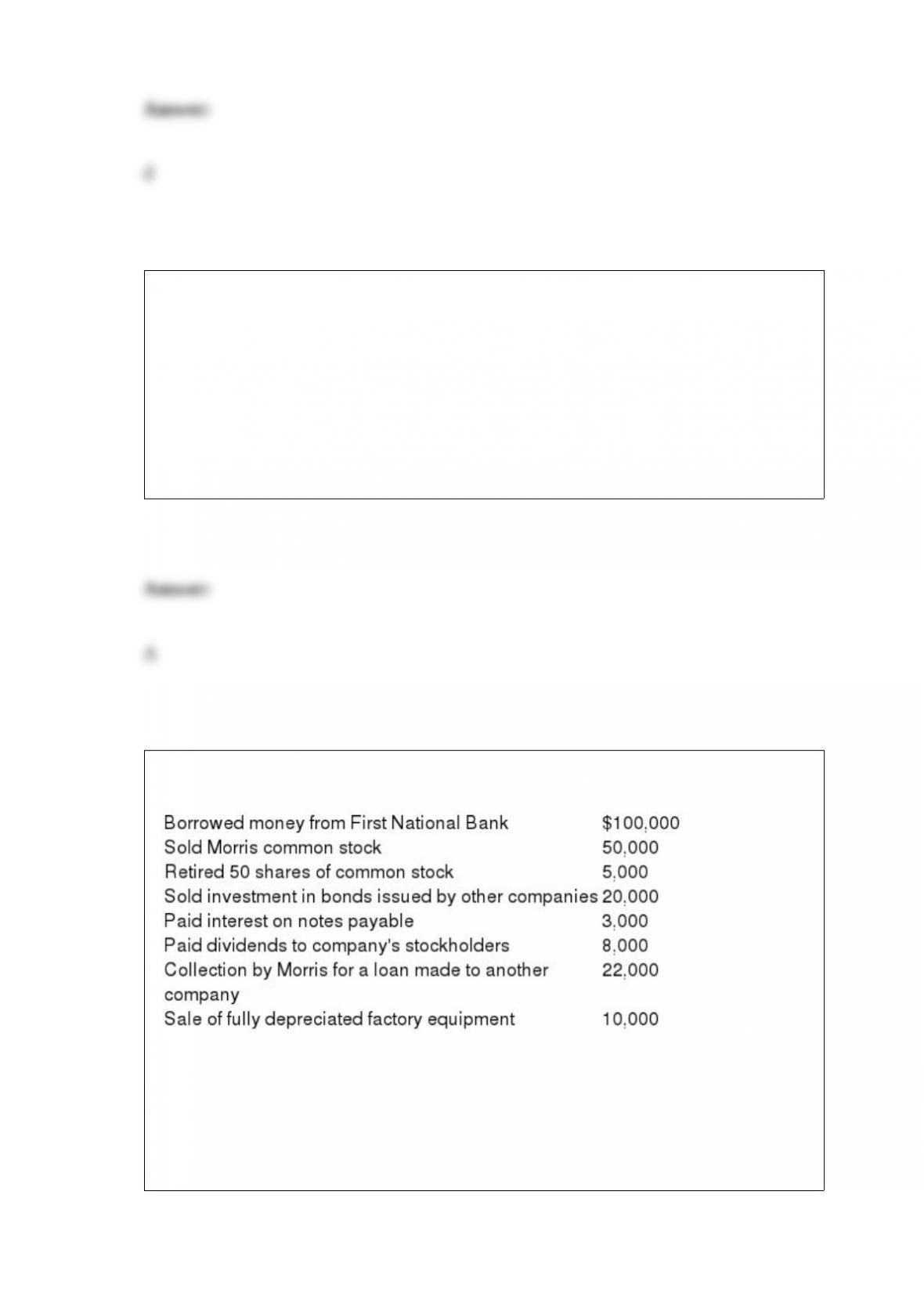
Morris Industries reported the following cash transactions for last year.
Required:
a. Prepare the investing section of Morris’s statement of cash flows.
b. Prepare the financing section of Morris’s statement of cash flows.
An example of an external user is a
a.Managerial accountant.
b.Vice-President of Marketing.
c.Potential Investor.
d.Payroll Manager.
Firms can manage their degree of operating leverage by converting variable costs into
fixed costs, or vice versa.

Capital budgeting differs from cash budgeting in that
a. Cash budgeting focuses on short-term results while capital budgeting focuses on five,
ten, or even twenty years in the future.
b. Cash budgeting focuses on the balance sheet while capital budgeting focuses on the
income statement.
c. Cash budget does not contain cash outflows for capital assets while capital budgeting
does.
d. All of these answer choices are correct.
When the production manager is investigating and understanding the cause of the
variable overhead spending variance relating to indirect materials, he will most likely
want to talk to the
a. Inventory manager.
b. Purchasing agent.
c. Design engineer.
d. Both the inventory manager and the purchasing agent.

Any return a company receives over and above the original investment is referred to as
a. Return on investment.
b. Return of investment.
c. Return of contribution.
d. None of these answer choices are correct.
Which of the following is an advantage of decentralization?
a. Duplication of effort is minimized.
b. The potential for sharing ideas throughout the organization is enhanced.
c. Lower-level managers understand the company ‘s strategies and goals, and thus make
decisions that are in the best interest of the organization as a whole.
d. Top management is free to focus on the long-term strategies of the organization.
Which of the following is an assumption made in a multiproduct environment?
a. The sales mix can be determined and will remain constant.
b. The sales mix must be broken into variable, fixed, and mixed costs.
c. The relevant range will vary with a change in activity.
d. Fixed costs are no longer static.

The second step in the preparation of activity-based costing data is to
a. Calculate activity cost pool rates.
b. Develop activity cost pools.
c. Allocate costs to products.
d. Calculate the unit product cost.
If activity level decreases, what happens to the unit fixed cost?
a.It decreases.
b.It increases.
c.It remains the same.
d.It depends on how much the activity level increases.
Which of the following items is not classified as direct material for Family Ice Cream
Parlor?
a. The cost of empty ice cream cones
b. The cost of milk used in the manufacturing of ice cream
c. The cost of hairnets worn by production line workers
d. The cost of strawberries used in the manufacturing of ice cream
Calculate the effects on operating income of keeping or eliminating operations.
Your friend has accepted a position with a large manufacturing company as production
manager. She has found out that she must analyze and report any variances that relate to
production. She has been told that managers use a method called ‘œmanagement by
exception’ and is concerned that any variance will be viewed negatively by her
supervisors.
Required:
Explain to your friend the concept of ‘œmanagement by exception’ and put her mind at
ease about all variances being viewed as negative and explain what factors may be
considered when deciding what variances to investigate.
A segment margin income statement includes all allocated costs in the calculation of the
segment margin.
As managers evaluate business opportunities, they examine many factors including
profitability. Discuss two profitability factors that managers might evaluate. In addition
to the profitability factors discussed above, discuss three factors other than profitability
that managers might evaluate before engaging in a business opportunity.
Explain the difference between a leading indicator and a lagging indicator and give one
example of each relating to your performance in this class.
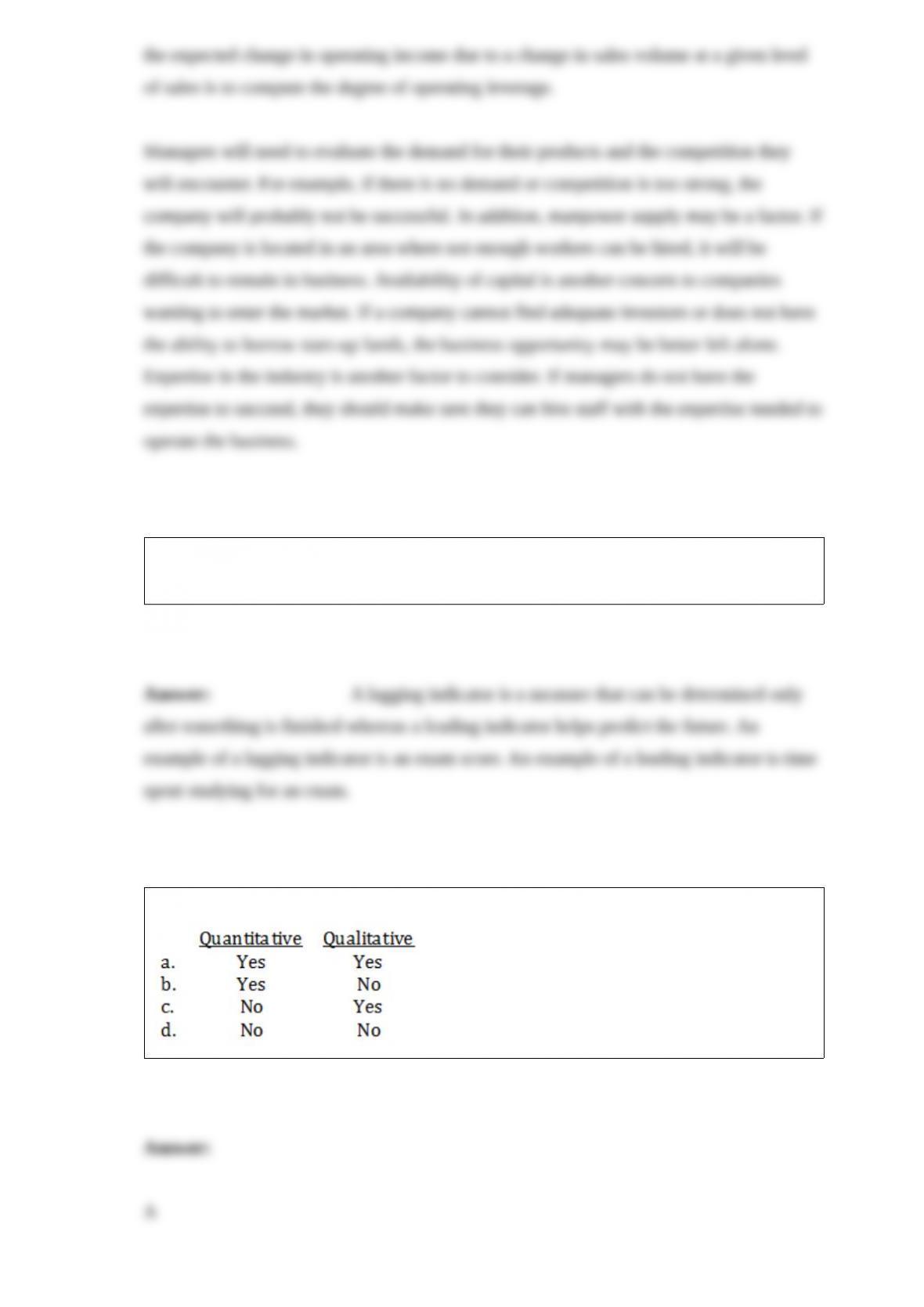
Nonfinancial measures can be
Describe the three major categories of product cost and explain why some raw materials
costs and some labor costs are treated as manufacturing overhead.
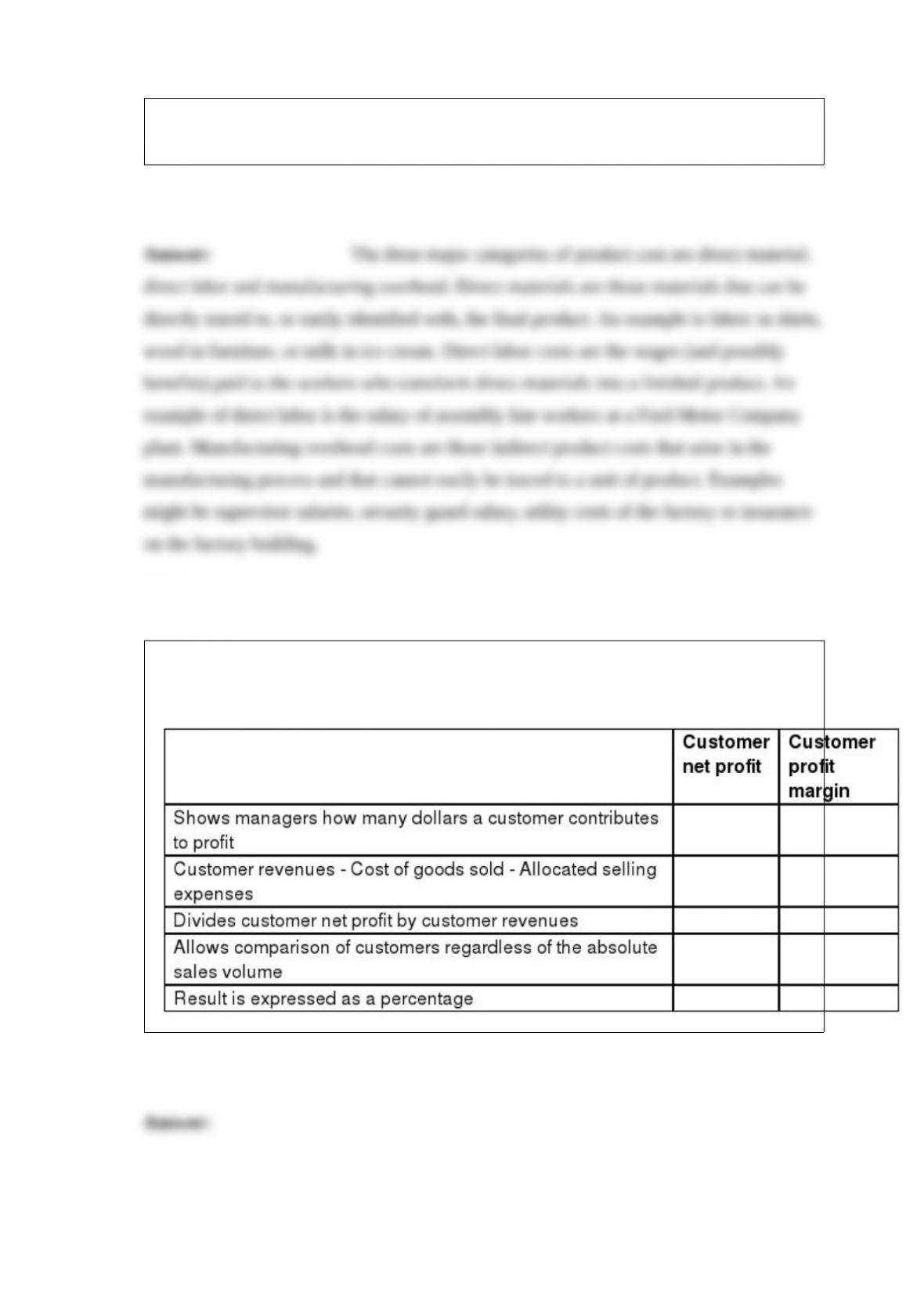
For each item below, identify whether the item applies to customer net profit or
customer profit margin by marking an “X” in the appropriate column.