The following transactions occurred during July:
1. Received $800 cash for services rendered during July.
2. Received $5,000 from issuance of stock to investors.
3. Received $400 from a customer in payment of accounts receivable from the prior
month.
4. Billed customers for services performed in July, $3,500.
5. Borrowed $2,500 from the bank, giving a promissory note in exchange.
6. Received $1,000 from a customer for services to be performed next year.
Recording the above transactions would include which of the following?
A. Transaction #1 would include a debit to Revenue.
B. Transaction #3 would include a debit to Accounts Receivable.
C. Transaction #4 would include a debit to Accounts Receivable.
D. Transaction #6 would include a debit to Unearned Revenue.
Answer:
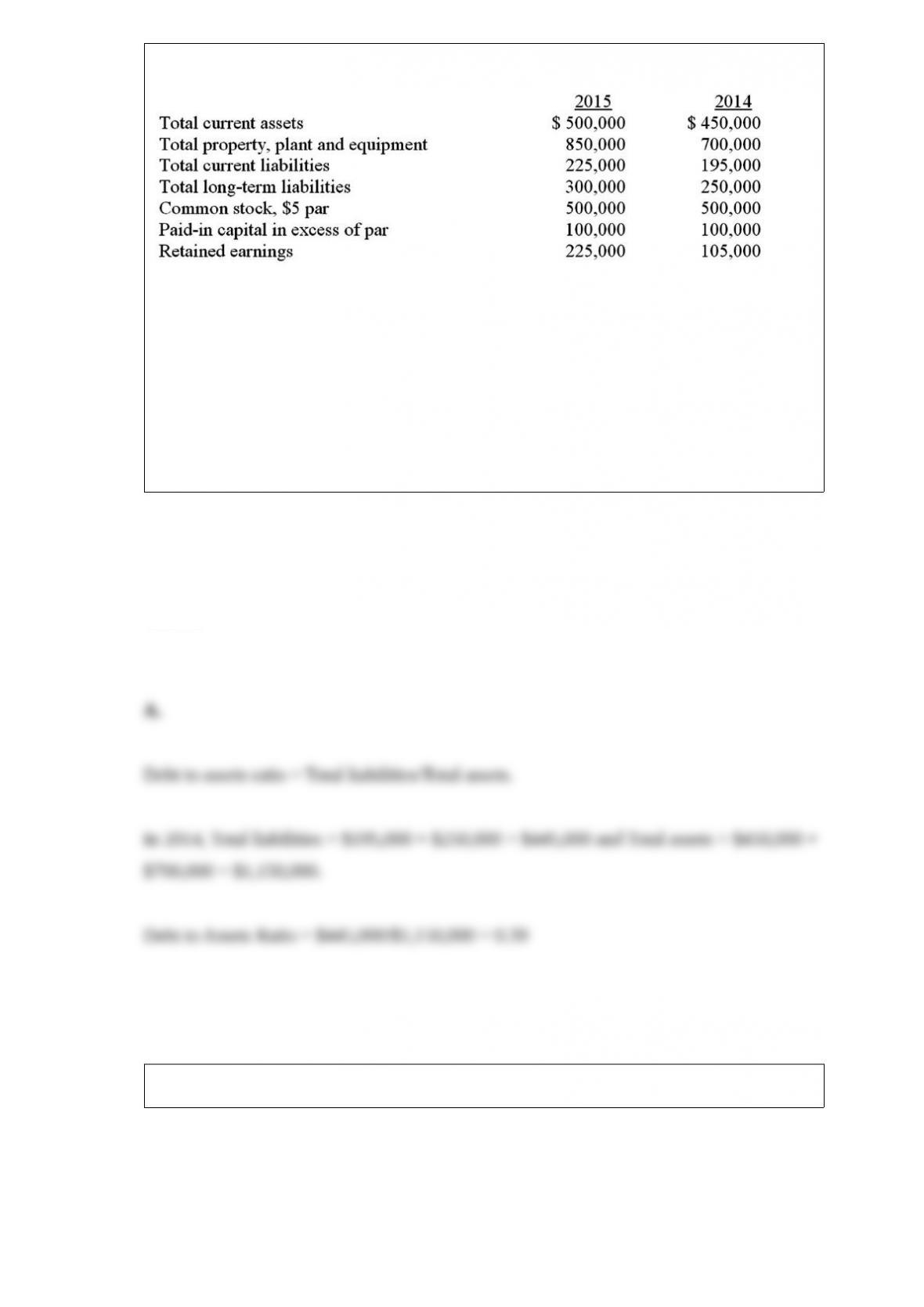
Whic
h of the following is closest to the company’s debt-to-assets ratio for 2014?
A. 0.39
B. 0.61
C. 0.35
D. 0
Answer:
A company reported the following information at December 31, 2013:
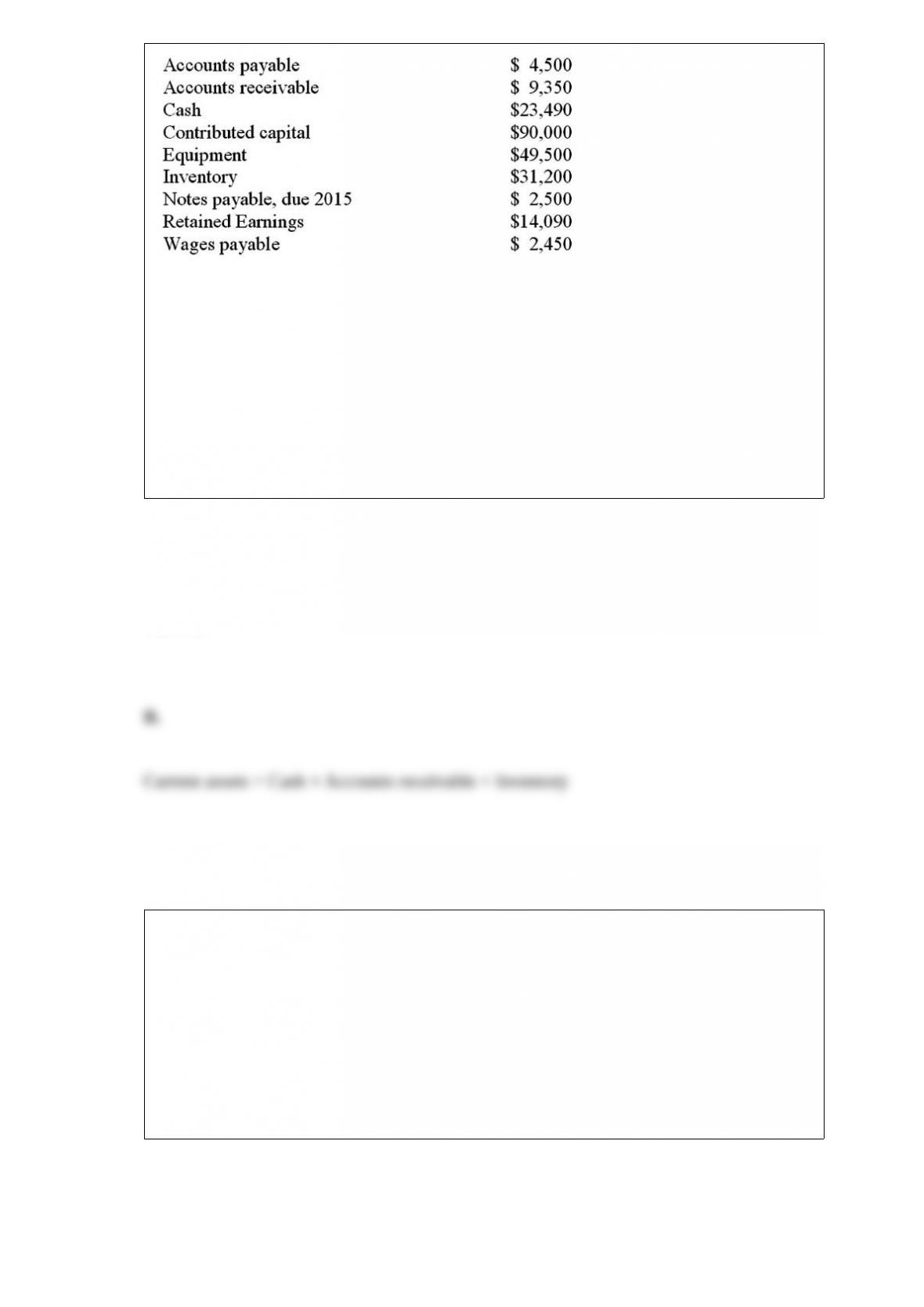
What is the amount of current assets on the classified balance sheet?
A. $113,540
B. $64,040
C. $32,840
D. $82,170
Answer:
The asset turnover ratio measures:
A. the profit generated by efficient management of assets.
B. the level of financing risk assumed by the company.
C. the sales revenue generated by efficient management of assets.
D. the ability to earn profit for the stockholders.
Answer:
In recording the acquisition cost of an entire business:
A. goodwill is recorded as the excess of cost over the fair value of identifiable net
assets.
B. assets are recorded at the seller’s book values.
C. goodwill, if it exists, is never recorded.
D. goodwill is recorded as the excess of cost over the book value of identifiable net
assets.
Answer:
Your business declared a $200 dividend on August 31, payable in September. On
August 31, which of the following journal entries would be made?
A. Debit Dividends Receivable for $200; credit Dividends Declared for $200.
B. Debit Dividends Declared for $200; credit Dividends Payable for $200.
C. Debit Dividends Payable for $200; credit Dividends Declared for $200.
D. Debit Dividends Declared for $200; credit Dividends Receivable for $200.
Answer:
Conservatism is
A. the requirement that businesses should intentionally understate assets.
B. the requirement that businesses should intentionally overstate liabilities.
C. the requirement that if an asset’s value falls over time it will continue to be reported
at its original cost.
D. the requirement that when faced with uncertainty about the numbers to report,
accountants must use the least optimistic measure.
Answer:

Which of the following are the three basic elements of the balance sheet?
A. assets, liabilities, and retained earnings.
B. assets, liabilities, and contributed capital.
C. assets, liabilities, and revenues.
D. assets, liabilities, and stockholders’ equity.
Answer:
B-Mart sells $5,000 of blue jeans. The customer later tells B-Mart that $200 of them are
defective. The sale of the $5,000 of blue jeans on account has already been recorded.
The customer agrees to keep the blue jeans and B-Mart agrees to a $200 allowance.
Assuming a perpetual inventory system is used, B-Mart will:
A. debit Accounts receivable for $200 and credit Inventory for $200.
B. debit Inventory for $200 and credit Accounts receivable for $200.
C. debit Accounts receivable for $200 and credit Sales Returns & Allowances for $200.
D. debit Sales Returns & Allowances for $200 and credit Accounts Receivable for
$200.
Answer:
Almost all U.S. companies have used the indirect method of preparing the statement of
cash flows:
A. because most users of the financial statements do not understand the direct method.
B. in spite of the Financial Accounting Standard Board’s stated preference for the direct
method.
C. because it usually requires less space in the annual report.
D. so that stockholders cannot determine how much cash was spent on executives’
salaries.
Answer:
Which of the following is not an example of an asset?
A. Notes receivable
B. Supplies
C. Prepaid expenses
D. Retained Earnings
Answer:
A company receives $100,000 cash from investors in exchange for stock. Several weeks
later, the company buys a $250,000 machine using all of the cash from the stock issue
and signing a promissory note for the remainder. The accounts involved in these two
transactions are:
A. Cash; Equipment; Long-term Investments; and Accounts Payable.
B. Cash; Long-term Investments; Contributed Capital; and Notes Payable.
C. Cash; Equipment; Contributed Capital; and Notes Payable.
D. Equipment; Notes Payable; and Retained Earnings.
Answer:
Which of the following is a recordable transaction for a gardening supply store?
A. The company signed an agreement to rent store space at $200 month.
B. The vice president of the company spoke at a luncheon which contributed to
enhancing the company’s reputation as a responsible company.
C. The company ordered supplies for $500.
D. The company loaned $500 to an employee.
Answer:
A company received a bill of $3,500 for utilities used in the current month. The journal
entry to record this would include:
A. a debit to Accounts receivable for $3,500.
B. a credit to Accounts payable for $3,500.
C. a credit to Utilities expense.
D. No entry would be made until the utilities are paid.
Answer:
Which of the following depreciation methods is most commonly used for tax purposes?
A. MACRS.
B. Straight-line.
C. Units-of-production.
D. Double-declining balance.
Answer:
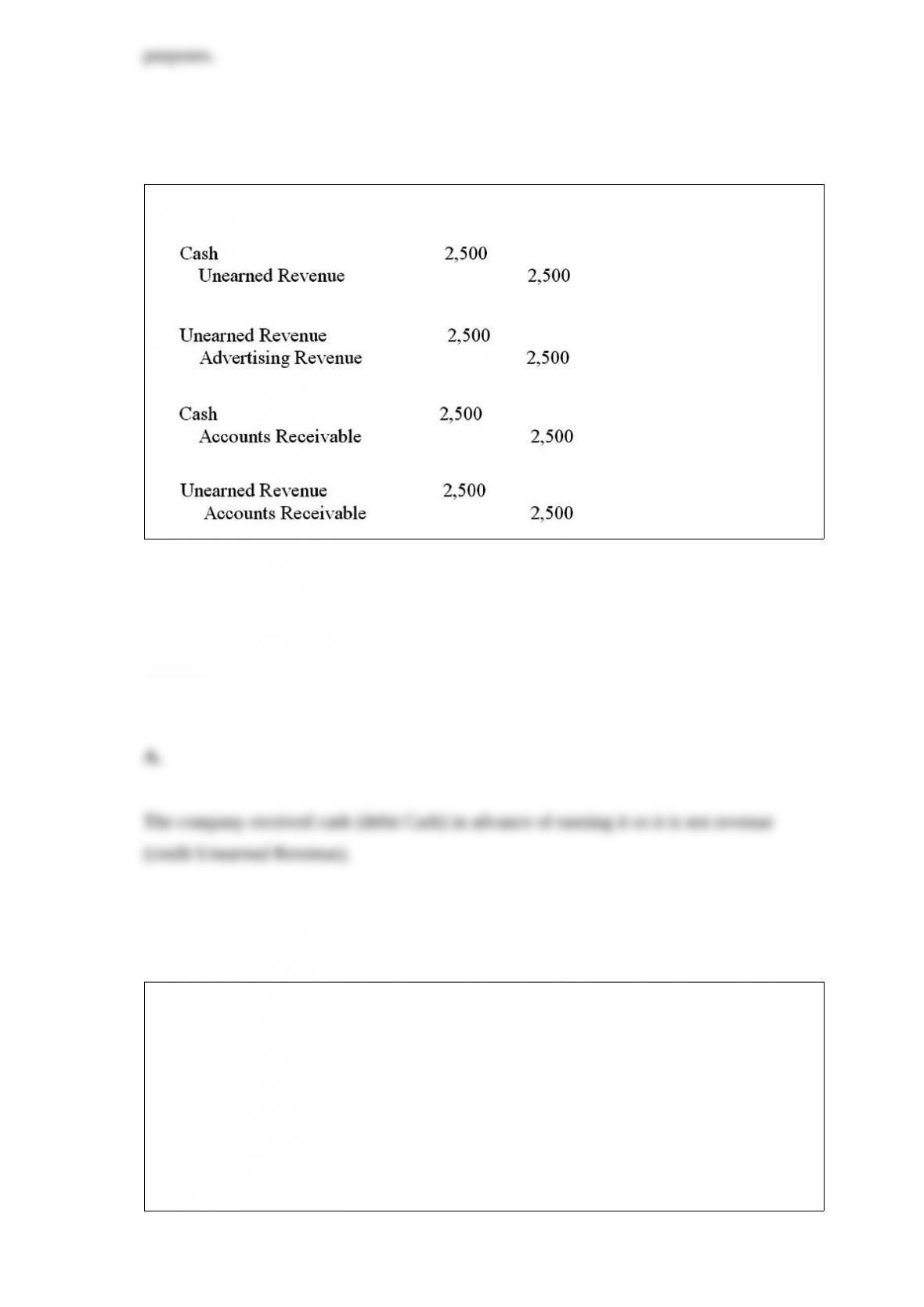
Which of the following is the journal entry to record activity #5?
A.
B.
C.
D.
Answer:
Days to sell is calculated as:
A. 365 divided by ending inventory.
B. Cost of goods sold divided by ending inventory.
C. 365 divided by Inventory turnover ratio.
D. Cost of goods sold divided by Average inventory.
Answer:
If an analyst wants to examine a company’s short-run ability to survive, which of the
following would best be considered?
A. Liquidity.
B. Market share.
C. Profitability.
D. Solvency.
Answer:
When the replacement cost of inventory drops below the cost recorded in the financial
records, applying the lower of cost or market (LCM) rule causes:
A. a decrease in cost of goods sold.
B. no change in net income, other things being equal.
C. a reduction in the book value of total assets.
D. an increase in net income.
Answer:
Which of the following is not a difference between notes payable and accounts
payable?
A. Notes payable are not interest free while accounts payable may be interest free.
B. Notes payable are often outstanding for longer periods of time than accounts
payable.
C. Notes payable are documented using formal written debt contracts while accounts
payable are generally informal.
D. Notes payable are reported as stockholders’ equity on the balance sheet while
accounts payable are reported as liabilities on the balance sheet.
Answer:
A company starts the period with 100 computers in inventory, purchases 30 more,
returns 4 of them to suppliers, and has 83 in inventory at the end of the period. If there
is no shrinkage, how many computers were sold?
A. 47 computers.
B. 43 computers.
C. 17 computers.
D. 83 computers.
Answer:
Investing activities on the Statement of Cash Flows are
A. transactions with lenders, borrowing and repaying cash.
B. transactions with stockholders, selling company stock and paying dividends.
C. transactions directly related to running the business to earn profit.
D. transactions of buying or selling productive resources with long lives.

Answer:
Match the category of business activity to the specific business action.
A. Operating activity.
B. Investing activity.
C. Financing activity.
_____ 1/ The purchase of a new line of assembly equipment.
_____ 2/ Company payment of a dividend.
_____ 3/ The purchase of office supplies.
_____ 4/ The purchase of advertising time by the company.
_____ 5/ The building of a new factory.
_____ 6/ Company repayment of a bank loan.
Answer:
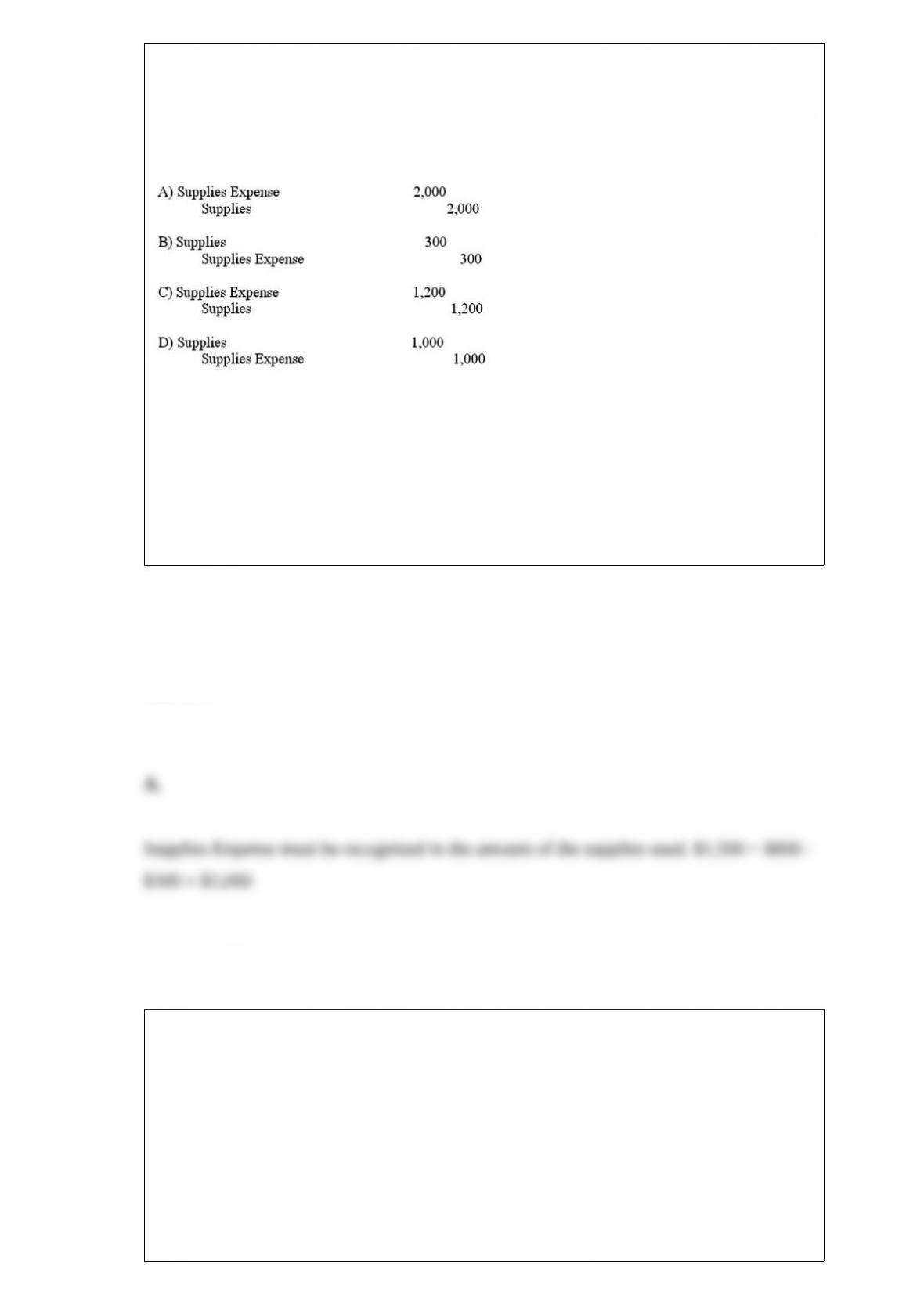
A company started the year with $1,500 of supplies on hand. During the year the
company purchased additional supplies of $800 and recorded them as increase to the
supplies asset. At the end of the year the company determined that only $300 of
supplies are still on hand. What is the adjusting journal entry to be made at the end of
the period?
A. Option A
B. Option B
C. Option C
D. Option D
Answer:
When a company encounters a contingent liability that is remote in likelihood, the
company should:
A. include a description in the notes to the financial statements.
B. record the amount of the liability times the probability of its occurrence.
C. record the amount of the liability as a long-term liability on the balance sheet.
D. exclude the information about the contingent liability from its financial statements
and notes.
Answer:
Cansing Company collected $5,000 from a customer on account. What journal entry
will Cansing record?
A. Debit Cash, credit Accounts Receivable.
B. Debit Cash, credit Revenue.
C. Debit Accounts Receivable, credit Revenue.
D. Debit Accounts Receivable, credit Cash.
Answer:
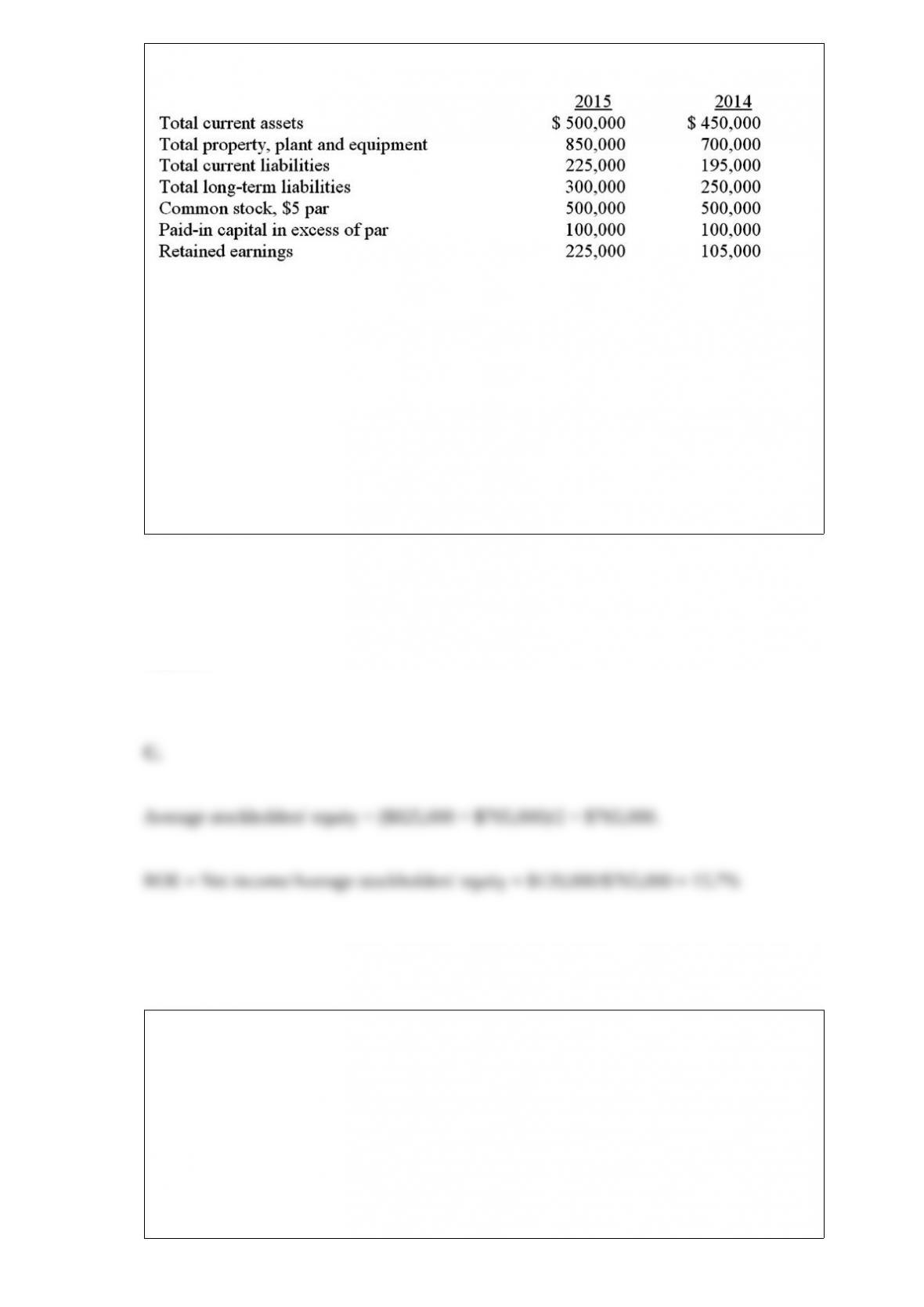
Use the information above to answer the following question. If net income for 2015 is
$120,000, which of the following is closest to the company’s return on equity for 2015?
A. 20%
B. 14.5%
C. 15.7%
D. 13.3%
Answer:
If XYZ Company had $12 million in revenue and net income of $3 million, then its:
A. expenses must have been $15 million.
B. expenses must have been $9 million.
C. assets must have been $12 million.
D. assets must have been $3 million.
Answer:
The Whackem-Smackem Software Company sold $11 million of computer games in its
first year of operations. The company received payments of $7.5 million for these
computer games. The company’s income statement would report:
A. sales revenue of $7.5 million.
B. accounts receivable of $3.5 million.
C. expenses of $3.5 million.
D. sales revenue of $11 million.
Answer:

When the amount of a contingent liability cannot be reasonably estimated but its
likelihood is probable, the company should:
A. include a description in the notes to the financial statements.
B. record the amount of the liability times the probability of its occurrence.
C. record the amount of the liability as a long-term liability on the balance sheet.
D. exclude the information about the contingent liability from its financial statements
and footnotes.
Answer:
Patel Inc. issued 5-year, 10% bonds with a face value of $10,000 on January 1, 2013.
The market rate of interest was 8% and the proceeds from the bond issuance was
$10,800.
Use the information above to answer the following question. If the Simplified Approach
(Effective-interest Method) of amortization is used, how much total interest expense
would be recorded in 2013?
A. $1,000
B. $1,080
C. $800
D. $864
Answer:
A company retires its bonds with a face value of $100,000 at 105. The carrying value of
the bonds at the retirement date is $103,745. The journal entry to record this retirement
will include a:
A. debit to Premium on bonds payable.
B. credit to Gain on bond retirement.
C. credit to Bonds payable.
D. debit to Discount on bonds payable.
Answer:
JC Corporation had 20,000 shares of $4 par value common stock outstanding on
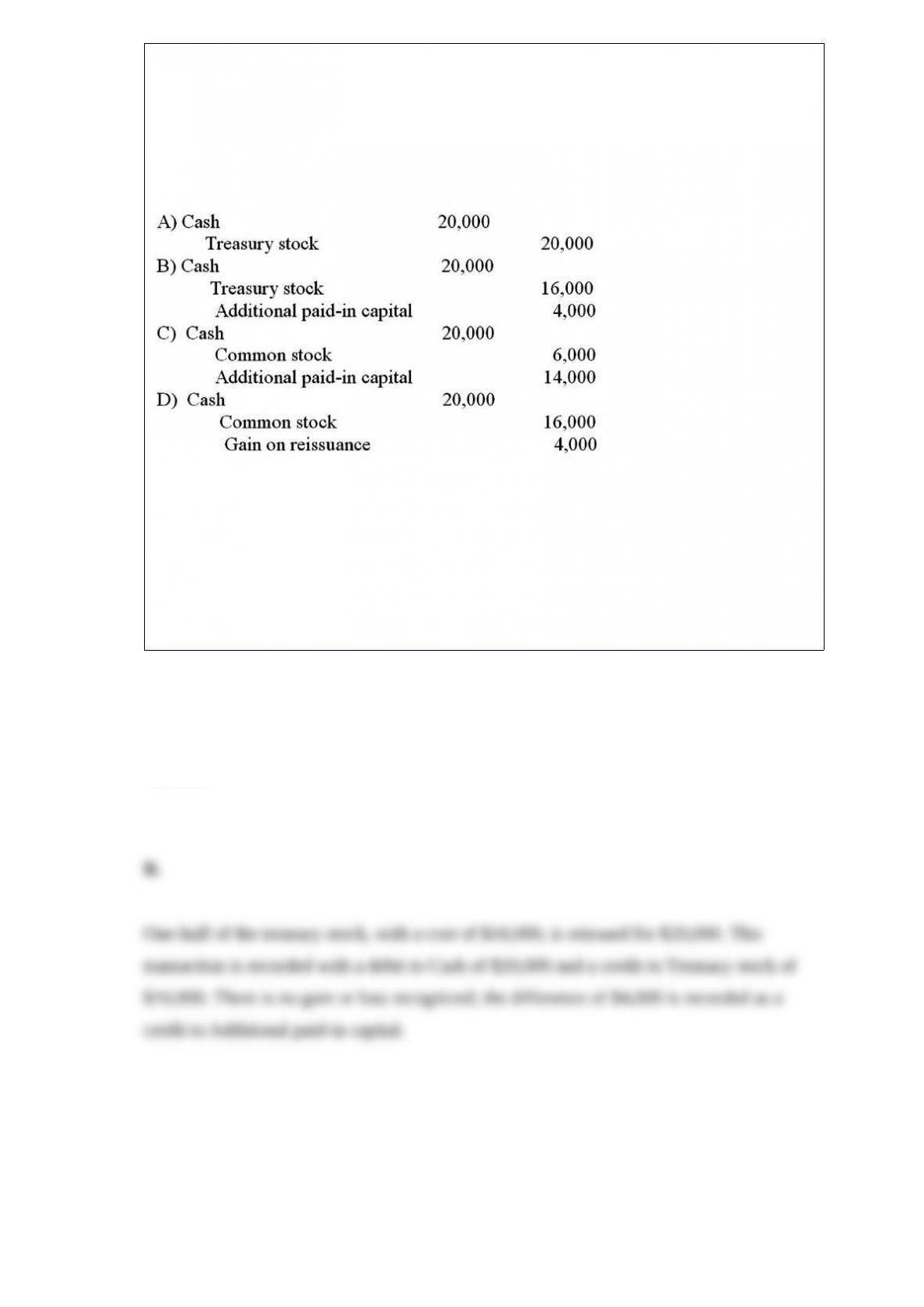
January 1, 2014. On January 20, 2014, the company purchased 2,000 of the outstanding
shares for $16 per share. On July 3, 2014, the company reissued 1,000 of the shares at
$20 per share.
Use the information above to answer the following question. What is the journal entry
to record the reissuance on July 3?
A. Option A
B. Option B
C. Option C
D. Option D
Answer: