
The journal entry to record depreciation expense consists of a debit to the asset being
depreciated and a credit to Accumulated Depreciation.
Compounding interest assumes the interest on an investment is reinvested.
In a standard cost system actual costs are recorded in Material, Direct Labor, and
Overhead accounts, but standard costs are charged to Work in Process.
Residual income is calculated by subtracting the minimum acceptable return on the
average invested capital from the operating income.
For a company to survive in the long-run it must have positive cash flows from
investing activities.

Loss contingencies should be recorded in the accounting records whenever it is
probable that a loss has been incurred and the amount of loss might be material in
amount.
In preparing monthly bills to be sent to individual credit customers, the billing
department will use the accounts payable subsidiary ledger, rather than the general
ledger.
A common criticism of capital ROI as a performance measurement criterion is that it
encourages a long-term orientation sometimes to the detriment of shorter-term
planning.
In a periodic inventory system, the Cost of Goods Sold account may be created during
the closing process by debiting Cost of Goods Sold and crediting the Beginning
Inventory and the Purchases account.

Just-in-time inventory systems cannot be used in conjunction with the LIFO cost flow
assumption.
Ledger accounts are updated first, and then transactions are recorded in the journal.
Metalworks employs 3 assembly workers that, on average, each work 40 hours per
week and earn $9 per hour. During the current accounting period, Job #543 consumed
77 hours of direct labor totaling $693.
An adjusting entry to recognize revenue that has been earned but not yet billed or
collected will cause an increase in total liabilities.

The contribution margin is the amount by which revenue exceeds variable costs.
Maple syrup and pancakes are examples of joint products.
The impact of a capital budgeting decision upon the environment is an example of a
nonfinancial consideration.
Measures of profitability tell us how quickly current assets can be converted into
profits.

When doing a bank reconciliation, an NSF check will reduce the bank’s balance.
The split-off point is the point at which joint products can be separated into two or more
products.
A company’s annual report includes comparative statements for several years.
When bonds are sold by one investor to another, they sell at market price plus accrued
interest since the last payment date.
“Convergence” means changing the country’s existing standards so that IFRS
“equivalent” financial reports are produced.

Inventory is a relatively liquid asset and usually appears above Accounts Receivable on
the balance sheet.
One purpose of a responsibility accounting system is to evaluate the performance of
center managers.
International accounting standards require mandatory redeemable preferred stock to be
classified as a liability on the balance sheet and not as equity.
A large company with many different kinds of low-cost items would tend to use a
perpetual inventory system.

Goodwill is only recorded when the value of a company increases and not when it
decreases in value.
It is possible for the overhead volume variance to be favorable and the overhead
spending variance to be unfavorable.
A master budget is a comprehensive financial plan setting forth the financial and
operational goals of a business.
Differential costs are those that are the same among alternatives.
In a periodic inventory system, when a sale is made there is no entry made to record the

cost of goods sold.
The purchase of an asset, such as office equipment, for cash will cause owners’ equity
to decrease.
Jiffy Company has 3,000 units that are 70% complete. Jiffy’s “equivalent units” are
3,000 completed units.
When goods are sold, a journal entry is made transferring the goods from cost of goods
sold to finished goods.
Cultural traits in the United States include high uncertainty avoidance and a long-term
orientation.

Pepsi Cola would most likely use a job order costing system.
Companies that show profits on the income statement will always show positive cash
flows from operating activities.
If a business activity qualifies as a profit center, it cannot also qualify as an investment
center.
A budget prepared using the total quality management approach is always achievable
by departments within a company.

Which of the following is an example of a loss contingency that should be disclosed in
a footnote to a company’s financial statements?
A. The president of the company has threatened to resign if the board of directors does
not vote to increase executive salaries.
B. A lawsuit has been brought against the company, but the company hopes to prevail in
the suit and thereby avoid any liability.
C. The allowance for uncollectible accounts receivable is estimated at $200,000.
D. The company owns special-purpose machinery which, if sold, would probably bring
a price less than its current book value.
Amortizing a premium on bonds payable:
A. Increases interest expense.
B. Increases periodic cash payments to bondholders.
C. Decreases interest expense.
D. Decreases periodic cash payments to bondholders.
Grand Gimmicks Company produces a single product with a current selling price of
$170. Variable costs are $130 per unit, and fixed costs per month average $6,240.
Management is considering increasing the selling price to $190 per unit. Assume that
the variable cost per unit of the product and monthly fixed expenses will not change as
a result of the proposed increase in selling price.
Refer to the information above. At the proposed increased selling price of $190 per unit,
closest to what dollar volume of sales per month is required to break-even? (Round
your intermediate percentage to one decimal place.)
A. $19,747.
B. $10,400.
C. $9,123.
D. $18,480.

Which of the following is not a strategy of the learning and growth lens of a balanced
scorecard?
A. Improve employee relations.
B. Improve customer relations.
C. Improve employee productivity.
D. Increase new product development.
A statement of cash flows is not intended to assist investors in evaluating:
A. Reasons for differences between the amount of net income and net cash flow from
operations.
B. The company’s ability to meet its obligations and to pay dividends.
C. Non-cash aspects of investing and financing activities.
D. The profitability of business operations.
On November 1, a French company purchased machinery from an American company
for 800,000 Euros when the exchange rate was $0.83. When preparing financial
statements on December 31, assuming the rate for Euros was $0.88, what amount of
gain or loss should the American company report?
A. $40,000 gain.
B. $40,000 loss.
C. $19,000 gain.
D. No gain or loss would be reported.
Given below are comparative balance sheets and an income statement for Eleva
Corporation.
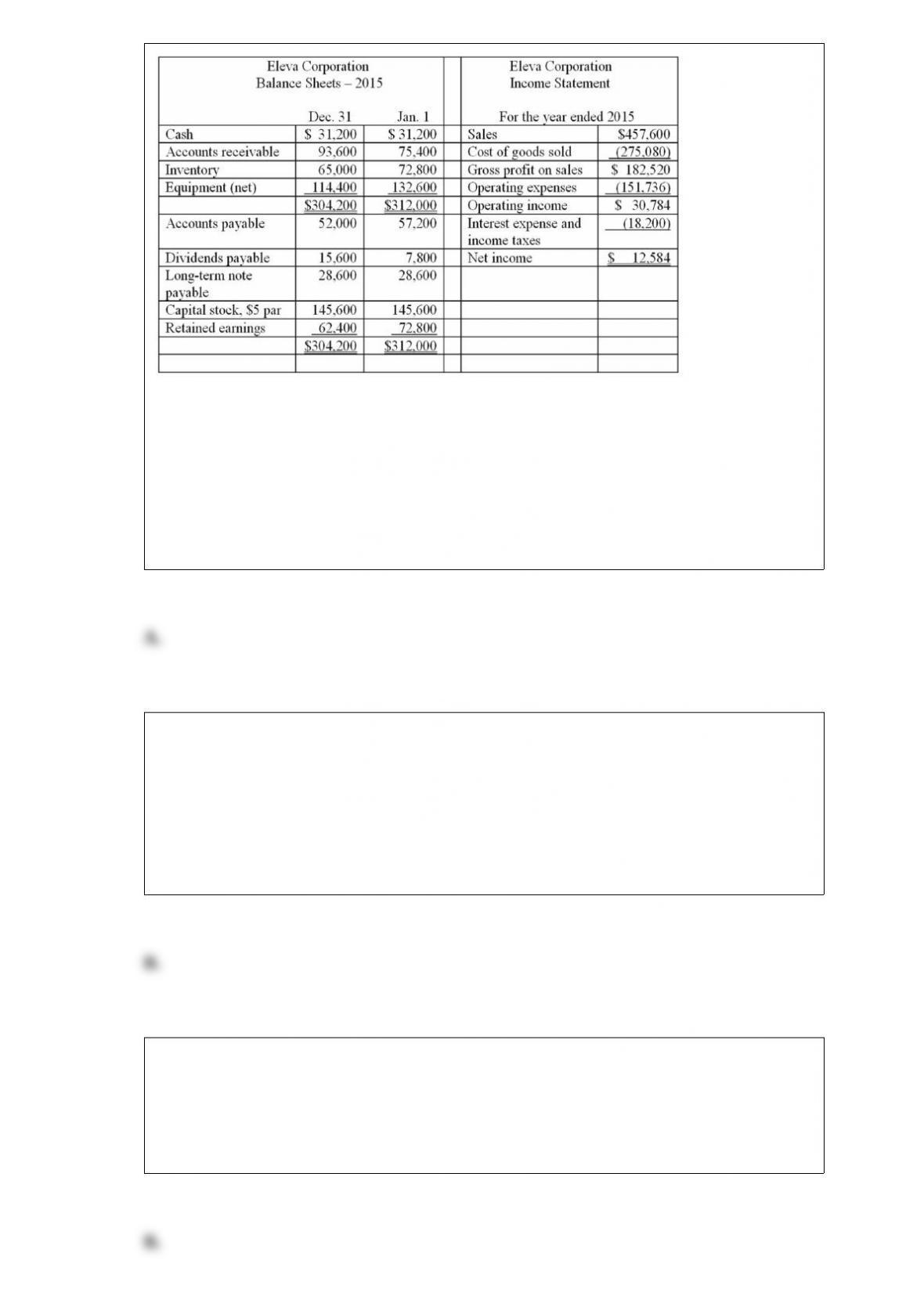
All sales were made on account. Cash dividends declared during the year totaled
$22,984.
Refer to the information above. Eleva Corporation’s operating cycle (in days) for 2015
is:
A. 158.8 days.
B. 122.0 days.
C. 213.4 days.
D. 188.0 days.
The basic purpose of a subsidiary ledger is to:
A. Provide a chronological record of all business transactions.
B. Provide details about the individual items comprising the balance of a general ledger
account.
C. Enable accountants to prepare financial statements.
D. Provide persons outside of the organization with detailed information about the
company’s operations.
Manufacturing companies normally have three types of inventory:
A. Direct materials, direct labor, and manufacturing overhead.
B. Raw materials, work in process, and finished goods.
C. Work in process, finished goods, and returned merchandise.
D. Economy, standard, and deluxe.
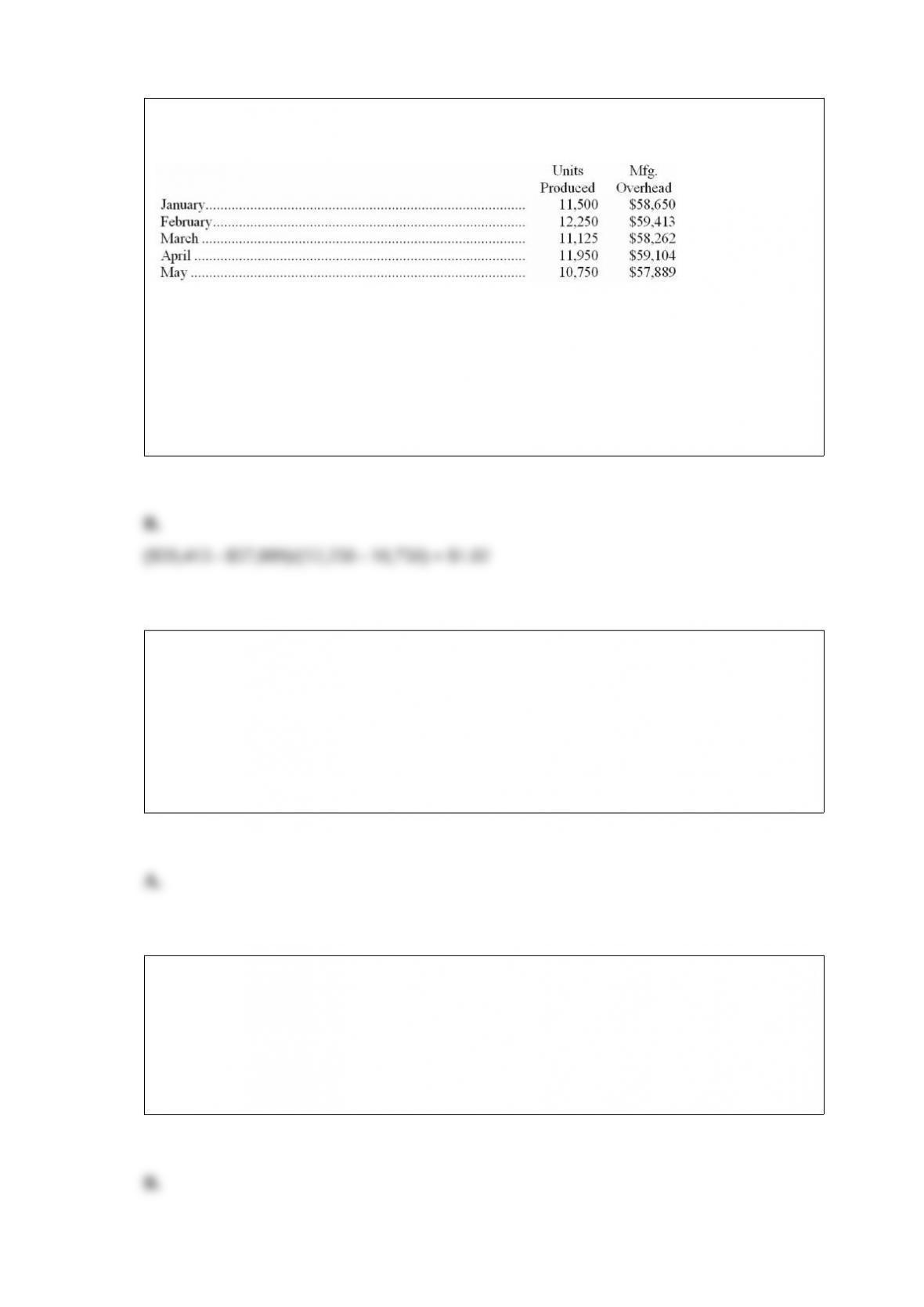
The levels of production and of manufacturing overhead for the first five months of
2015 for Duke & Duchess Products are shown below:
Refer to the information above. Using the high-low method, compute the variable
element of manufacturing overhead per unit of production closest to.
A. $0.83 per unit.
B. $1.02 per unit.
C. $0.95 per unit.
D. $0.08 per unit.
The accountant for Eric’s Plumbing Equipment Company recently made a journal entry
consisting of a debit to Work in Process and a credit to Raw Materials Inventory. This
entry recorded:
A. The use of raw materials in the production process.
B. Payment for raw materials.
C. The return of unused materials to inventory.
D. The receipt of raw materials from the company’s supplier.
Merchandising companies that are small and do not use a perpetual inventory system
may elect to use:
A. A physical inventory system.
B. A periodic inventory system.
C. An inventory shrinkage method.
D. An inventory subsidiary ledger system.
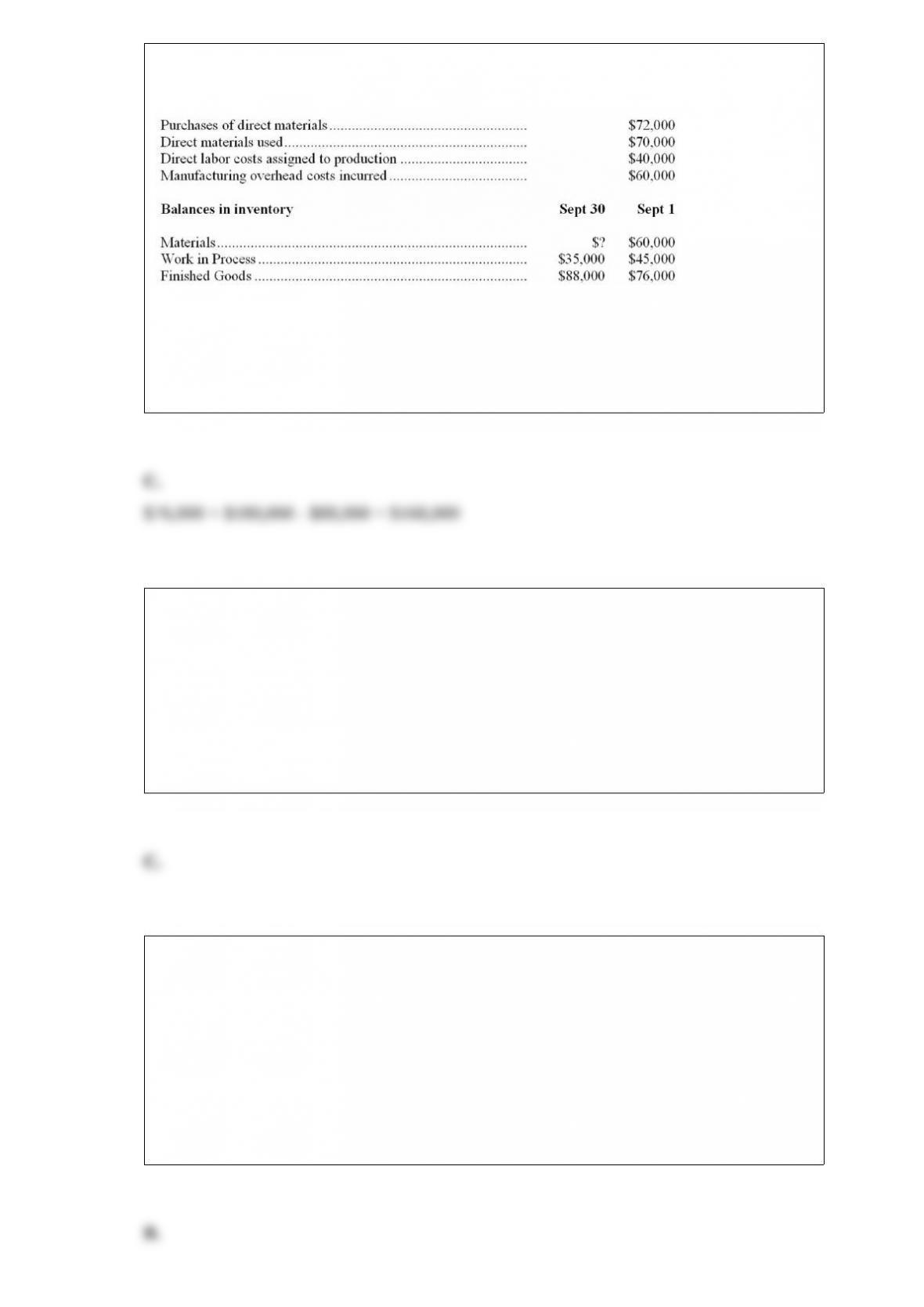
The following information has been taken from the perpetual inventory system of
Imperial Mfg. Co. for the month ended September 30:
Refer to the above data. The cost of goods sold in September is:
A. $190,000.
B. $158,000.
C. $168,000.
D. Some other amount.
The financial statements of Baxter Corporation include an Unrealized Holding Gain on
Investments. This item:
A. Is included in the income statement.
B. Is shown as a reduction in total stockholders’ equity.
C. Indicates that Baxter’s marketable securities have a current market value higher than
cost.
D. Indicate that Baxter Corporation sold marketable securities during the period at a
gain.
Grand Co.’s ending inventory of work in process is twice as large as at the beginning of
the period. Therefore:
A. The ending inventory of finished goods must be larger than the beginning inventory
of finished goods.
B. Total manufacturing costs for the period must exceed the cost of finished goods
manufactured.
C. Total manufacturing costs for the period must exceed the cost of goods sold.
D. The cost of finished goods manufactured must be smaller than the cost of goods
sold.
Generally speaking, which appears to be a desirable current ratio?
A. 20 to 1.
B. 1 to 20.
C. 2 to 1.
D. 1 to 2.
An NSF check returned by the bank should be entered in the depositor’s accounting
records by a debit to:
A. Accounts Receivable.
B. An expense account.
C. Cash.
D. Cash Over and Short.
Sales to customers using bank credit cards, such as Visa or MasterCard, are recorded as:
A. Cash sales.
B. An account receivable from the cardholder.
C. An account receivable from the bank.
D. Credit card discount expense.
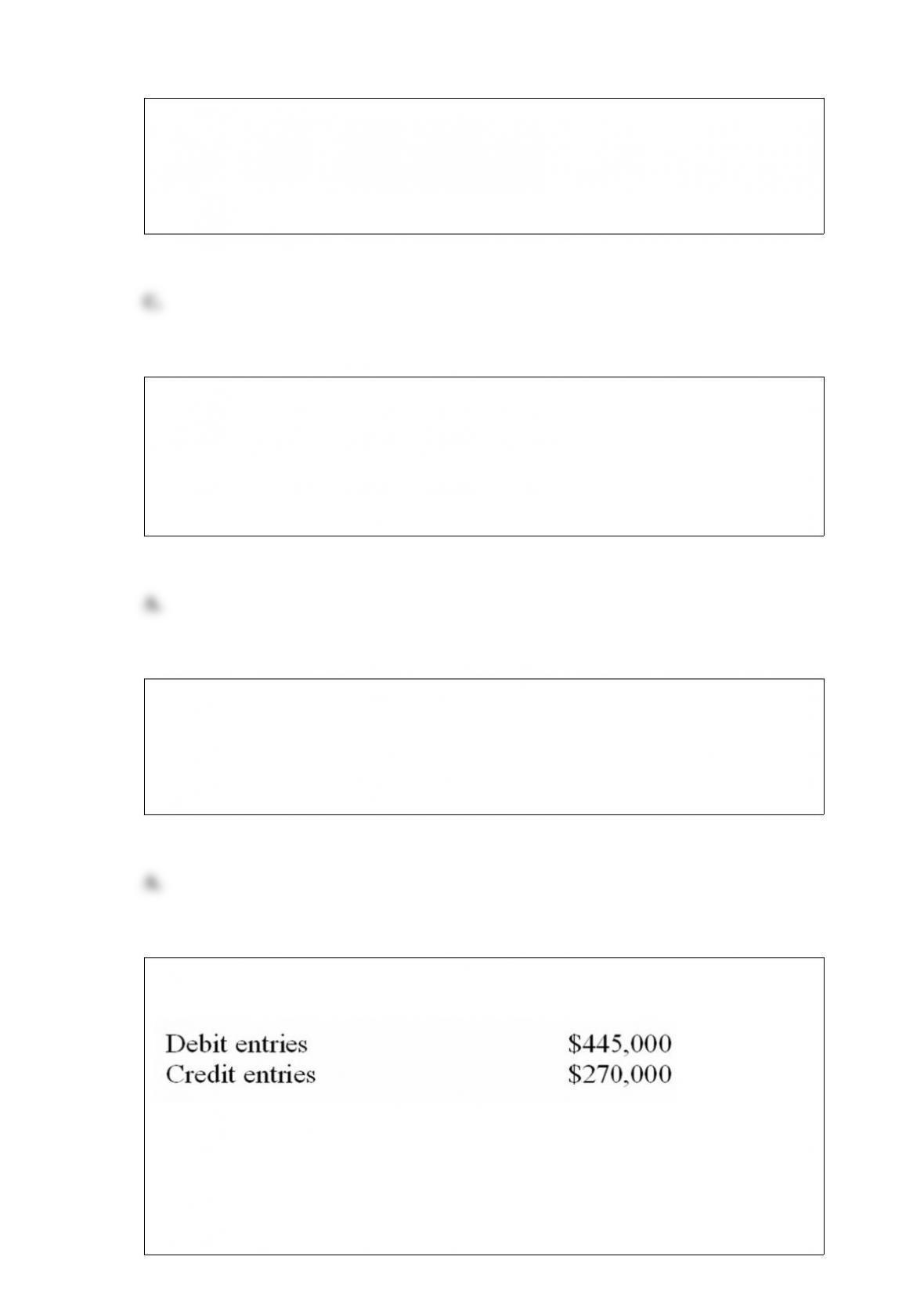
An analysis of Kenny Corporation’s Investment in Marketable Securities account during
2015 disclosed the following:
Kenny’s 2015 income statement included a $90,000 loss on sale of marketable securities
and $65,000 dividend income from marketable securities. All payments and proceeds
relating to marketable securities transactions were in cash.
Refer to the information above. The cash proceeds received by Kenny Corporation in
2015 for the sale of marketable securities was:

A. $230,000.
B. $280,000.
C. $195,000.
D. $180,000.
The basic purpose of audited financial statements is to:
A. Provide the reporting company with assurance that all assets are protected from theft
or embezzlement.
B. Prepare financial statements for companies that do not have their own accounting
departments.
C. Provide users of the financial statements with assurance that the statements are
verifiable and are presented in conformity with generally accepted accounting
principles.
D. Provide both the reporting company and the users of the statements with a written
guarantee that the statements are error-free.
When the government uses central planning to allocate resources and to determine
output among various segments of the economy, this is known as:
A. A dictatorship.
B. A democracy.
C. A planned economy.
D. A market economy.
The best definition of an accounting system is:
A. Journals, ledgers, and worksheets.
B. Manual or computer-based records used in developing information about an entity
for use by managers and also persons outside the organization.
C. The personnel, procedures, devices, and records used by an entity to develop
accounting information and communicate this information to decision makers.
D. The concepts, principles, and standards specifying the information which should be
included in financial statements, and how that information should be presented.
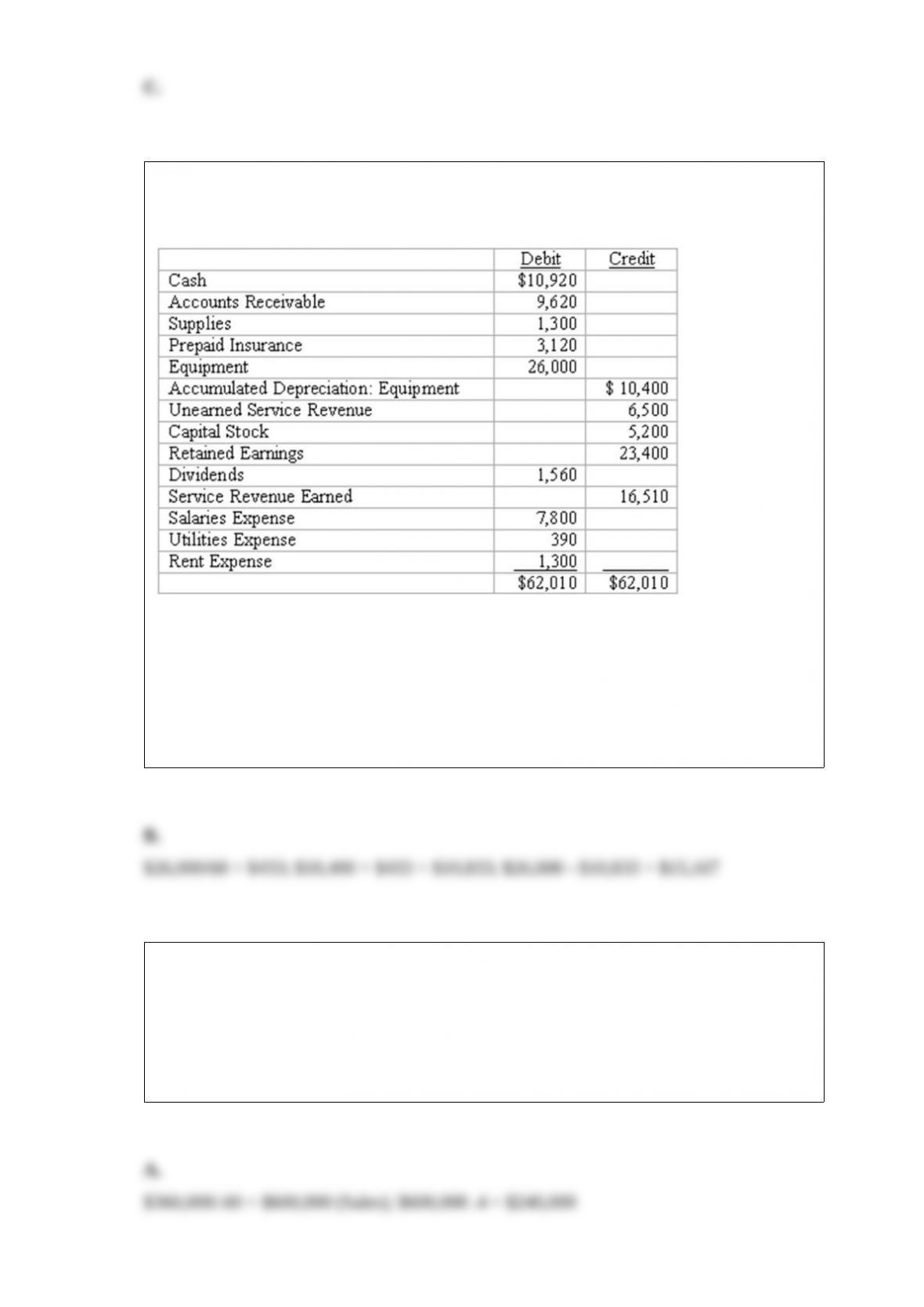
Hoffman, Inc. adjusts its books each month but closes its books at the end of the year.
The trial balance at March 31 before adjustments is as follows:
Refer to the information above. The equipment had an estimated useful life of five
years. Compute the book value of the equipment at March 31, after the proper March
adjustment is recorded.
A. $10,833.
B. $15,167.
C. $25,567.
D. $10,400.
If cost of goods sold is $360,000 and the gross profit rate is 40%, what is the gross
profit?
A. $240,000.
B. $360,000.
C. $600,000.
D. $900,000.
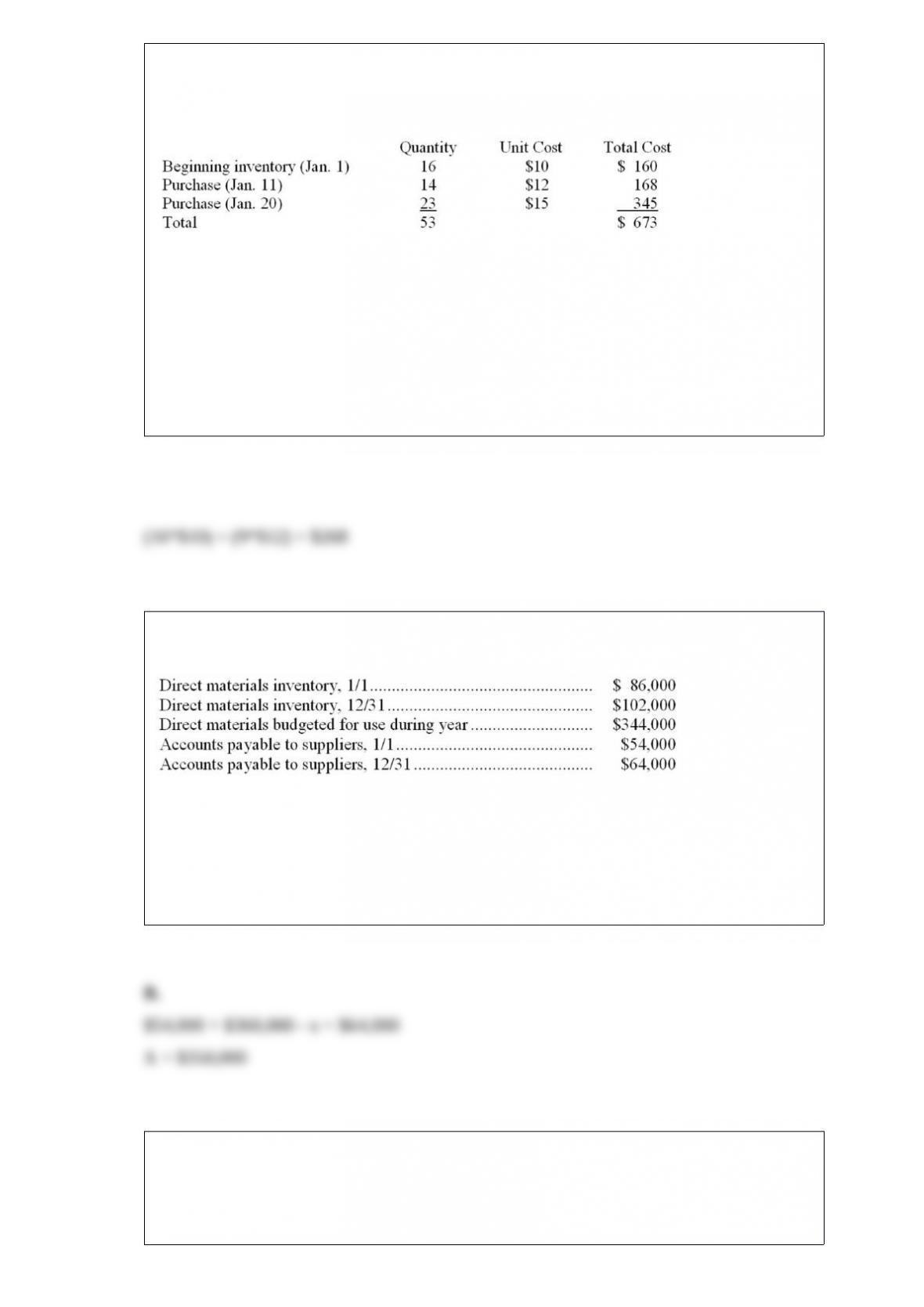
Beech Soda, Inc. uses a perpetual inventory system. The company’s beginning
inventory of a particular product and its purchases during the month of January were as
follows:
On January 14, Beech Soda, Inc. sold 25 units of this product. The other 28 units
remained in inventory at January 31.
Refer to the information above. Assuming that Beech Soda uses the FIFO cost flow
assumption, the cost of goods sold to be recorded at January 14 is:
A. $278.
B. $268.
C. $393.
D. $673.
The following information is from the manufacturing budget and budgeted financial
statements of Altman Corp.:
Refer to the information above. For the year, budgeted cash payments to suppliers
amounted to:
A. $344,000.
B. $350,000.
C. $334,000.
D. $354,000.
Sanford Corporation borrowed $90,000 by issuing a 12%, six-month note payable, all
due at the maturity date. After one month, the company’s total liability for this loan
amounts to:
A. $90,000.
B. $90,450.
C. $90,900.
D. $91,800.
Kenny Company is considering the possibility of investing $1,500,000 in a special
project. This venture will return $375,000 per year for 12 years in after tax cash flows.
Depreciation on the project will be $187,500 per year using straight-line depreciation.
The payback period for the project is:
A. 6 years.
B. 12 years.
C. 4 years.
D. 2 years.
International standards require that goodwill:
A. Be capitalized and amortized over 20 years or less.
B. Be capitalized and amortized over 40 years or less.
C. Be capitalized and reviewed annually and its value should be adjusted if impaired.
D. Be expensed immediately.
When direct labor employees contribute to the production process, the cost of their
labor is recorded by debiting:
A. Wages Expense.
B. Direct Labor.
C. Work in Process Inventory.
D. Manufacturing Overhead.

The logic behind the lower-of-cost-or-market rule is:
A. Inventory gradually becomes obsolete.
B. Inventory that is unsalable should be written down to zero (or its scrap value).
C. An asset is not worth more than it would cost the owner to replace it.
D. Inventory that is unsalable should be written down to its replacement cost.