1) Under the perpetual inventory system, a company purchases merchandise on terms
2/10, n/30. If payment is made within 10 days of the purchase, the entry to record the
payment will include a credit to Cash and a credit to Purchase Discounts.
2) For a period during which the quantity of inventory at the end was larger than that at
the beginning, income from operations reported under variable costing will be smaller
than income from operations reported under absorption costing.
3) The cost of production report reports the cost charged to production and the costs
allocated to finished goods and work in process.
4) When a corporation discontinues a segment of its operations at a loss, the loss should
be reported as a separate item after income from continuing operations on the income
statement.
5) Cost behavior refers to the methods used to estimate costs for use in managerial
decision making.
6) Activity-based costing is determined by charging products for only the services
(activities) they used during production.
7) The statement of cash flows is an optional financial statement.
8) Allowance for Doubtful Accounts is a liability account.
9) The maturity value of a note receivable is always the same as its face value.
10) During the first year of operations, a company granted warranties on its products.
The estimated cost of the product warranty liability at the end of the year is $8,500. The
product warranty expense of $8,500 should be recorded in the years of the expenditures
to repair the products covered by the warranty payments.
11) The standard cost is how much a product should cost to manufacture.
12) The profit center income statement should include only revenues and expenses that
are controlled by the manager.
13) An increase in the accounts receivable turnover may be due to an improvement in
the collection of receivables or to a change in the granting of credit and/or in collection
practices.
14) If the standard to produce a given amount of product is 1,000 units of direct
materials at $11 and the actual was 800 units at $12, the direct materials quantity
variance was $1,000 unfavorable.
15) In net present value analysis for a proposed capital investment, the expected future
net cash flows are reduced to their present values.
16) Lead time is the process time between start and completion.
17) The primary purpose of a stock split is to reduce the number ofshares outstanding in
order to encourage more investors to enter the market for the company’s shares.
18) Paid-in capital may originate from real estate donated to thecorporation.
19) On September 1, the company pays rent for twelve months in advance and debits an
asset account. At year end, the adjusting entry on the work sheet would
A.increase an expense account
B.decrease a liability account
C.increase an asset account
D.decrease an expense account
20) Those most responsible for the major policy decisions of a corporation are the
A.management
B.board of directors
C.employees
D.stockholders
21) The balance in Discount on Bonds Payable that is applicable to bonds due in 2015
would be reported on the balance sheet in the section entitled
A.investments
B.long-term liabilities
C.current assets
D.intangible assets
22) Prepare entries to record the following:
(a) Issued 1,000 shares of $15 par common stock at $54 for cash.
(b) Issued 1,400 shares of no-par common stock in exchange for equipment with a fair
market price of $24,000.
(c) Purchased 100 shares of treasury stock at $26.
(d) Sold 100 shares of treasury stock purchased in (c) at $29.
23) Prior to the adjusting process, accrued revenue has
A.been earned and cash received
B.been earned and not recorded as revenue
C.not been earned but recorded as revenue
D.not been recorded as revenue but cash has been received
24) The following procedures were recently implemented at the Pampered Pets, Inc. For
each procedure, indicate whether the internal control over cash represents (1) a strength
or (2) a weakness. If it is a weakness, please explain why.
(a) At the end of the day, cash register clerks are required to use their own funds to
make up any cash shortages in their registers.
(b) At the end of the day, an accounting clerk compares the duplicate copy of the daily
cash deposit slip with the deposit receipt obtained from the bank.
(c) After necessary approvals have been obtained for the payment of a voucher, the
treasurer signs and mails the check. The treasurer then stamps the voucher and
supporting documentation as paid and returns the voucher and supporting
documentation to the accounts payable clerk for filing.
(d) Along with the petty cash expense receipts for postage, office supplies, etc., several
post-dated employee checks are in the petty cash fund.

25) Division A of Mocha Company has sales of $155,000, cost of goods sold of
$83,000, operating expenses of $43,000, and invested assets of $150,000.
What is the rate of return on investment for Division A?
A.19.3%
B.48.0%
C.18.7%
D.5.47%
26) According to a summary of the payroll of Scotland Company, $450,000 was subject
to the 7.0% social security tax and $500,000 was subject to the 1.5% Medicare tax.
Federal income tax withheld was $98,000. Also, $15,000 was subject to state (4.2%)
and federal (0.8%) unemployment taxes. The journal entry to record accrued salaries
would include:
A.a debit to Salary Payable of $313,000
B.a credit to Salary Payable of $363,000
C.a debit to Salary Expense of $363,000
D.a credit to Salary Expense of $313,000
27) Samuels, Inc. reported net income for 2011 is $105,000. During 2011 the company
had 5,000 shares of $100 par, 5% preferred stock and 20,000 of $5 par common stock
outstanding. Samuels earnings per share for 2011 is
A.$4.00
B.$5.25
C.$6.50
D.$5.00
28) Starling Co. is considering disposing of a machine with a book value of $12,500
and estimated remaining life of five years. The old machine can be sold for $1,500. A
new high-speed machine can be purchased at a cost of $25,000. It will have a useful life
of five years and no residual value. It is estimated that the annual variable
manufacturing costs will be reduced from $26,000 to $23,500 if the new machine is
purchased. The total net differential increase or decrease in cost for the new equipment
for the entire five years is:
A.decrease of $11,000
B.decrease of $15,000
C.increase of $11,000
D.increase of $15,000
29) Which of the following describes the behavior of the fixed cost per unit?
A.Decreases with increasing production
B.Decreases with decreasing production
C.Remains constant with changes in production
D.Increases with increasing production
30) The systematic examination of the relationships among selling prices, volume of
sales and production, costs, and profits is termed:
A.contribution margin analysis
B.cost-volume-profit analysis
C.budgetary analysis
D.gross profit analysis
31) Which of the following is not a characteristic of a job order costing system?
A.It accumulates cost for each department within the factory
B.It provides a separate record for the cost of each quantity of product that passes
through the factory
C.It is best suited for industries that manufactures custom goods
D.Uses only one work in process account
32) A financial statement user would determine if a company was profitable or not
during a specific period of time by reviewing
A.the income statement
B.the balance sheet
C.the statement of cash flows
D.the retained earnings statement
33) Which of the following entries records the receipt of cash from patients on account?
A.Accounts Payable, debit; Fees Earned, credit
B.Accounts Receivable, debit; Fees Earned, credit
C.Accounts Receivable, debit; Cash, credit
D.Cash, debit; Accounts Receivable, credit
34) Match each item with its definition.
1>Useful for comparing one company to another or a company with industry averages
A. Horizontal analysis
2>Focuses on a companys ability to generate net income B. Extraordinary Items
3>The percentage analysis of the relationship of each component in a financial
statement to a total within the statement. C. Current position analysis
4>An analysis of a companys ability to pay its current liabilities. D. Vertical analysis
5>Occurs when a company abandons a segment. E. Discontinued Operations
6>A percentage analysis of increases and decreases in related items in comparative
financial statements. F. Profitability analysis
7>Something that is both unusual and infrequent. G. Common-sized financial
statements
8>This requires a restatement of prior period financial statements. H. Change from one
generally accepted accounting principle to another
35) All of the following are ways that managers use managerial information except
A.to evaluate the companys stock performance
B.to evaluate the performance of a companys operations
C.to support long-term planning decisions
D.to determine the cost of manufacturing a product
36) A business borrowed $40,000 on March 1 of the current year by signing a 60-day,
9% interest bearing note. Assuming a 360-day year, when the note is paid on April 30,
the entry to record the payment should include a
A.debit to Interest Payable $600
B.debit to Interest Expense $600
C.credit to Cash for $40,000
D.credit to Cash for $46,300
37) At the end of the current year, Accounts Receivable has a balance of $700,000;
Allowance for Doubtful Accounts has a credit balance of $5,500; and net sales for the
year total $3,500,000. Bad debt expense is estimated at 1/2 of 1% of net sales.
Determine (a) the amount of the adjusting entry for bad debt expense; (b) the adjusted
balances of Accounts Receivable, Allowance of Doubtful Accounts; and Bad Debt
Expense; and (c) the net realizable value of accounts receivable.
38) On January 1, 2011, Cary Parsons established Carys Catering Service. Listed below
are accounts to use for transactions (a) through (f), each identified by a number.
Following this list are the transactions that occurred during the first month of
operations. You are to indicate for each transaction the accounts that should be debited
and credited by placing the account number(s) in the appropriate box.
Transactions Account(s) Debited Account(s) Credited
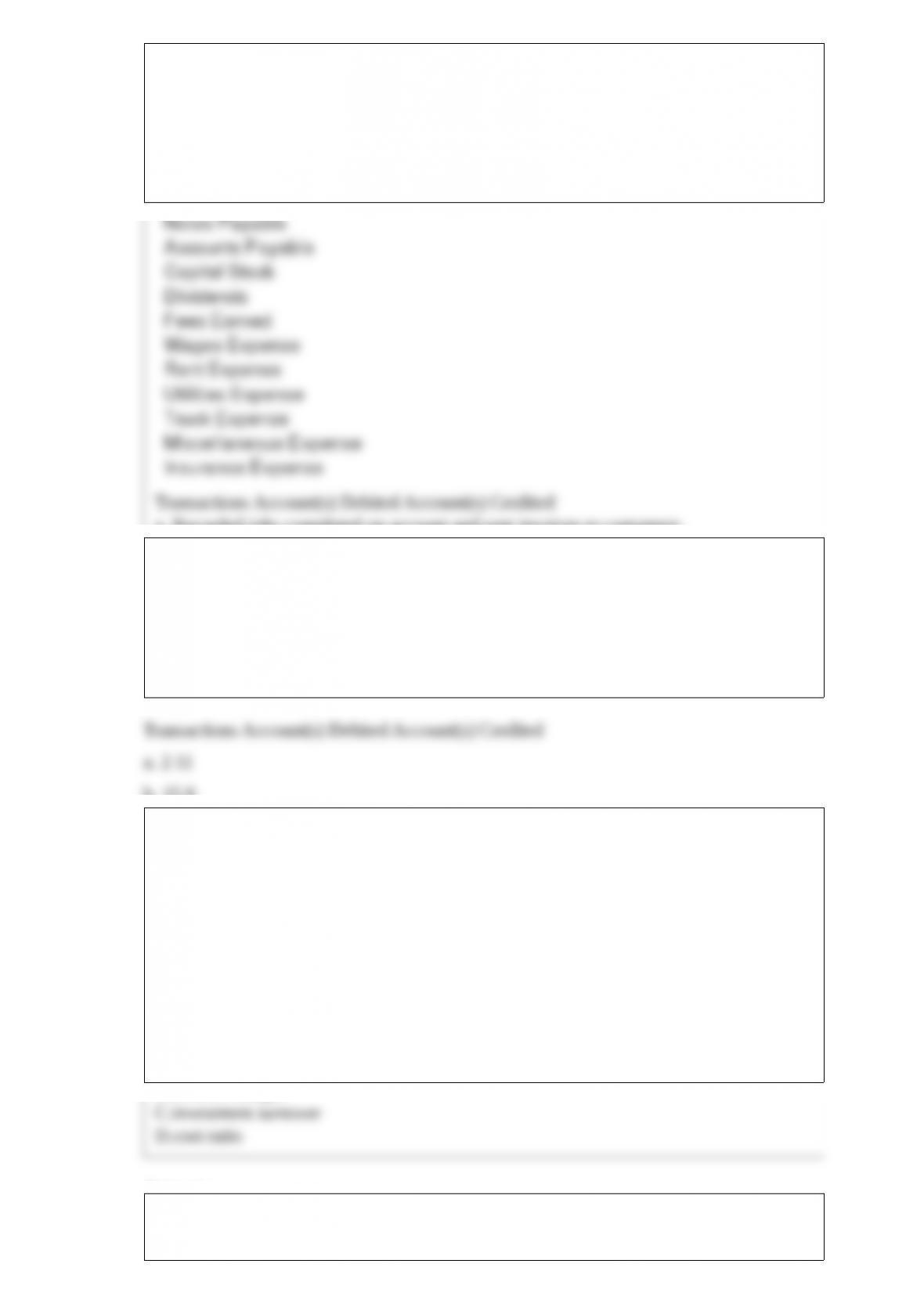
a. Recorded jobs completed on account and sent invoices to customers.
b. Received an invoice for truck expenses to be paid in February.
c. Paid utilities expense
d. Received cash from customers on account.
e. Paid employee wages.
f. Paid Cary a cash dividend.
39) A factor in determining the rate of return on investment–the ratio of sales to
invested assets–is called:
A.profit margin
B.indirect margin
C.investment turnover
D.cost ratio
40) Department W had 2,400 units, one-third completed at the beginning of the period,
16,000 units were transferred to Department X from Department W during the period,
and 1,800 units were one-half completed at the end of the period. Assume the
completion ratios apply to direct materials and conversion costs.
What is the equivalent units of production used to compute unit conversion cost on the
cost of production report for Department W (Assuming the company uses FIFO)?
A.16,100 units
B.13,600 units
C.15,000 units
D.18,500 units
41) At December 31, 2011, Martin Consultants has assets of $430,000 and liabilities of
$205,000. Using the accounting equation and considering each case independently,
determine the following:
a. Total Stockholders Equity as of December 31, 2011.
b. Total Stockholders Equity as of December 31, 2012, assuming that assets increased
by $12,000 and liabilities increased by $15,000 in 2012.
c. Total Stockholders Equity as of December 31, 2012, assuming that assets decreased
by $8,000 and liabilities increased by $14,000 during 2012.
42) If the actual direct labor hours spent producing a commodity differs from the
standard hours, the variance is termed a:
A.time variance
B.price variance
C.quantity variance
D.rate variance
43) The reconciliation of the cash register tape with the cash in the register is an
example of
A.other controls
B.independent internal verification
C.establishment of responsibility
D.segregation of duties
44) If bonds are issued at a premium, the stated interest rate is
A.higher than the market rate of interest
B.lower than the market rate of interest
C.too low to attract investors
D.adjusted to a higher rate of interest
45) On January 1, 2014, the retained earnings account of Crystal Pool Service Company
had a balance of $252,000. During the year, the company issued an additional $20,000
of capital stock and paid $52,400 in dividends. For the year ended December 31, 2014,
Crystal Pool Service Company reported a net income of $73,200. Prepare a retained
earnings statement for the year ended December 31, 2014.
46) Selected accounts and amounts appear below. Journalize the closing entry,
assuming a perpetual inventory system.
47) Within the United States, the dominant body in the primary development of
accounting principles is the
A. American Institute of Certified Public Accountants (AICPA)
B. American Accounting Association (AAA)
C. Financial Accounting Standards Board (FASB)
D. Institute of Management Accountants (IMA)
48) On March 5th, Blowout Sales makes $22,500.00 in sales on the companys own
credit cards. The cost of merchandise sold are $16,825.00. Journalize the sales and
recognition of the cost of merchandise sold.
49) What is the purpose of an adjusted trial balance? What types of errors does it
detect? What types of errors does it not detect?
50) Define operating leverage. Explain the relationship between a companys operating
leverage and how a change in sales is expected to impact profits.
51) Crane Company Division B recorded sales of $360,000, variable cost of goods sold
of $315,000, variable selling expenses of $13,000, and fixed costs of $61,000, creating
a loss from operations of $29,000. Determine the differential income or loss from the
sales of Division B. Should this division be discontinued?