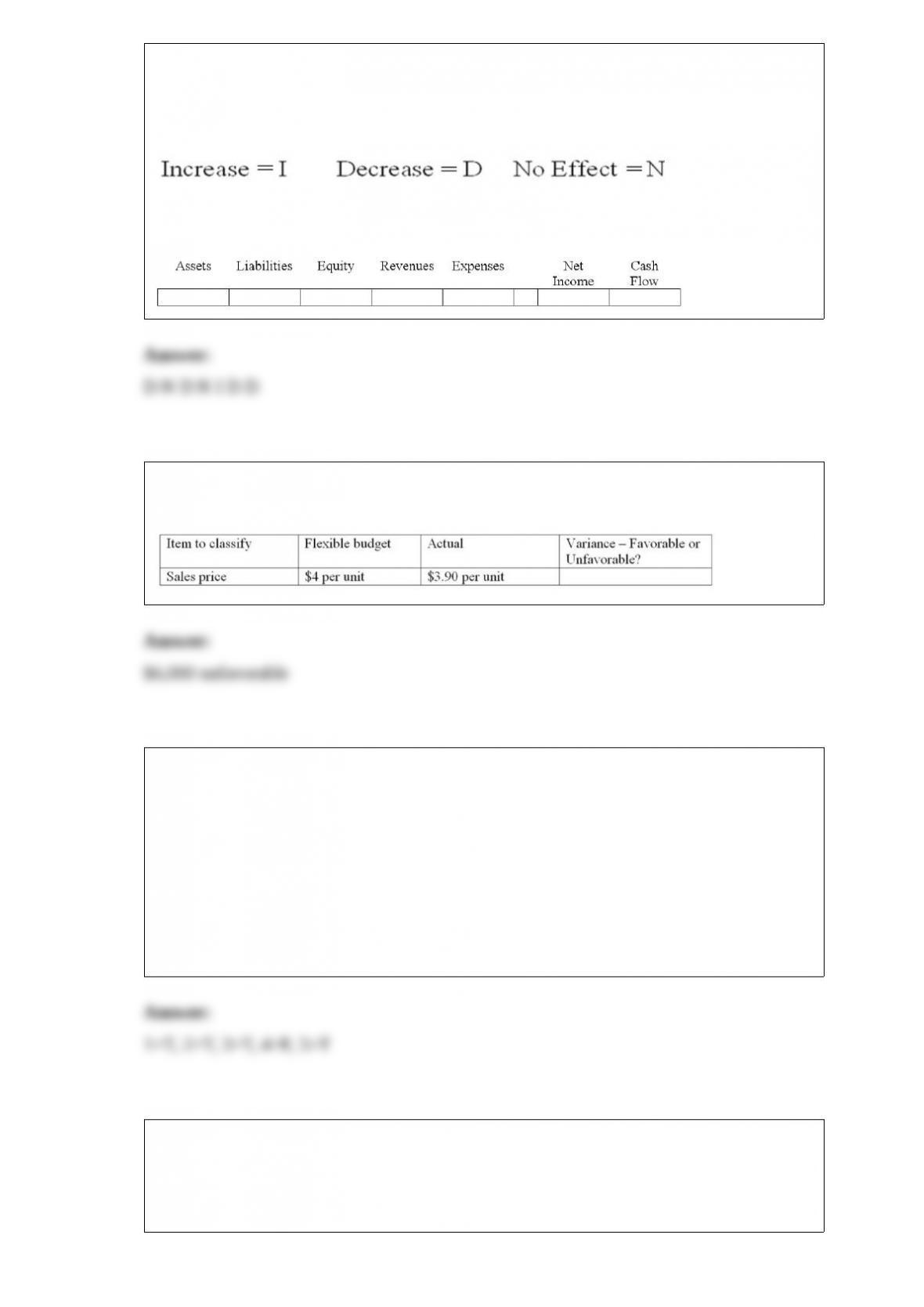
1) Indicate how each event affects the elements of financial statements. Use the
following letters to record your answer in the box shown below each element. You do
not need to enter amounts. Assume use of a perpetual inventory system.
Bryan Co. paid $40 for freight cost to have merchandise shipped to one of its
customers. Show how the transaction would affect Bryan’s financial statements.
2) Based on the information given, calculate the dollar amount of the variance and
indicate whether it is favorable or unfavorable.
3) Indicate whether each of the following statements about costs is true or false.
1>When a company manufactures many units of a product, calculating the exact cost of
each unit is not practical
2>Salaries earned by the sales staff are reported as period costs
3>When a unit of a product is sold, the average cost is transferred from Inventory to
Cost of Goods Sold
4>General and administrative costs are expensed in the period they are incurred
5>For a manufacturer, total manufacturing costs include materials, labor, and overhead
4) Indicate how each event affects the elements of financial statements. Use the
following letters to record your answer in the box shown below each element. You do
not need to enter amounts.
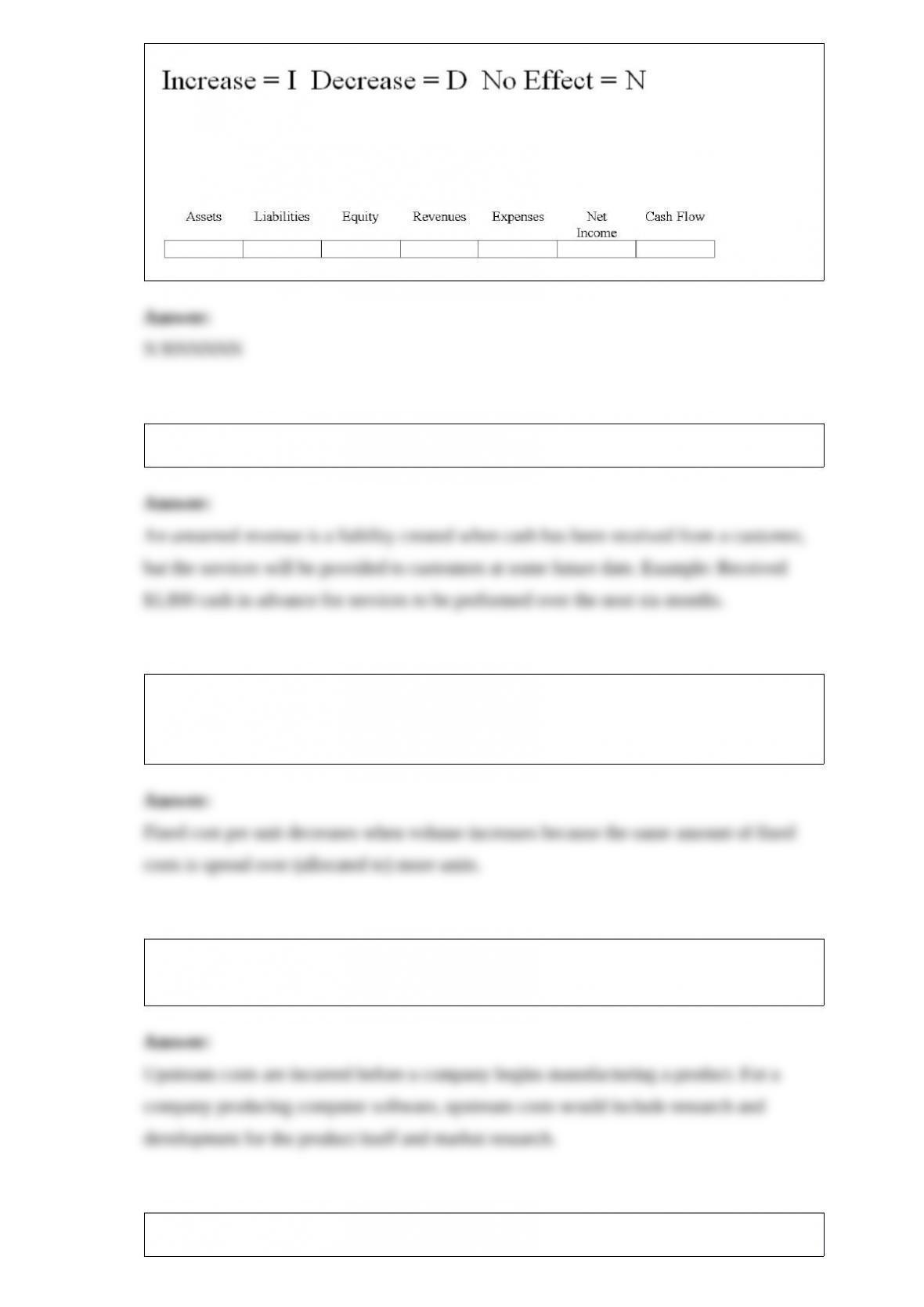
Potter Co. used the allowance method to account for uncollectible accounts expense.
On June 20, 2012, Potter wrote off an uncollectible account in the amount of $8,000.
Show the effect of this write-off.
5) What is unearned revenue? Give an example.
6) Company A has variable costs per unit of $20, fixed costs of $300,000, and a
break-even sales volume of 60,000 units.
How does fixed cost per unit behave when volume increases?
7) What are upstream costs? What upstream costs would be incurred by a company that
produces and sells computer software programs?
8) What are the consequences of having too much inventory? Of having too little
inventory?
9) What is meant by the term “net realizable value” for accounts receivable?