1) Which of the following best describes assets?
A.They are equal to liabilities minus stockholders’ equity.
B.They are considered to be the economic resources of the business.
C.They are all reported on the balance sheet at their current market value.
D.They equal financing provided by creditors.
2) During 2014, the Bowtie Company reported net income of $1,872 million,
depreciation expense of $1,412 million and $978 million paid for purchases of property,
plant and equipment. What would be the effect on cash flows from operating activities
during 2014?
A.Cash flows from operating activities would be increased by depreciation expense and
decreased by the property, plant and equipment purchases.
B.Cash flow from operating activities would be increased by depreciation expense and
by the property, plant and equipment purchases.
C.Cash flow from operating activities would be increased by depreciation expense but
the property, plant and equipment purchases would have no effect on cash flow from
operating activities.
D.Depreciation is a noncash expense and would not be used to calculate cash flow from
operating activities.
3) Which of the following correctly describes the effect of a journal entry involving the
recording of a sales return?
A.Gross profit decreases.
B.Net sales increases.
C.Current assets remain the same.
D.Net income increases.
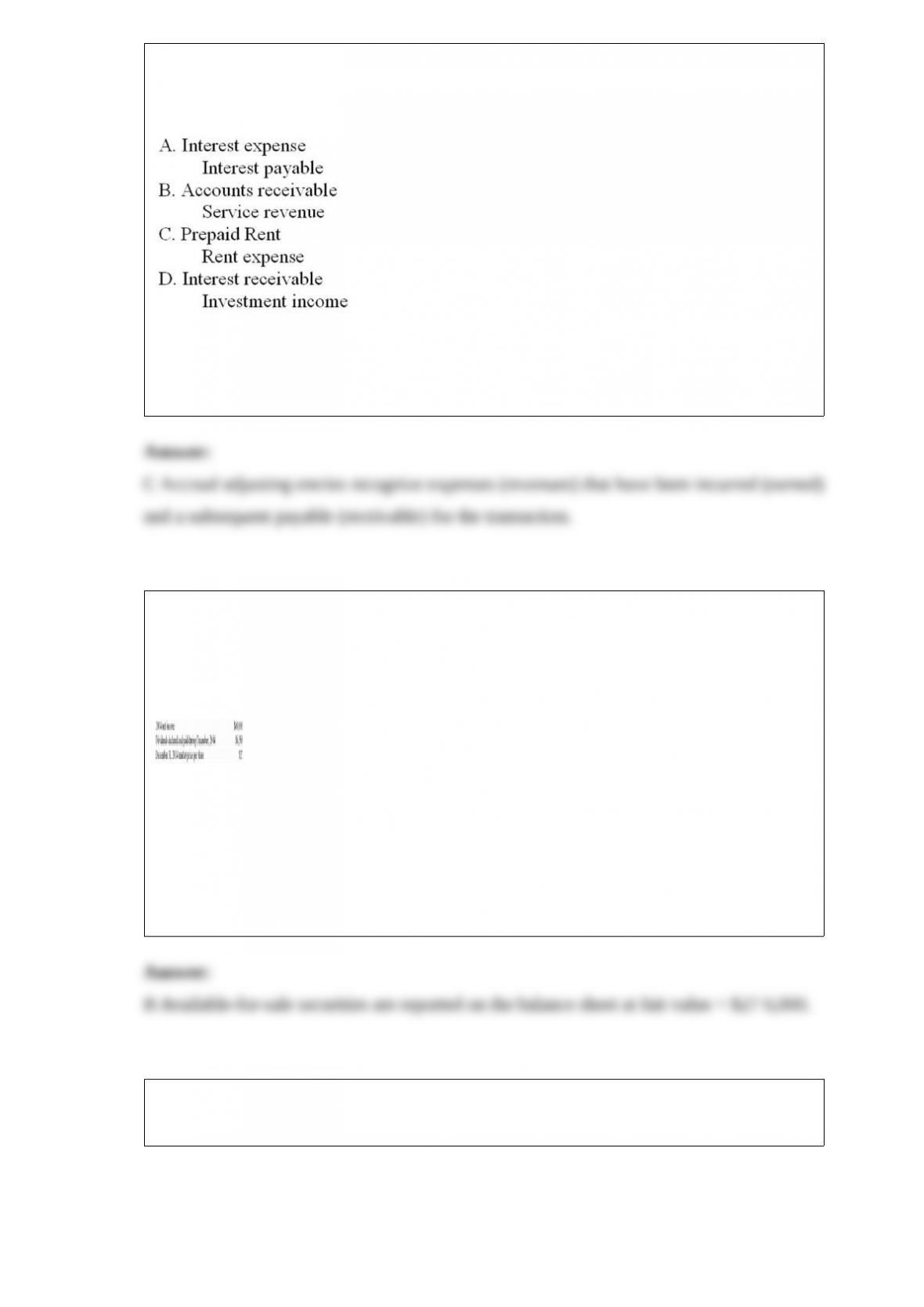
4) Which of the following adjusting journal entries is not created as the result of an
accrual?
A.Option A
B.Option B
C.Option C
D.Option D
5) On July 1, 2014, as a long-term investment in available-for-sale securities, Wildlife
Supply Company purchased 6,000 of the 18,000 outstanding shares of the nonvoting
preferred stock of Nature Company for $30 per share. The records of Nature Company
reflect the following:
The amount reported on the balance sheet by Wildlife Company for its investment at
December 31, 2014 would be which of the following?
A.$179,800.
B.$162,000.
C.$182,000.
D.$197,800.
6) The records of Marshall Company include the following:
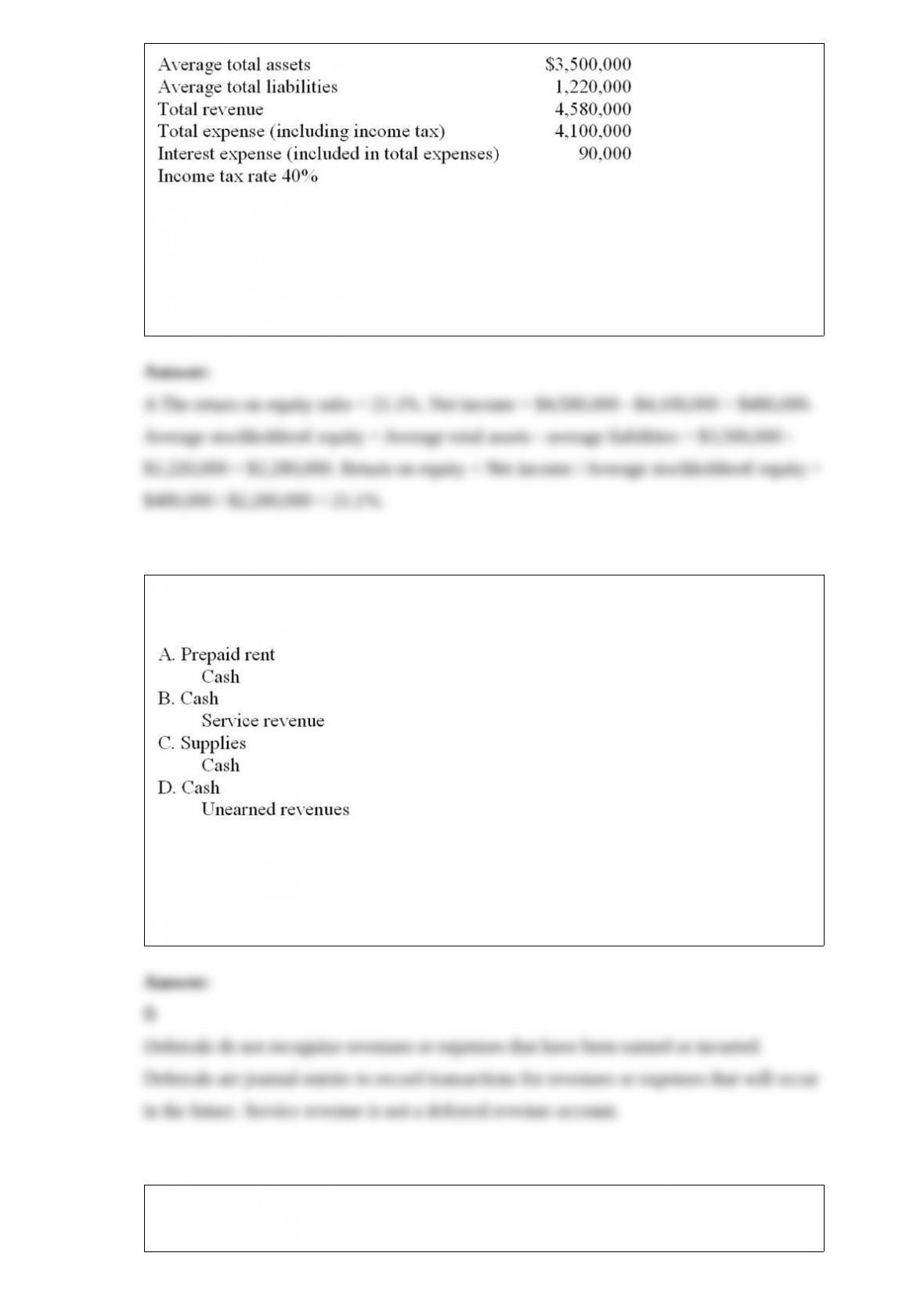
The return on equity is closest to:
A.21.1%
B.10.2%
C.16.4%
D.17.1%
7) Which of the following journal entries would not be used to record a deferral?
A.Option A
B.Option B
C.Option C
D.Option D
8) Kudos Corporation bought a 40% interest in the voting stock of Nutribar
Corporation’s $1 par value common stock for $20 million, in exchange for 2 million
shares at a $10 market price, on March 31, 2014. On December 12, 2014, Nutribar
declared and paid a $1 million cash dividend and reported net income for the year
ended 2014 of $10 million. On December 31, 2014, Nutribar’s stock was trading at
$11.50 per share.
Required:
A. Record the journal entry on Kudos’ book for the acquisition of Nutribar on March
31, 2014.
B. Record the cash dividend received by Kudos on December 12, 2014.
C. Record any end of year entries needed on Kudos’ books.
9) Which of the following journal entries is correct assuming that Mama June Pizza
Company received cash for interest earned on investments?
A.Option A
B.Option B
C.Option C
D.Option D
10) Which of the following accounts would not be considered a tangible asset?
A.Buildings
B.Land
C.Equipment
D.Copyright
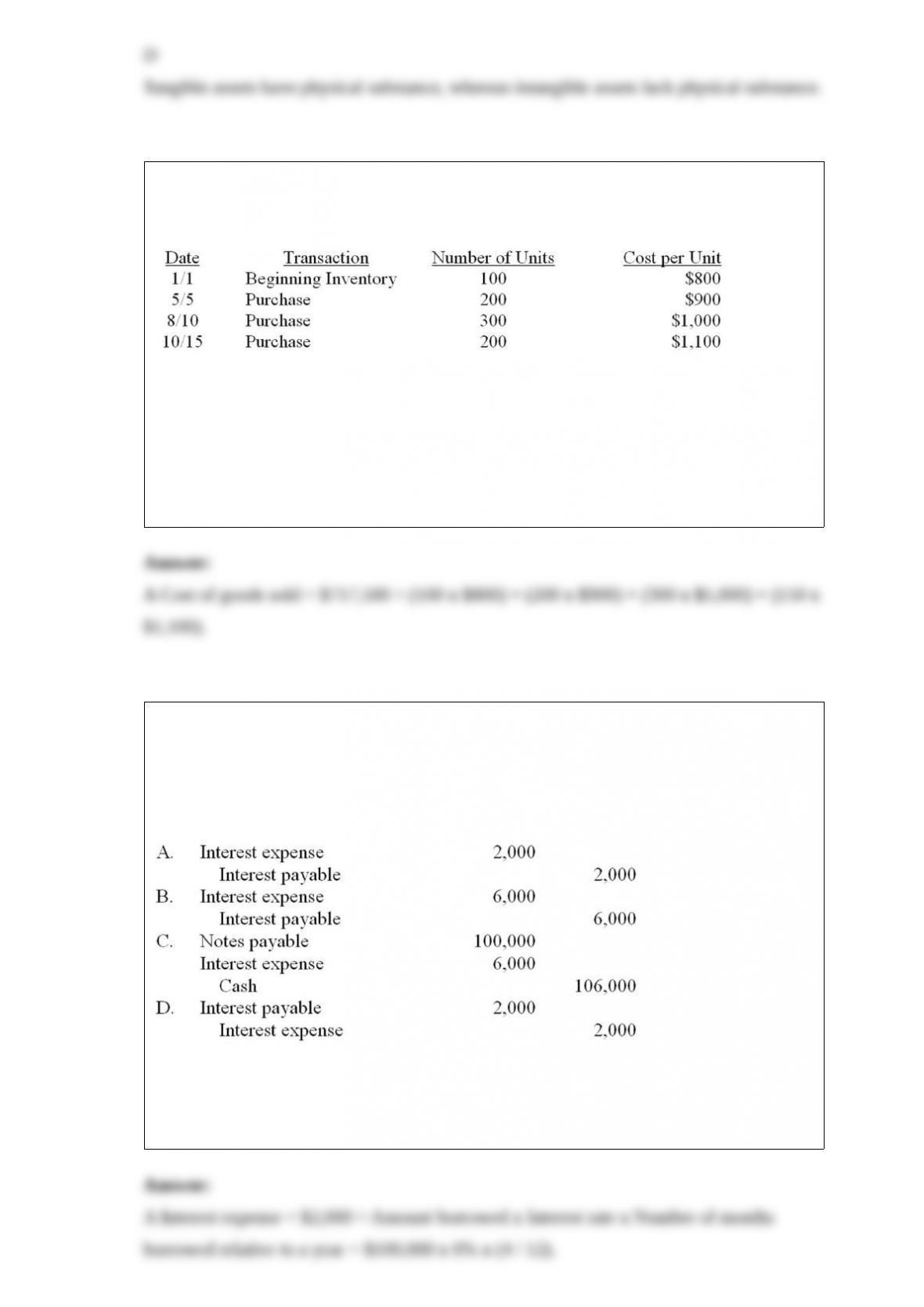
11) Lauer Corporation uses the periodic inventory system and has provided the
following information about one of its laptop computers:
During the year, Lauer sold 750 laptop computers.
What was cost of goods sold using the FIFO cost flow assumption?
A.$725,000.
B.$740,000.
C.$735,000.
D.$720,000.
12) Miranda Company borrowed $100,000 cash on September 1, 2014, and signed a
one-year 6%, interest-bearing note payable. Assume no adjusting entries have been
made during the year. Which of the following would be the required adjusting entry at
the end of the December 31, 2014 accounting period?
A.Option A
B.Option B
C.Option C
D.Option D
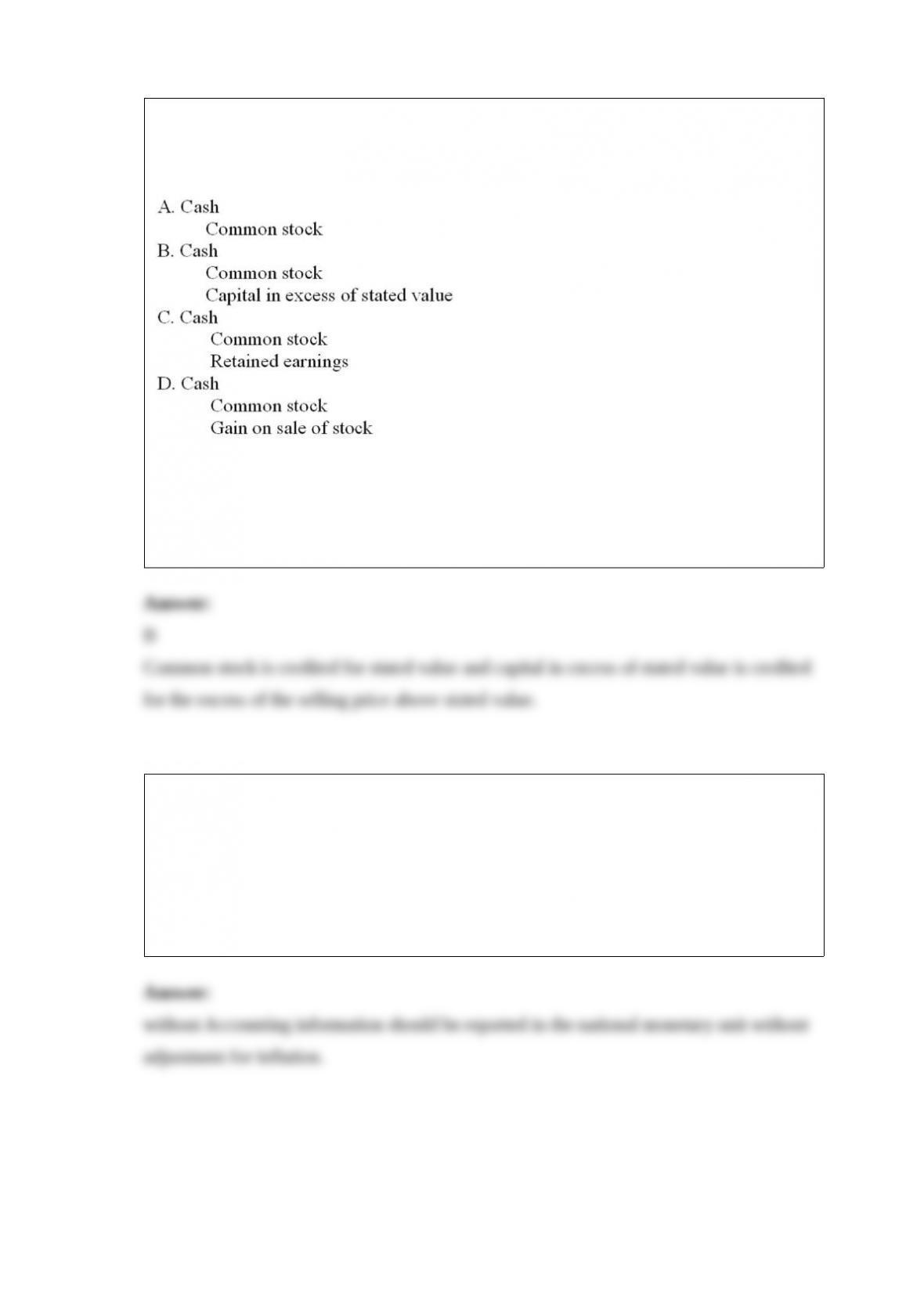
13) Which of the following journal entries is correct when common stock is initially
issued for cash at a price in excess of the stock’s stated value?
A.Option A
B.Option B
C.Option C
D.Option D
14) Which of the following statements is false?
A.The benefits of providing financial reporting information should outweigh the costs.
B.An item is considered relevant if it has the ability to influence a decision.
C.Information is considered to be faithfully represented when it is complete, neutral,
and free from error.
D.Accounting information should be reported in the national monetary unit with
adjustment for inflation.