
If all the data points were on a line, the r-square would be
A.zero.
B.one.
C.two.
D.impossible to interpret.
Which of the following is used to compute the present value of future cash flows when
evaluating investments involving cash flows over time where time elapses between cash
payment and receipt?
A.prime rate plus 1 point.
B.United States Federal Reserve Interest Rate.
C.firm’s cost of capital.
D.short-term United States Treasury Bill rate.
When using the internal rate of return to evaluate investment alternatives, what rate
would an analyst need to specify?
A.cutoff rate.
B.Federal funds rate.
C.prime interest rate.
D.time-adjusted rate.

Which statement is true concerning curvilinear variable cost functions?
A.Curvilinear variable cost functions have both fixed and variable components which
vary in constant proportion.
B.Curvilinear variable cost functions increase in logical steps which vary in constant
proportion.
C.Curvilinear variable cost functions always involves long-term assets which vary in
constant proportion.
D.Curvilinear variable cost functions are where costs vary with the volume of activity,
but not in constant proportion.
Narrative 5-1
The following question(s) refer to the this equation analyzing the relationship of total
cost to changes in machine hours. The following relationship was determined:
TC = $2,200 + $3X
Refer to Narrative 5-1. The TC in the above equation is an estimate of which of the
following?
A.total variable costs.
B.total costs.
C.total fixed costs.
D.total machine hours.
On the balanced scorecard, the measure of employee turnover would most likely be an
example of a performance measure in the:
A.financial dimension
B.customer dimension
C.internal business process dimension
D.learning and growth dimension

What costing method should a manufacturing company use when it produces batches of
products where the value and quality of direct material varies by batch, but the direct
labor and time spent are standardized?
A.Job costing
B.Process costing
C.Operation costing
D.Dynamic costing
The rate of return on investment (ROI) has two components:
A.Profit margin percentage and investment turnover ratio.
B.Sales margin percentage and investment turnover ratio.
C.Profit margin percentage and accounts receivable turnover ratio.
D.Sales margin percentage and accounts receivable turnover ratio.
The Satin Division of the Christmas Candy Company had a rate of return on investment
(ROI) of 12 percent (= $1,500,000/$10,000,000) during Year 4, based on sales of
$30,000,000. In an effort to improve its performance during Year 5, the company
instituted several cost-saving programs, including the substitution of automatic
equipment for work previously done by workers and the purchase of raw materials in
large quantities to obtain quantity discounts. Despite these cost-saving programs, the
company’s ROI for Year 5 was 10 percent (= $1,200,000/$12,000,000), based on sales
of $30,000,000.
Required:
a. Break down the ROI for Year 4 and Year 5 into profit margin and investment
turnover ratios.
b. Explain the reason for the decrease in ROI between the two years using the results
from part a.
Assume that Kent Manufacturing has two categories of overhead: material handling and
quality inspection. The costs expected for these categories for the coming year are as
follows:
The plant currently applies overhead using direct labor hours and expected actual
capacity. This figure is 50,000 direct labor hours.
Carla Wells, the plant manager, has been asked to submit a bid and has assembled the
following data on the proposed job:
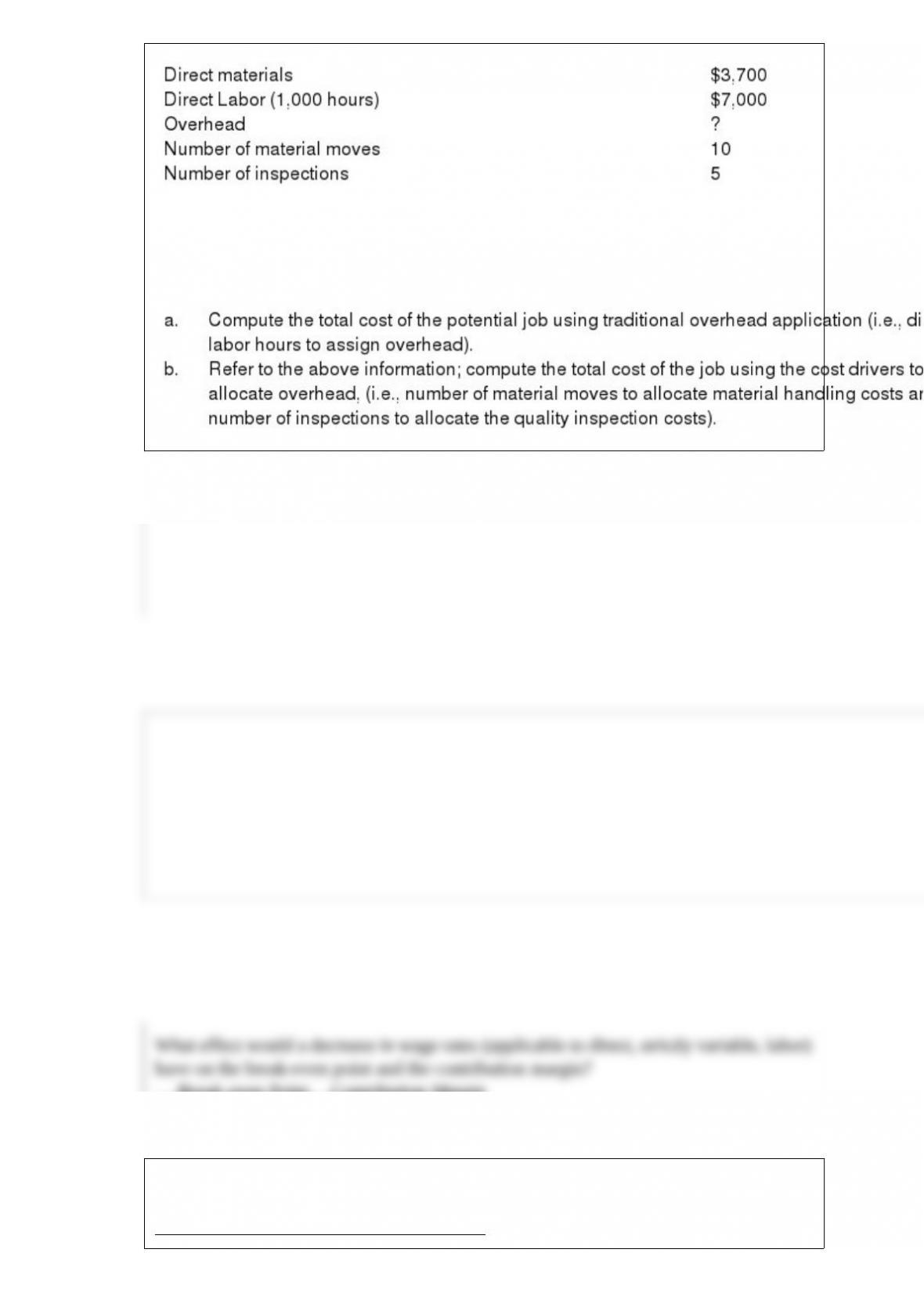
Carla has been told that many companies use an activity-based approach to assign
overhead to jobs. Before submitting her bid, she wants to assess the effects of this
alternative approach.
REQUIRED:
What effect would a decrease in wage rates (applicable to direct, strictly variable, labor)
have on the break-even point and the contribution margin?
Break-even Point Contribution Margin
A. Increase Increase
B. Increase Decrease
C. Decrease Increase
D. Decrease Decrease
Which of the following is the term that represents the costs of preparing machinery for
each production run?
A.production costs.
B.setup costs.
C.discretionary costs.
D.sunk costs.
Analysts often comment that
A.the results of an analysis can be better than the input data.
B.”garbage in, garbage out.”
C.the results of an analysis cannot be better than the input data.
D.both “b” and “c”are correct.
The periodic cash flows associated with an investment project include which of the

following?
A.savings in taxes caused by deductibility of depreciation on tax return.
B.income tax effect of gain(loss) on disposal of existing assets.
C.asset and freight costs.
D.all of the above.
Data for Cost A and Cost B are as follows:
Which of the following best describes the behavior of Costs A and B?
A.Cost A is fixed, Cost B is variable.
B.Cost A is variable, Cost B is fixed.
C.Both Cost A and Cost B are variable.
D.Both Cost A and Cost B are fixed.
Which of the following is the discount rate that equates the net present value of a series
of cash flows to zero?
A.investment rate of return.
B.external rate of return.
C.internal rate of return.
D.international rate of return.
In managerial accounting, what is the cost of capital?
A.the amount a firm could earn on its assets by putting them to their best alternative
use.
B.not included in the financial accounting statements.
C.the weighted average of the costs of the firm’s sources of funds taking into account
both debt and equity sources of capital.
D.All of the answers are correct.