1) An investor uses the cost method of accounting for its investment in common stock.
During the current year, the investor received $25,000 in dividends, an amount that
exceeded the investor’s share of the investee company’s undistributed income since the
investment was acquired. The investor should report dividend income of what amount?
A) $25,000
B) $25,000 less the amount in excess of its share of undistributed income since the
investment was acquired
C) $25,000 less the amount that is not in excess of its share of undistributed income
since the investment was acquired
D) None of the above is correct
2) Pew Corporation acquired 80% ownership of Sordid Incorporated, at a time when
Pew’s investment cost was equal to 80% of Sordid’s book value. At the time of
acquisition, the book values and fair values of Sordid’s assets and liabilities were equal.
Pew uses the equity method. During 2011, Pew sold goods to Sordid for $160,000
making a gross profit percentage of 20%. Half of these goods remained unsold in
Sordid’s inventory at the end of the year. Income statement information for Pew and
Sordid for 2011 were as follows:
Pew Sordid
Sales Revenue$800,000 $300,000
Cost of Goods Sold500,000160,000
Operating Expenses200,00080,000
Separate incomes$100,000$60,000
The 2011 consolidated income statement showed cost of goods sold of
A) $500,000
B) $516,000
C) $532,000
D) $660,000
3) Pasfield Corporation acquired a 90% interest in Santini Corporation for $90,000 cash
on January 1, 2011 . The following information is available for Santini at that time.
Book ValueFair ValueDifference
Current assets$40,000$50,000$10,000
Plant assets60,00075,00015,000
Liabilities(50,000)(50,000)0

Net assets$50,000$75,000
Under the entity theory, a consolidated balance sheet prepared immediately after the
business combination will show goodwill of
A) $15,000
B) $22,500
C) $25,000
D) $32,500
4) In computing consolidated diluted EPS, the replacement calculation replaces the
parent’s equity in subsidiary earnings with the
A) parent’s share of basic EPS of the subsidiary
B) subsidiary’s share of basic EPS of the parent
C) parent’s share of diluted EPS of the subsidiary
D) subsidiary’s share of diluted EPS of the parent
5) Partnerships
A) are required to prepare annual reports
B) are required to file income tax returns but do not pay Federal income taxes
C) are required to file income tax returns and pay Federal income taxes
D) are not required to file income tax returns or pay Federal income taxes
6) Voluntary health and welfare organizations must report expenses classified by
A) restriction
B) function and natural classification
C) restriction and natural classification
D) restriction, function and natural classification
7) What is a significant difference for agency funds when compared to governmental
funds?
A) An agency fund has a separate ledger
B) An agency fund does not report revenues
C) Agency funds are not associated with any governmental unit
D) An agency fund will not balance because there is no fund balance account
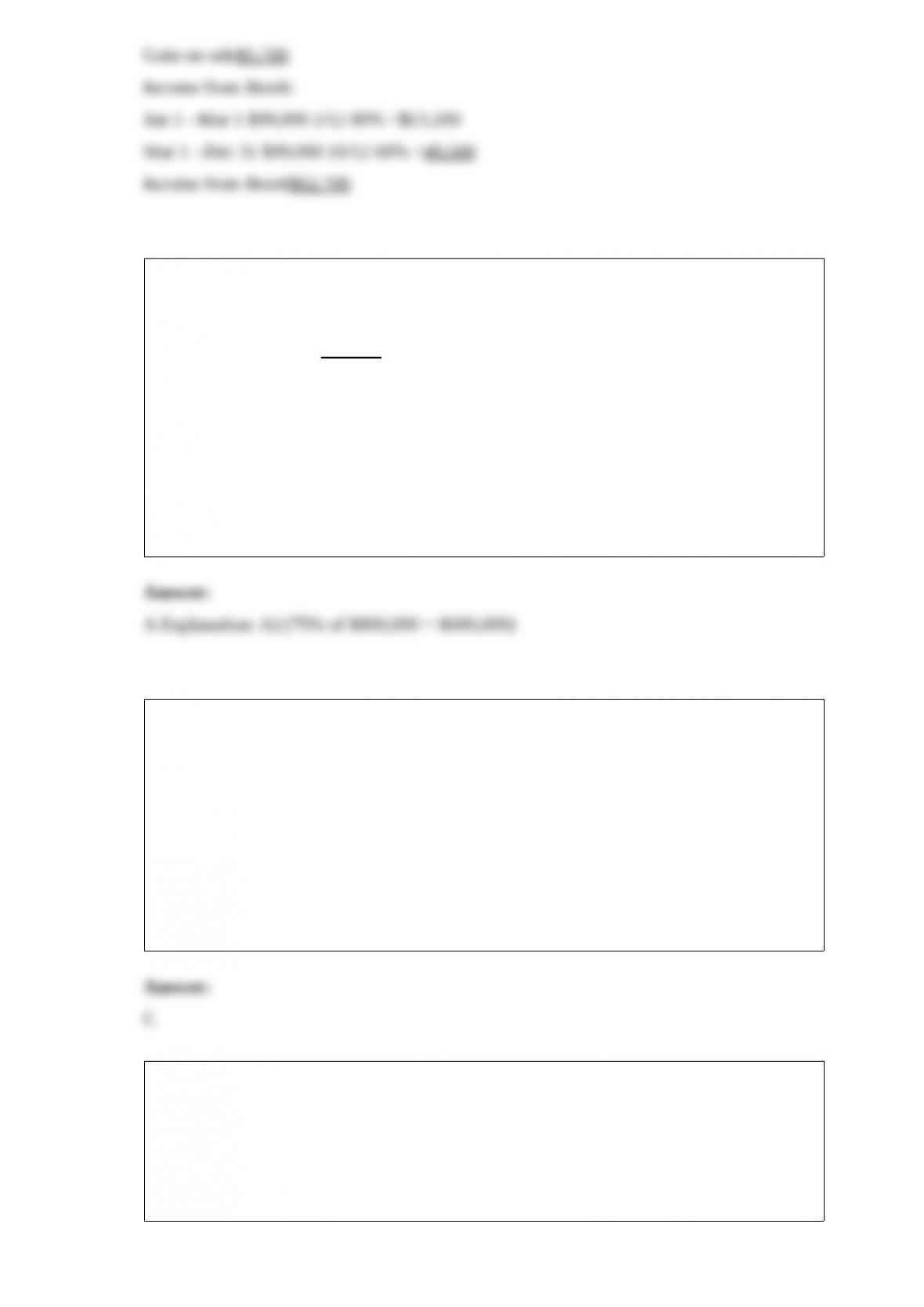
8) Bird Corporation purchased an 80% interest in Brush Corporation on July 1, 2010 at
its book value, and on January 1, 2011 its Investment in Brush account was $300,000,
equal to its book value. Brush’s net income for 2011 was $99,000 (earned uniformly);
no dividends were declared. On March 1, 2011, Bird reduced its interest in Brush by
selling a 20% interest, one-fourth of its investment, for $84,000.
If Bird uses the “actual-sale-date” sales assumption, its gain on the sale and income
from Brush for 2011 will be
A)
B)
C)
D)
9) Cole Company has the following 2011 financial data:
Consolidated revenue per income statement$800,000
Intersegment sales200,000
Intersegment transfers100,000
Combined revenues of all segments$1,100,000
Cole Company should add segments if
A) the sum of its segments’ external revenue does not exceed $600,000
B) the sum of its segments’ external revenue does not exceed $825,000
C) the sum of its segments’ revenue including intersegment revenue does not exceed
$600,000
D) the sum of its segments’ revenue including intersegment revenue does not exceed
$825,000
10) If the yield curve slope is flat for short maturities and then slopes steeply upward
for longer maturities, the liquidity premium theory (assuming a mild preference for
shorter-term bonds) indicates that the market is predicting
A) a rise in short-term interest rates in the near future and a decline further out in the
future
B) constant short-term interest rates in the near future and further out in the future
C) a decline in short-term interest rates in the near future and a rise further out in the
future
D) constant short-term interest rates in the near future and a decline further out in the
future
11) What is the purpose of interim reporting?
A) Provide shareholders with more timely information
B) Provide shareholders with more accurate information
C) Provide shareholders with more extensive detail about specific accounts and
transactions
D) Provide shareholders with more current audited information

12) A plot of the interest rates on default-free government bonds with different terms to
maturity is called
A) a risk-structure curve
B) a default-free curve
C) a yield curve
D) an interest-rate curve
13) When the Treasury bond market becomes more liquid, other things equal, the
demand curve for corporate bonds shifts to the ________ and the demand curve for
Treasury bonds shifts to the ________
A) right; right
B) right; left
C) left; right
D) left; left
14) Papal Corporation acquired an 80% interest in Sandman Corporation at a cost equal
to 80% of the book value of Sandman’s net assets in 2010 . At the time of the
acquisition, the book values and fair values of Sandman’s assets and liabilities were
equal. During 2011, Papal recorded sales of $440,000 of merchandise to Sandman at a
gross profit rate of 30%. Sandman’s beginning and ending inventories for 2011 were
$60,000 and $80,000, respectively. Income statement information for both companies
for 2011 is as follows:
PapalSandman
Sales Revenue$1,660,000$580,000
Invest.income from Sandman 59,600
Cost of Goods Sold(1,060,000)(394,000)
Expenses(358,000)(104,000)
Net Income$301,600$82,000
Required:
Prepare a consolidated income statement for Papal Corporation and Subsidiary for 2011
.

15) On November 1, 2010, Stateside Company (a U.S. manufacturer) sold an airplane
for 1 million New Zealand dollars (NZ$) to New Zealand company Aukland
Corporation. Stateside will receive payment on January 30, 2011 in New Zealand
dollars. In order to hedge the accounts receivable position, Stateside entered into a
90-day forward contract to sell 1 million New Zealand dollars on January 30, 2011 . On
November 1, 2010, the 90-day forward rate is US$0.73 per New Zealand dollar. The
forward contract will be settled net. Account for the hedge as a fair value hedge. Ignore
the time value of money.
The relevant exchange rates per New Zealand dollar:
Spot Rate Forward Rate to 1/30/11
Nov. 1, 2010US$0.73US$0.73
Dec. 31, 2010US$0.75US$0.76
Jan. 30, 2011US$0.79US$0.79
Required:
Record the journal entries that Stateside would need to prepare at November 1, 2010,
December 31, 2010 and January 30, 2011 .
December 31, 2010 is the fiscal year end.
16) In September of 2011, Gunny Corporation anticipates that the price of heating oil
will increase soon, and wishes to lock in a firm price for the winter months. They enter
into a forward contract with Selton Industries to buy 100,000 barrels of oil at $160 per
barrel in December 2011 . Selton’s cost of production of the heating oil is $120 per
barrel.
Required:
Determine the economic impact of the transaction to Selton (the seller of the heating
oil) at the market price levels indicated in the table below, with and without the hedge.
17) For internal decision-making purposes, Calam Corporation’s operating segments
have been identified as follows:
Operating
ProfitIdentifiable
Operating SegmentRevenuesor LossAssets
Appliances$110,000$(15,000)$120,000
Clothing130,000(75,000)40,000
Lawn and Garden85,00015,00015,000
Auto Accessories100,00010,00020,000
Service Contracts65,000(5,000)10,000
Catalog Sales230,0005,00050,000
Home Furnishings280,00025,000100,000
Tools240,00030,00025,000
$1,240,000(10,000)$380,000
Required:
1>In applying the “operating profit or loss” test to identify reporting segments, what is
the test value for Calam Corporation?
2>Using the “reported profit or loss” test, which of Calam’s operating segments will
also be reporting segments?
18) A review of Ace Industries, a U.S. corporation, shows the following balances in
accounts receivable and accounts payable detail at September 30, 2011, their fiscal year
end.
ACCOUNTS RECEIVABLE
Receivables denominated in U.S. dollar$426,000
Receivable denominated in 40,000 Australian dollar43,000
Receivable denominated in 70,000 Canadian dollar71,750
$ 540,750
ACCOUNTS PAYABLE
Payables denominated in U.S. dollar$ 107,000
Payable denominated in 50,000 Canadian dollar51,250
Payable denominated in 200,000 Hong Kong dollar26,500
$ 184,750
As Ace prepared to close their books, they noted that the September 30 exchange rates
for the Australian dollar, Canadian dollar and Hong Kong dollar were $1.0366, $1.0301
and $0.1284, respectively.
Required:
Determine the exchange gain or loss to be included in the 2011 financial statements,
and the amount of Accounts Receivable and Accounts Payable that will be included on
the September 30, 2011 balance sheet.
19) Pal Corporation paid $5,000 for a 60% interest in Sonny Inc. on January 1, 2011
when Sonny’s stockholders’ equity consisted of $5,000 Capital Stock and $2,500
Retained Earnings. The fair value and book value of Sonny’s assets and liabilities were
equal on this date. Two years later, on December 31, 2012, the balance sheets of Pal and
Sonny are summarized as follows:
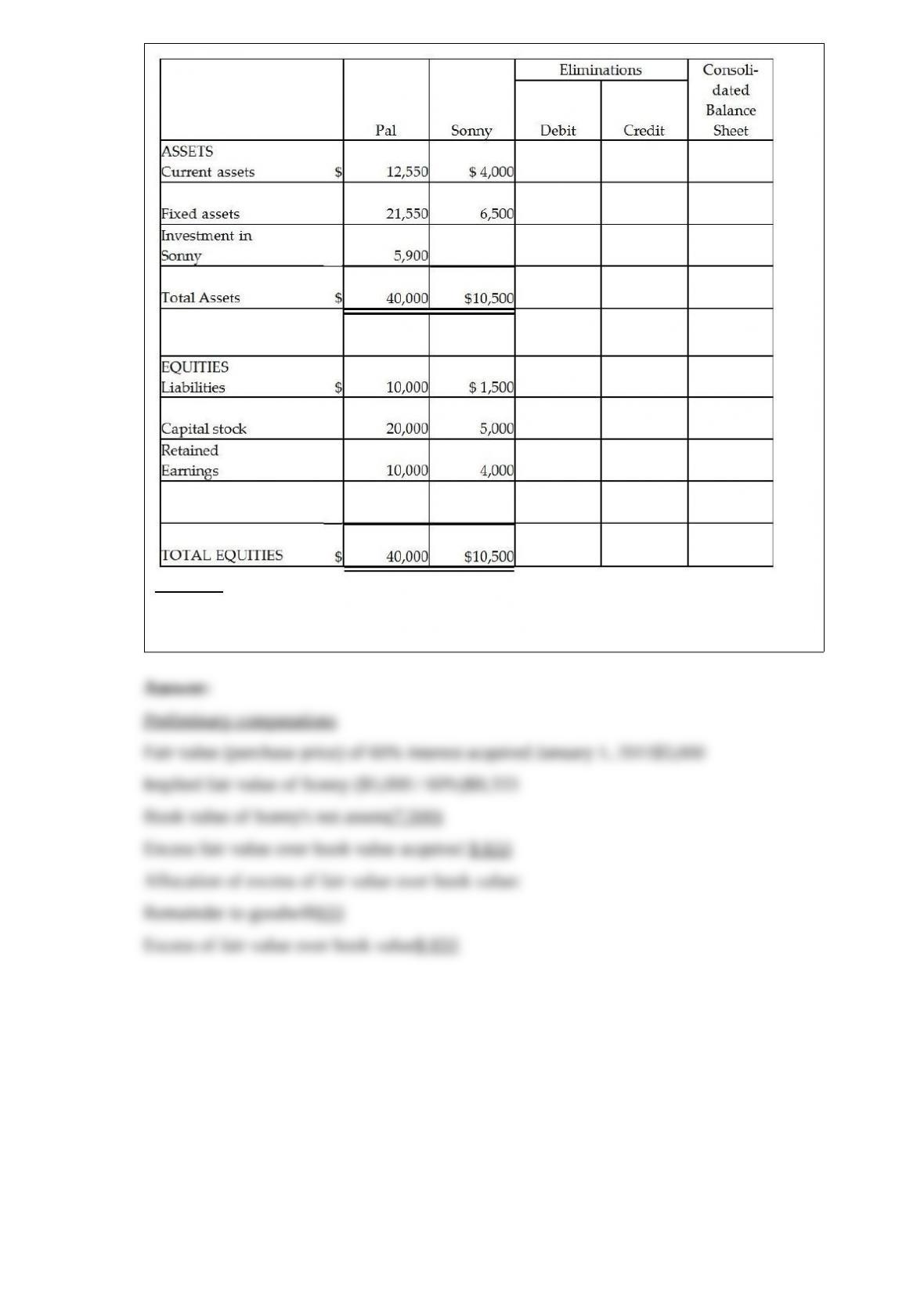
Required:
Complete the consolidated balance sheet working papers for Pal Corporation and
Subsidiary at December 31, 2012 .
20) Pigeon Company owns 80% of the outstanding stock of Spiniflex Corporation,
which was purchased on January 1, 2006, when Spiniflex’s book values were equal to
its fair values. The amount paid by Pigeon included $16,000 for goodwill.
On January 1, 2007, Pigeon purchased a truck for $40,000 which had no salvage value
with a useful life of 8 years, depreciated on a straight-line basis. On January 1, 2012,
Pigeon sold the truck to Spiniflex Corporation for $18,000. The truck was estimated to
have a three-year remaining life on this date and no salvage value. All affiliates use the
straight-line depreciation method.
Required:
Prepare all relevant entries with respect to the truck.
1>Record the journal entries on Pigeon’s books for 2012 .
2>Record the journal entries on Spiniflex’s books for 2012 .
3>Prepare the consolidation entries required for Pigeon and subsidiary for 2012 as a
result of this transaction.
21) Stello Corporation’s stockholders’ equity on December 31, 2010 was as follows:
10% cumulative preferred stock, $100 par value,
callable at $110, with no dividends in arrears$100,000
Common stock, $1 par value300,000
Additional paid-in capital40,000
Retained earnings160,000
Total stockholders’ equity$600,000
On January 1, 2011, Kaprelian Corporation paid $300,000 for a 90% interest in Stello’s
common stock. On January 1, 2011, the book values of Stello’s assets and liabilities
were equal to fair values. On January 2, 2011, Kaprelian Corporation paid $100,000 for
a 90% interest in Stello’s preferred stock.
Required:
1> Determine the book value of the common stockholders’ equity for Stello Corporation
on January 1, 2011 .
2> Prepare the journal entry(ies) on January 1, 2011 for Kaprelian Corporation.
3> Prepare the journal entry(ies) on January 2, 2011 for Kaprelian Corporation.
4> For the year ending December 31, 2011, Stello Corporation reported net income of
$50,000. Stello Corporation declared and paid dividends of $10,000 to preferred
stockholders and $10,000 to common stockholders. Prepare the journal entries for
Kaprelian Corporation relating to this information.
22) On December 18, 2011, Wabbit Corporation (a U.S. Corporation) has a Forward
Contract recorded on their ledger as a debit balance of $17,500. The forward contract
was related to a purchase of electronic components purchased overseas, which were
going to be re-sold in the United States. On December 20, the forward contract was
settled with a payment of $20,000, and the related parts which cost $118,000 were sold
for $160,000 cash. The forward contract is set up to lock in the price for the electronic
components when they are sold. The forward contract was settled net. Assume this is a
cash flow hedge.
Required:
Prepare the journal entries required by Wabbit on December 20 .
23) On January 1, 2011, Paisley Incorporated paid $300,000 for 60% of Smarnia
Company’s outstanding capital stock. Smarnia reported common stock on that date of
$250,000 and retained earnings of $100,000. Plant assets, which had a five-year
remaining life, were undervalued in Smarnia’s financial records by $10,000. Smarnia
also had a patent that was not on the books, but had a market value of $60,000. The
patent has a remaining useful life of 10 years. Any remaining fair value/book value
differential is allocated to goodwill. Smarnia’s net income and dividends paid the first
three years that Paisley owned them are shown below.
Net Dividends
IncomePaid
201180,00030,000
201290,00010,000
201360,00020,000
Requirement 1: Calculate the noncontrolling interest share in Smarnia’s income for each
of the three years.
Requirement 2: Calculate the noncontrolling interest that should be reported on the
consolidated balance sheet at the end of each of the three years.
Requirement 3: Assuming that Paisley uses the equity method to record their
investment in Smarnia, calculate the ending balance in the Investment in Smarnia
account for each of the three years.