
Which of the following is not true with respect to the risk of incorrect acceptance?
A. It results in an efficiency loss to the auditor.
B. It occurs when the auditor’s sample indicates that the account balance is fairly stated.
C. It occurs when the true misstatement in the account balance exceeds tolerable
misstatement.
D. The auditor can measure the exposure to this risk when using statistical sampling
applications.
How does the Securities Act of 1933, which imposes civil liability on auditors for
misrepresentations or omissions of material facts in a registration statement, expand
auditors’ liability to purchasers of securities beyond that of common law?
A. Purchasers only have to prove loss caused by reliance on audited financial
statements.
B. Privity with purchasers is not a necessary element of proof.
C. Purchasers have to prove either fraud or gross negligence as a basis for recovery.
D. Auditors are held to a standard of care described as professional skepticism.
Maple Company has an increase in purchases from specific vendors and an increase in
raw materials inventory for the items purchased from these vendors. Sales for the
company have not increased and are not forecast to increase. From this information an
auditor might suspect

A. an increase in obsolete raw material inventory.
B. theft of raw material inventory.
C. kickbacks from vendors.
D. poor security over raw material inventory.
Derivative instruments include
A. stocks.
B. preferred stocks.
C. stock options.
D. all the above.
What is the major difference between a reissued report and an updated report?
A. An updated report considers information that has come to their attention since the
date of the original report, while a reissued report does not consider this information.
B. An updated report can be presented along with the entity’s financial statements, but a
reissued report cannot be presented along with the entity’s financial statements.
C. An updated report will express a different opinion on the prior-years’ financial
statements that that originally expressed by the auditors, while a reissued report will
express the same opinion.

D. An updated report will not express an opinion other than an unmodified opinion,
while a reissued report can express an unmodified opinion, qualified opinion, adverse
opinion, or disclaimer of opinion.
Which of the following best describes the auditors’ responsibility with respect to
management’s estimates?
A. Verifying the mathematical accuracy of management estimates
B. Assessing the likelihood that actual results will be consistent with management’s
estimates
C. Evaluating the reasonableness of management’s estimates
D. Identifying how the failure of the entity to achieve management’s estimates will
influence users’ decisions
If an auditor encounters significant risks at the client the auditor should do all of the
following except
A. inform the SEC.
B. perform extended procedures.
C. include more experienced auditors on the engagement.
D. perform tests closer to year end.

Rule 201, General Standards, requires a member to comply with standards and
interpretations. Which of the following is NOT a standard covered by Rule 201?
A. Independence
B. Due professional care
C. Planning and supervision
D. Sufficient relevant data
Which of the following would not overstate current-period net income?
A. Capitalizing an expenditure that should be expensed.
B. Failing to record a liability for an expenditure.
C. Failing to record a check paying an item in vouchers payable.
D. All of the above would overstate net income.
When an auditor becomes aware of possible noncompliance by a client, the auditor

should obtain an understanding of the nature of the act to
A. evaluate the effect on the financial statements.
B. determine the reliability of management’s representations.
C. consider whether other similar acts may have occurred.
D. recommend remedial actions to the audit committee.
Which of the following audit procedures is best for identifying unrecorded accounts
payable?
A. Reviewing cash disbursements recorded subsequent to the balance sheet date to
determine whether the related payables apply to the prior period.
B. Investigating payables recorded just prior to and just subsequent to the balance sheet
date to determine whether they are supported by receiving reports.
C. Examining unusual relationships between monthly accounts payable balances and
recorded cash payments.
D. Reconciling vendors’ statements to the file of receiving reports to identify items
received just prior to the balance sheet date.
Which of the following explanations best describes why an auditor may decide to
reduce tests of details for a particular audit objective?
A. The audit is being performed soon after the balance sheet date.

B. Audit staff are experienced in performing the planned procedures.
C. Analytical procedures have revealed no unusual or unexpected results.
D. There were many transactions posted to the account during the period.
Sales are normally recorded on the date of the
A. customer purchase order.
B. bill of lading.
C. sales invoice.
D. payment check.
When confirming accounts payable, emphasis should be put on what kind of accounts?
A. Accounts with small or zero balances.
B. All accounts should be equally emphasized.
C. Accounts with large balances.
D. Accounts listed in the accounts payable subsidiary.

A CPA learns that his client has paid a vendor twice for the same shipment; once based
upon the original invoice and once based upon the monthly statement sent from the
vendor. A control procedure that should have prevented this duplicate payment is
A. prenumbering of disbursement vouchers.
B. attachment of the receiving report to the disbursement report.
C. use of a limit or reasonableness test.
D. prenumbering of receiving reports.
An auditor may decide to increase the risk of incorrect rejection when
A. increased reliability from the sample is desired.
B. many differences are expected.
C. initial sample results do not support the planned level of control risk.
D. the cost and effort of selecting additional items is low.
Auditors should not be liable to any party if they perform services that met the
standards of

A. ordinary negligence.
B. regulatory providence.
C. due care.
D. good faith.
The assertion that auditors will probably emphasize in the revenue and collection cycle
is
A. occurrence.
B. completeness.
C. accuracy.
D. classification.
Which of the following conditions or set of circumstances would not ordinarily raise
questions about the entity’s ability to continue as a going concern?
A. Violation of debt covenants
B. Failure to meet forecasted earnings per share
C. Legal proceedings that may have a significant negative impact on the entity
D. Negative cash flow from operations for each of the last three years

Which of the following is not a relevant aspect of internal controls over estimates?
A. External auditor involvement in developing assumptions.
B. Adequate review by appropriate levels of authority.
C. Comparison of prior estimates with subsequent results.
D. All the above are relevant aspects of internal controls over estimates.
Which of the following philosophical theories places emphasis on following rules,
rather than on the consequences of the decision?
A. Imperative principle
B. Utilitarianism
C. Generalization principle
D. Virtue ethics

Which of the following statements best describes auditors’ responsibility to detect errors
and frauds?
A. Auditors should design an audit to provide reasonable assurance of detecting errors
and frauds that are material to the financial statements.
B. Auditors are responsible to detect material errors, but have no responsibility to detect
material frauds that are concealed through employee collusion or management override
of the internal control structure.
C. Auditors have no responsibility to detect errors and frauds unless analytical
procedures or tests of transactions identify conditions causing a reasonably prudent
auditor to suspect that the financial statements were materially misstated.
D. Auditors have no responsibility to detect errors and frauds because an auditor is not
an insurer and an audit does not constitute a guarantee.
When goods are received, the receiving clerk should match the goods with the
A. purchase order and the requisition form.
B. vendor’s invoice and the receiving report.
C. vendor’s shipping document and the purchase order.
D. receiving report and the vendor’s shipping document.
Long and Short, CPAs, were auditing Island Corporation for the year ended December
31, 2014. On January 11, 2015, a major customer of Island Corporation declared
bankruptcy as the result of an uninsured loss due to a major fire in their warehouse on

January 8, 2015. As a result, a material accounts receivable from the customer was
determined to be uncollectible. Long and Short, CPAs, would expect the client to
A. record the loss on uncollectible accounts as a routine transaction in the year 2015.
B. treat the loss as a subsequent event and provide a footnote about the loss in the 2014
financial statements.
C. treat the loss as a subsequent event and adjust the 2014 financial statements to record
the loss on uncollectible accounts.
D. file a lawsuit against the customer in hopes of collecting some of the money owed to
the client.
Which of the following factors would not influence third parties’ abilities to bring suit
against auditors for ordinary negligence under common law?
A. The extent to which the third party relied upon the misstated financial statements and
this reliance resulted in their loss
B. The nature of activity by auditors that resulted in their failure to exercise appropriate
levels of professional care
C. The relationship between the auditors and third party
D. The jurisdiction in which the action occurred
Which of the following payroll control activities would most effectively ensure that
payment is made only for work performed?

A. Require all employees to record arrival and departure by using the time clock.
B. Have a payroll clerk recalculate all time cards.
C. Require all employees to sign their time cards.
D. Require employees to have their direct supervisors approve their time cards.
While performing an audit of the financial statements of a company for the year ended
December 31, year 1, the auditor notes that the company’s sales increased substantially
in December, year 1, with a corresponding decrease in January, year 2. In assessing the
risk of fraudulent financial reporting or misappropriation of assets, what should be the
auditor’s initial indication about the potential for fraud in sales revenue?
A. There is a broad indication of misappropriation of assets.
B. There is an indication of theft of the entity’s assets.
C. There is an indication of embezzling receipts.
D. There is a broad indication of financial reporting fraud.
Substantive tests of account balances in the payroll cycle are likely to include the
following procedures except
A. analytical review procedures.
B. recalculation of accruals.
C. comparison of accruals to subsequent payments.

D. detail vouching of payroll expense entries.
A client has a separate sales group for its largest “preferred” customers. This is a select
group of customers that normally make purchases in excess of $250,000 and often have
accounts receivable balances in excess of $1 million. Which of the following audit
procedures would the auditor most likely perform?
A. Prepare a schedule of purchases and payments for these customers.
B. Send out negative confirmations on a large sample of these customers.
C. Inquire of the sales manager regarding the accounts receivable terms.
D. Send out positive confirmations on a large sample of these customers.
Which of the following is not a control included as part of the systems development life
cycle?
A. Ensuring that all software acquisition and program development efforts are
consistent with the organization’s needs and objectives
B. Testing and validating new programs and developing proper implementation plans
C. Requiring that all programming efforts take place under the control of the requesting
user department
D. Ensuring that data are converted completely and accurately for use in the new
systems

Which of the following best reflects the auditors’ reporting responsibility under
generally accepted auditing standards?
A. Option A
B. Option B
C. Option C
D. Option D
The primary objective of procedures performed to obtain an understanding of the
entity’s internal control is to provide an auditor with
A. knowledge necessary for audit planning.
B. evidential matter to use in assessing inherent risk.
C. a basis for modifying tests of controls.
D. an evaluation of the consistency of application of management’s policies.

As part of the assessment of control risk, the auditor decided to use audit sampling.
After specifying the audit objectives, what would the auditor most likely do next?
A. Determine the sample size.
B. Select the sample.
C. Perform tests of control procedures.
D. Define the deviation conditions.
Which of the following procedures is not used in auditors’ examination of litigation,
claims, and assessments?
A. Obtaining a description and evaluation of litigation, claims, and assessments from
management
B. Examining documentary evidence regarding litigation, claims, and assessments
C. Reading minutes of meetings of stockholders, directors, and appropriate committees
D. Performing analytical procedures
A material error or fraud in inventory typically has a
_________________________________ on financial statements.
Ed’s wife Diane owns a printing business in town. Ed works in the accounts payable
department of Jiffy Abs Vitamin Company. Diane prints invoices for work supposedly
done for Jiffy Abs (no actual work was performed) and Ed places in the invoice in the
approved for payment invoice pile. Jiffy Abs pays these invoices and sends Diane a
check.
1. Name two internal controls that might prevent or detect these fraudulent payments.
2. Name two audit procedures that might detect this fraud.
Another way to obtain information about the internal control system is to take a single
example of a transaction and __________________________ the process from its
initiation to its recording in the accounting records.
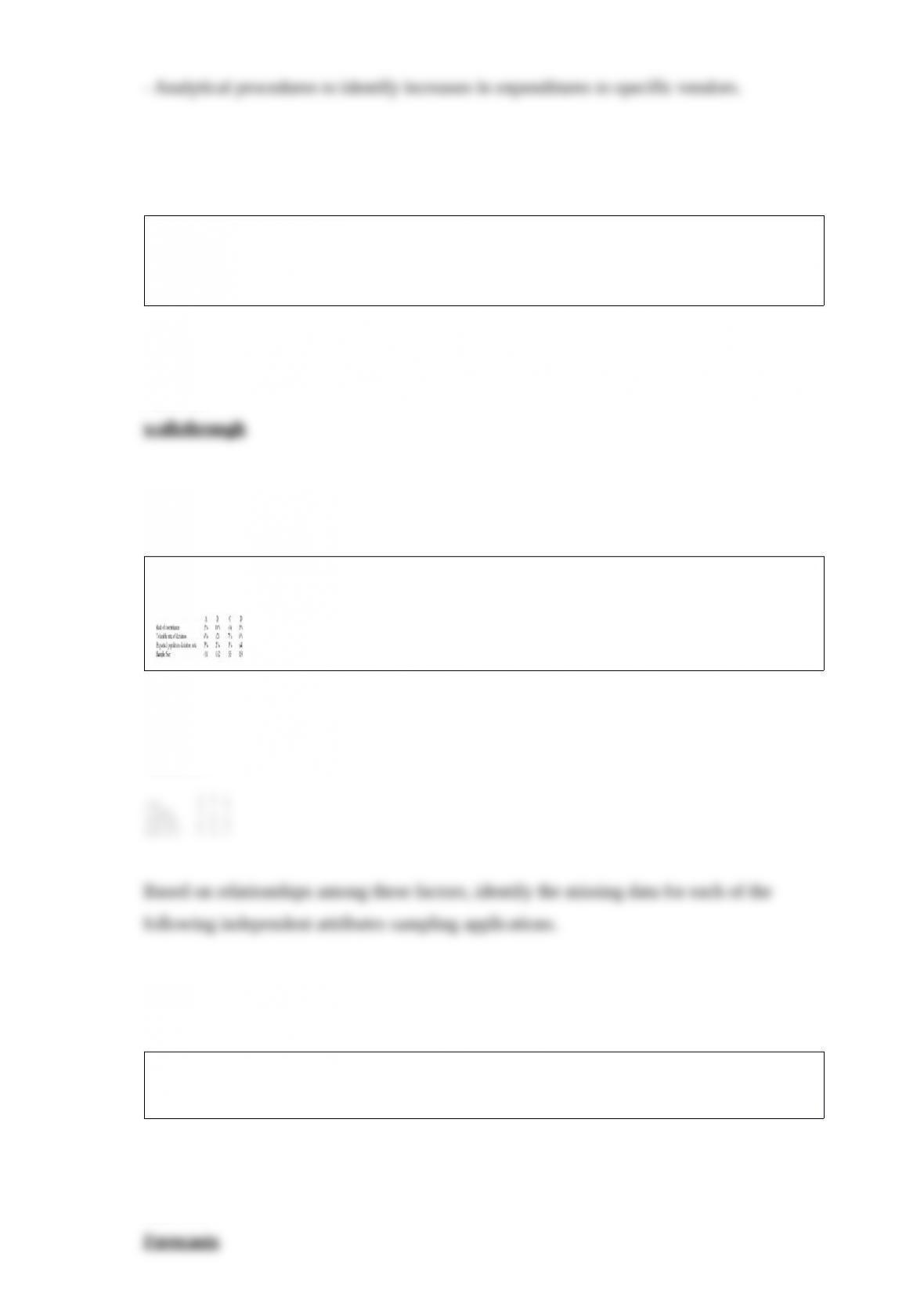
Using the appropriate sampling tables, identify the missing data for each of the
following independent attributes sampling applications.
_____________________________ can be used in connection with knowledge of the
shape of management’s plans for the year under audit.

________________________________ are used by the purchasing department to place
orders for materials.
Inventory observation may need to be scheduled on the year-end date, making a large
number of test counts if the test of controls ________________________________.
Auditors can compare the ________________________________ file to the
_________________________________ to determine whether the company has
material unrecorded liabilities on the financial statement date.