The AZ Company manufactures kitchen utensils. The company is currently producing
well below its full capacity. The BV Company has approached AZ with an offer to buy
20,000 utensils at $0.75 each. AZ sells its utensils wholesale for $0.85 each; the average
cost per unit is $0.83, of which $0.12 is fixed costs. If AZ were to accept BV’s offer,
what would be the increase in AZ’s operating profits?
A. $400
B. $800
C. $1,600
D. $2,000
E. AZ’s operating profits will not increase as a result of accepting the special order.
Answer:
Assume that the following events occurred at a division of Admiral Enterprises for the
current year.
(1) Purchased $900,000 in direct materials.
(2) Incurred direct labor costs of $520,000.
(3) Determined that manufacturing overhead was $820,000.
(4) Transferred 75% of the materials purchased to Work-in-Process Inventory.
(5) Completed work on 60% of the work in process. Costs assigned equally across all
work-in-process.
(6) The inventory accounts have no beginning balances. All costs incurred were debited
to the appropriate account and credited to Accounts Payable.
Required: Compute the following amounts in the Work-in-Process Inventory account:
(a) Transfers-in (TI).
(b) Transfers-out (TO).
(c) Ending balance (EB).
Answer:
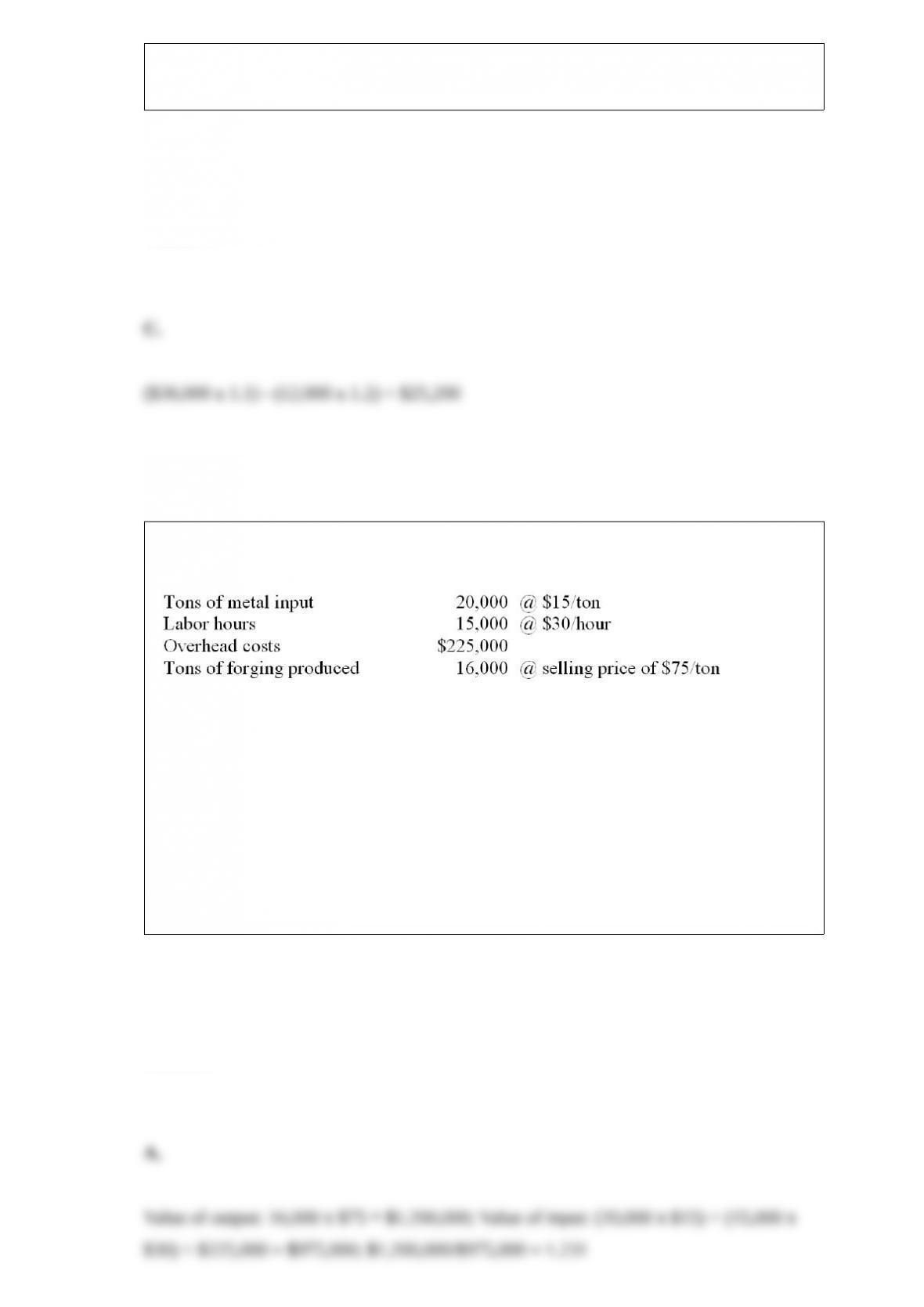
You have been provided with the following information:
If sales increase by 10%, what level of fixed expenses will yield a 20% increase in
profits?
A. $14,400.
B. $19,200.
C. $25,200.
D. $26,400.
Answer:
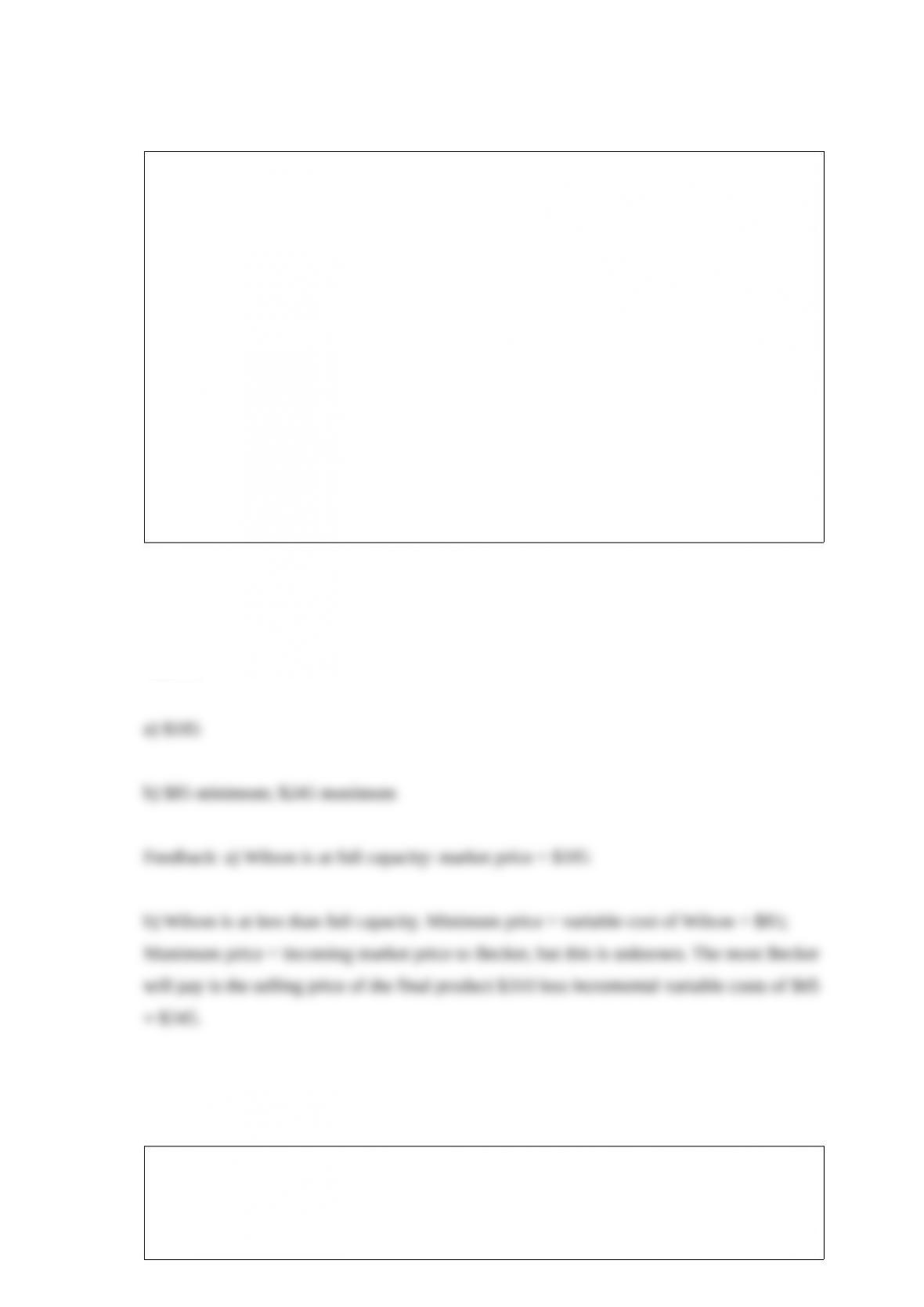
Toimi Toolworks Co. has provided the following information for last year:
The total factor productivity measure is:
A. 1.231
B. 1.600
C. 2.167
D. 3.250
Answer:
Dock Industries is a decentralized company that evaluates its divisions based on ROI.
The Wilson Division has the capacity to produce 2,000 units of a component. The
Wilson Division’s variable costs are $85 per unit; fixed costs are $70 per unit.
The Becker Division can use the product as a component in one of its products. The
Becker Division would incur $65 of variable costs to convert the component into its
own product which sells for $310.
Required (consider each question independent of each other):
a) Assume the Wilson Division can sell all that it produces for $185 each. The Becker
Division needs 100 units. What is the appropriate transfer price?
b) Assume the Wilson Division can sell 1,800 units at $265. Any excess capacity will be
unused unless the units are purchased by the Becker Division (which can use up to 100
units). What are the minimum and maximum transfer prices?
Answer:
Costs that change in response to a particular course of action are
A. differential costs
B. cost-benefit analysis
C. activity-based costs
D. cost drivers
Answer:
Which of the following is the most significant disadvantage of a cost-based transfer
price? (CIA adapted)
A. Requires internally developed information.
B. Imposes market effects on company operations.
C. Requires externally developed information.
D. May not promote long-term efficiencies.
Answer:
After-tax income divided by sales is called the
A. gross margin ratio.
B. profit margin ratio.
C. operating margin ratio.
D. contribution margin ratio.
Answer:
A limitation of transfer prices based on actual cost is that they (CIA adapted)
A. charge inefficiencies to the department that is transferring the goods.
B. charge inefficiencies to the department that is receiving the goods.
C. must be adjusted by some markup.
D. lack clarity and administrative convenience.
Answer:
Having one or more of the firms’ activities performed by another firm or individual in
the supply or distribution chain is called
A. lean accounting
B. responsibility centers
C. activity-based costing
D. budgeting
E. outsourcing
Answer:
Which of the following documents is used as the basis for posting to the direct labor
section of the job cost sheet?
A. Purchase requisition.
B. Materials requisition.
C. Receiving report.
D. Purchase order.
E. Time card.
Answer: