A classified balance sheet shows a subtotal for current assets and current liabilities.
The incentive element of the fraud triangle includes reasons why top management may
commit fraud such as enhancing job security and obtaining bigger paychecks.
Cash equivalents are short-term, highly liquid investments purchased within one year of
maturity.
Interest on a two-month, 7%, $1,000 note would be calculated as $1,000 x 0.07 x 2.
Unpaid dividends on cumulative preferred stock are called dividends in arrears.
LIFO and weighted average results will be the same using either a perpetual or periodic
system.
When a periodic inventory system is in use, an entry is made at year-end to transfer
beginning inventory and net purchases to cost of goods sold.
Which account would be increased with a debit?
A) Retained Earnings
B) Accounts Receivable
C) Common Stock
D) Notes Payable
Which of the following statements about cash basis accounting and accrual basis
accounting is correct?
A) Net income is generally larger under accrual basis accounting than cash basis
accounting.
B) GAAP does not require the use of accrual basis accounting for external reporting.
C) Accrual basis accounting and cash basis accounting will always produce the same
amount of net income.
D) Accrual basis accounting provides a better measure of operating performance than
cash basis accounting.
The petty cash fund was used to reimburse employees for office expenses during the
month. The cash and receipts in the locked box equaled the Petty Cash account balance.
When the petty cash fund is replenished, the related journal entry will include a debit
to:A) Office Expenses.B) Petty Cash.C) Cash.D) Cash Shortage.

During January 2015, the first month of operations, a consulting firm had following
transactions:
1> Issued common stock to owners in exchange for $20,000 cash.
2> Purchased $5,000 of equipment, paying $1,000 cash and signing a promissory note
for $4,000.
3> Received $9,000 in cash for consulting services performed in January.
4> Purchased $1,500 of supplies on account; all of the supplies were used in January.
5> Provided consulting services on account in the amount of $16,000.
6> Paid $750 on account.
7> Paid $3,000 to employees for work performed during January.
8> Received a bill for utilities for January of $3,400; the bill remains unpaid.
Use the information above to answer the following question. What is the amount to be
reported as total liabilities on the balance sheet at the end of January?
A) $4,750.
B) $4,150.
C) $8,150.
D) $8,500.
A company used the aging of accounts receivable method. At December 31,
management determined that the net realizable value of accounts receivable was
$304,000. The balance in Accounts Receivable was $384,000 and the unadjusted credit
balance in Allowance for Doubtful Accounts was $16,000. What was the amount of Bad
Debt Expense for the year?
A) $96,000
B) $64,000
C) $80,000
D) $16,000
Which of the following statements about the multistep income statement is not correct?
A) The multistep income statement provides a subtotal of Income before Income Tax
Expense.
B) Income from Operations is the amount of revenues minus expenses from the
company’s main business activities.
C) Any revenues and/expenses from activities other than the company’s main business
are peripheral results and are included in Income from Operations.
D) Income before Income Tax Expense and Income from Operations are different if
there are any peripheral revenues and expenses.
Which of the following are the three basic elements of the balance sheet?
A) assets, liabilities, and retained earnings.
B) assets, liabilities, and common stock.
C) assets, liabilities, and revenues.
D) assets, liabilities, and stockholders’ equity.
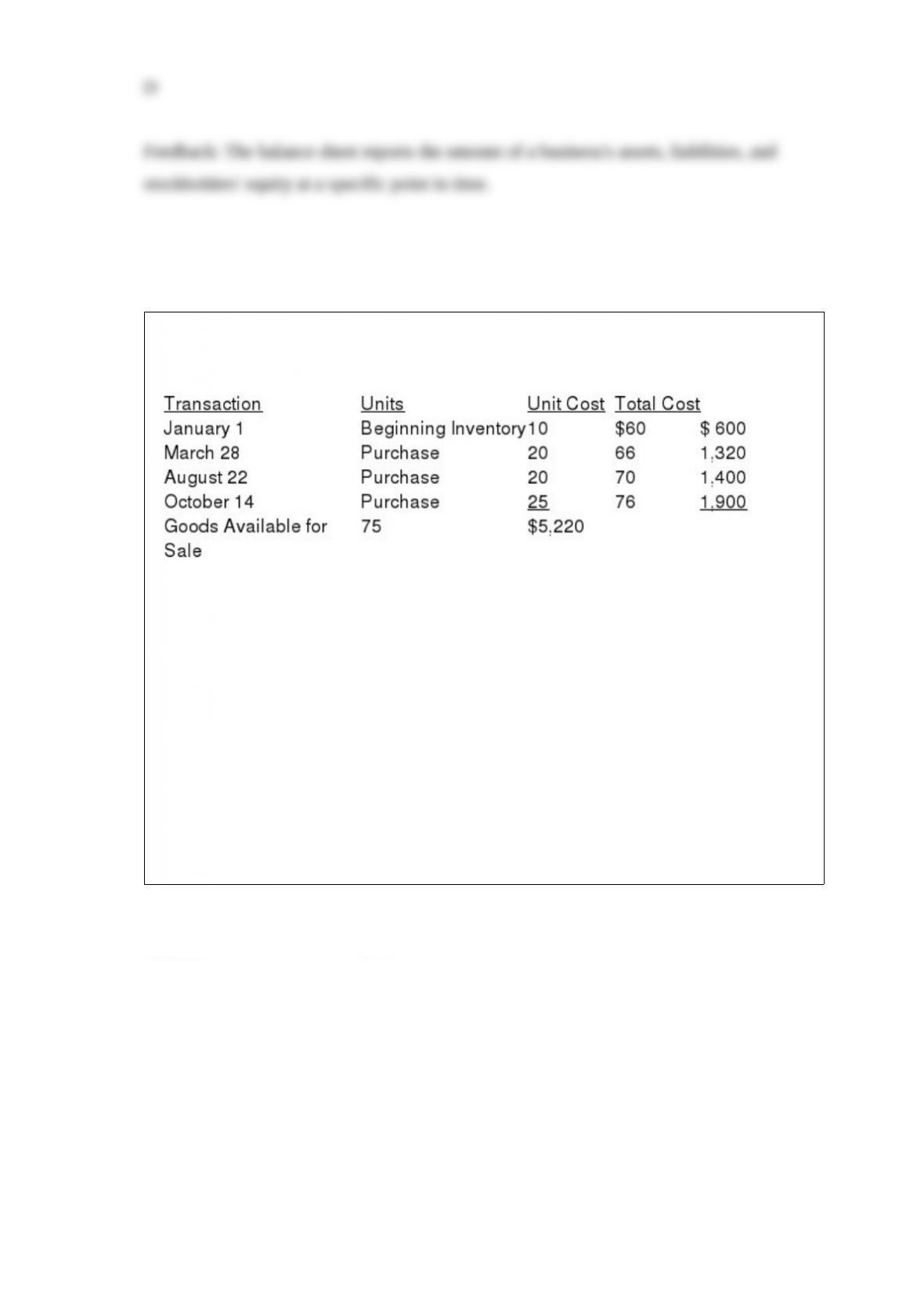
Consider the following information for Maynor Company, which uses a periodic
inventory system:
The company sold 25 units on May 1 and 20 units on October 28.
Required:
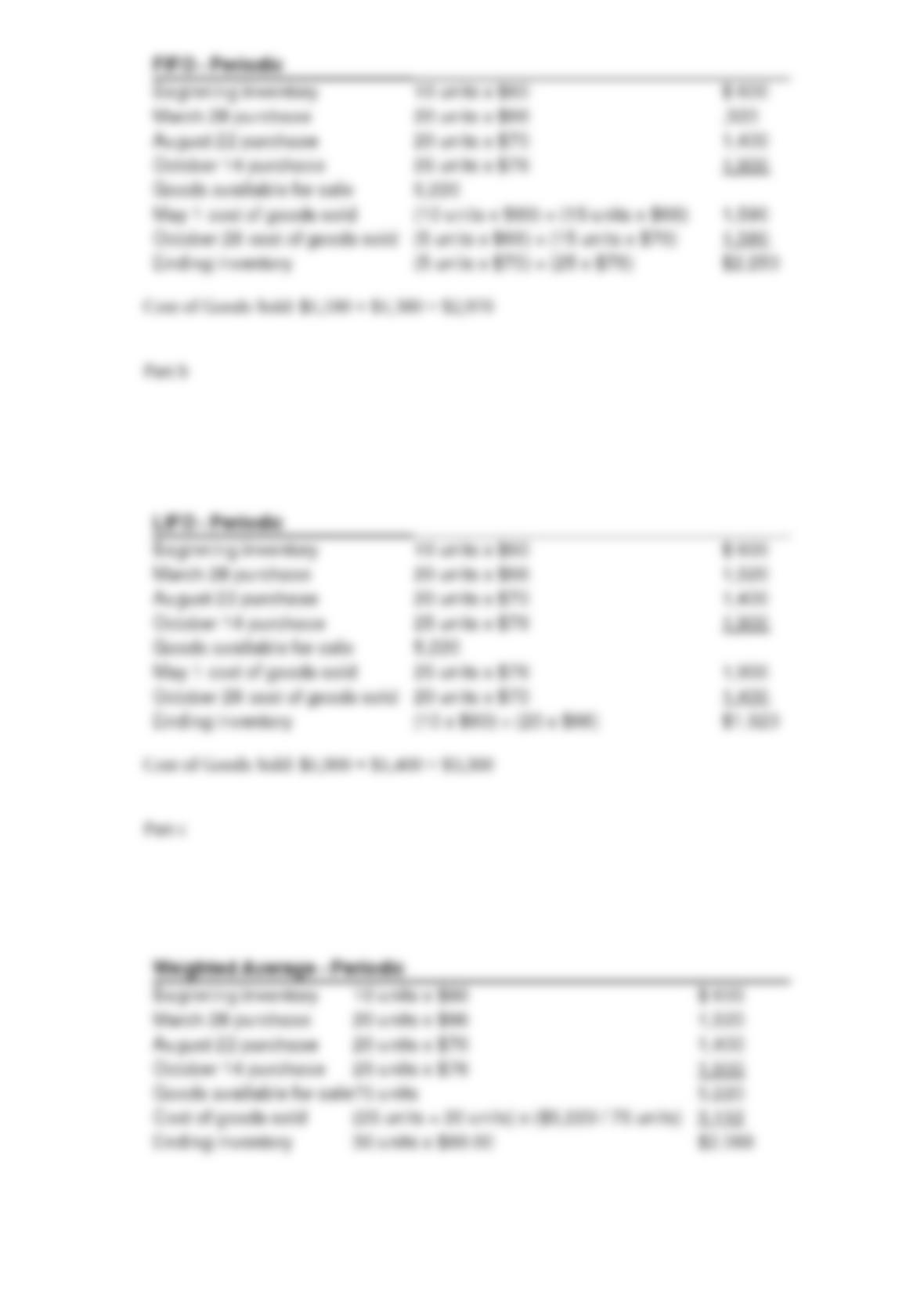
Calculate the company’s ending inventory and cost of goods sold using the each of
following inventory costing methods. (Round the per unit cost to two decimal places
and then round your answer to the nearest whole dollar.)
Part a. FIFO
Part b. LIFO
Part c. Weighted Average
On June, 30, 2015, a company purchased a two -year insurance policy for $18,000,
paying cash and debiting Prepaid Insurance for the entire two -year premium amount.
The adjusting entry on December 31, 2015 includes a:
A) credit to Prepaid Insurance $4,500.
B) credit to Insurance Expense $4,500.
C) credit to Prepaid Insurance $9,000.
D) debit to Insurance expense $9,000.
The company uses up $5,000 of an existing asset and the company adjusts its accounts
accordingly. This is an example of a(n):
A) accrual adjustment.
B) closing adjustment.
C) deferral adjustment.
D) unethical adjustment.
A check is said to have cleared the bank when:
A) it is returned NSF.
B) it bounces.
C) the bank withdraws the amount of the check from the check writer ‘s account.
D) it is presented to a financial institution for deposit or cash.
An increase in revenue always:
A) increases stockholders’ equity.
B) increases assets.
C) decreases stockholders’ equity.
D) decreases assets.
If a company’s ending inventory count was $50,000, cost of goods sold was $27,000,
and purchases were $56,000, its beginning inventory must have been:
A) $33,000.
B) $133,000.
C) $79,000.
D) $21,000.
On December 31, 2015, interest of $500 is owed on a bank loan that will not be paid
until June 30, 2016. What is the necessary adjusting journal entry on December 31,
2015?
A) Debit Interest Expense and credit Cash for $500
B) Debit Interest Expense and credit Interest Payable for $500
C) Debit Interest Payable and credit Interest Expense for $500
D) Debit Interest Receivable and credit Interest Revenue for $500
When the direct method is used to determine the cash flows from operating activities,
which of the following adjustments must be made to income tax expense to determine
total income tax payments?
A) Add all changes in income taxes and income taxes payable.
B) Add decreases in income taxes payable and subtract increases in income taxes
payable.
C) Add increases in income taxes payable and subtract decreases in income taxes
payable.
D) Subtract all changes in income taxes payable.
Use the information above to answer the following question. If the units-of-production
method is used, the depreciation expense for this period is:
A) $80,000.
B) $400,000.
C) $76,000.
D) $380,000.
For a manufacturer, inventory turnover refers to how many times:
A) during the period the company replaces the raw materials inventory.
B) the company purchases and sells its inventory of finished goods.
C) the company produces its goods and delivers the inventory to customers.
D) the company orders raw materials.
Your company received payment from a customer last month for a service that you
provided this month. How will the business activity of the current month affect the
basic accounting equation?
A) Assets will not change; liabilities will decrease; and stockholders’ equity will
increase.
B) Assets will increase, liabilities will increase, and stockholders’ equity will not
change.
C) Assets will increase, liabilities will not change, and stockholders’ equity will
increase.
D) Assets will decrease, liabilities will not change, and stockholders’ equity will
increase.
Which is the first financial statement that should prepared after the adjusted trial
balance has been prepared?
A) Balance Sheet
B) Income Statement
C) Statement of Cash Flows
D) Statement of Retained Earnings