Jones Company developed the following static budget at the beginning of the
company’s accounting period:
If actual production totals 8,200 units, the flexible budget would show total costs of:
A. $8,000.
B. $8,100.
C. $8,200.
D. None of these is correct.
Select the incorrect statement regarding the relevant range of volume.
A. Total fixed costs are expected to remain constant.
B. Total variable costs are expected to vary in direct proportion with changes in volume.
C. Variable cost per unit is expected to remain constant.
D. Total cost per unit is expected to remain constant.
The amounts of voluntary costs and failure costs:
A. are equal by definition.

B. tend to move in opposite directions (as one increases the other decreases).
C. tend to move in the same direction (as one increases the other increases).
D. None of these answers is correct.
When drawing a cost-volume-profit graph, how would the axes be labeled?
A. The horizontal axis would be labeled with dollars (of cost or revenue), while the
vertical axis would be labeled with number of units (volume or activity).
B. The horizontal axis would be labeled with dollars (of total fixed costs), while the
vertical axis would be labeled with dollars (of total variable costs).
C. The horizontal axis would be labeled with number of units (volume or activity),
while the vertical axis would be labeled with dollars (of cost or revenue).
D. None of these answers is correct.
Jasper Company has variable costs per unit of $20, fixed costs of $300,000, and a
break-even sales volume of 60,000 units. What will be the new break-even volume in
units if variable costs decrease by $3 per unit and fixed costs increase by $100,000?
A. 93,333 units
B. 33,333 units
C. 50,000 units

D. 200,000 units
Indirect costs are often pooled, and not allocated individually because:
A. individual allocation would be more timely.
B. individual allocation would be more accurate.
C. individual allocation would be tedious.
D. the benefits of individual allocation of indirect costs are greater than the costs.
Which of the following statements regarding Company A is incorrect?
A. If Company A has fixed costs of $720,000, a selling price of $50 per unit, and
contribution margin of $30 per unit, its break-even volume in units is 36,000 units.
B. If Company A has fixed costs of $720,000, a selling price of $50 per unit, and
contribution margin of $30 per unit, its variable expenses must be $20 per unit.
C. If Company A has fixed costs of $720,000, a selling price of $50 per unit, and
contribution margin of $30 per unit, once it has covered its fixed costs, net income will
increase by $30 for each additional unit sold.
D. Both if Company A has fixed costs of $720,000, a selling price of $50 per unit, and
contribution margin of $30 per unit, its break-even volume in units is 36,000 units and
if Company A has fixed costs of $720,000, a selling price of $50 per unit, and
contribution margin of $30 per unit, its variable expenses must be $20 per unit are
incorrect.
The two most common types of costing systems are:
A. Process cost and transfer cost systems.
B. Job order and process cost systems.
C. Job order and direct cost systems.
D. Process cost and standard cost systems.
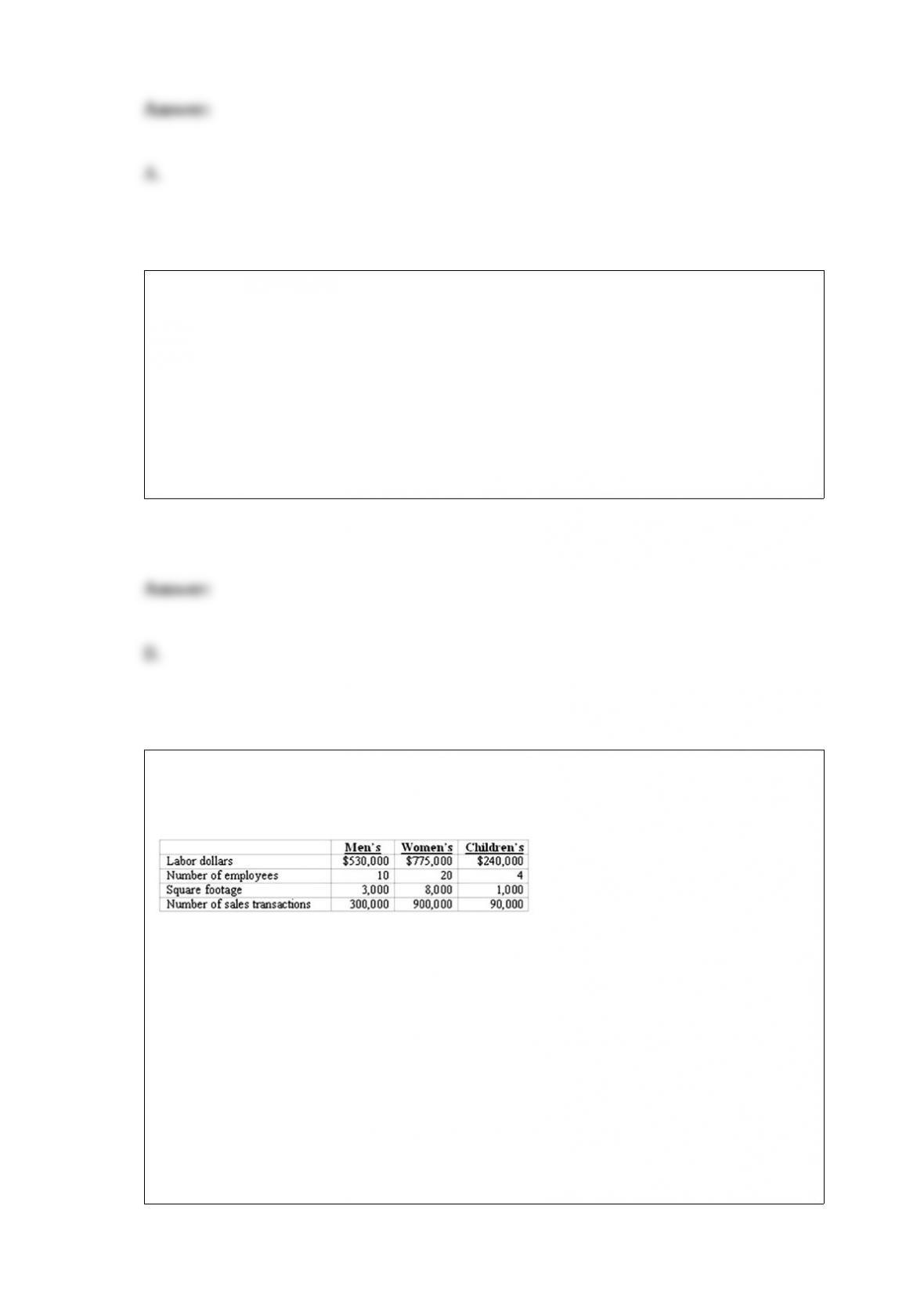
Bank’s Department Store has three departments: Men’s, Women’s and Children’s. The
store incurred $50,000 of store rental costs in 2013. The departments identified the
following cost drivers for 2013:
Using the most appropriate cost driver, how much rental cost (rounded to the nearest
dollar) should be allocated to the Women’s Department? (Do not round your
intermediate calculations.)
A. $33,333
B. $29,412
C. $25,081
D. $34,884

Anton believes his company’s overhead costs are driven (affected) by the number of
machine hours because the production process is heavily automated. During the period,
the company produced 3,000 units of Product A requiring a total of 100 machine hours
and 2,000 units of Product B requiring a total of 25 machine hours. What allocation rate
should be used if the company incurs overhead costs of $10,000?
A. $2 per unit
B. $2 per machine hour
C. $80 per unit
D. $80 per machine hour
Which of the following statements is false?
A. Both direct and indirect costs can be assigned to a cost object.
B. Cost drivers are often selected based on the availability of information.
C. Volume measures are good drivers for fixed overhead costs.
D. Fixed costs that do not have a definitive cost driver are allocated using an allocation
base that distributes a rational share of the cost to each product.

Wu Company incurred $40,000 of fixed cost and $50,000 of variable cost when 4,000
units of product were made and sold.
If the company’s volume doubles, the total cost per unit will:
A. stay the same.
B. decrease.
C. double as well.
D. increase but will not double.
A customary assumption in capital budgeting analysis is that:
A. the desired rate of return includes the effects of compounding.
B. the cash inflows generated by the investment are not reinvestment.
C. annual cash flows occur at the beginning of each period.
D. the time value of money is ignored.
Purchasing raw materials on account is a(n):
A. asset source transaction.
B. asset use transaction.
C. asset exchange transaction.

D. claims exchange transaction.
Which of the following is not an approach to compute equivalent whole units?
A. Weighted average.
B. Last-in-first-out.
C. First-in-first-out.
D. All of these can be used.
What budget is generally not included in a master budget?
A. Strategic budget
B. Capital budget
C. Operating budget
D. All of these answers are correct.

During its first year of operations, Silverman Company paid $14,000 for direct
materials and $19,000 for production workers’ wages. Lease payments and utilities on
the production facilities amounted to $17,000 while general, selling, and administrative
expenses totaled $8,000. The company produced 5,000 units and sold 3,000 units at a
price of $15.00 a unit.
What was Silverman’s net income for the first year in operation?
A. $7,000
B. $12,000
C. $28,000
D. $37,000
All of the following costs are accumulated in the work in process account except:
A. transportation-out costs.
B. direct labor costs.
C. manufacturing overhead costs.
D. direct material costs.
King Company has two divisions whose most recent financial statements are shown
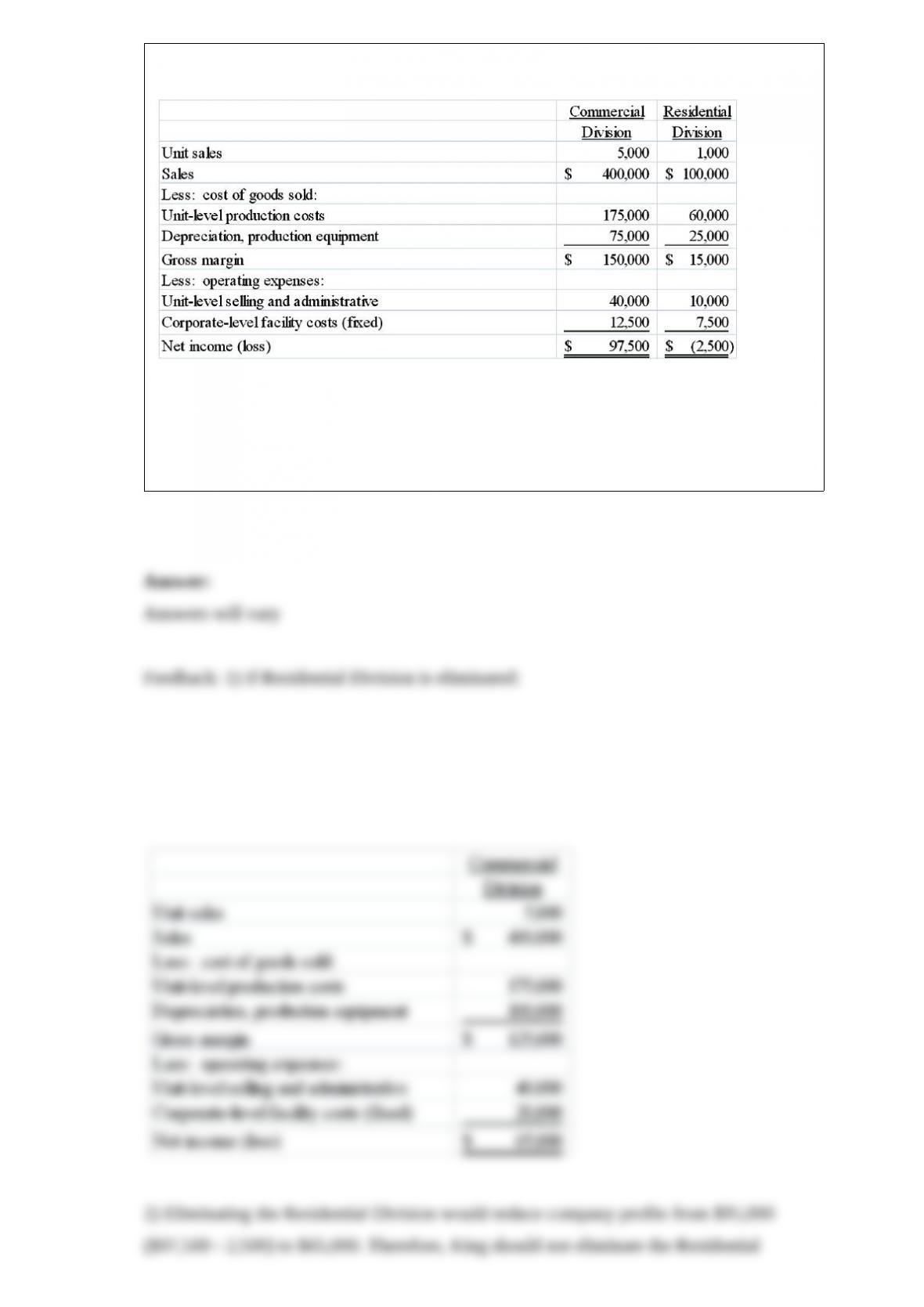
below:
Require
d:
1) Compute the impact on profit if the Residential Division is eliminated.
2) Do you recommend that King eliminate the Residential Division?
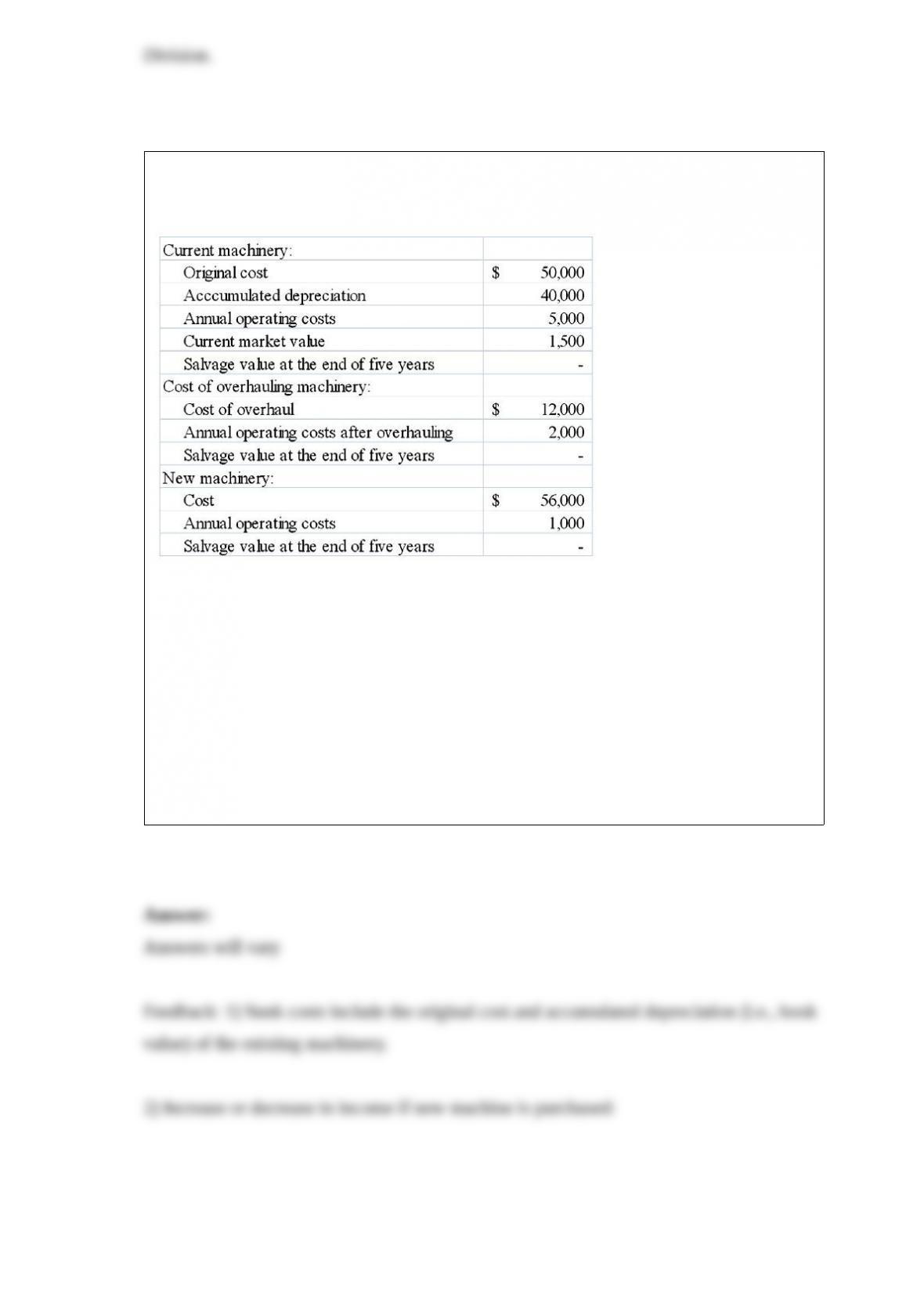
Chavez Company is considering purchasing new equipment or overhauling its existing
equipment. The manager has gathered the following information:
Required:
1) Identify the sunk costs associated with this decision.
2) Compute the increase or decrease in total income over the five-year period if the
company chooses to buy the new equipment.
3) Compute the increase or decrease in total income over the five-year period if the
company chooses to overhaul its existing machinery.
4) What is your recommendation for this decision?
Indicate whether each of the following statements about process costing systems is true
or false.
A company that uses a process costing system may use separate predetermined
overhead rates for each department involved in production.
Company X completed 10,000 units of a product in January and had 1,000 units (80%
completed) at the end of the month. Company X’s equivalent whole units for January
were 10,800.
The reason for calculating the number of equivalent whole units for a period is to
allocate product costs between work in process inventory and the cost of units
completed and transferred out.
A company that uses a process costing system completes a job cost sheet for each
department each month.
The transfer of goods from one processing department to another is an asset use
transaction.
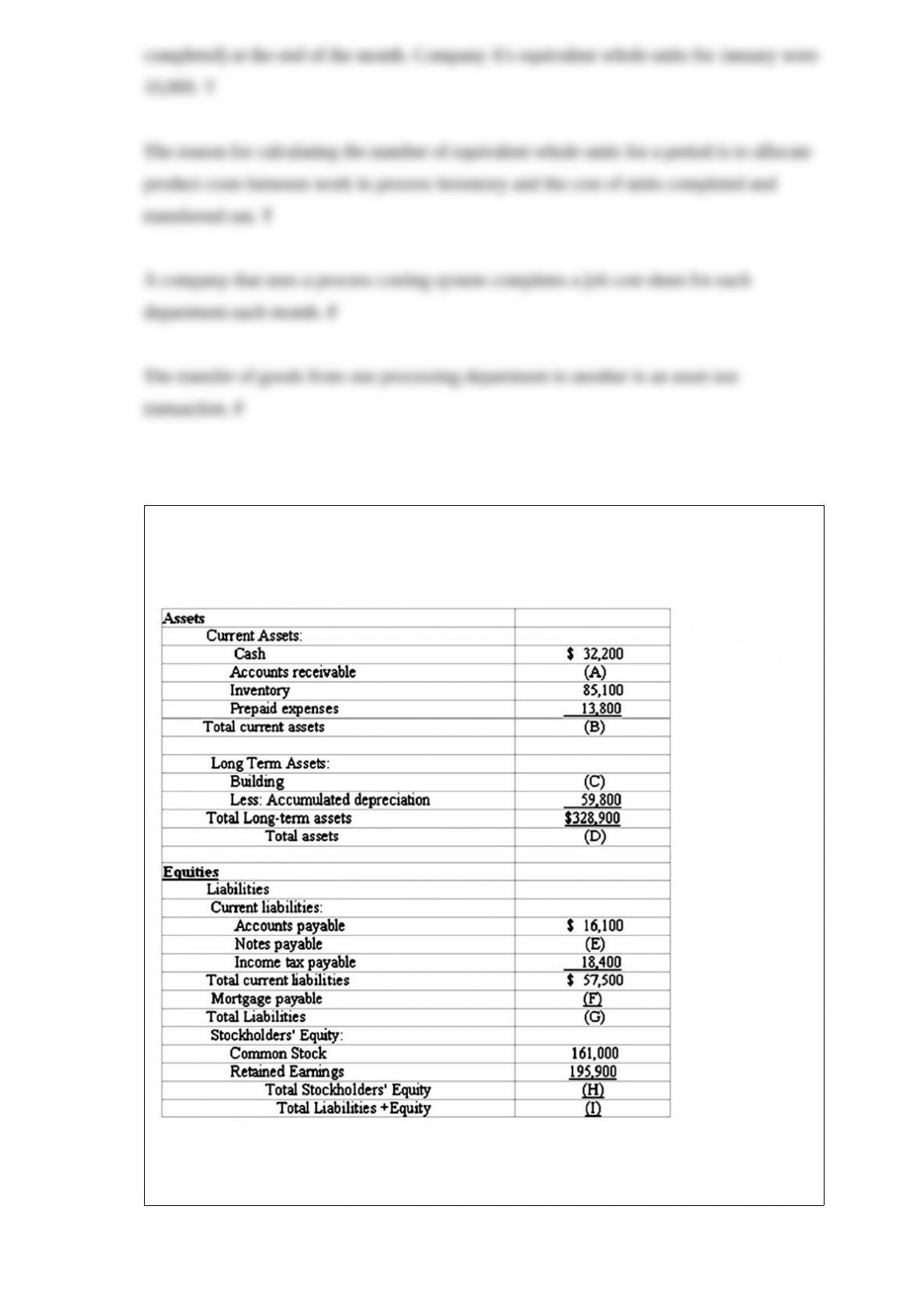
A careless accountant splattered spaghetti sauce on Kitchen Company’s balance sheet.
The balance sheet with its missing amounts is provided below:
Kitchen Company’s working capital is $138,000.
Required:Compute the missing amounts. Record your answers in the following table:
Would issuing a mortgage to purchase a building be reported on the statement of cash
flows? If so, where would it be reported? If not, why not?
How do differences between planned and actual volume impact companies that use a
cost plus pricing strategy?
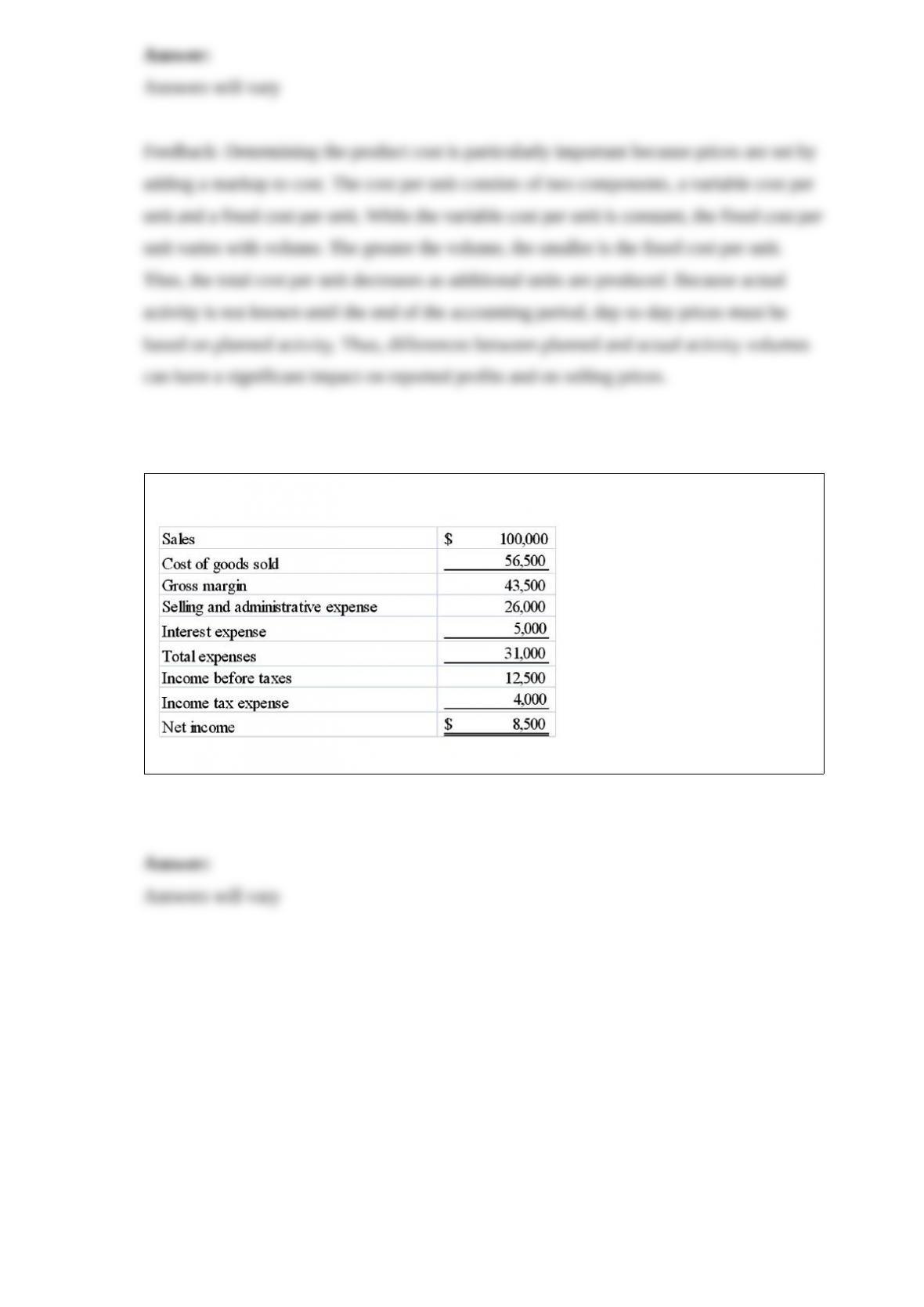
The following income statement was prepared by Case Company for 2014:
Required:Perform vertical analysis for Case Company’s 2014 income statement.