A plant asset’s useful life might not be the same as its productive life.
Input devices are the means to make accounting information available to users.
The process cost summary is an important managerial accounting report produced by a
process cost accounting system.
A payroll register is a cumulative record of an employee’s hours worked, gross earnings,
deductions, and net pay.
Current liabilities include accounts receivable, unearned revenues, and salaries payable.
A bond is a written promise to pay an amount identified as the par value of the bond
along with interest.
Organization costs are sometimes paid for by giving stock to the promoters of a
corporation in exchange for their services in organizing the corporation.
As the level of output activity increases, fixed cost per unit remains constant.

Segment information is often useful to investors for evaluating a company’s
profitability, risk, and growth.
When a partnership is liquidated, its business is ended.
Expenses decrease equity and are the costs of assets or services used to earn revenues.
A dishonored note receivable is usually reclassified as an account receivable.
In a limited partnership the general partner has unlimited liability.
A company with a high inventory turnover requires a smaller investment in inventory
than one producing the same sales with a lower turnover.
Indirect labor refers to the cost of the workers whose efforts are directly traceable to
specific units or batches of product.
The matching principle is used by some companies to avoid allocating incidental
inventory costs to cost of goods sold.
Depreciation expense is not reported on the statement of cash flows when prepared
using the direct method.
Generally accepted accounting principles require companies to use one specific format
for the financial statements.
A partnership is an unincorporated association of two or more people to pursue a
business for profit as co-owners.
On the work sheet, net income is entered in the Income Statement Credit column as
well as the Balance Sheet or Statement of Owner’s Equity Debit column.
Financial budgets are normally completed after preparation of operating and capital
expenditure budgets.
Current liabilities are cash and other resources that are expected to be sold, collected or
used within one year or the company’s operating cycle whichever is longer.
Horizontal analysis is the comparison of a company’s financial condition and
performance to a base amount.
The process of using accounts receivable as security for a loan is known as factoring
accounts receivable.
A controlling investor is called the parent, and the investee company is called the
subsidiary.
Most mortgage contracts grant the lender the right to foreclose on the property that is
identified as security for the mortgage if the borrower fails to pay in accordance with
the terms of the contract.
A bond’s par value is not necessarily the same as its market value.
A company has $90,000 in outstanding accounts receivable and it uses the allowance
method to account for uncollectible accounts. Experience suggests that 6% of
outstanding receivables are uncollectible. The current credit balance (before
adjustments) in the allowance for doubtful accounts is $800. The journal entry to record
the adjustment to the allowance account includes a debit to Bad Debts Expense for
$7,000.
A company has net income of $130,500. Its net sales were $1,740,000 and its total
assets were $2,750,000. Its profit margin equals 7.5%.
Companies that use a series of repetitive manufacturing processes to produce
standardized products should use a process cost accounting system.
The accounts payable ledger is used for storing transactions data regarding individual
customers.

The trial balance can serve as a replacement for the balance sheet, since debits must
equal with credits.
A trend percent, or index number, is calculated by dividing the analysis period amount
by the base period amount and multiplying the result by 100.
For a manufacturing firm, cycle time may be computed as process time + inspection
time + move time ” wait time.
Merchandise inventory is reported in the long-term assets section of the balance sheet.
The five basic principles of accounting information systems are control, competency,
compatibility, flexibility and cost-benefit.
Since the process cost summary describes the activities of a production department for a
specified reporting period, it does not present information about any costs incurred in
prior periods.
Indirect materials are accounted for as factory overhead because they are not easily
traced to specific units or batches of production.
A single basis for allocating service department costs to production departments should
be used for all service departments.
The predetermined overhead allocation rate based on direct labor cost is the ratio of
estimated overhead cost for the period to estimated direct labor cost for the period.
Bradford Company budgeted 4,000 pounds of material costing $5.00 per pound to
produce 2,000 units. The company actually used 4,500 pounds that cost $5.10 per
pound to produce 2,000 units.
What is the direct materials price variance?
A.$ 400 unfavorable.
B.$ 450 unfavorable.
C.$2,500 unfavorable.
D.$2,550 unfavorable.
E.$2,950 unfavorable.

The periodic expense created by allocating the cost of plant and equipment to the
periods in which they are used, representing the expense of using the assets, is called:
A.Accumulated depreciation.
B.A contra account.
C.The matching principle.
D.Depreciation expense.
E.An accrued account.
The comparison of a company’s financial condition and performance to a base amount

is known as:
A.Financial reporting.
B.Horizontal ratios.
C.Investment analysis.
D.Risk analysis.
E.Vertical analysis.
Sinking fund bonds:
A.Require the issuer to set aside assets to retire the bonds at maturity.
B.Require equal payments of both principal and interest over the life of the bond issue.
C.Decline in value over time.
D.Are registered bonds.
E.Are bearer bonds.
The process of transferring general journal information to the ledger is:
A.Double-entry accounting.
B.Posting.

C.Balancing an account.
D.Journalizing.
E.Not required unless debits do not equal credits.
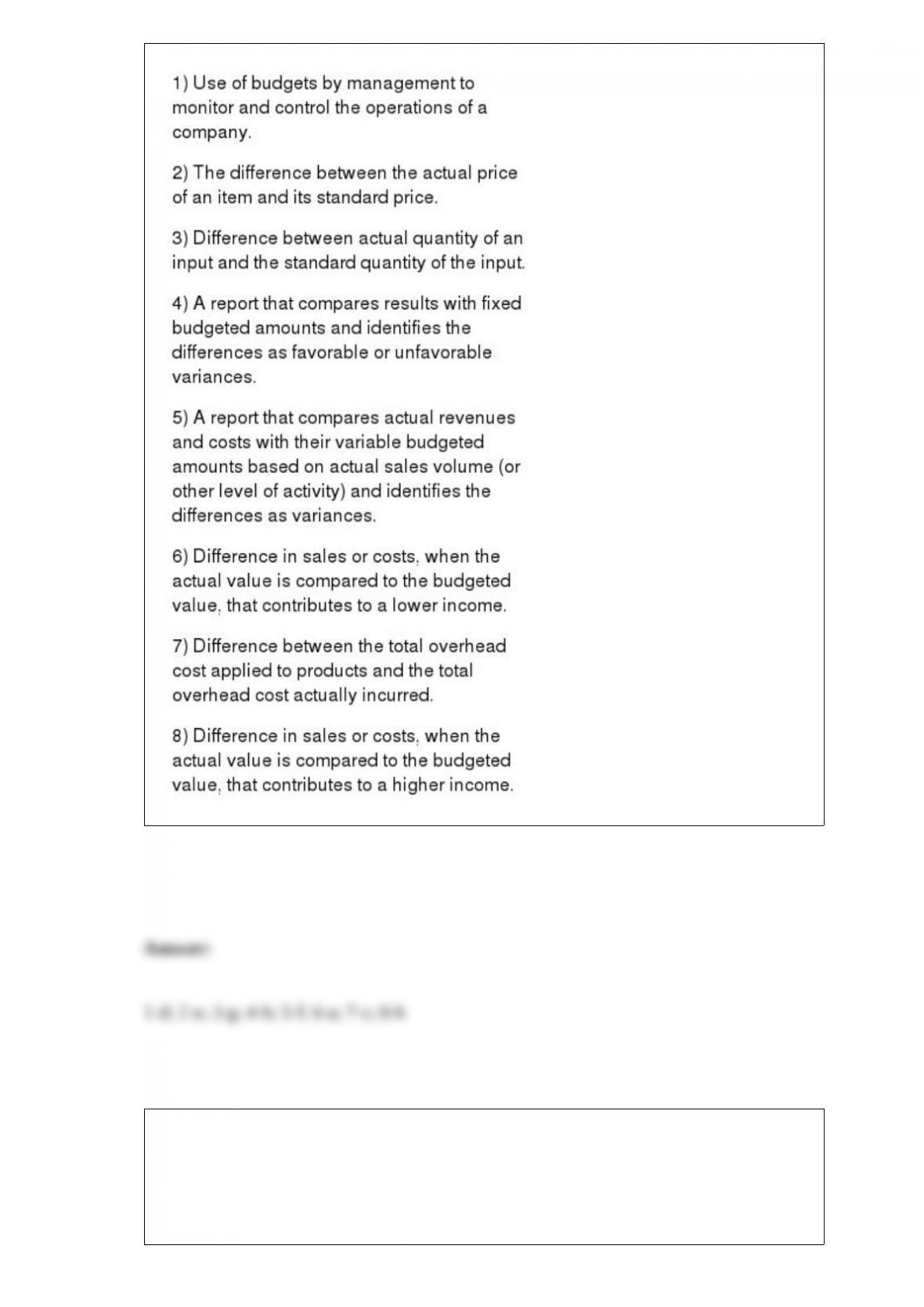
Presented below are terms preceded by letters a through h and followed by a list of
definitions 1 through 8. Enter the letter of the term with the definition, using the space
preceding the definition.
(a) Unfavorable variance
(b) Fixed budget performance report
(c) Overhead cost variance
(d) Budgetary control
(e) Spending variance
(f) Flexible budget performance report
(g) Quantity variance
(h) Favorable variance
When analyzing the changes on a spreadsheet used to prepare a statement of cash flows,
the cash flows from investing activities generally affect:
A.Net income, current assets, and current liabilities.

B.Noncurrent assets.
C.Noncurrent liability and the equity accounts.
D.Both noncurrent assets and noncurrent liabilities.
E.Equity accounts only.
The ability to provide financial rewards sufficient to attract and retain financing is
called:
A.Liquidity and efficiency.
B.Solvency.
C.Profitability.
D.Market prospects.
E.Creditworthiness.
Which of the following items represents a difference between financial and managerial
accounting?
A.Users of the information.
B.Flexibility of practices.
C.Timeliness and time dimension of the information reported.

D.Nature of the information.
E.All of these.
FUTA taxes are:
A.Social Security taxes.
B.Medicare taxes.
C.Employee income taxes.
D.Unemployment taxes.
E.Employee deductions.
A capital deficiency means that:
A.The partnership has a loss.
B.The partnership has more liabilities than assets.
C.At least one partner has a debit balance in his/her capital account.
D.At least one partner has a credit balance in his/her capital account.
E.The partnership has been sold at a loss.

The conservatism constraint:
A.Requires that when multiple estimates of amounts to be received or paid in the future
are equally likely, then the least optimistic amount should be used.
B.Requires that a company use the same accounting methods period after period.
C.Requires that revenues and expenses be reported in the period in which they are
earned or incurred.
D.Requires that all items of a material nature be included in financial statements.
E.Requires that all inventory items be reported at full cost.
The reporting of net cash provided or used by operating activities that lists the major
items of operating cash receipts, such as receipts from customers, and subtracts the
major items of operating cash disbursements, such as cash paid for merchandise, is
referred to as the:
A.Direct method of reporting net cash provided or used by operating activities.
B.Cash basis of accounting.
C.Classified statement of cash flows.
D.Indirect method of reporting net cash provided or used by operating activities.
E.Net method of reporting cash flows from operating activities.

In comparison to a general accounting system for a manufacturing company, a cost
accounting system places an emphasis on:
A.Periodic inventory counts.
B.Total costs.
C.Unit costs and cost control.
D.Products and average costs.
E.Large volume operations involving standardized products.
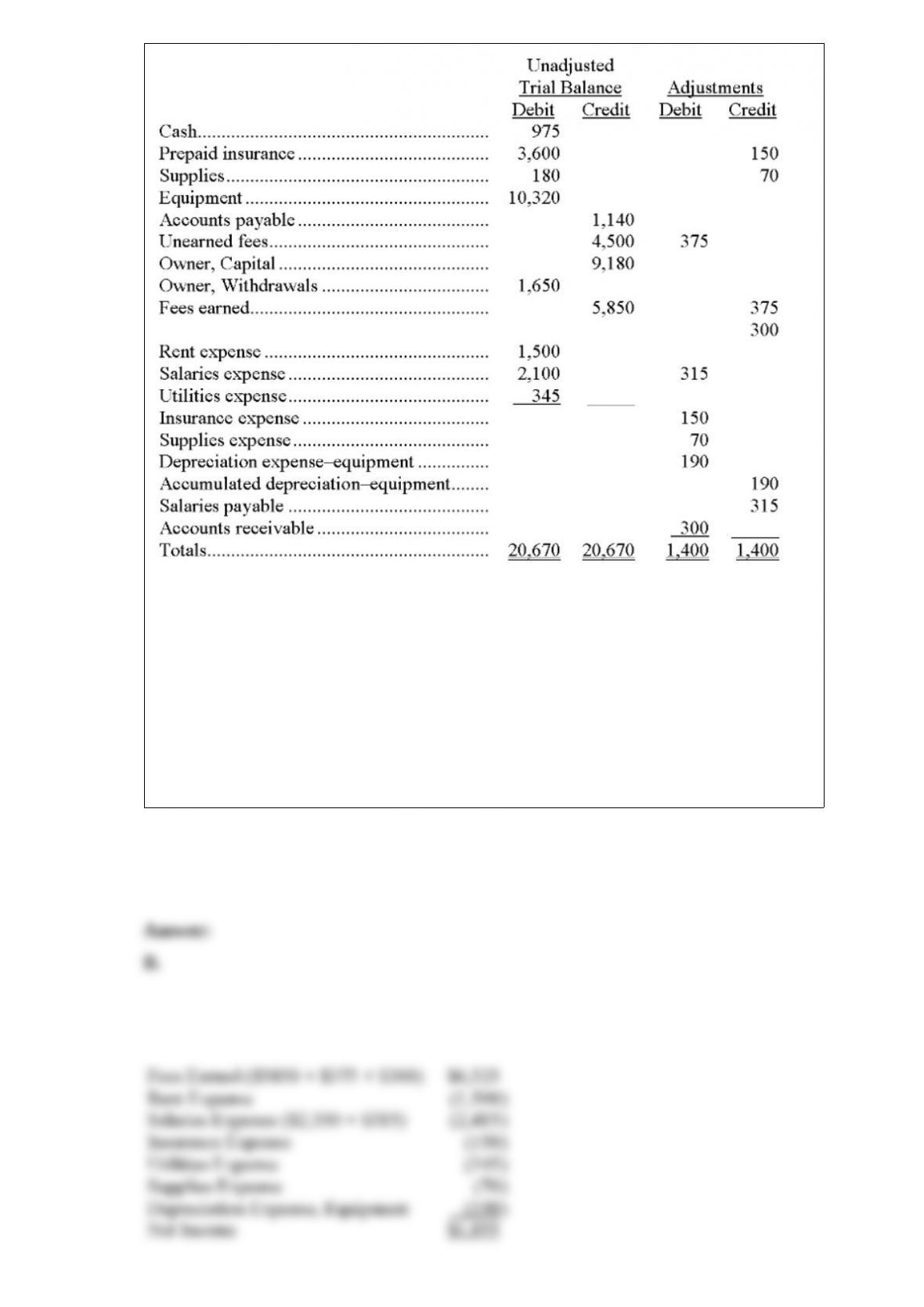
The following items appeared on a company’s December 31 work sheet for the current
period. Based on the following information, what is net income for the current period?
A.$1,400.
B.$1,855.
C.$1,905.
D.$2,060.
E.$4,670.

The credit terms 2/10, n/30 are interpreted as:
A.2% cash discount if the amount is paid within 10 days, or the balance due in 30 days.
B.10% cash discount if the amount is paid within 2 days, or the balance due in 30 days.
C.30% discount if paid within 2 days.
D.30% discount if paid within 10 days.
E.2% discount if paid within 30 days.
A company has the following per unit original costs and replacement costs for its
inventory:
Part A: 50 units with a cost of $5, and replacement cost of $4.50
Part B: 75 units with a cost of $6, and replacement cost of $6.50
Part C: 160 units with a cost of $3, and replacement cost of $2.50
Under the lower of cost or market method, the total value of this company’s ending
inventory is:
A.$1,180.00.
B.$1,075.00.
C.$1,075.00 or $1,112.50, depending upon whether LCM is applied to individual items
or the inventory as a whole.
D.$1,112.50.
E.$1180.00 or $1075.00, depending upon whether LCM is applied to individual items
or to the inventory as a whole.

Debt securities:
A.Can be short-term investments.
B.Can be long-term investments.
C.Can have a cost higher than the maturity value of the debt security.
D.Can have a cost lower than the maturity value of the debt security.
E.All of these.
A subsidiary ledger that contains a separate account for each supplier (creditor) to the
company is a(n):
A.Controlling account.
B.Accounts receivable ledger.
C.Accounts payable ledger.
D.General ledger.
E.Special journal.
A company had no office supplies available at the beginning of the year. During the
year, the company purchased $250 worth of office supplies. On December 31, $75
worth of office supplies remained. How much should the company report as office
supplies expense for the year?
A.$75.
B.$125.
C.$175.
D.$250.
E.$325.
The materiality principle:
A.States that an amount can be ignored if its effect on financial statements is
unimportant to user’s business decisions.
B.Requires use of the allowance method for bad debts.
C.Requires use of the direct write-off method.
D.States that bad debts not be written off.

E.Requires that expenses be reported in the same period as the sales they helped
produce.
A manufacturing statement is also known as a schedule or listing of the:
A.Raw materials processed.
B.Factory supplies used.
C.Cost of goods manufactured.
D.Total finished goods.
E.Cost of goods sold.
Match the following definitions and terms by placing the letter for the terms a through j
in the blank space next to the best definition.
a. List price
b. Merchandise inventory
c. EOM
d. Single-step income statement
e. FOB
f. Acid-test ratio

g. Inventory shrinkage
h. Selling expenses
i. Multiple-step income statement
j. General and administrative expenses
1)Expenses that support overall operations and includes expenses related to accounting,
human resource management and financial management.
2)The catalog price of an item before any trade discount is deducted.
3)Products a company owns and intends to sell.
4)Inventory losses that can occur as a result of theft or deterioration.
5)An income statement format that shows detailed computations of net sales and other
costs and expenses, and reports subtotals for various classes of items.
6)The expenses of promoting sales by displaying and advertising merchandise, making
sales, and delivering goods to customers.
7)The abbreviation for end-of-month; used to describe credit terms for some
transactions.
8) The abbreviation for free on board; refers to the point when ownership of goods
passes to the buyer.
9)An income statement format that shows only one subtotal for total expenses.
10)A ratio used to assess a company’s ability to pay its current liabilities; defined as
quick assets divided by current liabilities.
A plan that states the number of units to be manufactured during each future period
covered by the budget, based on the budgeted sales for the period and the levels of
inventory needed to support future sales, is the:
A.Sales budget.

B.Merchandise purchases budget.
C.Production budget.
D.Cash budget.
E.Manufacturing budget.
Standard costs are used to measure:
A.Price and quantity variances.
B.Price variances only.
C.Quantity variances only.
D.Price, quantity, and sales variances.
E.Quantity and sales variances.
Doherty Corporation had net income of $30,000, net sales of $1,000,000, and average
total assets of $500,000. Its return on total assets is:
A.3%
B.200%
C.6%
D.17%
E.1.5%
Rice, Hepburn, and DiMarco formed a partnership with Rice contributing $60,000,
Hepburn contributing $50,000 and DiMarco contributing $40,000. Their partnership
agreement called for the income (loss) division to be based on the ratio of capital
investments. If the partnership had income of $75,000 for its first year of operation,
what amount of income (rounded to the nearest dollar) would be credited to DiMarco’s
capital account?
A.$20,000.
B.$25,000.
C.$30,000.
D.$40,000.
E.$75,000.
_____________________ is a general term that refers to any shares issued to obtain
owner financing in a corporation.
___________ expenses are those expenses that support a company’s overall operations
and include expenses related to accounting, human resource management, and financial
management.
________________________ refers to products that a company owns and intends to
sell.
How does the objectivity principle support ethical behavior?
Briefly explain the conditions under which job order cost accounting systems and
process cost accounting systems are commonly applied.
_____________________ inventory consists of goods a company acquires to use in
making products.
_______________________________________ refers to the programs that help
managers direct a company’s vital operations.
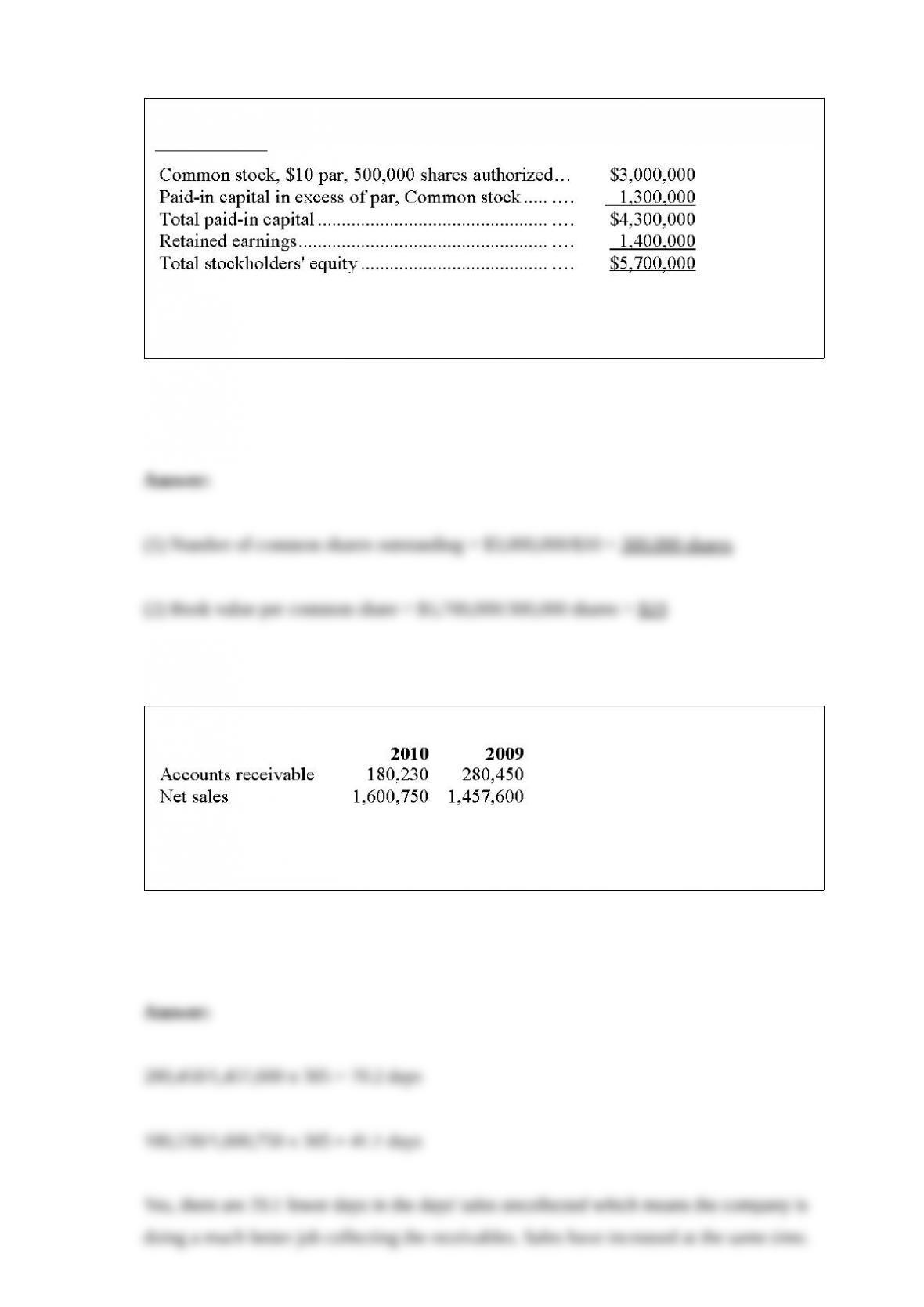
A company reports the following stockholders’ equity:
Paid-in Capital:
Compute the (1) number of common shares outstanding and (2) book value per
common share.
The following account balances are taken from Mesky Sports at December 31.
Calculate the number of days’ sales uncollected for both years. According to this
analysis, is the company’s collection of receivables improving? Explain.
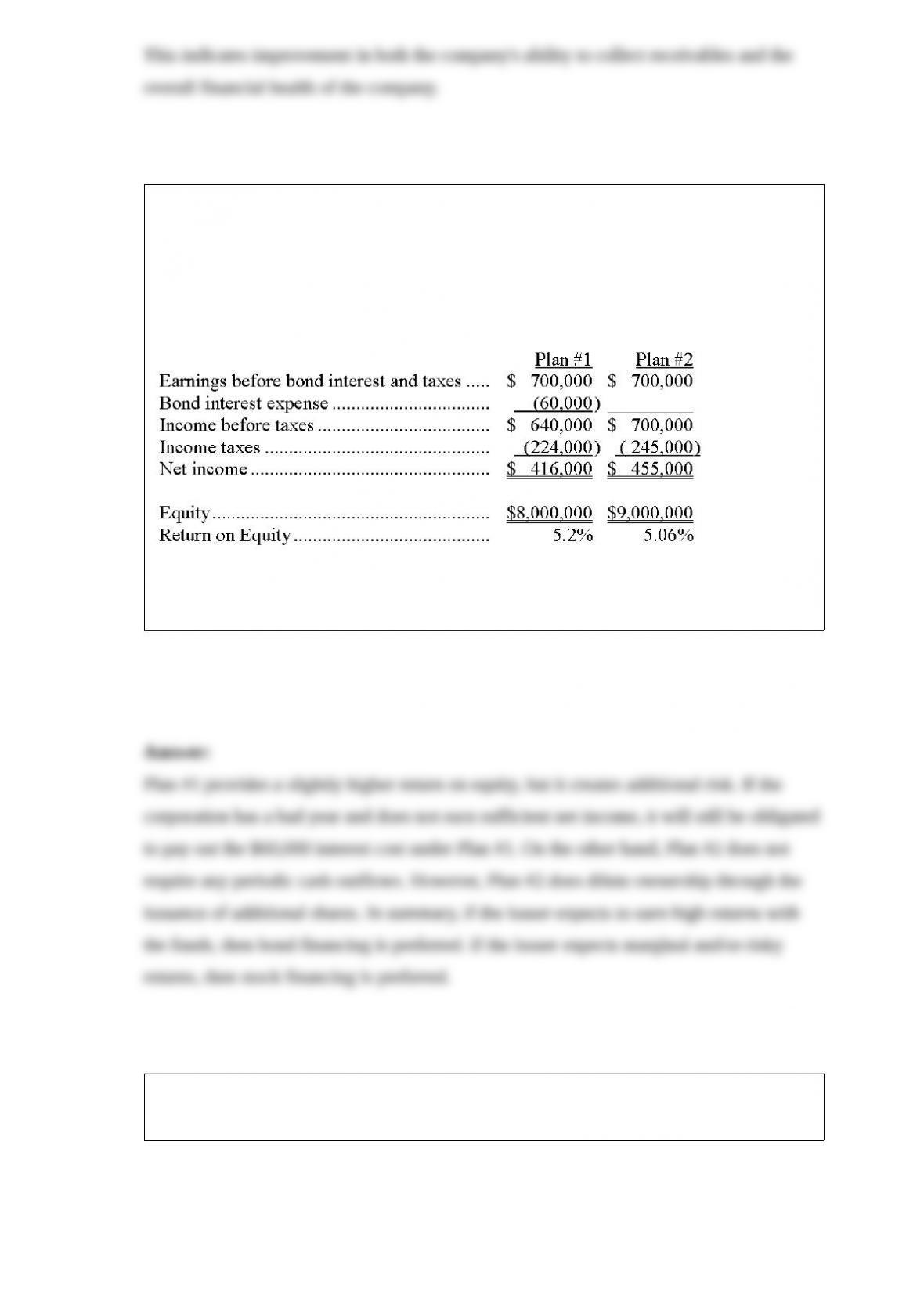
A corporation plans to invest $1 million in oil exploration. The corporation is
considering two plans to raise the money. Under Plan #1, bonds with a contract rate of
interest of 6% would be issued. Under Plan #2, additional shares of common stock
would be issued at $20 per share. The corporation currently has 300,000 shares of stock
outstanding, and it expects to earn $700,000 per year before bond interest and income
taxes. The net income and return on investment for both plans is shown below:
Comment on the relative effects of each alternative, including when one form of
financing is preferred to another.
Investments in trading securities are always classified as ______________ and are
reported as _______________ on the balance sheet.
Discuss the purpose of a bank reconciliation.
The cost of an inventory item includes the _____________, plus ______________ costs
necessary to put it in a place and condition for sale.
A seller usually prepares a ____________________ to confirm a buyer’s return or
allowance, and informs the buyer of the seller’s credit to the buyer’s Account Receivable
on the seller’s books.