Which of the following is a model based on four perspectives: (1) learning and growth,
(2) internal business and production process efficiency, (3) customer, and (4) financial?
A.Zero-based budgeting
B.Planning programming and budgeting
C.Management by objectives
D.Balanced scorecard
Which of the following are examples of batch activities in the product cost hierarchy?
A.Product specifications and product testing.
B.Market research, customer records, and promotion.
C.Machine setups and quality inspections.
D.Energy to run machines and direct materials.
The following information relates to the operating performance of three divisions of
Paul, Inc. for last year.
Required:
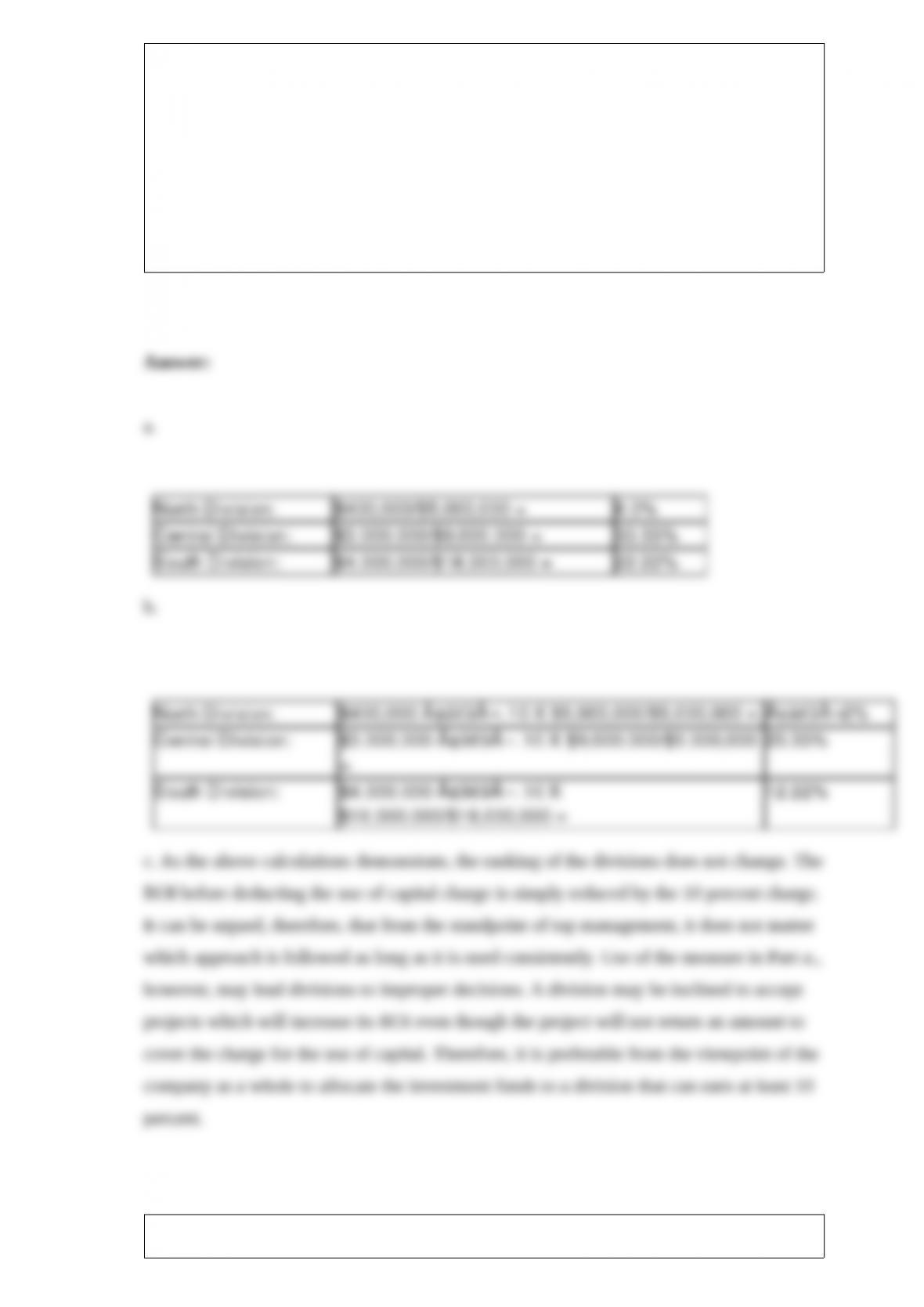
a. Compute the rate of return on investment (ROI) of each division for last year.
b. Assume that the firm levies a charge on each division for the use of funds. The
charge is 10 percent on investment, and the accounting system deducts it in measuring
divisional net income. Recalculate ROI using divisional net income after deduction of
the use-of-funds charge in the numerator.
c. Which of these two measures do you think gives the better indication of operating
performance? Explain your reasoning.
An effective cost system has which of the following characteristic(s)?

A.Decision focus
B.Different costs for different purposes
C.Cost benefit test
D.All of the answers are correct.
A company produces two products, A and B. A sells for $16 and has variable costs of
$10. B sells for $12 and has variable costs of $8. Fixed Costs for the period are
$35,000. An equal number of A and B units are sold. At the break-even volume, how
many units of A will be sold?
A.14,000
B.8,750
C.7,000
D.3,500
The balanced scorecard is a causal model of lead and lag indicators of performance and
is based on the financial perspective and the non-financial perspective(s) of
A.learning and growth.
B.internal business and production process.
C.customer.

D.All of the answers are correct.
Which of the following statements is true concerning budgeting?
A.Budgeting is a dynamic process that ties together goals, plans, decision making, and
employee performance evaluation
B.Budgeting is required by generally accepted accounting principles.
C.Budgeting is a static process that ties together goals, plans, decision making, and
employee performance evaluation
D.none of the above.
Which of the following is a mathematical tool for solving such multiply-constrained
decision problems?
A.curvi-linear programming.
B.random number generators.
C.mini-max decision-making.
D.linear programming.

For a furniture manufacturer, which of the following activities could not be eliminated
without changing the customer’s perception of the product’s desirability?
A.Set-up of machinery to produce different pieces of furniture.
B.Reducing the product’s distribution network.
C.Inspection of incoming shipments of wood and fabrics.
D.Movement of work-in-process from one work station to another.
The periodic cash outflows associated with an investment project do not include which
of the following?
A.savings in taxes caused by deductibility of depreciation on tax return.
B.expenditures for fixed production costs.
C.expenditures for variable production costs.
D.selling, general, and administrative expenditures.
All of the following terms refer to a similar cost concept except:

A.discretionary costs
B.managed costs
C.programmed costs
D.costs to achieve short run goals
Property taxes, executive salaries, and security are examples of which of the following
costs?
A.committed costs.
B.discretionary costs.
C.variable costs
D.All of the answers are correct.
Marketing costs include expenditures for salaries, advertising, and sales office costs
would be classified as which of the following type of activity?
A.customer-level activities.
B.facility-level activities.
C.product-level activities.
D.unit-level activities.
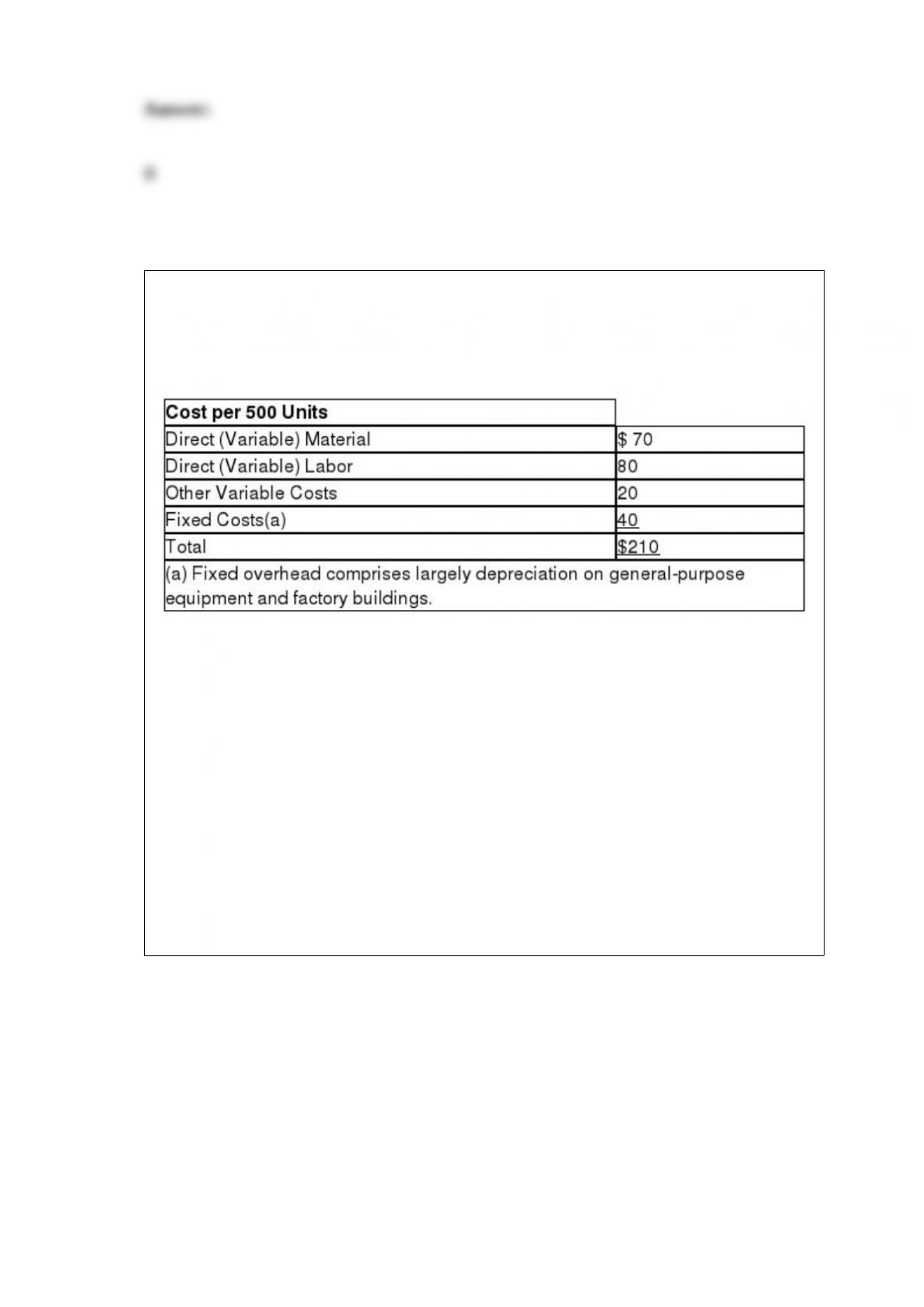
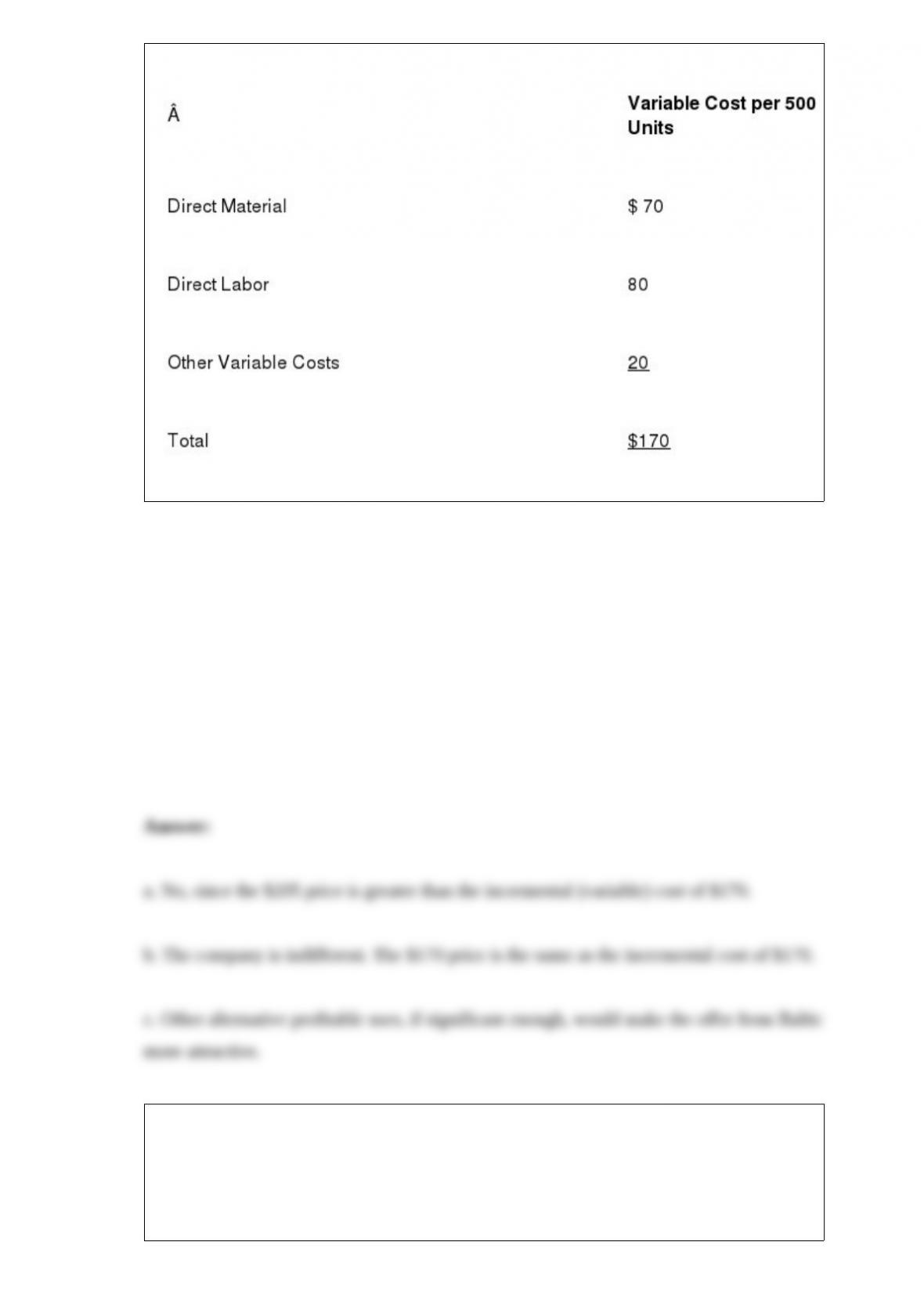
Make or buy. Towson, Inc., produces semiconductors of which part no. 200 is a
subassembly. Towson, Inc., currently produces part no. 200 in its own shop. The Baltic
Company offers to supply it at a cost of $205 per 500 units. An analysis of the costs
Towson incurs producing part no. 200 reveals the following information:
Required:
Management of Towson, Inc., needs your advice in answering the following questions:
a. Should Towson, Inc., accept the offer from Baltic if Towson’s plant is operating well
below capacity?
b. Should the offer be accepted if Baltic reduces the price to $170 per 500 units?
c. Suppose Towson can find other profitable uses for the facilities that it now uses in
turning out part no. 200. How would that fact affect the price Towson is willing to pay
Baltic?
(Towson, Inc.; make or buy.)
What is the result of substituting computerized equipment for direct labor?
A.Less direct material and more manufacturing overhead.
B.Less direct labor and more manufacturing overhead.
C.Less manufacturing overhead and more direct materials.
D.Less direct labor and more direct material.
Bubbling Springs, Inc., produces bottled drinks. Division #1 acquires the water, adds
carbonation, and sells it in bulk quantities to Division # 2 of Spring Waters and to
outside buyers. Division # 2 buys carbonated water in bulk, adds flavoring, bottles it,
and sells it. Last year, Division #1 produced 1,500,000 gallons, of which it sold
1,300,000 gallons to the Division # 2 and the remaining 200,000 gallons to outsiders for
$0.40 per gallon. Division #2 processed the 1,300,000 gallons, which it sold for
$1,500,000. Division #1’s variable costs were $440,000 and its fixed costs were
$120,000. The Division # 2 incurred an additional variable cost of $320,000 and
$200,000 of fixed costs. Both divisions operated below capacity.
Required:
a. Prepare division income statements assuming the transfer price is at the external
market price of $0.40 per gallon.
b. Repeat part a. assuming a negotiated transfer price of $0.30 per gallon is used.
c. Respond to the statement: “The choice of a particular transfer price is immaterial to
the company as a whole.”
Wilcox Company is considering an investment that will generate cash revenues of
$120,000 per year for 8 years, and have cash expenses of $60,000 per year for 8 years.
The cost of the asset is $120,000, and it will be depreciated using straight-line
depreciation over its 8 year life. Berringer pays income taxes at a rate of 30%. The cost
of capital is 12%
Required:
a. Prepare an analysis showing the annual after tax cash flow associated with this asset.
b. Compute the net present value of this investment using the cash flow you computed
in a above.
Strategic and operational uses of activity-based management include developing which
of the following?
A.Strategy.
B.Long-range plans.
C.Competitive cost advantage by focusing attention on activities.
D.All of the answers are correct.
Activity-based costing is commonly used with standard costing. Using more activity
drivers increases the potential for managers to
A.get much more information from activity-based costing than from the traditional
approach.
B.get much more information from the traditional approach than from activity-based
costing.
C.get the same information from activity-based costing as from the traditional
approach.
D.None of the above.
What is the definition of economic depreciation according to managerial accounting?
A.the decline in value of assets during the period using the sales value of assets as the
measure of value, only.
B.the decline in value of assets during the period using the replacement costs as the
measure of value, only.
C.the decline in value of assets during the period using either the sales value of assets or
their replacement costs as the measure of value.
D.the decline in value of assets during the period using amortized acquisition cost as the
measure of value.
How are fixed manufacturing costs treated for managerial and external reporting
purposes?
Describe various production methods and the different accounting systems each
requires.
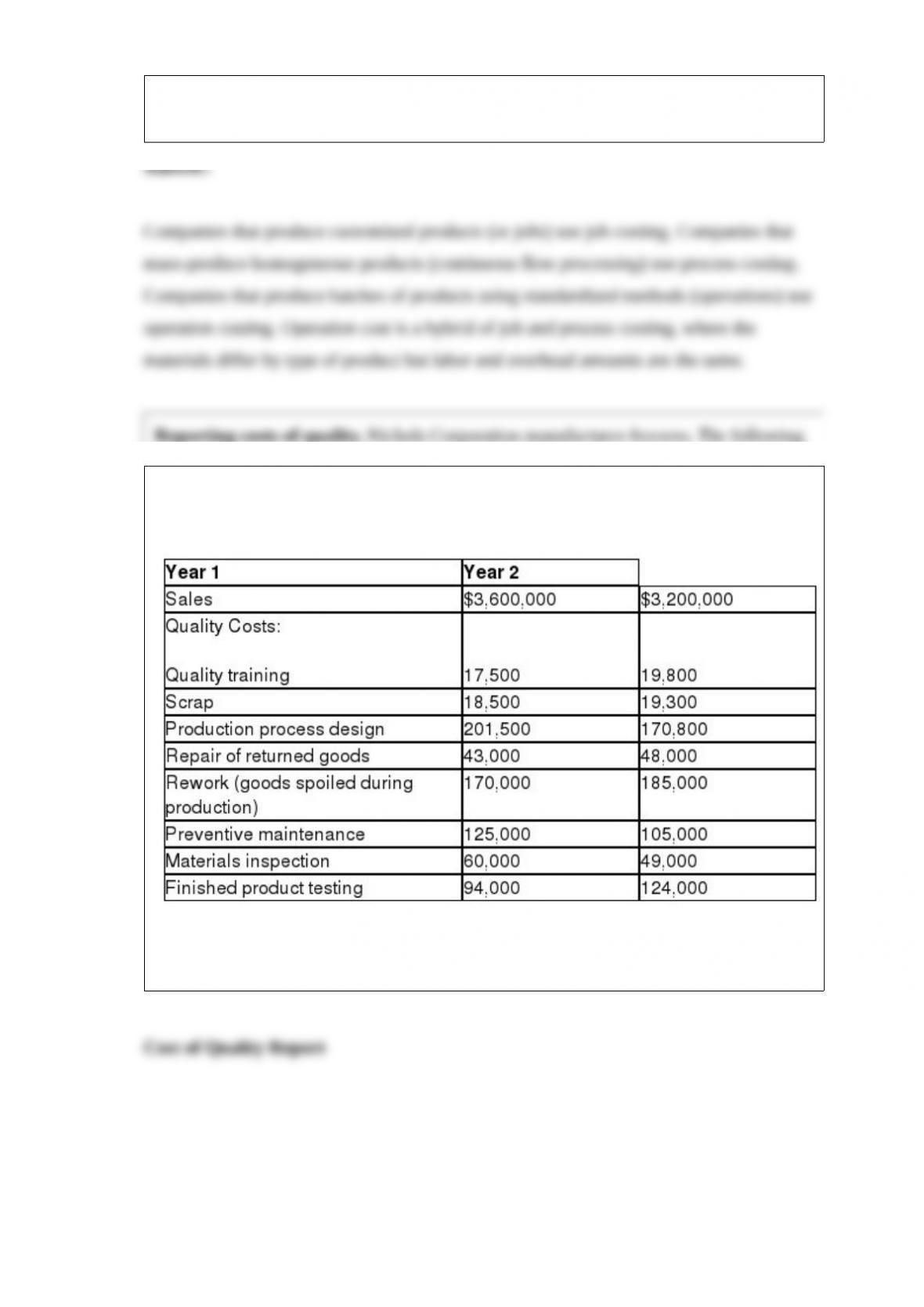
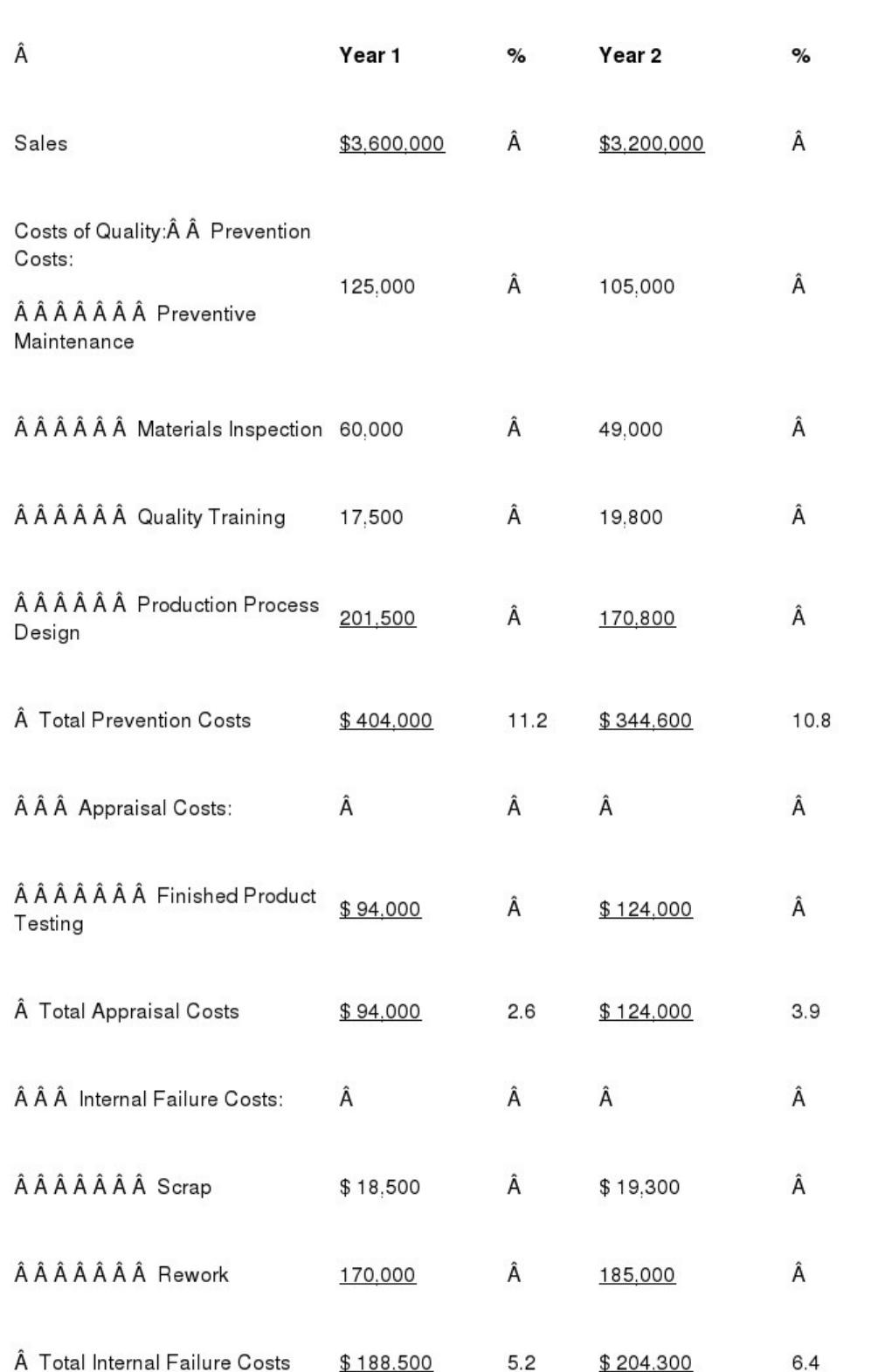
Reporting costs of quality. Nichols Corporation manufactures freezers. The following
table presents financial information for two years.
Required:
Using the data, prepare a cost of quality report for Year 1 and Year 2.
How do you apply activity-based costing to variance analysis?
How do incentive plans affect the development phase of the product life cycle?
Why are joint-process costs allocated?
Describe the master budget.
Identify the key financial players in the organization.
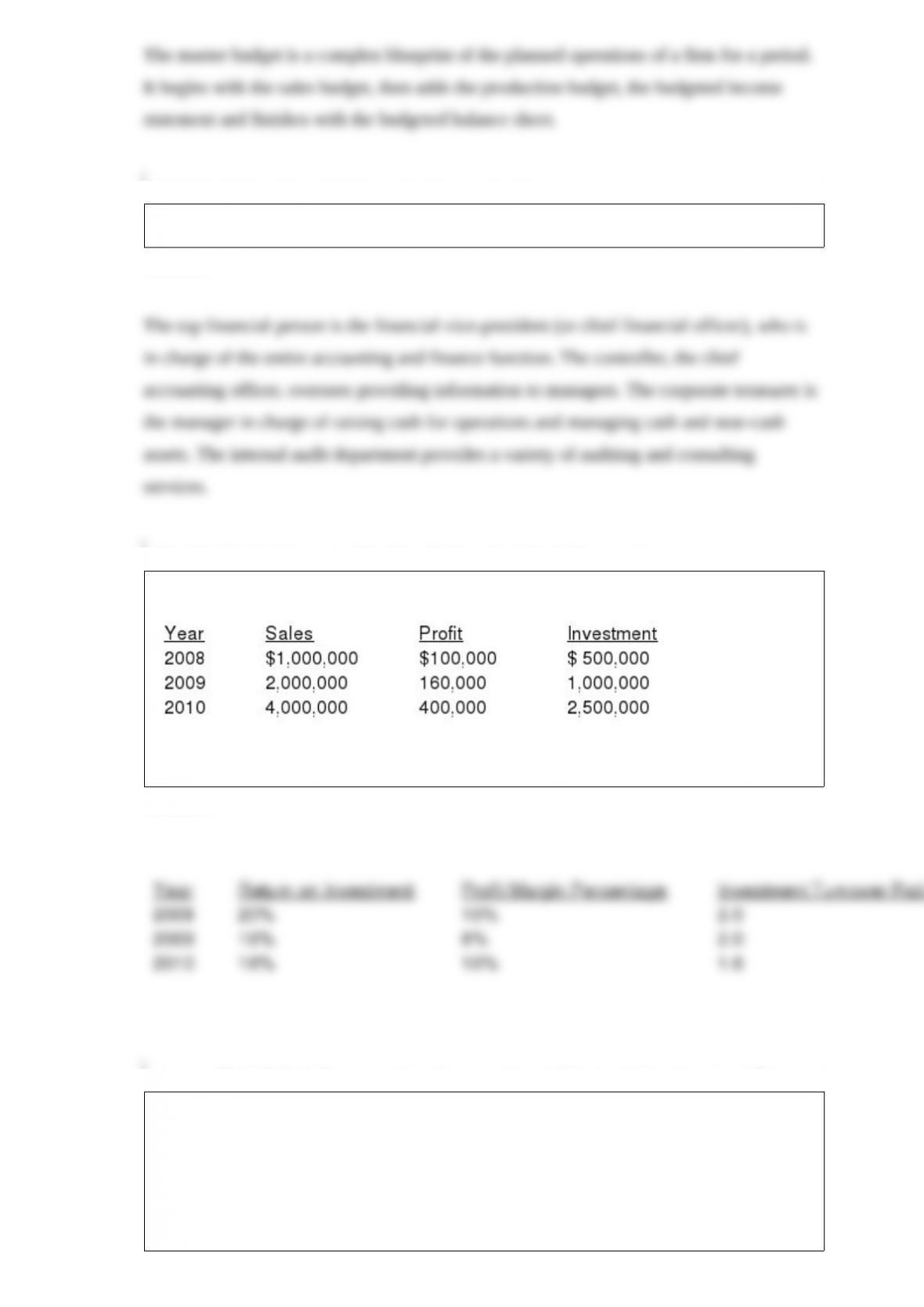
The Worldwide Computer Retailing Division had the following data:
What is the return on investment (ROI), profit margin percentage, and investment
turnover ratio for Years 2008, 2009, and 2010?
Assume Fruit Delight Beverages has discovered a problem involving the mix of flavor
to their seltzer water that costs the company $4,000 in waste and $2,800 in lost business
per period. There are two alternative solutions. The first is to lease a new mix regulator
at a cost of $4,000 per period. The new regulator would save Fruit Delight Beverages
$2,000 in waste and $2,000 in lost business each period. The second alternative is to
hire an additional employee to manually monitor the existing regulator at a cost of
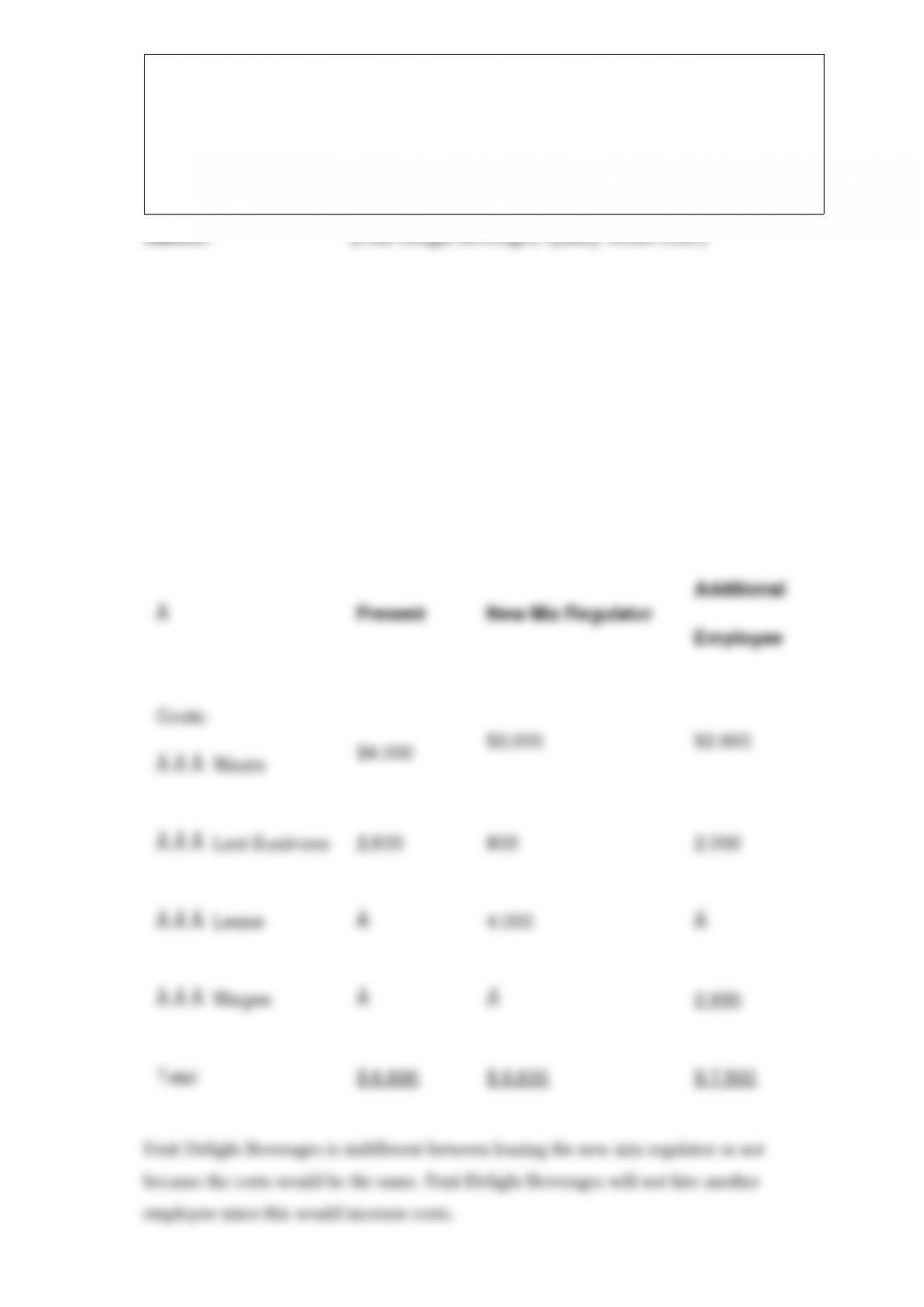
$2,900 per period. This would save Fruit Delight Beverages $1,400 in waste and $800
in lost business per period.
Required:
Which alternative should Fruit Delight Beverages choose?