
To ensure that goods and services acquired are for authorized company purposes, and
help acquire only needed items
A) receiving reports should be independently signed and reconciled to the purchase
order.
B) proper authorization for acquisitions and changes to the master file should take
place.
C) purchase requisitions should be approved and matched to purchase orders.
D) account allocations of vendor invoices should be carefully checked.
Confirmation of individual accounts receivable balances directly with debtors will, of
itself, normally provide evidence concerning the
A) collectability of the balances confirmed.
B) ownership of the balances confirmed.
C) existence of the balances confirmed.
D) internal control over balances confirmed.
In the audit of a corporate tax return, the report provided by the Canada Revenue
Agency auditor would describe

A) an opinion on the likelihood of tax return error.
B) the likely accounting errors that could contribute to tax errors.
C) management issues with respect to accurately reporting taxes.
D) corporate income tax overages or income tax under payments.
Audit evidence is generally considered sufficient when
A) it is appropriate.
B) there is enough of it to afford a reasonable basis for an opinion on financial
statements.
C) it has the qualities of being relevant, objective, and free from known bias.
D) it has been obtained by random selection.
During the audit of the fixed asset section, the auditor decided to inspect source
documents supporting all fixed asset additions exceeding $3,000. This type of audit
procedure is called a
A) census of the strata over $3,000
B) analytical review

C) attribute sample
D) monetary unit sample
What is the auditor’s role in the detection of computer fraud?
A) use computer assisted audit techniques to make sure that the computer programs do
not have any unauthorized processing
B) use test data to make sure that the computer programs are functioning as described
by the client
C) investigate unusual relationships or patterns, conduct the audit properly, and report
to management
D) only detect fraud if it has been ongoing for a long period of time and leaves many
different types of evidence
The auditor verifies the summarizing, accuracy, and posting of entries by performing
A) analytical procedures.
B) tests of controls.
C) dual-purpose tests.
D) procedures to gain an understanding of internal control.

PA has designed an audit approach where she places maximum possible reliance on
controls. This means that she will be
A) conducting only tests of controls.
B) using analytical review and tests of controls.
C) following a combined audit approach.
D) setting control risk at 100%.
Why does a self-review threat pose a problem when conducting an audit engagement?
A) The audit can be conducted more efficiently.
B) You are auditing your own work, and may not detect inadequacies.
C) The audit is more expensive, as you have to provide clear documentation.
D) The auditor may not have the expertise to complete the special work.

When comparing the auditor’s responsibility for detecting employee fraud and for
detecting errors, the profession has placed the responsibility
A) more on discovering errors than employee fraud.
B) more on discovering employee fraud than errors.
C) equally on discovering either one.
D) on the senior auditor for detecting errors and on the manager for detecting employee
fraud.
Because control risk and inherent risk vary from cycle to cycle, account to account, or
objective to objective,
A) audit risk must also change.
B) planned detection risk and required audit evidence will also vary.
C) planned detection risk will vary but audit evidence will remain constant.
D) planned detection risk will remain constant but audit evidence will vary.
An example of an audit procedure that relates to the auditor’s understanding of internal
control is

A) reperform the counting of physical inventory.
B) inspect documents and records.
C) recalculate the depreciation expenses.
D) trace all legal expenses to supporting invoices.
A) Discuss three important differences between the human resources and payroll cycle
and other cycles in a typical audit.
B) Describe each of the six business functions in a typical human resources and payroll
cycle.
C) Describe each of the primary documents and records used in the timekeeping and
payroll preparationfunction in the payroll and personnel cycle.
D) Discuss each of the primary documents and records used in the (1) payment of
payroll function, and (2) preparation of employee withholdings and benefits remittance
forms function in the payroll and personnel cycle.
Proper authorization for the issuance of notes payable requires that
A) whenever notes are renewed (refinanced), they should be subject to the same
authorization procedures as those used when they were first issued.
B) responsibility for authorizing notes should lie with the manager who will receive the
benefits of the loan.
C) responsibility for authorization should lie with the treasurer’s function, since the
treasurer’s department will receive the cash generated.
D) responsibility for authorization should lie with the manager who must generate the

revenue to repay the loan.
Comparing expenses to prior years is an effective analytical procedure for accounts
payable because expenses from year to year are
A) relatively stable.
B) erratic.
C) variable.
D) dynamic.
A) What are the different business organization structures that an accountant may use?
What are the advantages of these structures?
B) What is the difference between auditors and lawyers with respect to privileged
information?
The essence of an effectively controlled organization lies in the
A) effectiveness of its auditor.
B) effectiveness of its internal auditor.
C) attitude of its employees.
D) attitude of its management.

Frank has discovered that his employer is part of a group of banks that is manipulating
interest rates. He would like to stop this practice at his employer, and is not sure how
best to talk to his boss. He has heard of the GVV (Giving Voice to Values) approach,
and thinks he may be able to use it successfully because his company has recently
implemented new initiatives to empower employees to speak of improvements to
business practices. The first step of the GVV approach includes
A) identifying the stakeholders, what is at stake for them, and how to connect with
them.
B) identifying the values underpinning the different positions in the conflict and the
possibilities for action.
C) considering Frank’s personal and professional purpose and choices in this situation.
D) development and practice of a powerful response that Frank can use with his boss.
It is important for the public accountant to consider the competence of the audit clients’
employees because their competence bears directly and importantly upon the
A) cost/benefit relationship of internal controls.
B) achievement of the objectives of the system of internal control.
C) comparison of recorded accountability with assets.
D) timing of the tests to be performed.

When the auditor issues an erroneous opinion as the result of an underlying failure to
comply with the requirements of generally accepted auditing standards, it results in
A) business failure.
B) audit failure.
C) audit risk.
D) business risk.
Formamould Inc. sells plastic moulds to a variety of companies. Some moulds are
custom made and cost thousands of dollars. To help customers finance these purchases,
Formamould uses a variety of methods, such as payment terms stretched over three
years, delayed payment, and pay-as-you-produce models tailored to the individual
customer’s needs. The outstanding balance is included in current accounts receivable.
The general balance-related audit objective affected by this activity is
A) completeness.
B) accuracy.
C) allocation to accounts.
D) existence.
The existence of advanced automated systems affects the audit process. Which of the

following characteristics is an indicator of the presence of an advanced automated
information system?
A) custom-designed operational or strategic information systems
B) use of packaged software to process sales both locally and across Canada
C) use of customer relationship management systems to manage sales information
D) numerically-controlled equipment used in the manufacturing process
Big Bank requires, as part of its loan agreement, that only accounts receivable less than
60 days old be used as collateral. An auditor has been engaged to provide assurance that
the accounts receivable on the list provided to the bank are indeed less than 60 days old.
What type of engagement is the auditor conducting?
A) financial statement
B) compliance
C) operational
D) review
When the auditor has the same level of willingness to risk that material errors will exist
after the audit is finished for all five cycles,

A) the same amount of evidence will be gathered for each cycle.
B) a different extent of evidence is needed for various cycles.
C) he/she has not followed generally accepted auditing standards.
D) the level for each cycle must be no more than 2% so that the entire audit does not
exceed 10%.
The information systems audit specialist on your audit team has indicated that the
general controls over program changes are excellent for all application cycles. What
impact does this have upon your audit of sales invoice processing?
A) Generalized audit software should be used to select a sample of sales transactions
for control testing.
B) Tests of controls should be omitted; only substantive tests may be conducted.
C) There could be problems with the accuracy of calculations for sales taxes and goods
and excise taxes.
D) The auditor can place reliance upon the programs performing sales calculations.
The most important balance-related and presentation and disclosure-related audit
objectives for notes payable are
A) accuracy, existence, completeness.

B) existence, completeness, valuation.
C) accuracy, completeness, understandability.
D) accuracy, completeness, valuation.
The acceptable risk of incorrect acceptance (ARIA) has a significant effect on sample
size. The relationship of ARIA to sample size is
A) direct (larger ARIA = larger sample).
B) inverse (larger ARIA = smaller sample).
C) variable (sometimes larger, sometimes smaller).
D) not determinable.
Which of the following is a substantive test of transactions?
A) Review personnel policies
B) Account for a sequence of payroll cheques
C) Reconcile the disbursements in the payroll journal with the disbursements on the
payroll bank statement

D) Examine printouts of transactions rejected by the computer as having invalid
employee numbers
The tests of details of balances procedure for manufacturing equipment which requires
the auditor to examine vendors’ invoices of closely related accounts such as repairs and
maintenance to uncover items that should be manufacturing equipment would satisfy
the audit objective of
A) detail tie-in.
B) existence.
C) classification.
D) accuracy.
When the client’s internal control structure is adequate, the cutoff can usually be
verified by
A) the client’s representation letter.
B) inquiries of the controller.
C) obtaining the last shipping document number of the year and comparing it with
current and subsequent period recorded sales.
D) confirmation of the receivable for the last recorded sale.

Office Design Inc. (ODI) has been your audit client for five years. ODI designs and
sells office furniture, such as desks, cabinets, and couches used in reception areas. ODI
has sales in Canada and the U.S., with five distribution locations, where furniture is
available to prospective purchasers to try out before purchasing. These locations are in
Toronto, Montreal, Halifax, New York and Chicago. The company uses custom
designed software for its order processing and sales, kept current by one of the five
information systems personnel.
The Vice President Finance is new. Executive management is paid based upon a salary
and a bonus based upon the annual net income of ODI. Unfortunately, the accounting
staff at head office (Montreal) has been downsized from ten people to six due to a
recent slowdown in sales. Your review of the aged accounts receivable trial balance
revealed that one third of the accounts have been outstanding for more than one year.
ODI’s profits have declined substantially from last year. The line of credit and bank
loans are at their maximum, and the company is considering selling its U.S. operations
to provide cash flow.
Prior year working papers revealed few errors and that you considered management
integrity to be good. However, due to segregation issues, you did not rely on the
internal controls in the prior year.
Required:
A) What issues in corporate governance and in the control environment affect your
assessment of internal controls for revenue? How does this affect the decision to
conduct substantive testing (i.e. exclusion of tests of controls)?
B) What is the likely assessment of computer general controls? How does this affect the
type of audit testing conducted at ODI?
The first step in applying materiality is
A) estimating the misstatement in a segment, for each functional cycle.
B) setting a judgment about materiality for the financial statements as a whole.
C) estimating the combined effects of errors.
D) comparing the error estimate with the materiality levels.
A) There are seven types of audit evidence: inspection, observation, inquiries of the
client, external confirmation, recalculation, reperformance, analytical procedures. For
each of the following types of audit tests, indicate the type(s) of evidence that can be
obtained through the test: (1) tests of controls, (2) analytical procedures, and (3) tests of
details of balances.
B) Contrast the circumstances in which the auditor would choose not to test controls
with those in which he or she would perform tests of controls.
C) Types of audit tests include tests of controls, analytical procedures, and tests of
details of balances. Please rank the preceding three types of tests from least costly to
most costly.

Carrie is the manager of the Bay Street Pharmacy. Carrie is considering implementing a
security tag system to reduce the losses related to stolen goods at their store. The system
Carrie is looking at currently costs $60,000 and is expected to be effective for 5 years.
In order to justify the implementation of the security tag system, average theft per year
should be at least
A) $1,000.
B) $12,000.
C) $60,000.
D) theft should be prevented at all costs.
Which of the following types of evidence is most appropriate in the audit of fixed
assets?
A) recalculation of the amortization schedule provided by the client
B) auditor inspection of recently acquired fixed assets
C) reperformance of the posting of depreciation expenses to the general ledger
D) analytical review to assess the reasonableness of depreciation expense
State the five specific balance-related audit objectives as applied to accounts receivable.
Discuss three factors that affect client business risk, and therefore audit risk.
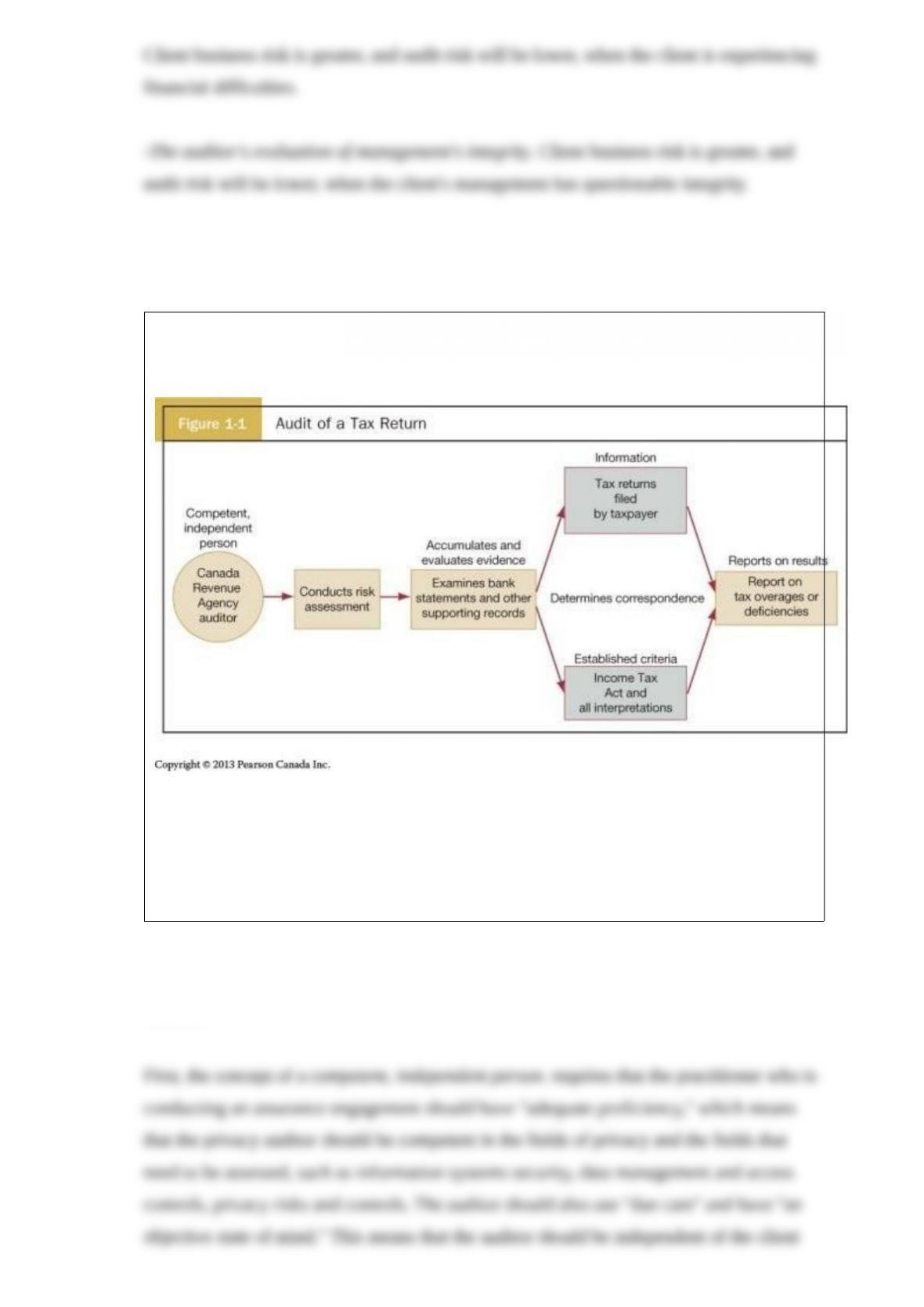
[Note: If this question is used as part of an examination question, Figure 1-1. Audit of a
Tax Return will need to be included as part of the examination.]
Use your knowledge of the definition of auditing and Figure 1-1. Audit of a Tax Return,
to explain how an auditor would conduct a privacy audit.

GreenGrow Limited is a local landscaping company that does household and
commercial landscaping. Primarily, it helps businesses select plants and manage the
plants. It also has regular maintenance contracts such as watering, weeding, and
mowing. In the winter, it has some contracts for managing the indoor plants of shopping
malls, and does snow clearing to help boost that low income season.
Joey, the majority shareholder of GreenGrow is ecstatic. He has managed to come in as
the low bidder for a new type of contract. He bid on the construction of a track for the
track and field area of a local university. A piece of land on the north end of the
university is being cleared and GreenGrow will be leveling the land and placing a bed
of crushed stone for the track. Joey has just the right person to be in charge. Jack has
previous experience working as an assistant on a road crew and knows how to use the
surveying equipment needed to keep the track level. This is a big contract, and will
increase revenues by one third!
Required:
Assess inherent risk for revenue for GreenGrow Limited.

Always Quick Manufacturing Limited is a small business that manufactures metal and
plastic components for a variety of industries. The bulk of the business is in the
computing industry, although the occasional contract is for the automotive industry.
Jose, the owner, would like to expand the business so that he can bid on larger
contracts. This requires an investment of about $500,000 to finance capital assets and
about $300,000 for a working capital loan. Jose has financed the business himself to
this point, and has been given some alternatives by the bank.
The alternatives pertain to which assets are used as guarantees, and whether Jose also
guarantees the loans personally (as he has substantial personal assets). The bank also
stated that if Jose personally guarantees the loan, the company will only require a
review engagement, whereas if the loan is only secured by corporate assets, then an
audit of the company will be required.
Jose understands the differences among the guarantees, but is not sure about the
difference between a review and audit engagement. Presently, the company financial
statements are prepared using a compilation engagement.
Required:
Explain to Jose the difference between a review and audit engagement in the context of
his present compilation engagement.
Pet Shop Ltd. is a large retail outlet with ten full time employees in addition to the
owner. You dropped by on your way home one day to organize the audit planning
process for the coming year, and noticed brand new terminals at the cashier’s desk. One
of the employees was having fun zapping inventory items. The owner teased him about
the new laser scanning devices and told him to get to work to see which items needed to
be ordered. It turns out that Pet Shop Ltd. has implemented a new point of sale
computer system that is integrated with inventory. The last time you were there to buy
dog food (about three months ago) there were old computer terminals that were no
longer functional and recorded sales transactions manually in the sales journal.
Required:
List the three sections of the audit. For each section, explain how these new computer
systems might affect the audit process.
Analyze the “Auditor Responsibility Section” of the standard Independent Auditor’s
Report, ie. explain the intended purpose of the sentences in this section.
There are six factors that affect the reliability of audit evidence. One factor is the
independence of the provider; i.e., evidence obtained from a source outside the client
company is more reliable than that obtained within. Identify and discuss the remaining
five factors that affect the appropriateness of evidence.
Discuss how materiality affects audit reporting decisions.
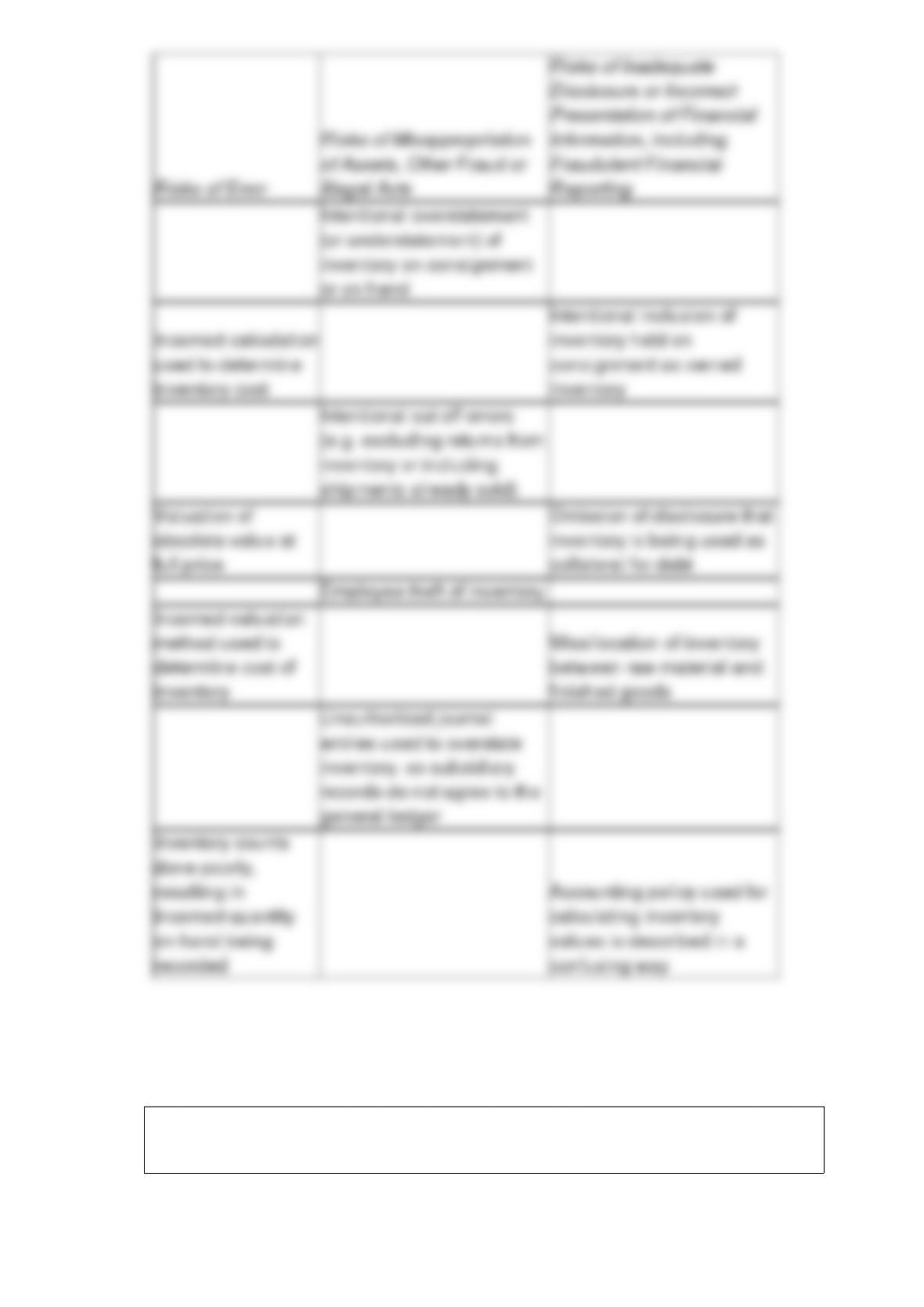
Describe the major risks of error or fraud in the inventory and distribution cycle, using
the headings of (i) risks of error, (ii) risks of misappropriation of assets, other fraud or
illegal acts, and (iii) risks of inadequate disclosure or incorrect presentation of financial
information, including fraudulent financial reporting.
State the four audit concerns for capital stock and describe how the auditor typically
verifies each of these areas.