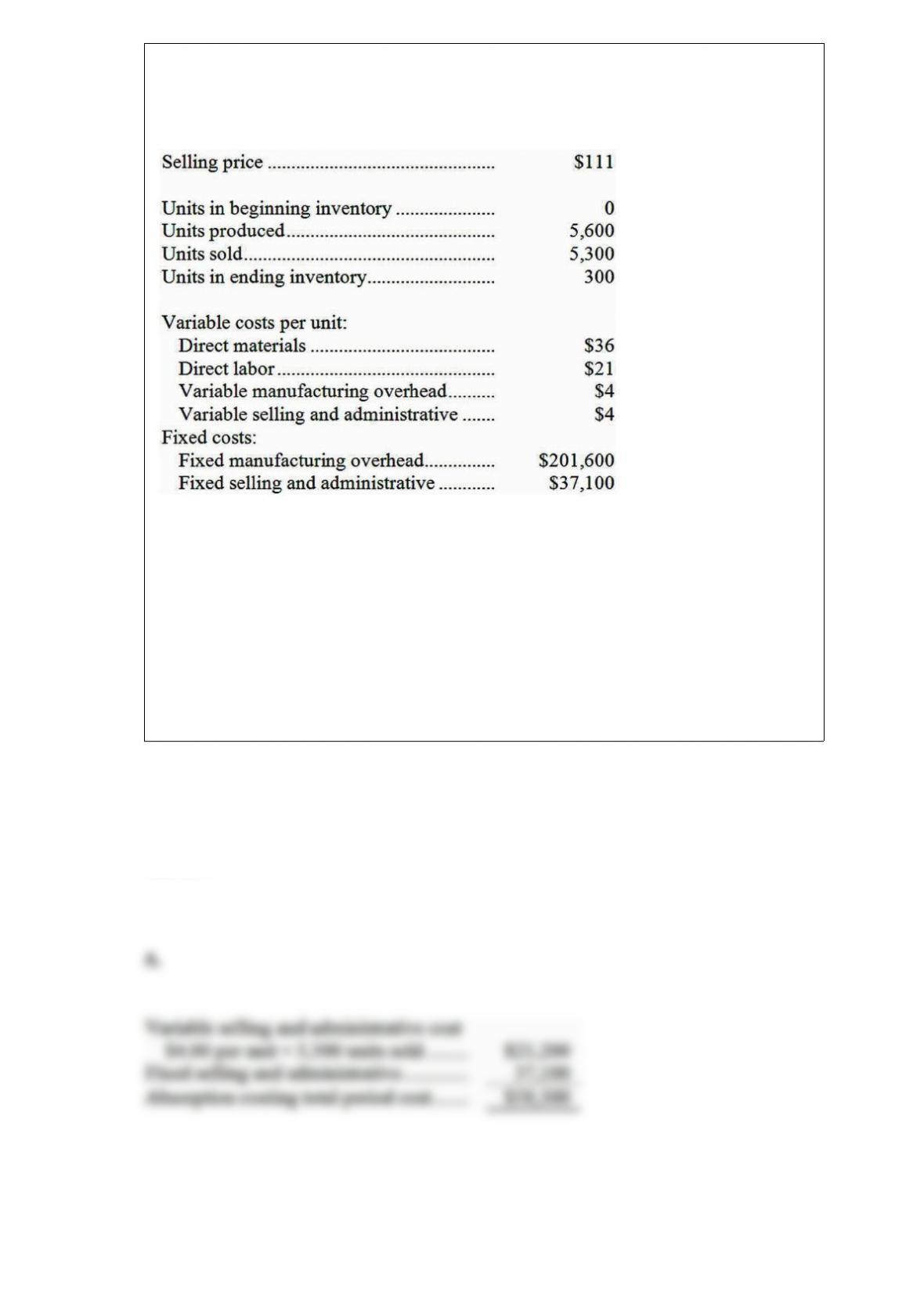
A manufacturing company that produces a single product has provided the following
data concerning its most recent month of operations:
What is the total period cost for the month under absorption costing?
A. $58,300
B. $37,100
C. $259,900
D. $201,600
Answer:
Nyman Company successfully switched to a lean production system at the beginning of
March. Therefore, as shown by the summary below, there were no work in process
inventories on hand at the end of the month.
If Nyman continues to successfully employ lean production and starts 140,000 units
into production during April (the next month), the April equivalent units for conversion
costs using the weighted-average method would be:
A. 150,000 units
B. 140,000 units
C. 190,000 units
D. 160,000 units
Answer:
Excerpts from Zorra Corporation’s most recent balance sheet appear below:
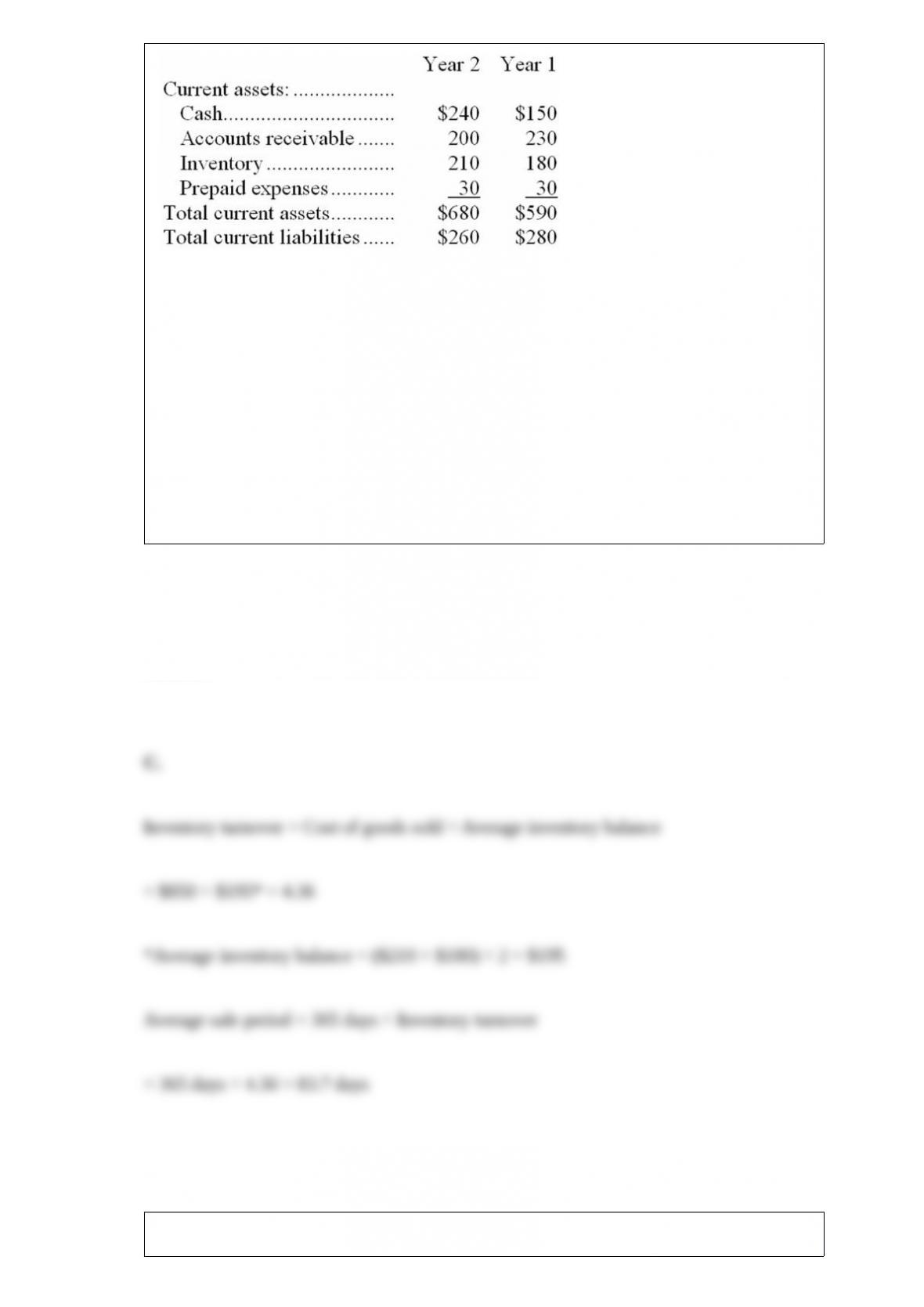
Sales on account in Year 2 amounted to $1,370 and the cost of goods sold was $850.
The average sale period for Year 2 is closest to:
A. 55.9 days
B. 90.1 days
C. 83.7 days
D. 226.5 days
Answer:
On April 1, Bogdon Corporation had $30,000 of raw materials on hand. During the
month, the company purchased an additional $63,000 of raw materials. During April,
$76,000 of raw materials were requisitioned from the storeroom for use in production.
These raw materials included both direct and indirect materials. The indirect materials
totaled $2,000.
The journal entry to record the requisition from the storeroom would include a:
A. debit to Raw Materials of $76,000
B. debit to Work in Process of $76,000
C. credit to Manufacturing Overhead of $2,000
D. debit to Work in Process of $74,000
Answer:
Hartzog Corporation’s most recent balance sheet and income statement appear below:
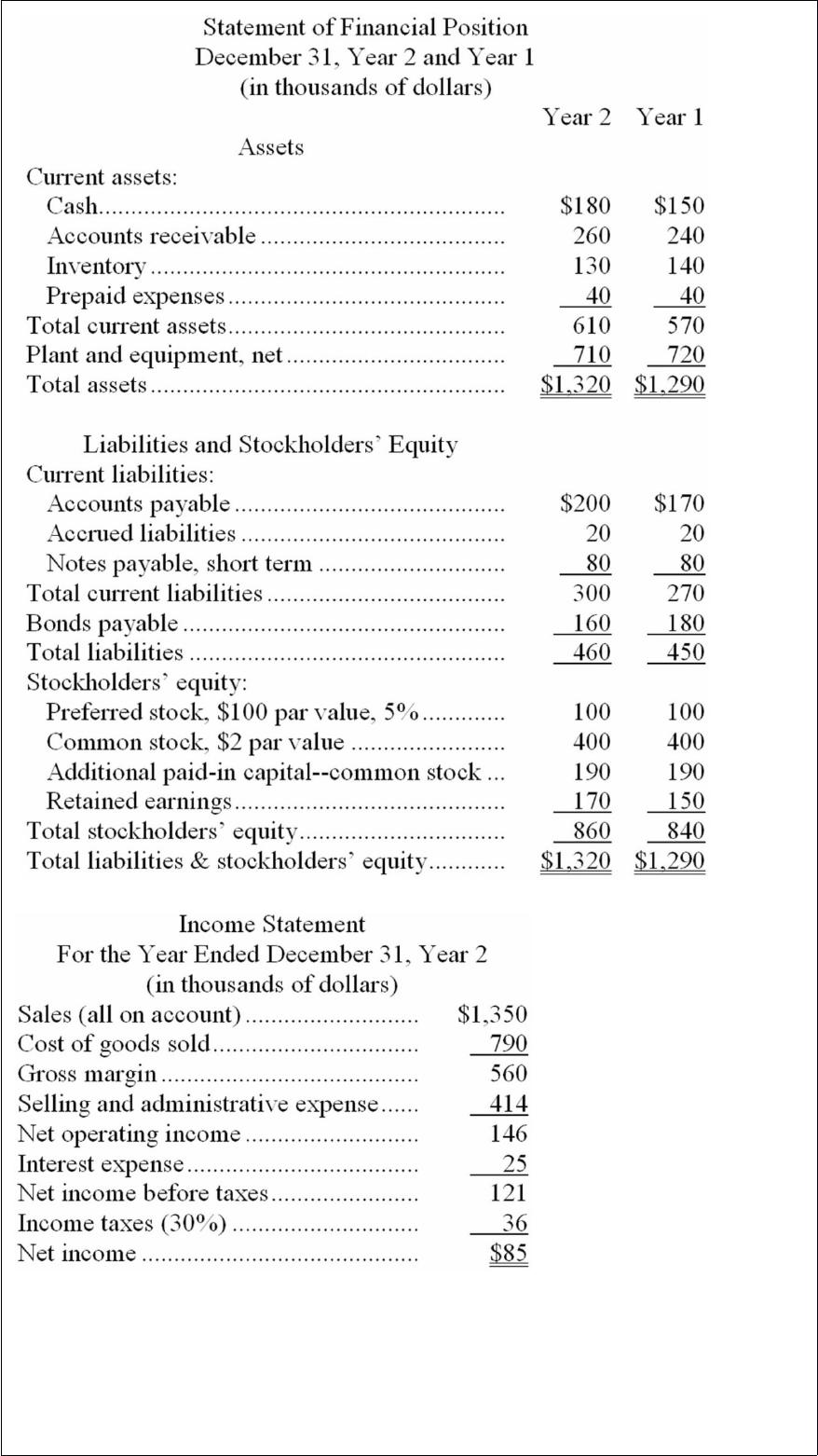
Dividends on common stock during Year 2 totaled $60 thousand. Dividends on
preferred stock totaled $5 thousand. The market price of common stock at the end of
Year 2 was $7.04 per share.
The acid-test ratio at the end of Year 2 is closest to:
A. 2.03
B. 1.47
C. 1.60
D. 1.33
Answer:
Morvan Corporation uses the FIFO method in its process costing system. Data
concerning the first processing department for the most recent month are listed below:
Note: Your answers may differ from those offered below due to rounding error. In all
cases, select the answer that is the closest to the answer you computed.
The cost of a completed unit transferred out of the department is closest to:
A. $74.51
B. $68.27
C. $74.02
D. $70.29
Answer:
Reference: 8-55
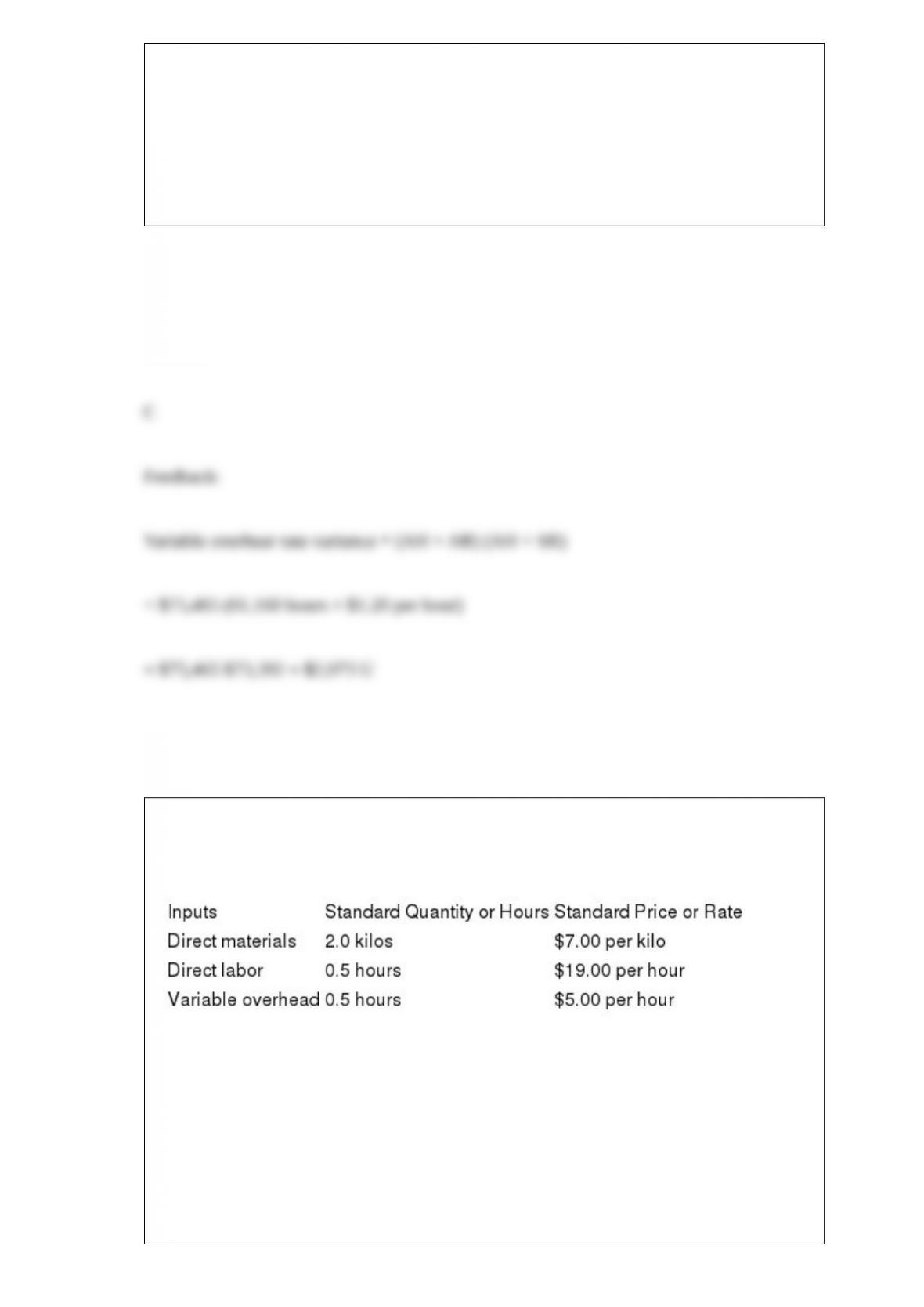
The following data have been provided by Pollo Corporation:
Lubricants and supplies are both elements of variable manufacturing overhead.
The variable overhead rate variance for supplies is closest to:
A) $2,757 U
B) $2,757 F
C) $2,073 U
D) $684 U
Answer:
Reference: 8-36
Landram Corporation makes a product with the following standard costs:
In March the company produced 4,700 units using 10,230 kilos of the direct material
and 2,210 direct labor-hours. During the month, the company purchased 10,800 kilos of
the direct material at a cost of $76,680. The actual direct labor cost was $38,233 and the
actual variable overhead cost was $11,934.
The company applies variable overhead on the basis of direct labor-hours. The direct
materials purchases variance is computed when the materials are purchased.
The variable overhead rate variance for March is:
A) $884 U
B) $884 F
C) $940 U
D) $940 F
Answer:
The Labor Rate Variance for December would be recorded as a:
A) Credit of $9,086
B) Debit of $9,086
C) Credit of $8,428
D) Debit of $8,428
Answer:

Self-imposed budgets typically are:
A. not subject to review by higher levels of management since to do so would
contradict the participative aspect of the budgeting processing.
B. not subject to review by higher levels of management except in specific cases where
the input of higher management is required.
C. subject to review by higher levels of management in order to prevent the budgets
from becoming too loose.
D. not critical to the success of a budgeting program.
Answer:
Reference: 8-10
Caballes Clinic uses client-visits as its measure of activity. During November, the clinic
budgeted for 3,100 client-visits, but its actual level of activity was 3,070 client-visits.
The clinic has provided the following data concerning the formulas used in its
budgeting and its actual results for November:
Data used in budgeting:
Actual results for November:
The occupancy expenses in the flexible budget for November would be closest to:
A) $12,898
B) $13,090
C) $13,347
D) $12,940
Answer:
Jarvinen Company, which has only one product, has provided the following data
concerning its most recent month of operations:
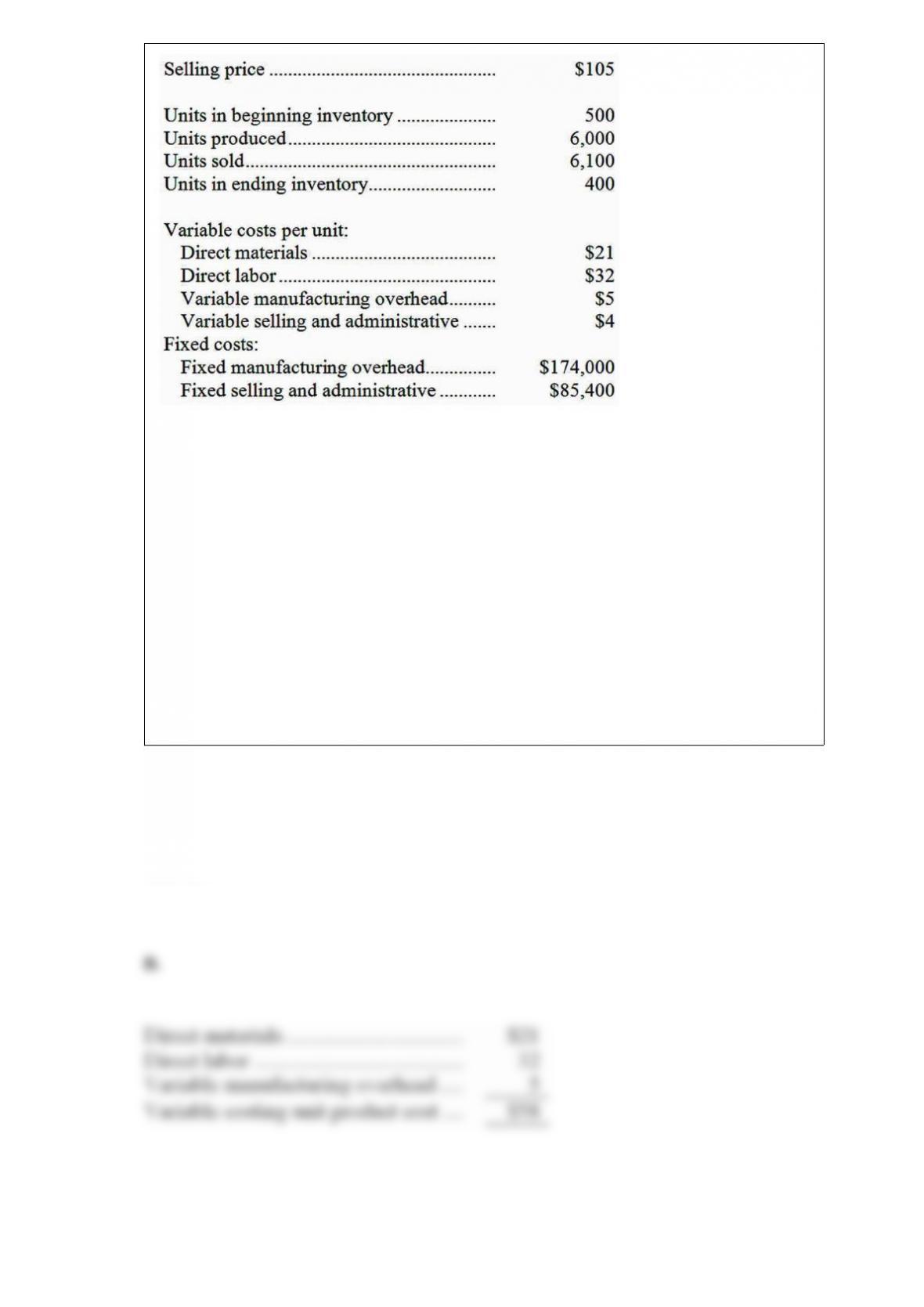
The company produces the same number of units every month, although the sales in
units vary from month to month. The company’s variable costs per unit and total fixed
costs have been constant from month to month.
What is the unit product cost for the month under variable costing?
A. $62
B. $58
C. $91
D. $87
Answer:
Which of the following represents the correct order in which the indicated budget
documents for a manufacturing company would be prepared?
A. Sales budget, cash budget, direct materials budget, direct labor budget
B. Production budget, sales budget, direct materials budget, direct labor budget
C. Sales budget, cash budget, production budget, direct materials budget
D. Selling and administrative expense budget, cash budget, budgeted income
statement, budgeted balance sheet
Answer:
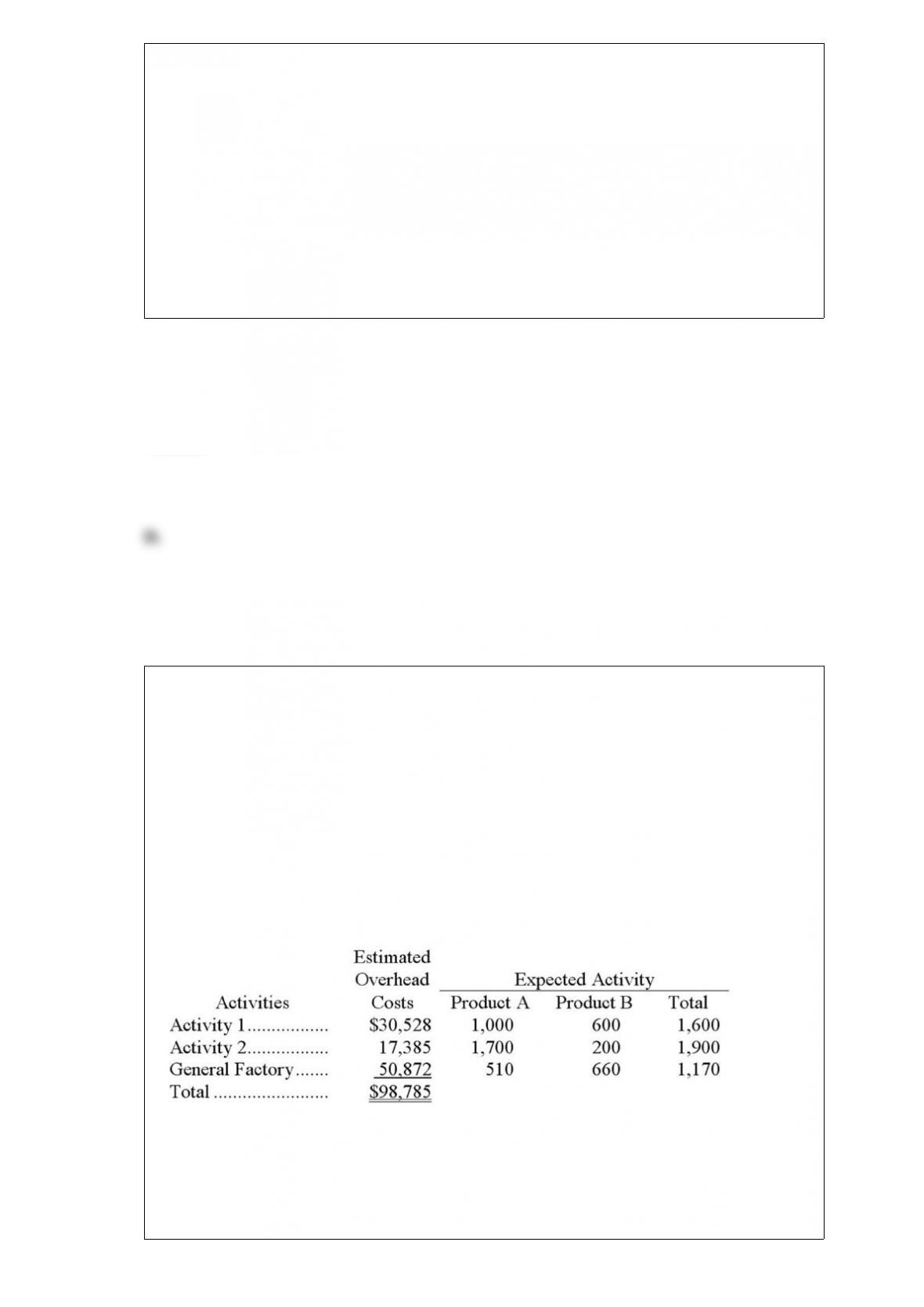
Addy Company has two products: A and B. The annual production and sales of Product
A is 1,700 units and of Product B is 1,100 units. The company has traditionally used
direct labor-hours as the basis for applying all manufacturing overhead to products.
Product A requires 0.3 direct labor-hours per unit and Product B requires 0.6 direct
labor-hours per unit. The total estimated overhead for next period is $98,785.
The company is considering switching to an activity-based costing system for the
purpose of computing unit product costs for external reports. The new activity-based
costing system would have three overhead activity cost pools–Activity 1, Activity 2,
and General Factory–with estimated overhead costs and expected activity as follows:
(Note: The General Factory activity cost pool’s costs are allocated on the basis of direct
labor-hours.)
The overhead cost per unit of Product B under the activity-based costing system is
closest to:
A. $50.66
B. $26.09
C. $35.28
D. $38.16
Answer:
Reference: 8-26
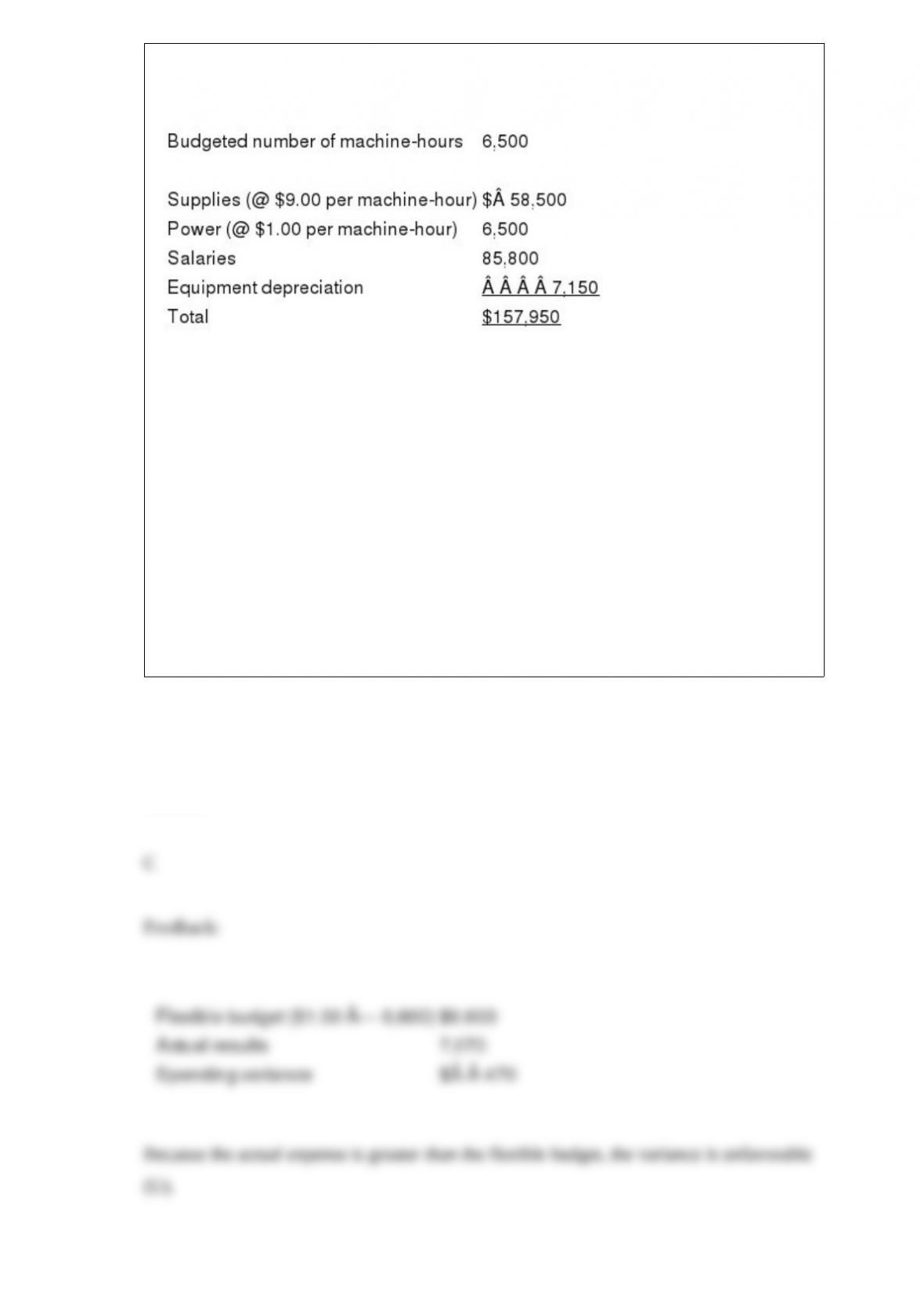
Wayland Corporations static planning budget for April appears below. The company
bases its budgets on machine-hours.
In April, the actual number of machine-hours was 6,600, the actual supplies cost was
$64,040, the actual power cost was $7,070, the actual salaries cost was $88,300, and the
actual equipment depreciation was $7,430.
The spending variance for power cost for the month should be:
A) $570 F
B) $470 F
C) $470 U
D) $570 U
Answer:
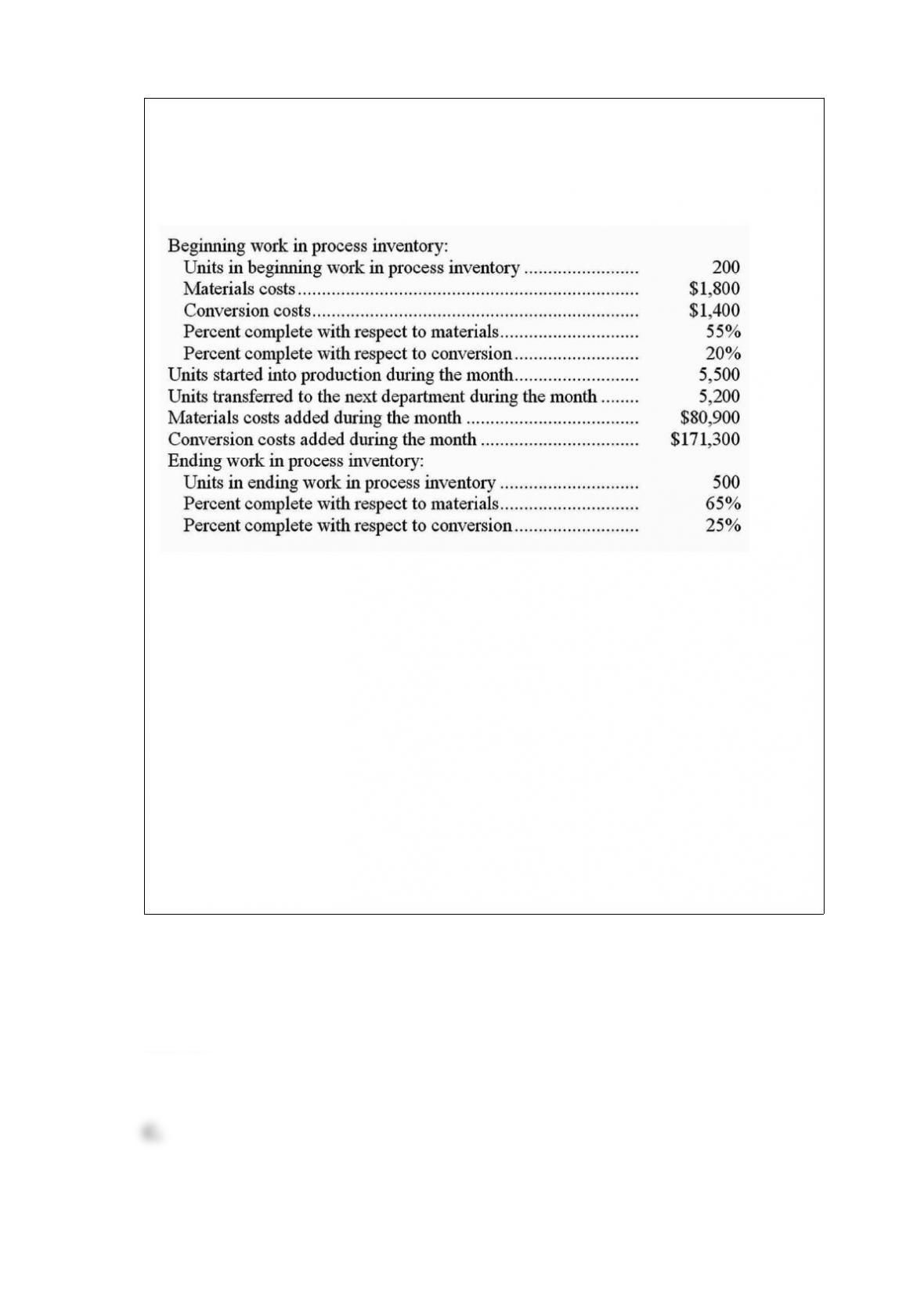
Lothian Corporation uses the weighted-average method in its process costing system.
Data concerning the first processing department for the most recent month are listed
below:
Note: Your answers may differ from those offered below due to rounding error. In all
cases, select the answer that is the closest to the answer you computed. To reduce
rounding error, carry out all computations to at least three decimal places.
What are the equivalent units for materials for the month in the first processing
department?
A. 5,200
B. 325
C. 5,525
D. 5,700
Answer:
Product engineering is an example of a:
A. Unit-level activity.
B. Batch-level activity.
C. Product-level activity.
D. Facility-level activity.
Answer:
Diltex Farm Supply is located in a small town in the rural west. Data regarding the
store’s operations follow:
o Sales are budgeted at $220,000 for November, $200,000 for December, and $210,000
for January.
o Collections are expected to be 70% in the month of sale, 27% in the month following
the sale, and 3% uncollectible.
o The cost of goods sold is 65% of sales.
o The company desires to have an ending merchandise inventory at the end of each
month equal to 50% of the next month’s cost of goods sold. Payment for merchandise is
made in the month following the purchase.
o Other monthly expenses to be paid in cash are $22,500.
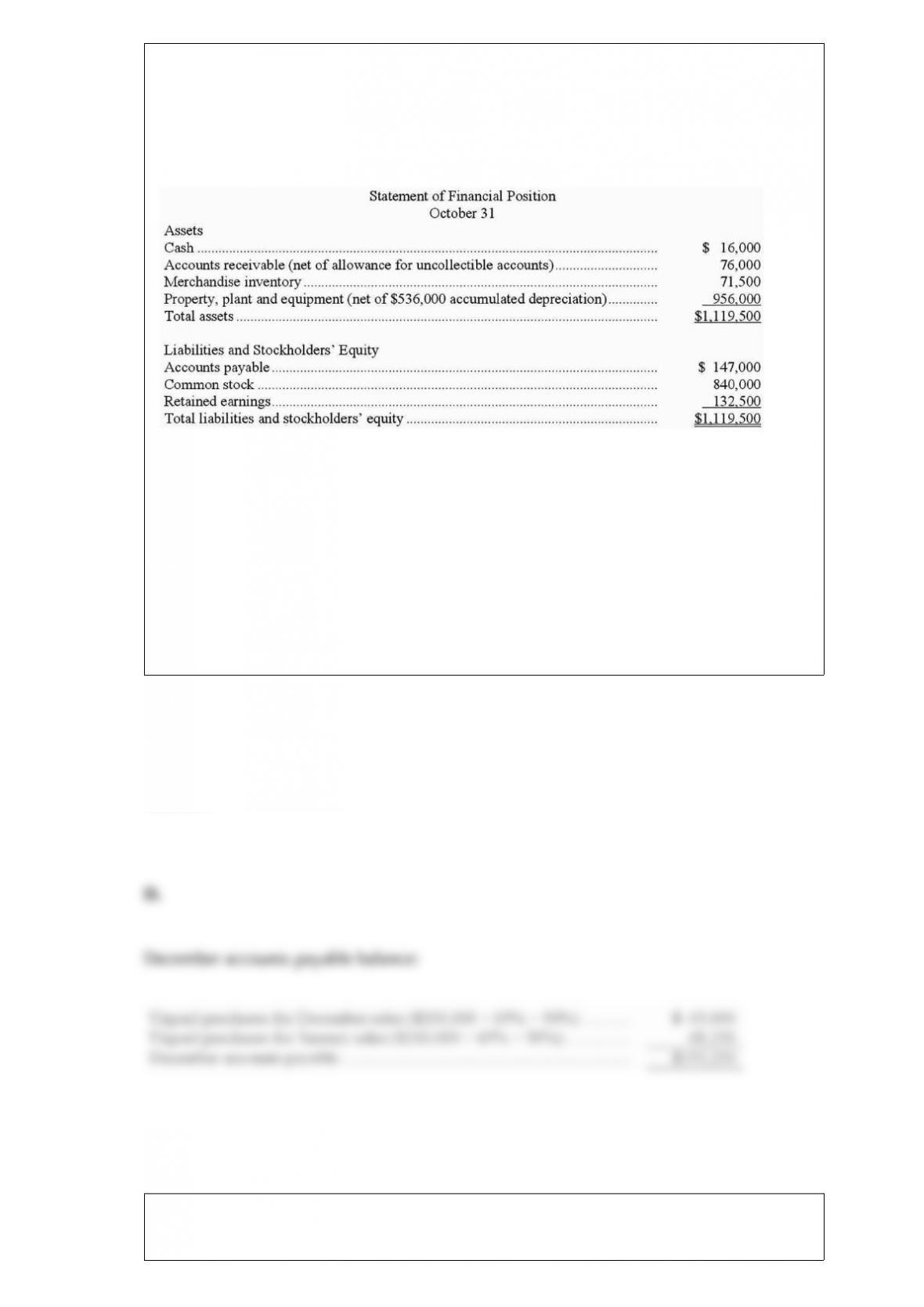
o Monthly depreciation is $19,000.
o Ignore taxes.
Accounts payable at the end of December would be:
A. $65,000
B. $68,250
C. $130,000
D. $133,250
Answer:
Data concerning Homme Corporation’s single product appear below:

The company is currently selling 2,000 units per month. Fixed expenses are $130,000
per month.
This question is to be considered independently of all other questions relating to
Homme Corporation. Refer to the original data when answering this question.
The marketing manager would like to cut the selling price by $18 and increase the
advertising budget by $8,000 per month. The marketing manager predicts that these two
changes would increase monthly sales by 700 units. What should be the overall effect
on the company’s monthly net operating income of this change?
A. decrease of $32,600
B. increase of $32,600
C. increase of $112,400
D. decrease of $3,400
Answer:
Reference: 8-10
Caballes Clinic uses client-visits as its measure of activity. During November, the clinic
budgeted for 3,100 client-visits, but its actual level of activity was 3,070 client-visits.
The clinic has provided the following data concerning the formulas used in its
budgeting and its actual results for November:
Data used in budgeting:
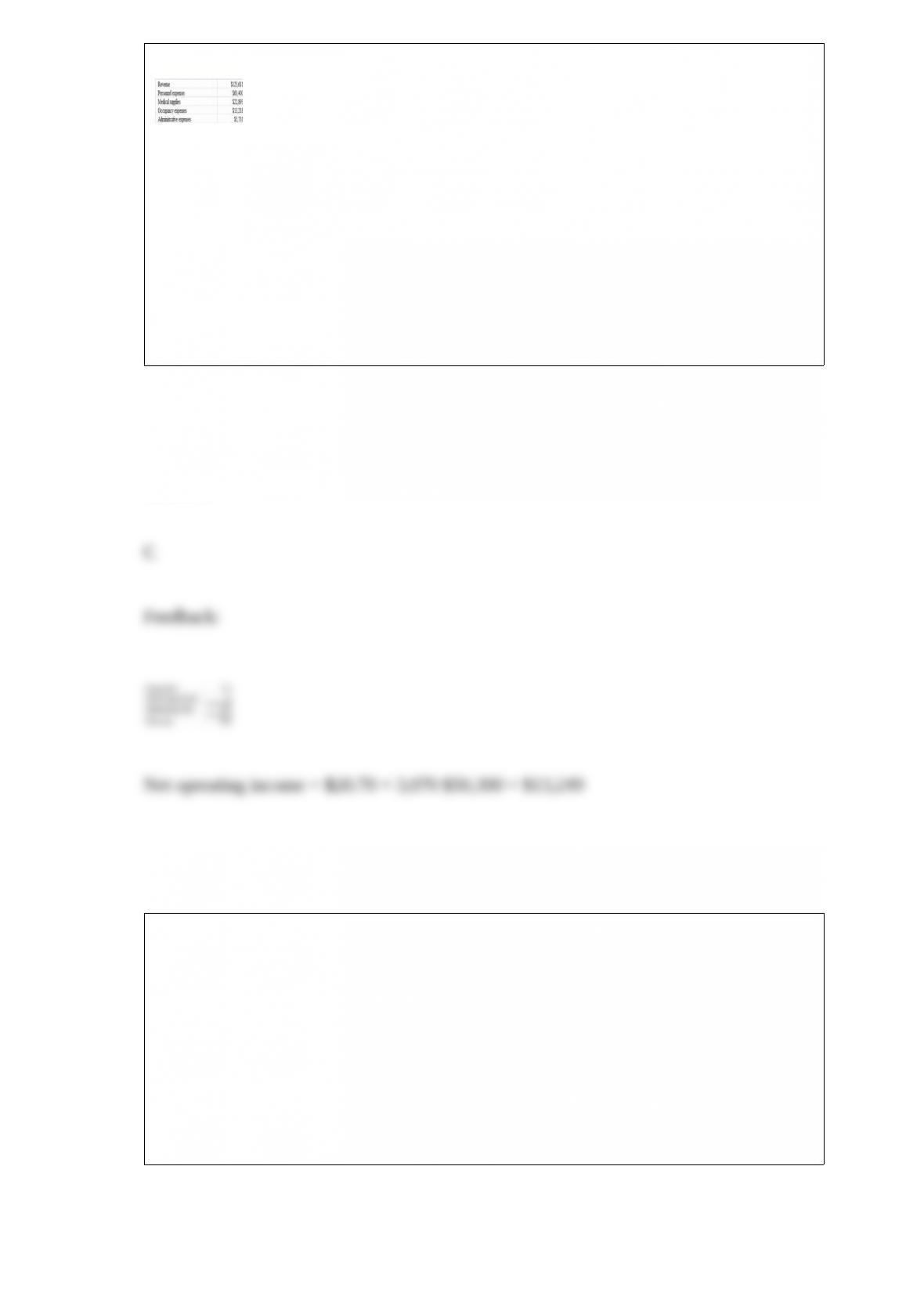
Actual results for November:
The net operating income in the flexible budget for November would be closest to:
A) $20,172
B) $13,870
C) $13,249
D) $20,568
Answer:
Kendall Company has sales of 1,000 units at $60 a unit. Variable expenses are 30% of
the selling price. If total fixed expenses are $30,000, the degree of operating leverage is:
A. 1.50
B. 5.00
C. 1.67
D. 3.50
Answer:
Denise Corporations standard wage rate is $14.40 per direct labor-hour (DLH) and
according to the standards, each unit of output requires 7.0 DLHs. In May, 5,200 units
were produced, the actual wage rate was $13.70 per DLH, and the actual hours were
36,520 DLHs. The Labor Efficiency Variance for May would be recorded as a:
A) credit of $1,644.
B) credit of $1,728.
C) debit of $1,728.
D) debit of $1,644.
Answer:
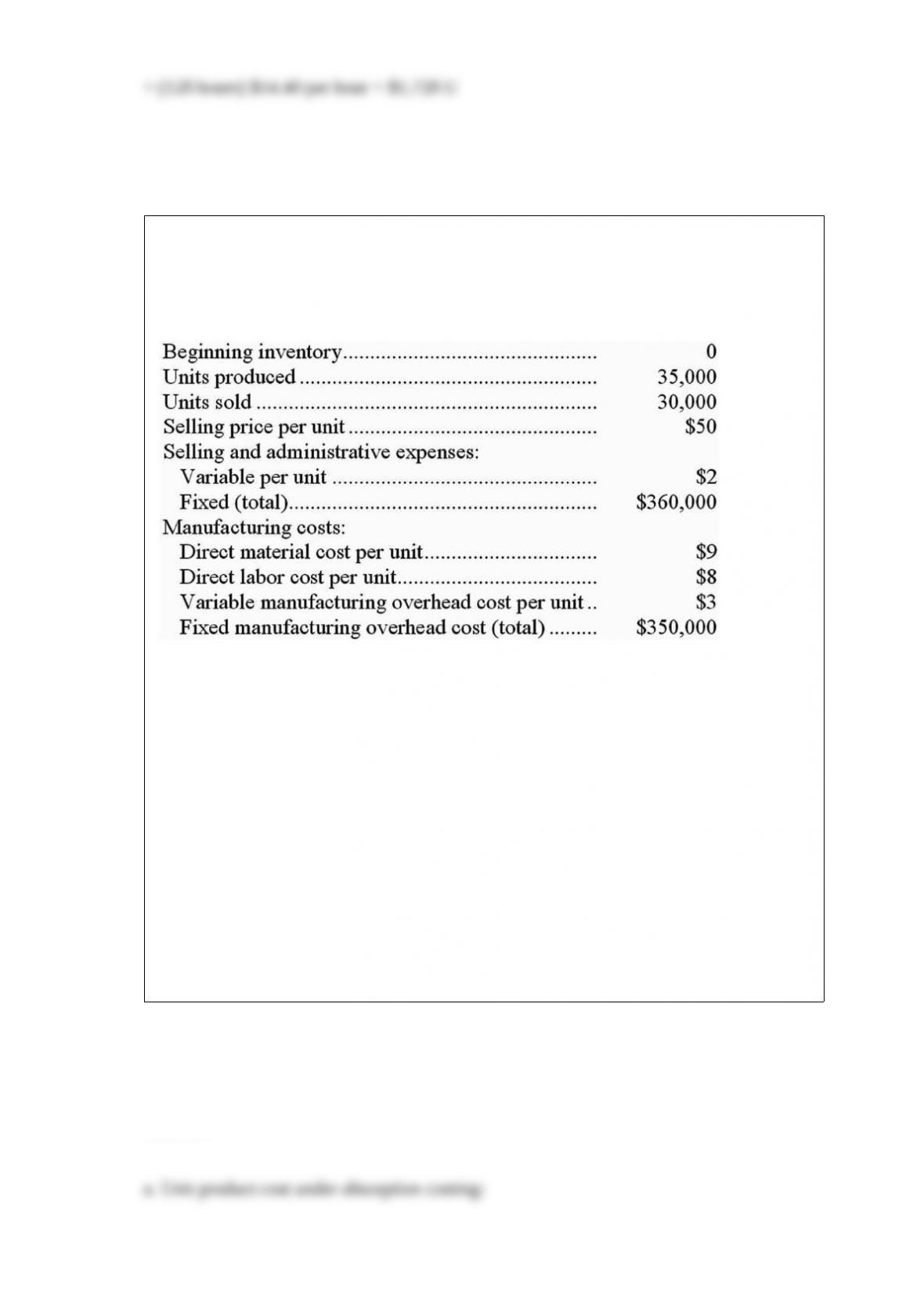
UHF Antennas, Inc., produces and sells a unique television antenna. The company has
just opened a new plant to manufacture the antenna, and the following cost and revenue
data have been reported for the first month of the new plant’s operation:
Management is anxious to see how profitable the new antenna will be and has asked
that an income statement be prepared for the month. Assume that direct labor is a
variable cost.
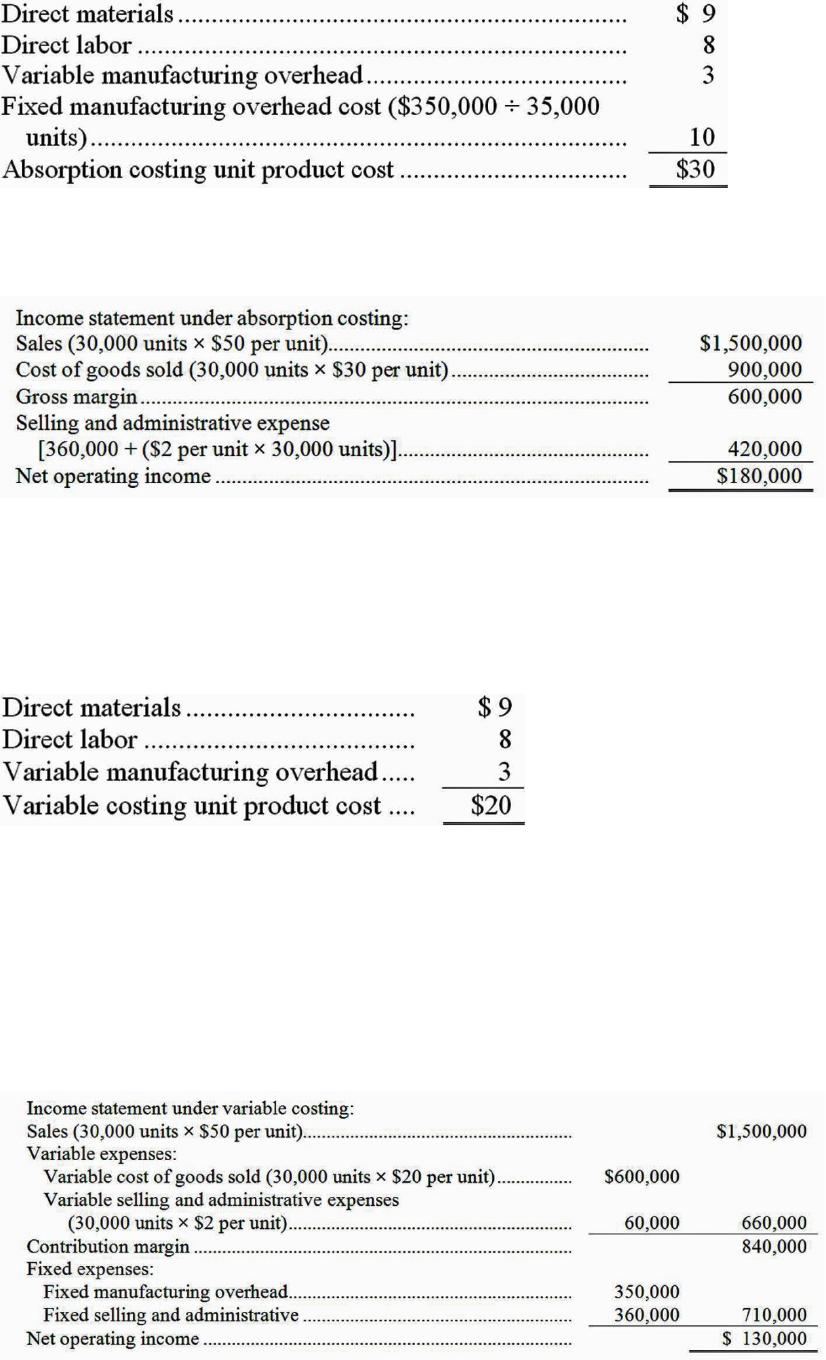
a. Assuming that the company uses absorption costing, compute the unit product cost
and prepare an income statement.
b. Assuming that the company uses variable costing, compute the unit product cost and
prepare an income statement.
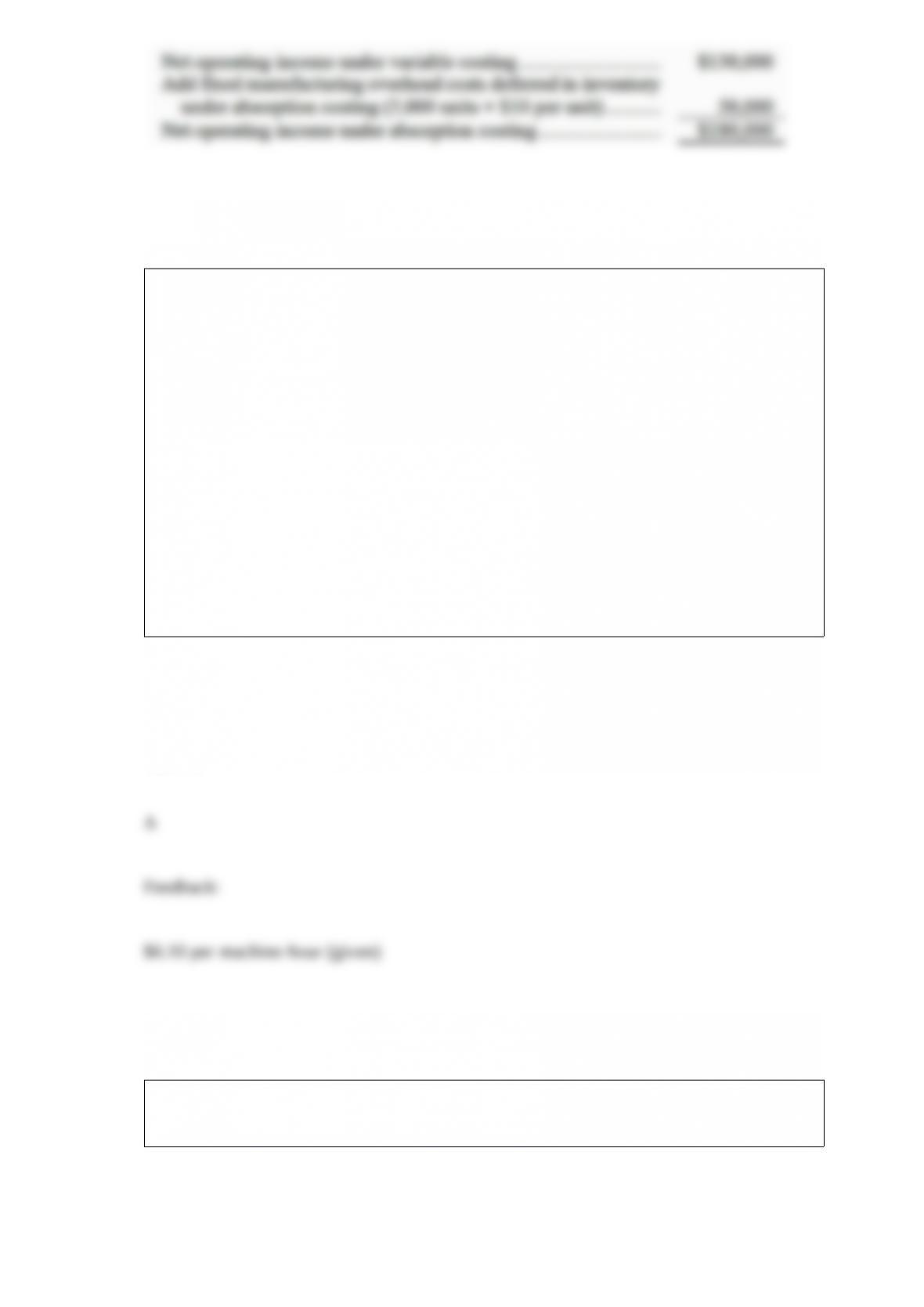
c. Explain the reason for any difference in the ending inventories under the two costing
methods and the impact of this difference on reported net operating income.
Answer:
Reference: 8A-14
Favreau Corporation estimates that its variable manufacturing overhead is $6.10 per
machine-hour and its fixed manufacturing overhead is $352,590 per period.
If the denominator level of activity is 6,900 machine-hours, the variable element in the
predetermined overhead rate would be:
A) $6.10
B) $51.10
C) $57.20
D) $56.47
Answer:
Dieringer Corporation’s most recent balance sheet and income statement appear below:
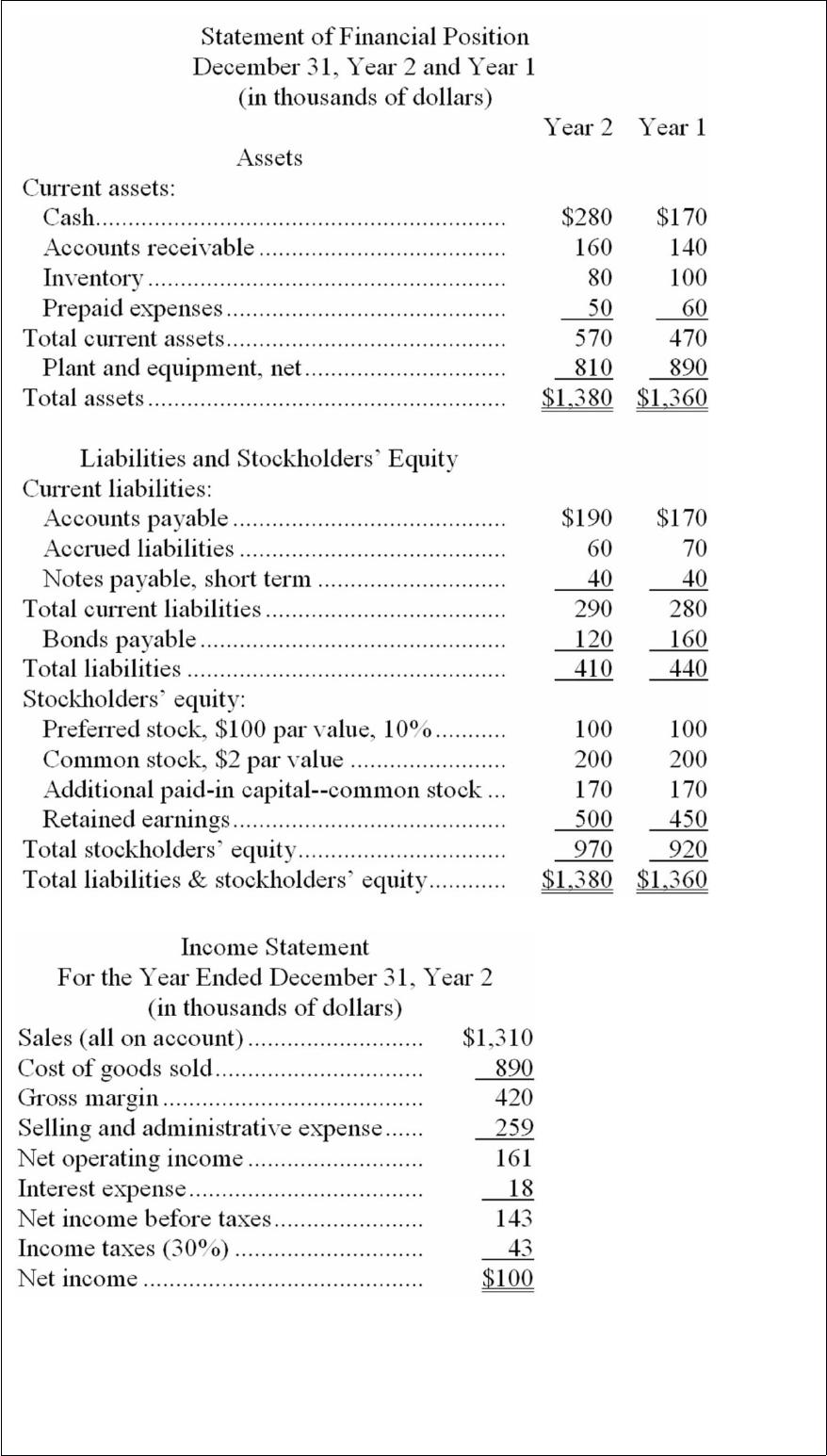
The accounts receivable turnover for Year 2 is closest to:
A. 1.14
B. 8.19
C. 0.88
D. 8.73
Answer:
Van Aalst Company’s comparative balance sheet and income statement for last year
appear below:
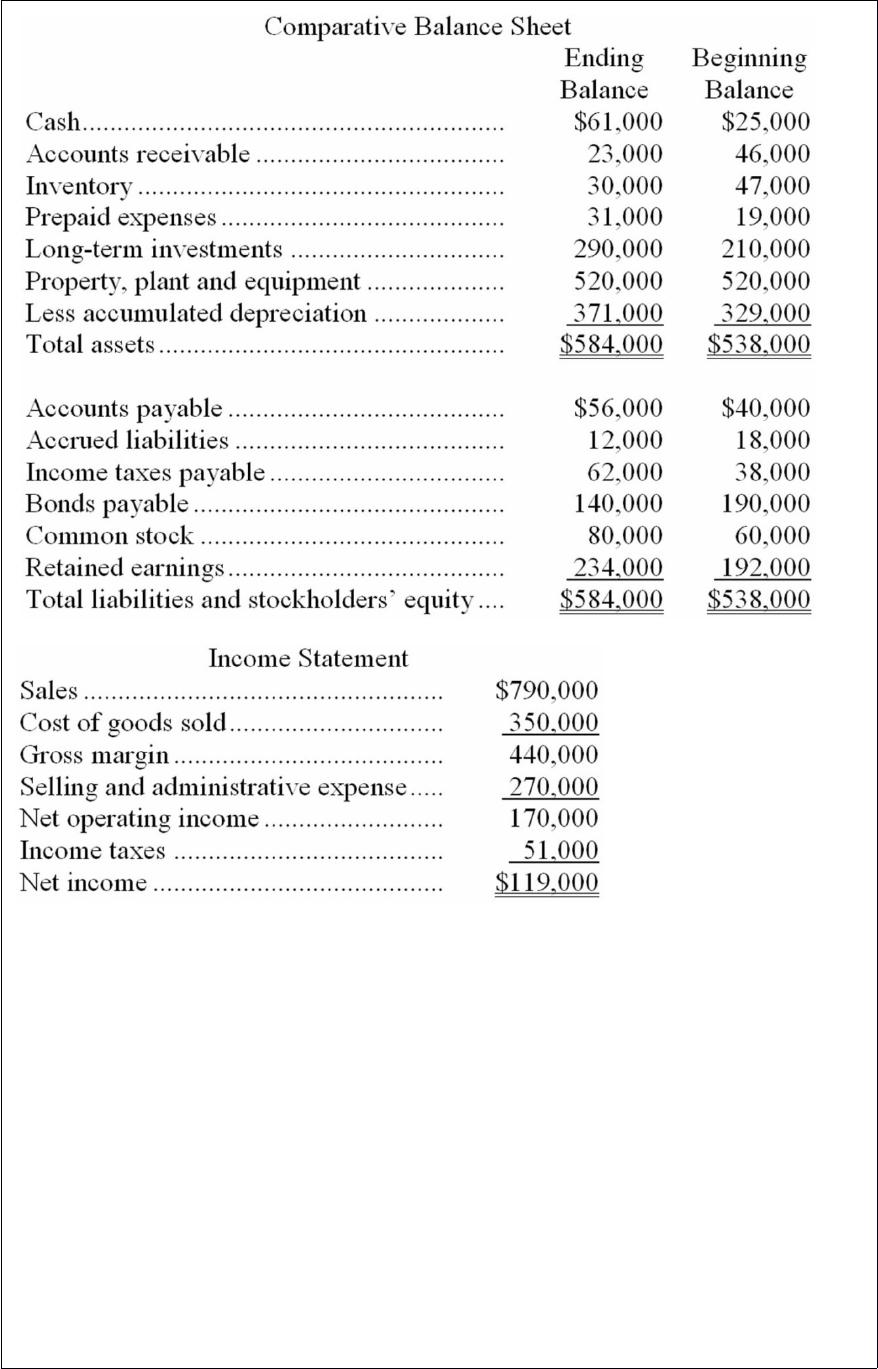
The company declared and paid $77,000 in cash dividends during the year. It did not
sell or retire any property, plant, and equipment during the year. The company uses the
direct method to determine the net cash provided by operating activities.
On the statement of cash flows, the cost of goods sold adjusted to a cash basis would
be:
A. $350,000
B. $383,000
C. $317,000
D. $334,000
Answer:
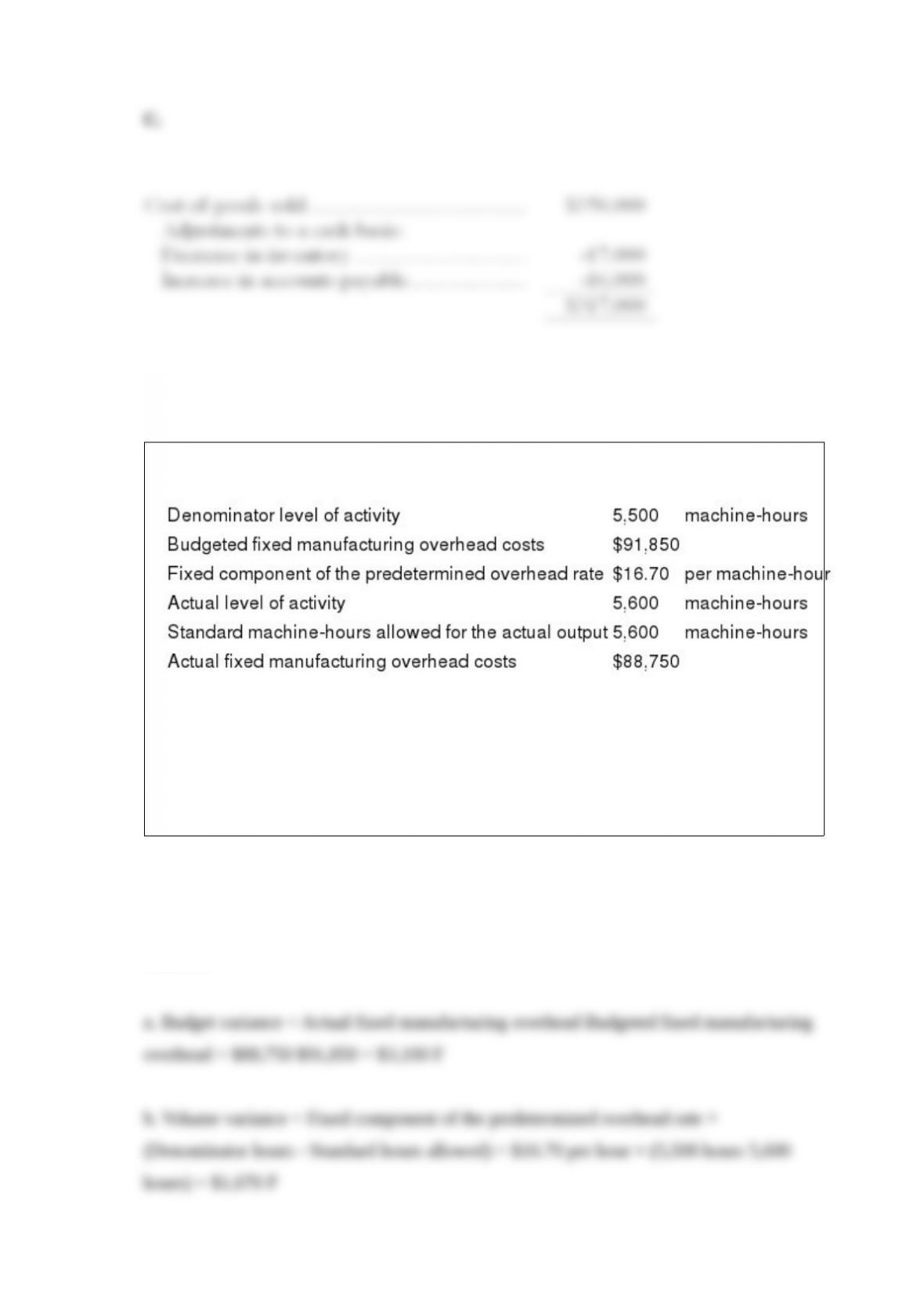
Bahr Corporation has provided the following data for February.
Required:
a. Compute the budget variance for February. Show your work!
b. Compute the volume variance for February. Show your work!
Answer:
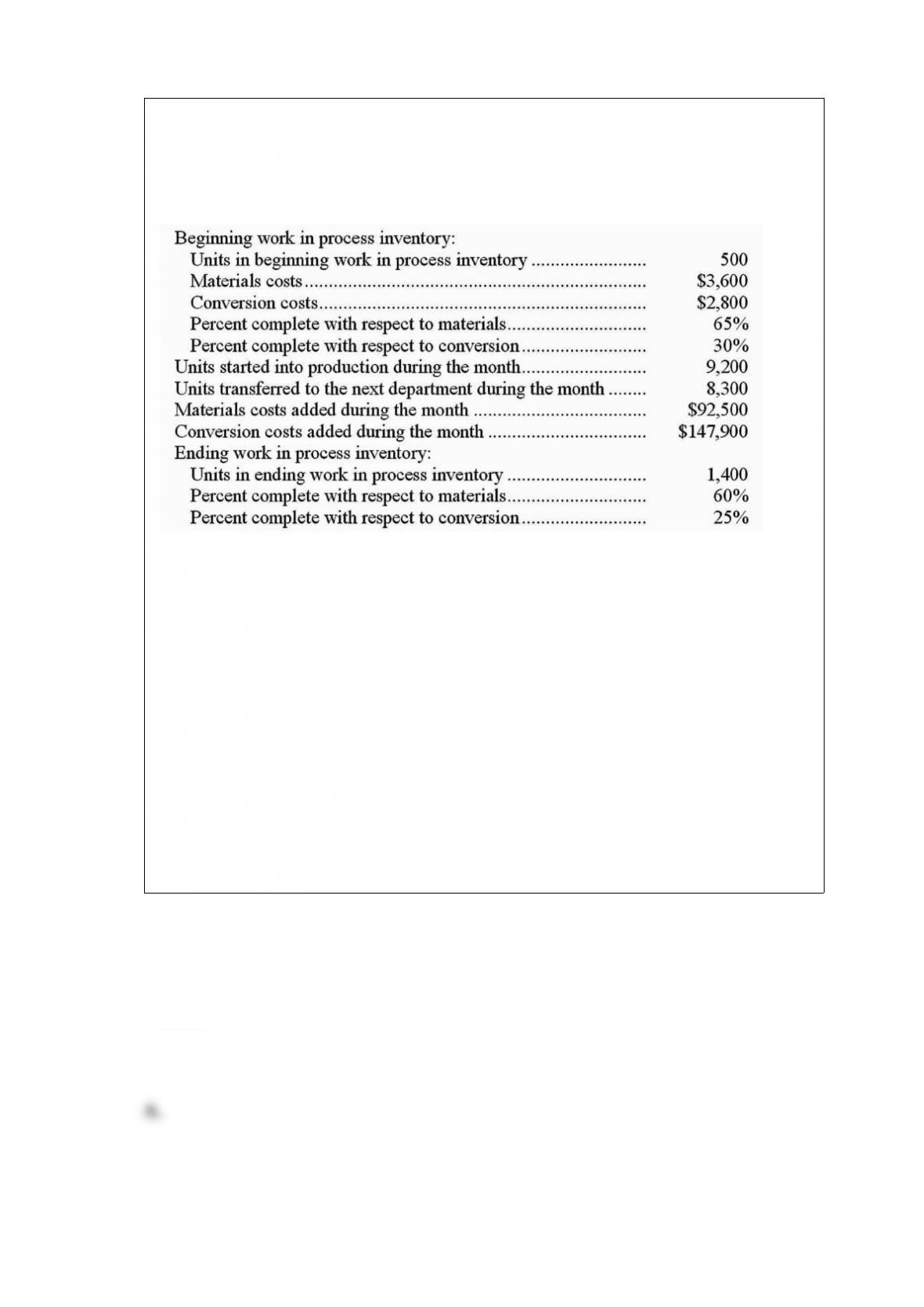
Heller Corporation uses the weighted-average method in its process costing system.
Data concerning the first processing department for the most recent month are listed
below:
Note: Your answers may differ from those offered below due to rounding error. In all
cases, select the answer that is the closest to the answer you computed. To reduce
rounding error, carry out all computations to at least three decimal places.
What are the equivalent units for conversion costs for the month in the first processing
department?
A. 8,650
B. 9,700
C. 8,300
D. 350
Answer:
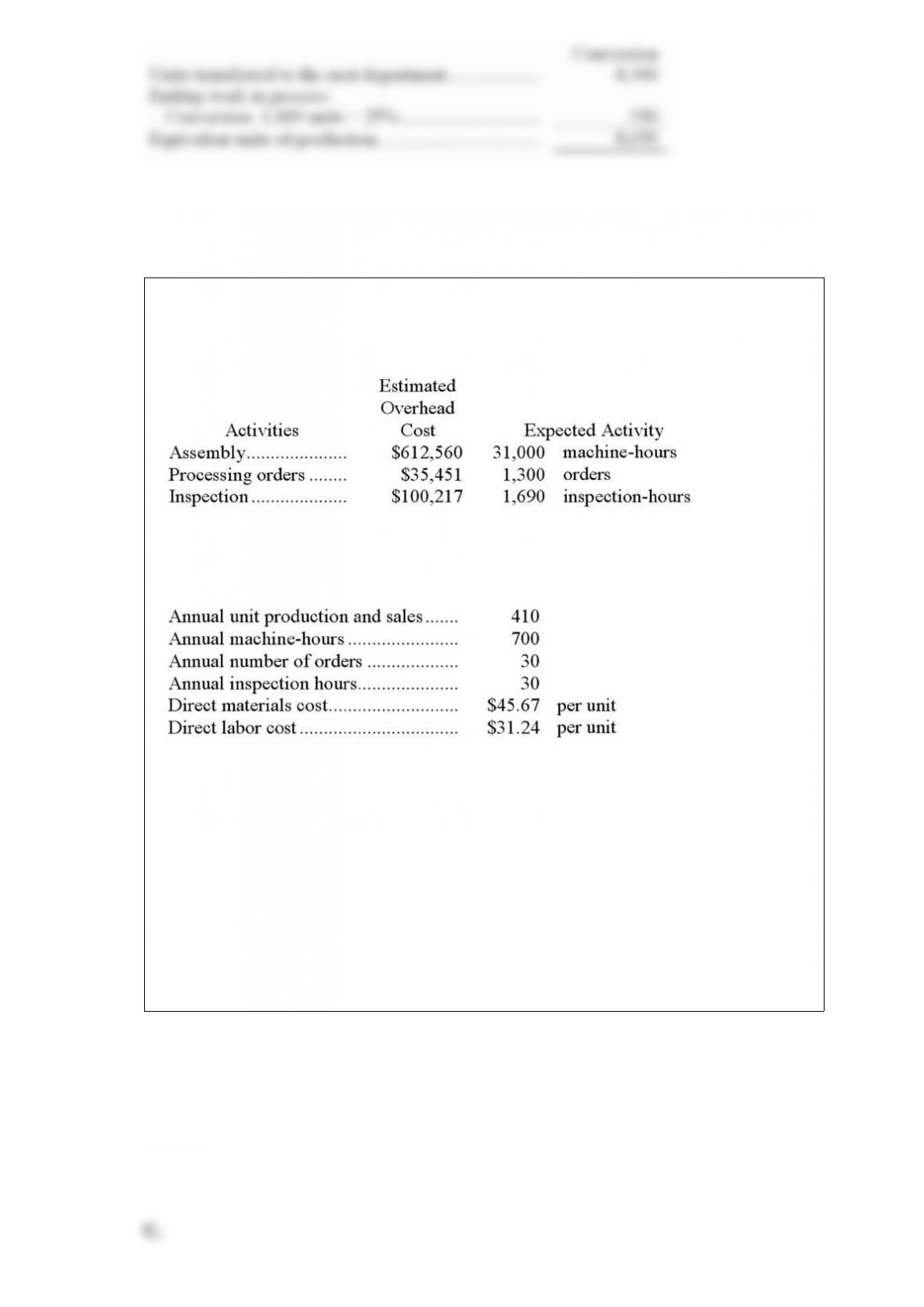
Petitte Corporation has provided the following data from its activity-based costing
system:
Data concerning the company’s product K54A appear below:
According to the activity-based costing system, the unit product cost of product K54A
is closest to:
A. $112.64 per unit
B. $114.99 per unit
C. $116.98 per unit
D. $76.91 per unit
Answer:
Reference: 8-29
Hurren Corporation makes a product with the following standard costs:
The company reported the following results concerning this product in June.
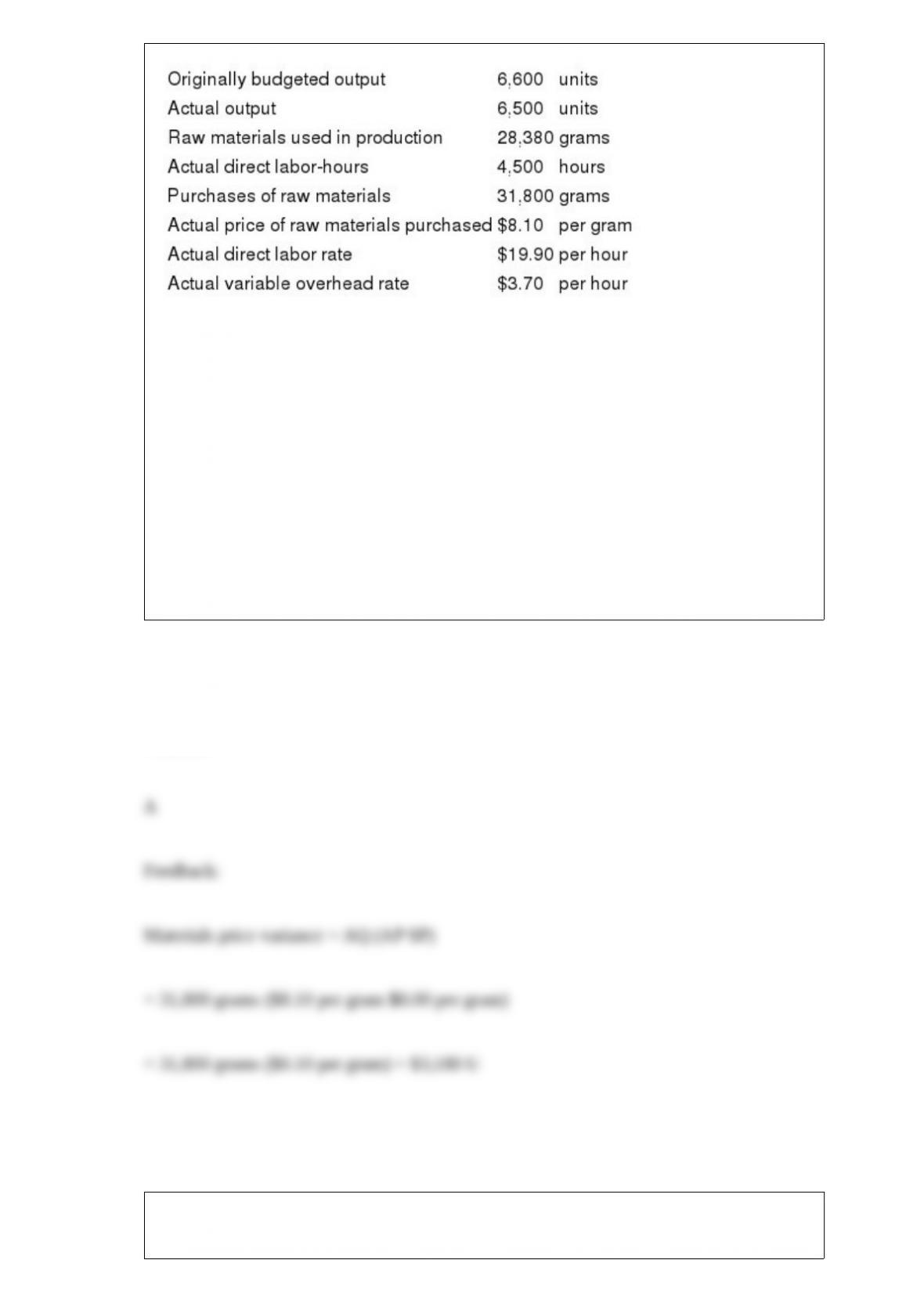
The company applies variable overhead on the basis of direct labor-hours. The direct
materials purchases variance is computed when the materials are purchased.
The materials price variance for June is:
A) $3,180 U
B) $2,860 F
C) $2,860 U
D) $3,180 F
Answer:
Mckerchie Inc. manufactures industrial components. One of its products, which is used
in the construction of industrial air conditioners, is known as G62. Data concerning this
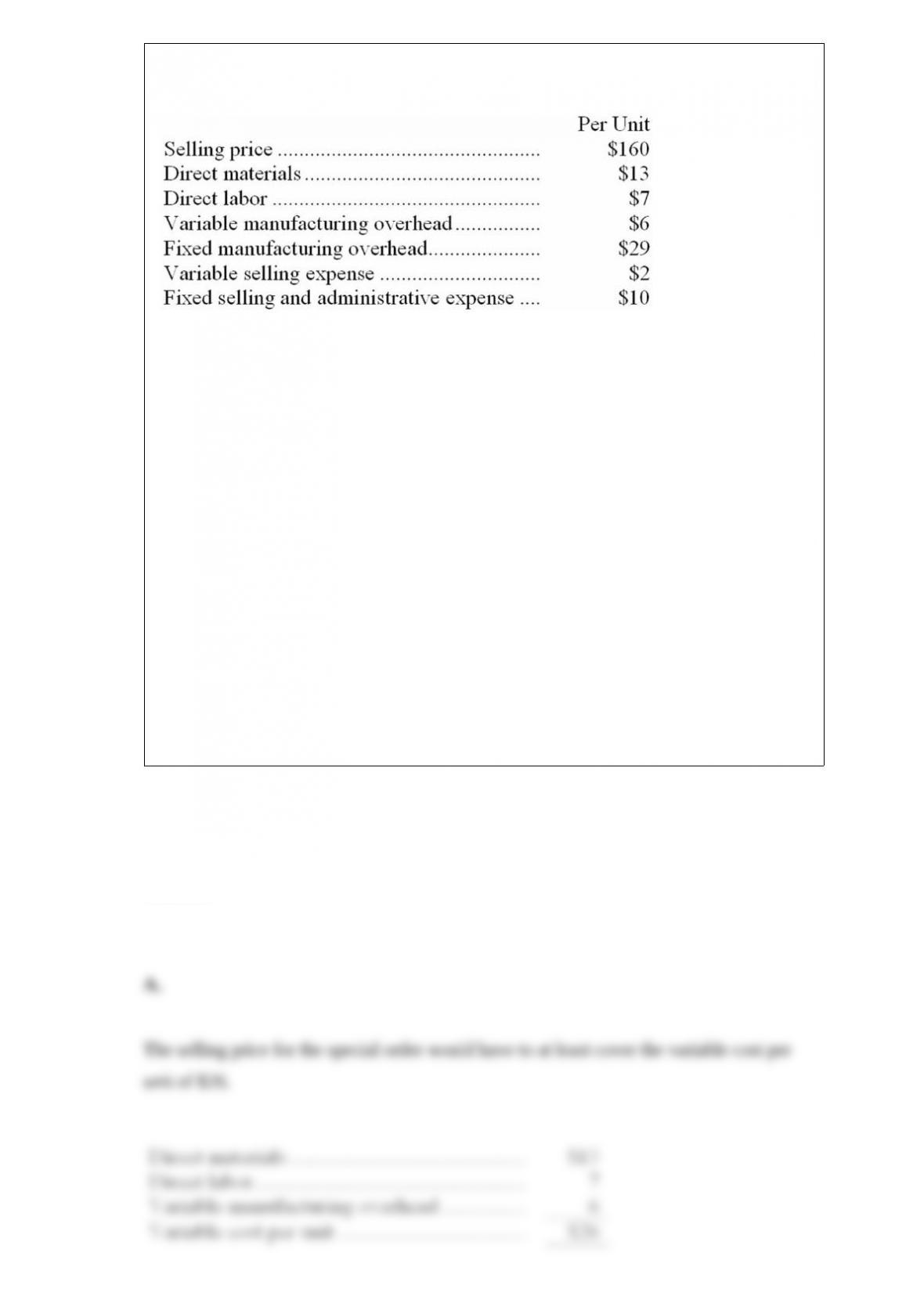
product are given below:
The above per unit data are based on annual production of 9,000 units of the
component. Direct labor can be considered to be a variable cost.
The company has received a special, one-time-only order for 300 units of component
G62. There would be no variable selling expense on this special order and the total
fixed manufacturing overhead and fixed selling and administrative expenses of the
company would not be affected by the order. Assuming that Mckerchie has excess
capacity and can fill the order without cutting back on the production of any product,
what is the minimum price per unit on the special order below which the company
should not go?
A. $26
B. $67
C. $55
D. $160
Answer:
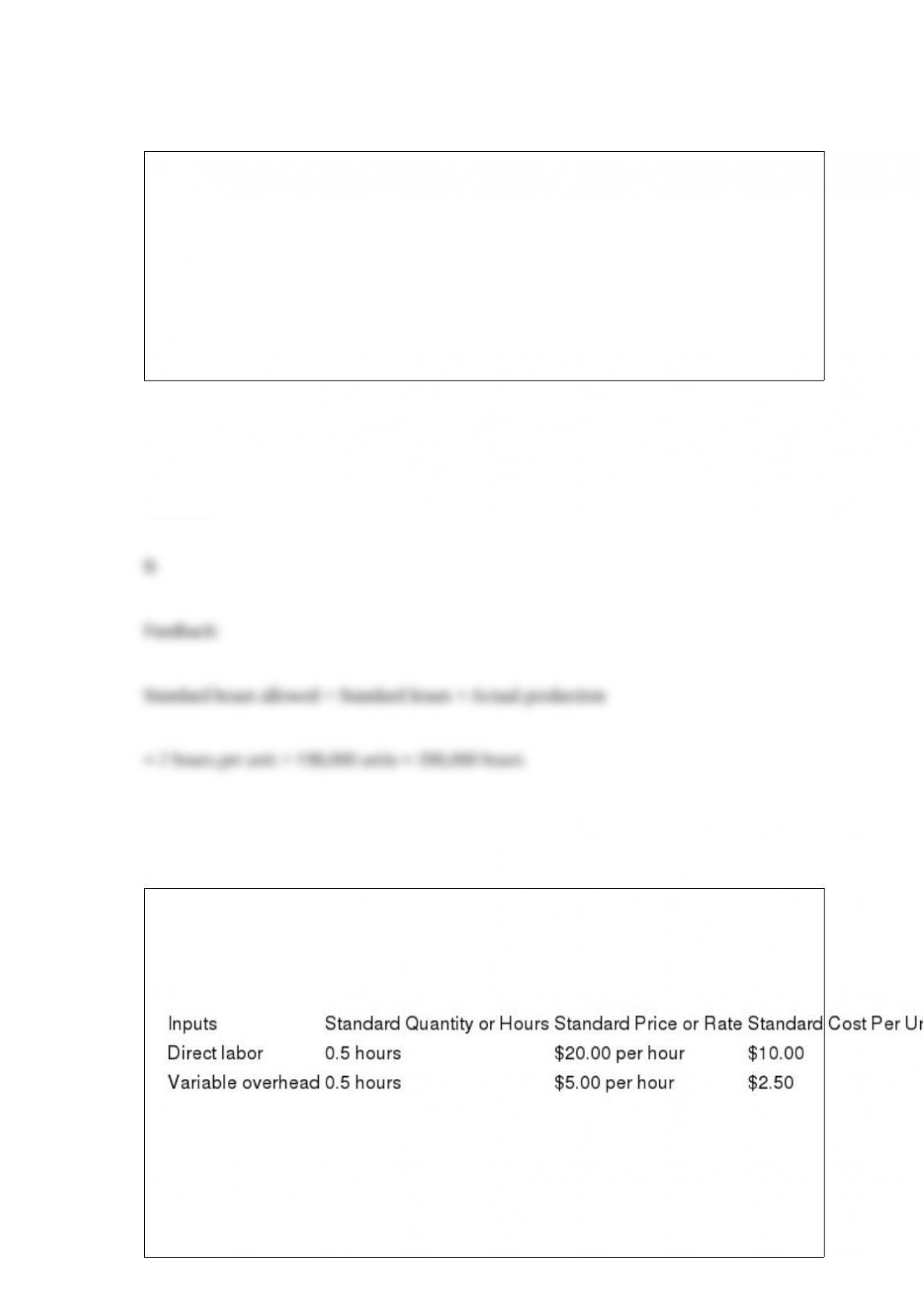
The standard hours allowed for actual production for the year total:
A) 247,500
B) 396,000
C) 400,000
D) 495,000
Answer:
Reference: 8-57
Jardell Corporation makes a product with the following standards for labor and variable
overhead:
The company budgeted for production of 6,400 units in June, but actual production was
6,400 units. The company used 3,180 direct labor-hours to produce this output. The
actual variable overhead rate was $4.90 per hour. The company applies variable
overhead on the basis of direct labor-hours.
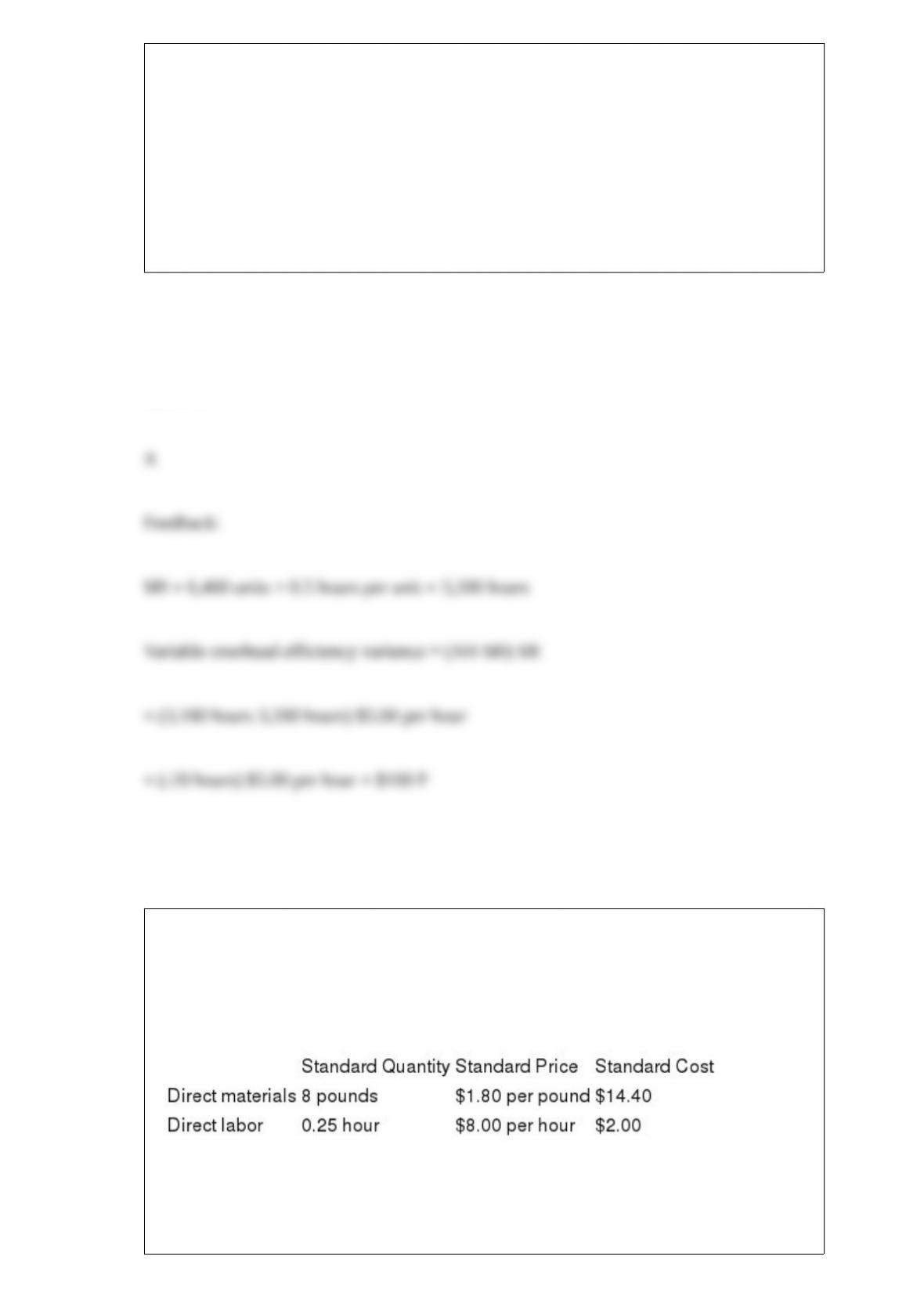
The variable overhead efficiency variance for June is:
A) $100 F
B) $98 F
C) $100 U
D) $98 U
Answer:
Reference: 8-37
Arrow Industries uses a standard cost system in which direct materials inventory is
carried at standard cost. Arrow has established the following standards for the prime
costs of one unit of product.
During May, Arrow purchased 160,000 pounds of direct material at a total cost of
$304,000. The total direct labor wages for May were $37,800. Arrow manufactured
19,000 units of product during May using 142,500 pounds of direct material and 5,000
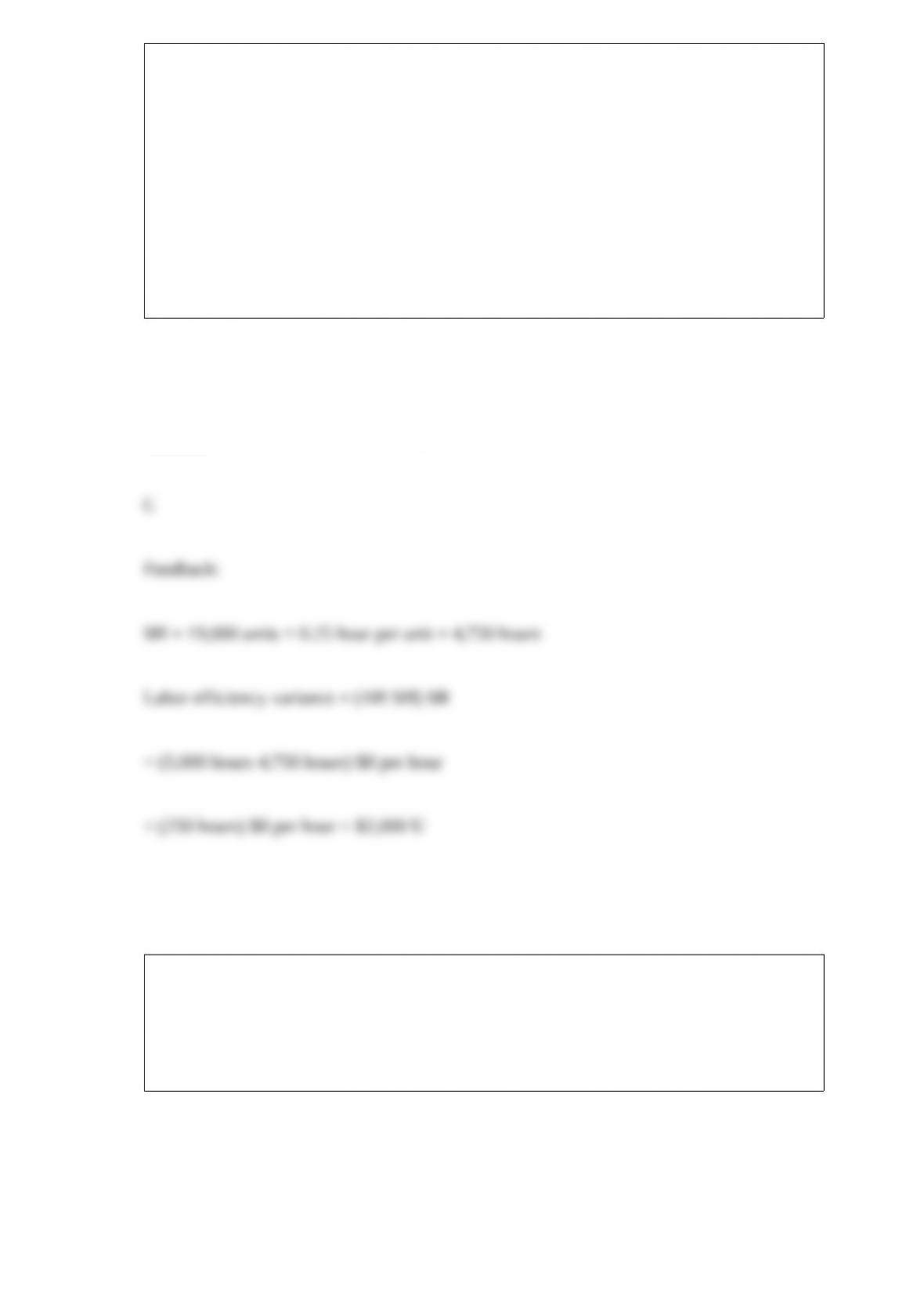
direct labor-hours.
The direct labor efficiency variance for May is:
A) $2,200 favorable
B) $2,000 favorable
C) $2,000 unfavorable
D) $1,800 unfavorable
Answer:
Lund Company applies manufacturing overhead to jobs using a predetermined
overhead rate of 75% of direct labor cost. Any underapplied or overapplied
manufacturing overhead cost is closed out to Cost of Goods Sold at the end of the
month. During March, the following transactions were recorded by the company:
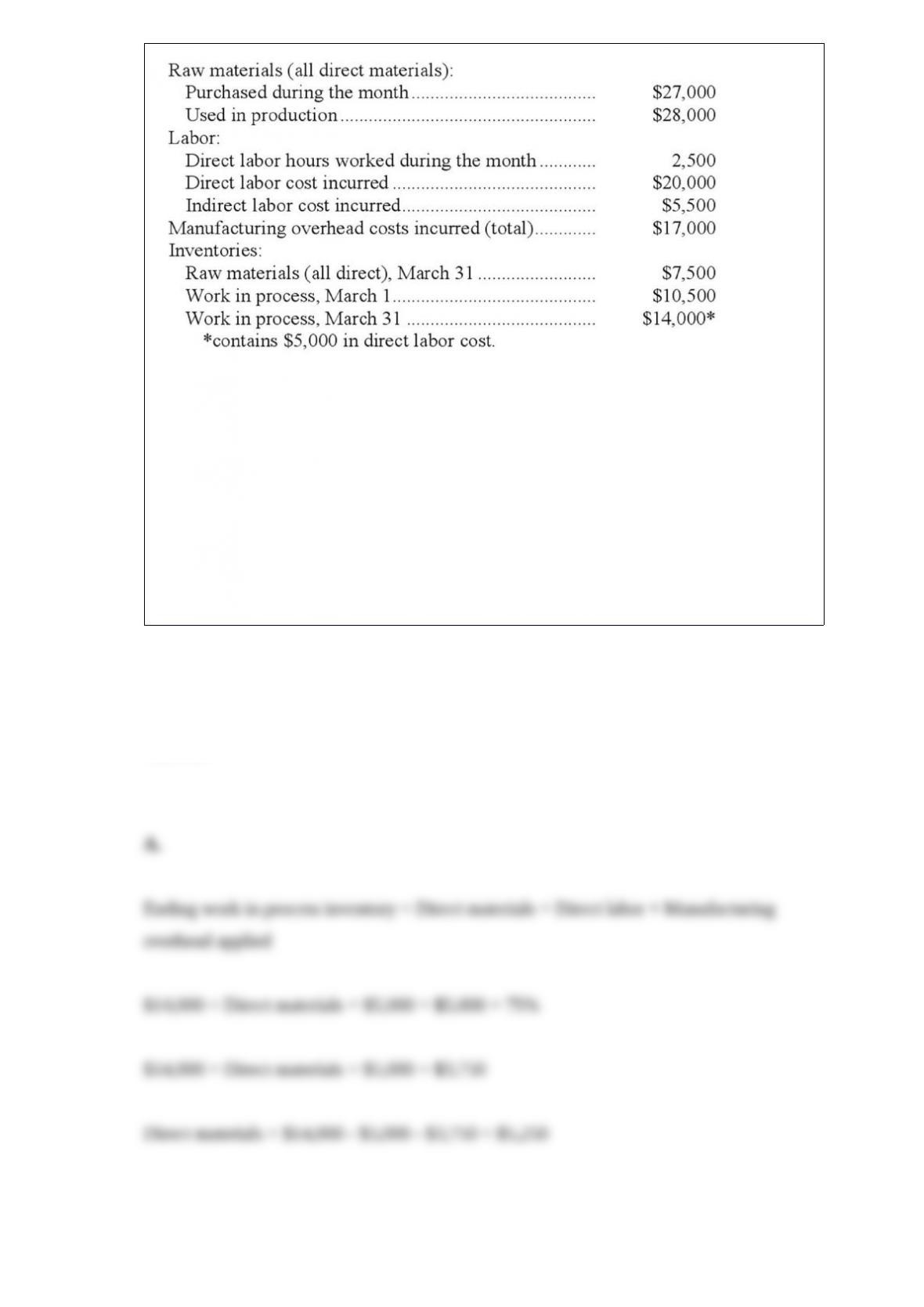
The amount of direct materials cost in the March 31 Work in Process inventory account
was:
A. $5,250
B. $3,500
C. $9,000
D. $8,750
Answer: