Carson Company uses a cost of capital rate of 10 percent in making investment
decisions. It currently is considering two mutually exclusive projects, each requiring an
initial investment of $12 million. The first project has a net present value of $23 million
and an internal rate of return of 18 percent. The firm will complete this project within
one year. It will raise accounting income and earnings per share almost immediately
thereafter. The second project has a net present value of $45 million and an internal rate
of return of 28 percent. The second project requires incurring large, noncapitalizable
expenses over the next few years before net cash inflows from sales revenue result.
Thus accounting income and earnings per share for the next few years will not only be
lower than if the first project is accepted but will also be lower than earnings currently
reported.
Required:
a. Should the short-run effects on accounting income and earnings per share influence
the decision about the choice of projects? Explain.
b. Should either of the projects be accepted? If so, which one? Why?
Pauter Company
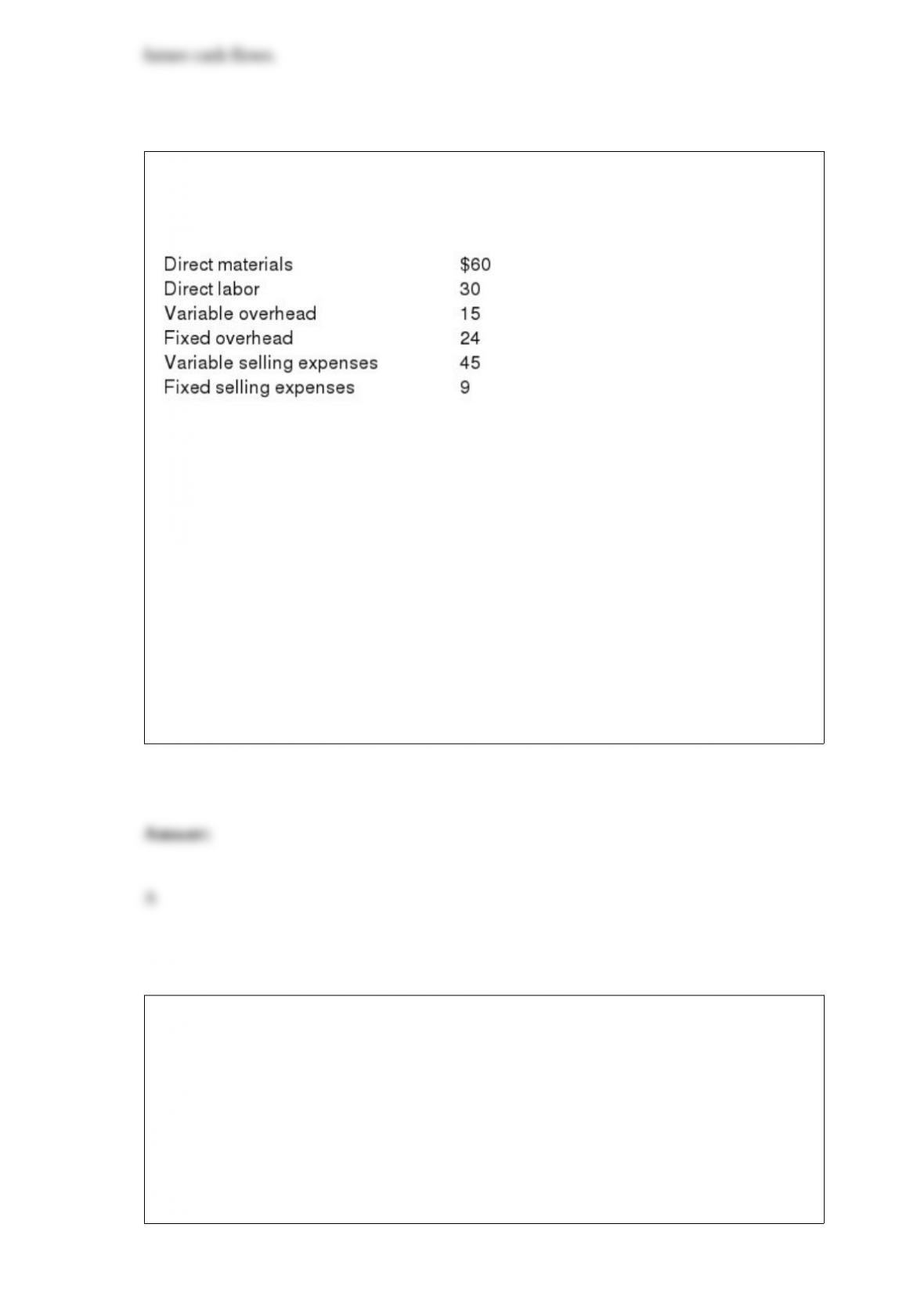
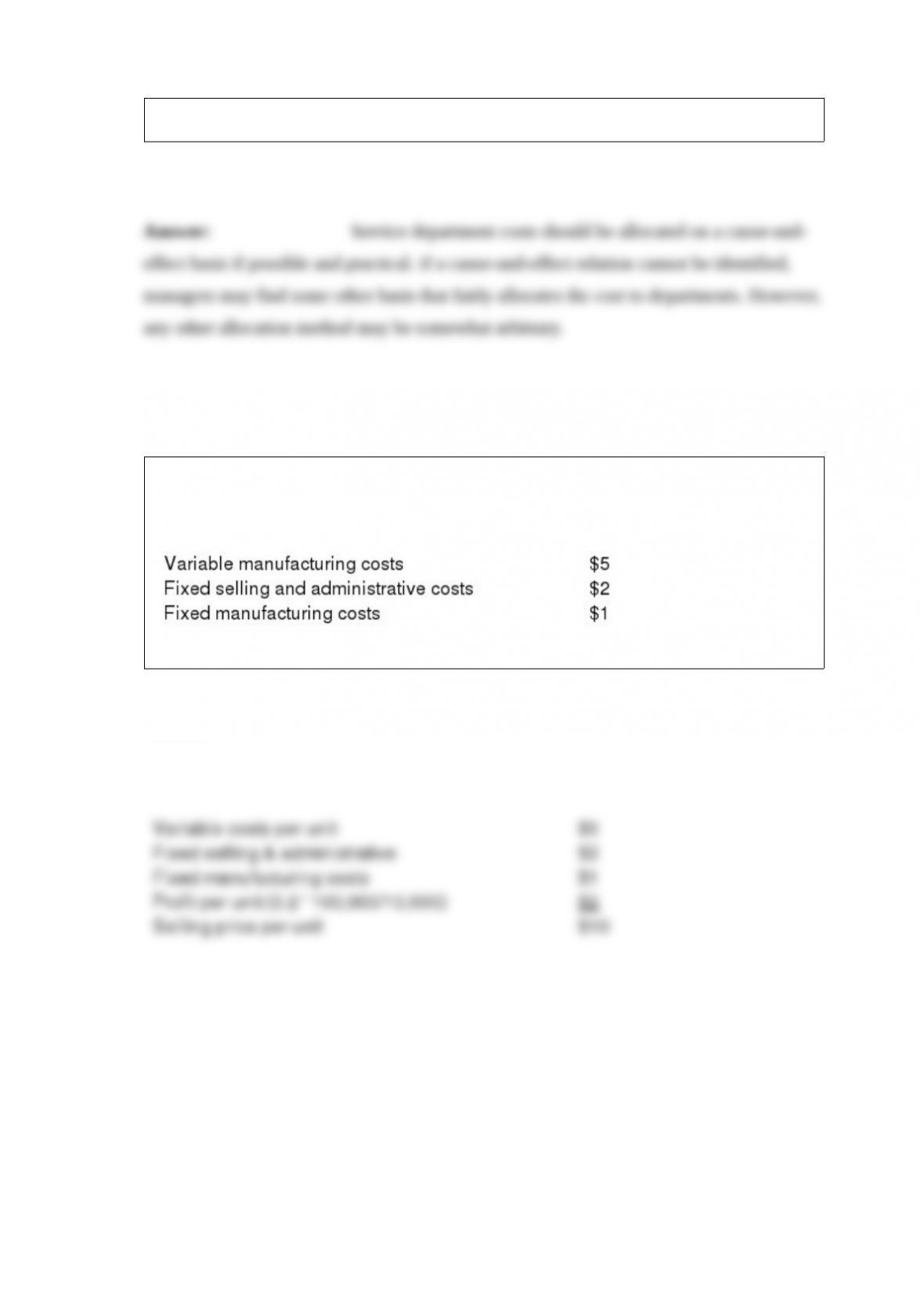
Pauter Company had the following historical accounting data per unit:
The units are normally transferred internally from Division A to Division B. The units
also may be sold externally for $210 per unit. The minimum profit level accepted by the
company is a markup of 30 percent. There were no beginning or ending inventories.
Refer to Pauter Company. If the negotiated price is used, Division A’s transfer price
should be a
A.maximum of $210.00.
B.minimum of $153.00
C.maximum of $198.90
D.minimum of $120.00
Which of the following statements is true?
A.As quality goes up, scrap and rework fall, raising costs.
B.As quality goes up, scrap and rework increase, reducing costs.
C.As quality goes up, scrap and rework fall, reducing costs.
D.As quality goes up, scrap and rework increase, increasing costs.
Which of the following might cause a materials variance?
A.Failing to take purchase discounts.
B.Using a better grade of raw material.
C.Changes in the market supply for the raw materials.
D.All of the above.
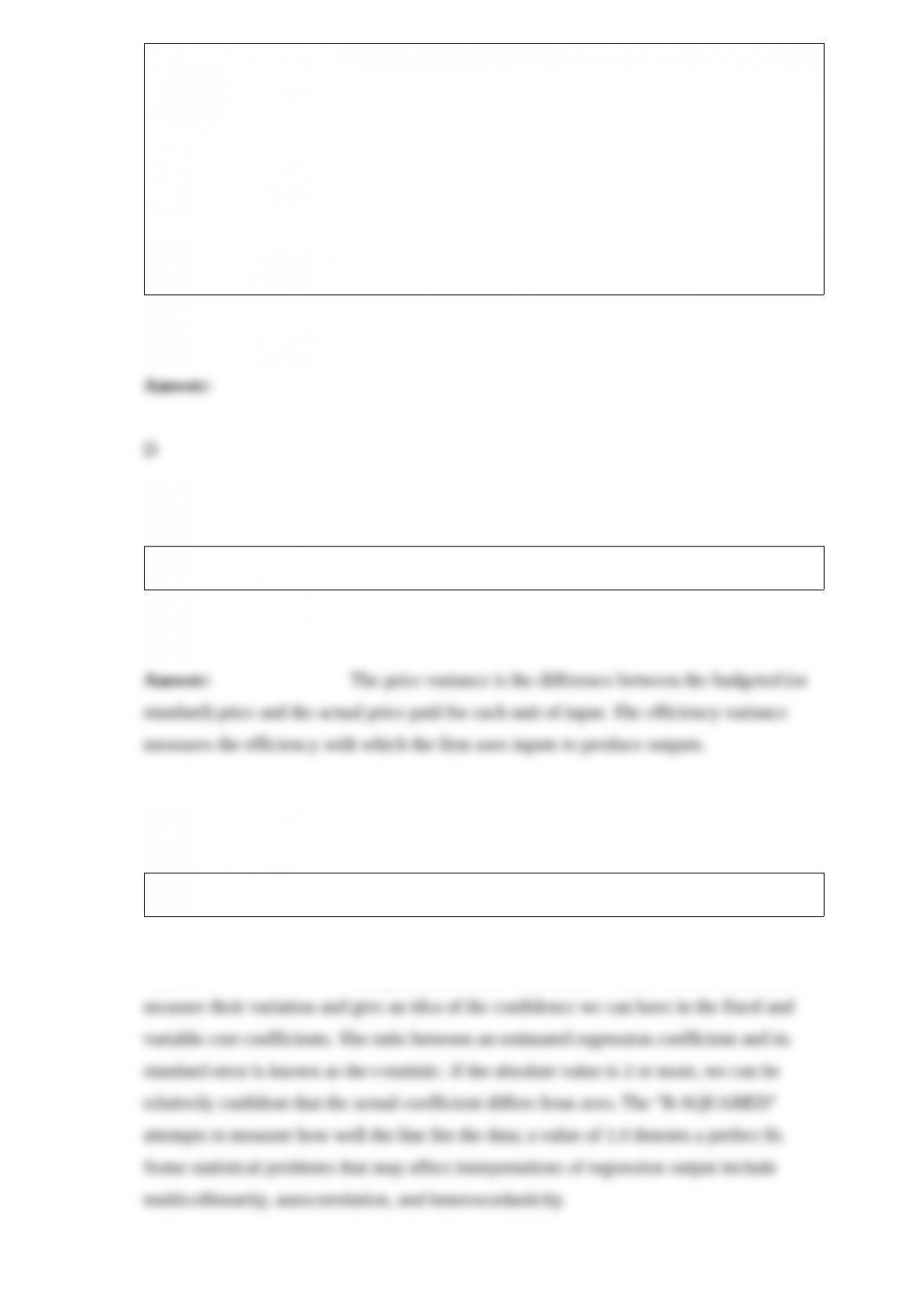
Use the following information to answer the following questions. Magnolia
Company makes products B546 and C245. Information for overhead costs and for the
two products appears below. The company makes 100,000 units of product B546 each
year and 20,000 units of product C245.
Use the information from the Magnolia Company and assume that Activity Based
Costing is used, with each activity in its own cost pool. What is the rate per inspection
that should be used to assign inspection cost to the two products?
A.$8 per inspection

B.$40 per inspection
C.$36 per inspection
D.$400,000 per inspection
Rewards that include grades, money, praise, and prizes are called
A.traditional rewards.
B.intrinsic rewards.
C.extrinsic rewards.
D.outside rewards.
A basic financial model that summarizes the effects of volume changes on an
organization’s costs, revenue, and income is the
A.total revenue-total cost model.
B.break-even model.
C.cost-volume-profit model.
D.program, planning, and profit model.

Under United States laws, dumping occurs when
A.when a business deliberately prices below its costs in an effort to drive out
competitors.
B.when a business unintentionally prices below its costs which results in driving out
competitors.
C.when a foreign company sells a product in the United States at a price below the
market value in the country of its creation, and this action materially injuries (or
threatens to materially injure) an industry in the United States.
D.when a U.S. company sells a product in a foreign country at a price below the market
value in the U.S., and this action materially injuries (or threatens to materially injure) an
industry in the foreign country.
Which of the following statements is correct?
A.Fixed cost per unit increase as activity increases.
B.Fixed cost per unit decrease as activity increases.
C.Fixed cost per unit stay the same as activity increases.
D.Fixed cost per unit first increase, then decrease as activity increases.

In what type of responsibility centers are the managers responsible for revenues, only?
A.Cost
B.Revenue
C.Profit
D.Investment
Bush Enterprises adopts Strategic activity-based costing and management techniques
which would most likely result in
A.adding surcharges for particular customers
B.”firing” some customers
C.seeking to serve more profitable customers
D.All of the answers are correct.
The last step in activity-based costing (ABC) is to
A.identify the activities that consume resources, and assign costs to those activities.
B.identify the cost driver(s) associated with each activity.

C.compute a cost rate per cost driver unit.
D.assign costs to products by multiplying the cost driver rate by the volume of cost
drivers consumed by the product.
Which of the following terms describes a cost that does not relate directly to a cost
object?
A.outlay cost.
B.direct cost.
C.indirect cost.
D.opportunity cost.
Which of the following would not be included as part of the periodic cash inflows
associated with an investment project?
A.savings for fixed and variable production costs
B.savings in selling, general, and administrative expenditures
C.receipts from sales
D.opportunity costs of undertaking this particular project.

If the balance in the Finished Goods Inventory account increased by $30,000 during the
period and the cost of goods manufactured was $220,000, what was the cost of goods
sold?
A.$190,000
B.$220,000
C.$250,000
D.$110,000
Which statement is true concerning depreciation?
A.Depreciation is not a cash flow and does not affect the tax cash flow.
B.Depreciation is not a cash flow and does affect the tax cash flow.
C.Depreciation is a cash flow and does not affect the tax cash flow.
D.Depreciation is a cash flow and does affect the tax cash flow.
On which of the following factors should the decision to drop a product line should be
based?

A.the fact that the product line shows a net loss over several periods.
B.the ability of the firm to eliminate some fixed costs as a result of dropping the
product.
C.whether the fixed costs that can be avoided by dropping the product line are less than
the contribution margin that will be lost.
D.whether the fixed costs that can be avoided by dropping the product line are greater
than the contribution margin lost.
What is true of audits of the capital investment process?
A.Audits of the capital investment process compare the estimates made in the capital
budgeting process with the actual results.
B.Audits of the capital investment process should never be conducted because of the
effect on employee morale.
C.Audits of the capital investment process should never be used to identify and reward
good planners
D.Audits of the capital investment process create an environment in which planners will
be tempted to inflate their estimates of the benefits associated with the project to get it
approved.
Justification of investments in advanced manufacturing systems by using discounted
cash flow analysis results in rejection of the proposal because the present value of
future cash flows are negative. What is/are possible reason(s) for adopting the proposal,
anyway?
A.to inject new technology into the company’s manufacturing operations
B.improved quality, greater flexibility, and lower inventories that lead to long-term cash
flows.
C.intangible benefits in addition to quantifiable benefits should be considered.
D.all of the above.
What is the difference between price and efficiency variances?
How does one interpret the results of regression analysis?
Describe the factors that should be considered in allocating service department costs.
Potomac Corporation wishes to earn a 20% return on its $100,000 investment in
equipment used to produce product M. Based on estimated sales of 10,000 units of
product M, the cost per unit would be as follows:
At how much per unit should Product M be priced for sale?
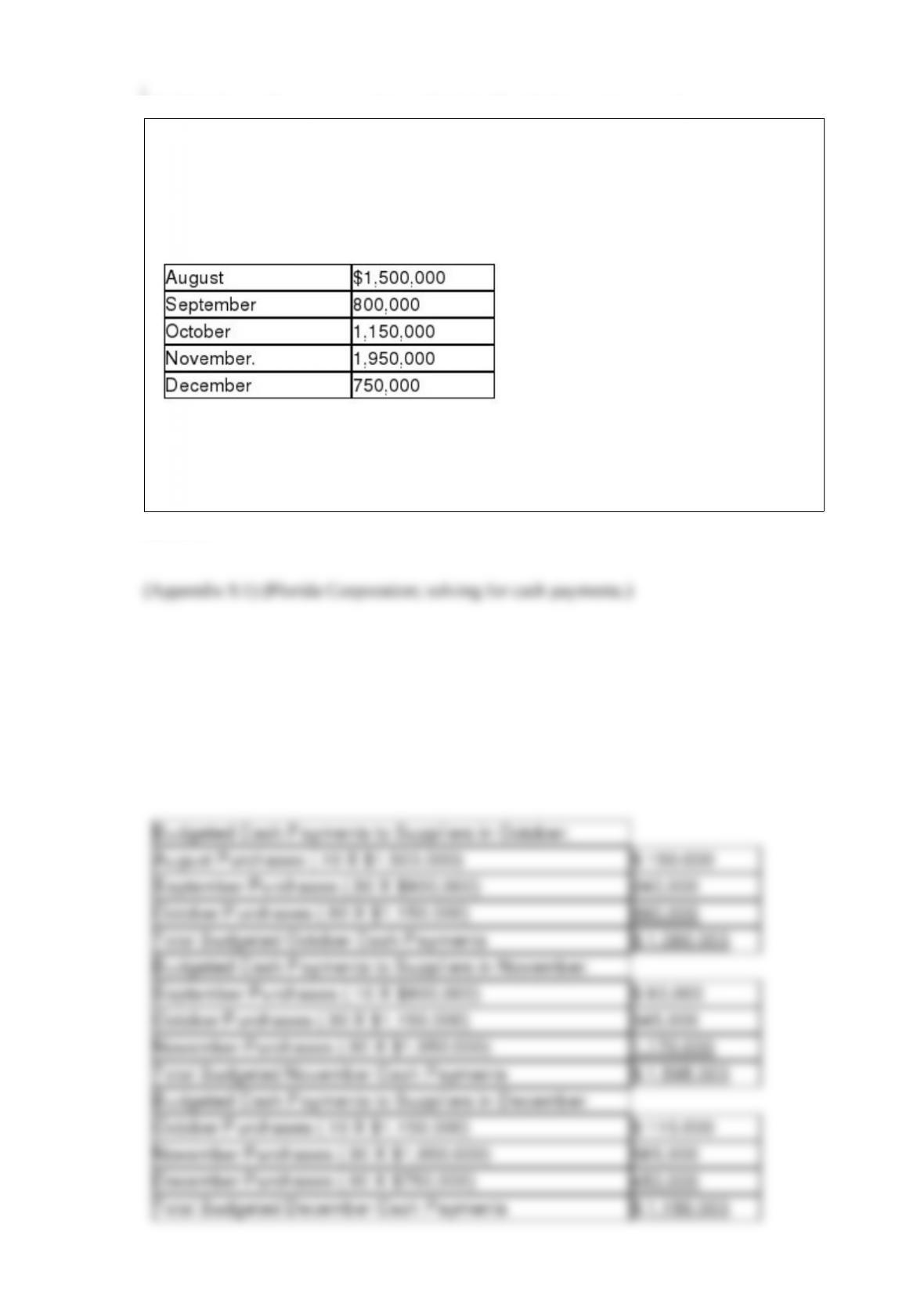
Solving for cash payments (Appendix 9.1). Florida Corporation purchases raw
materials on account from various suppliers. It normally pays for 60 percent of these in
the month purchased, 30 percent in the first month after purchase, and the remaining 10
percent in the second month after purchase. Raw materials purchases during the last
five months of the year are expected to be
Required:
Compute the expected amount of cash payments to suppliers for the months of October,
November, and December.
How do you analyze variances using the variable cost variance model?
Briefly explain how to use historical data to estimate costs.
Break-even time. Weldon Company’s research and development department is
presenting a proposal for new-product research. The new product will require research,
development, and design investments of $800,000 (discounted cash flow). Sales will
begin after three years and will generate an annual discounted net cash flow of
$200,000 starting in Year 3.