
Financial information prepared using one or more assumptions (hypotheses) that do not
necessarily reflect the most likely course of action in management’s judgment is called
a(n)
A) forecast.
B) projection.
C) prospective financial statement.
D) prospectus.
When a misstatement in the financial statements exists but is unlikely to affect the
decisions of a reasonable user, it would be appropriate to issue
A) an unqualified opinion.
B) a qualified opinion.
C) a disclaimer of opinion.
D) an adverse opinion.
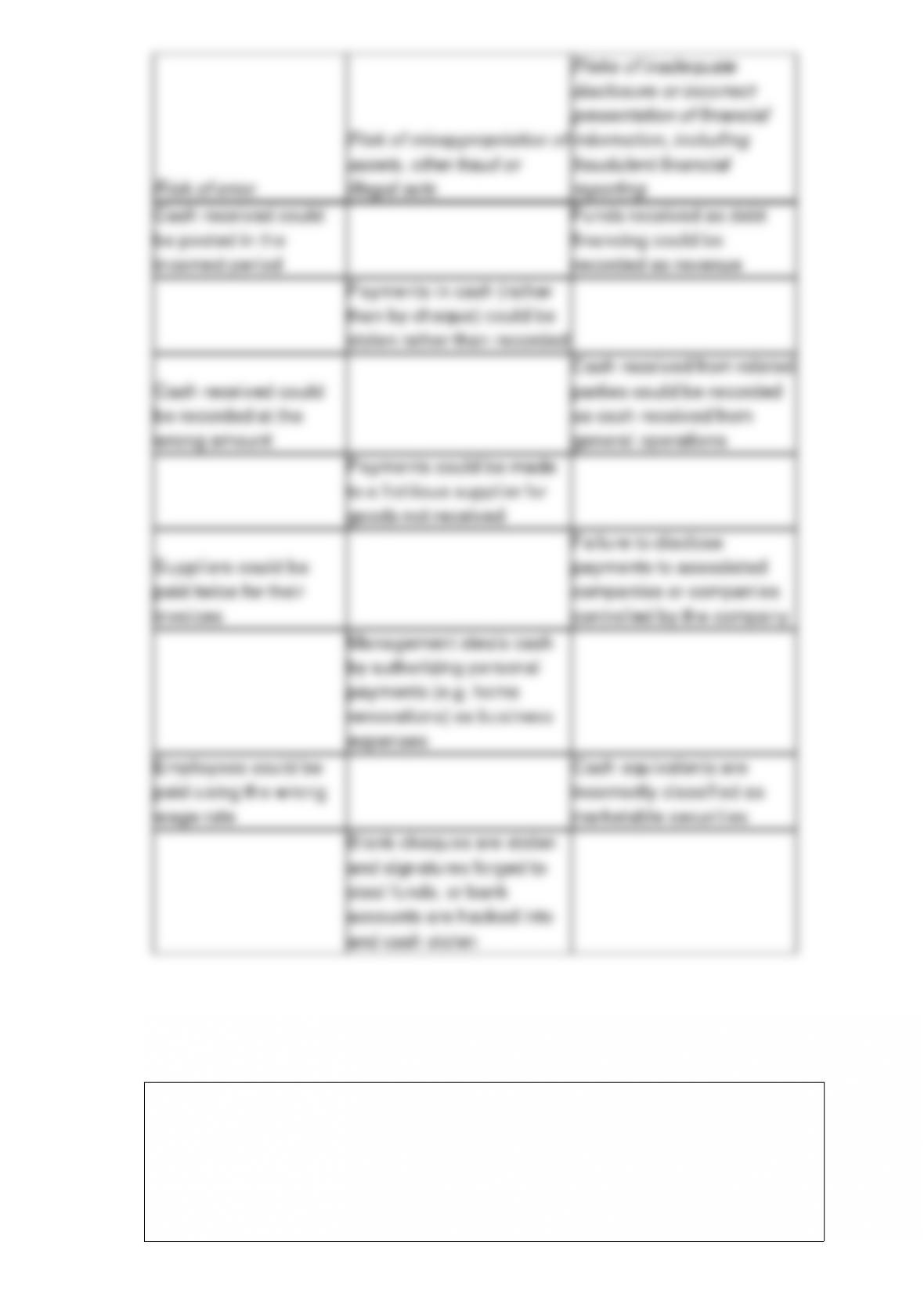
A) Distinguish between (i) risks of error, (ii) risks of fraud, and (iii) risks of inadequate
presentation or disclosure of financial information.
B) For each of the three types of risks described in (A), provide three examples of

major risks of error or fraud in the cash cycle.
Three presentation and disclosure audit objectives are not affected by assessed control
risk for the sales transactions. These are
A) rights and obligations, valuation, understandability.
B) understandability, valuation, occurrence.

C) valuation, rights and obligations, classification.
D) classification, understandability, rights and obligations.
You are the auditor of Jehello Incorporated, a public company with a December year
end. Your firm has audited Jehello for the past three years. The following issues were
documented in the working paper files for the prior year audit:
∙ The company had incurred expenditures of $400,000 related to the development of a
new music format for electronic media. The large majority of the costs were related to
development of software, hardware, and presentation of the results to customers who
participated in focus groups. Management had been optimistic that the new sound
system would work well, even though focus group results had been poor. These costs
had been fully capitalized.
∙ About 40% of the company’s revenues were from one customer. That contract had
been due for renewal on May 15, ten days after the audit report had been issued.
Documents on file indicated that the customer seemed likely to renew the contract,
although quality control disputes were escalating. On May 14, Jehello was informed
that the contract would not be renewed.
Jehello has defaulted on its bank loans and the bank is suing you, saying that the
financial statements presented last year were false and misleading.
Required:
A) Which defences should the auditor use?
B) Do you believe that the auditor will lose the suit? Why or why not?
From an audit perspective, an imprest bank account at a client can
A) require less time for the audit of general cash.
B) increase audit risk.
C) result in an increase in control risk.
D) improve client internal controls.

When should a PA assess the five threats to independence with respect to an audit
engagement?
A) When deciding to accept a client or whether to continue an existing engagement
B) After signing the engagement letter and before commencing field work
C) After the completion of this year’s audit, before starting the next engagement
D) After a discussion with the Board of Directors
During the audit engagement, the primary auditor may rely on other individuals, such as
specialists, other auditors and internal auditors (secondary auditors). The primary way
to defend the auditor against negligence should such other individuals conduct poor
quality work is whether the
A) other individuals were professionals with recognized credentials.
B) primary auditor conducted sufficient quality control work with respect to the
secondary auditor.
C) secondary auditor had ever been sued before.
D) the appropriate level of materiality had been used during the conduct of the
engagement.

When a compilation engagement is performed, the report attached is called a
A) Compilation Report.
B) Notice to Reader.
C) No Assurance Report.
D) Auditor’s Report.
A compilation presents information, in the form of financial statements, that is the
representation of management. The public accountant who prepares the compilation
undertakes to express
A) limited assurance on the statements.
B) minimal assurance on the statements.
C) no assurance on the statements.
D) full assurance on the statements.
The underlying reason for a high level of professional conduct, such as exemplified in a
code of conduct, for any profession is

A) the need for public confidence in the quality of service of the profession.
B) that it provides a safeguard to keep unscrupulous people out.
C) that it is required by federal legislation.
D) that it allows licensing agencies to have a yardstick to measure deficient
performance.
Ideally, tests of controls should be applied to controls
A) at the balance sheet date.
B) at each quarterly interim period.
C) for the entire period under audit.
D) at the beginning of the fiscal period.
An intimidation threat occurs when
A) it is difficult to believe the actions of management because there is a suspicion of
irregular activity with respect to the recording of transaction activity.
B) the auditor suspects that fraud has occurred at the middle management level of the
organization.

C) the auditor has been working on a client engagement for many years and has trouble
believing that management would deceive the auditors.
D) a client threatens the firm or its staff with respect to the content of the financial
statements or with respect to the conduct of the audit.
Which one of the following situations is a violation of the professional rules of
conduct? PA
A) looked the other way when he noticed that one of his firm’s accounting staff
accepted money from client management.
B) resigned so that he could accept a position on the Board of Directors at a major
client.
C) prepared personal and corporate tax returns for a client and all of its executive
officers.
D) placed an advertisement in the local paper indicating that she conducted audit
engagements for five major insurance companies.
There are many types of analytical procedures that the auditor can conduct during the
planning stage of the financial statement audit. What is the purpose of comparing
prepaid expenses and related expense accounts with those of prior years?
A) understand the client’s industry and business

B) assess going concern
C) indicate possible misstatements
D) reduce tests of controls
If the auditor does not obtain a cut-off statement directly from the bank for testing, an
alternative procedure that the auditor can use is to
A) account for a continuity of cheques that covers the year end.
B) reconcile cash paid to the cash disbursements journal for the last month of the year.
C) reconcile cash received to the cash receipts journal for the last month of the year.
D) prove the bank statement for the period after the year end.
One of the purposes of using statistical sampling is to quantify sampling risk. For which
of the following audit tests would sampling risk be zero? The auditor
A) used monetary unit sampling to select a sample of payroll payments.
B) used attribute sampling to select a sample of shipping documents.
C) sent empty (zero balance) external confirmations to suppliers with large dollar
balances.

D) sent external confirmations to all financial institutions used by the client.
A review engagement requires what amount of evidence to be accumulated?
A) Minimal
B) Moderate
C) Extensive
D) Maximum
Which of the following would be required in a compilation?
A) An understanding between the client and the accountant for the services to be
provided
B) A formal engagement letter signed by the client
C) Management’s acknowledgements for its responsibility with regards to the financial
statements
D) A confirmation of the auditor’s independence

The Federal Auditor General provides the results of operational audits to Parliament in
Auditor General reports. What type of engagements are these?
A) direct reporting
B) attest engagement
C) review engagement
D) compilation engagement
If the auditor is not using tests of control, then
A) tests of detail must be used.
B) analytical procedures must be used.
C) tests of design of internal controls must at least be used.
D) the auditor will have to qualify the audit opinion.

As part of audit planning, you have calculated gross margin for the last five years, and
compared gross margin to industry averages. Your client’s gross margin has increased
by about 5% in the current year, while the industry gross average has declined. One
possible cause of this increased gross margin is
A) higher cost of goods sold.
B) increased bad debt expenses.
C) premature revenue recognition.
D) fictitious expenses.
The first step in applying materiality is
A) estimating the misstatement in a segment, for each functional cycle.
B) setting a judgment about materiality for the financial statements as a whole.
C) estimating the combined effects of errors.
D) comparing the error estimate with the materiality levels.
The auditor is tracing from the duplicate sales invoices to related shipping documents
with respect to the occurrence transaction-related audit objective. This type of evidence
is

A) independent.
B) relevant.
C) timely.
D) related to external documentation.
Cimco Forest is a client of your PA firm that has requested that the audit of its financial
statements be completed 25 days after its year end. Given the time constraint, the
auditor
A) should not accept Cimco as a client.
B) should increase the size of the audit team.
C) can perform audit procedures at an interim date and roll forward the interim balances
to year end.
D) should change the audit program to include more tests of controls and less tests of
details as they are more time consuming.
The exclusion of a single transaction of the capital acquisition and repayment cycle
could be material in itself. This means that the following audit assertion is a major audit
concern
A) completeness.

B) existence.
C) accuracy.
D) rights and obligations.
Adequate technical training and proficiency in auditing is a requirement of which
category of generally accepted auditing standards?
A) General
B) Examination
C) Reporting
D) Quality control
Which of the following internal controls would assist in ensuring that recorded payroll
transactions are for the amount of time actually worked and at the proper pay rate, and
that withholdings are properly calculated?
A) Comparison of batch totals with computer summary reports
B) Comparison of payroll master file with payroll general ledger totals
C) Adequate personnel files

D) Separation of duties between personnel, timekeeping, and payroll disbursements
Which of the following is an advantage of a review engagement as compared to an
audit engagement? For the review engagement
A) information risk is reduced more than for an audit.
B) the documentation to be provided by the client is greater.
C) the financial statements assessed will have more detail.
D) it requires considerably less work, so is less costly.
The audit objective to determine that existing notes payable are included in the notes
payable schedule (completeness) is accomplished by the following test of balances
procedure.
A) Examine balance sheet for disclosure details.
B) Recalculate accrued interest.
C) Review the bank reconciliation for new notes credited directly to the bank account
by the bank.
D) Examine duplicate copies of notes for principal and interest rates.