
When a different extent of evidence is needed for the various cycles, the difference is
caused by
A) errors in the client’s accounting system.
B) the client’s need to achieve an unqualified opinion.
C) the auditor’s need to follow GAAS.
D) the auditor’s expectations of errors and assessment of internal control.
Prior to accepting an engagement to examine a financial forecast or projection included
in a prospectus or other public offering document, the public accountant should
A) obtain an understanding of the controls over preparation of internal forecasts such as
budgets.
B) increase the risk profile of the client with respect to management integrity.
C) ensure that management will provide sufficient evidence to conduct the engagement.
D) inform the client that the engagement may not detect errors in the client’s forecasts.
Analytical procedures are mandatory during which phases of the audit?
A) tests of controls and tests of details

B) planning and final evaluation
C) planning and tests of details
D) tests of details and final evaluation
The decision to continue doing the audit of an existing client is
A) as important as deciding whether or not to accept a new client.
B) less important than deciding whether or not to accept a new client.
C) more important than deciding whether or not to accept a new client.
D) only to be reconsidered if the client’s operations or upper management has changed.
PA is working on the audit of a publicly held corporation. At what level will the auditor
likely set audit risk?
A) low
B) medium
C) high
D) very high

How does a financial statement audit affect a bank manager’s decision in providing
loans to a corporate client?
A) Information risk could be reduced, so the bank manager may lower the interest rate
charged.
B) The bank manager will lower the risk-free interest rate that applies to the
corporation.
C) The business risk for the client will be reduced, so the borrowing costs will decline.
D) The business risk for the client will be increased, so the borrowing costs will be
lowered.
Dishware Distribution Limited uses average costing to cost its inventory. It keeps a
perpetual inventory file that is linked to its sales systems. It orders inventory in for
specific customers as needed, and traditionally has a slow time just before its year end.
Accordingly, inventory at the yearend is about $2,000, while materiality is about
$30,000. How should the auditor approach the audit of physical inventory?
A) exclude testing of physical inventory from the audit program
B) use attribute sampling to select a sample of items to count
C) use dollar unit sampling to select a sample of items to count
D) count only those items that have a dollar value in excess of $100

It is important for the public accountant to consider the competence of the audit clients’
employees because their competence bears directly and importantly upon the
A) cost/benefit relationship of internal controls.
B) achievement of the objectives of the system of internal control.
C) comparison of recorded accountability with assets.
D) timing of the tests to be performed.
When the auditor identifies an area of the accounting system with missing controls (i.e.,
a weakness or deviation), this would lead to a modification of the audit program in that
area that would
A) increase the amount of tests of controls.
B) increase the reliance on tests of controls.
C) cause the issuance of a qualified or adverse opinion.
D) eliminate the need for a test of controls.

The codes of professional conduct of the various accounting bodies are meant to
A) provide a standard of conduct for all members, including those in public practice.
B) interpret the assurance recommendations and views of the AASB.
C) provide the rules underlying the audits and related service activities carried on by the
accountants.
D) establish the norms for quality control of an audit.
A form issued for each employee summarizing the earnings record for the calendar year
is the
A) rate authorization form.
B) summary payroll report.
C) payroll master file.
D) T-4 form.

When the auditor issues an erroneous opinion as the result of an underlying failure to
comply with the requirements of generally accepted auditing standards, it results in
A) business failure.
B) audit failure.
C) audit risk.
D) business risk.
Pierre, a CA, was convicted of stealing money from his clients and for deliberately
preparing personal tax returns that were false. In addition, Pierre will likely
A) need to take additional training courses to upgrade his tax skills.
B) need to defend himself to prove non-negligent performance.
C) be charged with misconduct by his professional institute (or ordre).
D) have lack of privity with the federal and provincial tax authorities.
Canadian auditing standards (CASs) require that the audit be conducted using
A) a controls testing approach.
B) a risk assessment approach.

C) a substantive approach.
D) a standard approach.
The “unqualified report with explanatory paragraph” or the “unqualified report with
modified wording”
A) arise as a result of an incomplete audit.
B) arise when the financial statements are not quite “presented fairly.”
C) meet the criteria of a complete audit with satisfactory results but further explanation
is required.
D) meet the criteria of a complete audit but with unsatisfactory results.
During his examination of a January 19, 2013 cutoff bank statement, an auditor noticed
that the majority of cheques listed as outstanding at December 31, 2012 had not cleared
the bank. This would indicate
A) a high probability of lapping.
B) a high probability of kiting.
C) that the cash disbursements journal had been held open past December 31, 2012.

D) that the cash disbursements journal had been closed prior to December 31, 2012.
According to the CICA Handbook, the auditor’s responsibility for failure to detect fraud
arises
A) when such failure clearly results from failure to comply with generally accepted
auditing standards.
B) whenever the amounts involved are material.
C) only when the examination was specifically designed to detect fraud.
D) only when such failure clearly results from negligence so gross as to sustain an
inference of fraud on the part of the auditor.
When statistical sampling is used, the sample selected must be a probabilistic one. In
addition, the auditor should
A) use the haphazard selection method to make sure that the sample is properly
selected.
B) use appropriate statistical evaluation methods of non-sampling risk computations.
C) request the client to review the sample and approve all items that are selected.
D) use appropriate statistical evaluation methods of sampling risk computations.

The audit objective to determine that notes payable and accrued interest on the notes
payable schedule are accurate is accomplished by which of the following test of
balances procedure?
A) Examine duplicate copies of notes for principal and interest rates.
B) Review the minutes of the board of directors for authorized but unrecorded notes.
C) Trace the total of the notes payable schedule to the general ledger.
D) Review the notes to determine whether any are with related parties or should be
accounts payable.
What is the role of internal controls during the assessment of inherent risk?
A) Internal controls are considered separately, so they are ignored during the
assessment of inherent risk.
B) As the quality of internal controls increases, inherent risk decreases.
C) As the quality of internal controls improves, inherent risk increases.
D) There is a direct relationship between the quality of internal controls and inherent
risk.

When accounts payable and purchasing systems are highly automated, more detail is
included in the transaction files. This deeper level of detail is illustrated by including
A) economic order quantities for each item that is held in inventory, including delivery
times.
B) quantities, prices and item descriptions from each line of the supplier invoice.
C) sequentially numbered purchase requisitions and purchase orders (with matching
numbers).
D) having receiving report numbers match the numbers on the supplier invoices for
improved tracking.
An example of an internal document is
A) a cancelled cheque.
B) a bank statement.
C) a bill of lading for purchases.
D) employees’ time reports.

“The detailed instructions for the collection of a particular type of audit evidence” that
is to be obtained at some time during the audit is the definition of a(n)
A) sampling plan.
B) audit procedure.
C) audit plan.
D) audit program.
Black Rock Limited is a marble and tile outlet that has a large outdoor area as well as
an indoor showroom for a variety of rock, tile and marble. It is July and your firm has
just been appointed auditors for the September year end audit. The previous firm of
auditors had conducted review engagements. The company’s bank has asked for audited
financial statements for the current year end.
Required:
A) What is the purpose of obtaining knowledge of the client’s industry and business
environment? Identify at least three procedures that you could undertake in this area.
B) What is the purpose of obtaining knowledge of the client’s business? Identify at least
three procedures that you could undertake in this area.
The internal auditor is running a computer-assisted audit test that compares names and
wage rates in the personnel files (stored on optical disk) with the wage rates in the
payroll master file and the whole year’s payroll transaction files. What is the purpose of
these tests?
A) determine whether any employees were not paid in the most recent pay
B) check for wage rates that are under the amount specified by the union contract

C) help with the reconciliation of wage rates to the T4 summary
D) determine whether terminated employees are still being paid
Joe is recording sales transactions in the accounting system so that they can be
summarized in a logical manner for the purpose of providing financial information for
decision-making. Joe is performing
A) accounting.
B) auditing.
C) review.
D) management consulting.
The final step in the evaluation of the audit results is the decision to
A) determine the acceptability of the population.
B) determine sampling error and calculate the estimated total population error.
C) analyze exceptions or misstatements.
D) determine the error in each sample.

In systematic selection, population size is divided by the number of sample items
desired in order to determine the
A) interval.
B) tolerable exception rate.
C) computed upper exception rate.
D) mean.
Georgina was working as the part time accountant for three small businesses. Whenever
she could, she pocketed cash and neglected to record the sale in the sales system. The
general transaction-related audit objective affected by her actions is
A) occurrence.
B) completeness.
C) accuracy.
D) posting and summarization.

If the internal controls for recording sales returns and allowances are evaluated as
ineffective,
A) a larger sample is needed to verify cutoff.
B) sampling is not appropriate.
C) all sales returns must be traced to supporting documentation.
D) all sales returns must be confirmed with the customer.
The existence of an adequate storeroom with a competent custodian in charge results in
the orderly storage of inventory. It can protect inventory from theft and misuse. How
would the auditor assess these controls? Using
A) observation during the audit and inquiry of the accounting staff.
B) inquiry of the accounting staff and inspection of theft statistics.
C) observation during the inventory count and inquiry of inventory personnel.
D) inspection of inventory damage statistics and inquiry of inventory personnel.
The primary purpose of accounts receivable confirmation is to satisfy the

A) existence objective.
B) existence and cutoff objectives.
C) accuracy and cutoff objectives.
D) existence, accuracy, and cutoff objectives.
When a dividend is declared by the Board, the source for determining who should
receive dividend cheques is the
A) shareholders’ capital stock register or master file.
B) stock certificate books.
C) common stock account in the general ledger.
D) corporate directory.
GreenGrow Limited is a local landscaping company that does household and
commercial landscaping. Primarily, it helps businesses select plants and manage the
plants. It also has regular maintenance contracts such as watering, weeding, and
mowing. In the winter, it has some contracts for managing the indoor plants of shopping
malls, and does snow clearing to help boost that low income season.
Joey, the majority shareholder of GreenGrow is ecstatic. He has managed to come in as
the low bidder for a new type of contract. He bid on the construction of a track for the
track and field area of a local university. A piece of land on the north end of the
university is being cleared and GreenGrow will be leveling the land and placing a bed
of crushed stone for the track. Joey has just the right person to be in charge. Jack has
previous experience working as an assistant on a road crew and knows how to use the
surveying equipment needed to keep the track level. This is a big contract, and will
increase revenues by one third!
Required:
Assess inherent risk for revenue for GreenGrow Limited.
Discuss how materiality affects audit reporting decisions.
Jane is a sole practitioner operating out of a local office. She is part of a regional group
of firms, and occasionally does a small audit, with the assistance of one staff person.
Using automated working paper software, she runs a standard set of analytical review
calculations for each audit, then puts them in the working paper file. She does not look
at the analytical review process again.
Since most of her audit clients have no internal controls, she then calculates materiality,
and conducts a substantive audit. She prefers to do more substantive testing rather than
having to do all kinds of work with internal controls.
Required:
What is wrong with Jane’s audit approach?

Samru has been assigned the sales cycle as part of an audit team. He will be evaluating
several key controls in the sales cycle and conducting tests of detail for accounts
receivable.
Samru has been told to look at 15 customers with respect to the credit limit approval
process (a test of control). Then, he has been told to use dual purpose tests for the rest
of his testing.
Required:
Explain the relationship between tests of controls, dual purpose tests and tests of details.

You have been working on the audit of Ballistic Defence Company for several years
now. There are about 15,000 employees working at the company in various positions.
Recently, the company contracted for a new customized payroll system, which is to be
implemented next month. You have been asked to assess the acceptance testing plan
that is being prepared by accounting staff. In particular, they want you to help assess
controls that will improve the accuracy of information entered into the new computer
system.
The company uses mainframe computing systems. You need to assume that the typical
payroll information is available on computer files, i.e. employee number, employee
name, social insurance number, department code, payment type code (salaried or
hourly), time worked, wage rate, gross pay, deductions (by type), net pay, and cheque
number.
Required:
Identify the tests that should be conducted by the company’s accounting staff with
respect to accuracy before accepting the software.
You have been working on the audit of Big Insurance Company for several years now.
There are about 5,000 employees working at the company in various positions.
Your audit partner has indicated that this year, the firm will be implementing computer
assisted audit techniques (CAATs), using generalized audit software. The information
systems audit specialist will be assisting the audit team with the implementation of
these tests. She wants you to provide a draft list of CAATs that could assist with the
coming year’s audit of payroll.
The company uses mainframe computing systems. You need to assume that the typical
payroll information is available on computer files, i.e. employee number, employee
name, social insurance number, department code, payment type code (salaried or
hourly), time worked, wage rate, gross pay, deductions (by type), net pay, and cheque
number.
Required:
Prepare a list of potential computer assisted audit techniques that could be prepared for
the payroll audit. Identify the audit objective to which they relate, and indicate if any
manual procedures are required to supplement the suggested CAAT.
Juniper Berry is a private company, operating in the fruits and vegetable industry,
located in the Niagara region. In its main St-Catharines plant, it receives the picked
berries and proceeds to sort, package and also make some related products such as
jams, cookies and pies. Your firm has recently been hired as the auditor of Juniper
Berry. The partner in charge of the audit has asked you to write a memo explaining why
it is important to gain understanding of the business operations and processes of Juniper
Berry and also to list some suggested procedures to be performed in the process of
understanding the business operations and processes.
To assist you with your memo, the partner provided you with some notes he took at a
recent meeting with the management of Juniper Berry.
– Juniper Berry (JB) sells and manufactures a wide range of products. From fresh to
frozen berries, to jam, cookies and pies. Fresh and Frozen berries make up most of the
revenues of JB.
– JB sells mostly to grocery stores directly. Its frozen berries however are packaged with
the Mondo Grocers logo as they have an exclusive contract to sell all of their frozen
berry production to Mondo.
– In 2011, JB installed a high tech scale system where the berries received from the
various farms are weighed when they are delivered and the amount to be paid to the
farmer is calculated and recorded immediately. The system automatically records the
inventory and the central system also issues an electronic payment for the amount
calculated by the scale. JB is proud to be technologically advanced as it allowed the
company to cut some jobs and be more cost efficient.
– Given that most of the packaging and processing of berries into derived products is
automated, capital assets represent a significant portion of the balance sheet and also
required JB to obtain large bank loan in 2011 when the plant upgrade took place.
Discuss the overall objectives of the audit of notes payable.
Discuss the alternative procedures an auditor can perform to test the existence objective
for accounts receivable when customers do not respond to confirmation requests.

You are the senior in charge of the accounts receivable section of the audit of a large
clothing manufacturer downtown in the clothing district. The client sells to local
clothing stores as well as to other retailers in the province.
Accounts receivables seem to be deteriorating, with many more accounts in the over 90
days column than in the past. You sent out twenty accounts receivable confirmations,
but only six were returned. Of these six, only three confirmed the balance as in
agreement with the client, while the others indicated that they kept their records on an
open item basis (rather than a balance forward basis) and were unable to respond to the
confirmation request. When you looked at the prior year’s file, it seemed that the same
thing had happened last year.
When you phoned the supervisor in charge of the audit engagement, she told you to not
bother with follow up, as the engagement was already over budget and costs need to be
kept down. You were concerned that you would be unable to state a conclusion with
respect to the fairness of the accounts receivable balance and she was really angry with
you, saying that she would have to sign off for you then.
Required:
Discuss the ethical and quality issues raised by this audit engagement.
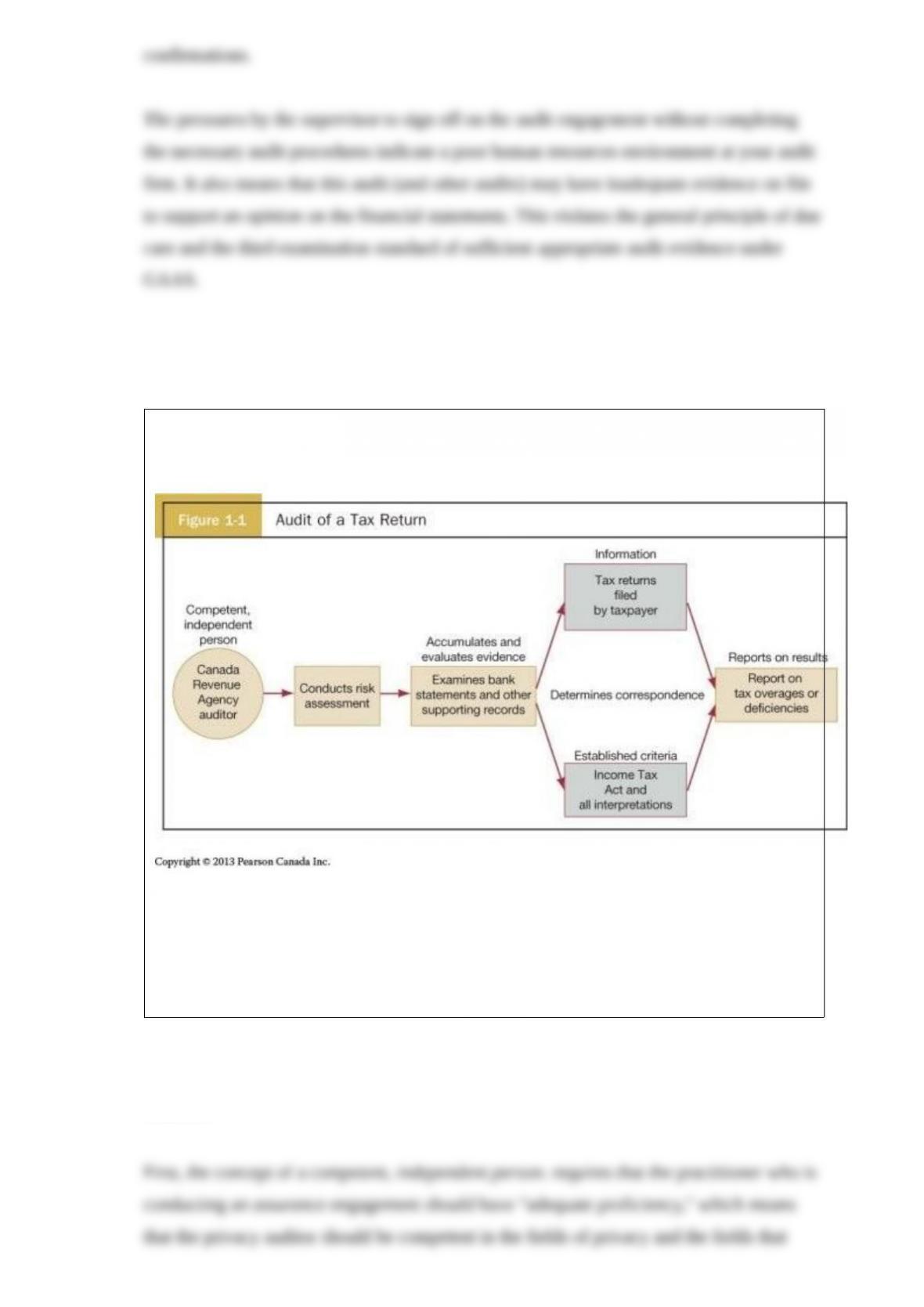
[Note: If this question is used as part of an examination question, Figure 1-1. Audit of a
Tax Return will need to be included as part of the examination.]
Use your knowledge of the definition of auditing and Figure 1-1. Audit of a Tax Return,
to explain how an auditor would conduct a privacy audit.
State the two primary types of subsequent events that require consideration by
management and evaluation by the auditor, and give two examples of each type.
State the six specific transactions-related audit objectives as related to payroll, and for
each objective, state one common test of controls that can be used to test the objective.
A financial statement audit typically consists of three sections. Identify each of the three
sections of an audit and discuss the major activities performed by the auditor in each
section.
What are the three main factors that influence the organizational structure of all Public
Accounting firms?
“This is really confusing! I’ve sat in on three audit planning meetings so far, and each
one has gone differently. I’ve been responsible for the sales section each time. Sure the
risks are all different, but in the first one I’m supposed to do flowcharts and detailed
narrative for the sales systems, in the second one I’m supposed to use the firm’s
computerized system to answer detailed questions, and in the last one the partner only
wants a brief description of the system in narrative form – no more than one page, he
said.”
Required:
Explain why it may be necessary to do different types of documentation to support an
understanding of internal controls, in the context of risks and evidence mix.
Discuss the four characteristics of the capital acquisition and repayment cycle that make
it unique from other cycles.

You are the auditor of Foundry Inc., a company that manufactures chocolate bars and
assorted candies. The description of the sales and collection cycle for Foundry is as
follow:
Clients & Credit Limits
Foundry has 50 clients as they mostly sell to grocery stores’ central purchasing
departments or distributors. For each customer, Foundry performs a credit check prior
to setting the credit limit for the client. The credit limit is reviewed each year.
In the past year, the credit limits were increased by 10%. This is due to the growth in
product lines of Foundry and increased demand from customers. This also came at the
same time the CEO of Foundry set the objective of growing the company’s revenue by
25% over the next two years. Increasing the credit limit has helped Foundry move
towards that objective.
Allowance for Doubtful Accounts
The allowance for doubtful accounts is calculated by the controller by taking a
percentage of the total sales for the month. The controller has been taking 3% of total
sales. The estimate has not been revised in the current year, but it has always been
sufficient to cover for any write-off incurred.
Required: For each of the two areas discussed above, identify the risk areas and the
most likely misstatements for Foundry.
Gonzo is an on-line dating agency. Gonzo has been in business for 5 years and has been
able to reach revenues of $1 million last year. Given its recent expansion, Gonzo’s
shareholders have required that the company’s financial statements be audited for the
first time this year. You have been assigned to the audit team for this mandate.
The senior manager asked you to review the process description for the sales of Gonzo.
The manager asked you to identify the controls in place that could be tested and used
for the audit and also, any controls that might be missing. Briefly explain the impact on
the audit.
Gonzo’s CEO provided you with the following description of their processes and
activities for the past year:
Sales
Gonzo’s web-site is operational 24 hours per day. All of the sales for Gonzo are done
on-line when the customer opens a profile. A customer will pay $50 to open a profile
and will then pay $10 per month to keep his profile active. Most customers pay on-line
with their credit cards and the sale is automatically recorded in the sales ledger of
Gonzo at the time of payment.
Gonzo also had a promotion for the last 3 months of the year. If the customer wanted to
subscribe for one year, they could pay $100 upfront to keep their profile active for the
full year instead of paying $10 each month for 12 months. This proved to be a popular
sales tactic as customers enjoyed the $20 savings.
Web-Site Security
In the past year, one hacker managed to intrude the web-site and steal the credit card
information of 25 Gonzo customers. To ensure quality of customer service, Gonzo
reimbursed a total of $10,000 to the customers to compensate them for the amounts that
were stolen as a result of the intrusion on their web-site. Since then, Gonzo hired a third
party, Mindster Box, to update the security features of their web-site. Mindster Box
performs monthly updates to the security features and monitors any intrusion attempt.
Gonzo did not have a problem since.
Collection and Reconciliation
As most of the sales are done by credit card, Gonzo receives the money from large
credit card companies on a by-weekly basis.
When the money is received from the credit card company, Jo-Ann, the accounting
manager of Gonzo, reconciles the detail of the payments received by the credit card
company to the sales ledger of Gonzo. Jo-Ann has often complained that this is nearly
impossible to do since the accounting system of Gonzo keeps track of the payment by
the on-line user name which is often very different from the actual name of the person
as stated on the detailed report provided by the credit card company.
Jo-Ann therefore mostly relies on the statement of the credit card company to record
and adjust revenues reported by Gonzo.
Discuss the internal controls related to owners’ equity that are of concern to the auditor.