Because of the low volume of purchase return transactions, the auditor normally does
not test the controls associated with these transactions.
The concept of internal control includes IT systems and manual systems.
A going concern issue requires a modification of the three-paragraph standard
unqualified audit report (public company).
Prepaid expenses provide economic benefit for longer than a year.

The occurrence assertion is being tested when the auditor vouches stock repurchases to
the canceled stock certificates.
The cutoff assertion for prepaid insurance
A. is never tested because amounts always are immaterial.
B. is best tested as part of the testing of property and equipment purchasing.
C. is best tested exclusively by sending confirmations to vendors.
D. is best tested by recomputing the unexpired portion of insurance policies in effect.
An example of an analytical procedure is the comparison of
A. Financial information with similar information regarding the industry in which the
entity operates.
B. Recorded amounts of major disbursements with appropriate invoices.
C. Results of a statistical sample with the expected characteristics of the actual
population.

D. EDP generated data with similar data generated by a manual accounting system.
An audit program for the examination of the retained earnings account should include a
step that requires verification of the
A. gain or loss resulting from disposition of treasury shares.
B. market value used to charge retained earnings to account for a two-for-one stock
split.
C. authorization for both cash and stock dividends.
D. approval of the adjustment to the beginning balance as a result of a write-down of an
account receivable.
Which of the following bodies ordinarily would have the authority to suspend or revoke
a CPA’s license to practice public accounting?
A. The SEC.
B. The AICPA.
C. A state CPA society.
D. A state board of accountancy.

Hawkins requested permission to communicate with the predecessor auditor and review
certain portions of the predecessor auditor’s working papers. The prospective client’s
refusal to permit this will bear directly on Hawkins’ decision concerning the
A. Adequacy of the preplanned audit program.
B. Ability to establish consistency in application of accounting principles between
years.
C. Apparent scope limitation.
D. Integrity of management.
Which of the following situations will not result in modification of the auditor’s report
because of a scope limitation?
A. Restriction imposed by the client.
B. Reliance placed on the report of another auditor.
C. Inability to obtain sufficient appropriate evidential matter.
D. Inadequacy in the accounting records.

Which of the following explanations might satisfy an auditor who discovers significant
debits to an accumulated depreciation account?
A. Several fully depreciated assets were retired during the year.
B. Prior years’ depreciation charges were erroneously understated.
C. A reserve for possible loss on retirement has been recorded.
D. An asset has been recorded at its fair value.
In attributes sampling, population size has little or no effect on sample size once the
population exceeds approximately
A. 1,000.
B. 5,000.
C. 100,000.
D. 1,000,000.
After issuance of the auditor’s report, the auditor has no obligation to make any further
inquiries with respect to audited financial statements covered by an auditor’s report
unless
A. a lawsuit in which risk of loss was considered remote is resolved in the company’s
favor.
B. a development occurs that may affect the entity’s ability to continue as a going

concern.
C. a material fraud is initiated by an employee after the report is issued.
D. evidence of significant, non-arms-length, related party transactions that happened
prior to year-end is discovered.
Which of the following audit procedures would be least likely to lead the auditor to find
unrecorded fixed asset disposals?
A. Examination of insurance policies for evidence of a dropped or cancelled policy.
B. Review of repairs and maintenance expense.
C. Review of property tax files.
D. Scanning of invoices for fixed asset additions for evidence of a purchase to replace a
previously owned fixed asset.
A number of factors influence the sample size for a substantive test of details of an
account balance. All other factors being equal, which of the following would lead to a
larger sample size?
A. Greater reliance on internal controls.
B. Greater reliance on analytical procedures.
C. Smaller expected frequency of misstatements.
D. Smaller measure of tolerable misstatements.

Which of the following procedures relating to the examination of accounts payable
could the auditor delegate entirely to the entity’s employees?
A. Test footings in the accounts payable ledger.
B. Reconcile unpaid invoices to vendors’ statements.
C. Prepare a schedule of accounts payable.
D. Mail confirmations for selected account balances.
Which of the following audit tests would be regarded as a test of controls?
A. Tests of the specific items making up the balance in a given general ledger account.
B. Tests comparing inventory pricing to vendors’ invoices.
C. Tests of the signatures on canceled checks to the board of directors’ authorizations.
D. Tests of the additions to property, plant, and equipment by physical inspections.

Auditors often request that the entity send a letter of inquiry to those attorneys who
have been consulted with respect to litigation, claims, and/or assessments. The primary
reason for this request is to provide the auditor with
A. an estimate of the dollar amount of the probable loss.
B. an expert opinion as to whether a loss is possible, probable, or remote.
C. information concerning the progress of cases to date.
D. corroborative inquiries made of the entity by the auditor.
Which of the following is not an audit procedure that the independent auditor would
perform with respect to litigation, claims, and assessments?
A. Inquire of and discuss with management the policies and procedures adopted for
identifying, evaluating, and accounting for litigation, claims, and assessments.
B. Obtain from management a description and evaluation of litigation, claims, and
assessments that existed at the balance sheet date.
C. Obtain assurance from management that it has disclosed all unasserted claims that
the lawyer has advised are likely to be asserted and must be disclosed.
D. Confirm directly with the entity’s lawyer that all claims have been recorded in the
financial statements.
An auditor is reviewing sales cutoff as of March 31, 2013. All sales are shipped FOB
destination and the company records sales three days after shipment. The auditor notes
the following transactions:
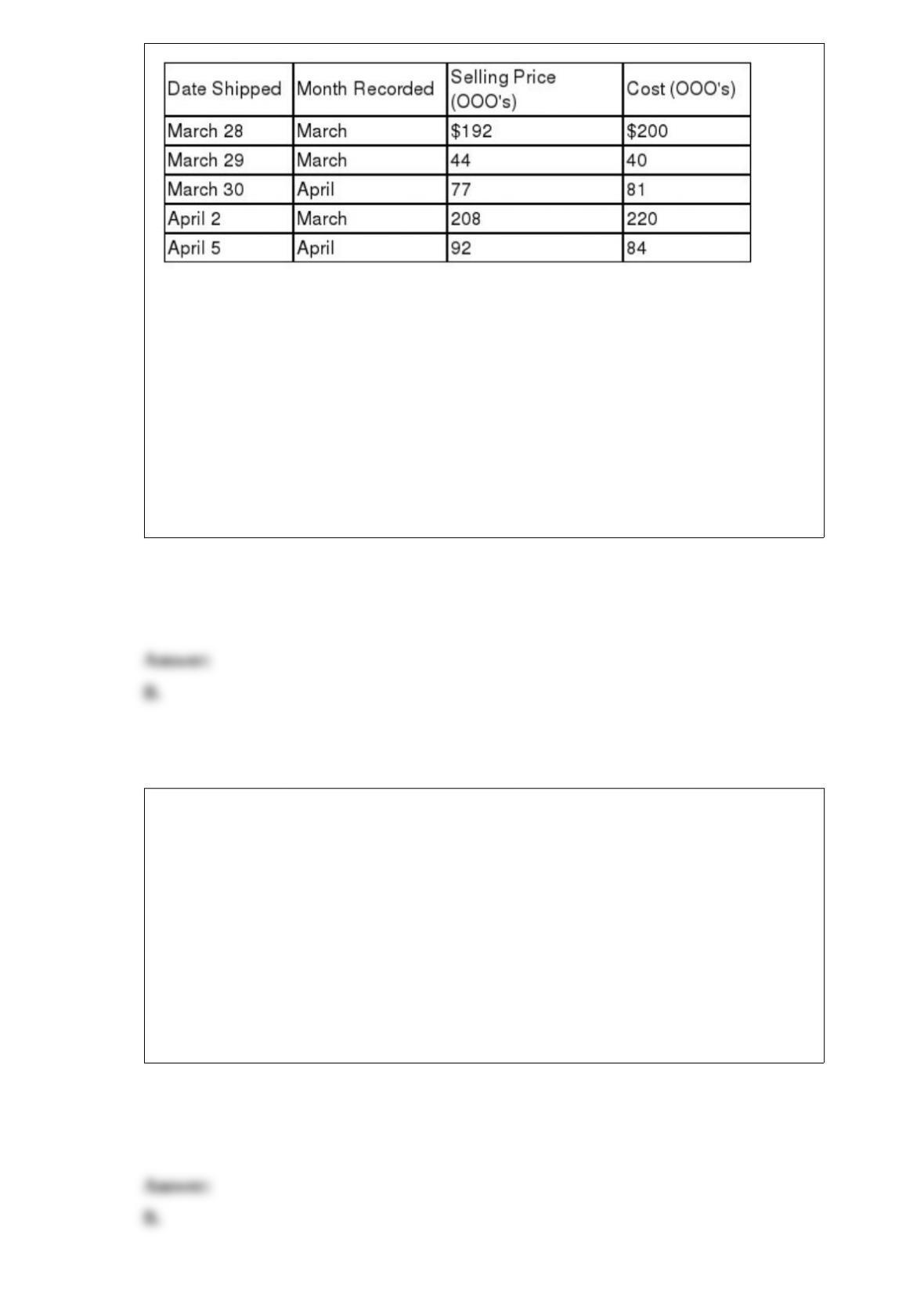
If the entity records the required adjustments, the net effect on income (in thousands of
dollars) for the period ended March 31, 2013 is
A. an increase of 12.
B. an increase of 8.
C. a decrease of 12.
D. a decrease of 8.
The independent auditor selects several transactions in each functional area and traces
them through the entire system, paying special attention to evidence about whether or
not the control activities are in operation. This is an example of a(n)
A. Analytical procedure.
B. Test of controls.
C. Substantive procedure.
D. Functional test.

On February 25, a CPA issued an auditor’s report expressing an unqualified opinion on
financial statements for the year ended January 31. On March 2, the CPA learned that,
on February 11, the entity incurred a material loss on an uncollectible trade receivable
as a result of the ongoing deterioration of the financial condition of the entity’s principal
customer, which finally led to the customer’s bankruptcy. Management then refused to
adjust the financial statements for this subsequent event. The CPA determined that the
information is reliable and that there are creditors currently relying on the financial
statements. The CPA’s next course of action most likely would be to
A. notify the entity’s creditors that the financial statements and the related auditor’s
report should no longer be relied upon.
B. notify each member of the entity’s board of directors about management’s refusal to
adjust the financial statements.
C. issue revised financial statements and distribute them to each creditor known to be
relying on the financial statements.
D. issue a revised auditor’s report and distribute it to each creditor known to be relying
on the financial statements.
Based on a study and evaluation completed at an interim date, the auditor concludes
that no significant internal control weaknesses exist. The records and procedures would
most likely be tested again at year-end if
A. Compliance tests were not performed by the internal audit staff during the remaining
period.
B. The internal control system provides a basis for reliance in reducing the extent of
substantive procedures.
C. The auditor used nonstatistical sampling during interim compliance testing.
D. Inquiries and observations lead the auditor to believe that conditions within the
internal control system have changed.

Analytical procedures are
A. Never required.
B. Required for planning, substantive testing, and overall review of the financial
statements.
C. Required for planning and overall review of the financial statements.
D. Required during planning only.
You are auditing a manufacturing company that has a large production facility. Some of
the production equipment is held through lease agreements. Which of the following is
the account balance assertion you would be most concerned about?
A. Existence or occurrence.
B. Completeness.
C. Rights and obligations.
D. Accuracy.

Which of the following would best be described as an assurance service?
A. Preparing a report representing a client’s position during an IRS audit.
B. Working with a company to develop a more efficient method of processing financial
transactions.
C. Offering an opinion concerning the accuracy of statements made on an entity’s
website relating to its online privacy policies.
D. Assisting a company in identifying potential sources of capital for potential
acquisitions.
An auditor is preparing to sample an entity’s customer receivables for overstatement. A
statistical sampling method that automatically provides stratification when using
systematic selection is
A. attribute sampling.
B. ratio-estimation sampling.
C. monetary-unit sampling.
D. mean-per-unit sampling.
Which of the following is not an element of quality control as defined by Statement of
Quality Control Standards No. 8?
A. Monitoring.

B. Independence.
C. Human resources.
D. Relevant ethical requirements.
A voucher
A. is a bill from the vendor.
B. is a document that records the receipt of goods.
C. is a document that requests goods from an authorized individual in the entity.
D. serves as the basis for recording a vendor’s invoice in the purchases journal.
The accounting department reports that the balance of accounts receivable is $210,000.
You are willing to accept that balance if audit sampling suggests it is within $15,000 of
the actual balance. Using a classical variables sampling plan, you compute a 95%
confidence interval of $208,000 to $225,000. You would therefore
A. not be able to determine the acceptability of the receivable balance.
B. accept the balance but with a lower level of confidence.
C. take a larger sample before totally rejecting the balance and requiring adjustments.
D. accept the $210,000 balance because the confidence interval is within the materiality
limits.

When there has been a change in accounting principle that materially affects the
comparability of the comparative financial statements presented for a public company
and the auditor concurs with the change, the auditor should
Concur Explicitly
In the Change Issue an “Except for”
Qualified Opinion Refer to the Change in an Explanatory Paragraph
A. No No Yes
B. Yes No Yes
C. Yes Yes No
D. No Yes No

Which of the following factors most likely would heighten an auditor’s concern about
the risk of fraudulent financial reporting?
A. Inability to generate cash flows from operations while reporting substantial earnings
growth.
B. Management’s lack of interest in increasing the entity’s earnings trend.
C. Large amounts of liquid assets that are easily converted into cash.
D. Inability to borrow necessary capital without granting debt covenants.
A flowchart is most frequently used by an auditor in connection with the
A. Preparation of generalized computer audit programs.
B. Review of the entity’s internal controls.
C. Use of statistical sampling in performing an audit.
D. Performance of analytical procedures of account balances.
The Public Company Accounting Oversight Board’s role is to
A. Conduct the final review of auditors’ work before the auditor’s opinion is issued.
B. Oversee the auditors of public companies in order to protect the interests of
investors.
C. Conduct audits of governmental entities.

D. Sanction auditors who fail to follow GAAS.
Of the following, which is the most important procedure that an auditor should use
when making an overall review of the income statement?
A. Select sales and expense items and trace amounts to related supporting documents.
B. Compare actual revenues and expenses with the corresponding figures of the
previous year and investigate significant differences.
C. Obtain, from the proper entity representative, inventory certificates for the beginning
and ending inventory amounts that were used to determine cost of sales.
D. Ascertain that the net income amount in the statement of cash flows agrees with the
net income amount in the income statement.
Tracing costs used to price inventory to vendors’ invoices test which of the following
assertions?
A. Occurrence.
B. Cutoff.
C. Accuracy.
D. Classification.

Which of the following control activities would an entity most likely use to assist in
satisfying the completeness assertion related to long-term investments?
A. Senior management verifies that securities in the bank safe-deposit box are
registered in the entity’s name.
B. The internal auditor compares the securities in the bank safe-deposit box with
recorded investments.
C. The treasurer vouches the acquisition of securities by comparing brokers’ advices
with canceled checks.
D. The controller compares the current market prices of recorded investments with the
brokers’ advices on file.
As the acceptable level of detection risk decreases, the assurance directly provided from
A. Substantive procedures should increase.
B. Substantive procedures should decrease.
C. Tests of controls should increase.
D. Tests of controls should decrease.
After fieldwork audit procedures are completed, a partner of the CPA firm who has not
been involved in the audit performs a second or wrap-up review of the working papers.
This second review usually focuses on
A. the audit report, financial statements, and footnotes for consistency.
B. irregularities involving the entity’s management and its employees.
C. the materiality of the adjusting entries proposed by the audit staff.
D. the communication of internal control weaknesses to those charged with governance.
In nonstatistical sampling, describe the two methods auditors use to project sample
results to the population. How does an auditor determine which method to use?
There are several types of audit services that are provided by auditors. Identify and
define three of these types of audits.
State the two primary purposes of the management representation letter.
Name and describe three supervisory activities that should be performed by the
engagement partner and other engagement team members performing supervisory
activities.
While performing an audit on the internal controls over financial reporting for
AirWaves Corporation, your audit team finds what it considers to be a significant
deficiency. AirWaves is a large, private company. What steps would you take to
communicate this finding?
Discuss an overview of the financial statement audit process using the terms
“assertion,” “evidence,” and “report.”
There are a number of important disclosure items to consider when auditing the
property management process. List two. Where in the financial statements can some of
the disclosures relating to property, plant, and equipment be found?
The most restrictive view under common law is that auditors have no liability to third
parties who do not have a privity relationship with the auditor. Briefly define privity
and the effect it has on the auditor, client, investors, and creditors under common law.
What are two potential benefits and two potential risks of using IT for an entity’s
internal control?
Discuss the reliability of the types of audit evidence and identify the level of reliability
for each type of evidence.
Discuss the purposes for planning the audit and identify the steps that are performed
during this phase of the engagement.
Identify the types of transactions that occur in the property management process.
Define “information asymmetry” and discuss it in the context of the financial markets.
Include in your discussion how information asymmetry is reduced.
Name two management assertions pertaining to the inventory account balance and
explain why they are considered in an audit.
Distinguish between the following theories of ethical behavior: utilitarianism, a
rights-based approach, and a justice-based approach.
Describe the two types of confirmations and indicate which one is more reliable and
why.
You are auditing SBT, which has a December 31st year-end. On December 24th, the
person responsible for processing receiving reports and recording the receipt of
inventory became very ill and was out of the office for a week. Due to the company’s
small staff and the holiday season, a number of the receiving reports were not processed
on a timely basis. As an auditor, on which assertion would you place a high importance
for this entity and how would you test for it?