Dividends are subtracted from revenues on the income statement.
Answer:
If a company factors its receivables, its receivables turnover ratio will be lower than it
would have been if the receivables had not been factored.
Answer:
Which of the following statements isTRUE?
A. Accrual-based net income can be manipulated because it is based on estimates.
B. Cash flows are easily manipulated because they are based on estimates.
C. Accrual-based net income is not easily manipulated because valuation for such items
as bad debts and inventory are precise and based on objectively verifiable information.
D. Cash flows are not easily manipulated because they are generated by internal
transactions and do not involve external parties.
Answer:
A physical count of inventory is performed annually in both a perpetual inventory
system and a periodic inventory system.
Answer:
Which of the following statements about retained earnings isTRUE?
A. Retained earnings is the amount of cash that the company has retained since its
inception.
B. Retained earnings is the amount of creditors’ claims on assets.
C. Retained earnings is increased when treasury stock is reissued at a price greater than
its cost.
D. Retained earnings is decreased by cash dividends and stock dividends.
Answer:
LIFO is preferred when costs are rising because managers will benefit from larger
bonuses and better performance reviews.
Answer:
Inaccurately counted inventory levels reduce a company’s net income, either by
increasing cost or reducing revenue.
Answer:
The period of time from buying goods and services to collecting cash from customers is
called the accounting cycle.
Answer:
If the total dollar value of credits to an account exceeds the total dollar value of debits
to that account, the ending balance of the account will be a debit balance.
Answer:
Corporate income taxes cannot be calculated until all other adjustments are made.

Answer:
Which one of the following statements regarding the trial balance isTRUE?
A. A trial balance is included in the full set of external financial statements, just like an
income statement.
B. If debits equal credits in the unadjusted trial balance, you have made no errors in
preparing and posting journal entries.
C. The balances for each account reported on an unadjusted trial balance are determined
by adding the amounts on the “+” side and subtracting the amounts on the “-” side of
each ledger or T-account.
D. GAAP allows companies to choose between the cash basis or the accrual basis of
accounting.
Answer:

Which of the following statements isTRUE?
A. Depreciation allocates the cost of tangible assets over their useful lives.
B. Depreciation allocates the cost of intangible assets over their useful lives.
C. Amortization allocates the cost of tangible assets over their useful lives.
D. The term “depreciation” relates to all long-lived assets whereas “amortization”
relates only to intangible assets.
Answer:
The net amount of a bond liability that appears on the balance sheet is equal to the face
value of the bond plus any related discount or minus any related premium.
Answer:
Which of the following statements regarding inventory counts is notTRUE?
A. Companies need to perform a physical count of their inventory at least yearly
regardless of which inventory system is being used.
B. A perpetual inventory system does not require a physical count during the accounting
period to determine cost of goods sold.
C. In a perpetual inventory system, the inventory count is compared to the inventory
account balance to reveal shrinkage.
D. If a company uses a perpetual inventory system and the inventory count at the end of
the accounting period is greater than the balance in the inventory ledger account, there
must have been shrinkage.
Answer:
It is possible for a company to be profitable, yet not have enough cash to pay its bills.
Answer:

Interest on a two-month, 7%, $1,000 note would be calculated as $1,000 x 0.07 x 2.
Answer:
Which of the following is notTRUE for a 10-year bond issued at a discount?
A. At the end of ten years, the balance in the Discount on Bonds Payable account will
equal 0.
B. At the end of ten years, the carrying value will equal the face value.
C. At the end of ten years, the total interest expense will reflect the market rate of
interest.
D. At the end of ten years, the total interest expense will equal the total interest paid.
Answer:
Which of the following statements regarding the receivables turnover ratio isTRUE?
A. The receivables turnover ratio indicates how many times, on average, the process of
selling to and collecting from customers occurs during the accounting period.
B. Companies of similar size in different industries tend to have similar receivables
turnover ratios.
C. A high turnover ratio may suggest the company is allowing too much time for
customers to pay.
D. The days to collect ratio is found by dividing the receivables turnover ratio by 365
days.
Answer:
Retained earnings is the cumulative earnings of a company which have not been
distributed to owners, and is the same as the amount of cash in the bank.
Answer:
Choose theTRUE statement.
A. All asset accounts have a normal debit balance with the exception of cash which has
a normal credit balance.
B. The Contributed Capital account is increased by debits.
C. When payment is made on a liability such as accounts payable, the liability account
is decreased with a debit.
D. The total amount of debits to asset accounts must equal the total amount of credits to
liability and stockholders’ equity accounts.
Answer:
Which of the following statements isTRUE?
A. Because gross profit percentages are so consistent from period to period, they are not
very useful for analyzing one company over time.
B. Because gross profit percentages are so variable across industries, they are most
useful in comparing companies from different industries.
C. Because gross profit percentages are so variable across industries, they are more
useful in analyzing one company over time.
D. Because gross profit percentages are so consistent across industries, they are most
useful in comparing companies from different industries.
Answer:
A stock split increases total stockholders’ equity.
Answer:
Your company has net sales of $468,300 and average trade receivables of $111,500 for
the year. Which of the following isTRUE? (Round all calculations to one decimal
place.)
A. The receivables turnover ratio is 4.2 and the days-to-collect is 0.01.
B. The receivables turnover ratio is .2 and the days-to-collect is 1,520.
C. The receivables turnover ratio is 4.2 and the days-to-collect is 86.9.
D. The receivables turnover ratio is .2 and the days-to-collect is 87.6.
Answer:
In the United States, generally accepted accounting principles (GAAP) are established
by the PCAOB (Public Company Accounting Oversight Board).
Answer:
Which of the following statements regarding journal entries under a perpetual inventory
system isTRUE?
A. “Freight-out” or delivery costs associated with sales should be included in the cost of
goods sold amount.
B. When a company receives payment from a customer for a sale, cash is debited and
accounts payable is credited.
C. When a company grants an allowance to a customer, inventory is credited when
using a perpetual inventory system.
D. When a customer returns inventory, the seller debits sales returns and allowances
under a perpetual inventory system.
Answer:
Creditors are mainly interested in the profitability of a company.
Answer:

Which of the following statements regarding distribution of financial information is
notTRUE?
A. A company does not issue a press release containing financial data until the data
have been checked by management.
B. Company filings with the SEC, such as Forms 10-K and 10-Q, are available to the
public.
C. SEC filings are available to the public after they are received by the SEC’s EDGAR
service.
D. An audit involves an examination of every transaction that occurred during the year
by an independent auditor.
Answer:
Company A uses an accelerated depreciation method while Company B uses the
straight-line method for an asset of the same cost and useful life. Which of the
following statements isTRUE?
A. Company A will have higher depreciation expense in the early years, but Company
B will have the higher expense towards the end of the asset’s useful life.
B. Company A will consistently have higher depreciation expense until residual value is
reached.
C. Company B will have higher depreciation expense in the early years, but Company A
will have the higher expense towards the end of the asset’s useful life.
D. Company B will consistently have higher depreciation expense until residual value is
reached.
Answer:
To evaluate a company’s net profit margin, it is best to compare it to another company
in the same industry.
Answer:
Which of the following is notTRUE?
A. The multiple-step income statement includes subtotals which separate core and
peripheral results.
B. The multiple-step income statement includes the subtotal of income before income
tax expense.
C. The statement of stockholders’ equity is another name for the statement of retained
earnings.
D. Comparative financial statements report numbers for two or more periods.
Answer:
According to the full disclosure principle, financial reports should present detailed
information about every transaction.
Answer:
A contingent liability is recorded by making an appropriate journal entry if the
likelihood of a loss is possible.

Answer:
Which of the following statements regarding nonrecurring and other special items
isTRUE?
A.Some special items, such as changes in the value of certain balance sheet accounts,
are excluded from the calculation of net income.
B. Nonrecurring items such as discontinued operations are presented above the income
tax expense line on the income statement.
C. Discontinued operations are reported net of tax as part of the income from
continuing operations.
D. The cumulative effect of change in accounting principles is reported on the income
statement as part of income from continuing operations.
Answer:
In this period, a company recorded sales revenue of $50,000 from sales of goods to
customers who agreed to pay later. In the next period, the company received payment
from customers of $45,000. Choose theTRUE statement.
A. Revenue for this period is $45,000.
B. Accounts receivable at the end of this period is $50,000.
C. Accounts payable at the end of this period is $5,000.
D. Cash for next period will increase by $50,000.
Answer:
One of the purposes of the closing entries is to bring the balances in all asset, liability,
revenue, and expense accounts down to zero to start the next accounting period.
Answer:
Generally accepted accounting principles (GAAP) require that the inventory be
reported at:

A. market value.
B. historical cost.
C. lower of cost or market.
D. retail value.
Answer:
On October 1, 2013, you borrow $200,000 at 6% interest and record the promissory
note. In April and again in October of the following year, you are required to pay half
the annual interest to your creditor. On December 31, 2013, your adjusting journal entry
for the quarter should:
A. debit Interest Expense for $3,000 and credit Interest Payable for $3,000.
B. debit Interest Payable for $3,000 and credit Interest Expense for $3,000.
C. debit Interest Expense for $6,000 and credit Cash for $6,000.
D. debit Interest Expense for $6,000 and credit Interest Payable for $6,000.
Answer:
The direct write-off method for uncollectible accounts is required
A. by the IRS.
B. by GAAP
C. by IFRS.
D. for external financial reporting.
Answer:
In January, a company pays for advertising space in the local paper for ads to be run
during the months of January, February, and March at $1,500 a month. The payment
would be recorded in January as a:
A. debit of $4,500 to Cash, a credit of $1,500 to Advertising Expense, and a credit of
$3,000 to Prepaid Advertising.
B. debit of $4,500 to Accounts Payable and a credit of $4,500 to Cash.
C. debit of $4,500 to Accounts Payable and a credit of $4,500 to Stockholders’ Equity.
D. debit of $1,500 to Advertising Expense, a debit of $3,000 to Prepaid Advertising,
and a credit of $4,500 to Cash.
Answer:
The perpetual inventory method of tracking inventory is considered superior to the
periodic method because the perpetual method:
A. makes calculations easier and less technology can be deployed.
B. tells what inventory a company should have at any point in time.
C. saves a company from ever having to count the goods in inventory.
D. is more consistent with how companies calculated inventory in the past.
Answer:
Contra-revenue accounts:
A. are balance sheet accounts.
B. increase net income.
C. are increased with a debit.
D. increase net sales.
Answer:
B. Darin Company purchased land at a cost of $15,000 and planned to se it to construct
a new storage facility on the property. A short time later, the company changed its plans
and sold the property to S. Dee Company for $15,000. S. Dee Company promised to
pay cash in 60 days.
Which of the following would be part of the journal entry by B. Darin Company to
record the sale of the property?
A. Credit Accounts receivable
B. Debit Cash
C. Credit Land
D. Debit Accounts payable

Answer:
How competitors calculate depreciation is most likely to affect comparisons between
competitors if property, plant and equipment:
A. makes up a large percentage of assets and average useful lives are fairly different.
B. makes up a small percentage of assets and assets are financed in a different way.
C. makes up a small percentage of assets and average useful lives are fairly similar.
D. is primarily leased in the industry, not purchased.
Answer:
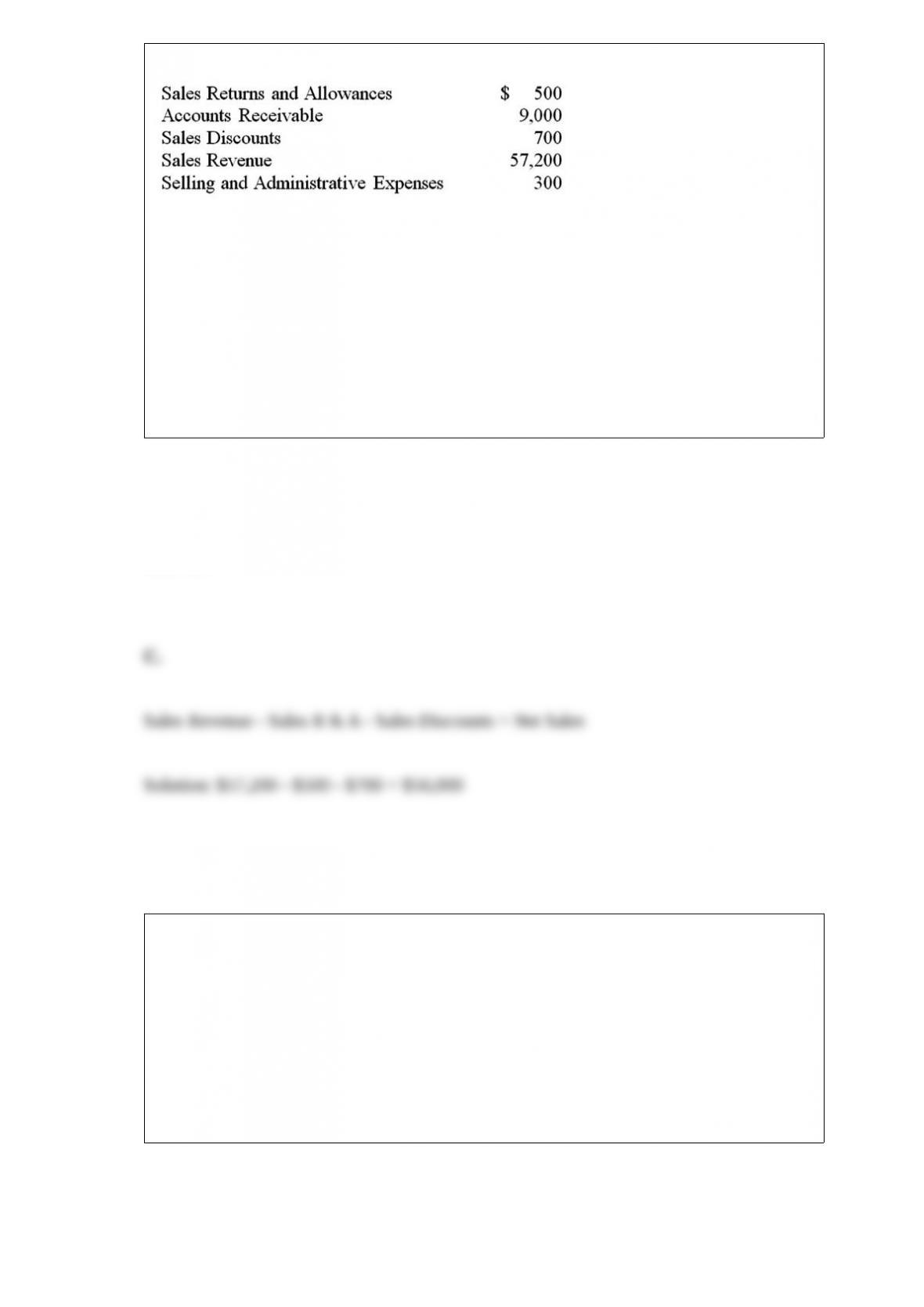
A company had the following partial list of account balances at year-end:
The amount of net sales reported on the income statement would be:
A. $57,200.
B. $64,200.
C. $56,000.
D. $55,700.
Answer:
Accumulated depreciation:
A. is an expense account.
B. is a liability account.
C. is an asset account.
D. is a contra-asset account.

Answer:
The Return on Equity ratio is calculated as:
A. dividends paid divided by the average book value of stockholders’ equity.
B. net income divided by the average number of outstanding common shares.
C. dividends divided by the average number of total shares.
D. net income divided by average stockholders’ equity.
Answer:
Which of the following would be the best investment?
A. A company that pays no dividends, but has substantial net income.
B. A company that pays substantial dividends, but whose earnings per share has been
declining over the past several years.
C. A company whose stock price has increased steadily, but pays no dividends.
D. It depends on one’s investment objectives.
Answer:
Performance-based bonuses DO NOT give managers a personal incentive to:
A. increase sales and enhance company growth.
B. decrease expenses and boost efficiency.
C. misrepresent financial data on company performance.
D. overstate liabilities of the company.
Answer:
What would a financial statement user learn from reading the auditors’ report?
A. Whether the financial statements present a fair picture of the company’s financial
results and are prepared in accordance with GAAP.
B. Whether or not it is a good time to purchase the stock.
C. How much the company plans to distribute as dividends.
D. Whether or not the company has plans for future expansion.
Answer:
Choose the appropriate letter to match the term and the definition. Not all definitions
will be used.
Term:
_______ 1/ Operating activities
_______ 2/ Indirect method
_______ 3/ Working capital
_______ 4/ Cash equivalents
_______ 5/ Investing activities
_______ 6/ Supplemental disclosures
_______ 7/ Direct method

_______ 8/ Financing activities
Definition:
A. Includes such events as the receipt of dividends and interest on investment assets.
B. Includes assets that are very liquid and are purchased by the entity within three
months of maturity.
C. These activities include only purchases made with borrowed funds.
D. Where cash flows from operating activities are calculated by converting each
revenue and expense item from an accrual to a cash basis.
E. This ratio uses net income instead of operating cash flow to analyze a company’s
ability to finance the cost of its debt.
F. Measures the ability of a company to finance its interest payments with its operating
cash flow before taxes and interest.
G. A measure of the amount by which current assets exceed current liabilities.
H. These activities include money lent by a company as well as money borrowed by a
company.
I. Must include cash paid for interest and income tax in a separate schedule.
J. The purchases and sales of investments and long-lived assets.
K. These activities include changes in a company’s debt or its stockholders’ equity
accounts.
L. Where cash flows from operating activities are calculated by making adjustments to
net income.
Answer:
At the beginning of the first quarter, your company borrows $20,000 for four years at
8% interest and has to repay $5,000 of principal each year. Interest is paid at the end of
the second and fourth quarters, and the principal is due at the end of the year.
Use the information above to answer the following question. How would this
information be reported on the balance sheet at the end of the first quarter?
A. $400 as interest expense and $20,000 under long-term debt.
B. $400 as interest payable, $5,000 as current portion of long-term debt under current
liabilities, and $15,000 under long-term debt.
C. $1,600 of interest under current liabilities, $5,000 as current portion of long-term
debt under current liabilities and $15,000 under long-term debt.
D. $400 as interest payable under current liabilities and $20,000 under long-term debt.
Answer:
Divergence between net income and cash flow may be due to any of the following
except
A. use of the direct method of presenting cash flows from operations.
B. the company being brand new.
C. fraudulent financial reporting.
D. seasonal variations in a company’s operations.
Answer:
Cash flows from investing activities include cash:
A. inflows and outflows reflecting revenues and expenses.
B. outflows from the sale of long-term investments.
C. inflows from the sale of long-term investments.
D. inflows from the sale of a company’s own stock to its stockholders.
Answer:
Which of the following is not a SOX requirement?
A. SOX establishes a requirement for a tip line for employees to report questionable
acts.
B. SOX requires the external auditors to issue a report on the effectiveness of internal
controls.
C. SOX increases the maximum fines for individuals who commit fraudulent acts.
D. SOX requires management to report on the effectiveness of internal controls and to
make it clear that they are not responsible for the internal control system.
Answer:
Use the information above to answer the following question. If the units-of-production
method is used, the depreciation rate is:
A. $0.95 per unit.
B. $0.19 per unit.
C. $0.05 per unit.
D. $1.00 per unit.
Answer:

Unearned insurance premiums were $5,500 at the beginning of the year and $7,500 at
the end of the year. Insurance premiums collected were $42,000. How much in
insurance premiums were earned this year?
A. $40,000
B. $44,000
C. $55,000
D. $29,000
Answer:
Which of the following would not affect a company’s net income?
A. A change in the company’s income taxes.
B. Changing the selling price of a company’s product.
C. Paying a dividend to stockholders.
D. Advertising a new product.
Answer:
Which of the following is not a characteristic of tangible long-lived assets?
A. productive
B. used for a year or more
C. not for resale
D. amortized over their useful life
Answer:
Which of the following measures would assist in assessing the solvency of a company?
A. Debt-to-assets ratio.
B. Fixed asset turnover ratio.
C. Return on equity ratio.
D. Quick ratio.
Answer:
What is the minimum number of accounts that must be involved in any transaction?
A. One
B. Two
C. Three
D. There is no minimum.
Answer:
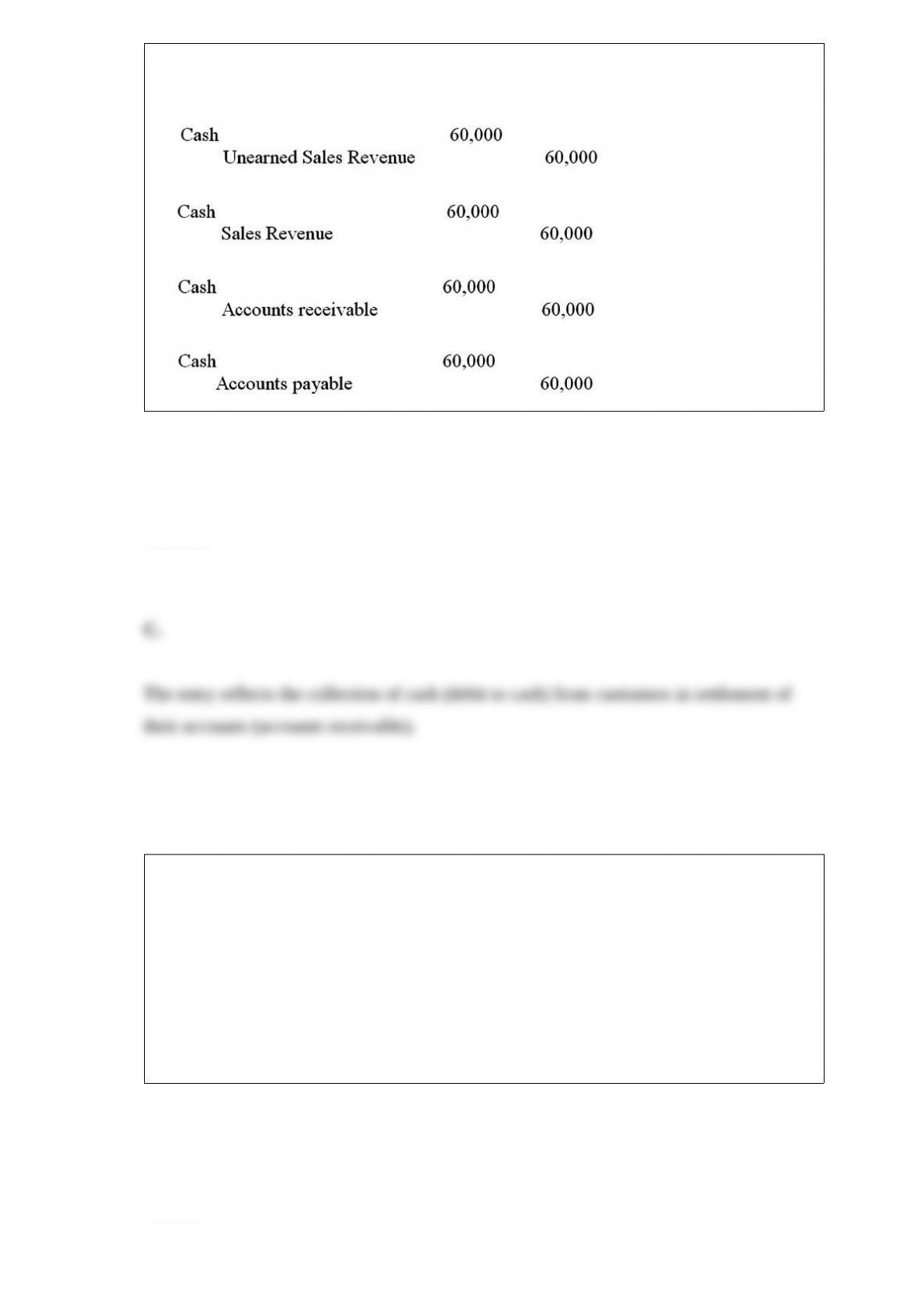
The correct entry by Seconds Best Company to record the receipt of payment in the
current month is:
A.
B.
C.
D.
Answer:
Which of the following would appear in the credit column of an adjusted trial balance?
A. Income tax payable.
B. Depreciation expense.
C. Prepaid insurance.
D. Interest receivable.
Answer:
The standard formatting for a journal entry lists the dollar amounts for:
A. credits underneath and to the right of the dollar amounts for debits.
B. debits and credits aligned equally to the right.
C. debits underneath and to the right of the dollar amounts for credits.
D. debits and credits aligned equally to the left.
Answer:
Central Company sold goods for $5,000 to Western Company on March 12 on credit.
Terms of the sale were 2/10, n/30. At the time of the sale, Central recorded the
transaction by debiting accounts receivable for $5,000 and crediting sales revenue for
$5,000. Western paid the balance due, less the discount, on March 21. To record the
March 21 transaction, Central would debit:
A. Cash for $4,900.
B. Accounts Receivable for $4,900.

C. Cash for $5,000.
D. Accounts Receivable for $5,000.
Answer:
A company’s quarterly income statements show that in the last three quarters both sales
revenue and net income have been falling. Which of the following conclusions drawn
by users are valid, given this information?
A. Creditors are likely to conclude that the risk of lending to the company is falling and
might be willing to accept a lower interest rate on loans.
B. Investors are likely to conclude that the stock price is likely to rise, making the
company more attractive as a potential investment.
C. Customers are likely to conclude that the company is struggling, therefore it is
permissible to take longer to pay amounts they owe to the company.
D. Owners may conclude that the company will be less likely to distribute dividends.
Answer:

Presented below are selected accounts from the unadjusted trial balance of Sneetch Star
Makers Inc., a talent agency, at 12/31/13 (debit and credit labels have been omitted;
assume all balances are normal).
A count of supplies revealed $400 worth on hand at 12/31/13. The adjusting entry
would include
A. a debit to supplies expense for $400.
B. a debit to supplies expense for $600.
C. a debit to supplies for $400.
D. a debit to supplies for $600.
Answer:
Creditors are:
A. people or organizations who owe money to a business.
B. people or organizations to whom a business owes money.
C. stockholders of a business.
D. customers of a business.
Answer:
Identify the category to which each of the following assets belongs.
T – tangible long-lived asset

I – intangible long-lived asset
N – not a long-lived asset
______ 1/ Warehouse
______ 2/ Licensing rights
______ 3/ Supplies
______ 4/ Patents
______ 5/ Production equipment
______ 6/ Goodwill
______ 7/ Land
______ 8/ Office computer
Answer:
Last year bell-bottom jeans were fashionable and this year boot cut jeans are in style. A
retail company’s inventory has 375 bell-bottom jeans that cost $17 each and could be
replaced for $15. The inventory also includes 1,000 boot cut jeans that cost $16 each
and could be replaced for $19. Explain why this situation requires an adjustment to the
accounting records, prepare the journal entry that would be used to make the
adjustment, and show the effects of the adjustment on the accounting equation.
Answer:
Adventure Company uses the aging of accounts receivable method to estimate bad debt
expense. The balance of each account receivable is aged on the basis of three categories
as follows: (1) 1-30 days old, (2) 30-90 days old, and (3) more than 90 days old.
Experience has shown that for each age group, the average loss rate on the amount of
the receivable due to uncollectibility is (1) 1%, (2) 15%, and (3) 40%, respectively. At
December 31, 2014, the unadjusted balance in the Allowance for Doubtful Accounts
was $100 (credit), and the total amounts receivable in each category were: (1) 1-30 days
old, $65,000, (2) 30-90 days old, $10,000, and (3) more than 90 days old, $4,000.
Calculate the balance that should be reported in the Allowance for Doubtful Accounts at
December 31, 2014, and prepare the appropriate bad debt expense adjusting entry at
December 31, 2014.
Answer:

Indicate whether the inventory account is debited (Dr), credited (Cr), or neither (N)
when using a perpetual inventory system to record each of the following transactions:
_____ 1/ The company purchases $3,000 of goods intending to sell them to customers.
_____ 2/ The company returns $200 of damaged goods to the supplier.
_____ 3/ The company pays a shipping firm $685 to ship an order of goods from the
supplier to the company.
_____ 4/ The company receives a purchase discount for prompt payment to a supplier.
_____ 5/ Customers return $550 of goods in excellent condition to the company.
_____ 6/ The company sells $4,600 of goods to consumers.
_____ 7/ The company purchases $1,600 of supplies intending to use them internally.
_____ 8/ The company gives a sales discount for prompt payment to customers.
_____ 9/ The company does a physical count and finds three items missing due to
shrinkage.
Answer:
Match the letter with each item below to indicate how net income is adjusted when
using the indirect method to determine net cash flow from operating activities.
A – Add item to net income
S – Subtract item from net income
N – No adjustment necessary
_______ 1/ decrease in property, plant and equipment
_______ 2/ increase in accounts receivable
_______ 3/ decrease in inventory
_______ 4/ decrease in prepaid expenses
_______ 5/ increase in accounts payable
_______ 6/ decrease in accrued liabilities
_______ 7/ decrease in income tax payable
_______ 8/ increase in dividends payable
_______ 9/ gain on sales of property, plant and equipment
_______ 10/ depreciation
Answer:
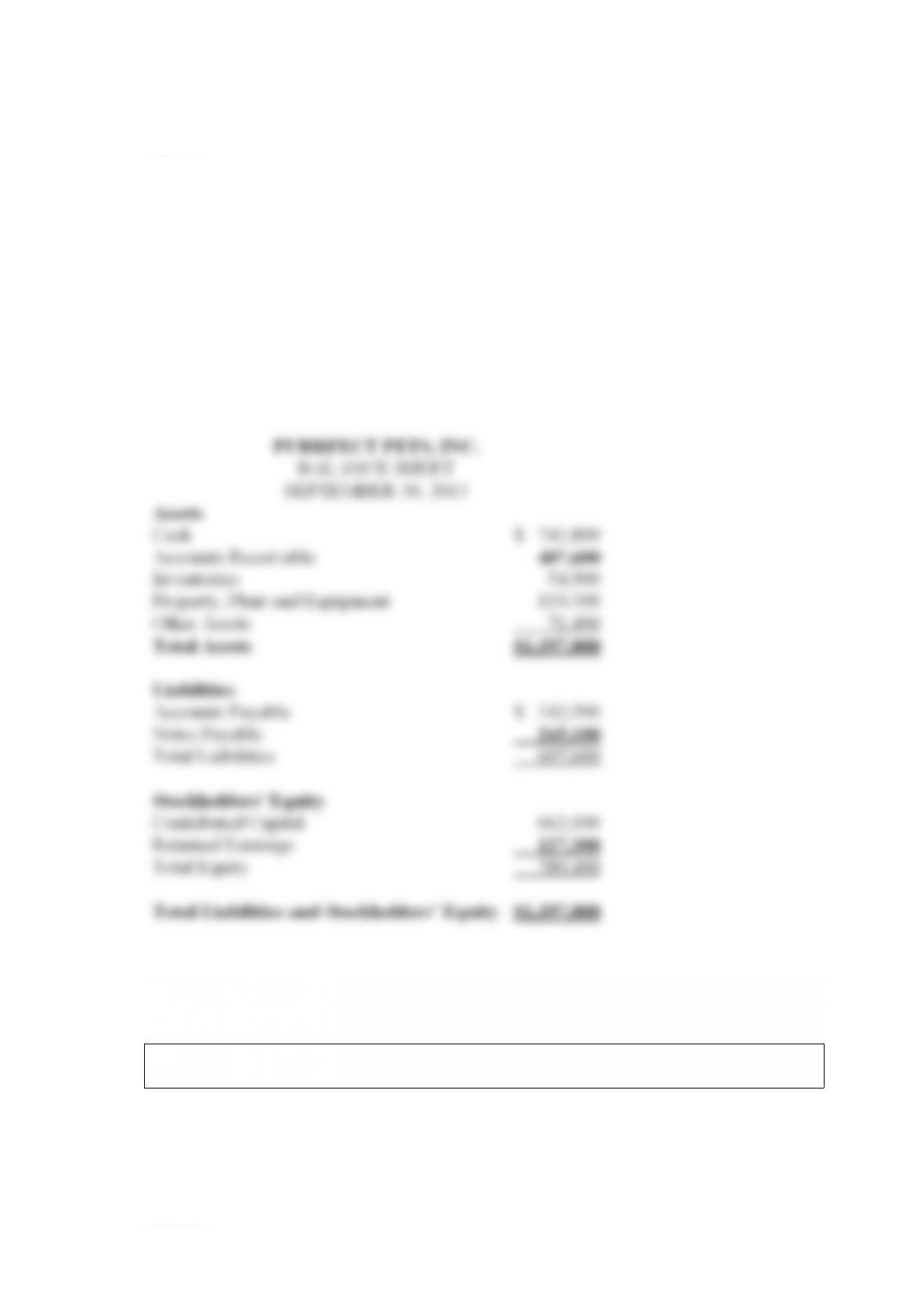
Fill in the missing items in the balance sheet.
Answer:
Answer:
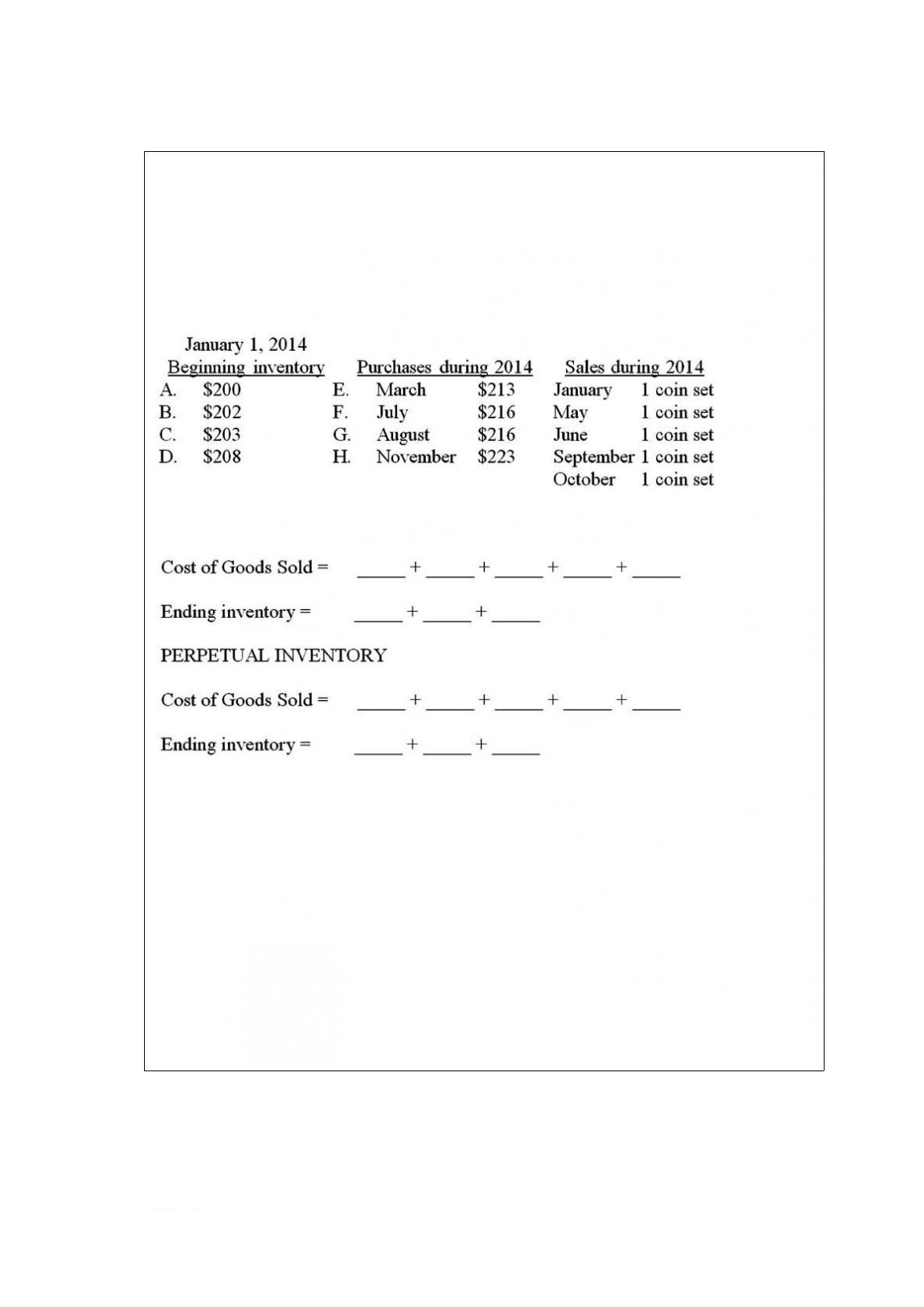
The following company buys and sells identical collectors’ coin sets. The company uses
LIFO. In the first two columns below, each coin set is identified by its letter and its cost.
The third column indicates when coin sets were sold.
For each inventory costing method given below, fill in the blanks to indicate the letter
of the coin set which will be used to calculate either cost of goods sold or the cost of
ending inventory.
PERIODIC INVENTORY: Inventory is taken on December 31, 2014.
This example shows the cost of the coin sets increasing over time. Using the symbols
“>” (greater than), ” = ” (equals), or “<” (less than), complete the following
comparisons by filling in the blanks in the statements below.
Using LIFO with increasing costs, cost of goods sold under periodic inventory _____
cost of goods sold under perpetual inventory.
Using LIFO with increasing costs, ending inventory under periodic inventory _____
ending inventory under perpetual inventory.
Using LIFO with increasing costs, net income under periodic inventory _____ net
income under perpetual inventory.
Answer:
For each of the following, indicate if the asset would be depreciated, amortized or
neither.
D – Depreciate
A – Amortize
N – Neither
_____ 1/ Transportation equipment
_____ 2/ Copyright
_____ 3/ Licensing rights
_____ 4/ Office equipment
_____ 5/ Goodwill

_____ 6/ Patents
_____ 7/ Self-constructed buildings
_____ 8/ Land
_____ 9/ Production equipment
_____ 10/Trademark
Answer:
Answer:
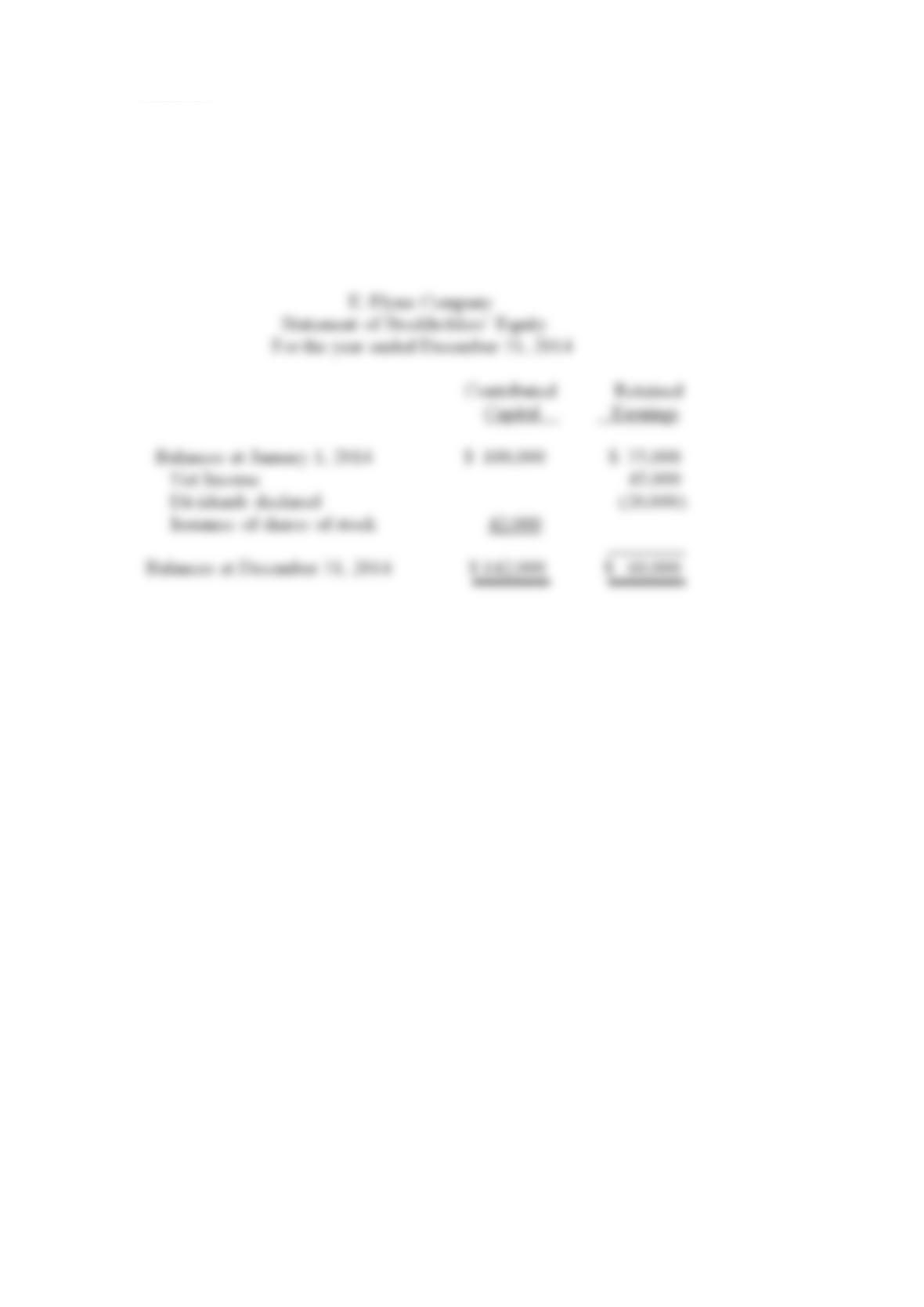
Use the following information and prepare a statement of stockholders’ equity for the
year ended December 31, 2014.
E. Flynn Company had $100,000 of contributed capital and $35,000 of retained
earnings at January 1, 2014. The following transactions occurred during the year 2014:
– Issued stock to investors for cash, $42,000.
– Declared and paid a cash dividend of $20,000.
– Reported total revenue of $130,000 and total expenses of $85,000.
Answer: