
When tax rates are changed subsequent to the creation of a deferred tax asset or
liability, GAAP requires that:
a. All deferred tax accounts be adjusted to reflect the new tax rates.
b. The beginning deferred tax accounts are left unchanged.
c. Only the current deferred tax accounts are adjusted to reflect the new tax rates.
d. Only the noncurrent deferred tax accounts are adjusted to reflect the new tax rates.
On December 31, 2016, the end of Larry’s Used Cars’ first year of operations, the
accounts receivable was $53,600. The company estimates that $1,200 of the year-end
receivables will not be collected. Accounts receivable in the 2016 balance sheet will be
valued at:
a. $53,600.
b. $54,800.
c. $52,400.
d. $ 1,200.
On September 1, 2016, Blue Co., issued $1,600,000 of its 10% bonds at 98 plus accrued
interest. The bonds are dated June 1, 2016, and mature on May 30, 2026. Interest is
payable semiannually on June 1 and December 1. At the time of issuance, Blue would
receive cash of:
a. $1,640,000
b. $1,608,000
c. $1,607,200
d. $1,568,000
Rothbart Manufacturing agrees to manufacture bumper cars for 12 Banners Amusement
Parks. Under the terms of the contract, 12 Banners will pay Rothbart a total of $60,000,
and 12 Banners can cancel the contract if it so chooses but must pay Rothbart for work
completed. Rothbart believes that, if 12 Banners cancelled the contract, Rothbart could
sell the bumper cars to another amusement park and still make a profit. The
manufacturing contract is expected to last six months, and as of December 31, 2016, the
job is 80% complete. How much revenue should Rothbart recognize in 2016 for this
contract?
a. $0
b. $12,000
c. $48,000
d. $60,000
Which of the following is not a characteristic of a qualified pension plan?
a. It can be limited to highly compensated salaried employees.
b. It must be funded in advance of retirement.
c. Benefits must vest after a specified period of service.
d. It must cover at least 70% of employees.
Cash that is restricted and not available for current operations is reported in the balance
sheet as:
a. Equity.
b. Investments.
c. Liabilities.
d. A separate section between liabilities and equity.
Wilson Company had the following cash balance items listed in its trial balance at
12/31/2016:
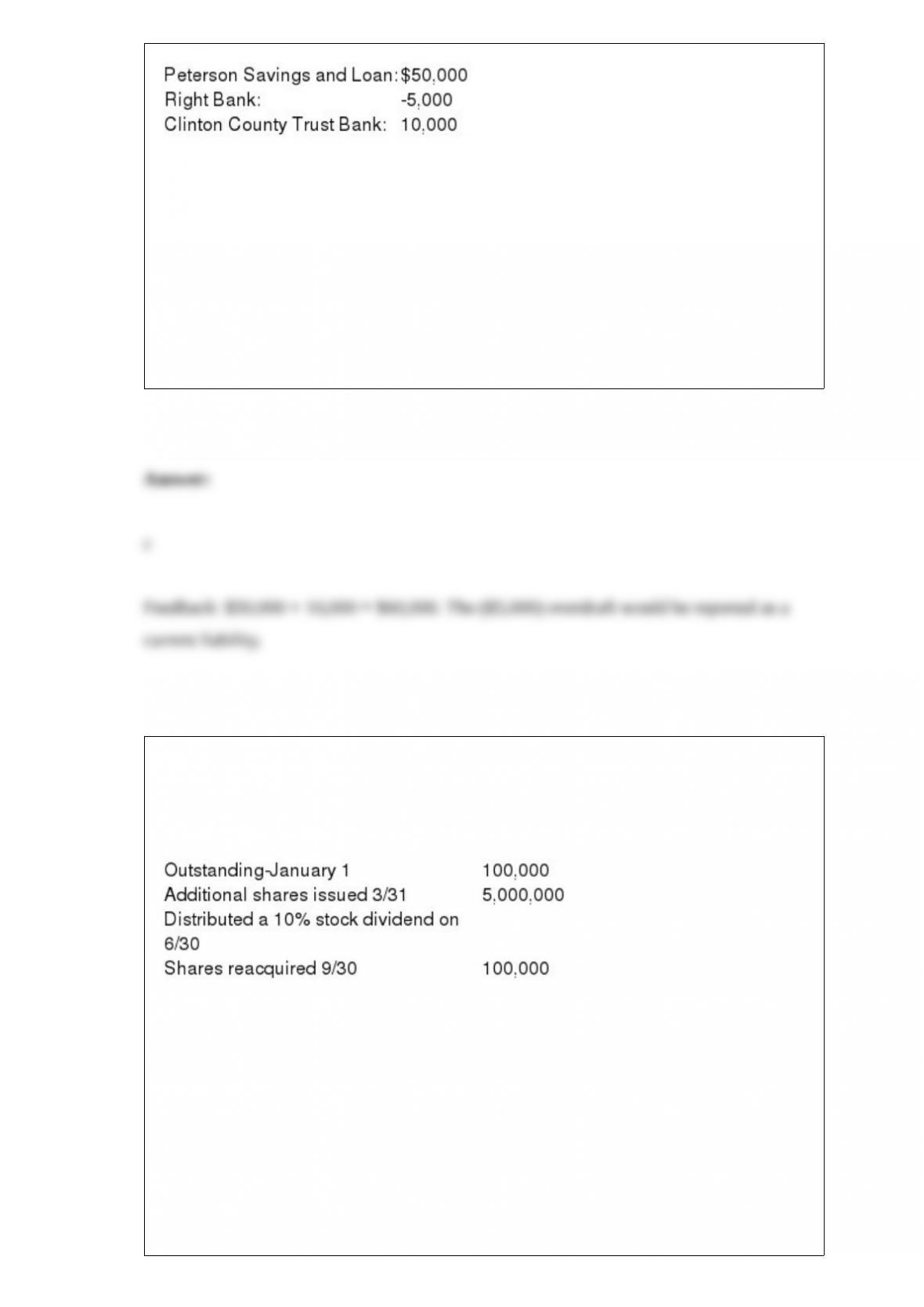
If Wilson reports under U.S. GAAP, its 12/31/2016 balance sheet would show what
cash balance?
a. ($5,000).
b. $55,000.
c. $60,000.
d. None these answer choices are correct.
Gear Corporation had the following common stock record during the current calendar
year:
What is the number of shares to be used in computing basic EPS?
a. 5,500,000.
b. 4,210,000.
c. 5,303,750.
d. 5,050,000.
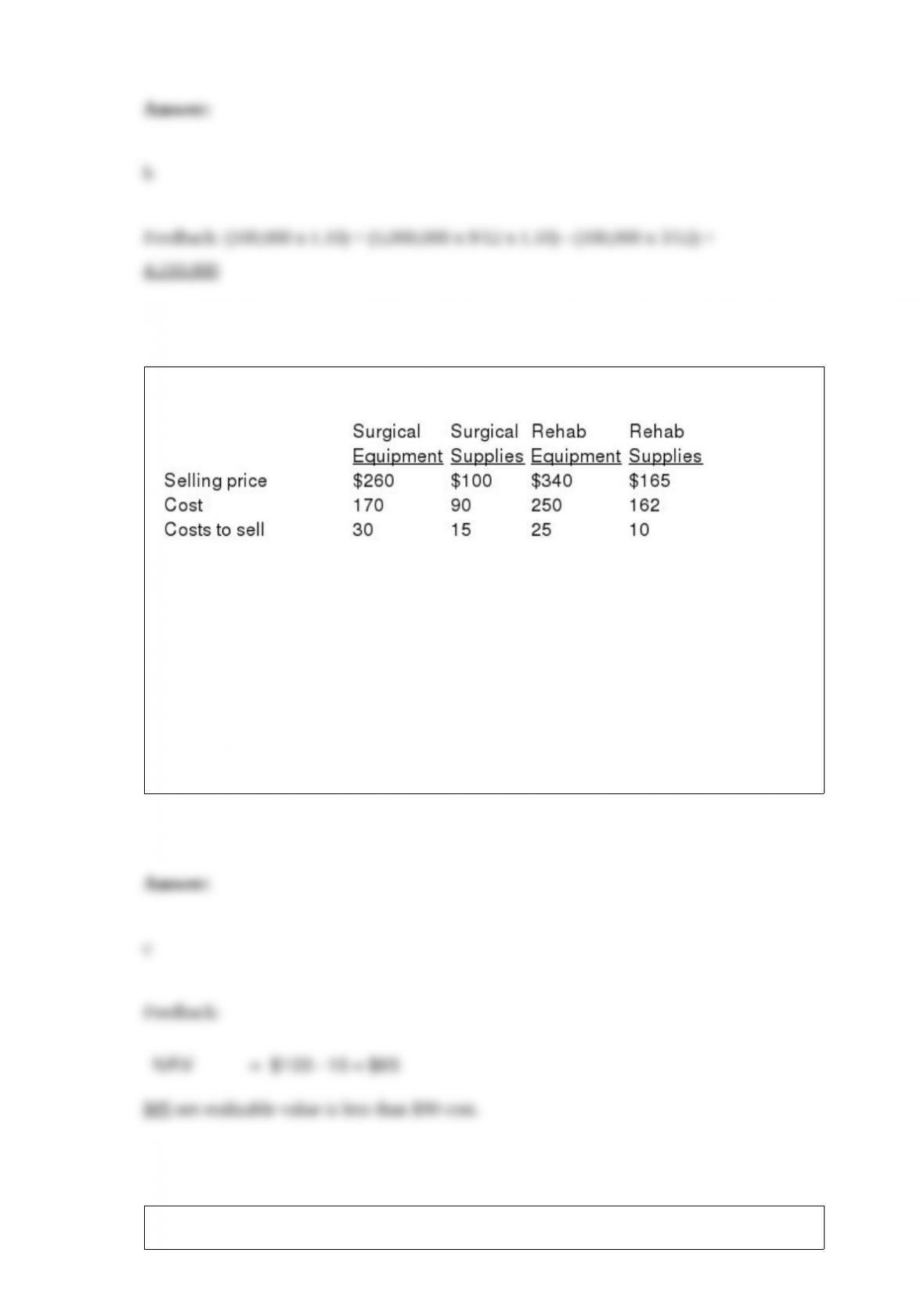
Data related to the inventories of Costco Medical Supply are presented below:
In applying the lower of cost and net realizable value rule, the inventory of surgical
supplies would be valued at:
a. $100.
b. $90.
c. $85.
d. $75.
Amber Inc. is one of the largest pharmacy retailers in mid-America. In its 2016 annual
report to shareholders, it made the following disclosure:
In 2011, Amber assigned a number of leases to Bell’s Inc. and Home Stores, Inc., as part
of the sale of the Company’s former Eastern divisions. Amber is contingently liable if
Bell’s and Home are unable to continue making rental payments on these leases. In
2015, Amber recorded a pretax charge to earnings of $42.7 million to recognize the
estimated lease liabilities associated with the Bell’s and Home bankruptcies and for a
single lease from Amber’s former Georgia division. In 2016, Bell’s began the liquidation
process and Home emerged from bankruptcy and, based on the resolution of various
leases, Amber reversed $12.1 million of this accrual.
Explain the accounting principle(s) that required Amber to record the $42.7 million
charge in 2015 and the $12.1 million reversal in 2016.
On January 1, 2016, Black Inc. issued stock options for 200,000 shares to a division
manager. The options have an estimated fair value of $6 each. To provide additional
incentive for managerial achievement, the options are not exercisable unless divisional
revenue increases by 6% in three years. Black initially estimates that it is probable the
goal will be achieved. In 2017, after one year, Black estimates that it is not probable
that divisional revenue will increase by 6% in three years. Ignoring taxes, what is the
effect on earnings in 2017?
a. $200,000 decrease.
b. $200,000 increase.
c. $400,000 increase.
d. No effect.
Fulbright Corp. uses the periodic inventory system. During its first year of operations,
Fulbright made the following purchases (listed in chronological order of acquisition):
– 40 units at $100
– 70 units at $ 80
– 170 units at $ 60 Sales for the year totaled 270 units, leaving 10 units on hand at the
end of the year. Ending inventory using the LIFO method is:
a. $ 650.
b. $1,000.
c. $ 707.
d. $ 600.
Hawkeye Auto Parts uses the average cost retail method to estimate inventories. Data
for the first six months of 2016 include: beginning inventory at cost and retail were
$55,000 and $100,000, net purchases at cost and retail were $785,000 and $1,300,000,
and sales during the first six months totaled $800,000. The estimated inventory at June
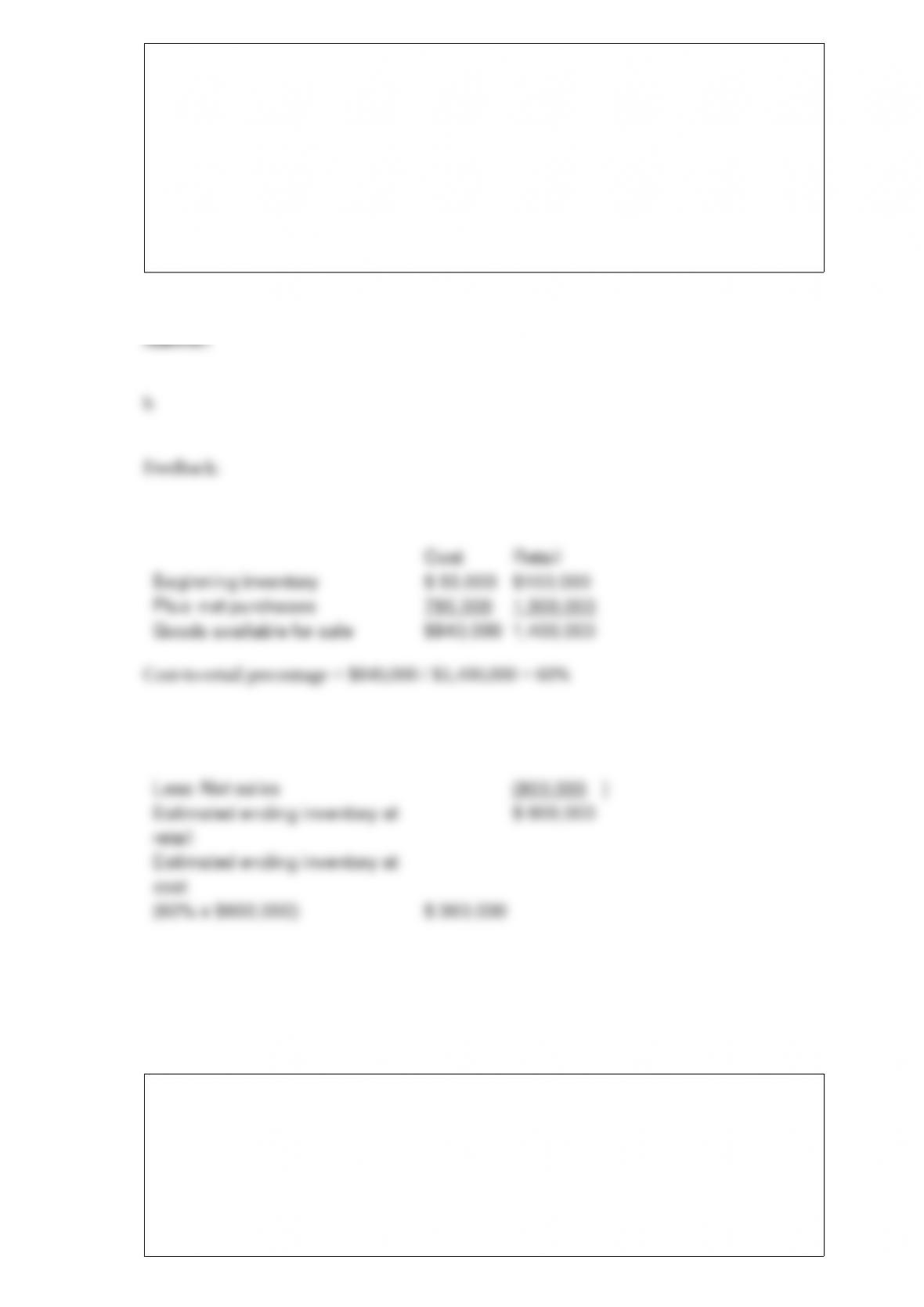
30, 2016, would be:
a. $330,000.
b. $360,000.
c. $362,300.
d. None of these answer choices are correct.
Under the gross method, purchase discounts taken are:
a. Deducted from interest expense.
b. Added to net purchases.
c. Added to interest income.

d. Deducted from purchases.
At December 31, 2016, Hansen Corporation had 50,000 shares of common stock and
5,000 shares of 6%, $100 par cumulative preferred stock outstanding. No dividends
were declared or paid in 2016. Net income was reported as $200,000. What is basic
EPS?
a. $4.00.
b. $3.40.
c. $3.64.
d. $4.02.
Two banks each have annual CD rates of 12%. Bank A compounds quarterly and Bank
B compounds semiannually. Explain which bank offers the better CD.
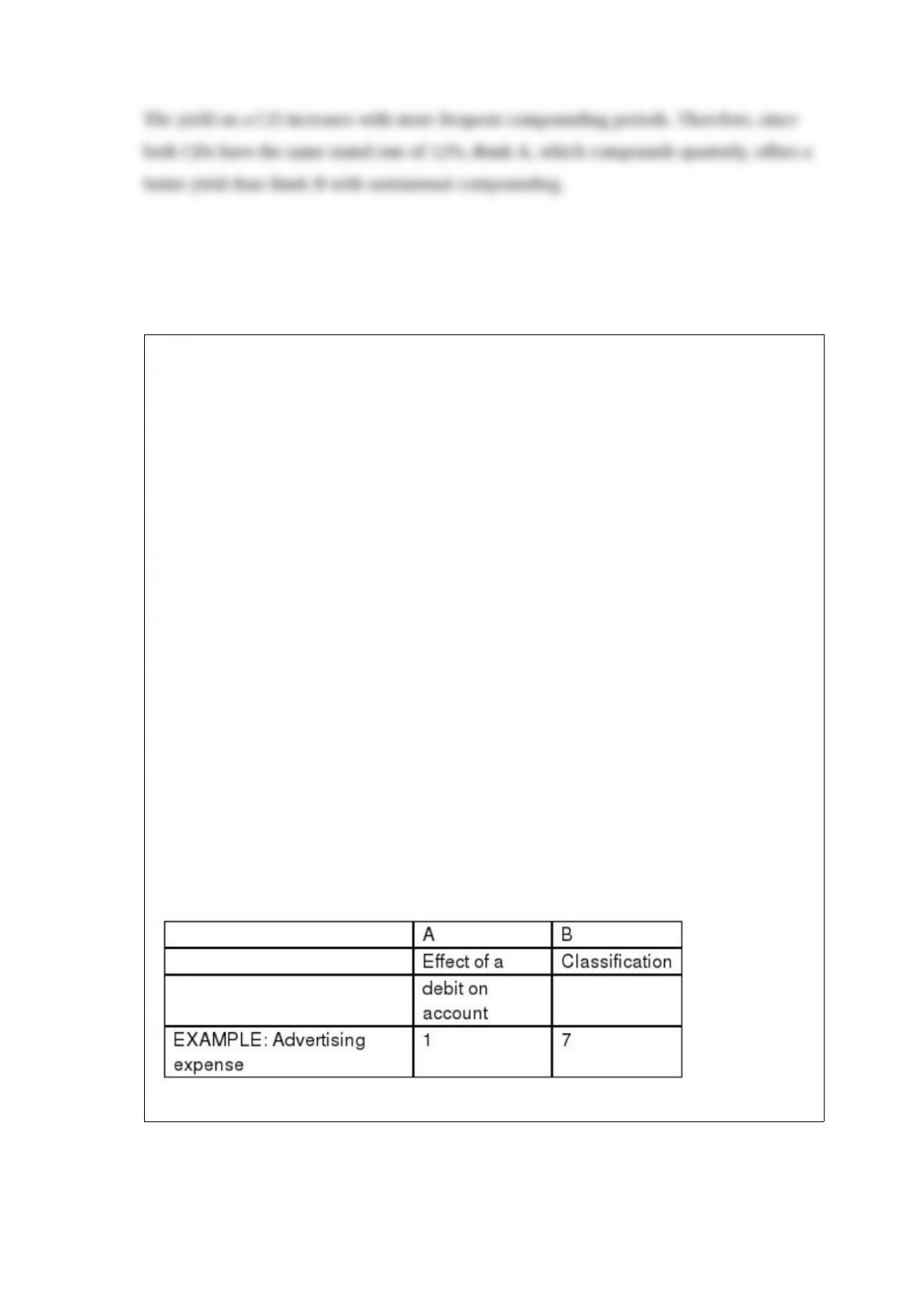
Below is a list of accounts in no particular order. Assume that all accounts have normal
balances. Required: In column A, indicate whether a debit will:
1> Increase the account balance, or
2> Decrease the account balance. In column B, classify each account according to the
following scheme. For contra accounts, indicate the classification of the account to
which it relates.
1>A current asset in the balance sheet.
2>A noncurrent asset in the balance sheet.
3>A current liability in the balance sheet.
4>A long-term liability in the balance sheet.
5>A permanent equity account in the balance sheet.
6>A revenue account in the income statement.
7>An expense account shown in the income statement.
8> Account does not appear in either the balance sheet or the income statement.
Cost of goods sold
Squeaky Shine provides car washing services in Jersey City, New Jersey. A three-month
pass for automatic car wash sells for $60, which entitles the customer for an unlimited
number of car washes during the contract period. Squeaky Shine estimates that pass
holders wash their cars equally throughout the three-month period. On December 1st,
customers purchased $1,260 of the three-month passes, with purchases of the passes
occurring evenly throughout December. Required:
1) Prepare the journal entries that Squeaky Shine would record on December 1 and on
December 31, 2016, with respect to this transaction.
2) State the account titles and amounts that will be included in Squeaky Shine’s 2016
income statement and balance sheet.
Did accounts receivable increase or decrease during 2016? Explain.
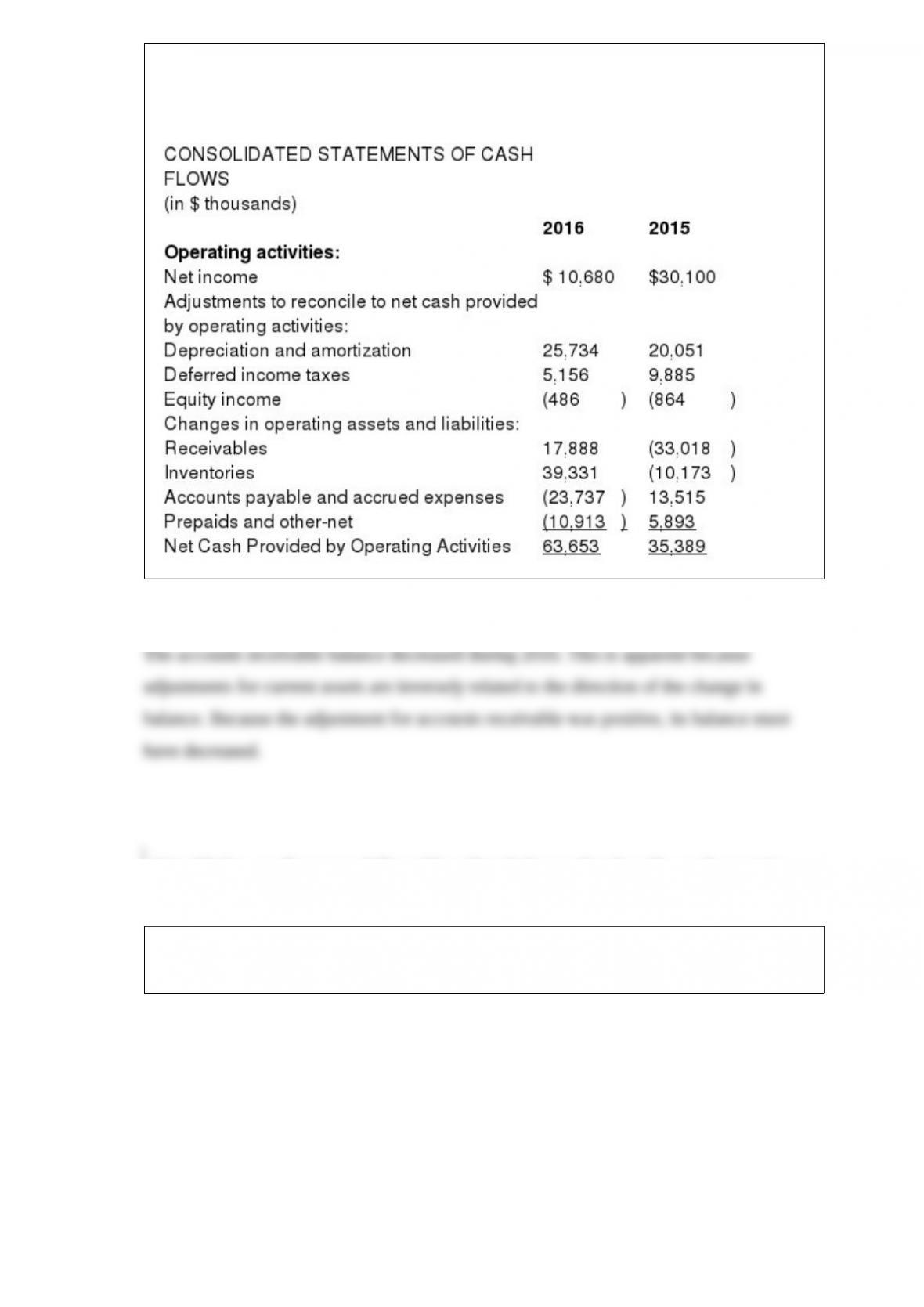
In its 2016 Annual Report to Shareholders, Sisters Corporation included the following
information on cash flows from operations:
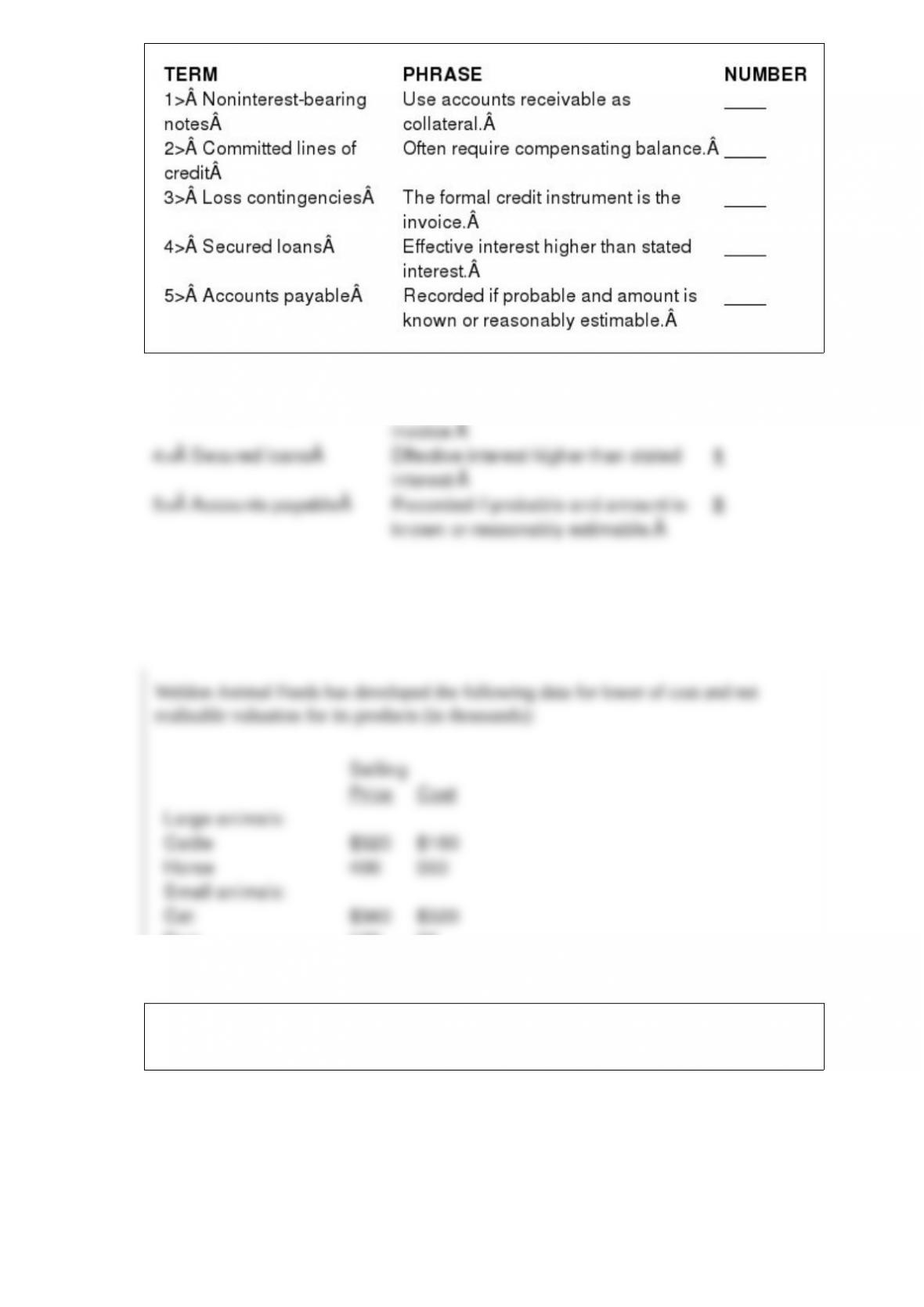
Listed below are five terms followed by a list of phrases that describe or characterize
each of the terms. Match each phrase with the number for the most correct term.
Weldon Animal Feeds has developed the following data for lower of cost and net
realizable valuation for its products (in thousands):
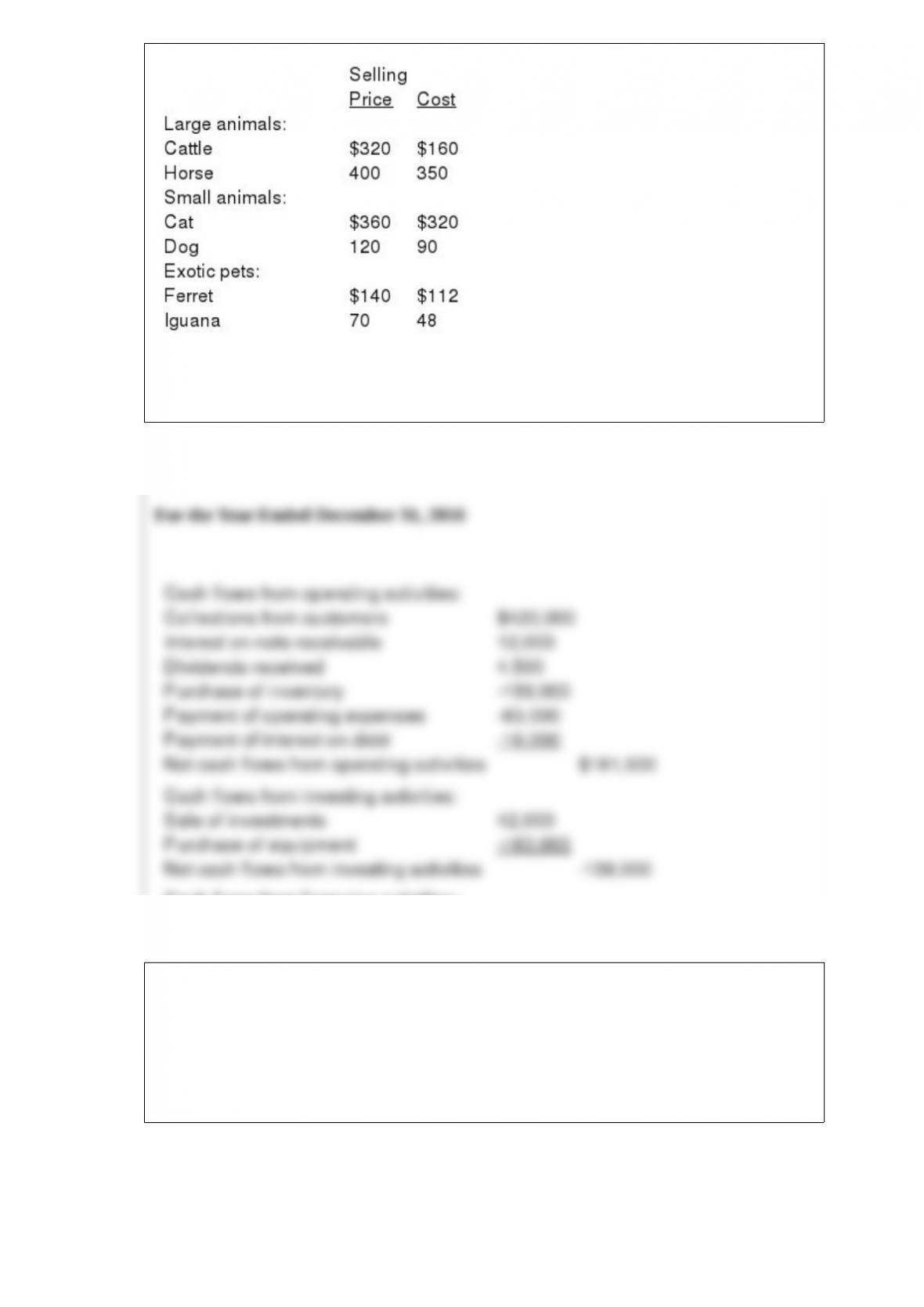
The costs to sell are 20% of selling price. Required: Determine the reported inventory
value assuming the lower of cost and net realizable value rule is applied to individual
types of feeds.
The statement of cash flows for the year ended December 31, 2016, for Whiteside
Incorporated is presented below. Whiteside Incorporated
Statement of Cash Flows
For the Year Ended December 31, 2016
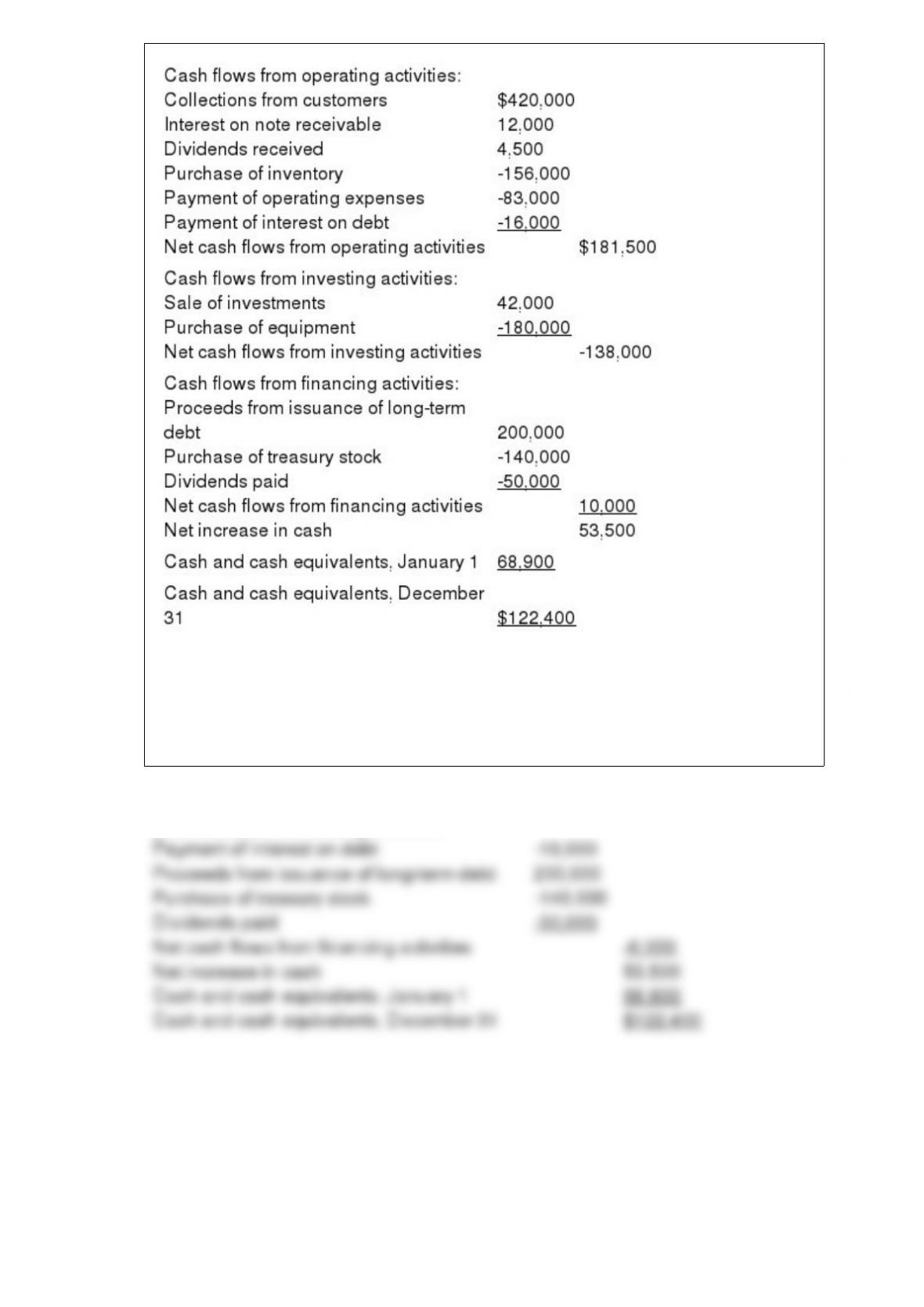
Required:
Prepare the statement of cash flows assuming that Whiteside prepares its financial
statements according to International Financial Reporting Standards. Where IFRS
allows flexibility, use the classification used most often in IFRS financial statements.
