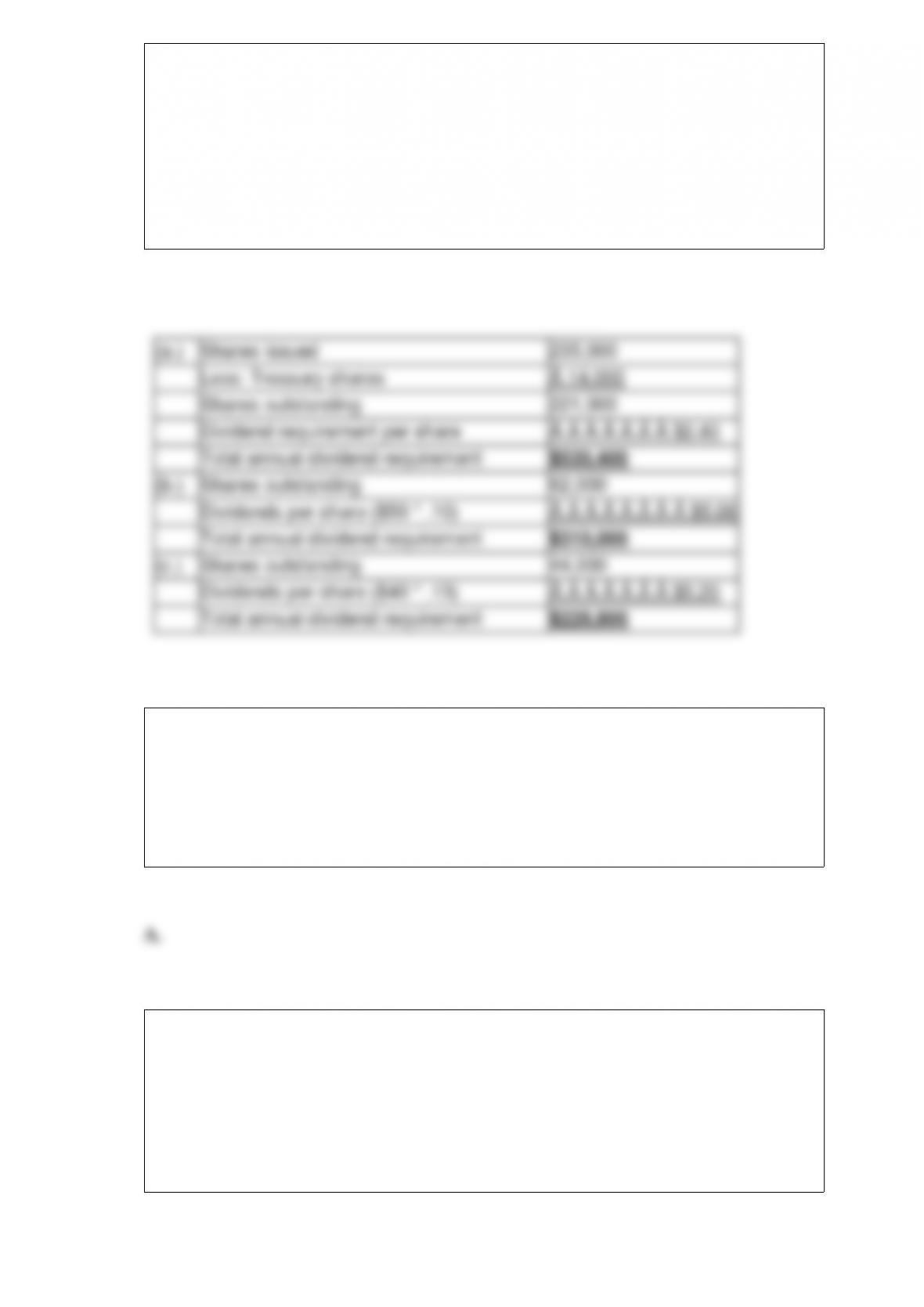
Calculate the annual cash dividends required to be paid for each of the following
preferred stock issuances:
(a.) $2.40 cumulative preferred, no par value; 300,000 shares authorized, 235,000
shares issued, 14,000 shares held as treasury stock.
(b.) 10%, $50 par value preferred; 100,000 shares authorized, 62,000 shares issued and
outstanding.
(c.) 13% cumulative preferred, $40 stated value, $42 liquidating value; 70,000 shares
authorized, 46,000 shares issued, 44,000 shares outstanding.
In order to calculate the net present value of a proposed investment, it is necessary to
know:
A. the cash flows expected from the investment.
B. the net income expected from the investment.
C. the interest rate paid on funds borrowed to make the investment.
D. the cash dividends paid on the stock each year.
Each of a company’s two product lines has a different contribution margin ratio. If the
company’s total sales remain the same but the sales mix shifts toward selling more of
the product with the higher contribution ratio, which of the following is true?
A. operating income will increase.
B. the average contribution margin ratio will increase.
C. the break-even point will decrease.
D. all of the above are true.

Use the appropriate factors from Table 6 – 4 or Table 6 – 5 to answer the following
questions.
(a.) What is the present value of $90,000 to be received in six years using a discount
rate of 12%?
(b.) How much should be invested today at a return on investment of 16% compounded
annually to have $150,000 in eleven years?
Management’s use of resources can best be evaluated by focusing on measures of:
A. liquidity.
B. activity.
C. leverage.
D. book value.
When an income statement shows data for segments of the organization, and data for
each segment are added together to get totals for the whole organization:
A. all expenses should be allocated to the segments.
B. common fixed expenses should be allocated to the segments.
C. only direct revenues and direct expenses should be assigned to segments.
D. direct fixed expenses should be subtracted as one amount in the “total” column.
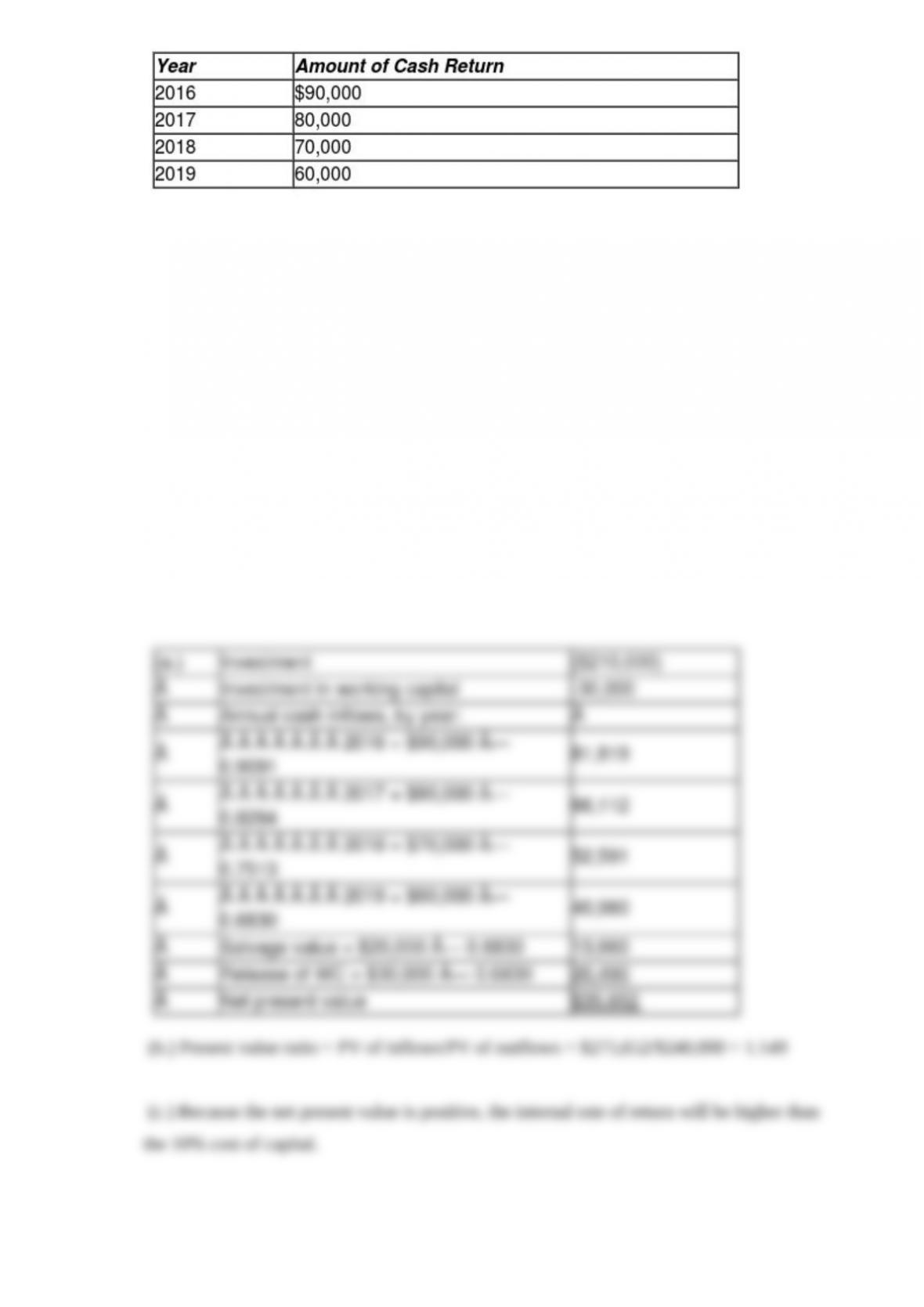
The following data have been collected by capital budgeting analysts at Halda, Inc.
concerning an investment in an expansion of the company’s product line. Analysts
estimate that an investment of $210,000 will be required to initiate the project at the
beginning of 2016. Estimated cash returns from the new product line are summarized in
the following table; assume that the returns will be received in lump sum at the end of
each year.
The new product line will also require an investment in working capital of $30,000; this
investment will become available for other purposes at the end of the project. Salvage
value of machinery and equipment at the end of the product line’s life is expected to be
$20,000. The cost of capital used in Hilda, Inc.’s capital budgeting analysis is 10%.
(a.) Calculate the net present value of the proposed investment. Ignore income taxes, and
round all answers to the nearest $1.
(b.) Calculate the present value ratio of the investment.
(c.) What will the internal rate of return on this investment be relative to the cost of
capital? Explain your answer.
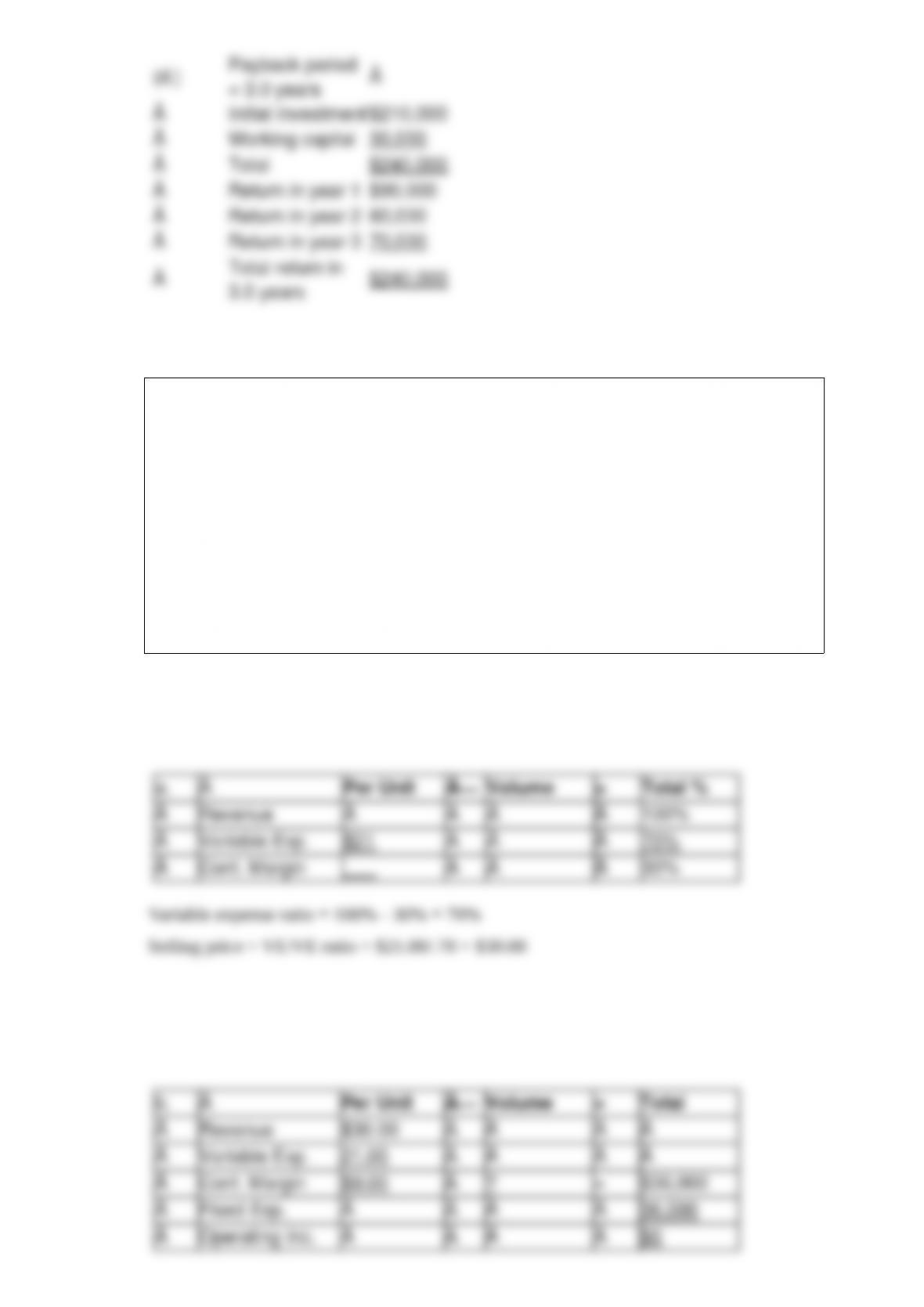
(d.) Calculate the payback period of the investment. .
Krultz Corp. has annual revenues of $760,000, an average contribution margin ratio of
30 percent, and fixed expenses of $75,000.
(a.) Management is considering adding a new product to the company’s product line.
The new item will have $21 of variable costs per unit. Calculate the selling price that
will be required if this product is not to affect the average contribution margin ratio.
(b.) If the new product adds an additional $36,000 to Krultz’s fixed expenses, how
many units of the new product must be sold to break even on the new product?
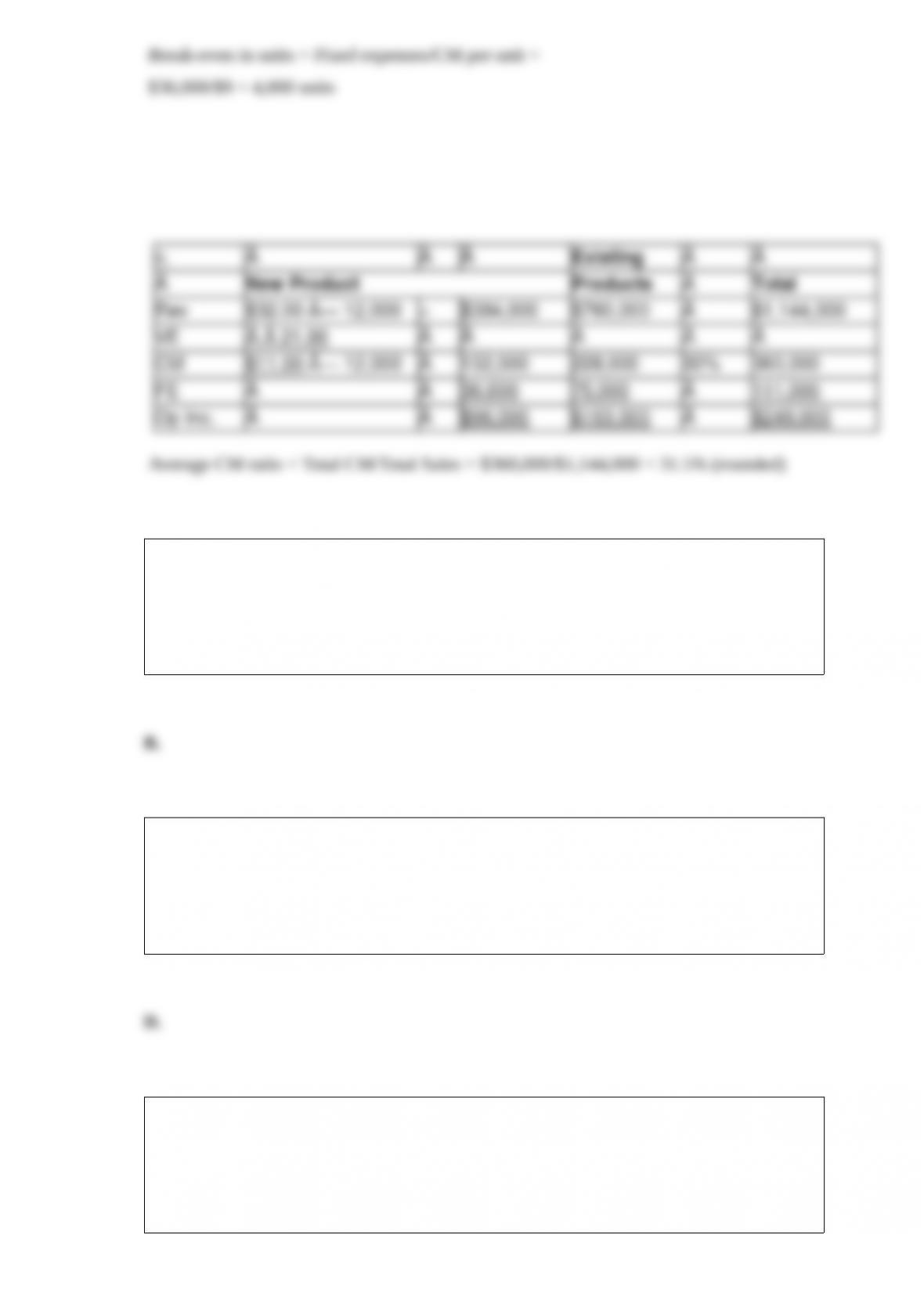
(c.) If 12,000 units of the new product could be sold at a price of $32 per unit, and the
company’s other business did not change, calculate Krultz’s total operating income and
average contribution margin ratio.
The decision to continue or discontinue a segment of the business should focus on:
A. sales minus total variable expenses and total fixed expenses.
B. sales minus total variable expenses and avoidable fixed expenses of the segment.
C. sales minus total variable expenses and allocated fixed expenses of the business.
D. none of the above.
Which of the terms is not used to identify owners’ equity or stockholders’ equity?
A. Partner’s capital.
B. Proprietor’s capital.
C. Paid-in-capital and retained earnings.
D. Additional-paid-in-retained earnings.
The purpose of the income statement is to show the:
A. change in the fair value of the assets from the prior income statement.
B. market value per share of stock at the date of the statement.
C. revenues collected during the period covered by the statement.
D. net income or net loss for the period covered by the statement.
An example of a cost that is controllable in the short run is:
A. property taxes.
B. machine depreciation.
C. supervisors salaries.
D. building lease.
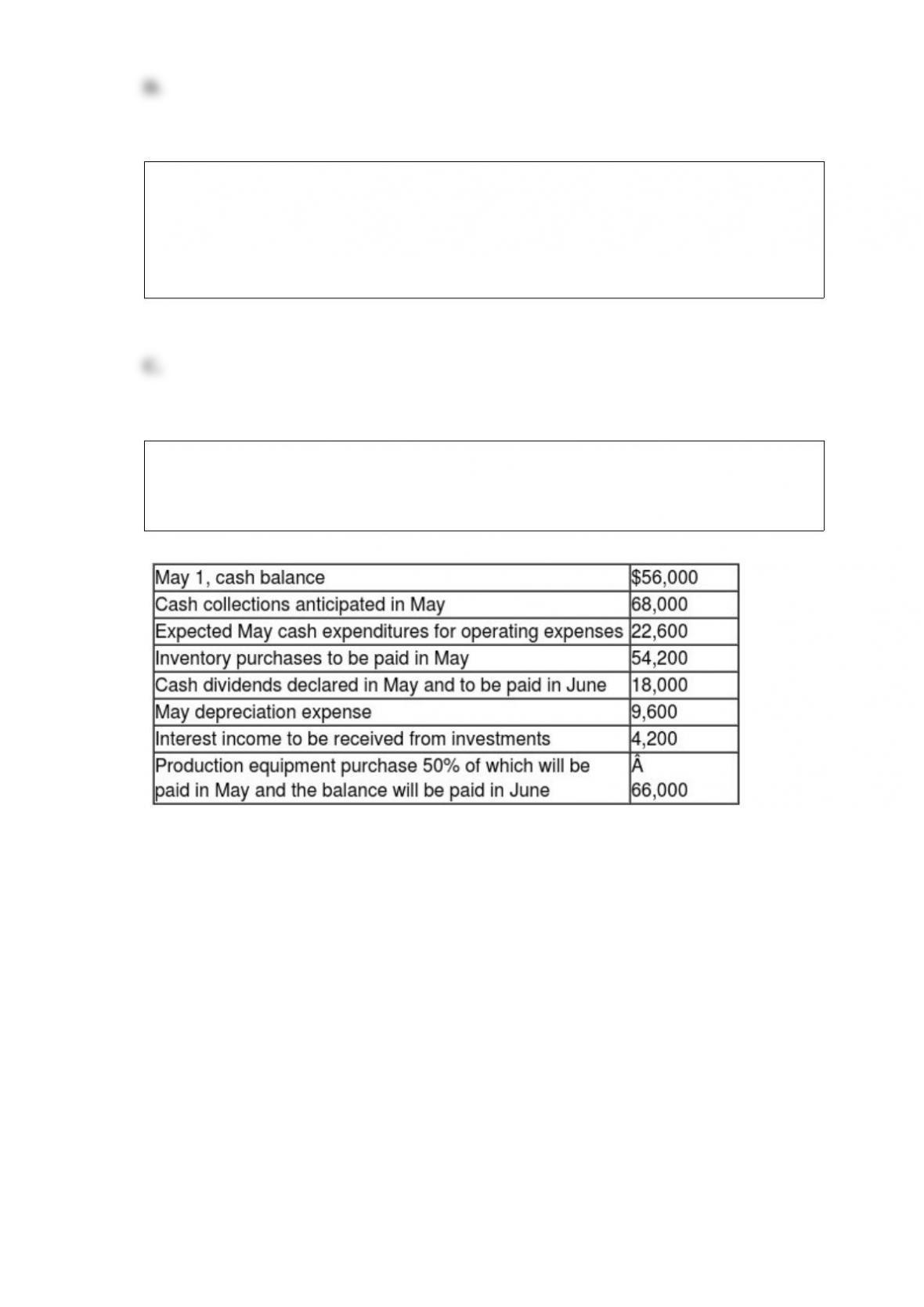
The following information for the month of May has been provided for Bowser
Company:
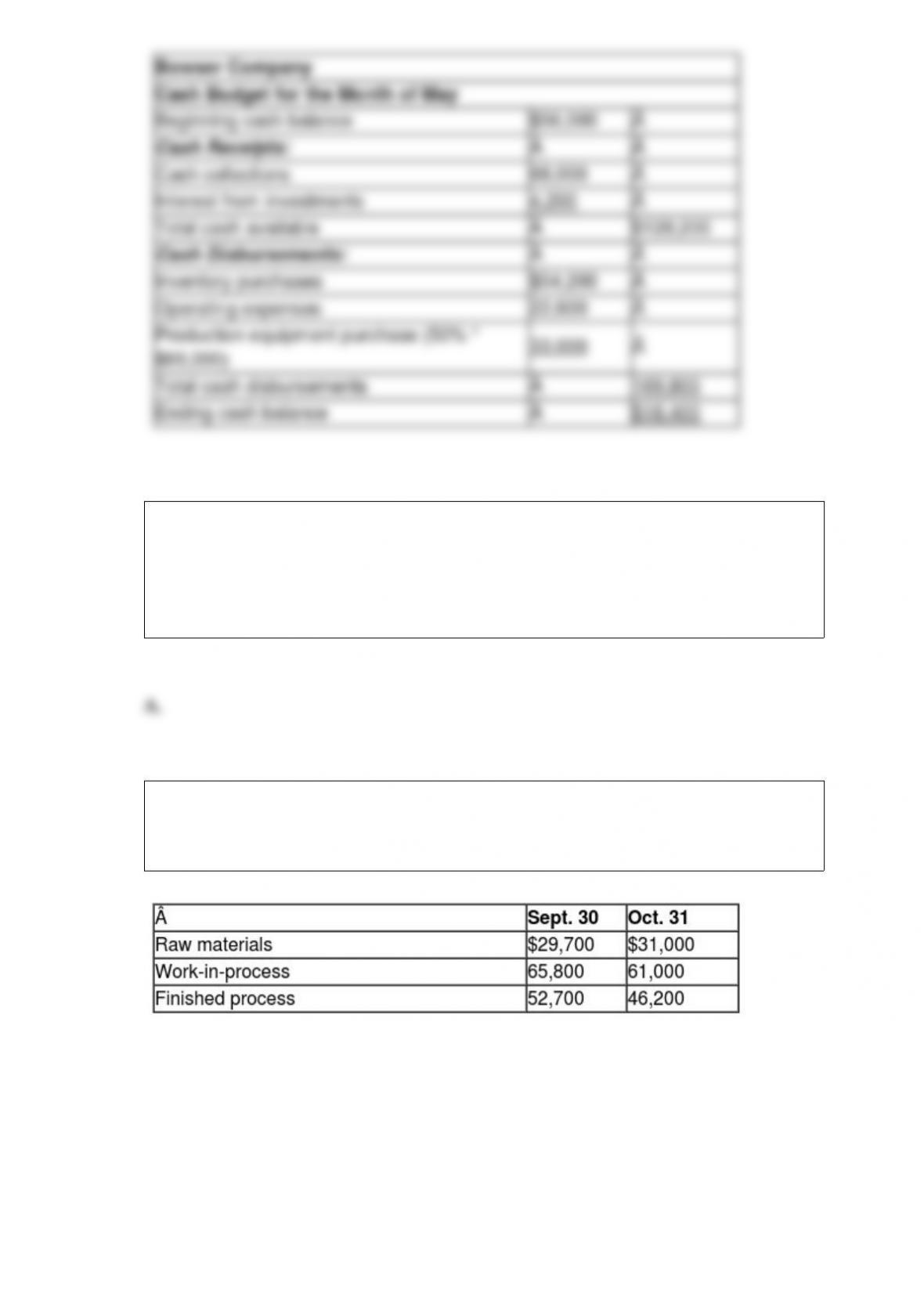
(a.) Prepare a cash budget for May.
Direct costing may be used for:
A. internal reporting purposes.
B. external financial reporting purposes.
C. income tax reporting purposes.
D. all of the above.
The following table summarizes the beginning and ending inventories of Ariel Co. for
the month of October:
Raw materials purchased during the month of October totaled $112,300. Direct labor costs
incurred totaled $234,800 for the month. Actual and applied manufacturing overhead costs
for October totaled $145,100 and $149,400, respectively.
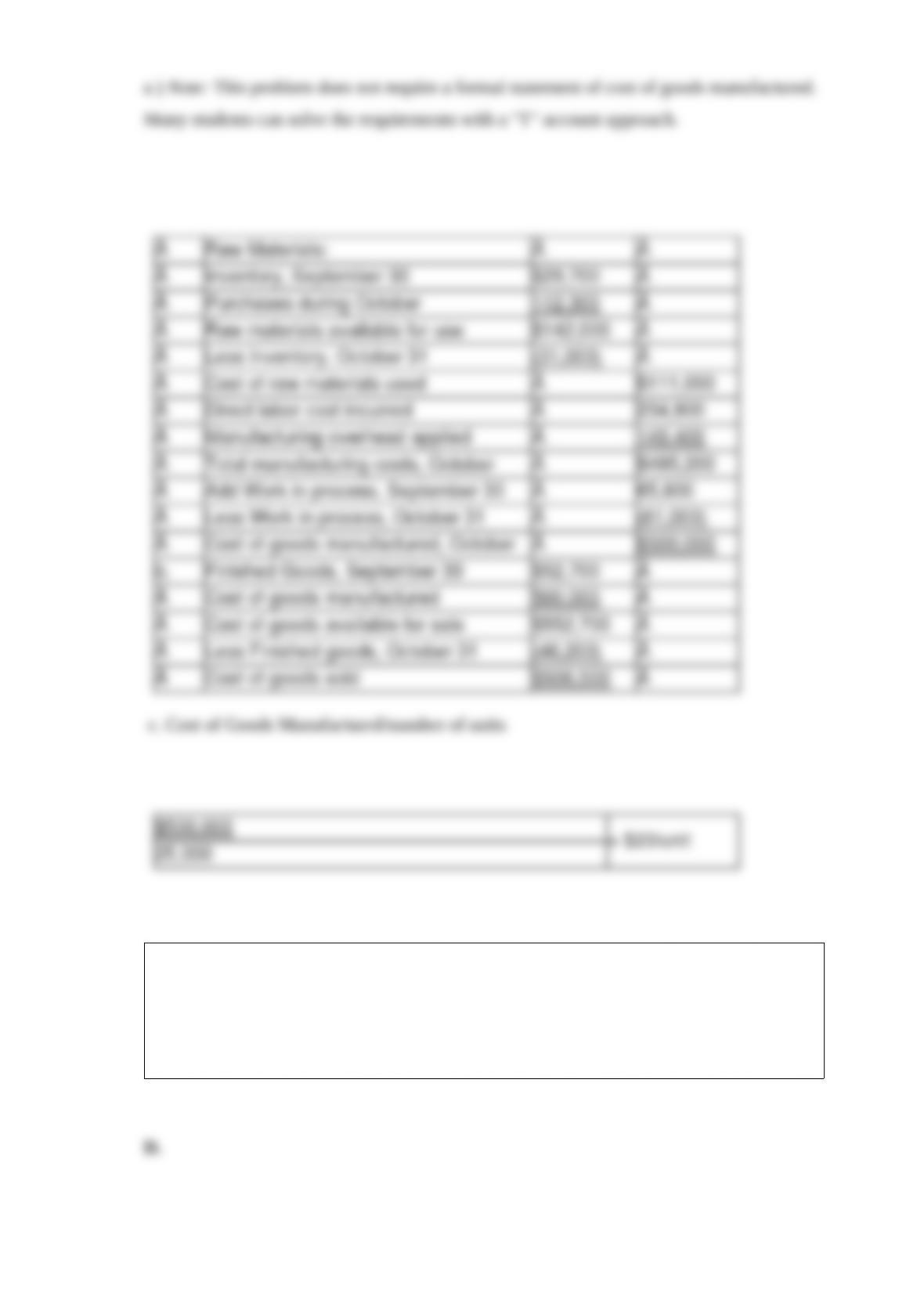
(a) Calculate the cost of goods manufactured for October.
(b) Calculate the cost of goods sold for October (Ignore under/overapplied overhead).
(c) Given the fact that 25,000 units were produced, what is the cost per unit for October?
Expenses are:
A. cash disbursements.
B. decreases in net assets from uninsured accidents.
C. decreases in net assets from dividends to stockholders.
D. decreases in net assets resulting from usual operating activities.

A debit entry will:
A. always decrease the account balance.
B. always increase the account balance.
C. increase the balance of a revenue account.
D. increase the balance of an expense account.
The kind of standard that is most useful for planning and control is:
A. an attainable standard.
B. an ideal standard.
C. a negotiated standard.
D. a past experience standard.
Financial ratios:
A. help financial statement users to evaluate the financial characteristics of companies
by putting the large dollar amounts reported in financial statements into relative terms
for comparison purposes.
B. provide for a more meaningful analysis when the trends of financial ratios for a
company are compared to the industry average trends over a period of time.
C. are required reporting disclosures in the notes to the consolidated financial
statements of U.S. companies that are regulated by the SEC.
D. All of the above statements are true.
E. A and B are true, but C is not true.
The noncurrent liability, Noncontrolling Interest, arises if:
A. A firm owns less than 50% of another entity.
B. A firm owns more than 50%, but less than 100%, of another entity.
C. A firm owns 100% of another entity.
D. Noncontrolling Interest is accounted for as an equity item.

Which of the following is not an example of a decision or informed judgment that a
potential investor would make from accounting information?
A. Future profitability based on past profitability.
B. Probability of success of a new product development.
C. A forecast of dividends.
D. Assessment of risk that a company may have more debt than it can repay if the
economy enters a recession.
If the net present value of the investment is $8,510, then:
A. the rate of return is less than the cost of capital.
B. the present value of the cash flows is greater than the required investment.
C. the cost of capital is higher than the internal rate of return.
D. the present value of the cash flows is $8,510 less than the investment.
The largest item of the Deferred Tax Liability for most companies is caused by:
A. providing the allowance for doubtful accounts for book purposes.
B. differences in inventory cost flow assumptions (FIFO vs. LIFO) for tax versus
financial accounting purposes.
C. differences in depreciation methods (accelerated vs. straight-line) for tax versus
financial accounting purposes.
D. amortizing bond premium or discount for tax purposes.
The shift in the amount of manufacturing overhead costs applied to the mix of products
produced that occurs when using a single cost driver rate as compared to using
activity-based costing rates is known as:
A. underapplied overhead.
B. overapplied overhead.
C. cost absorption.
D. cost distortion.

The present value concept is widely applied in business because:
A. inflation erodes the purchasing power of money.
B. money has value over time.
C. accounting for operating leases requires its use.
D. most obligations are settled within a year.
The purpose of reporting Current Maturities of Long-Term debt is to:
A. report any portion of a long-term borrowing that is to be paid in the upcoming
accounting period as a current liability.
B. reclassify a portion of debt from the noncurrent section of the balance sheet to the
current section of the balance sheet.
C. properly classify liabilities.
D. all of the above.
A balanced scorecard framework is integrated through four key perspectives. The
presentation of these key perspectives on a balanced scorecard from the lowest level
perspective to the highest level perspectives is:
A. customer, financial, internal business process, learning and growth.
B. financial, customer, learning and growth, internal business process.
C. learning and growth, internal business process, customer, financial.
D. internal business process, learning and growth, customer financial.
A firm’s cash dividends were $1.98 per share of common stock for calendar 2016. In
2017, the stock was split 3-for-1, and in 2018 a 10% stock dividend was issued.
Dividends per share for 2016, to be reported in the firm’s annual report for 2018, are:
A. $1.98
B. $0.73
C. $0.66
D. $0.60 Stock split occurred in 2017 so $1.98/3 = $0.66. Then in 2018 there was a

stock dividend of 10% so $0.66/1.1 = $060 per share, as reported in 2018.
Fixed costs classified according to the time frame perspective are known as:
A. direct cost and indirect cost.
B. constant and inconsistent cost.
C. committed cost and discretionary cost.
D. product cost and period cost.
Managerial accounting can best be described as:
A. the preparation and distribution of the financial statements.
B. the preparation and distribution of the corporate tax return.
C. the preparation and use of accounting information within the organization.
D. meeting the requirements of generally accepted accounting principles.