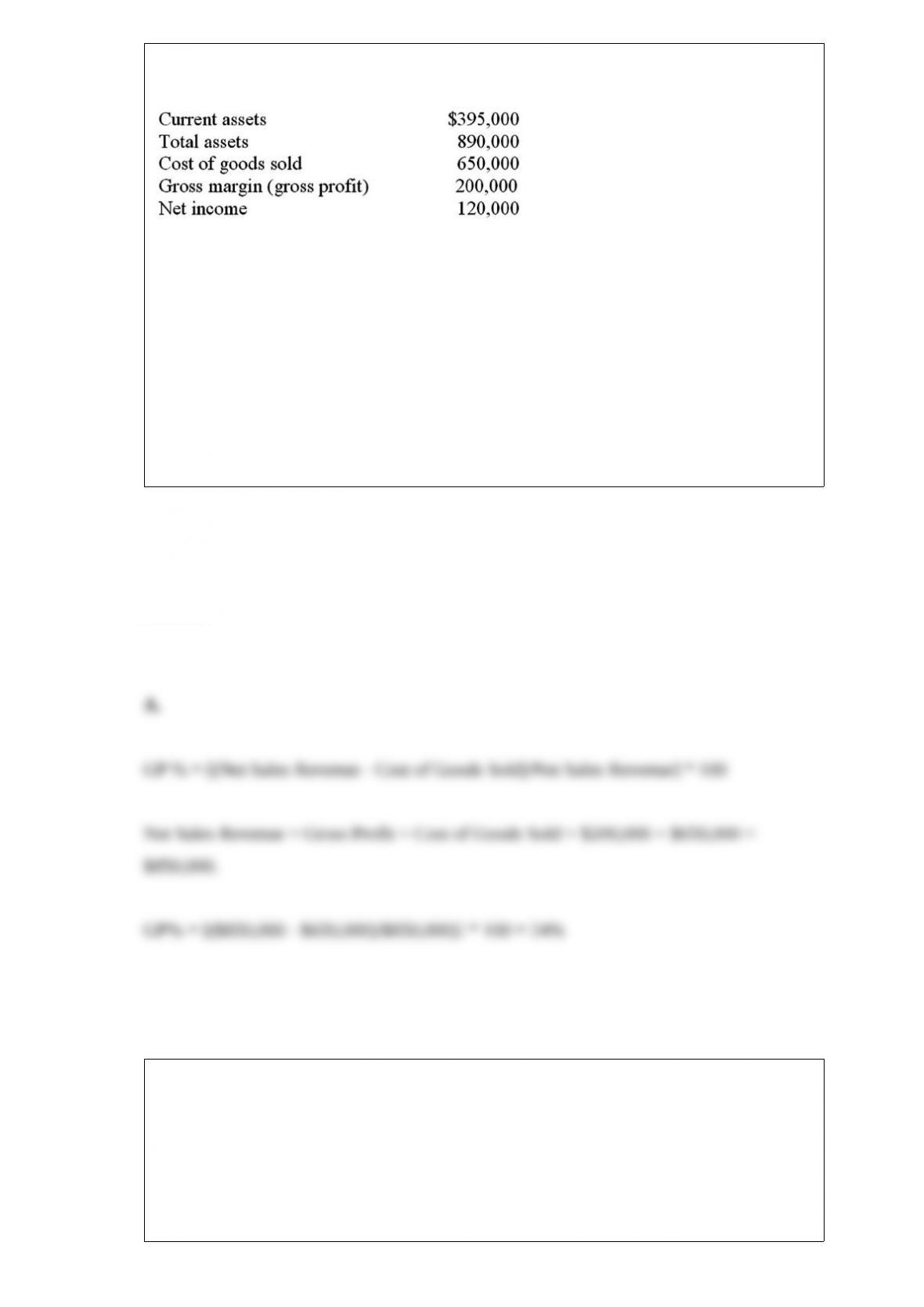
The following information is taken from the financial statements of a company for the
current year:
Use the information above to answer the following question. The gross profit
percentage for the current year rounded to the nearest whole percent is closest to
A. 24%.
B. 76%.
C. 60%.
D. 31%.
Answer:
The Grass is Greener Corporation uses the allowance method and learns that a customer
who owes $350 has gone bankrupt and payment will not be made. The Grass is Greener
Corporation should:
A. debit Bad Debt Expense and credit Accounts Receivable for $350.
B. debit the Allowance for Doubtful Accounts and credit Accounts Receivable for $350.
C. debit Bad Debt Expense and credit Cash for $350.
D. debit Accounts Receivable and credit Bad Debt Expense for $350.
Answer:
Which of the following is not the same as book value?
A. Carrying value.
B. Cost – accumulated depreciation.
C. Unused cost.
D. Market value.
Answer:
Free cash flow may be used for all of the following except to:
A. expand the business.
B. pay off debt.
C. build up the cash balance.
D. pay employees.
Answer:
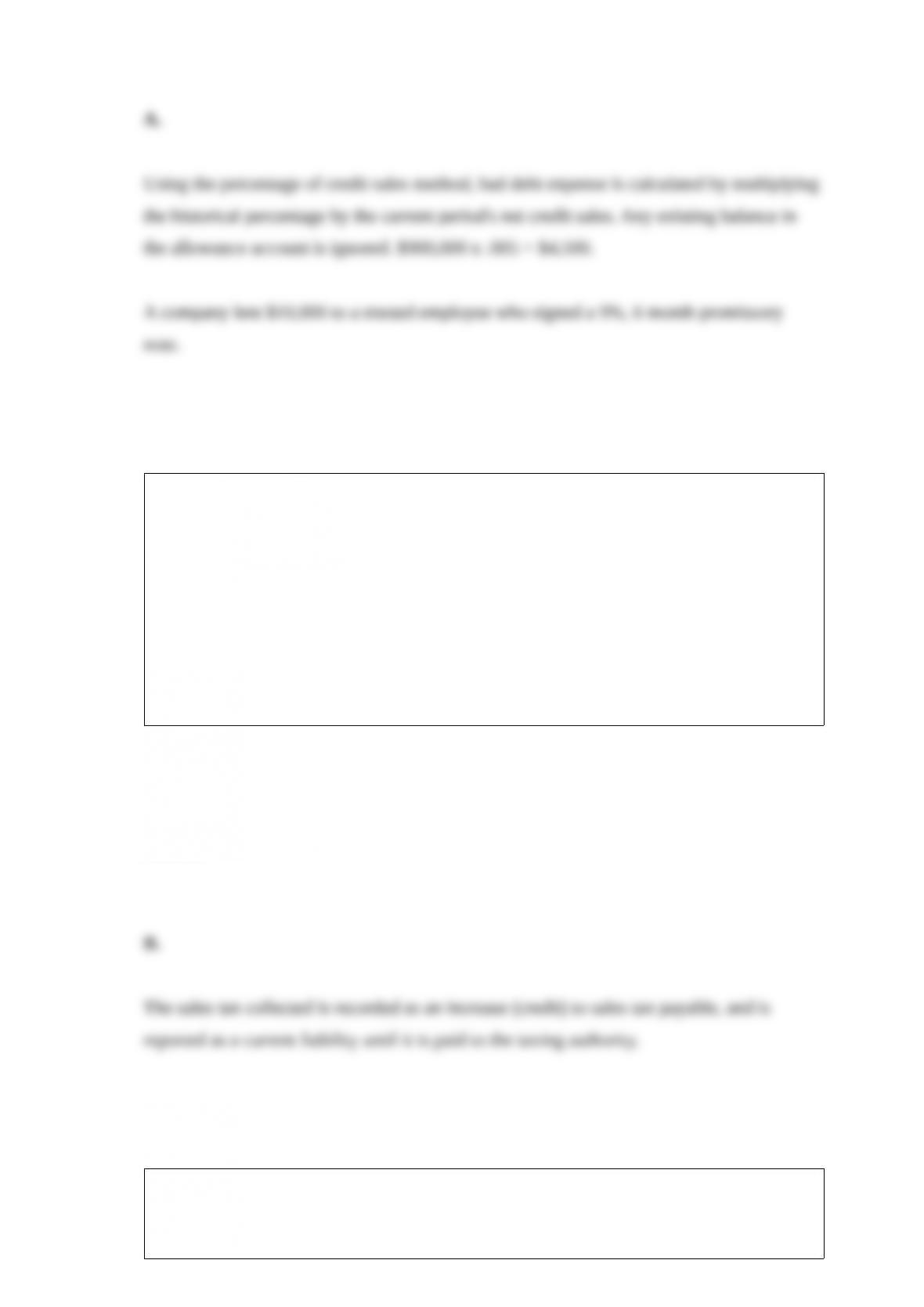
A company uses the percentage of credit sales method to estimate bad debt expense. At
the end of the year, the company’s unadjusted trial balance includes the following:
The company estimates, based on historical bad debt losses, that 0.5% of the sales will
be uncollectible. What is the bad debt expense to be recorded for the year?
A. $4,500
B. $4,300
C. $4,700
D. $45,000
Answer:
A company receives $95 for merchandise sold to a consumer, of which $5 is for sales
tax. The $5 of sales tax:
A. increases sales revenue.
B. increases current liabilities.
C. increases selling expenses.
D. is not recorded.
Answer:
Bad Debt Expense is classified as
A. part of cost of goods sold on the Income Statement.
B. a selling expense on the Income Statement.
C. a non-operating expense on the Income Statement.
D. a deduction from Accounts Receivable on the Balance Sheet.
Answer:
The Publish or Perish Printing Company paid a dividend to stockholders. This will be
reported on the:
A. audit report.
B. income statement.
C. balance sheet.
D. statement of retained earnings.
Answer:
Treasury stock:
A. does not appear on the balance sheet.
B. is a contra-equity account.
C. is an asset account.
D. is recorded as additional paid-in capital.
Answer:
A condensed balance sheet for Liu Company is presented below:
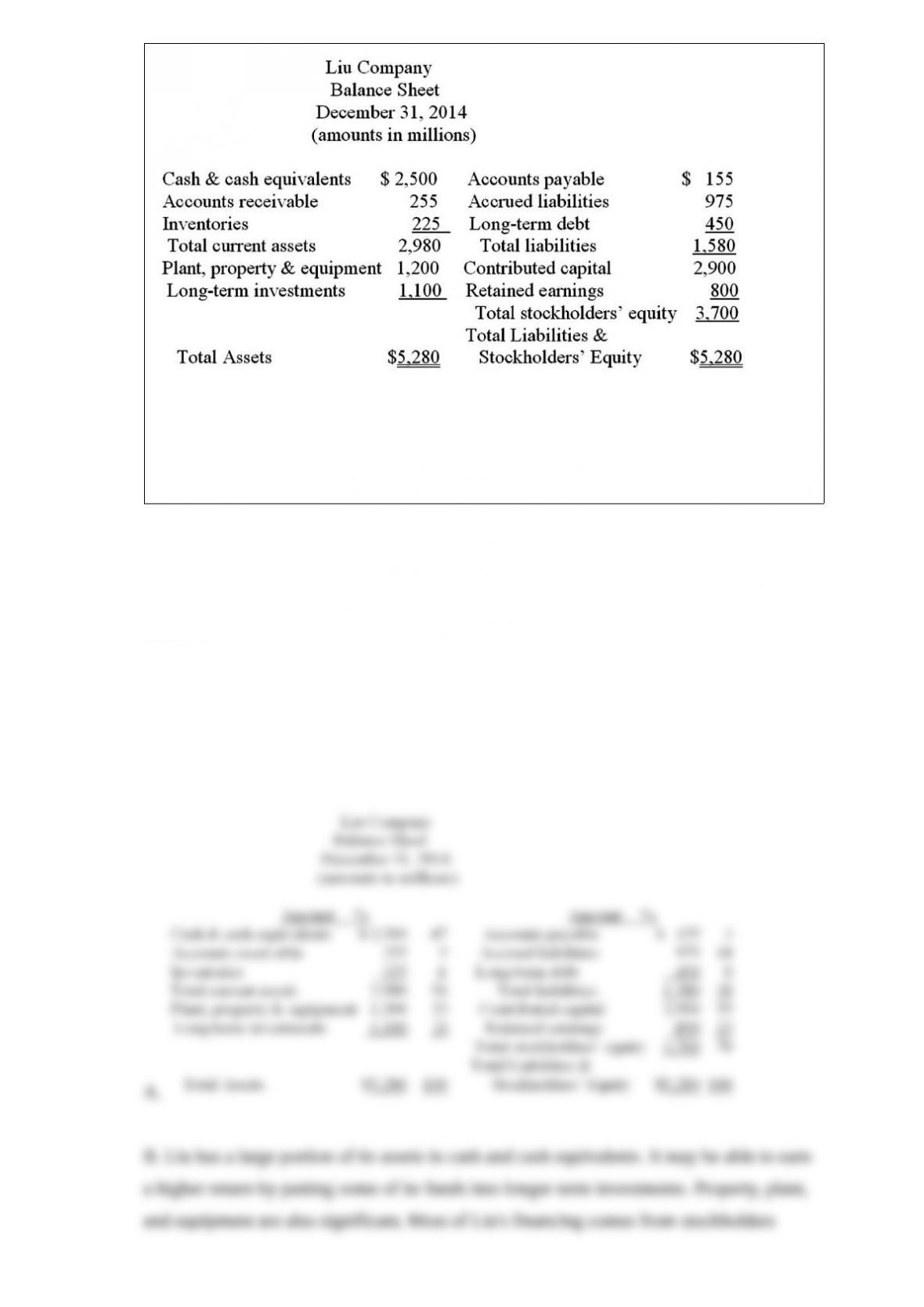
A. Prepare a vertical analysis of the balance sheet above. Round to the nearest whole
percent.
B. Interpret your analysis. Identify significant items. Comment on key relationships.
Answer:
Your company bought a 30-second advertisement that aired during the Super Bowl at a
cost of $1.2 million. It is legally obligated to pay for the ad but has not yet done so.
How does the purchase and use of the ad time affect your company’s balance sheet?
A. It increases both assets and liabilities by $1.2 million.
B. It increases assets and decreases stockholders’ equity by $1.2 million each.
C. It does not affect the balance sheet.
D. It increases liabilities and decreases stockholders’ equity by $1.2 million each.
Answer:
The entry to record the discount amortization and interest accrual on December 31,
2014, would include a
A. debit to Discount on Bonds Payable.
B. credit to Cash.
C. credit to Interest Payable.
D. debit to Bonds Payable.
Answer:
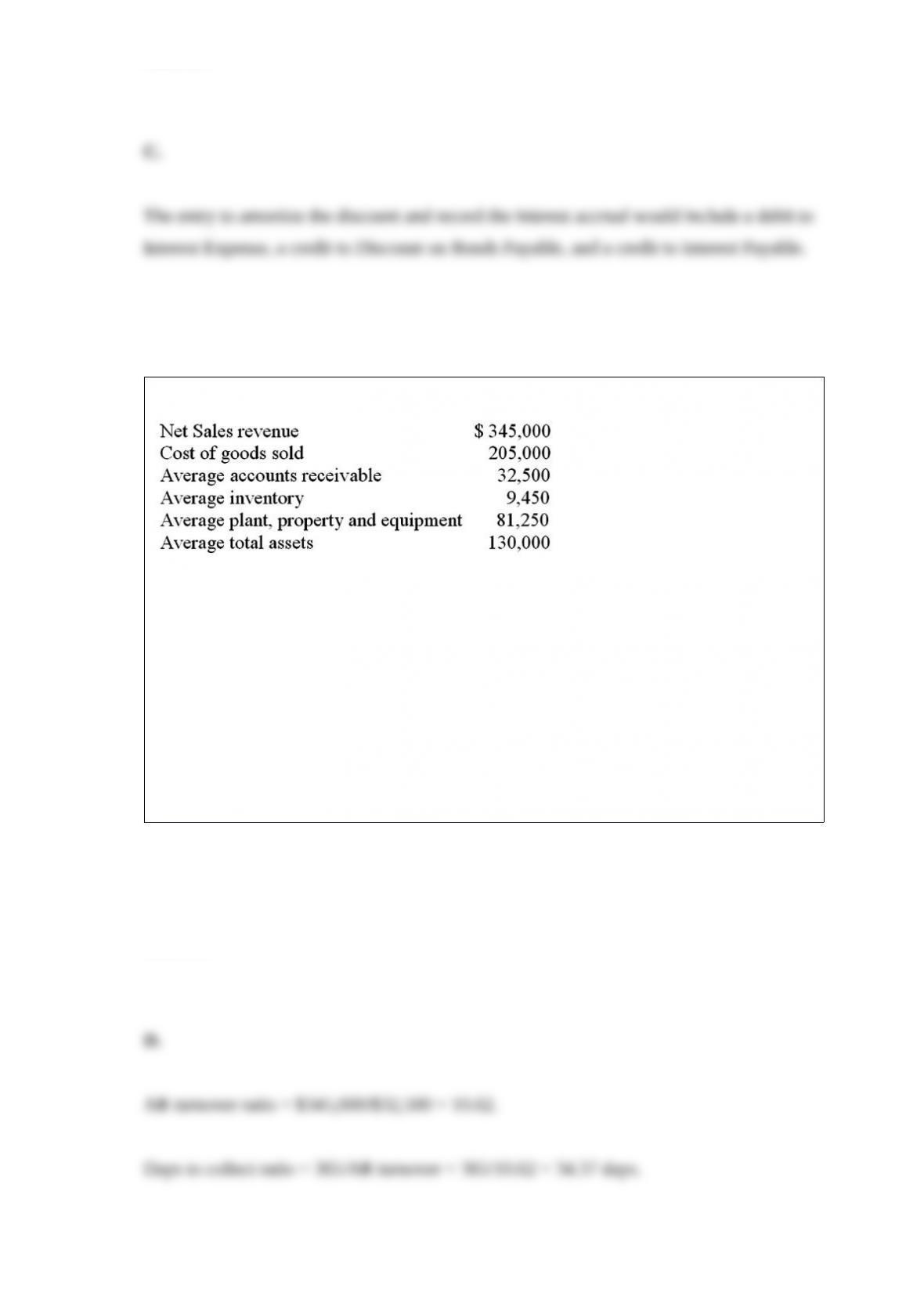
The following information is available for a company for the current year:
Which of the following is closest to the company’s days to collect ratio for the current
year?
A. 91.25
B. 84.88
C. 57.84
D. 34.37
Answer:
As of the beginning of 2013 a company had total contributed capital of $300,000 and
total retained earnings of $35,000. Total liabilities were $100,000. During the year
2013, the company had the following transactions:
– Issued stock for cash of $60,000.
– Declared and paid a cash dividend of $15,000.
– Reported total revenue of $160,000 and total expenses of $90,000.
What is the amount of contributed capital that will be reported on the Statement of
stockholders’ equity at the end of 2013?
A. $300,000
B. $360,000
C. $345,000
D. $415,000
Answer:
Which amount should be reported as cash on the balance sheet?
A. The ending cash balance per the bank statement.
B. The beginning cash balance per the bank statement.
C. The up-to-date ending cash balance per the bank reconciliation.
D. The ending cash balance per the books.
Answer:
Patel Inc. issued 5-year, 10% bonds with a face value of $10,000 on January 1, 2013.
The market rate of interest was 8% and the proceeds from the bond issuance was
$10,800.
Use the information above to answer the following question. If the straight-line method
of amortization is used, how much total interest expense would be recorded in 2013?
A. $1,840
B. $840
C. $1,000
D. $864
Answer:
If the total amount that should have been debited to insurance expense is mistakenly
debited to prepaid insurance, what will be the effect on the financial statements for the
year?
A. Revenues will be overstated.
B. Assets will be overstated.
C. Stockholders’ equity will be understated.
D. Expenses will be overstated.
Answer:
Which of the following is not a reason why it is especially important for companies to
have internal controls over cash?
A. Most businesses have a large amount of cash on hand.
B. There are a lot of transactions that affect cash.
C. Cash is portable.
D. Most theft of assets involve cash.
Answer:
On January 1, 2016, Horton Inc. sells a machine for $23,000. The machine was
originally purchased on January 1, 2014 for $40,000. The machine was estimated to
have a useful life of 5 years and no residual value. Horton uses straight-line
depreciation.
a. Prepare the journal entry to record the sale.
b. If the company had used the double-declining balance method, how would this have
affected any gain or loss on the sale?
Answer:
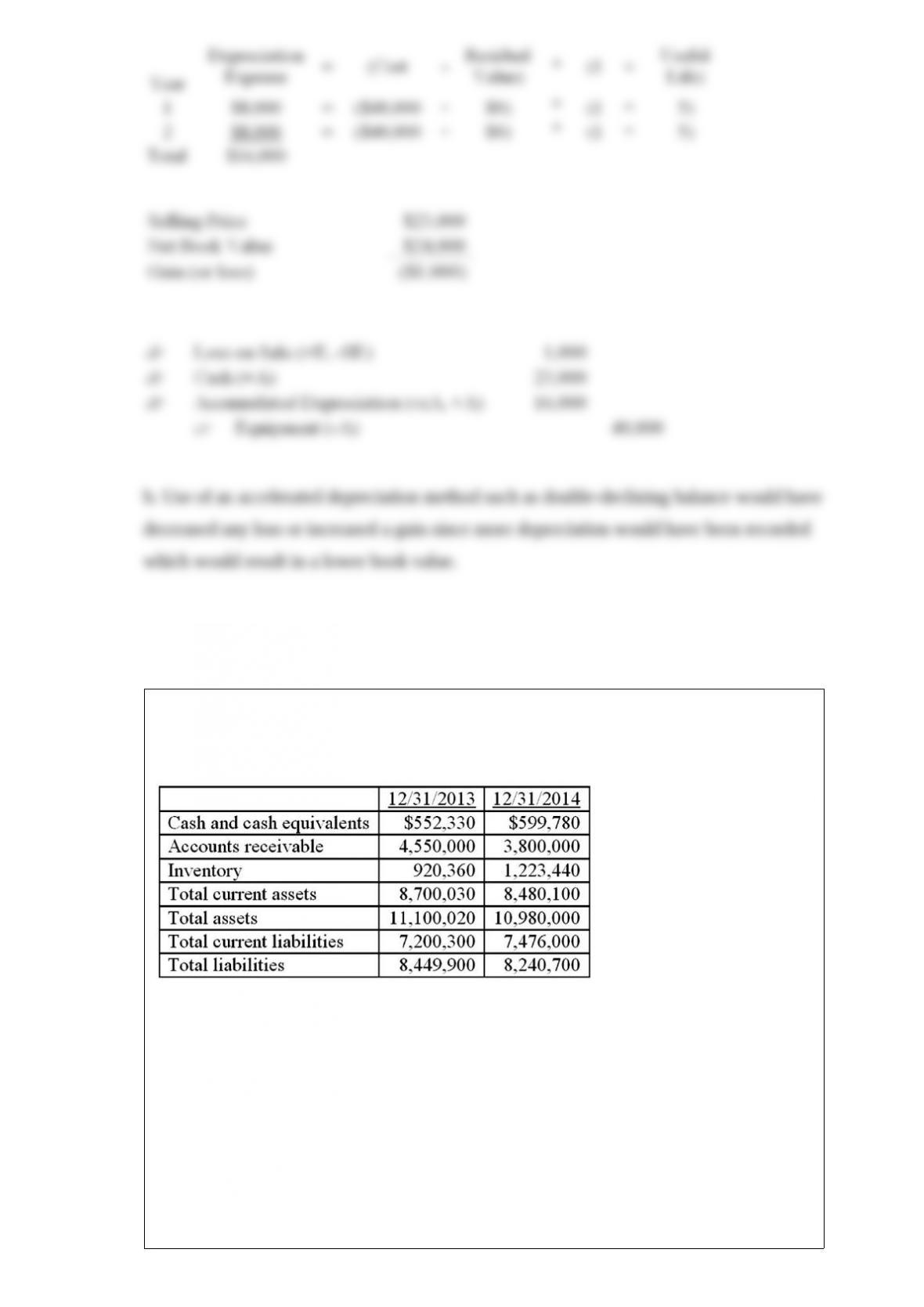
The financial information below presents selected information from the financial
statements of Pelican Company. Sales revenue in 2014 was $13,700,300. Cost of goods
sold was $8,905,195.
A. Calculate the following. Round to two decimal places.
1) Receivables turnover ratio assuming all Pelican’s sales are made on account.
2) Current ratios as of December 31, 2014, and as of December 31,
3) Quick ratio as of December 31, 2014, and as of December 31, 2013.
4) Inventory turnover ratio.
B. Evaluate the company’s liquidity position at 12/31/2014. Cite any additional
information not given in the problem that would be helpful in evaluating the company’s
liquidity.
Answer:
Which of the following represent cash provided by financing activities?
A. Issuing stock in exchange for another company’s stock.
B. Paying a bond’s face value at maturity.
C. Issuing long-term bonds at a discount.
D. Receiving interest on promissory notes.
Answer:
A corporation’s legal capital (legal value) is often defined as:
A. The par value of the issued shares.
B. The par value of the outstanding shares.
C. The par value of the authorized shares.
D. The par value of the shares in the treasury.
Answer:
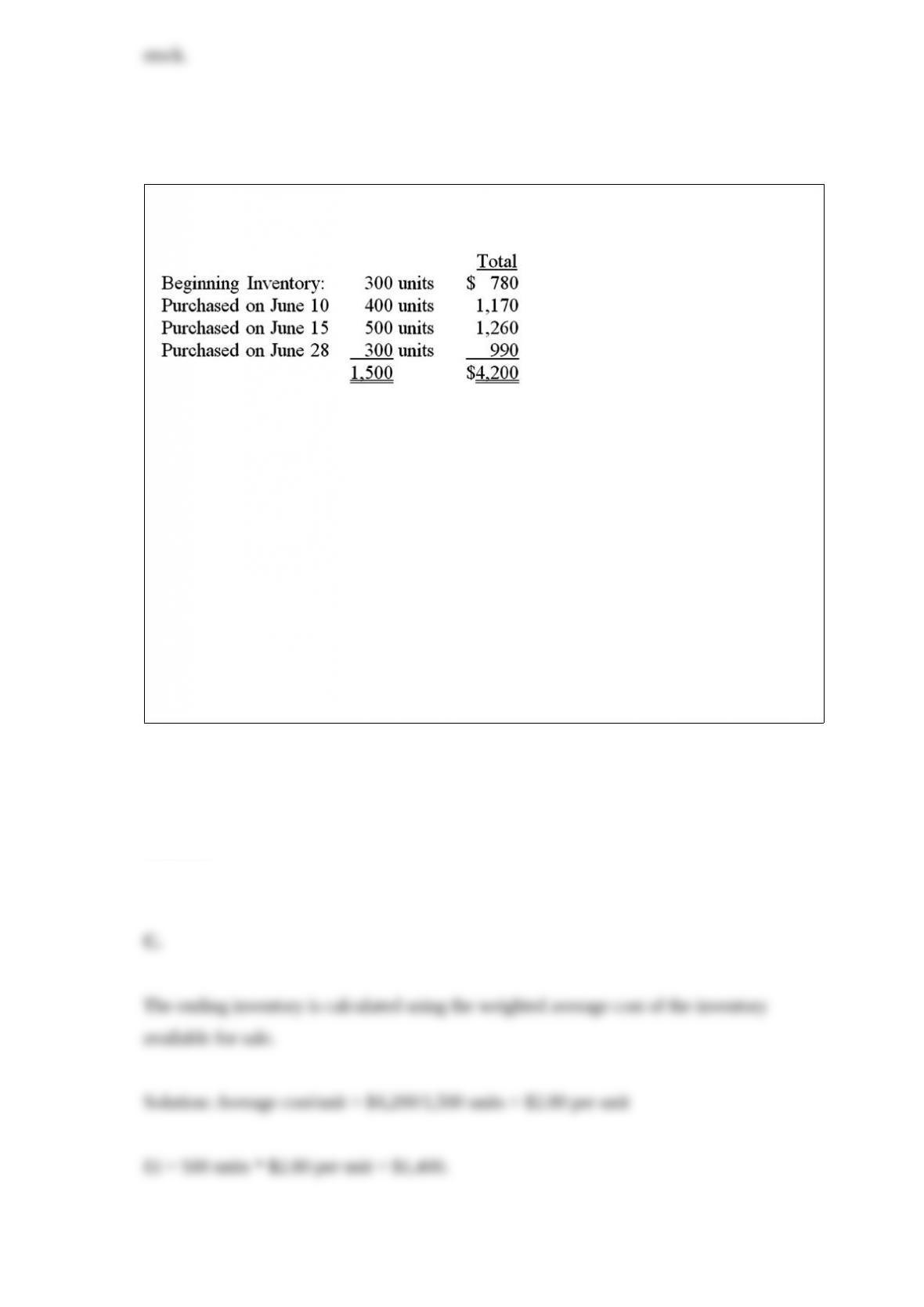
BAF Company uses a periodic inventory system and its inventory records for June
contain the following information:
The company sold 1,000 units during June and 500 units were in its ending inventory
on June 30.
Use the information above to answer the following question. If the company uses the
weighted average inventory costing method, what is the cost of its ending inventory?
A. $4,200.
B. $2,700.
C. $1,400.
D. $1,365.
Answer:
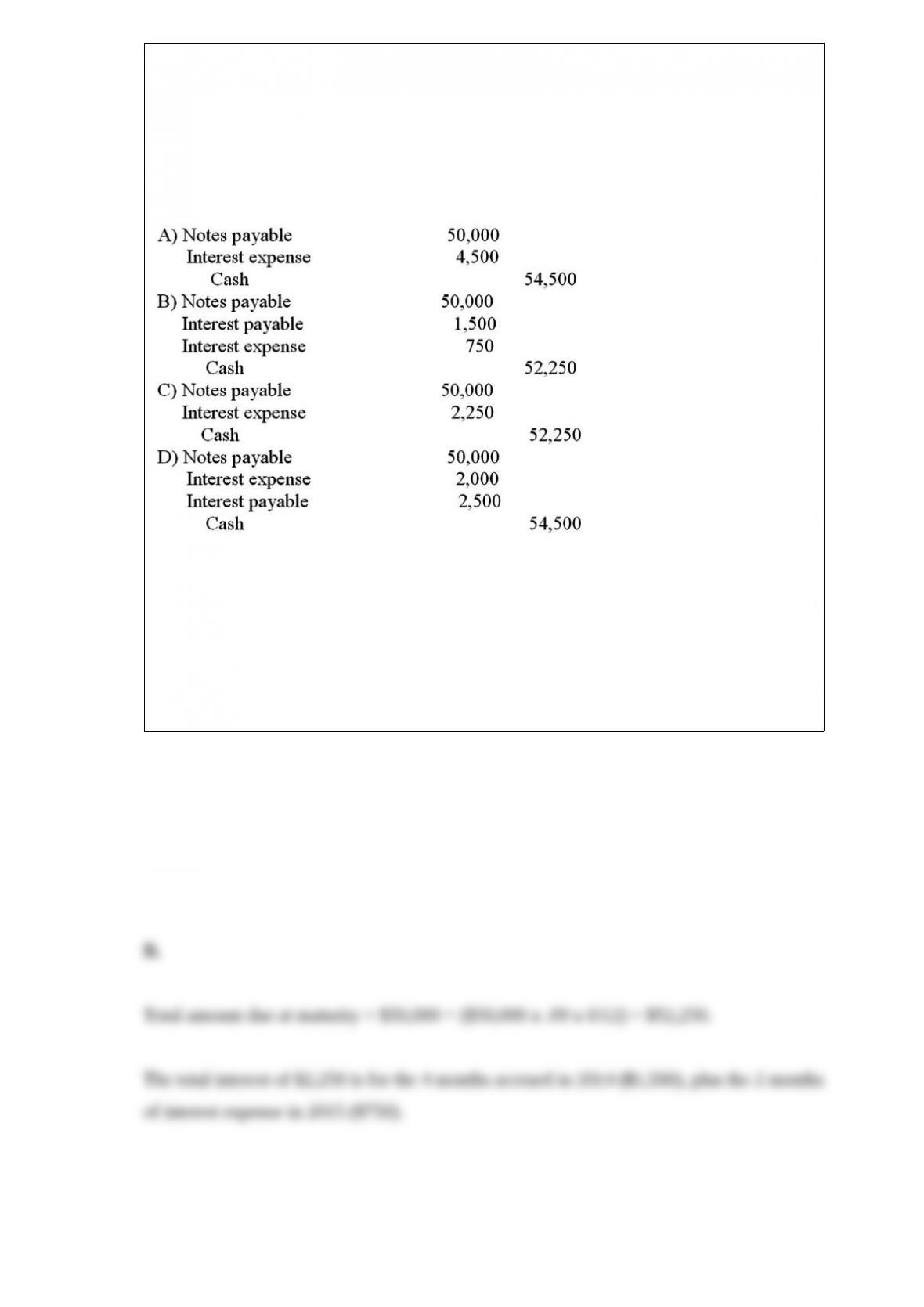
On September 1, 2014, a company issued a $50,000, 6-month, 9% note payable to
purchase a piece of equipment. The company pays the note with interest at the maturity
date.
Use the information above to answer the following question. What is the entry to record
the payment at the maturity date of the note?
A. Option A
B. Option B
C. Option C
D. Option D
Answer:
Special items reported as part of comprehensive income, but not included in net
income, might include:
A. gains or losses on foreign currency exchange.
B. interest expense.
C. extraordinary gains and losses.
D. income tax expense.
Answer:
A company has sales revenues of $200,000 and expenses of $50,000. What is its net
profit margin?
A. 4
B. 25%
C. 75%
D. $150,000
Answer:
The Tuck Shop began the current month with inventory costing $10,000, then
purchased inventory at a cost of $35,000. The perpetual inventory system indicates that
inventory costing $30,000 was sold during the month for $40,000. If an inventory count
shows that inventory costing $14,500 is actually on hand at month-end, what amount of
shrinkage occurred during the month?
A. $500.
B. $5,000.
C. $14,495.
D. $15,000.
Answer:
If you own 200,000 shares of stock in a company with 8 million shares outstanding and
the company issues an additional 2 million shares to its employees through a stock
purchase plan, your ownership percentage:
A. remains the same because the company now has more assets.
B. falls from 2.5% to 2%.
C. remains the same because the company now has fewer liabilities.
D. increases because the company now has more stock outstanding.
Answer:
Net accounts receivable is:
A. gross accounts receivable minus cost of goods sold.
B. gross accounts receivable minus bad debt expense.
C. gross accounts receivable minus allowance for doubtful accounts.
D. gross accounts receivable minus current liabilities.
Answer:

Choose the appropriate letter to match the term and the definition. Not all definitions
will be used.
TERM
_____ 1/ weighted average cost.
_____ 2/ work in process inventory.
_____ 3/ days to sell.
_____ 4/ freight-in.
_____ 5/ specific identification.
_____ 6/ goods available for sale.
_____ 7/ inventory.
_____ 8/ inventory turnover ratio.
_____ 9/ Cost of goods sold equation.
DEFINITION
A. The sum of beginning inventory and purchases by the company.
B. A company’s policy of requiring identification by customers who pay by check.
C. The book value of all the partially produced goods held by a manufacturer.
D. Beginning inventory plus purchases minus ending inventory.
E. Tangible property held for future sale or used to produce other goods or services for
sale.
F. The account used to record shipping costs paid by the seller.
G. The average cost a company paid for inventory taking into account the number of
units bought at each unit cost.
H. The average length of time it takes a company to sell an item in inventory.
I. An inventory costing method where the firm adds up all the different prices it paid for
inventory and divides by the number of prices.
J. The average number of times a company sells its inventory over the year.
K. The amount of money that firms set aside today to buy inventory in the future.
L. An inventory costing method where the firm keeps track of the cost and sale of each
individual good.
M. Shipping costs paid by the buyer are recorded in this account.
Answer:
You are considering buying a bond from a company that has a quick ratio of 0.45. This
means that:
A. the company has 45% of its total assets in the current category.
B. the company does not have the ability to pay off all the debt it owes with all the
assets it owns.
C. the company does not have the ability to pay off all the debt that is due in the near
future with assets that are available in the near future.
D. stockholders currently own 45% of the company’s assets.
Answer:
A credit would make which of the following accounts decrease?
A. Contributed Capital
B. Inventories
C. Notes Payable
D. Retained Earnings
Answer:
If a company is paid in full for services provided this month, how will the basic
accounting equation be affected?
A. Liabilities will decrease.
B. Stockholders’ equity will increase as revenue is recorded.
C. Liabilities will increase.
D. Assets will decrease.
Answer:
Which of the following statements would not explain why a company may want to
repurchase its stock?
A. To demonstrate to investors that it believes its own stock is worth purchasing.
B. To obtain shares to reissue to employees as part of an employee stock plan.
C. To obtain shares that can be reissued as payment for purchase of another company.
D. To increase the number of shares of outstanding stock.
Answer:
Use the information for Purrfect Pets below to calculate each of the required numbers.
Assume that expenses include taxes and the company has no other sources of revenue.
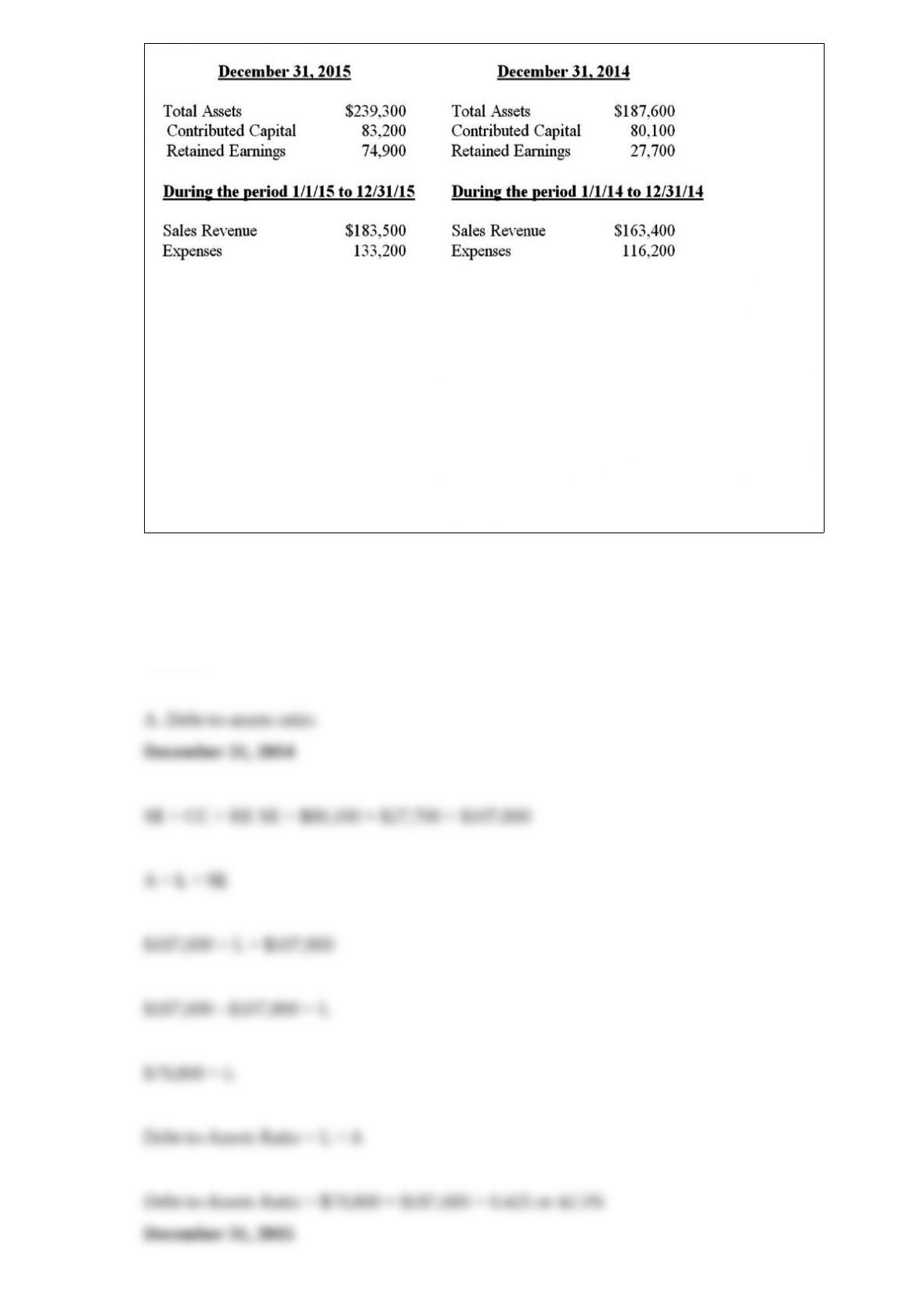
A. Determine the debt-to-assets ratio for the company as of December 31, 2014 and
December 31, 2015. Compare and interpret the results.
B. Determine the asset turnover ratio for the company during the year
C. Determine the net income for the company for 2014 and 2015. Compare and
interpret the results.
D. Determine the net profit margin ratio for the company for 2014 and Explain what
these calculations indicate in light of your answer to part C.
Answer: