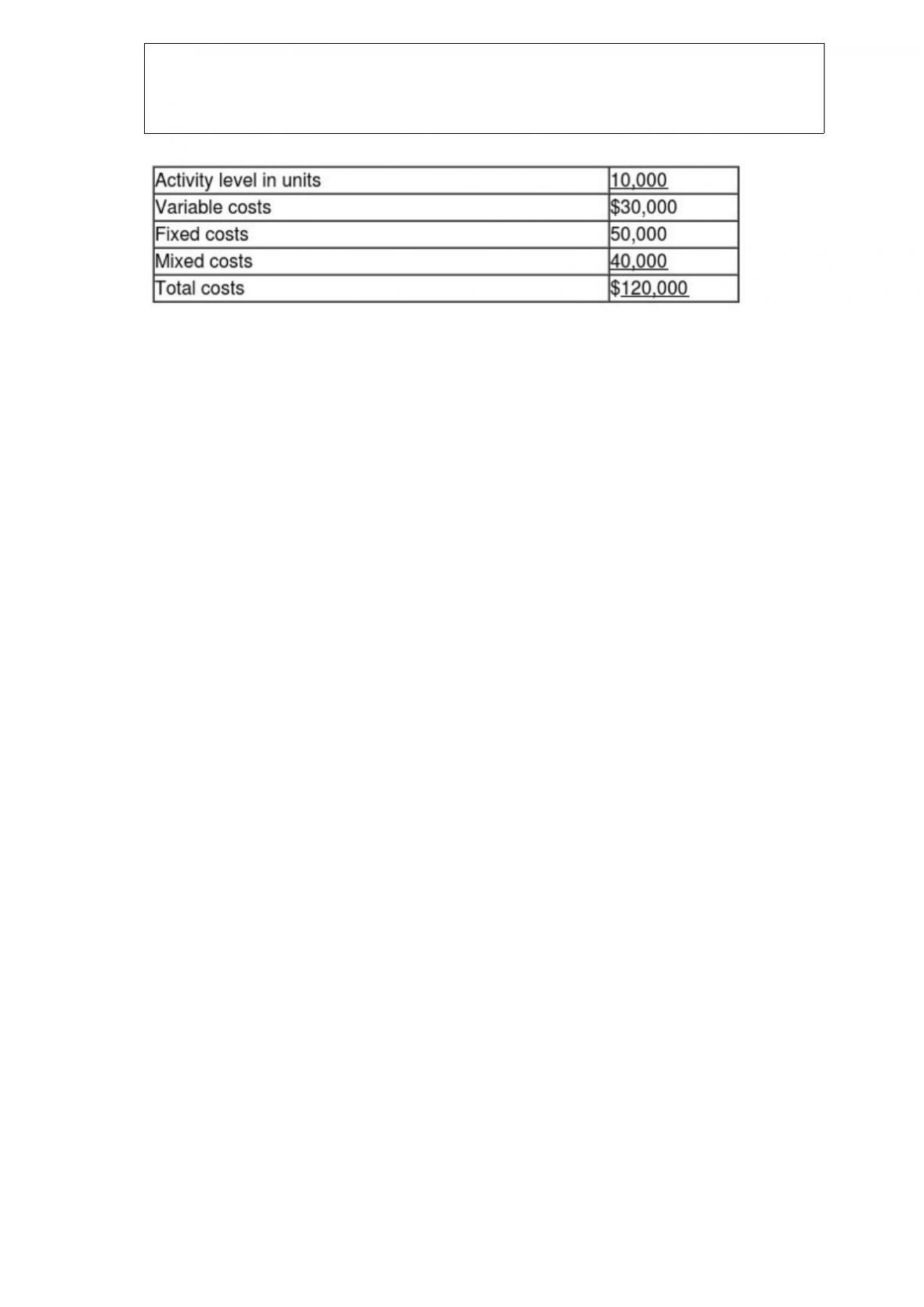
XYZ Company incurred the following costs for the month of August when it observed
an activity level of 10,000 units.
During October, the activity level was 16,000 units, and the total costs incurred were
$150,000.
a. Calculate the variable costs, fixed costs, and mixed costs incurred during October.
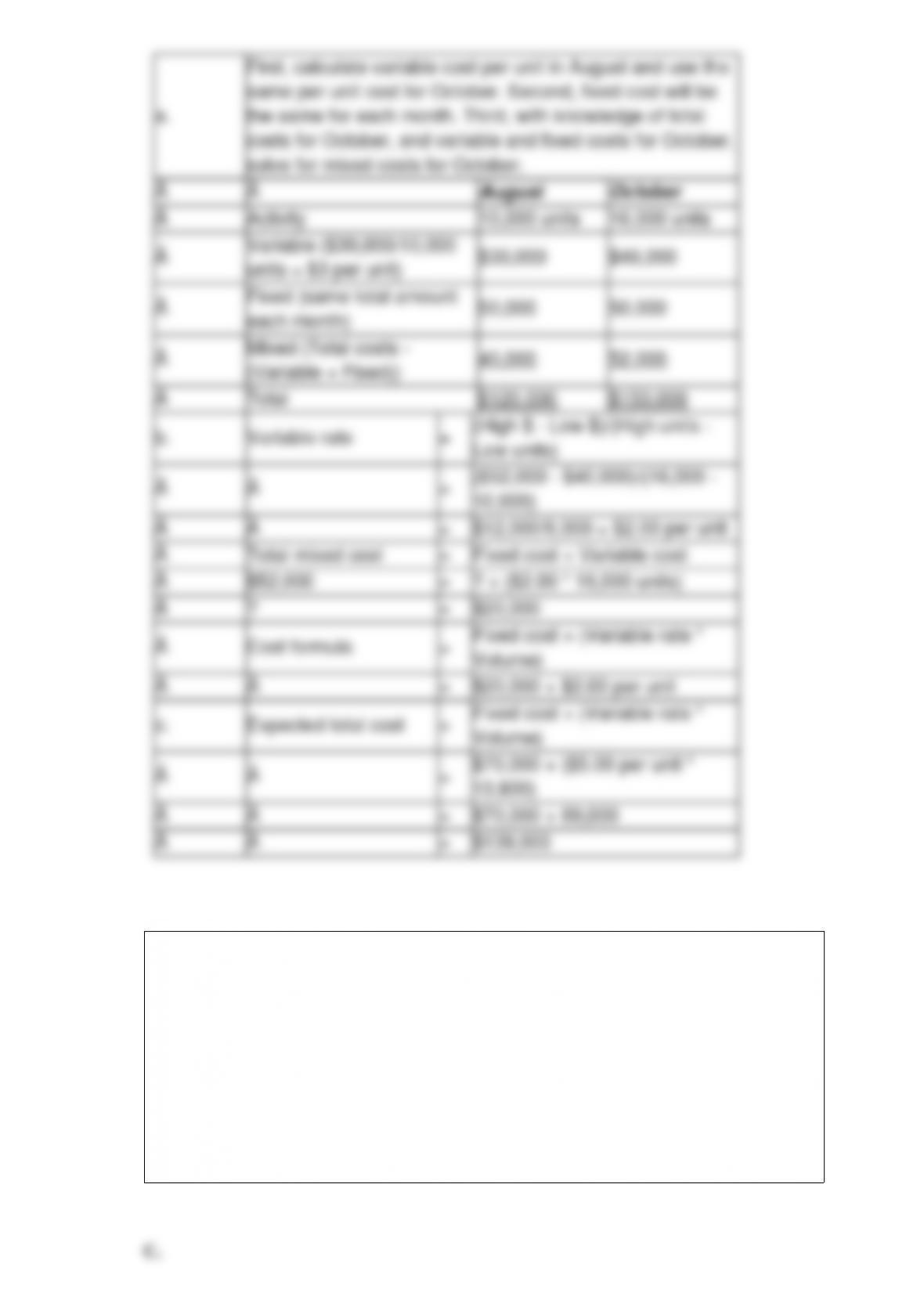
b. Use the high-low method to calculate the cost formula for mixed costs.
c. If the activity level were expected to be 13,800 units for the month of December, what
amount of total costs would be expected?
Which of the following was not one of the reasons for the FASB’s decision to undertake
the Conceptual Framework project?
A. To provide a structure or framework of financial accounting concepts.
B. To describe concepts that will underlie guidance on future accounting practices and
in due course serve as a basis for evaluating existing guidance and practices.
C. To provide detailed, industry-specific authoritative guidance for the accounting and
financial reporting of complex business transactions.
D. To facilitate the FASB’s efforts in developing accounting and reporting guidance by
providing a common foundation and basic reasoning on which to consider merits of
alternatives.

The concept of a standard used for planning and control purposes is most like a:
A. measure of ideal performance.
B. unit budget.
C. measure of maximum efficiency.
D. measure of historical performance.
To which function of management is CVP analysis most applicable?
A. Planning.
B. Organizing.
C. Directing.
D. Controlling.
A set of integrated financial and operating performance measures that communicate an
organization’s priorities associated with achieving strategic goals is known as a:
A. balanced scorecard.
B. segment report.
C. responsibility report.
D. master budget.
Which of the following statements is true regarding the reporting of discontinued
operations?
A. The impact that the discontinued operations had on any previous year results is not
shown for comparative purposes.
B. The income or loss, net of taxes, of the discontinued operations is reported as a
separate component of income from continuing operations.
C. Earnings per share data are not reported separately for discontinued operations.
D. By reporting discontinued operations as a separate item, net of taxes, all of the
effects of the discontinued business segment are excluded from the revenues, expenses,
gains, and losses of continuing operations.
A budgeting process that involves justifying resource requirements based on an analysis
and prioritization of organizational objectives is called:
A. continuous budgeting.
B. zero-based budgeting.
C. discretionary budgeting.
D. single-period budgeting.
Depreciation, in accounting, is a process that results in:
A. depreciable assets being reported in the balance sheet at their fair value.
B. accumulating cash for the replacement of the asset.
C. an accurate measurement of the economic usefulness of an asset.
D. spreading the cost of an asset over its useful life to the entity.
A magazine publisher has an account called “Unearned Subscription Revenue.” The
transaction that causes the balance of this account to decrease is:
A. cash is received from new subscribers.
B. magazines are printed for the publisher.
C. magazines are mailed to subscribers.
D. subscriptions are sold to new subscribers.
Management salaries are an example of a ____________ cost behavior pattern.
A. variable
B. semivariable
C. fixed
D. mixed

An item that cost $270 is sold for $360. The gross profit ratio for this item is:
A. 20%
B. 25%
C. 33.3%
D. 60% ($360 – $270)/$360 = 25%
Southern Company’s accountant failed to accrue as of 12/31/16 some employee fringe
benefit program expenses that were incurred in 2016 and that will be paid in 2017. The
result of this omission is to:
A. overstate the current ratio at 12/31/16 and overstate ROI and ROE for the year ended
12/31/16.
B. overstate the current ratio at 12/31/16 and understate ROI and ROE for the year
ended 12/31/16.
C. understate the current ratio at 12/31/16 and understate ROI and ROE for the year
ended 12/31/16.
D. not affect the current ratio at 12/31/16 but to overstate ROI and ROE for the year
ended 12/31/16.
At the beginning of the year, paid-in capital was $164 and retained earnings was $94.
During the year, the stockholders invested $48 and dividends of $12 were declared and
paid. Retained earnings at the end of the year were $104.
Total stockholders’ equity at the end of the year was:
A. $164
B. $188
C. $212
D. $316
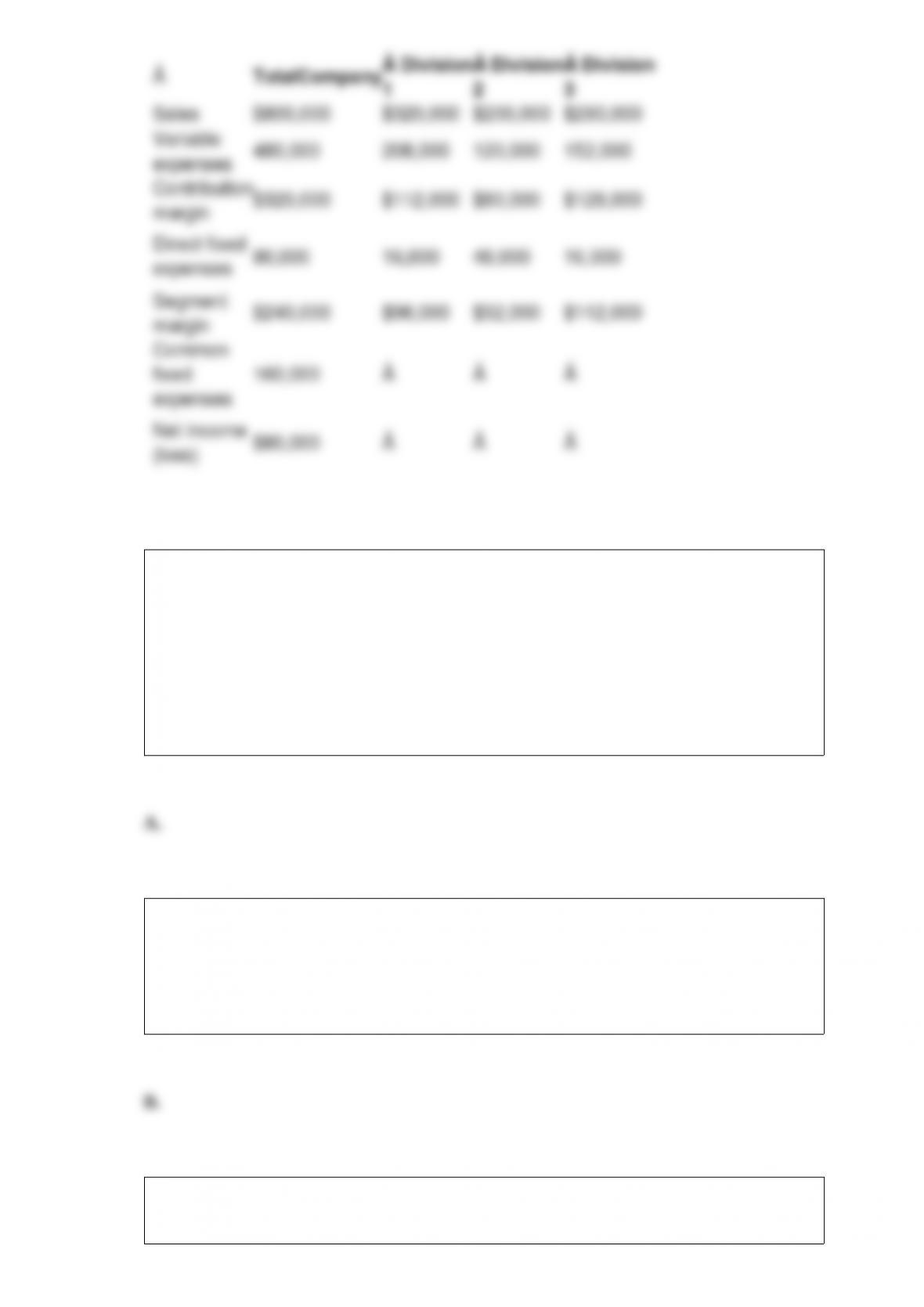
Niangua Co. is divided into three segments and is interested in preparing a segmented
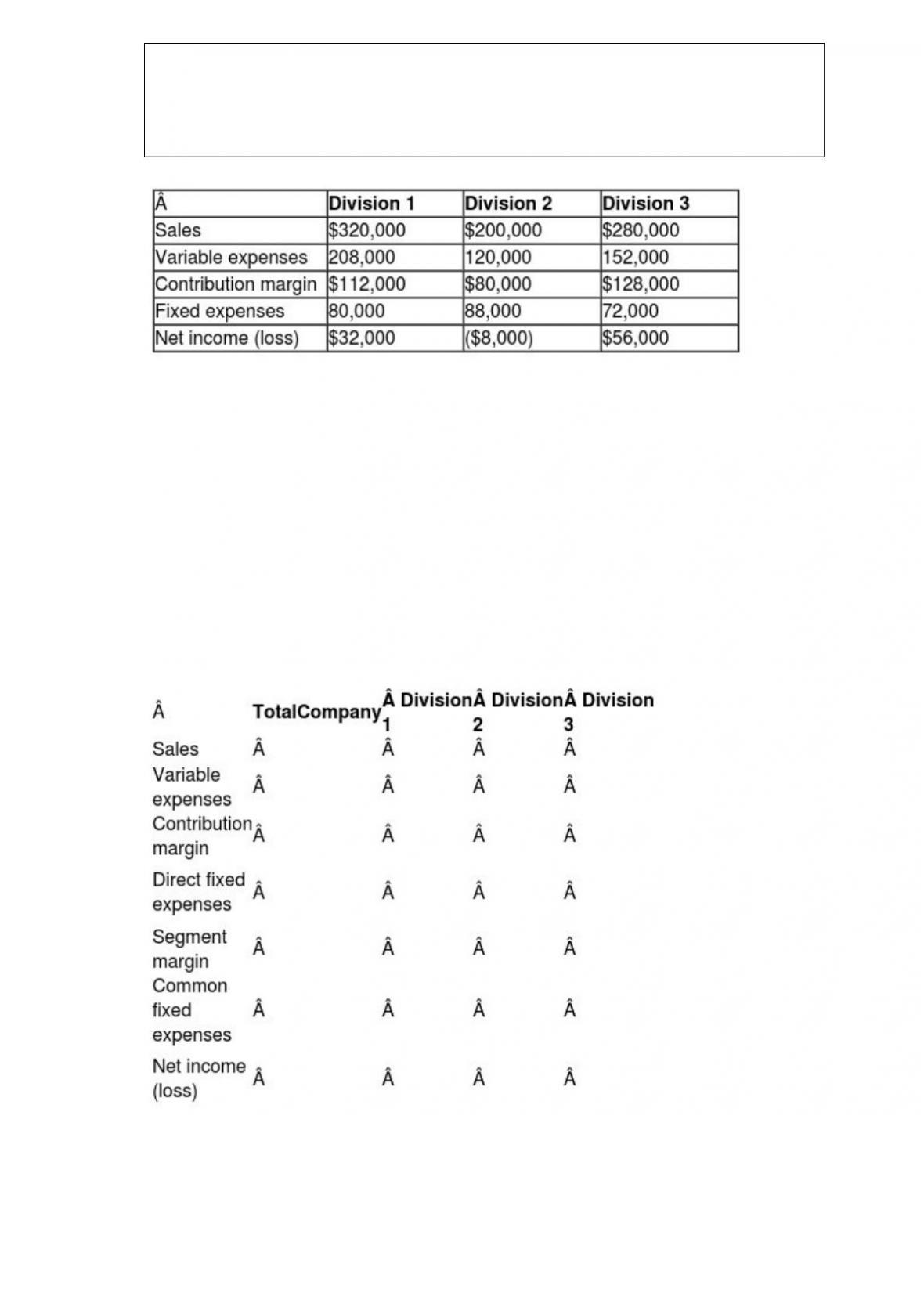
income statement in order to better understand the operating performance of each
segment. Fixed expenses in each division currently include an allocation of general
corporate expenses equal to 20% of the division’s sales.
(a.) Complete the following segmented income statement for Niangua Co.
If all units produced during the month of September are sold, and no additional units
are sold from the beginning finished goods inventory, then:
A. income determined with absorption costing will equal income determined with direct
costing.
B. ending work in process inventory will increase.
C. income determined with absorption costing will be lower than income determined
with direct costing.
D. ending finished goods inventory will decrease.
The intangible asset goodwill:
A. represents the management team’s assessment of its value to the company.
B. may arise when one company purchases another company.
C. arises because the fair value of a company’s assets is greater than cost.
D. all of the above are correct.
Current U.S. Generally Accepted Accounting Principles and auditing standards require
the financial statements of an entity for the reporting period to include:
A. Earnings and gross receipts of cash for the period.
B. Projected earnings for the subsequent period.
C. Financial position at the end of the period.
D. Current fair values of all assets at the end of the period.
Expressing fixed costs on a per unit basis of activity is misleading because:
A. total fixed costs decrease as activity decreases.
B. total fixed costs increase as activity increases.
C. fixed cost per unit increase as activity increases.
D. fixed cost per unit decrease as activity increases.
A debit balance in the manufacturing overhead account at the end of the period
indicates that:
A. manufacturing overhead is overapplied.
B. manufacturing overhead is underapplied.
C. manufacturing overhead has been accurately applied.
D. None of the above.
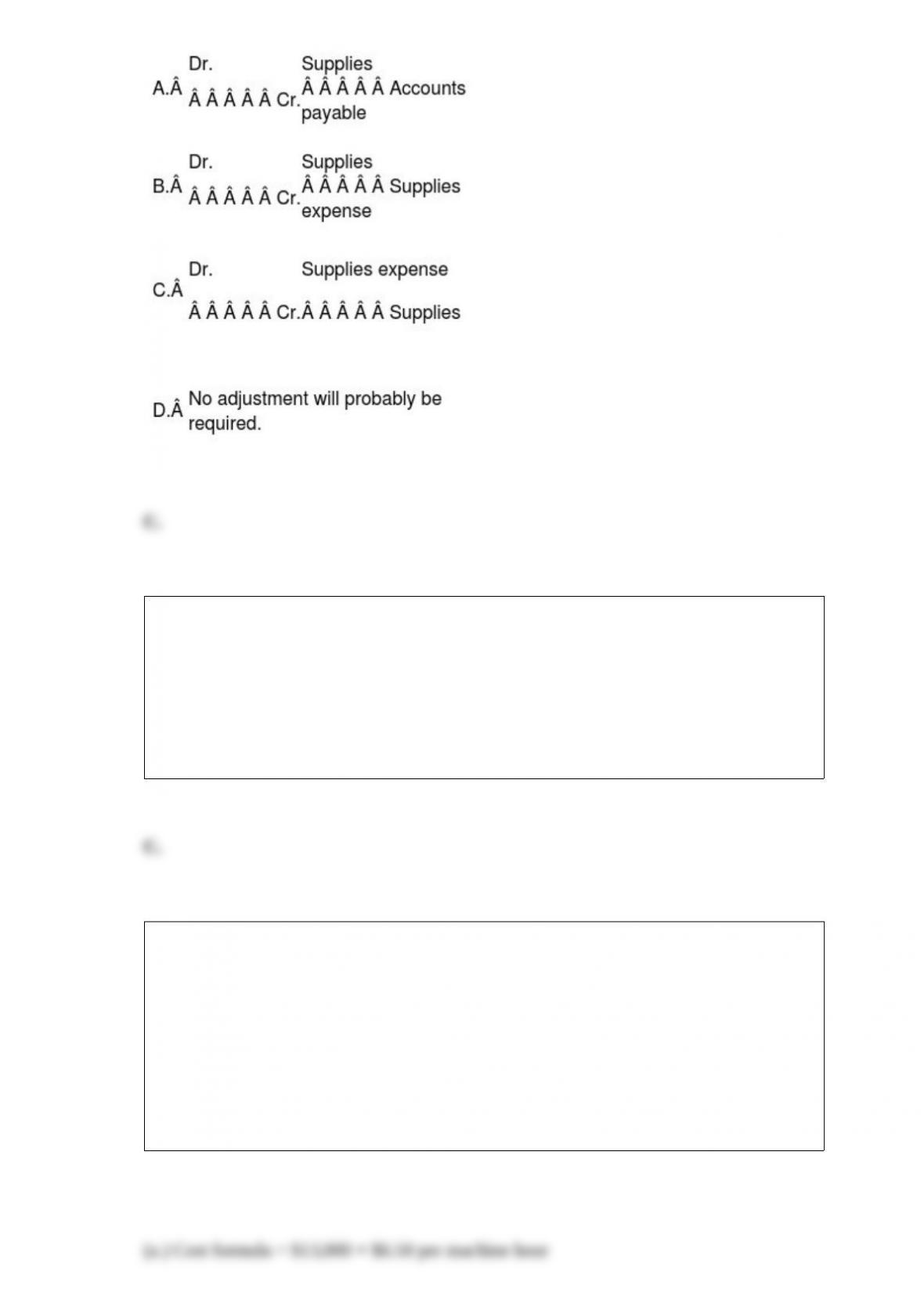
When a firm purchases supplies for use in its business, and the cost of the supplies
purchased is recorded as an asset, the following adjustment to recognize the cost of
supplies used will probably be required:
If a firm borrowed money on a six-month bank loan, the firm’s working capital
immediately after obtaining the loan, relative to its working capital just prior to the
loan, would be:
A. Higher.
B. Lower.
C. The same.
D. Would depend on the amount borrowed.
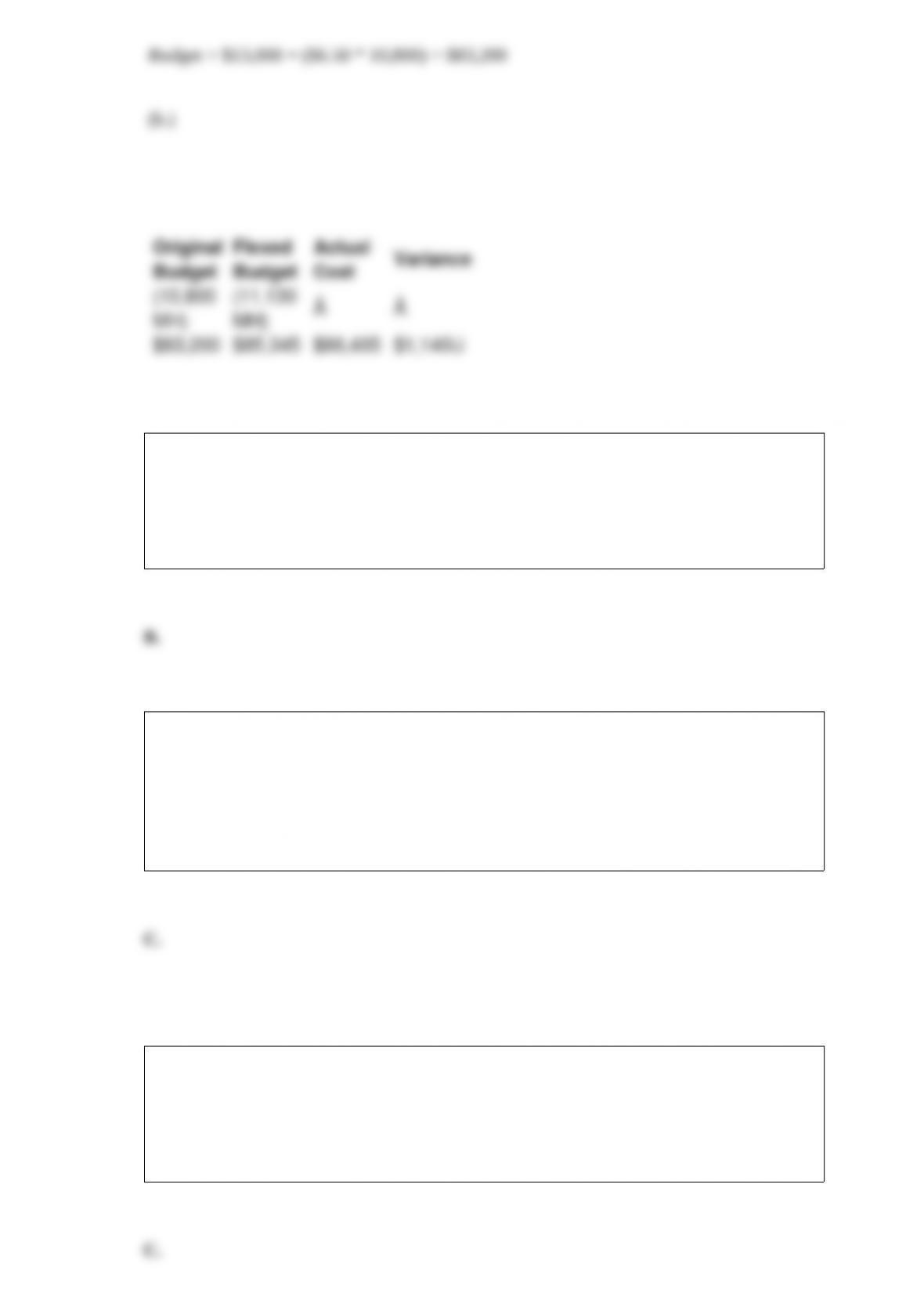
The cost formula for the maintenance department of the Raven Co. is $13,000 per
month plus $6.50 per machine hour used by the production department.
a. Calculate the maintenance cost that would be budgeted for the month of November in
which 10,800 machine hours are planned to be used.
b. Prepare an appropriate performance report for the maintenance department assuming
that 11,130 machine hours were actually used in the month of November, and the total
maintenance cost incurred was $86,485.
A transaction that is likely to cause an increase in a current liability is:
A. payment of accrued wages.
B. accrual of interest expense.
C. depreciation of equipment.
D. accrual of bad debts expense.
Which of the following is a plan for acquiring the resources needed to complete the
manufacturing activities that will satisfy the organization’s sales forecast?
A. sales budget.
B. raw materials budget.
C. production budget.
D. direct labor budget.
An example of a committed cost is:
A. employee training.
B. manufacturing supplies.
C. real estate taxes.
D. charitable contributions.
If fixed costs were increased by $9,000 and the contribution margin ratio remained at
30 percent, then sales must increase by _________ in order to cover the additional fixed
expenses.
A. $27,000
B. $30,000
C. $33,000
D. $54,000
ABC Company’s sales are $100,000, fixed costs are $50,000, and variable costs are
$30,000. ABC Company’s contribution margin ratio is:
A. 20%.
B. 30%.
C. 50%.
D. 70%.
Managerial accounting, as compared to financial accounting:
A. must conform to GAAP.
B. places a great deal of emphasis on historical transactions.
C. uses frequent and prompt control reports.
D. focuses on information prepared for the investors and creditors.
An individual interested in making a judgment about the profitability of a company
should:
A. review the trend of working capital for several years.
B. calculate the company’s ROI for the most recent year.
C. review the trend of the company’s ROI for several years.
D. compare the company’s ROI for the most recent year with the industry average ROI
for the most recent year.
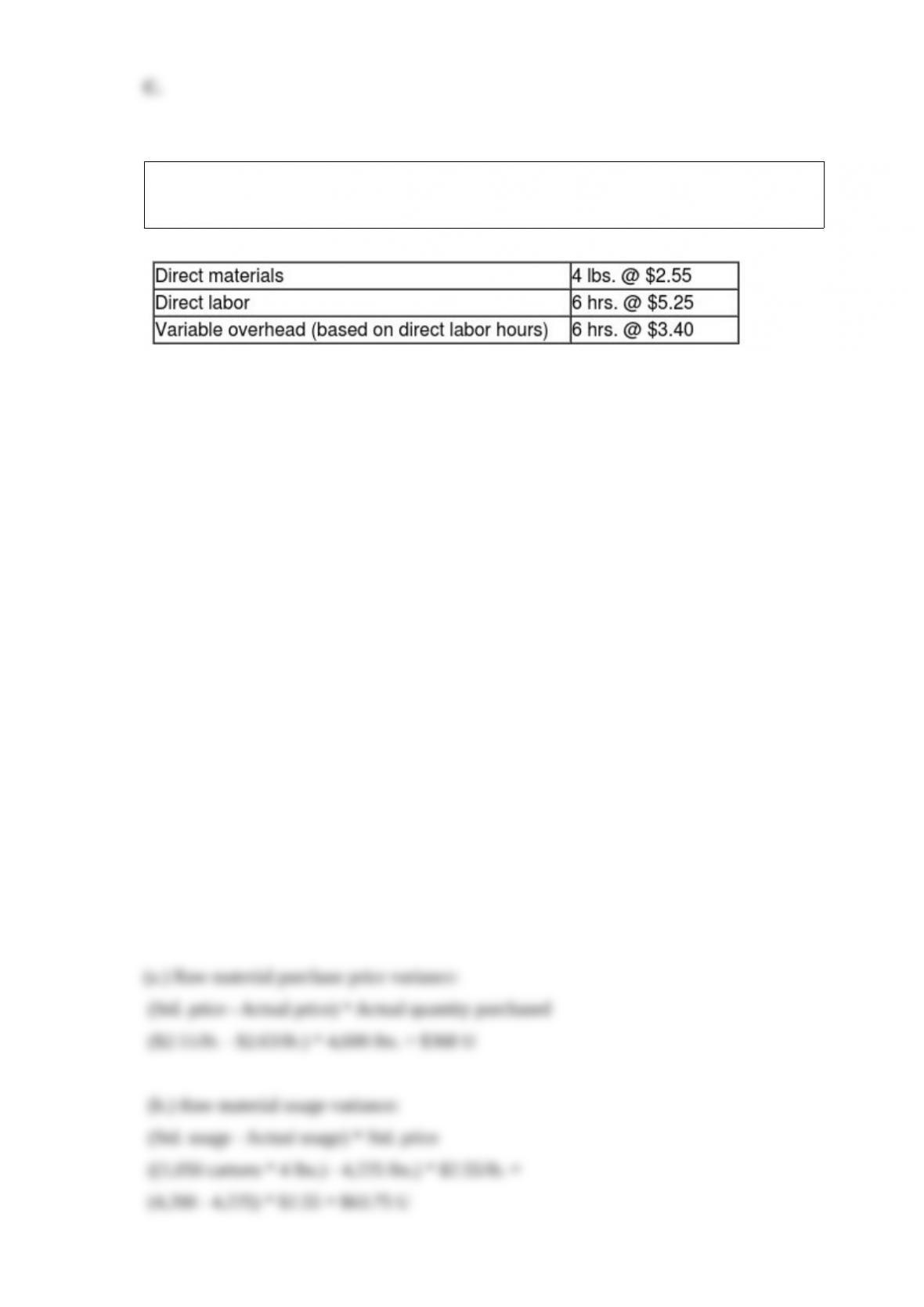
The standards for one carton of Wonder Wax are:
During the week ended December 4, the following activity took place:
• 4,600 lbs. of raw material were purchased for inventory at a cost of $2.63 per pound;
• 1,050 cartons of finished product were produced;
• 4,225 lbs. of raw material were used;
• 6,140 labor hours were worked at a total cost of $33,463;
• $20,569 actual variable overhead costs were incurred.
Calculate each of the following variances:
(a.) Price variance for raw materials purchased.
(b.) Raw materials usage variance.
(c.) Direct labor rate variance.
(d.) Direct labor efficiency variance.
(e.) Variable overhead spending variance.
(f.) Variable overhead efficiency variance.
Developing a standard cost for a product or service will usually involve:
A. efforts of cost accounting personnel only.
B. focusing only on variable costs.
C. the same kind of communication involved in the overall budgeting process.
D. concentrating on historical costs and performance levels.
Computing a borrower’s effective interest rate is another application of which of the
following concepts?
A. Present value concept.
B. Current value concept.
C. Periodic interest concept.
D. None of the above.
Which activity of the management planning and control process occurs in each phase of
the cycle?
A. planning.
B. managing.
C. controlling.
D. decision making.
On January 31, an entity’s balance sheet showed total assets of $2,250 and liabilities of
$750. Stockholders’ equity at January 31 was:
A. $1,500
B. $3,000
C. $1,250
D. $750
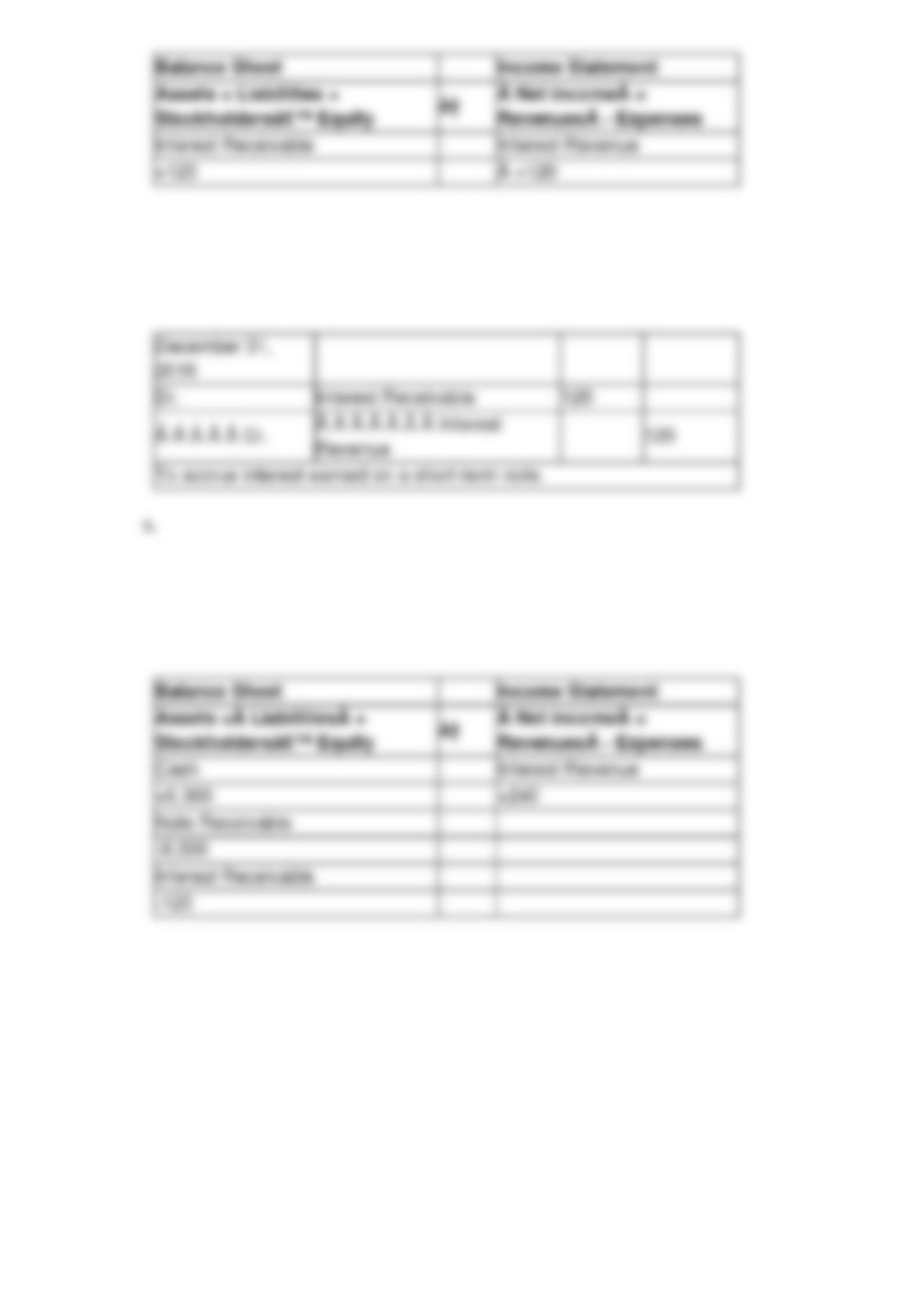
Agrico, Inc., accepted a 6-month, 9% (annual rate), $8,000 note from one of its
customers on November 1, 2016; interest is payable with the principal at maturity.
Required:
a. Use the horizontal model or write the journal entry to record the interest earned by
Agrico during its year ended December 31, 2016.
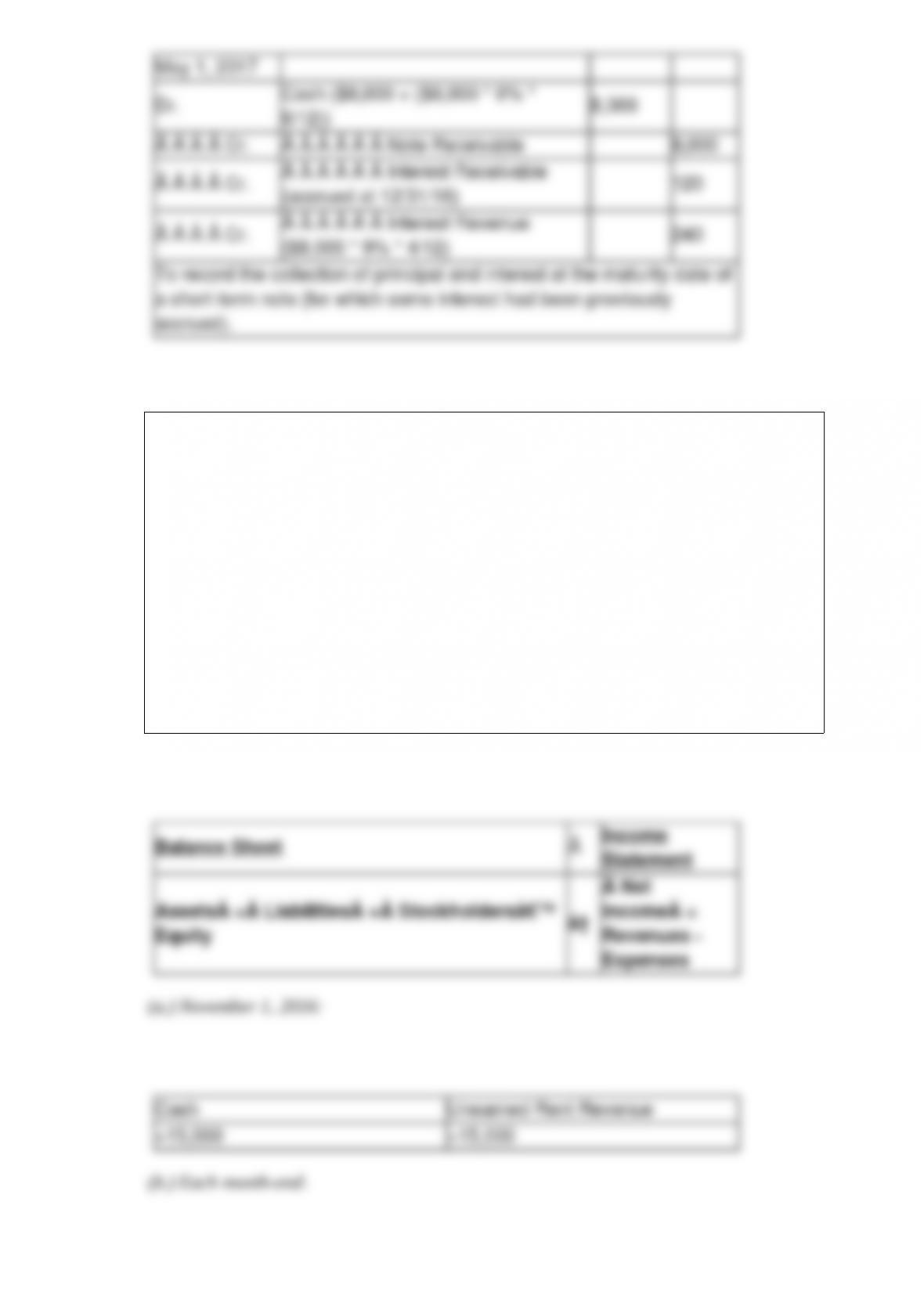
b. Use the horizontal model or write the journal entry to record collection of the note
and interest at maturity.
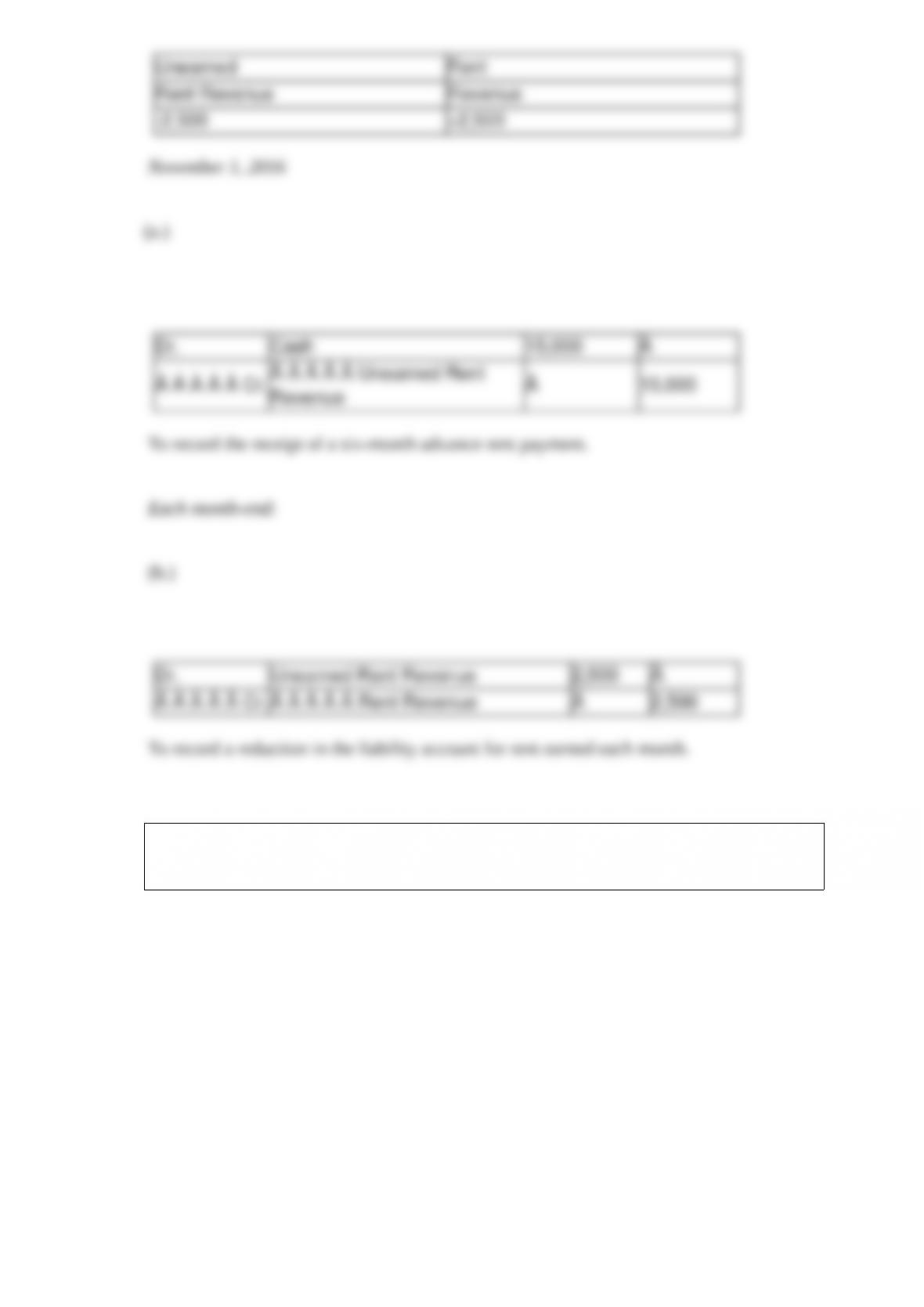
On November 1, 2016, an advance rent payment of $15,000, representing a six-month
prepayment (for the rental period beginning on that date) was received in cash from the
company’s tenant.
Required:
Use the horizontal model (or write the journal entries) to record the effects of the
following items:
(a.) The six months of rent collected in advance on November 1, 2016.
(b.) The adjustment that will be made at the end of each month to show the amount of
rent “earned” during the month.
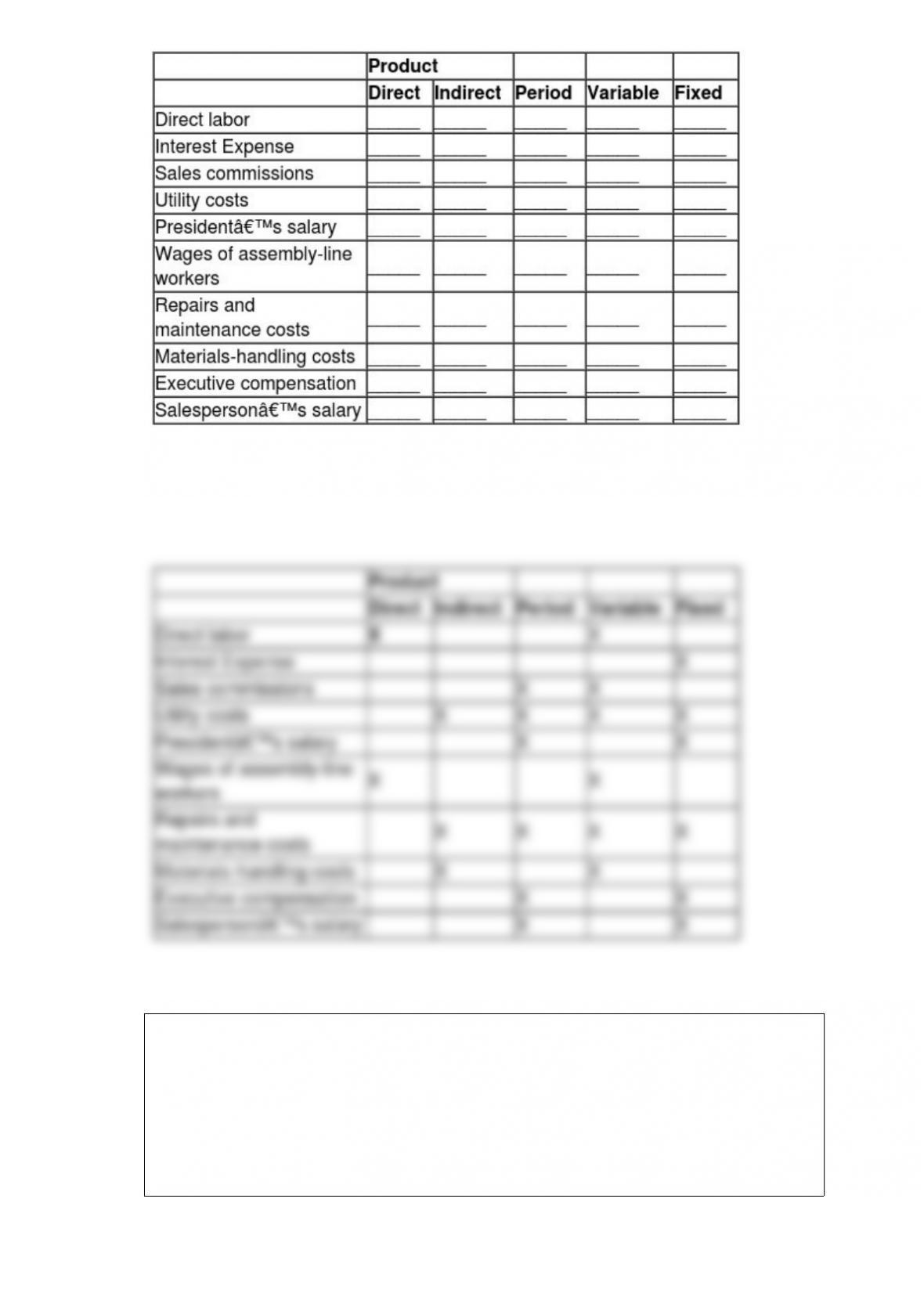
For each of the following costs, check the columns that most likely apply.
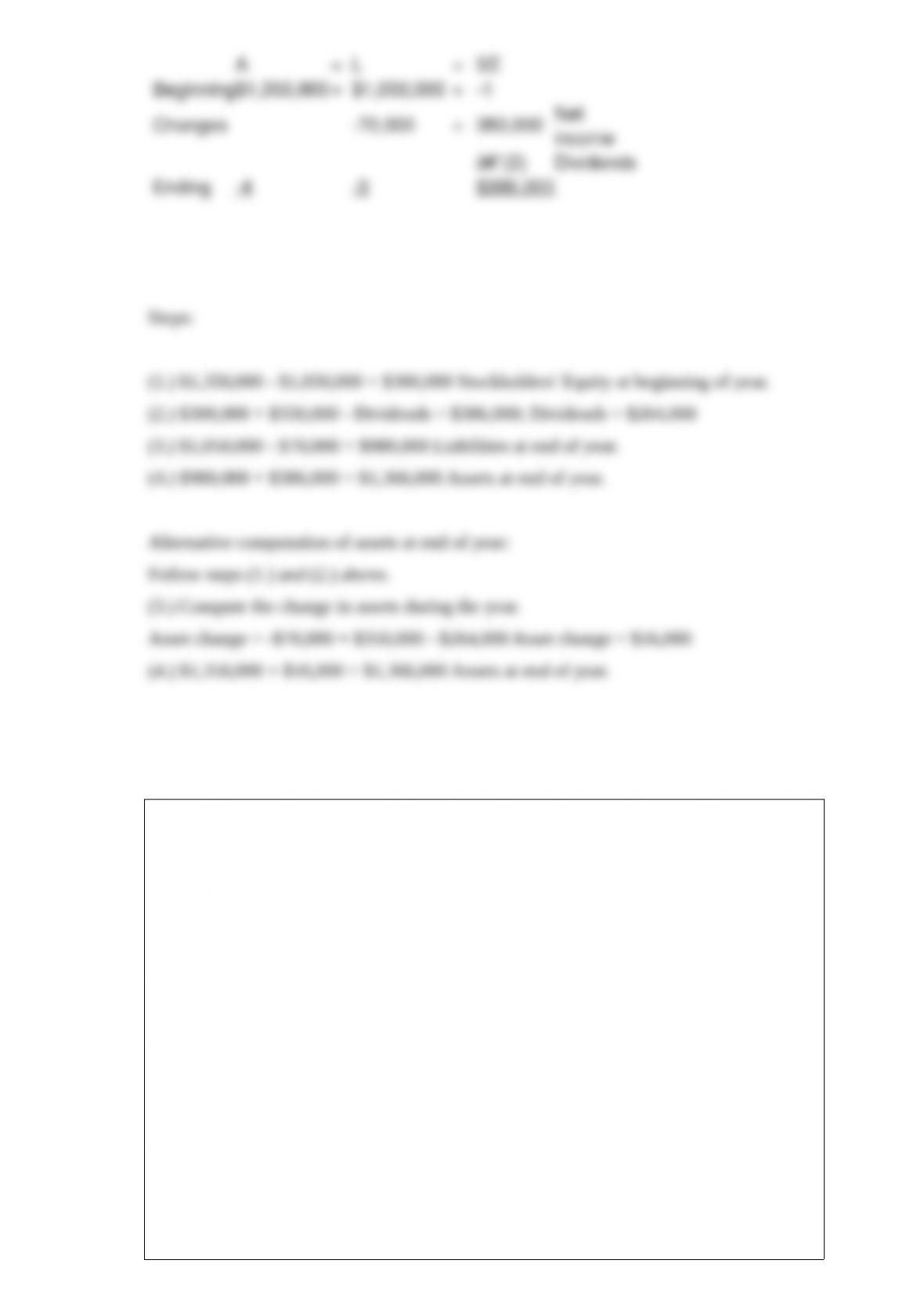
At the beginning of the current fiscal year, Surrey Corp.balance sheet showed assets of
$1,350,000 and liabilities of $1,050,000. During the year, liabilities decreased by
$70,000. Net Income for the year was $350,000, and net assets at the end of the year
were $386,000. There were no changes in paid-in capital during the year.
Calculate the dividends, if any, declared during the year.
Calculate the total assets at the end of the year.
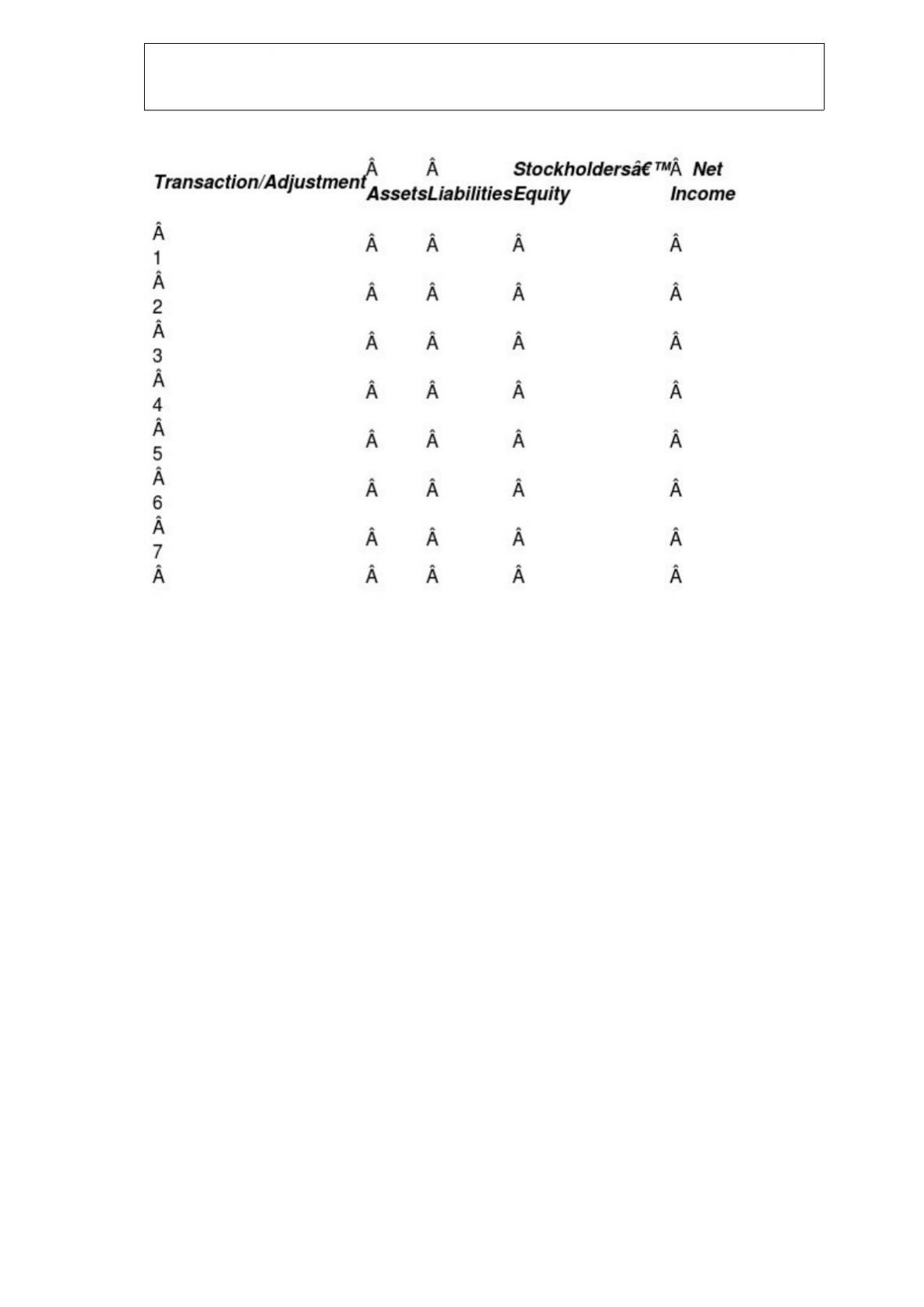
Using the column headings provided below, show the effect, if any, of the transaction
entry or adjusting entry on the appropriate balance sheet category or on the income
statement by entering the account name, amount, and indicating whether it is an
addition (+) or subtraction (-). Column headings reflect the expanded balance sheet
equation; items that affect net income should not be shown as affecting stockholders’
equity.
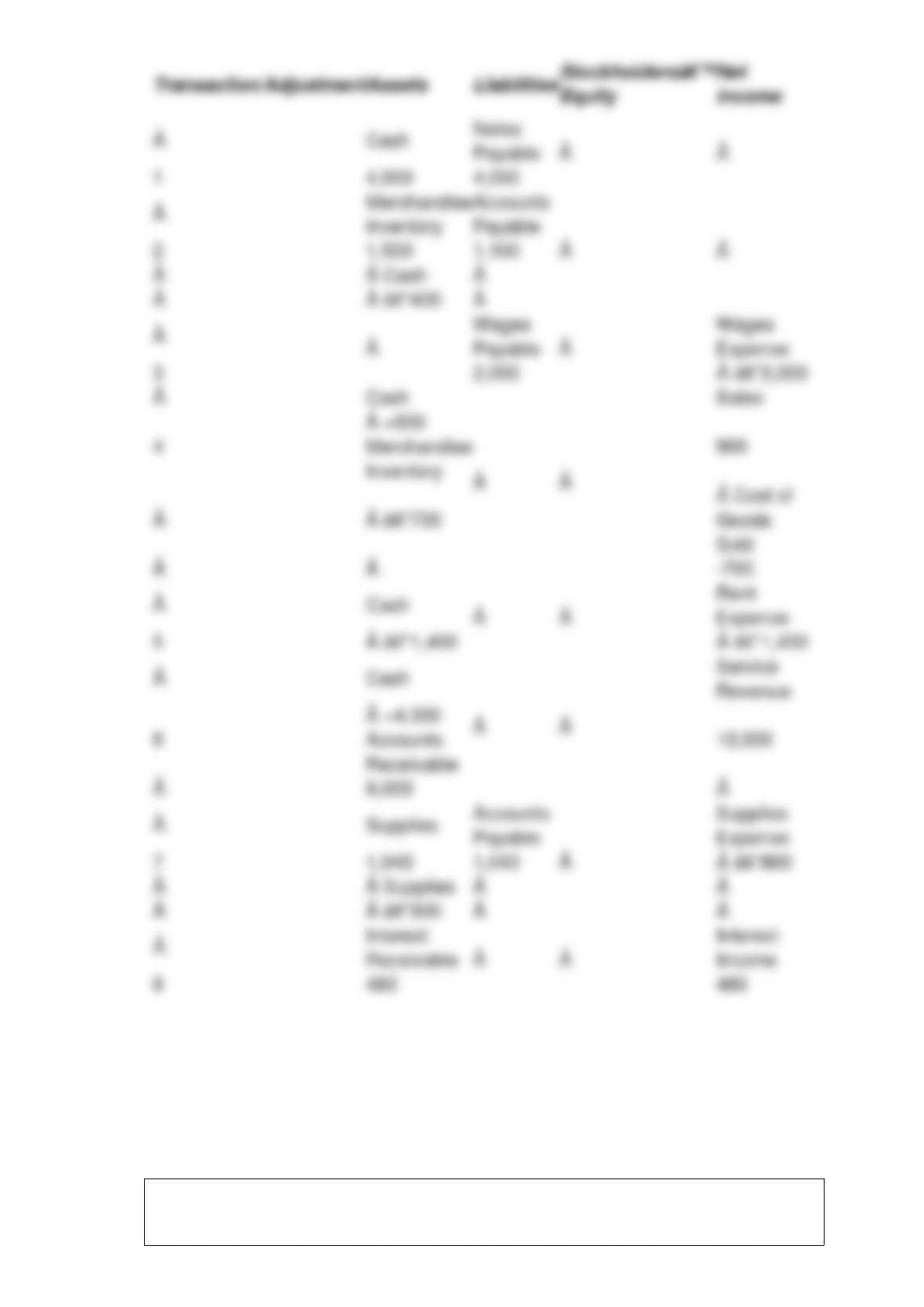
(1.) The firm borrowed $4,000 from the bank; a short-term note was signed.
(2.) Merchandise inventory costing $1,500 was purchased; cash of $400 was paid and
the balance is due in 30 days.
(3.) Employee wages of $2,000 were accrued at the end of the month.
(4.) Merchandise that cost $700 was sold for $900 in cash.
(5.) This month’s rent of $1,400 was paid.
(6.) Revenues from services during month totaled $13,000. Of this amount, $4,000 was
received in cash and the balance is expected to be received within 30 days.
(7.) During the month, supplies were purchased on account at a cost of $1,040, and
debited into the Supplies (asset) account. A total of $800 of supplies were used during
the month.
(8.) Interest of $480 has been earned on a note receivable, but has not yet been
received.
Innovation Inc.’s production budget for January is 35,000 units and includes the
following component unit costs: direct materials, $16; direct labor, $20; variable
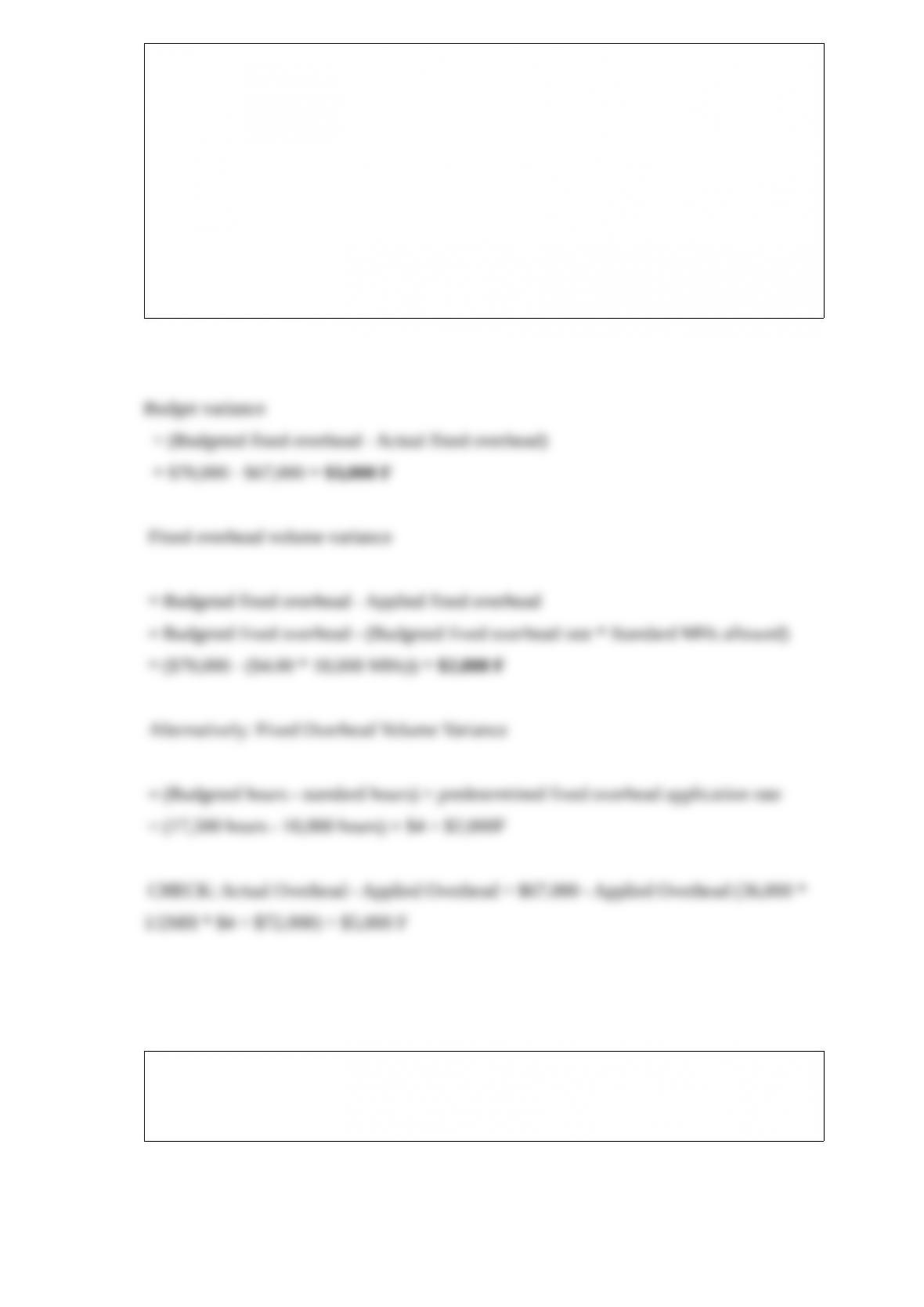
overhead, $12. Budgeted fixed overhead is $70,000 (35,000 units × 1/2hour × $4unit).
Actual production in January was 36,000 units. Actual unit component costs incurred
during January include direct materials, $16.50; direct labor, $18.90; variable overhead,
$13.64. Actual fixed overhead was $67,000. The standard fixed overhead application
rate per unit consists of $4 per machine hour and each unit is allowed a standard of 1/2
hour of machine time.
Calculate the fixed overhead budget variance and the fixed overhead volume variance.
Dominic’s, Inc. had actual sales for January and February and forecasted sales for
March, April, May, and June as follows:
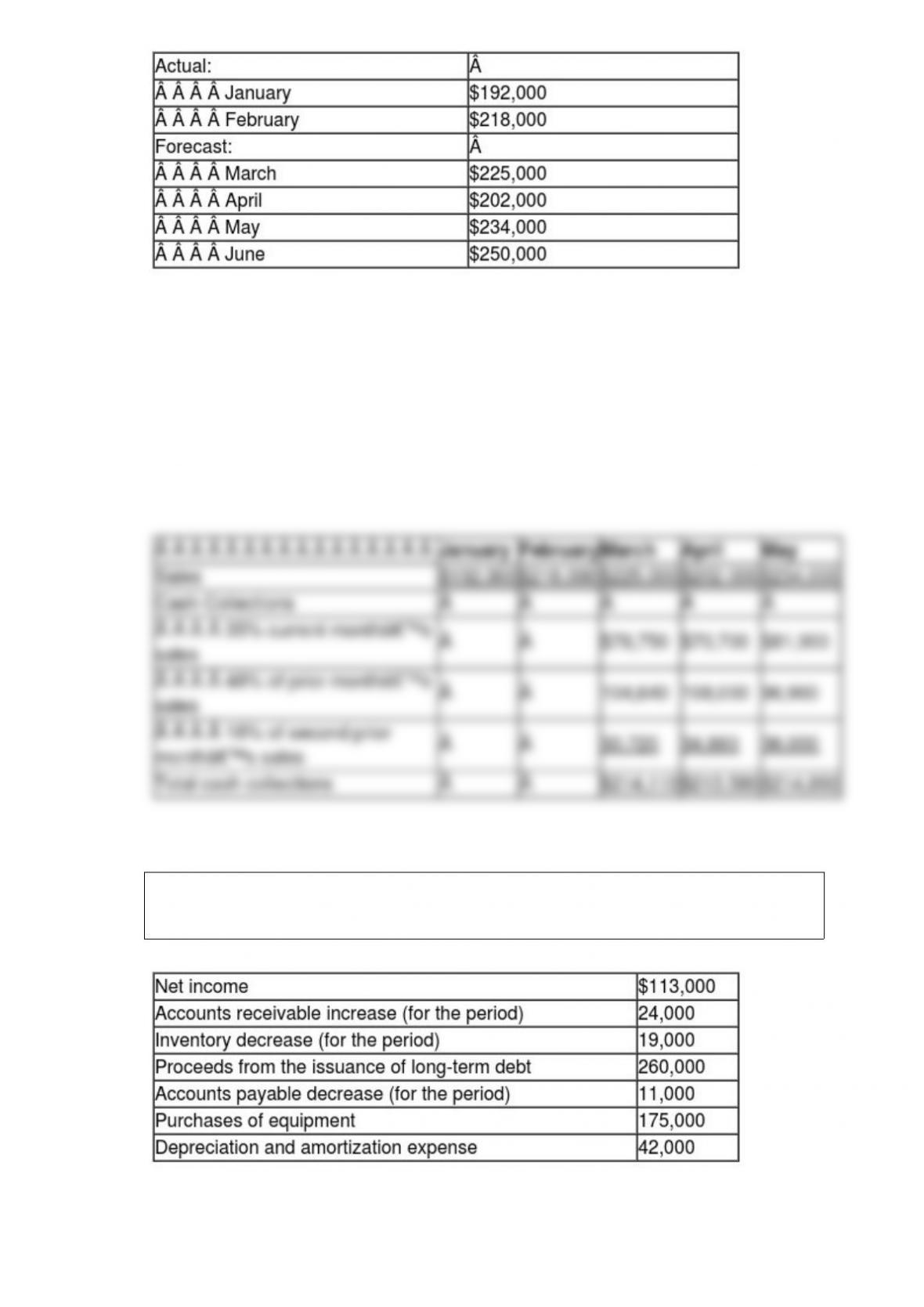
Based on company experience, it is estimated that 35 percent of a month’s sales are
collected in the month of sale, 48 percent in the month following the sale, and 16 percent
in the second month following the sale.
Calculate the estimated cash collections for March, April, and May.
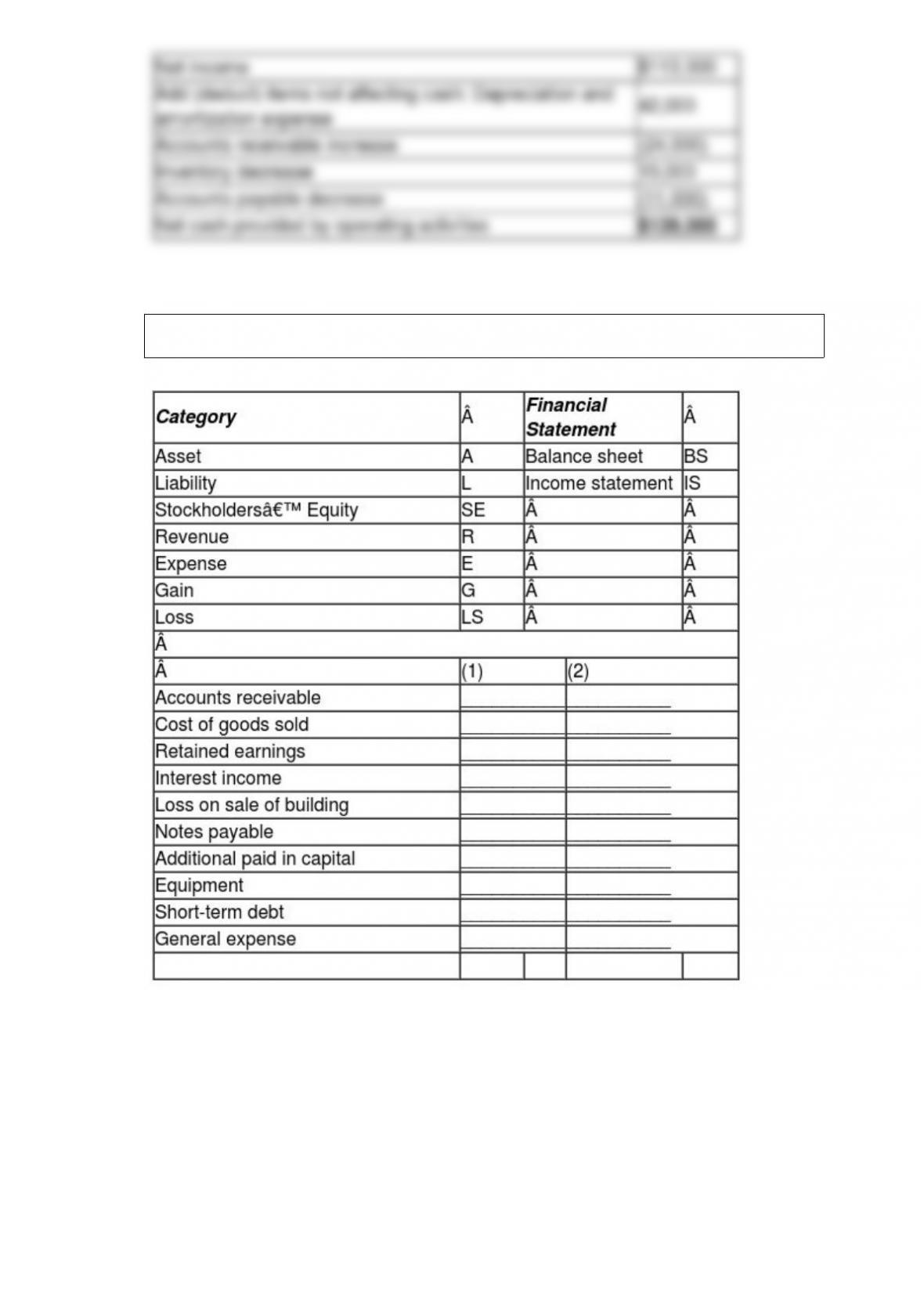
Use the appropriate information from the data provided below to calculate the net cash
provided (used) by operating activities for the period.
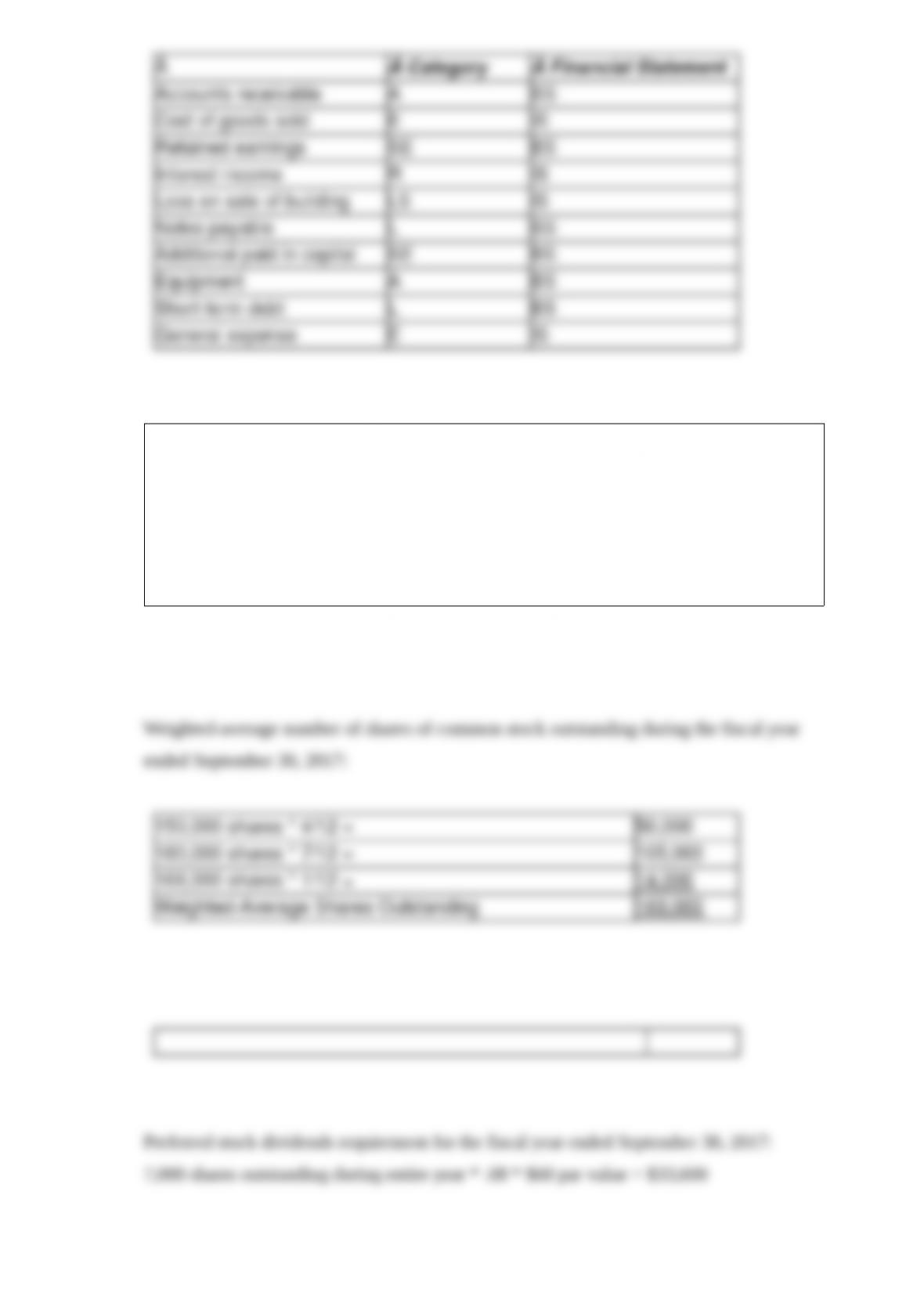
Listed below are a number of financial statement captions.
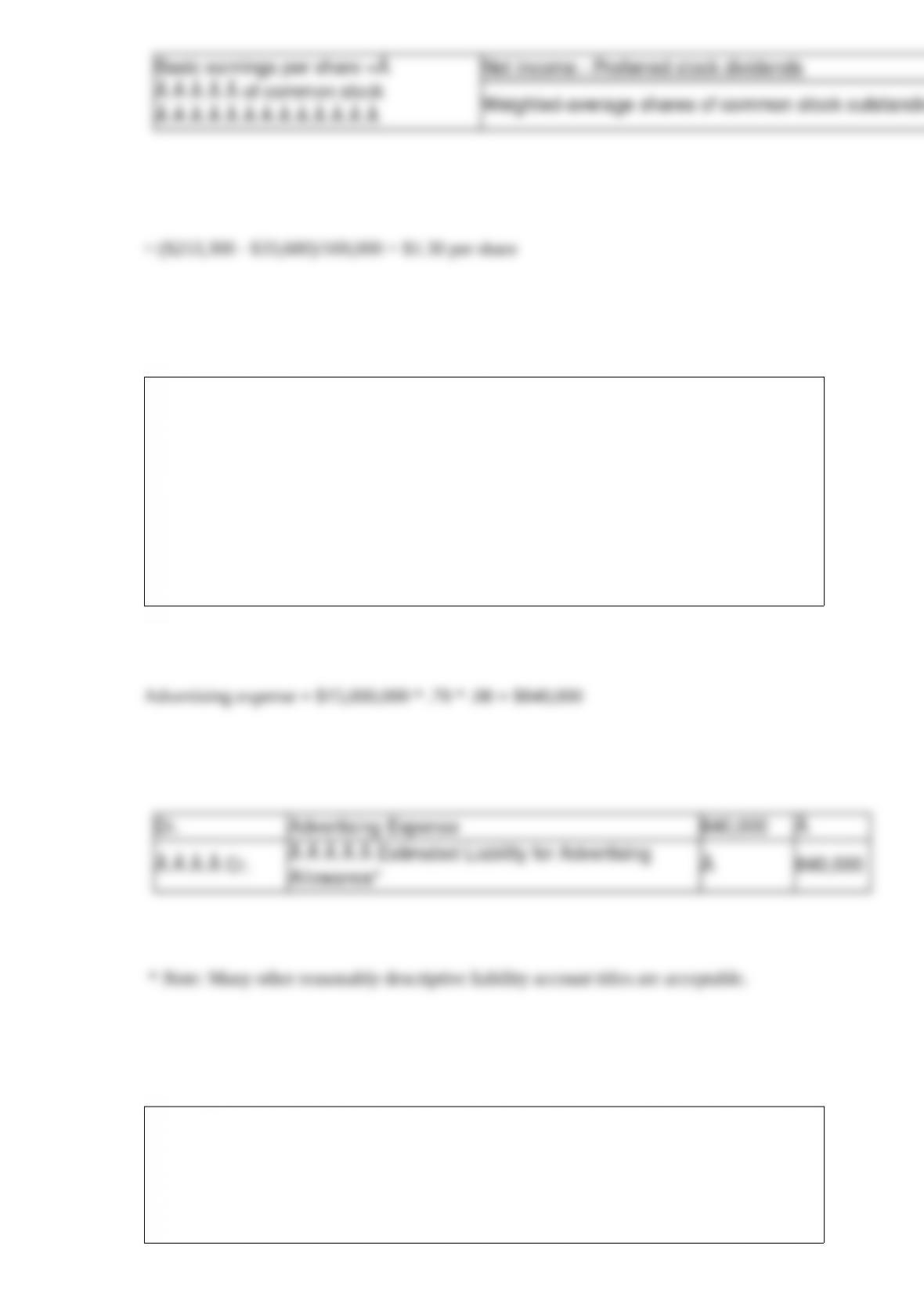
Gwinnett Park Co.reported net income of $253,300 for its fiscal year ended September
30, 2017. At the beginning of that year, 150,000 shares of common stock were
outstanding. On February 1, 2017, an additional 30,000 shares were issues. On
September 1, 2017, 12,000 shares were purchased as treasury stock. During the year,
the company paid the annual dividend on 7,000 shares of its 8%, $60 par value
preferred stock that were outstanding during the entire fiscal year. Calculate the basic
earnings per share of common stock for the year ended September 30, 2017.
Assume that Wallywill, Inc. offered its customers, which are primarily retail stores who
sell its products, an advertising allowance equal to 8% of the amount of purchases from
Wallywill during December, if the retail store would spend the money for advertising in
January. Wallywill Inc.’s sales in December totaled $15,000,000, and it was expected
that 70% of those sales were made to retailers who would take advantage of the
advertising allowance offer.
Write the journal entry or use the horizontal model to show the effect of the accrual that
should be made as of December 31 with respect to the advertising allowance offer.
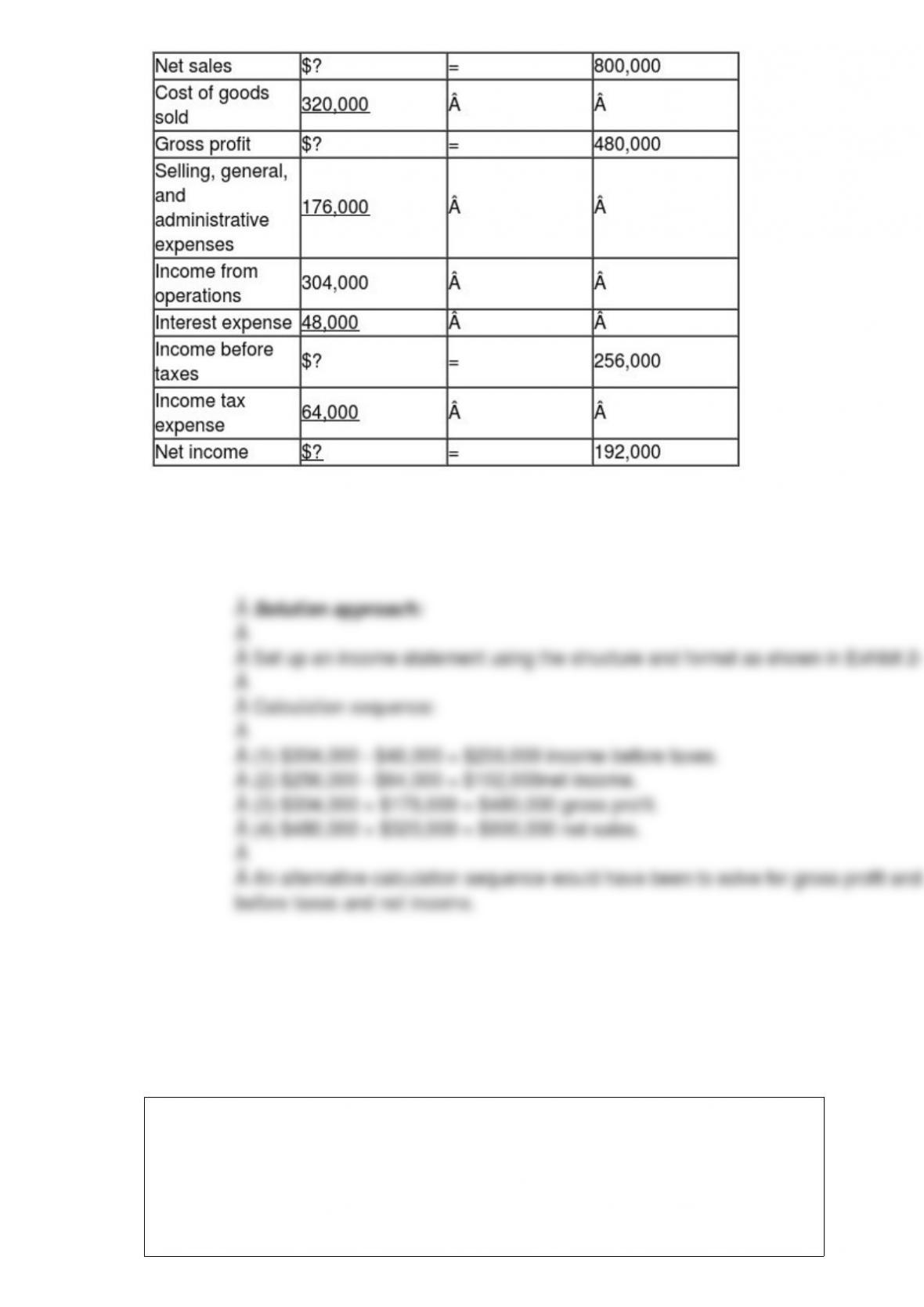
During the year, cost of goods sold was $320,000; income from operations was
$304,000; income tax expense was $64,000; interest expense was $48,000; and selling,
general, and administrative expenses were $176,000.
Required:
Calculate net sales, gross profit, income before taxes, and net income.
For each of the following costs, identify the cost behavior as variable, mixed, or fixed:
1. Wages of assembly line workers _________________
2. President’s salary _________________
3. Plant utilities _________________
4. Sales force commissions _________________
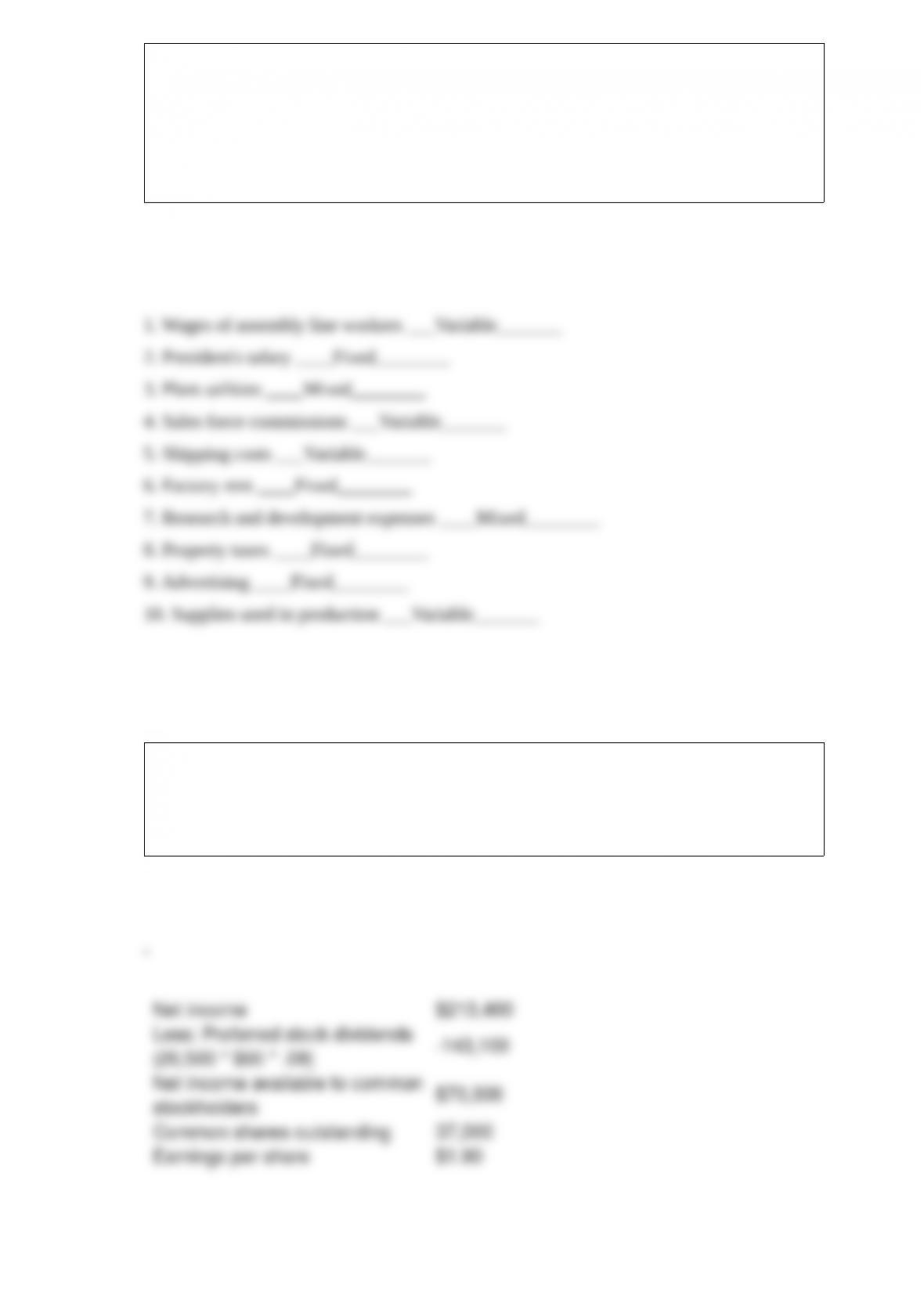
5. Shipping costs _________________
6. Factory rent _________________
7. Research and development expenses _________________
8. Property taxes _________________
9. Advertising _________________
10. Supplies used in production _________________
Norman’s Cabinet, Inc., had net income of $213,400 for its fiscal year ended October
31, 2017. During the year, the company had outstanding 26,500 shares of 9%, $60 par
value preferred stock, and 37,000 shares of common stock. Calculate the basic earnings
per share of common stock for the 2017 fiscal year.
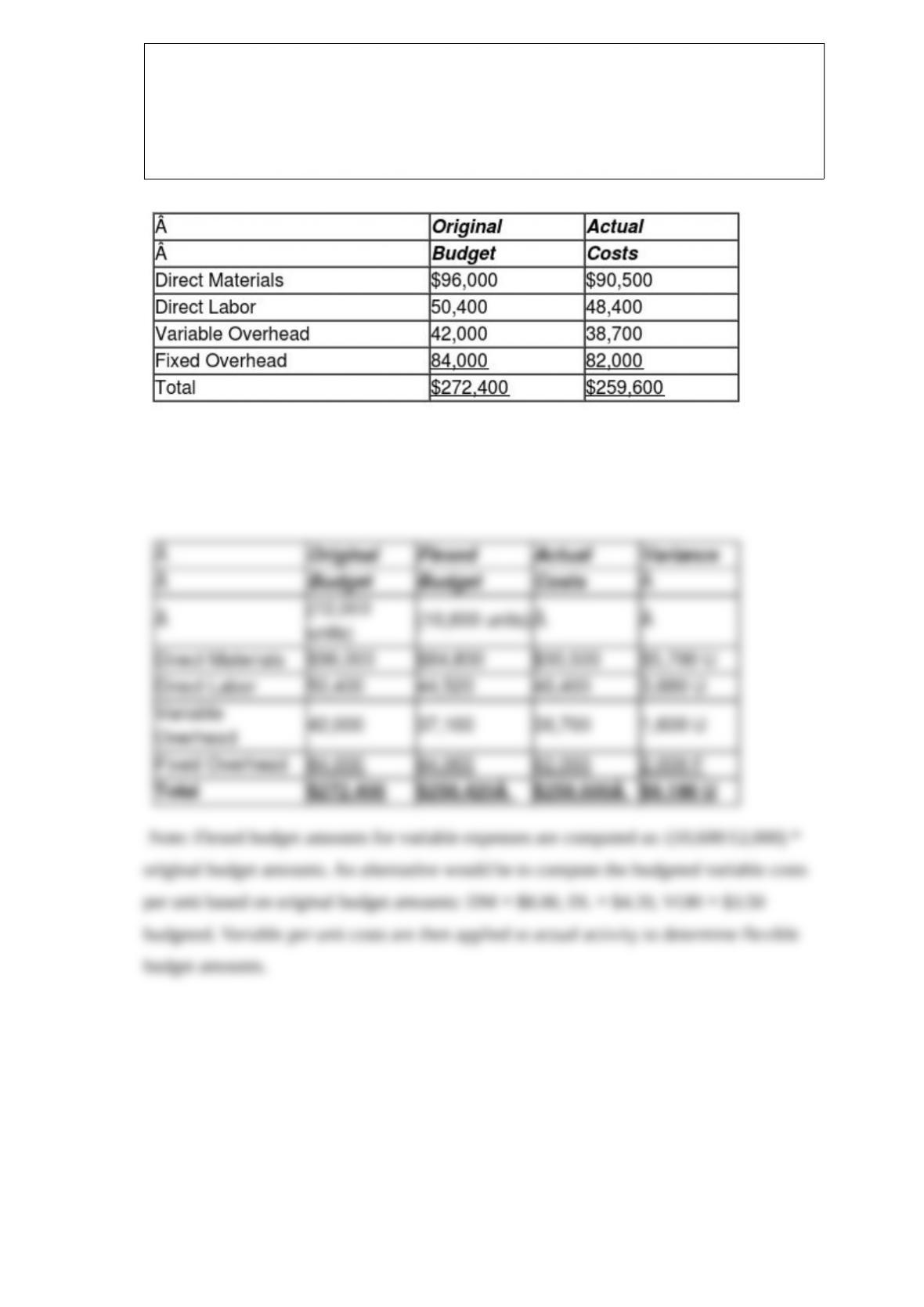
Patrick Company manufactures a single product. The original budget for April was
based on expected production of 12,000 units; actual production for April was 10,600
units. The original budget and actual costs for the manufacturing department are shown
below:
Prepare an appropriate performance report for the manufacturing department.