
If an available-for-sale investment is sold for which there are unrealized gains in
accumulated other comprehensive income (AOCI), a reclassification adjustment affects
other comprehensive income (OCI) in the period of sale by: A. Reducing OCI for the
amount of unrealized gains in AOCI.
B. Increasing OCI for the amount of unrealized gains in AOCI.
C. No effect on OCI, as OCI only includes the effects of unrealized gains and losses.
D. No effect on OCI, as the realized gain is included in AOCI.
Answer:
An asset that is not expected to be converted to cash or consumed within one year or the
operating cycle is: A. Goodwill.
B. Accounts receivable.
C. Inventory.
D. Supplies.
Answer:
Nichols Corporation purchased $100,000 of Holly Inc. 6% bonds at par with the intent

and ability to hold the bonds until they matured in 2017, so Nichols classifies its
investment as held to maturity. Unfortunately, a combination of problems at Holly and
in the debt market caused the fair value of the Holly investment to decline to $70,000
during 2013. Nichols calculates that, of the $30,000 drop in fair value, $10,000 of it
relates to credit losses and $20,000 relates to noncredit losses.
Assume that Nichols concludes that the Holly bonds are other-than-temporarily
impaired because Nichols is planning to sell the bonds in the near future. Before-tax net
income for 2013 will be reduced by: A. $0.
B. $10,000.
C. $20,000.
D. $30,000.
Answer:
At the beginning of 2011, Emily Corporation issued 10,000 shares of $100 par, 5%,
cumulative, preferred stock for $110 per share. No dividends have been paid to
preferred or common shareholders. What amount of dividends will a preferred
shareholder owning 100 shares receive in 2013 if Emily pays $1,000,000 in dividends?
A. $500.
B. $1,500.
C. $1,650.
D. $10,000.
Answer:

The overriding principle for all depreciation methods is that the method must be: A.
Conservative and economic.
B. Systematic and rational.
C. Consistent and conservative.
D. Significant and material.
Answer:
Under IFRS No. 9, which is not a category for accounting for investments? A. Fair
value through profit and loss.
B. Fair value through other comprehensive income.
C. Held-to-maturity.
D. Amortized cost.
Answer:

Cortez Associates purchased a debt investment that meets the characteristics of a simple
debt instrument. Cortez intends to hold the debt for purposes of maximizing its return
on investment. How should Cortez account for the investment? A. Amortized cost.
B. FV-NI.
C. FV-OCI.
D. Cost method.
Answer:
Like other assets, the cost of a leasehold improvement is allocated as depreciation
expense over its useful life to the lessee, which will be: A. The shorter of the physical
life of the asset or the lease term.
B. The physical life of the asset.
C. The lease term.
D. A time period determined by management.
Answer:

An asset should be written down if there has been an impairment of value that is: A.
Relevant and objectively determined.
B. Material and market driven.
C. Unplanned and sudden.
D. Significant.
Answer:
Which category completely excludes equity securities? A. Securities available for sale.
B. Consolidating securities.
C. Held-to-maturity securities.
D. Trading securities.
Answer:
During the year, L&M Leather Goods sold 1,000,000 reversible belts under a new sales
promotional program. Each belt carried one coupon, which entitles the customer to a

$4.00 cash rebate. L&M estimates that 70% of the coupons will be redeemed, even
though only 500,000 coupons had been processed during the year. At December 31,
L&M should report a liability for unredeemed coupons of: A. $700,000.
B. $800,000.
C. $1,000,000.
D. $2,800,000.
Answer:
The adjustment to the weighted-average shares for retired shares is the same as for
issuing new shares except: A. The shares are deducted rather than added.
B. The shares are added rather than deducted.
C. The shares are treated as being acquired at the end of the year.
D. The shares are treated as being acquired at the beginning of the year.
Answer:

On December 15, 2013, Rigsby Sales Co. sold a tract of land that cost $3,600,000 for
$4,500,000. Rigsby appropriately uses the installment sale method of accounting for
this transaction. Terms called for a down payment of $500,000 with the balance in two
equal annual installments payable on December 15, 2014, and December 15, 2015.
Ignore interest charges. Rigsby has a December 31 year-end.
In its December 31, 2013, balance sheet, Rigsby would report:A. Realized gross profit
of $100,000.
B. Deferred gross profit of $100,000.
C. Installment receivables (net) of $3,200,000.
D. Installment receivables (net) of $4,000,000.
Answer:
Nevada Boot Co. reported net income of $216,000 for its year ended December 31,
2013. Purchases totaled $152,000. Accounts payable balances at the beginning and end
of the year were $36,000 and $33,000, respectively. Beginning and ending inventory
balances were $44,000 and $46,000, respectively. Assuming that all relevant
information has been presented, Nevada Boot would report operating cash flows of: A.
$155,000.
B. $221,000.
C. $211,000.
D. $151,000.

Answer:
The International Accounting Standards Board: A.Was the predecessor to the IASC.
B.Can overrule the FASB when their policies disagree.
C.Promotes the use of high-quality, understandable global accounting standards.
D.Has its headquarters in Geneva.
Answer:
In 2013, Cupid Construction Co. (CCC) began work on a two-year fixed price contract
project. CCC uses the percentage-of-completion method to account for projects and
provides the following information (dollars in millions):
What were the construction billings by CCC during 2013? A. $142.5 million.
B. $67.5 million.
C. $37.5 million.

D. None of the other answers is correct.
Answer:
If Dizbert Company concluded that an investment originally classified as available for
sale would now more appropriately be classified as held to maturity, Dizbert would: A.
Not reclassify the investment, as original classifications are irrevocable.
B. Reclassify the investment as held to maturity and immediately recognize in net
income any unrealized gain or loss on the reclassification date.
C. Reclassify the investment as held to maturity and treat the fair value as of the date of
reclassification as the investment’s amortized cost basis for future amortization.
D. Need to restate earnings, as the original classification was in error.
Answer:
Isaac Inc. began operations in January 2013. For certain of its property sales, Isaac
recognizes income in the period of sale for financial reporting purposes. However, for
income tax purposes, Isaac recognizes income when it collects cash from the buyer’s

installment payments.
In 2013, Isaac had $600 million in sales of this type. Scheduled collections for these
sales are as follows:
Assume that Isaac has a 30% income tax rate and that there were no other differences in
income for financial statement and tax purposes.
Ignoring operating expenses and additional sales in 2014, what deferred tax liability
would Isaac report in its year-end 2014 balance sheet? A. $54 million
B. $144 million
C. $126 million
D. $180 million.
Answer:
Wilson Inc. developed a business strategy that uses stock options as a major
compensation incentive for its top executives. On January 1, 2013, 20 million options
were granted, each giving the executive owning them the right to acquire five $1 par
common shares. The exercise price is the market price on the grant date$10 per share.
Options vest on January 1, 2017. They cannot be exercised before that date and will
expire on December 31, 2019. The fair value of the 20 million options, estimated by an
appropriate option pricing model, is $40 per option. Ignore income tax.
Assume that all compensation expense from the stock options granted by Wilson
already has been recorded. Further assume that 200,000 options expire in 2018 without
being exercised. The journal entry to record this would include: A. Debit to paid-in
capitalstock options for $8 million.
B. A debit to common stock for $5 million.

C. A debit to paid-in capitalexpiration of stock options for $8 million.
D. None of these is correct.
This is 200,000 options that had been recorded by credits to paid-in capital-stock
options for $8 million, i.e., 200,000 options x $40 option. This is reversed at expiration.
Answer:
Phase A of the new conceptual framework focuses on: A.Objective and qualitative
characteristics.
B.Presentation and disclosure.
C.Recognition and measurement.
D.Elements of financial statements.
Answer:
Texas Petrochemical reported the following April activity for its VC-30 lubricant,
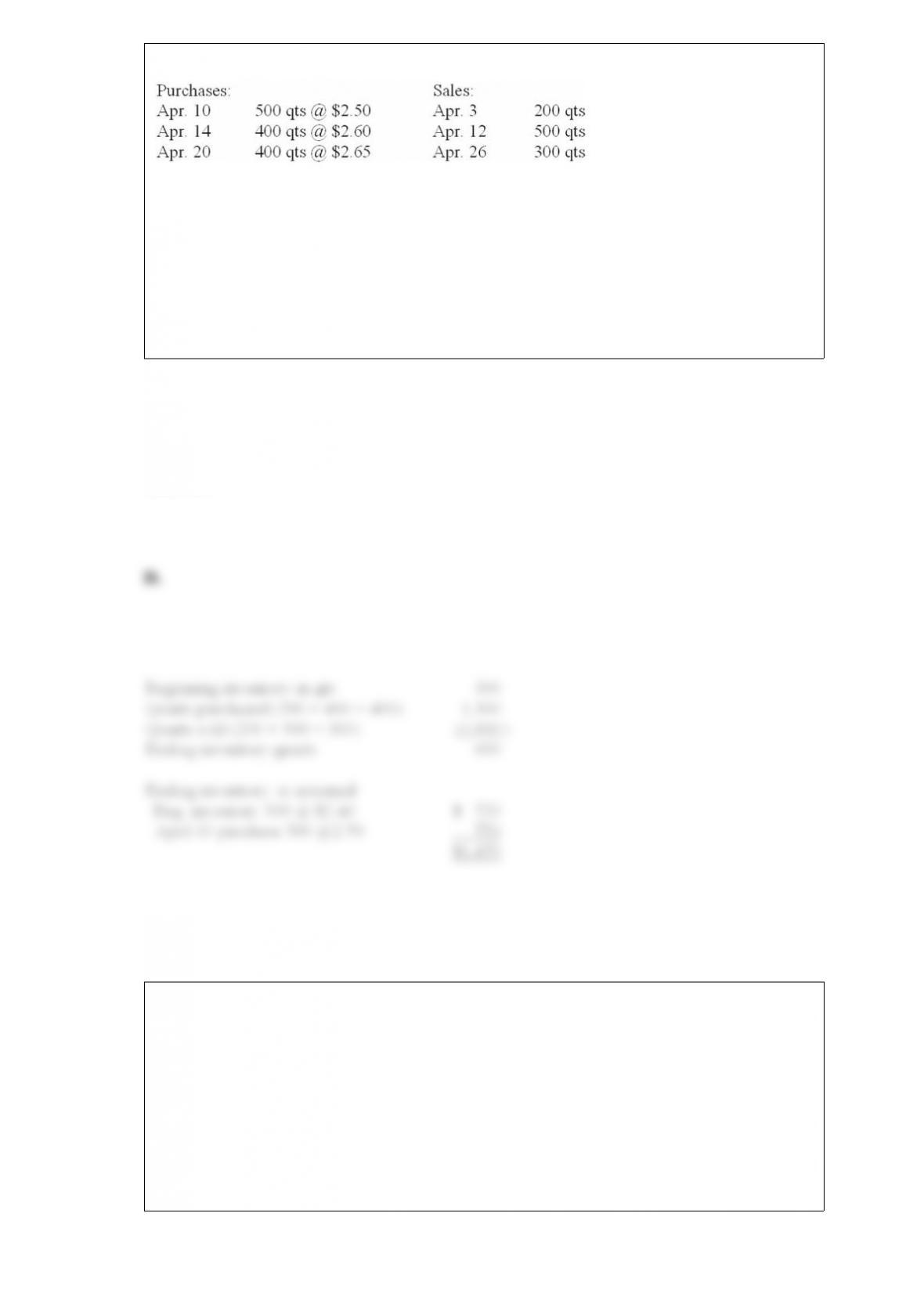
which had a balance of 300 qts. @ $2.40 on April 1.
The ending inventory assuming LIFO and a periodic inventory system is: A. $1,580.
B. $1,510.
C. $1,575.
D. $1,470.
Answer:
At the end of the current year, a company failed to accrue interest of $500,000 on its
investments in municipal bonds. Its tax rate is 30%. As a result of this error, net income
is: A. Unaffected.
B. Understated by $350,000.
C. Understated by $500,000.
D. Understated by $150,000.

Answer:
Leasehold improvements usually are classified in a balance sheet as: A. Property, plant,
and equipment.
B. Other long-term assets.
C. Investments.
D. Expenses.
Answer:
P. Chang & Co. exchanged land and $9,000 cash for equipment. The book value and the
fair value of the land were $106,000 and $90,000, respectively.
Chang would record equipment and a gain/(loss) of:
A. Option a
B. Option b
C. Option c
D. Option d
Answer:
Damon is the lessee in connection with a lease. Under the new ASU, Damon would not
record: A. Accretion revenue.
B. Amortization expense.
C. Interest expense.
D. A right-of-use asset.
Answer:

Clark’s Chemical Company received customer deposits on returnable containers in the
amount of $100,000 during 2013. Twelve percent of the containers were not returned.
The deposits are based on the container cost marked up 20%. What is cost of goods sold
relative to this forfeiture? A. $0.
B. $2,000.
C. $10,000.
D. $14,400.
Answer:
The fixed-asset turnover ratio provides: A. The rate of decline in asset lives.
B. The rate of replacement of fixed assets.
C. The amount of sales generated per dollar of fixed assets.
D. The decline in book value of fixed assets compared to capital expenditures.
Answer:

Which of the following statements characterizes a leveraged lease? A. The lessor
borrows part of the acquisition price of the leased asset from a third party lender.
B. The lessor treats the lease as an operating lease.
C. The lessee makes lease payments to the lessor’s lender.
D. The lessor’s interest rate is always higher because the lease is leveraged.
Answer:
A company switched from the cash basis to the accrual basis for recognizing warranty
expense. The unrecorded liability for warranties was $2 million at the beginning of the
year. Its tax rate is 30%. The company booked a year-end warranty liability of $3
million. As a result of this change, the firm would: A. Report a prior period adjustment
decreasing retained earnings by $600,000.
B. Report a prior period adjustment decreasing retained earnings by $1,400,000.
C. Report a current period charge decreasing net income by $600,000.
D. Report a current period charge decreasing net income by $1,400,000.
Answer:

Maltec Corporation has started placing its quarterly financial statements on its web
page, thereby reducing by 10 days the time to get information to investors and creditors.
The qualitative concept improved is: A.Comparability.
B.Consistency.
C.Timeliness.
D.Faithful representation.
Answer:
On January 1, 2013, Ouachita Airlines issued $400,000 of its 20-year, 8% bonds. The
bonds were priced to yield 10%. Interest is payable semiannually on June 30 and
December 31. Ouachita Airlines records interest at the effective rate and elected the
option to report these bonds at their fair value. On December 31, 2013, the fair value of
the bonds was $335,000 as determined by their fair value in the over-the-counter
market.
Required:
1) Determine the price of the bonds at January 1, 2013, and prepare the journal entry to
record their issuance. Show calculations.
2) Prepare the journal entry to record interest on June 30, 2013 (the first interest
payment). Show calculations.
3) Prepare the journal entry to record interest on December 31, 2013 (the second
interest payment). Show calculations.
4) Prepare the journal entry to adjust the bonds to their fair value for presentation in the
December 31, 2013, balance sheet. Show calculations.
Answer:
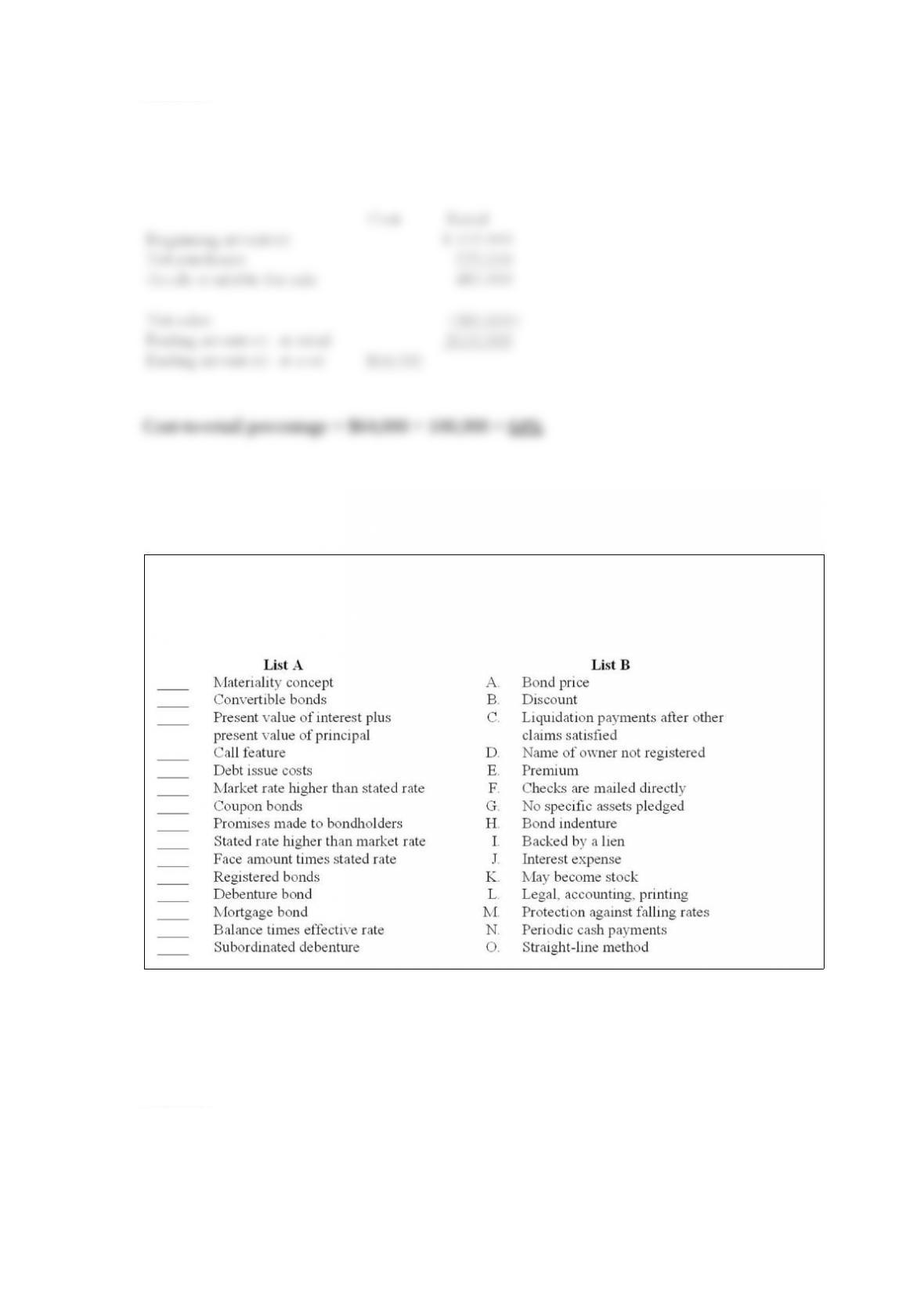
DK Super Stores Inc. uses the average cost retail method to estimate its ending
inventory. Information at June 30, 2013, is as follows:
Required:
Compute the cost-to-retail percentage used by DK.
Answer:
Listed below are several terms and phrases associated with long-term debt. Pair each
item from List A (by letter) with the item from List B that is most appropriately
associated with it.
Answer:

On December 31, 2012, Belair Corporation had 100,000 shares of common stock
outstanding and 30,000 shares of 7%, $50 par, cumulative preferred stock outstanding.
On February 28, 2013, Belair purchased 24,000 shares of common stock on the open
market as treasury stock paying $20 per share. On June 30, 2013, Belair declared and
issued a 2-for-1 stock split on outstanding common stock. Belair sold 6,000 treasury
shares on September 30, 2013, for $15 per share. Net income for 2013 was $180,905.
Required:
Compute Belair’s basic earnings per share for 2013.
Answer:
Agasse Industries began construction of a new facility and took out a $1,500,000, 8%
construction loan on April 1, 2013. Agasse made payments to the general contractor of
$400,000 on April 1, $900,000 on August 31, and $500,000 on December 31.
Required:
Compute the amount of interest that Agasse would capitalize in 2013.

Answer:
Annual depreciation expense on a building purchased a few years ago (using the
straight-line method) is $5,000. The cost of the building was $100,000. The current
book value of the equipment (January 1, 2013) is $85,000. At the time of purchase, the
asset was estimated to have a zero salvage value. On January 1, 2013, the company
decided to reduce the original useful life by 25% and to establish a salvage value of
$5,000. The firm also decided double-declining-balance depreciation was more
appropriate. Ignore tax effects.
Required:
(1) Record the journal entry, if any, to report the accounting change.
(2) Record the annual depreciation for 2013.
Answer:
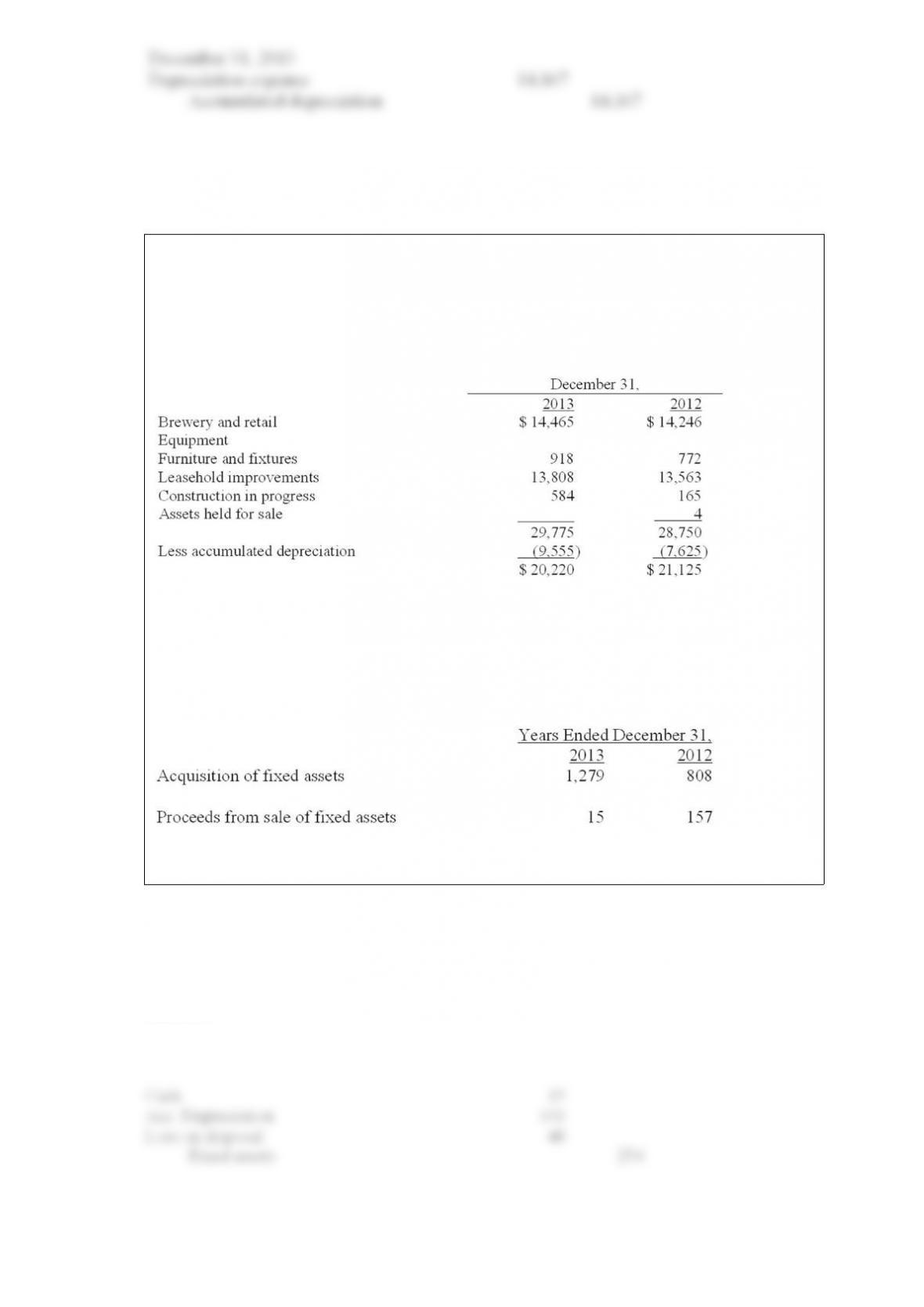
In its 2013 annual report to shareholders, Plank Breweries disclosed the following
footnote:
Fixed Assets
Fixed assets consist of the following (in $ thousands):
Total depreciation expense was approximately $2.121 million and $2.179 million for
the years ended December 31, 2013 and 2012, respectively.
Also, Plank Breweries reported the following information in its annual report (in $
thousands):
Show the journal entry to record Plank’s disposal of the fixed assets during 2013.
Answer:

Briefly explain how you can determine if a company is effectively using leverage.
Answer: