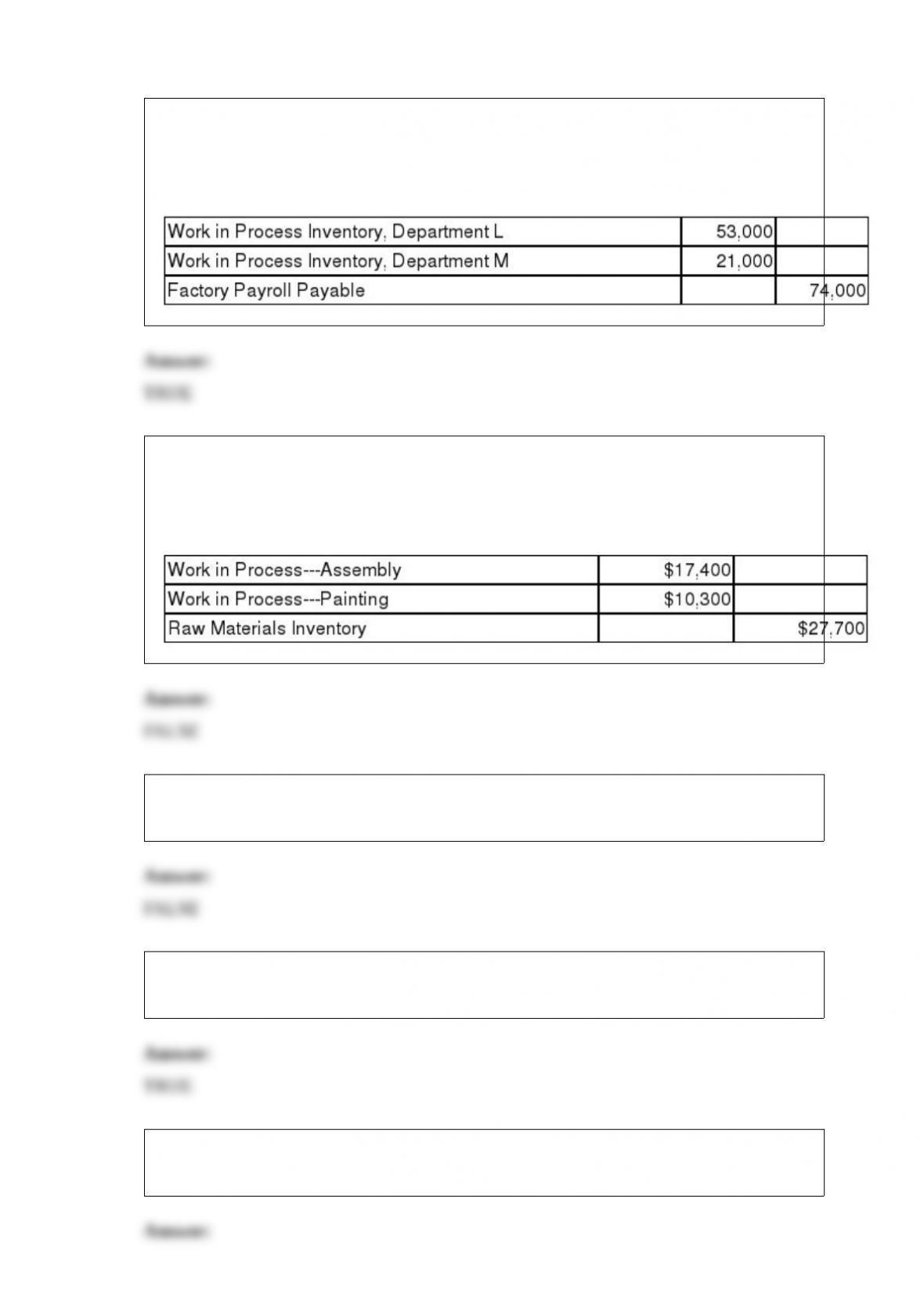
1) If Department L uses $53,000 of direct labor and Department M uses $21,000 of
direct labor, the following journal entry would be recorded using a process costing
system:
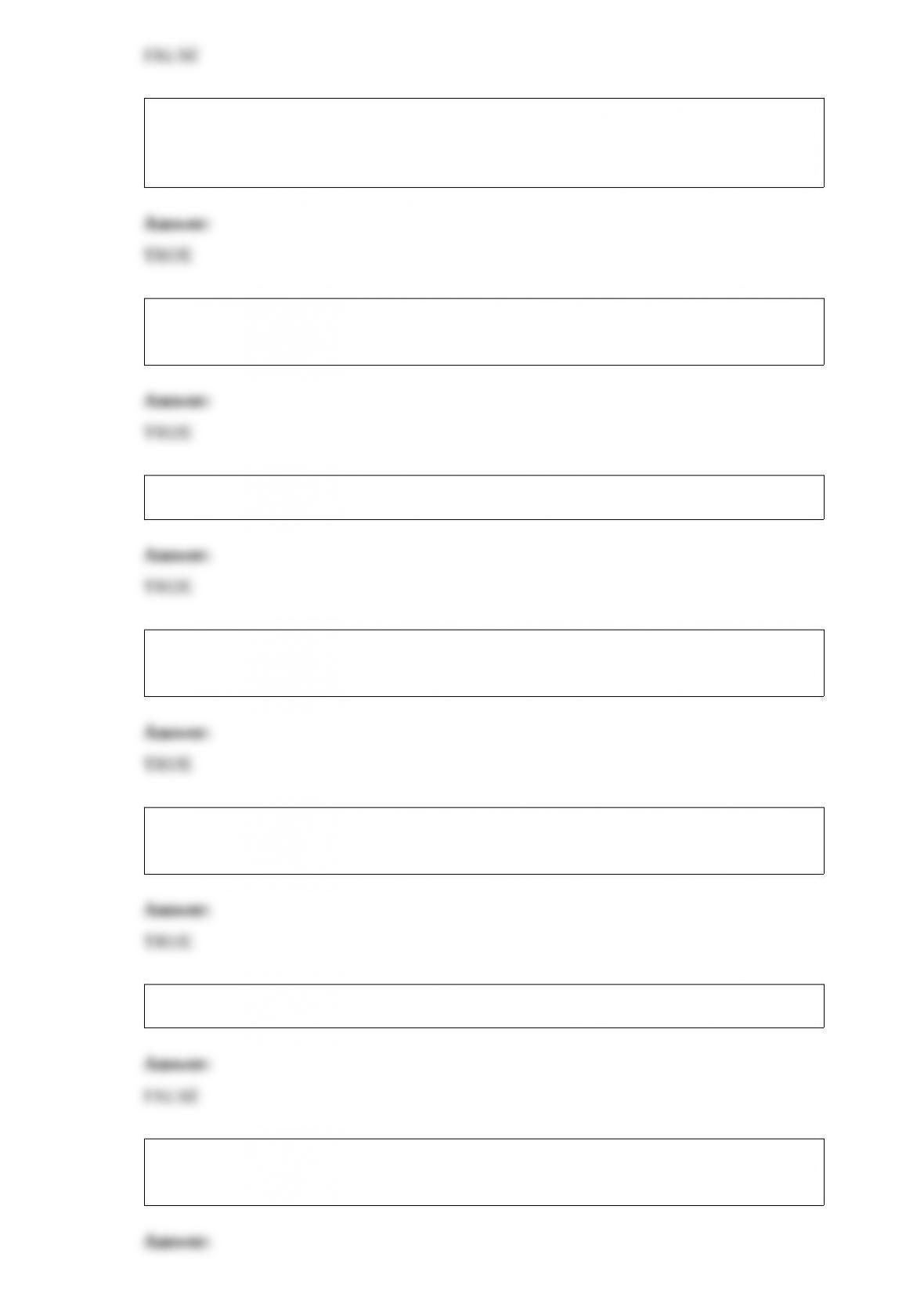
2) If Grayson Manufacturing incurred $17,400 for direct labor in the assembly
department and $10,300 for direct labor in the painting department, the journal entry to
record the labor used is:
3) The net method for recording purchases records the purchase invoice at its gross
amount and records cash discounts in the Merchandise Inventory account.
4) Both financial and managerial accounting report monetary information; managerial
accounting also reports considerable nonmonetary information.
5) A corporation may not legally give shares of its stock to promoters in exchange for
their services in organizing the corporation.
6) Short-term investments are intended to be converted into cash within the longer of
one year or the current operating cycle of the business, and are readily convertible to
cash.
7) The collection of cost sheets for unfinished jobs makes up a subsidiary ledger
controlled by the Work in Process Inventory account in the general ledger.
8) Variable budget is another name for a flexible budget.
9) Measures used to evaluate the manager of an investment center include investment
turnover and profit margin.
10) A loss on disposal of a plant asset occurs if the cash proceeds received from the
asset sale is less than the asset’s book value.
11) Shareholders in a corporation have the power to bind the corporation to contracts.
12) Foreign exchange rates fluctuate due to many factors including changing political
and economic conditions.
13) The private-sector group that currently has the authority to establish generally
accepted accounting principles in the United States is the:
A.APB.
B.FASB.
C.AAA.
D.
E.SEC.
14) You are reviewing the accounting records of Buddy’s Foreign Automotive, owned
by Bruce Jones. You have uncovered the following situations. List the appropriate
accounting principle related to each independent scenario and suggest a correct action
for each.
1> In August, a check for $500 was written to Community Sports. This amount
represents soccer camp for his daughter Cassie.
2> Bruce plans a Going Out of Business Sale for June, since he will be closing the
business for a month-long vacation in July. He plans to reopen August 1 and will
continue operating Buddy’s Foreign Automotive indefinitely.
3> Buddy received a shipment of tools from Ontario, Canada. The invoice was stated in
Canadian dollars.
4> Sandy Lane paid $1,500 for a major repair services. The amount was recorded as
revenue. The parts for the repair must be ordered from overseas and the service won’t
be complete until the following month.
15) Product costs:
A.Are expenditures necessary and integral to finished products.
B.Are expenditures identified more with a time period rather than with units of product.
C.Include selling and administrative expenses.
D.Are expensed on the income statement when incurred.
E.Are moved to the income statement for any unsold inventory at the end of the year.
16) Tara Westmont, the proprietor of Tiptoe Shoes, had annual revenues of $185,000,
expenses of $103,700, and withdrew $18,000 from the business during the current year.
The owner’s capital account before closing had a balance of $297,000. The entry to
close the Income Summary account at the end of the year, after revenue and expense
accounts have been closed, is:
A.Debit T. Westmont, Capital $297,000; credit Income Summary $297,000
B.Debit T. Westmont, Capital $63,300; credit Income Summary $63,300
C.Debit Income Summary $63,300; credit T. Westmont, Capital $63,300
D.Debit Income Summary $81,300, credit T. Westmont, Capital $81,300
E.Debit T. Westmont, Capital $81,300; credit Income Summary $81,300
17) On January 1, a company issues bonds dated January 1 with a par value of
$400,000. The bonds mature in 5 years. The contract rate is 7%, and interest is paid
semiannually on June 30 and December 31. The market rate is 8% and the bonds are
sold for $383,793. The journal entry to record the first interest payment using the
effective interest method of amortization is:
A.Debit Interest Expense $12,648.28; debit Premium on Bonds Payable $1,351.72;
credit Cash $14,000.00.
B.Debit Interest Payable $14,000.00; credit Cash $14,000.00.
C.Debit Interest Expense $12,648.28; debit Discount on Bonds Payable $1,351.72;
credit Cash $14,000.00.
D.Debit Interest Expense $15,351.72; credit Discount on Bonds Payable $1,351.72;
credit Cash $14,000.00.
E.Debit Interest Expense $15,351.72; credit Premium on Bonds Payable $1,351.72;
credit Cash $14,000.00.
18) Selected information from the budget of the Singh Corp. at the beginning of the

year follows:
Calculate the predetermined overhead rate if the company uses the following as a basis:
(a) Direct labor hours.
(b) Direct labor cost.
(c) Machine hours.
19) Holman Company owns equipment with an original cost of $95,000 and an
estimated salvage value of $5,000 that is being depreciated at $15,000 per year using
the straight-line depreciation method. The adjusting entry needed to record annual
depreciation is:
A.Debit Depreciation Expense, $15,000; credit Equipment, $15,000.
B.Debit Equipment, $15,000; credit Accumulated Depreciation, $15,000.
C.Debit Depreciation Expense, $10,000; credit Accumulated Depreciation, $10,000.
D.Debit Depreciation Expense, $10,000; credit Equipment, $10,000.
E.Debit Depreciation Expense, $15,000; credit Accumulated Depreciation, $15,000.
20) A company retires its bonds at 105. The face value is $100,000 and the carrying
value of the bonds at the retirement date is $103,745. The issuer’s journal entry to
record the retirement will include a:
A.Debit to Premium on Bonds.
B.Credit to Premium on Bonds.
C.Debit to Discount on Bonds.
D.Credit to Gain on Bond Retirement.
E.Credit to Bonds Payable.
21) Recording employee payroll deductions may involve:
A.Liabilities to the employer.
B.Liabilities to federal and state governments.
C.Expenses for state unemployment.
D.Expenses for the gross wages and salaries.
E.Expenses for the employer portion of any medical insurance.
22) All of the following statements related to reporting cash flows from operating
activities under U.S. GAAP and IFRS are true except:
A.The definition of cash and cash equivalents is similar for U.S. GAAP and IFRS.
B.U.S. GAAP requires cash flows from interest revenue and dividend revenue be
classified as operating activities.
C.IFRS permits classification of interest revenue and dividend revenue under operating
or investing activities.
D.U.S. GAAP requires cash outflows for interest expense to be classified as financing
activities.
E.IFRS permits classification of interest expense under operating or financing activities.
23) Extraordinary repairs:
A.Are revenue expenditures.
B.Extend the useful life of an asset beyond its original estimate.
C.Are credited to accumulated depreciation.
D.Are additional costs of plants assets that do not materially increase the asset’s life.
E. Are expensed when incurred.
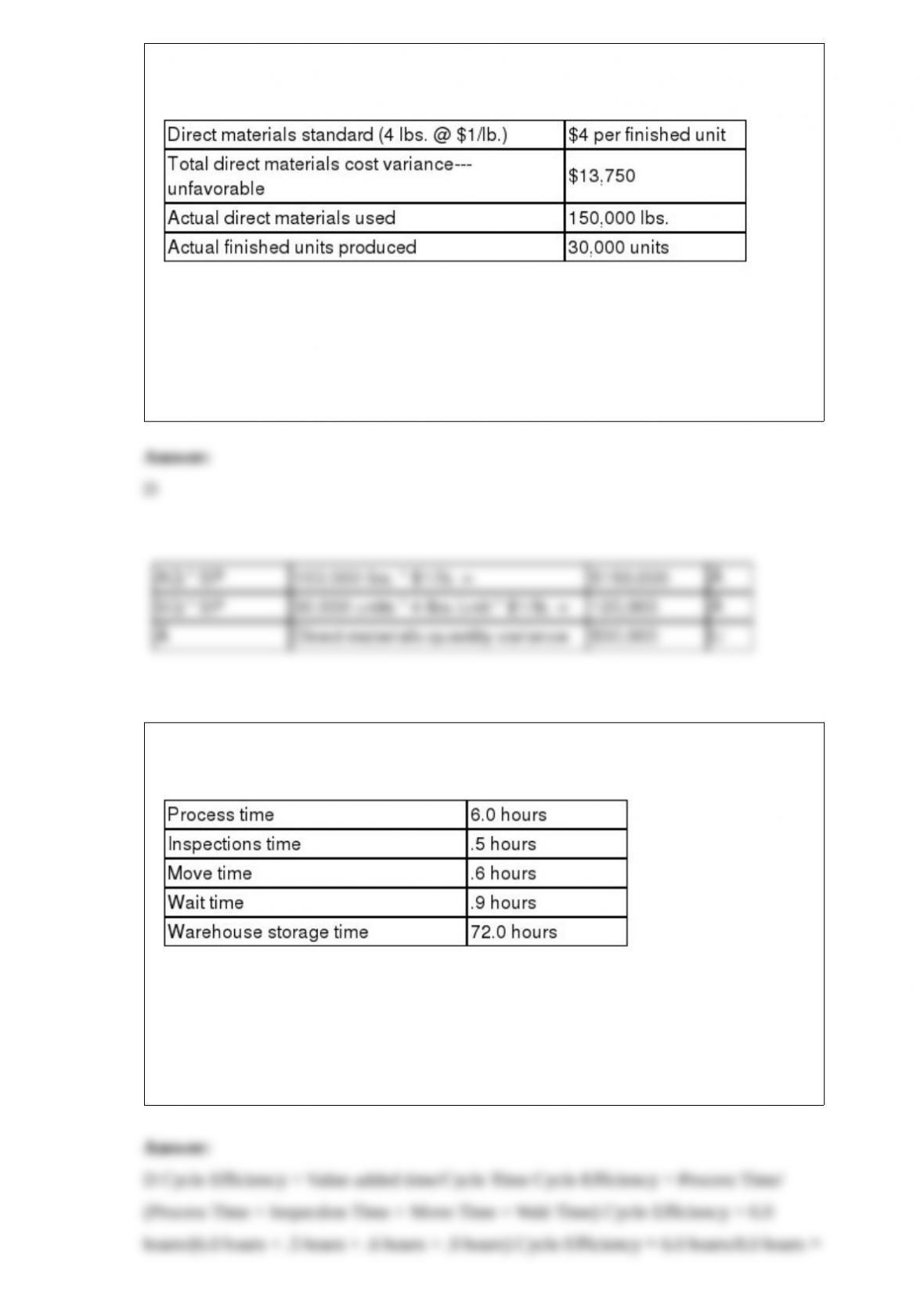
24) Georgia, Inc. has collected the following data on one of its products. The direct
materials quantity variance is:
A.$30,000 favorable.
B.$13,750 unfavorable.
C.$16,250 favorable.
D.$30,000 unfavorable.
E.$13,750 favorable.
25) Using the information below, compute the cycle efficiency:
A.93.8%.
B.81.3%.
C.100.0%.
D.75.0%.
E.88.8%.
26) Milltown Company specializes in selling used cars. During the month, the
dealership sold 22 cars at an average price of $15,000 each. The budget for the month
was to sell 20 cars at an average price of $16,000. Compute the dealership’s sales price
variance for the month.
A.$22,000 unfavorable.
B.$10,000 favorable.
C.$22,000 favorable.
D.$32,000 unfavorable.
E.$32,000 favorable.
27) Marlow Company purchased a point of sale system on January 1 for $3,400. This
system has a useful life of 10 years and a salvage value of $400. What would be the
depreciation expense for the first year of its useful life using the
double-declining-balance method?
A.$680.
B.$2,320.
C.$2,720.
D.$600.
E.$300.
28) The difference between the flexible budget sales and the fixed budget sales is called
the __________________________ variance.
29) Explain the difference between direct and indirect expenses in accounting for
departments.
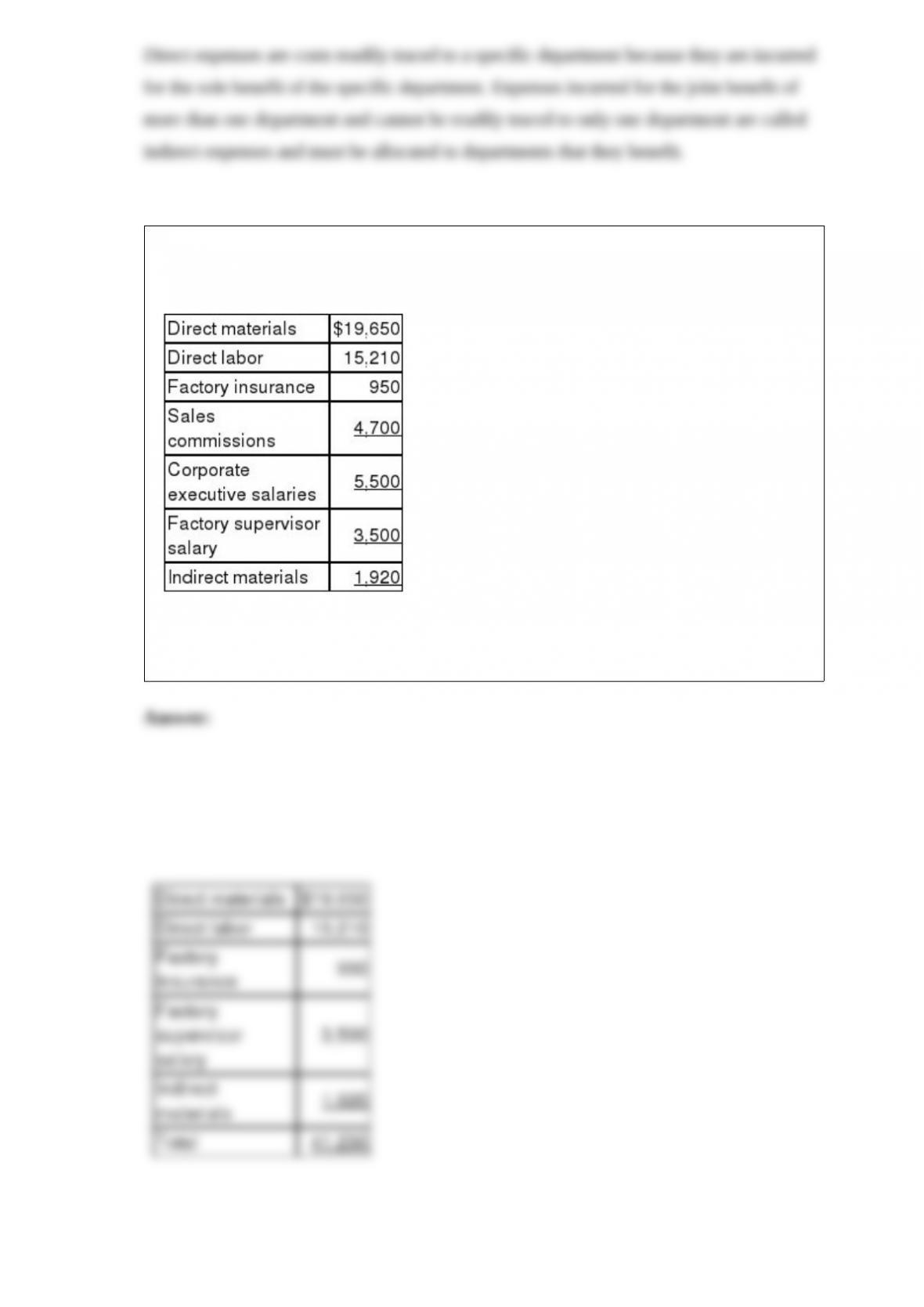
30) The Langston Company manufactures coats. Costs for February were as follows:
Required:
Calculate the total manufacturing cost for February.
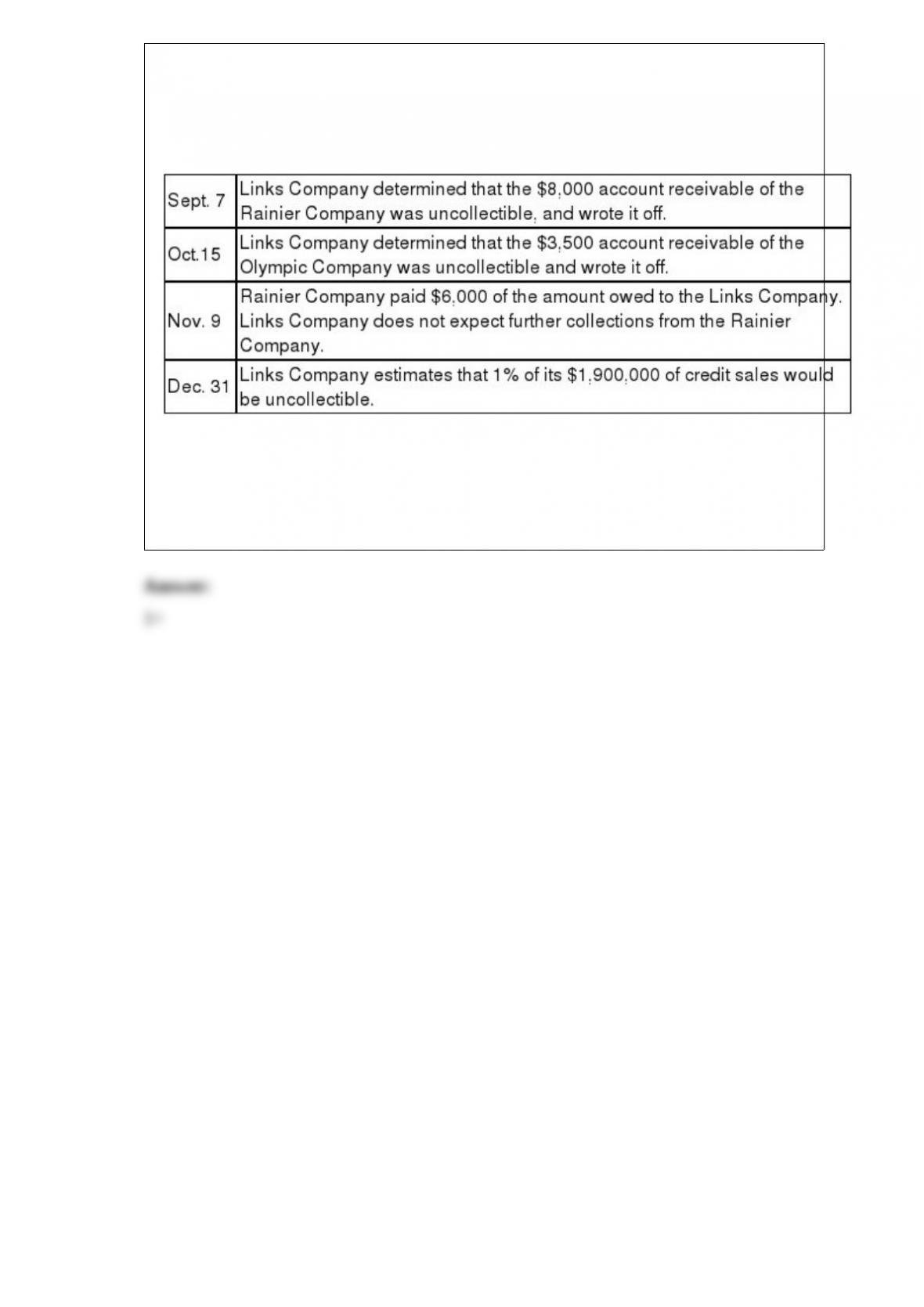
31) The Links Company uses the percent of sales method of accounting for
uncollectible accounts receivable. During the current year, the following transactions
occurred:
1> Prepare the general journal entries to record these transactions.
2> If the balance of the allowance for uncollectible accounts was a $4,000 credit on
January 1 of the current year, determine the balance of the allowance for uncollectible
accounts at December 31 of the current year. Assume that the transactions above are the
only transactions affecting the allowance for uncollectible accounts during the year.
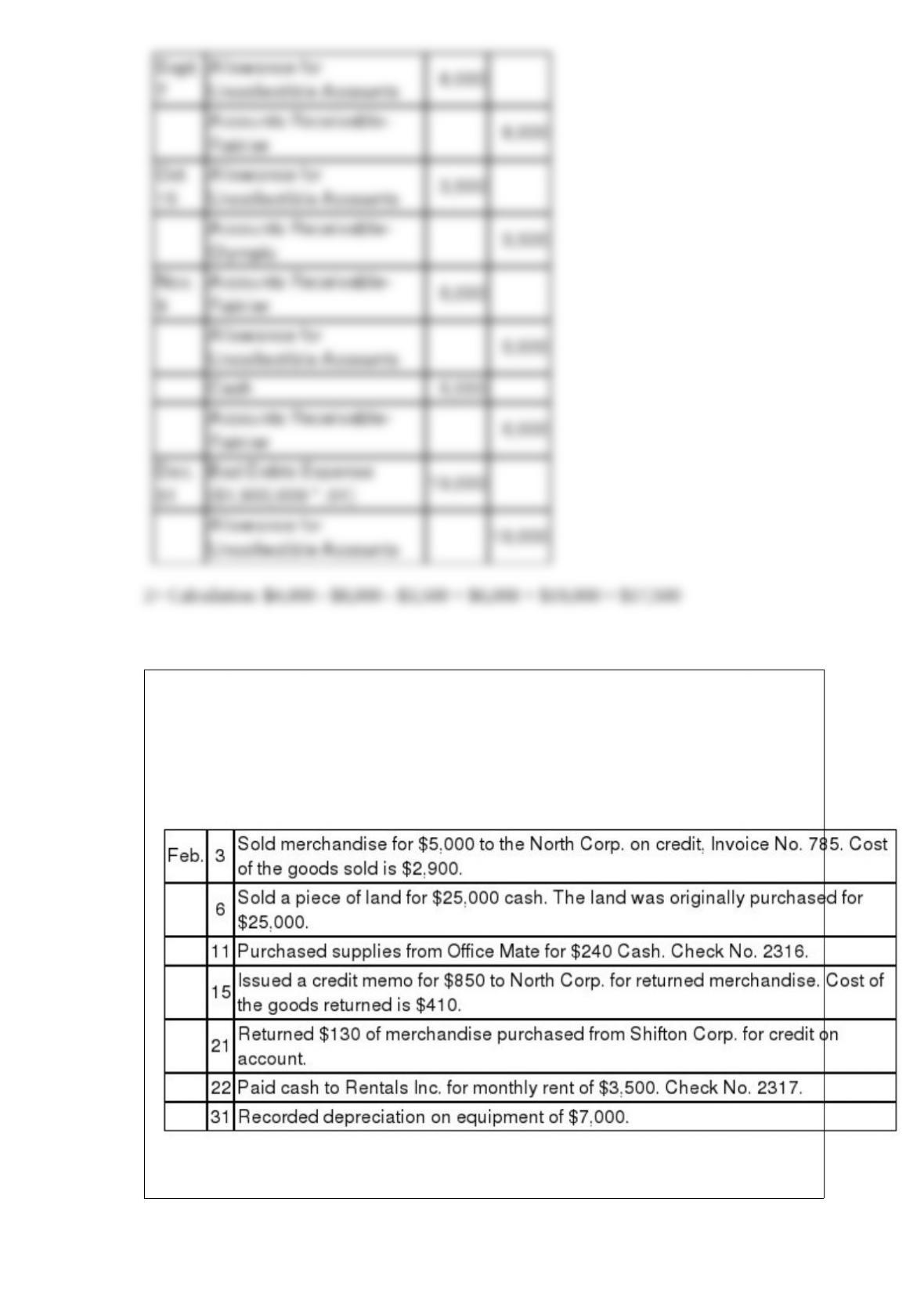
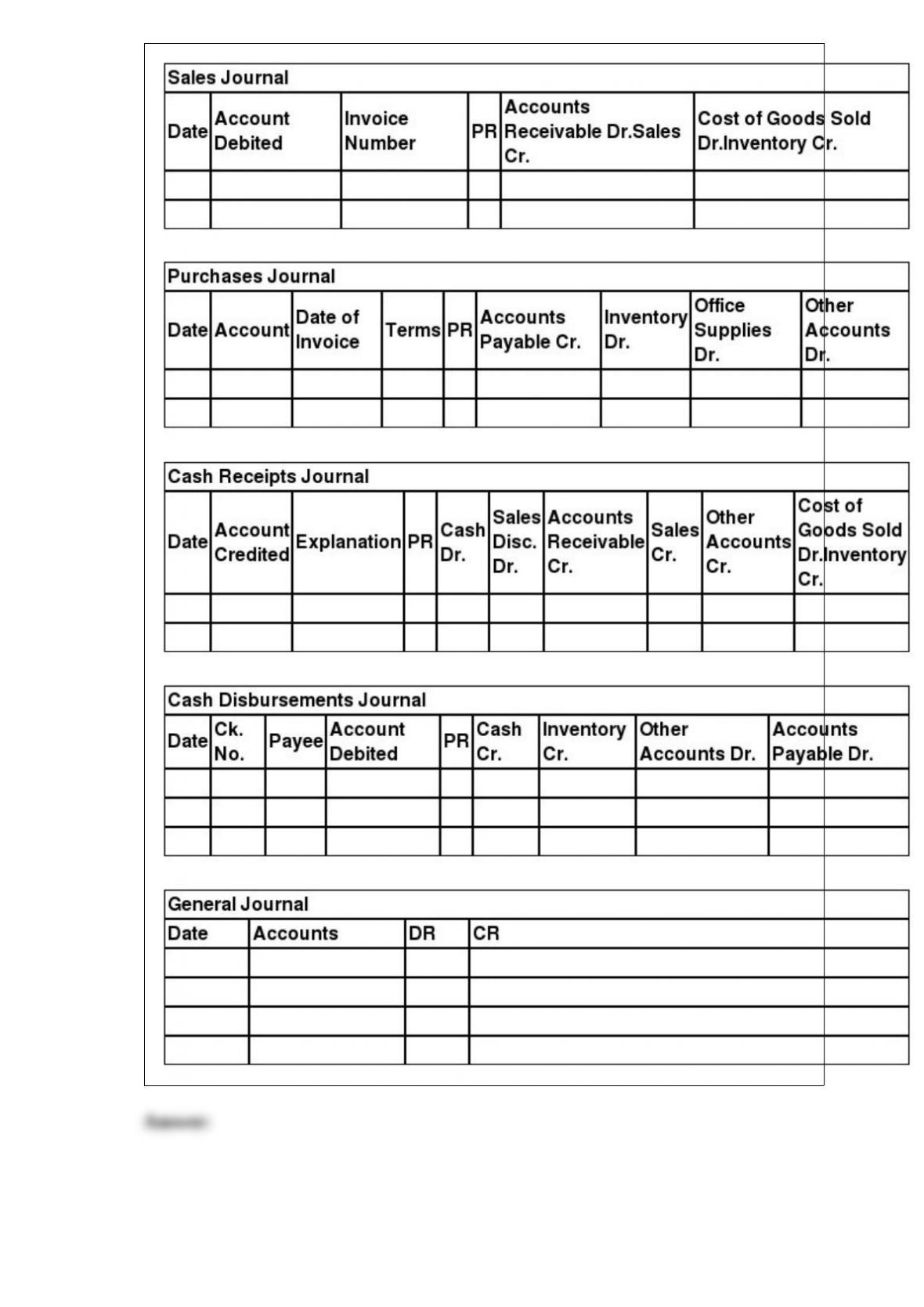
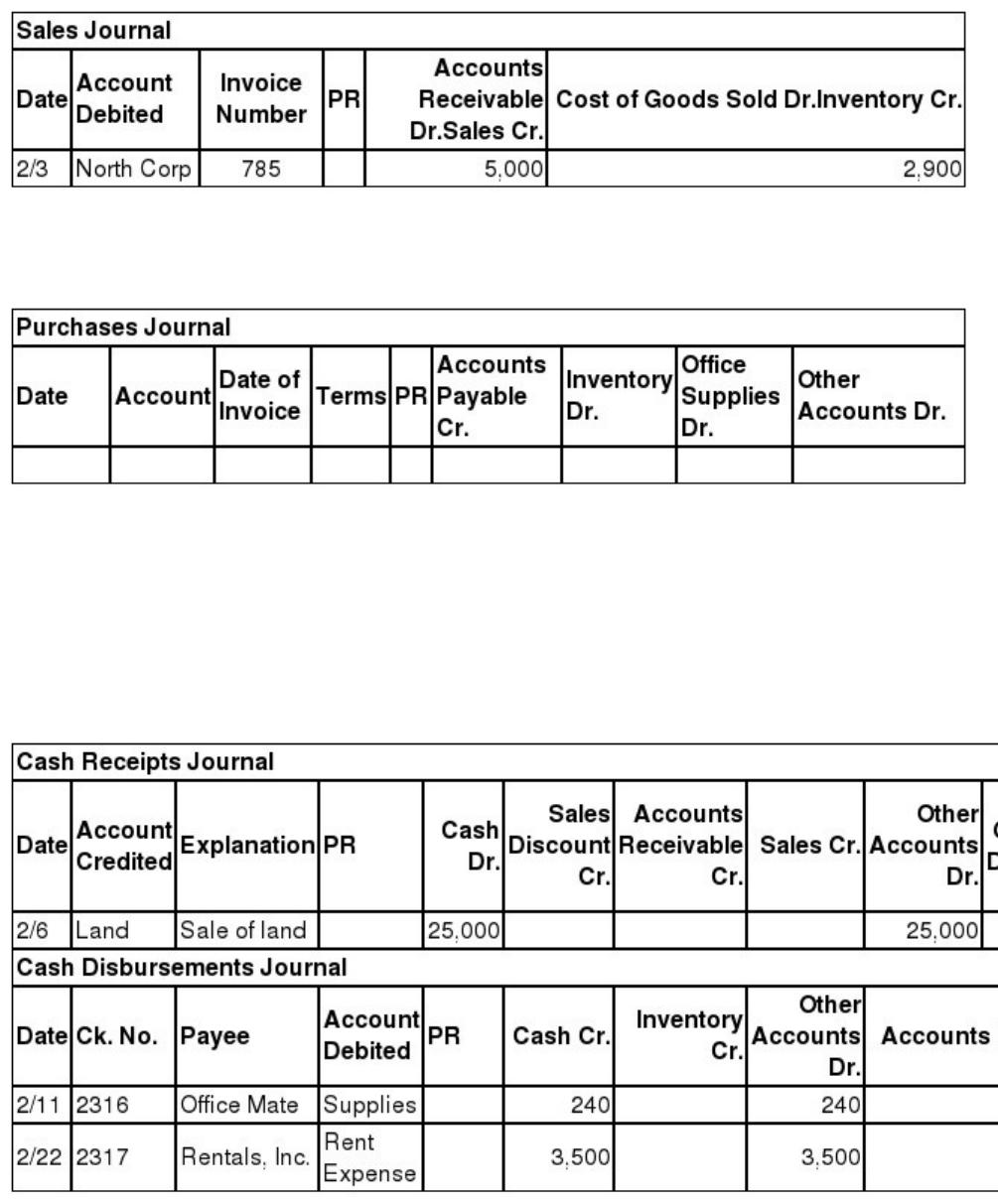
32) A company uses a sales journal, purchases journal, cash receipts journal, cash
disbursements journal, and general journal. A perpetual inventory system is used. The
following transactions were completed by the company during the current month of
February:
Record these transactions in the appropriate journals that follow.
33) ______________________, which is one part of accounting, is the recording of
transactions and events, either manually or electronically.
34) When applying equal total payments to a note, with each payment the amount
applied to the note principal ____________ while the interest expense for the note
_____________.