Activity-based costing (ABC) techniques used to evaluate customer profitability can
also be applied to evaluating suppliers.
Answer:
If a company has three cost pools, it should have three different cost allocation bases.
Answer:
The design and use of management control systems affects how an individual makes
and implements decisions.
Answer:
The direct material price variance is based on the quantity of materials purchased when
the quantity purchased is different from the quantity used.
Answer:
A scattergraph is useful for identifying outliers/irrelevant data points.
Answer:
Cost estimates using regression analysis are always more accurate and dependable than
cost estimates using the scattergraph methods.
Answer:
Tangible customer expectations include how the product’s salespeople treat customers
and the time required to deliver the product to the customer.
Answer:
The use of an optimal transfer price eliminates potential conflicts between an
organization’s interests and the divisional manager’s interest.
Answer:
The sales activity variance is the result of a difference between budgeted units sold and
actual units sold.
Answer:
In the short-run, plant capacity is fixed and product choices have to be made that
optimize the use of available capacity.
Answer:
Activity-based costing (ABC) provides more detailed measures of costs than do plant
wide or department allocation methods.
Answer:
Both the actual material used and the standard quantity allowed for material is based on
the actual output attained.
Answer:
The basic concepts involved in activity-based costing (ABC) can be used to determine
customer profitability as well as product costs.
Answer:
Operation costing is a hybrid system used in manufacturing goods that have some
common characteristics and some individual characteristics.
Answer:
The journal entry to record actual manufacturing overhead for indirect material debits
Manufacturing Overhead (Control) and credits Accounts Payable.
Answer:
The basic variance analysis framework used for manufacturing companies can also be
used in service organizations.
Answer:
Job cost sheets are used in accounting systems as a subsidiary ledger for the
Work-in-Process account.
Answer:
A responsibility center can be a department, division, or segment, but not a subsidiary
of the parent company.
Answer:
The department cost allocation method provides more accurate product cost
information for managerial decision-making than the plant wide cost allocation
method.
Answer:
An asset is a cost matched with revenues in a future accounting period.
Answer:
Cost allocations based on dual rates assume that a common cost can be separated into a
fixed and variable component.
Answer:
In general, organizations are more centralized in the early stages of their existence and
more decentralized as they grow.
Answer:
A cost can be differential for one particular course of action and non-differential for
another course of action.
Answer:
In effect, the cash budget simply restates the budgeted income statement to the cash
basis.
Answer:
Joint costs are processing costs incurred after the split-off point in a common
production process.
Answer:
One way to control the effects of a nonlinear relation between total costs and volume is
reduce the relevant range.
Answer:
In general, indirect costs are allocated, while direct costs are assigned.
Answer:
In general, low-volume products (and services) have a lower degree of complexity
associated with them.
Answer:
In general, negotiated transfer prices fall in a range between the selling division’s
differential costs and the buying division’s market price.
Answer:
Price discrimination is the practice of selling identical goods or services to different
customers at different prices.
Answer:
In general, a division’s investment base includes an allocated share of the corporate
headquarters’ assets.
Answer:
Managerial decisions based on activity-based costing (ABC) information affect only
volume-level, batch-level, and product-level costs.
Answer:
The reason opportunity costs are not included in the accounting system is because they
involve estimates.
Answer:
Ethical conflicts can occur in the budgeting process because managers supply
information for the budgets that are then used to evaluate their performance.
Answer:
If the number of units produced exceeds the number of units sold, the full-absorption
operating profit will be lower than variable costing operating profit.
Answer:
In general, the use of multiple independent variables increases the proportion of the
variation in the dependent variable explained by the cost equation.
Answer:
If an intermediate market exists but divisions are prohibited from buying or selling
from the outside, the intermediate market can be ignored in determining the optimal
transfer price.
Answer:
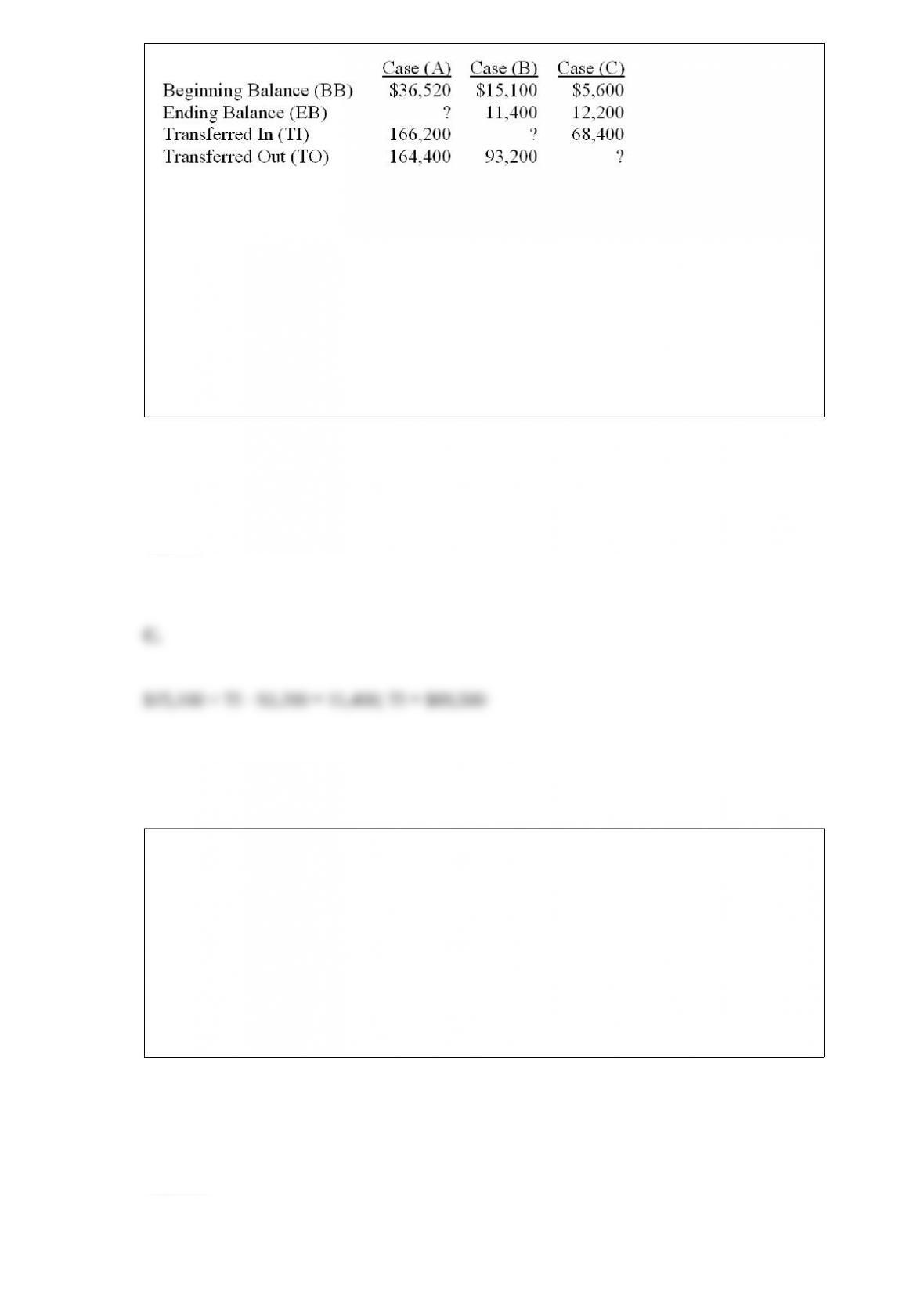
For Case (B) above, what is the Transferred-In (IT)?
A. $96,900
B. $119,700
C. $89,500
D. $66,700
Answer:
Which of the following is not a characteristic of job costing?
A. Each job is distinguishable from other jobs.
B. Identical units are produced on an ongoing basis.
C. Job cost data are used for setting prices and bids.
D. It is not possible to compare actual costs with estimated costs.
Answer:
Which one of the following budgets would be the last one prepared in the master
budget preparation process?
A. Manufacturing overhead budget.
B. Cost of goods sold budget.
C. Marketing cost budget.
D. Direct labor budget.
E. Cash budget.
Answer:
Which of the following statements is (are) true regarding compensation?
(A) Fixed compensation is generally not linked to measured performance; i.e., it is
independent of measured performance.
(B) Properly designed management control systems have contingent compensation
items but not fixed compensation items.
A. Only A is true.
B. Only B is true.
C. Both A and B are true.
D. Neither A nor B is true.
Answer:
A management purpose for allocating joint costs of a processing center to the various
products produced is to
A. establish inventory values for unsold units.
B. record accurate cost of sales by product line.
C. compute total processing cost variances by product.
D. report correct standard product costs for comparative analysis.
Answer:
Blue Company has beginning and ending Work-in-Process Inventories that are 45%
and 10% complete, respectively. Materials are added at the beginning of the process. If
first-in, first-out (FIFO) process costing is used, the total equivalent units for materials
will equal the number of units
A. transferred out during the period.
B. started and completed during the period.
C. started into the process during the period.
D. started into the process plus the units in the ending inventory.
Answer:
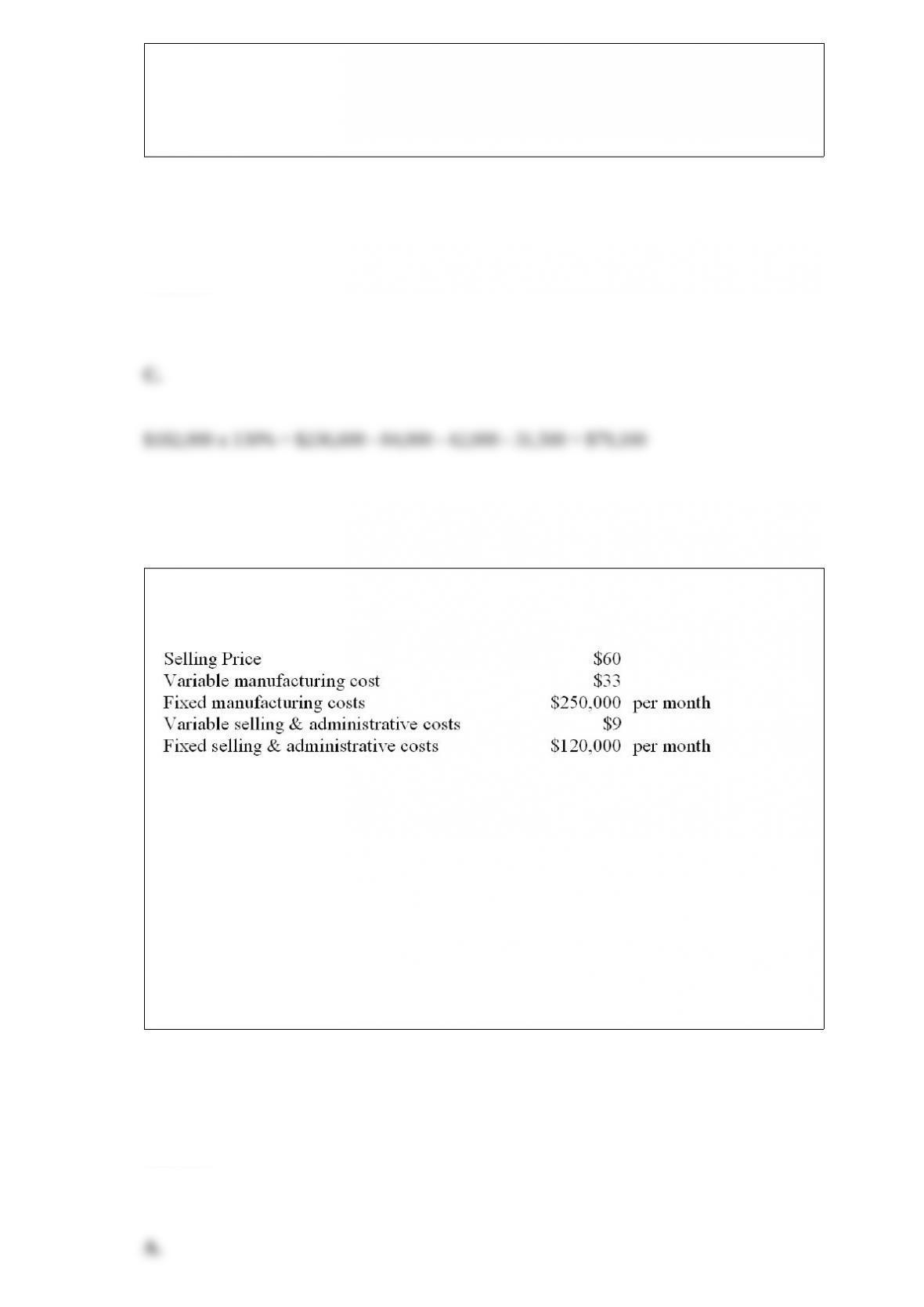
The operations of Gadwell Corporation are divided into the Blink Division and the
Blur Division. Projections for the next year are as follows:
If the Blur Division were dropped, Blink Division’s sales would increase by 30%. If this
happened, the operating income for Gadwell Corporation as a whole would be
A. $72,800
B. $56,000
C. $79,100
D. $59,150
Answer:
RedTail Mfg has the following data:
What dollar sales volume does RedTail need to achieve a $50,000 operating profit per
month?
A. $1,400,000
B. $7,560,000
C. $933,333
D. $1,233,333
Answer:
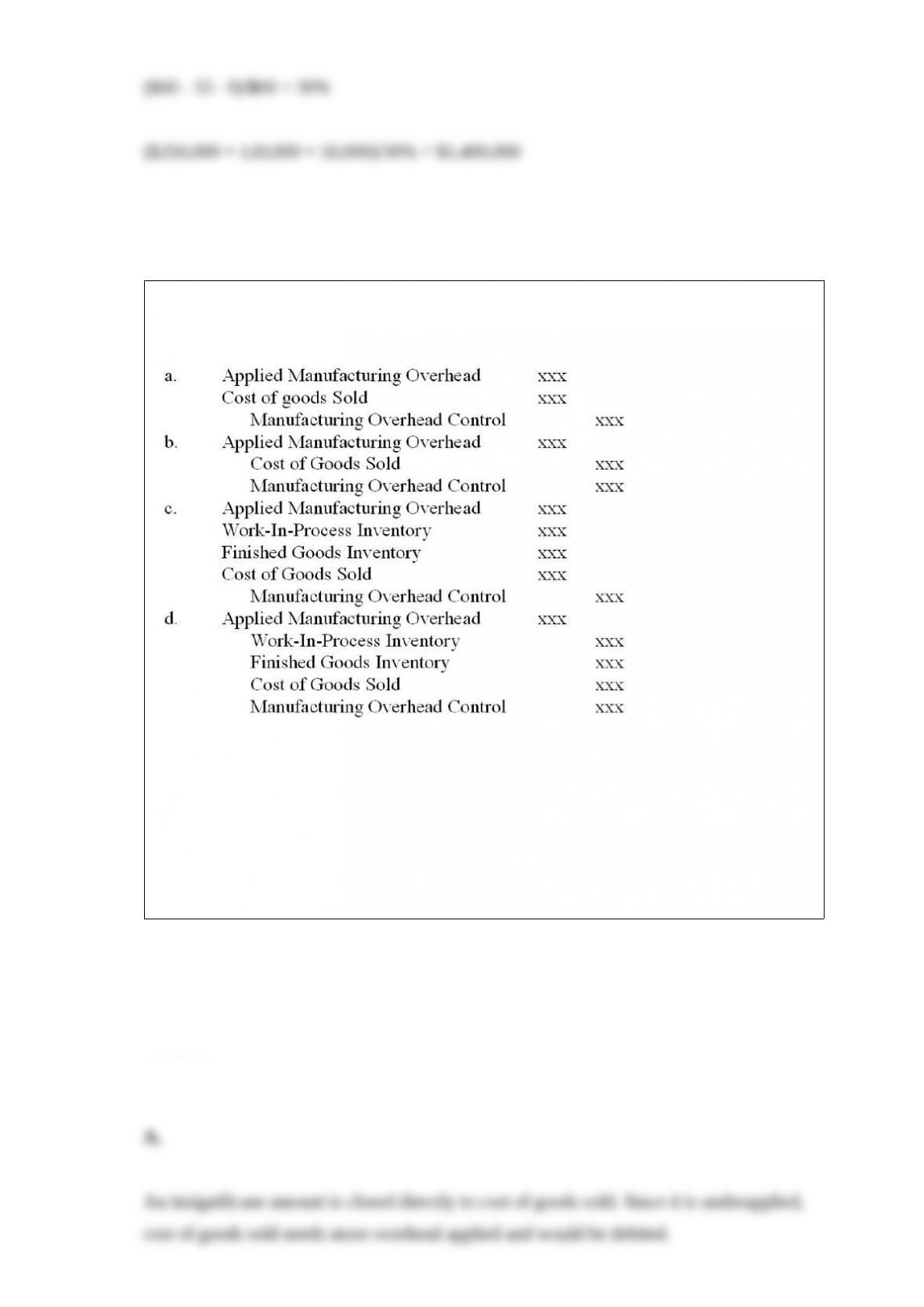
The journal entry to write-off an insignificant underapplied overhead balance at the end
of an accounting period is
A. a
B. b
C. c
D. d
Answer:
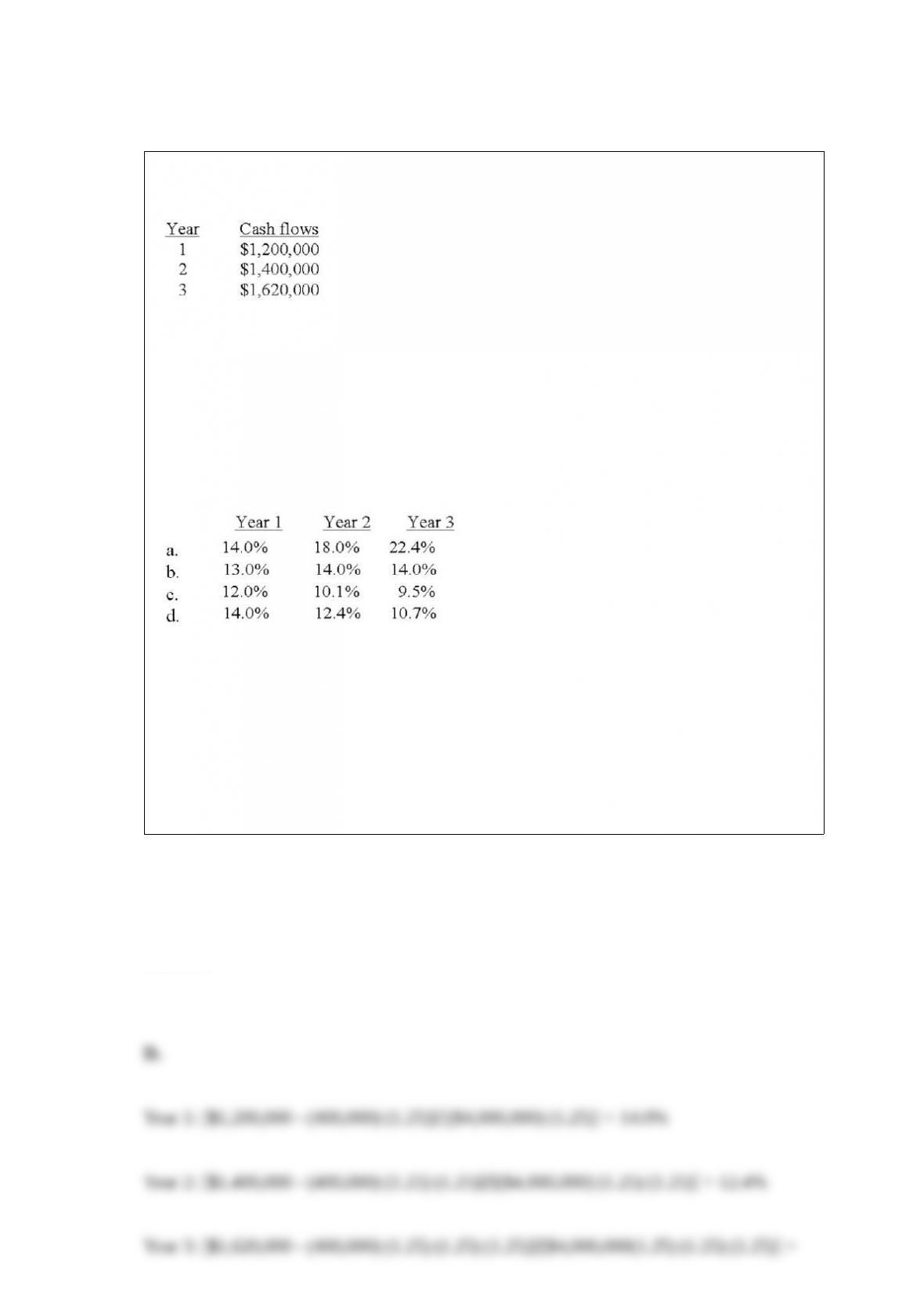
One division of the RST Enterprise Company has depreciable assets costing
$4,000,000. The cash flows from these assets for the past three years have been:
The current (i.e., replacement) costs of these assets were expected to increase 25% each
year. RST used the straight-line depreciation method; the estimated useful life is
10-years with no salvage value. For return on investment (ROI) calculations, RST uses
end-of-year balances.
What is the ROI using current costs and gross book value?
A. a
B. b
C. c
D. d
Answer:
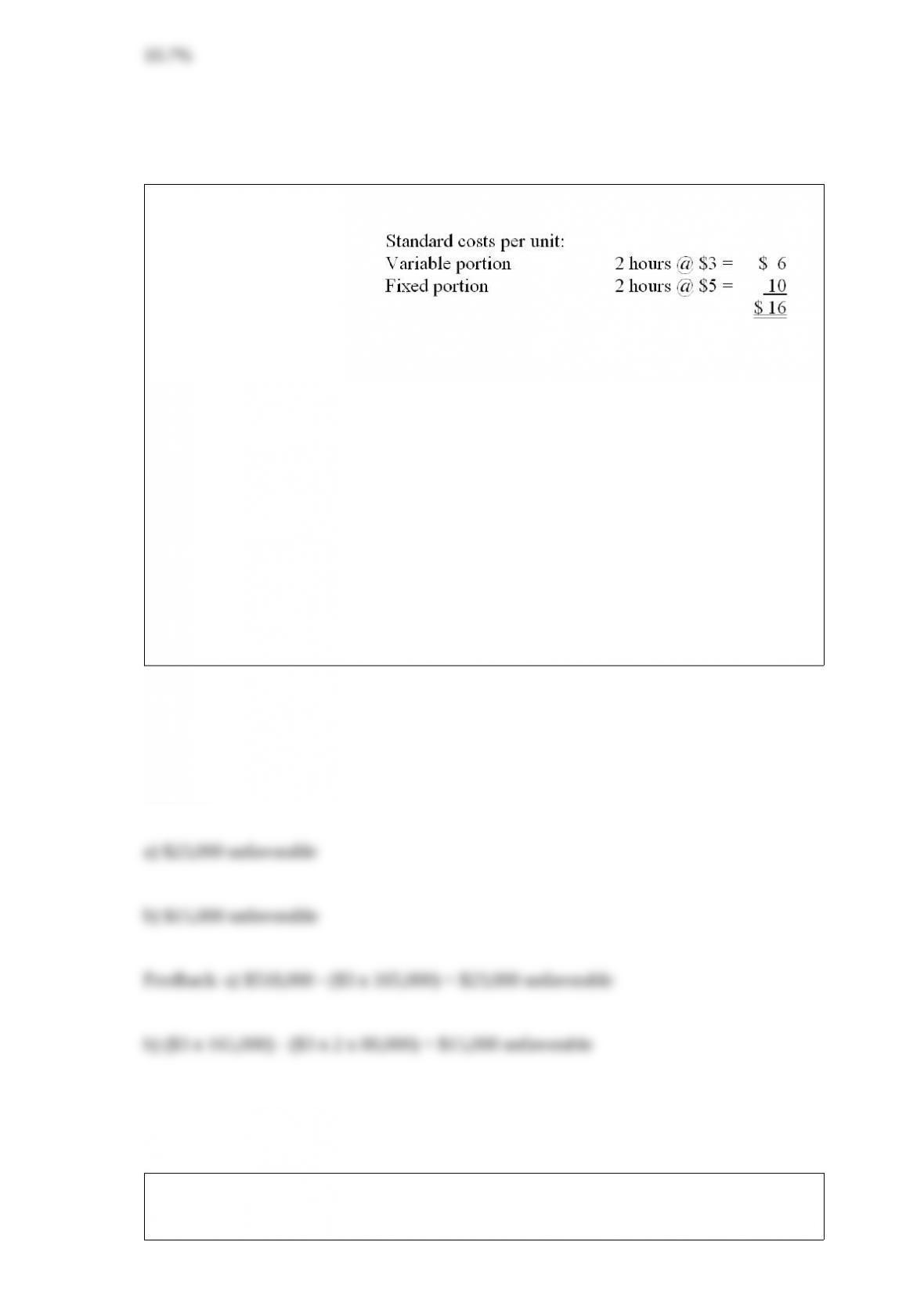
The Standard Company has developed standard overhead costs based upon a capacity
of 180,000 direct labor hours:
During April, 85,000 units were scheduled for production; however, only 80,000 units
were actually produced. The following data relate to April:
Actual direct labor cost incurred was $644,000 for 165,000 actual hours of work.
Actual overhead incurred totaled $1,378,000; $518,000 variable and $860,000 fixed.
All inventories are carried at standard cost.
Required: (Be sure to indicate whether the variances are favorable or unfavorable.)
a) Compute the variable overhead price variance.
b) Compute the variable overhead efficiency variance.
Answer:
An operating budget would not include a
A. cash budget.
B. sales budget.
C. labor budget.
D. production budget.
E. operating expense budget.
Answer:
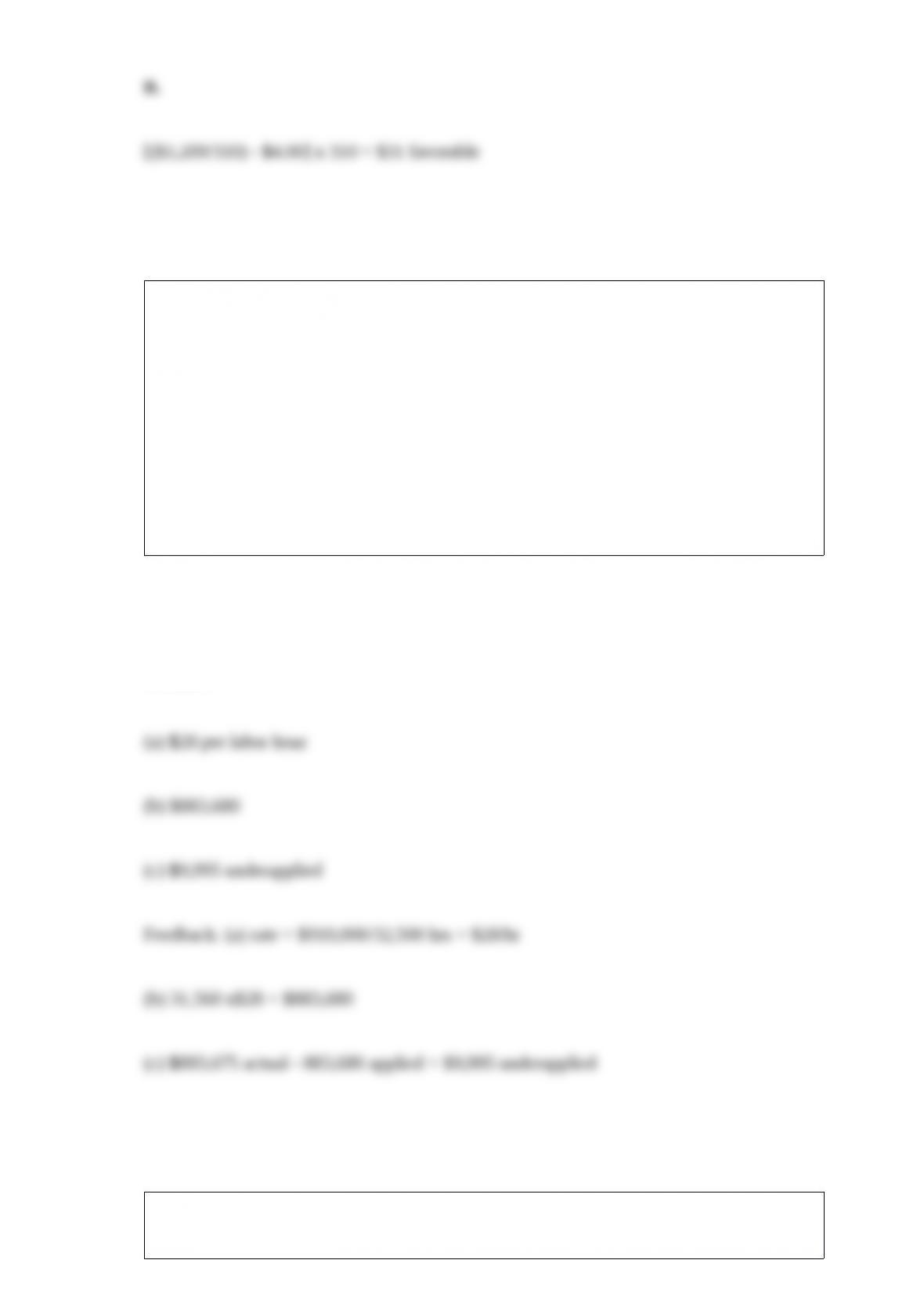
The Landry Company has developed standards for labor. During June, 75 units were
scheduled and 100 were produced. Data related to labor are:
What is the labor rate variance for June?
A. $30 unfavorable
B. $31 favorable
C. $31 unfavorable
D. $30 favorable
Answer:
Misa Company applies overhead based upon labor-hours. Budgeted factory overhead
was $910,000 and budgeted labor-hours were 32,500. Actual factory overhead was
$893,675 and actual labor-hours were 31,560.
Required:
a)Compute the overhead application rate.
b) Compute the amount of overhead applied to production.
c) Determine the amount of over- or underapplied overhead.
Answer:
What is the amount of the under- or overapplied manufacturing overhead?
A. $1,000 underapplied
B. $3,000 overapplied
C. $4,000 underapplied
D. $7,000 overapplied
Answer:
Slurpy produces soft drinks and sodas. Production of 100,000 liters was started in
February, 85,000 liters were completed. Material costs were $38,220 for the month
while conversion costs were $16,380. There was no beginning work-in-process; the
ending work-in-process was 40% complete. What is the cost of the product that was
completed and transferred to finished goods?
A. $54,600
B. $51,000
C. $46,410
D. $38,220
Answer:
The amount of production possible under normal working conditions, including
planned downtime and scheduled vacations, is called
A. actual capacity.
B. normal capacity.
C. practical capacity.
D. theoretical capacity.
Answer:
TRS is a large securities dealer. Last year, the company made 120,000 trades with an
average commission of $120. Because of the general economic climate, TRS expects
trade volume to decline by 20%. Fortunately, the average commission per trade is likely
to increase by 10% because trades are expected to be large in the coming year. What are
the estimated commission’s revenues for TRS in the coming year?
A. $11,520,000
B. $12,672,000
C. $15,552,000
D. $15,840,000
Answer:
XYZ Company manufactures a single product. The product’s prime costs consist of
A. direct material and direct labor.
B. direct material and factory overhead.
C. direct labor and factory overhead.
D. direct material, direct labor and factory overhead.
E. direct material, direct labor and variable factory overhead.
Answer:
The system that identifies the costs of producing low-quality items is called
A. customer relationship management
B. distribution chain
C. total quality management
D. cost of quality
E. enterprise resource planning
Answer:
Department D has recently purchased and installed new computerized equipment for
Product X. This equipment will increase the overhead costs by $2,700 and decrease
labor costs (due to time savings) in Department D by $3.00 per case. Machine hours
will not change. If Smelly uses a plantwide rate based on machine hours, what is the
revised product cost per case for Product J?
A. $161.50
B. $169.30
C. $172.00
D. $183.36
Answer:
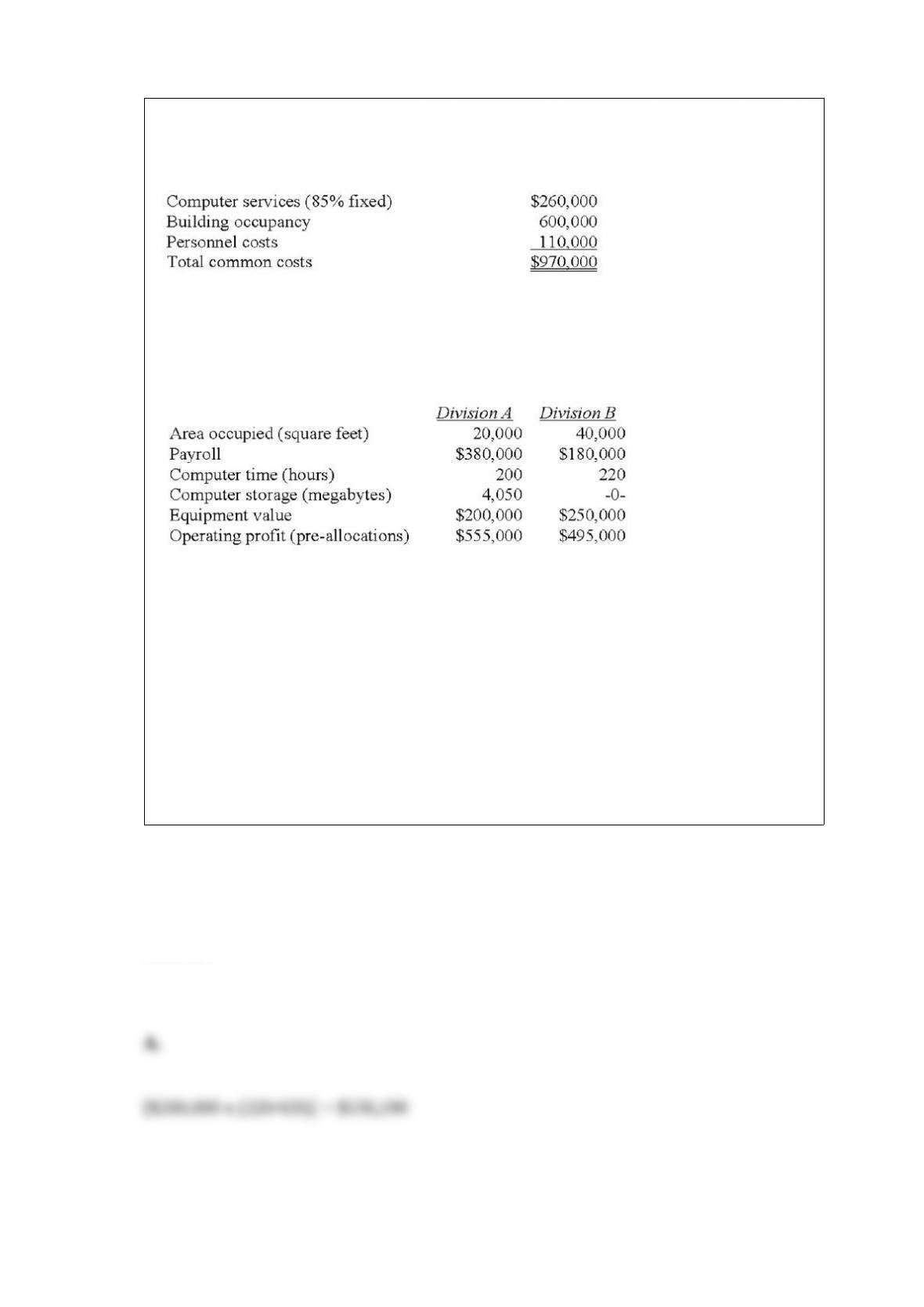
Cincinnati Million, Inc. operates two user divisions as separate cost objects. To
determine the costs of each division, the company allocates common costs to the
divisions. During the past month, the following common costs were incurred:
The following information is available concerning various activity measures and
service usages by each of the divisions:
If common computer service costs are allocated using computer time as the allocation
basis, what is the computer cost allocated to Division B?
A. $136,190
B. $137,647
C. $144,444
D. $173,333
Answer:
Which of the following actions do not cause an impropriety in job costing?
A. Misstating the stage of completion.
B. Choosing to use normal costing rather than actual costing.
C. Charging costs to the wrong job.
D. Choosing an allocation method based on the results rather than choosing the method
based on resource usage.
Answer:
If raw materials are carried in the Direct Materials Inventory at standard cost, then it is
reasonable to assume that the
A. price variance is recognized when materials are purchased.
B. price variance is recognized when materials are placed into production.
C. company does not follow generally accepted accounting principles.
D. efficiency variance is recognized when the materials are purchased.
E. efficiency variance is recognized when the materials are placed into production.
Answer:
For purposes of allocating joint costs to joint products, the estimated net realizable
value at split-off is equal to
A. final sales price reduced by cost to complete after split-off.
B. sales price less a normal profit margin at the point of sale.
C. separable product cost plus a normal profit margin.
D. total sales value less joint costs at point of split-off.
Answer:
The financial records for the Lee Manufacturing Company have been destroyed in a
fire. The following information has been obtained from a separate set of books
maintained by the cost accountant. The cost accountant now asks for your assistance in
computing the missing amounts.
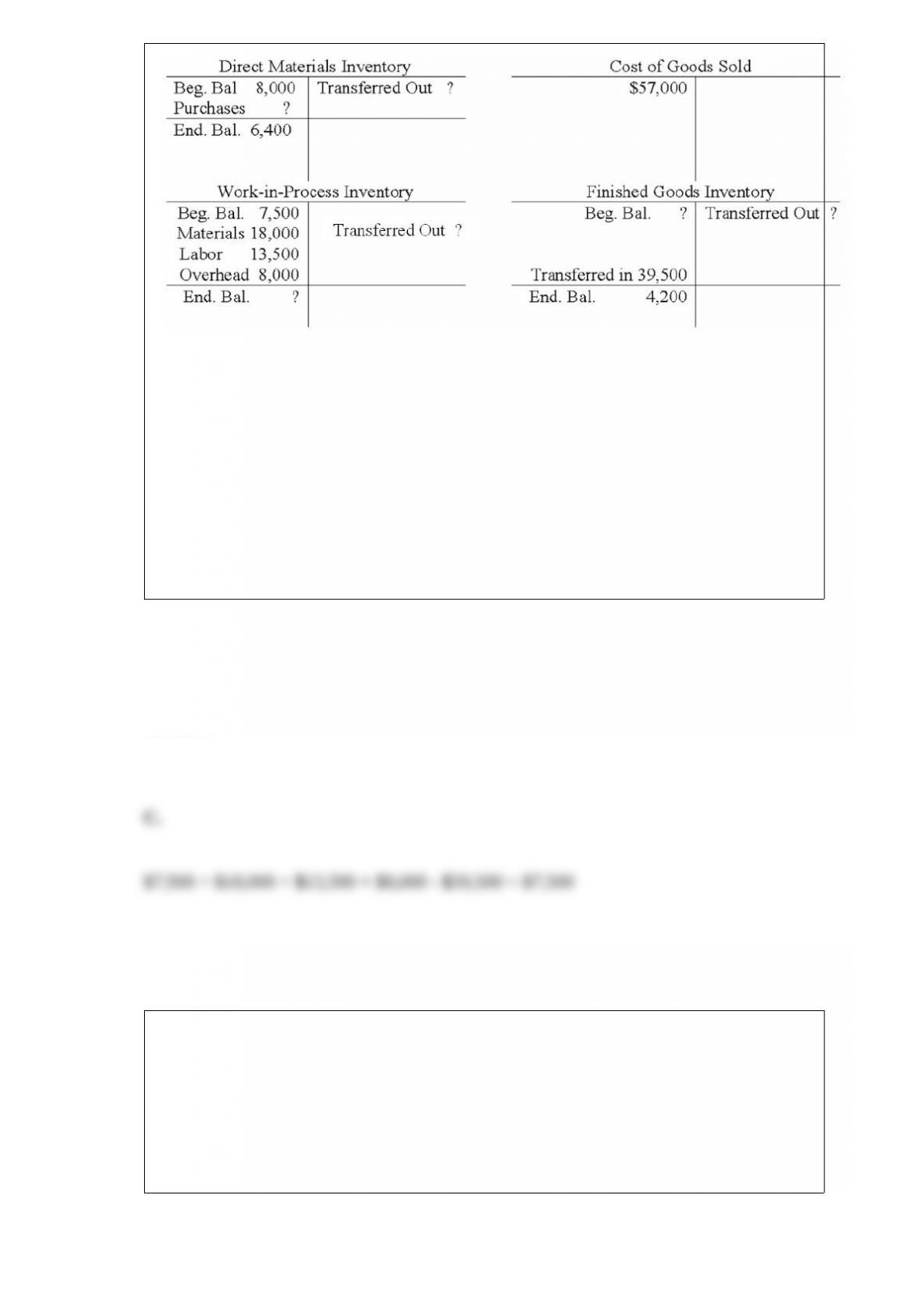
What is the value of the ending Work-in-Process inventory balance?
A. $-0-
B. $4,200
C. $7,500
D. $8,000
Answer:
Computer Complex, Inc. has two main services: (1) time on a timeshared computer
system, and (2) proprietary computer programs. Computer time is provided by the
operation department (Op) and programs are written by the programming department
(P)
The percentage of each service used by each department for a typical period is:
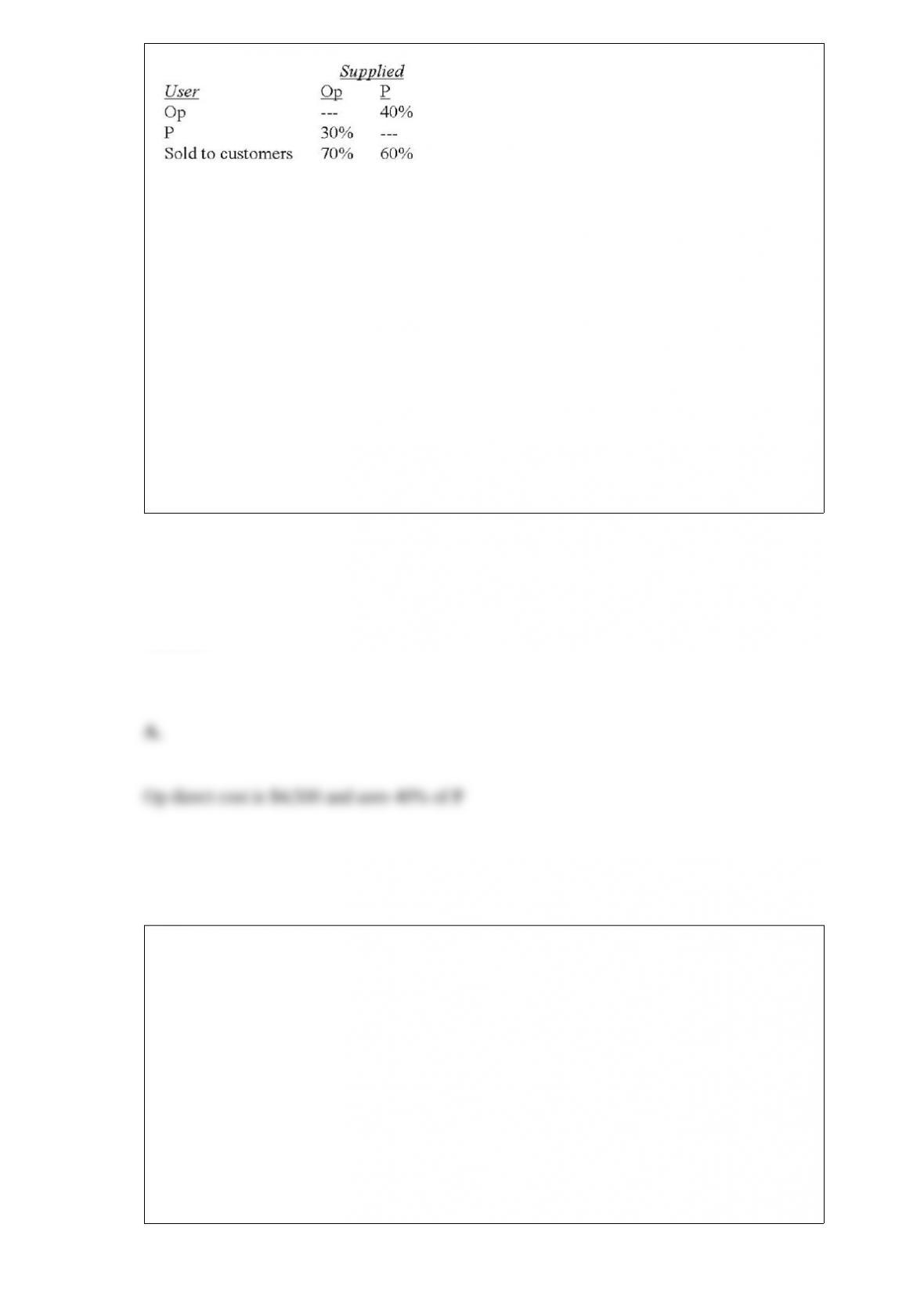
In a typical period, the operation department (Op) spends $4,500 and the programming
department (P) spends $2,500.
Under the reciprocal method what is the algebraic solution to the cost allocation
problem?
A. Op = 4,500 + .40 P; P = 2,500 + .30 Op.
B. Op = 4,500 + .70 P; P = 2,500 + .60 Op.
C. Op = 2,500 + .40 P; P = 4,500 + .30 Op.
D. Op = 2,500 + .70 P; P = 4,500 + .60 Op.
Answer:
In responsibility accounting, a center’s performance is measured by those costs which
are controllable. Controllable costs are best described as including (CMA adapted)
A. direct materials and direct labor only.
B. only those costs that the manager can influence in the current period.
C. only discretionary costs.
D. those costs about which the manager is knowledgeable and informed.
E. incremental and fixed costs.
Answer:
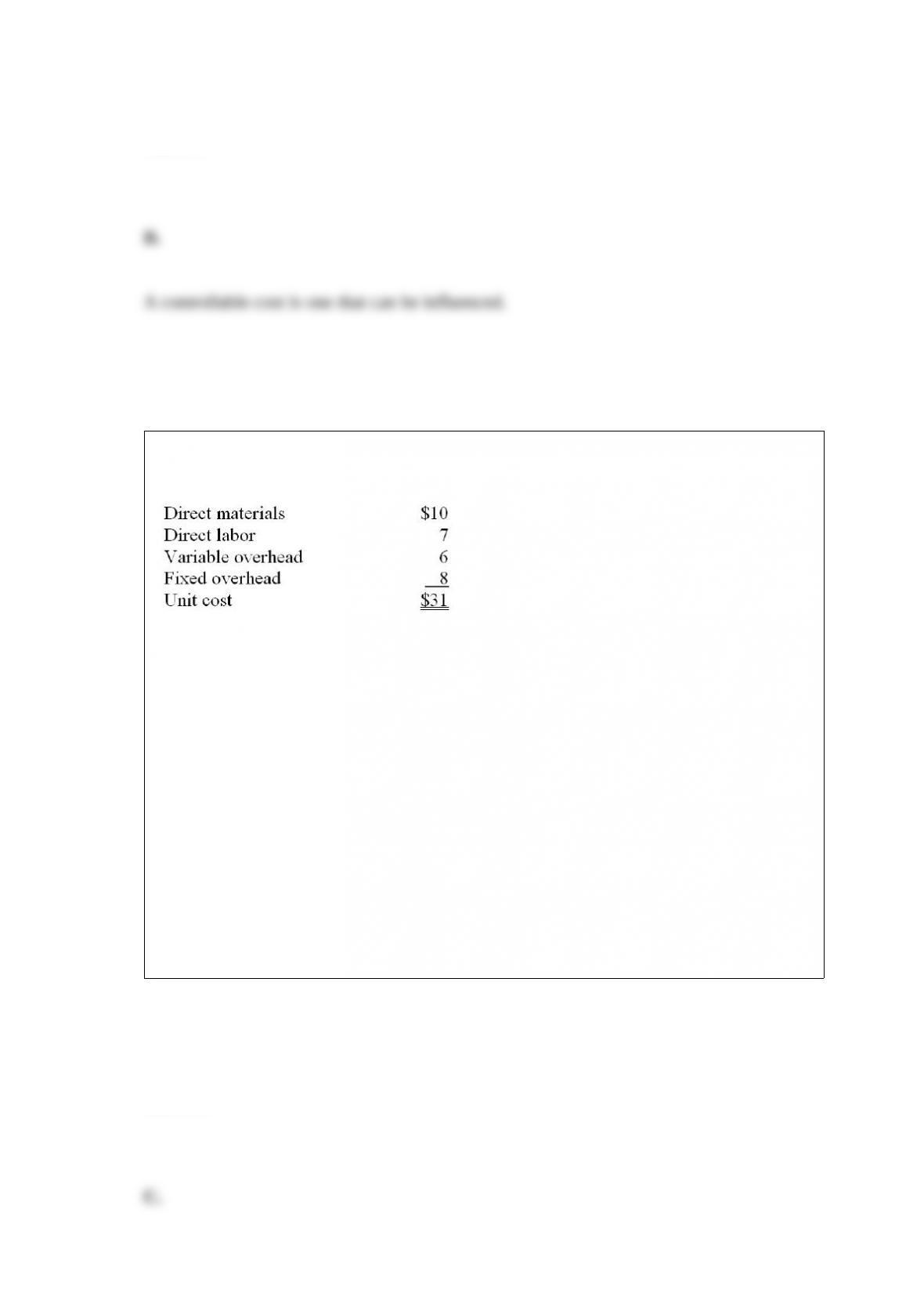
The following information relates to a product produced by Ashland Company:
Fixed selling costs are $1,000,000 per year. Variable selling costs of $4 per unit sold are
added to cover the transportation cost. Although production capacity is 500,000 units
per year, Ashland expects to produce only 400,000 units next year. The product
normally sells for $40 each. A customer has offered to buy 60,000 units for $30 each.
The customer will pay the transportation charge on the units purchased. If Ashland
accepts the special order, the effect on income would be a
A. $60,000 increase
B. $180,000 increase
C. $420,000 increase
D. $600,000 decrease
Answer:
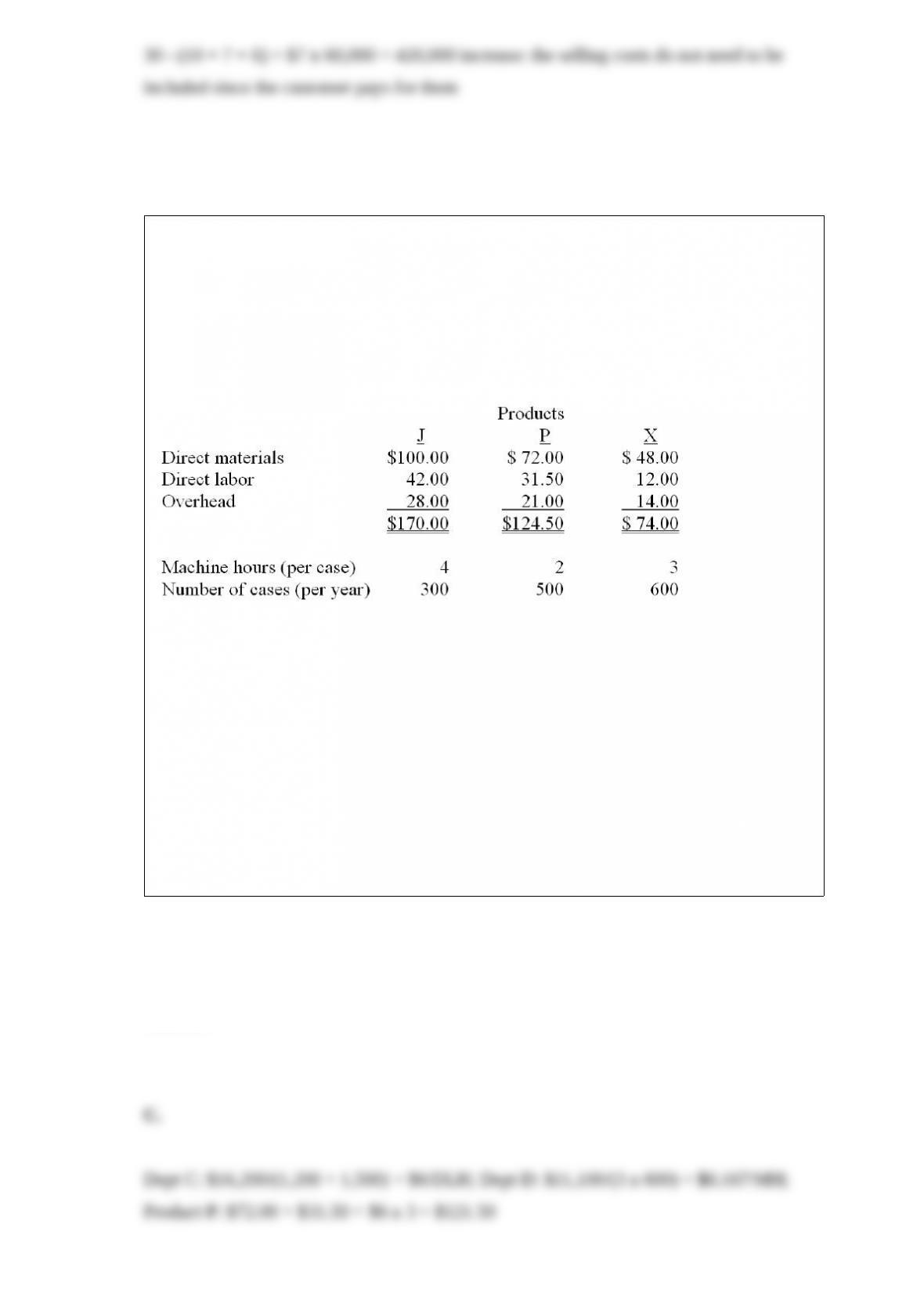
Smelly Perfume Company manufactures and distributes several different products.
They currently use a plantwide allocation method for allocating overhead at a rate of $7
per direct labor hour. Cindy is the department manager of Department C which
produces Products J and P. Department C has $16,200 in traceable overhead. Diane is
the department manager of Department D which manufactures Product X. Department
D has $11,100 in traceable overhead. The product costs (per case of 24 bottles) and
other information are as follows:
If Smelly changes its overhead allocation to departmental rates, what is the product
cost per case for Product P assuming Departments C and D use direct labor hours and
machine hours as their respective allocation bases?
A. $117.15
B. $163.50
C. $121.50
D. $138.15
Answer:
Division A has variable manufacturing costs of $50 per unit and fixed costs of $10 per
unit. Division A is operating at capacity, what is the opportunity cost of an internal
transfer when the market price is $75?
A. $20
B. $25
C. $50
D. $60
E. $75
Answer:
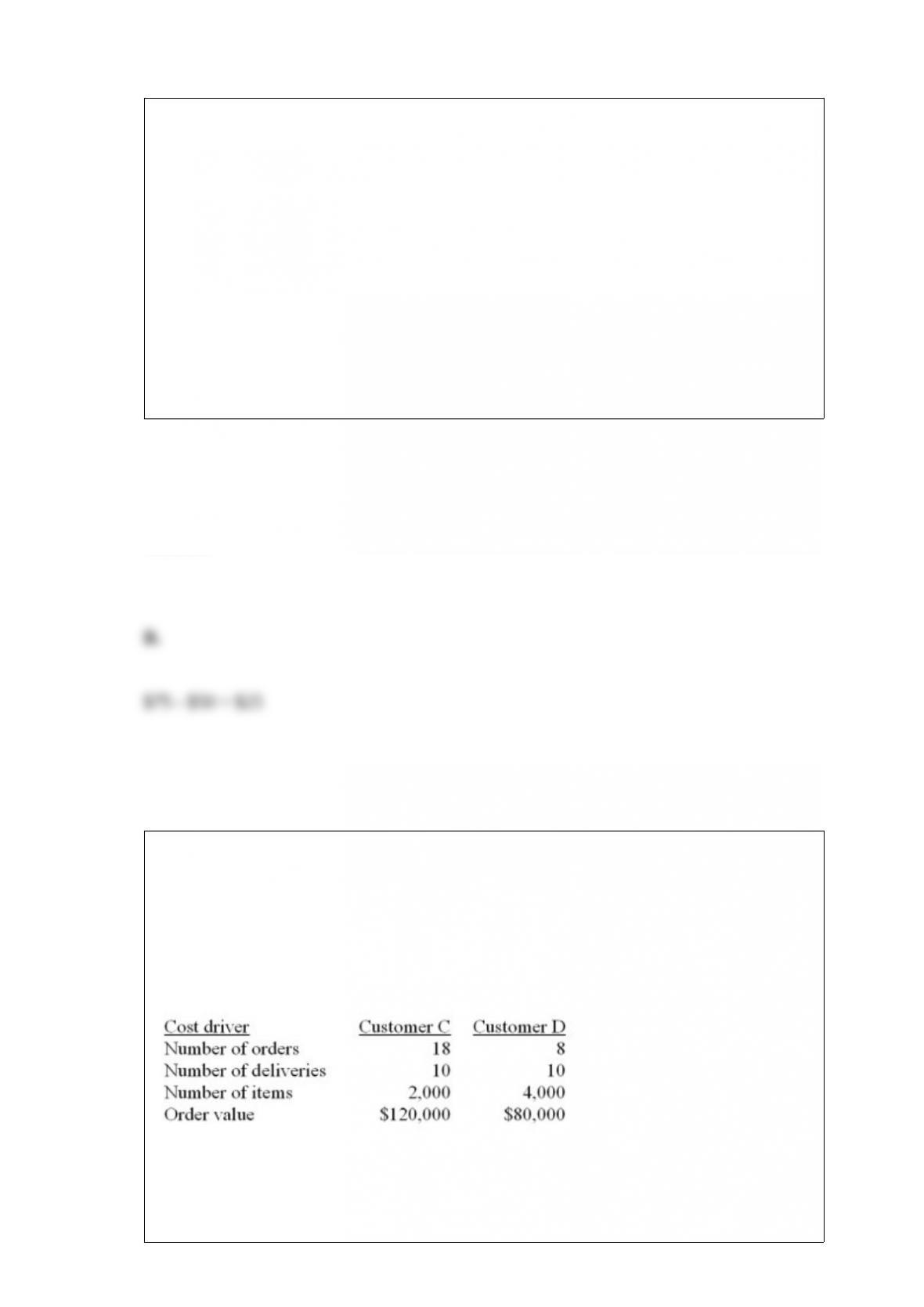
Yellow Industries decides to price delivery service according to the results of a recent
activity-based costing (ABC) study. The study indicates Yellow should charge $8 per
order, 2% of the order’s value for general delivery costs, $1.25 per item, and $30 for
delivery.
A year later, Yellow collected the following information for two of its best customers:
What are the total delivery costs charged to Customer C during the year?
A. $5,344
B. $5,364
C. $6,900
D. $6,964
Answer:
Division A has variable manufacturing costs of $50 per unit and fixed costs of $10 per
unit. Division A is operating at capacity, what is the optimal transfer price of an internal
transfer when the market price is $75?
A. $20
B. $25
C. $50
D. $60
E. $75
Answer:
Sensitivity analysis can best be used in the budgeting process to
A. explore the uncertainty surrounding their estimates.
B. remove the subjective nature from the budgeting process.
C. answer “what-if” questions regarding key projections.
D. consider alternatives and options in the budgeting process.
Answer:
Explain the difference between fixed compensation and contingent compensation. Give
an example of each.
Answer:
The next year’s budget for Green, Inc., a multi-product company, is given below:
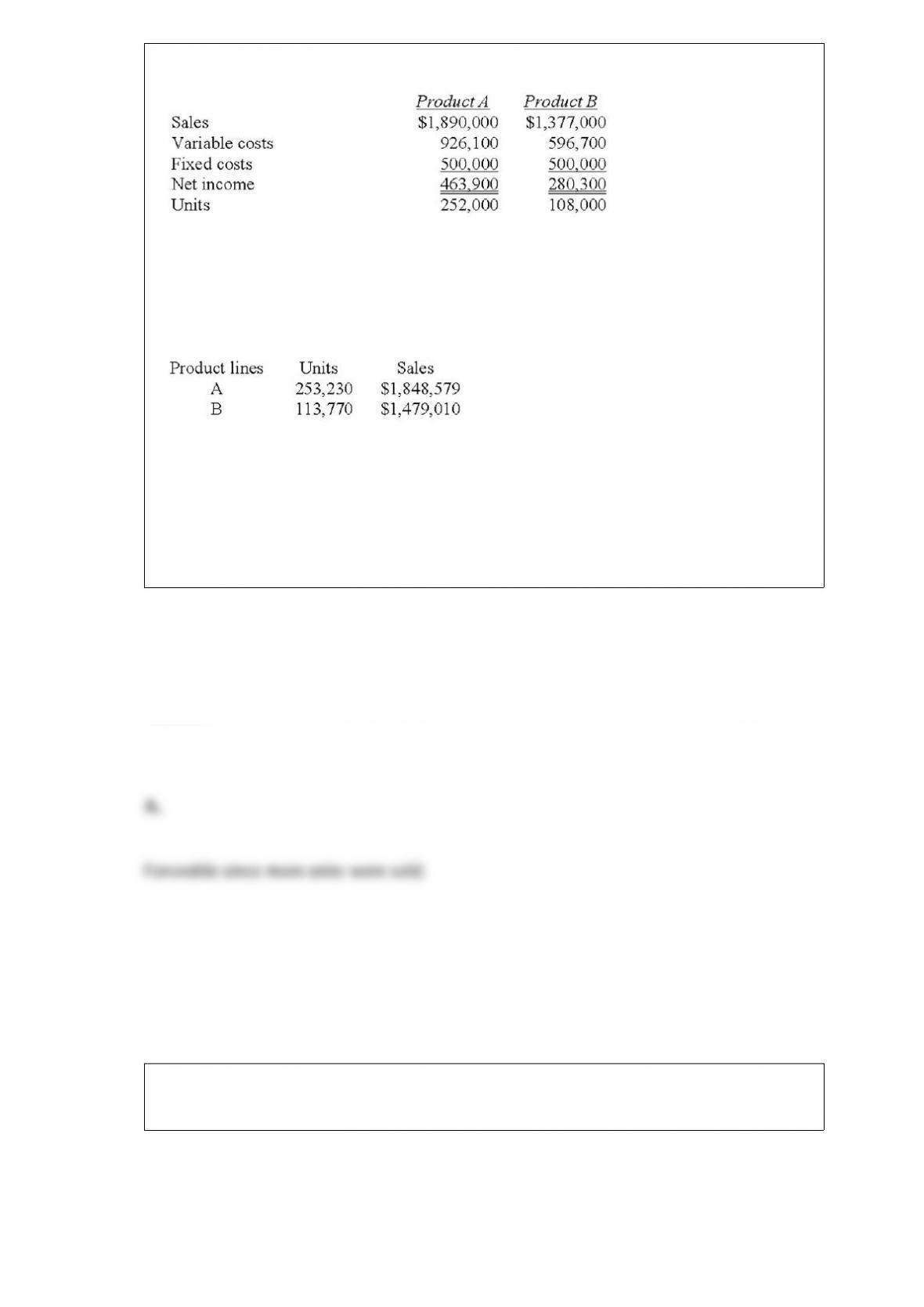
At the end of the year, the total fixed costs and the variable costs per unit were exactly
as budgeted, but the following units per product line were sold. Green analyzes the
effects its sales variances have on the profitability of the company.
​Is the total sales quantity variance favorable or unfavorable?
A. favorable
B. unfavorable
Answer:
Explain the differences between resources used, resources supplied, and unused
resource capacity.
Answer:
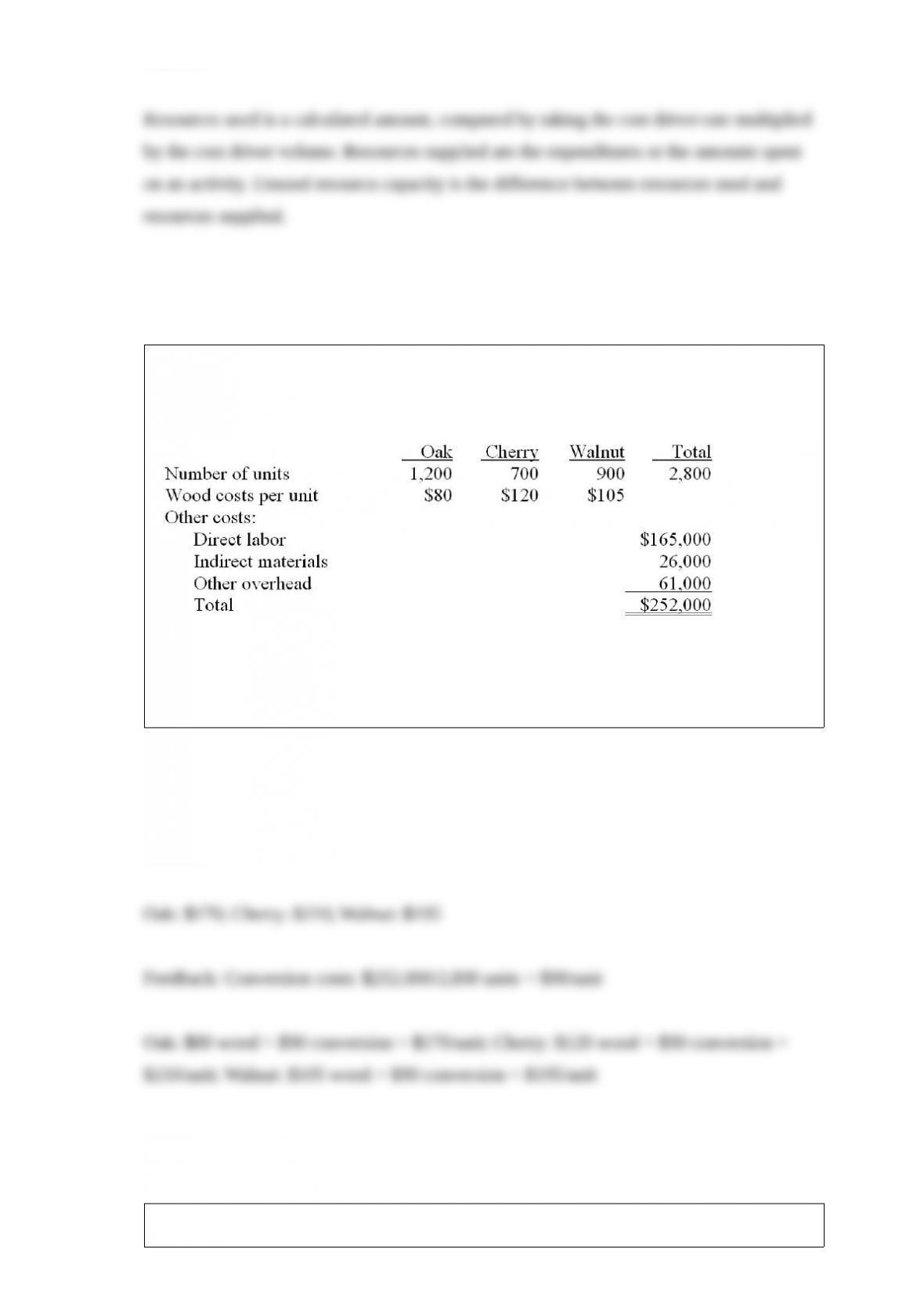
Owen Furniture manufactures three models of tables: oak, cherry and walnut. All
models are assembled in the same plant and require the same assembling operations.
The difference is in the cost of the wood. The following data are available for July.
Owen uses operations costing and assigns conversion costs on the number of tables
built.
Required: Compute the cost of the each of the three models for July.
Answer:
Describe the four steps that are taken in an activity analysis.
Answer:
Describe five advantages of decentralization.
Answer:
Explain two reasons why splitting production costs into price and efficiency variances
is beneficial for management control.
Answer:
Why is the time period so important for the definition of fixed costs?
Answer:
The owner of a small retail business asks, “Why do I need cost accountants? My CPA
produces financial statements, which are sufficient for me to discover my costs. Look at
my Income Statement. I expect sales to increase by 10% next year, so I am planning on
a 10% increase in profits. I don’t need a cost accountant to tell me that.”
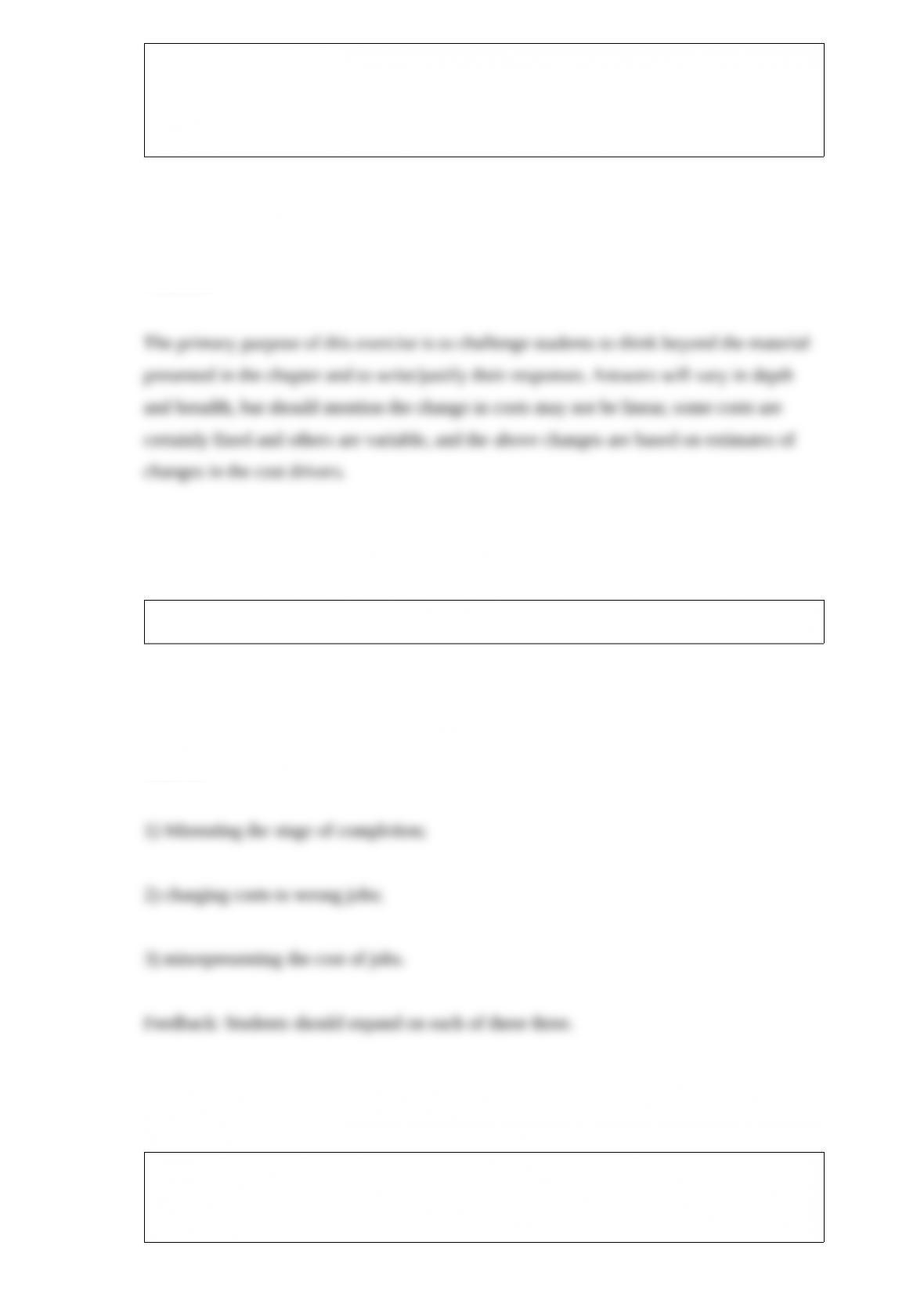
Required: Use your knowledge of the concept of differential costs and explain why a
cost accountant would question the conclusion that a 10% increase in sales would yield
a 10% increase in profit.
Answer:
Describe three possible unethical actions that can cause impropriety in job costing.
Answer:
The Rush Company manufactures two products: L and M. The costs and revenues are
as follows:
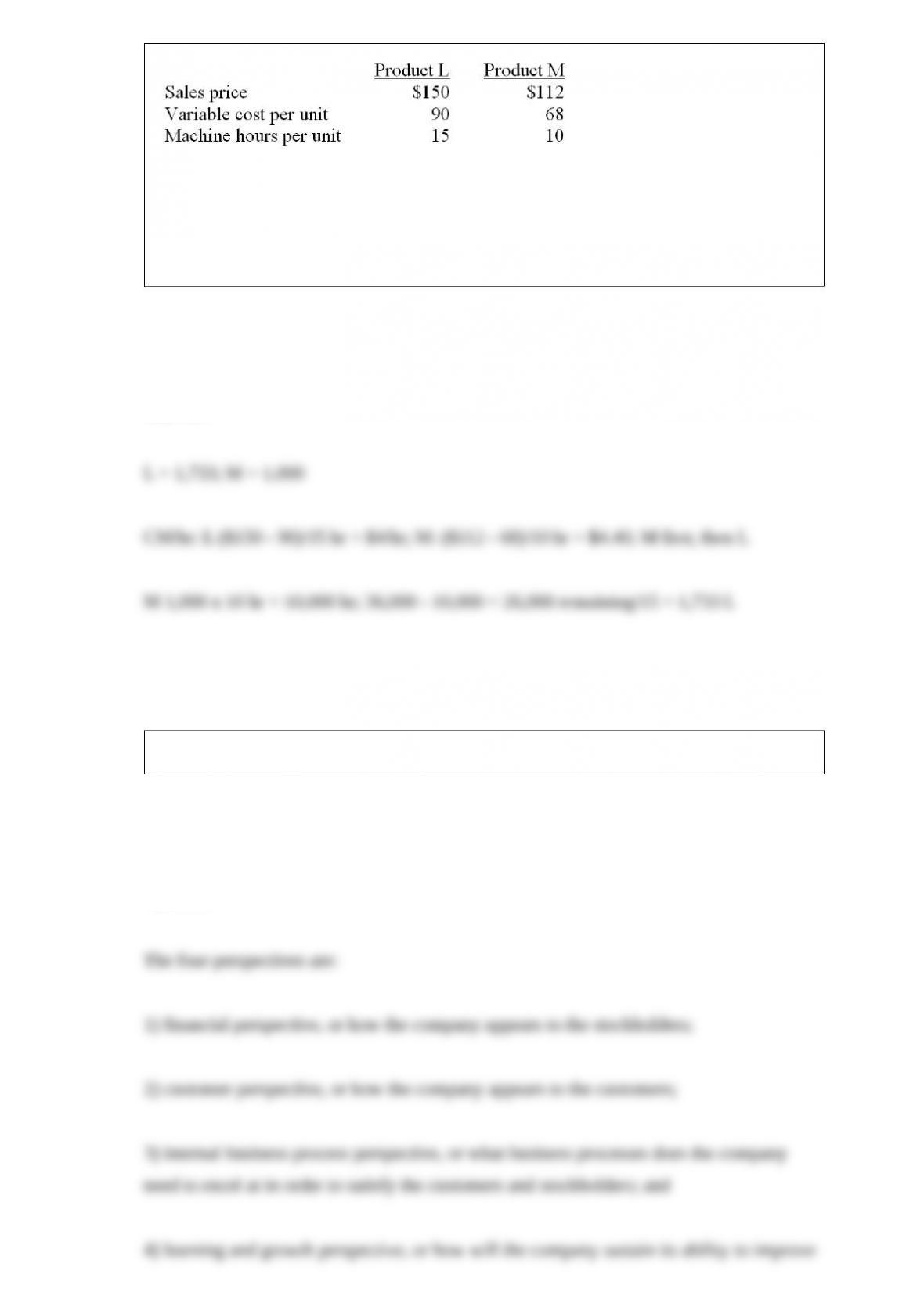
Total demand for Product L is 2,000 units and for Product M is 1,000 units. Machine
time is a scarce resource. During the year, 36,000 machine hours are available.
How many units of Products L and M should Rush produce?
Answer:
Describe the four common perspectives that are used in the balanced scorecard.
Answer:
Describe the four types of quality costs and give an example of each.
Answer:
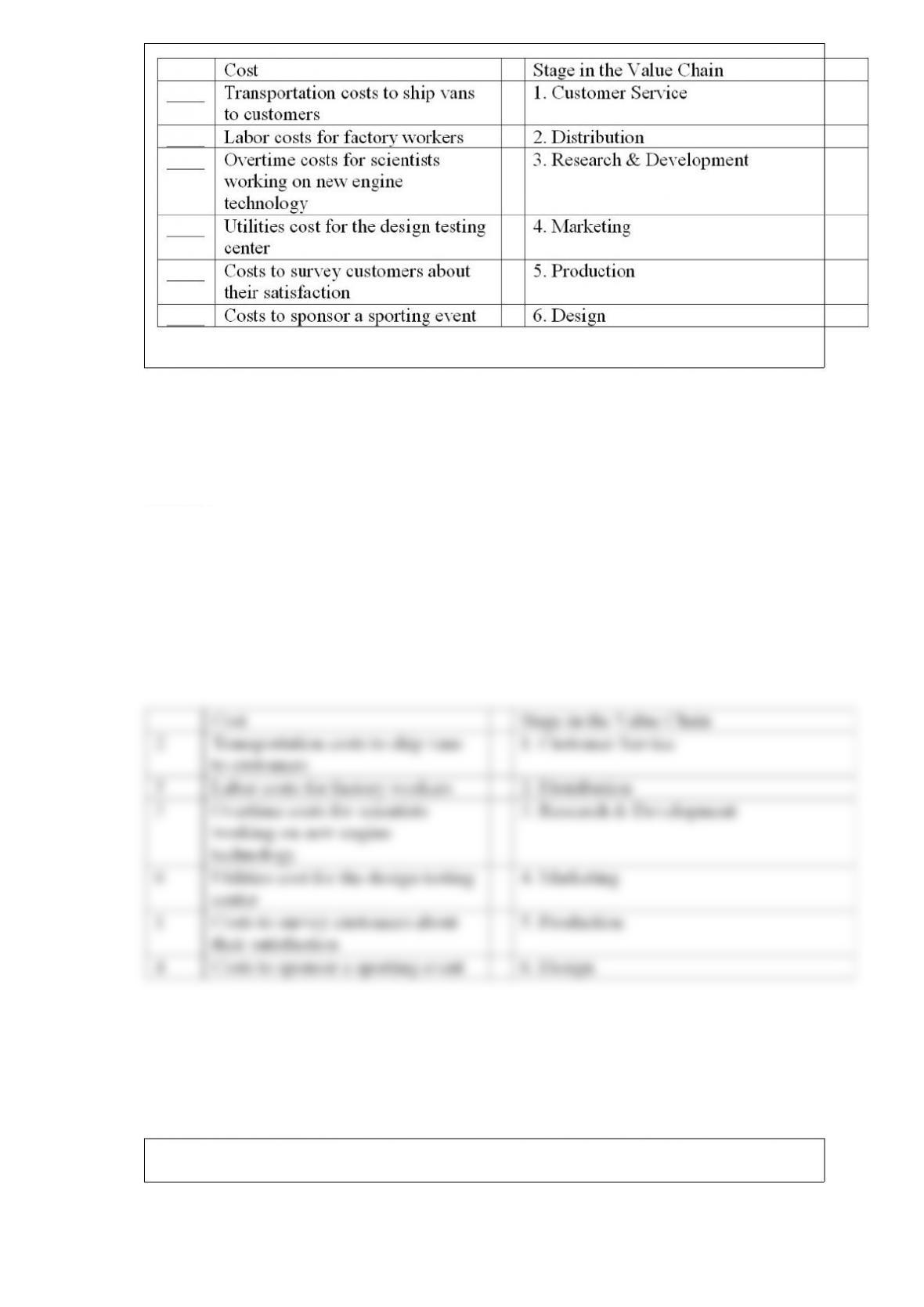
Honda incurs many types of costs in its operations.
Required: For each cost in the following table, identify the stage in the value chain
where the cost is incurred.
Answer:
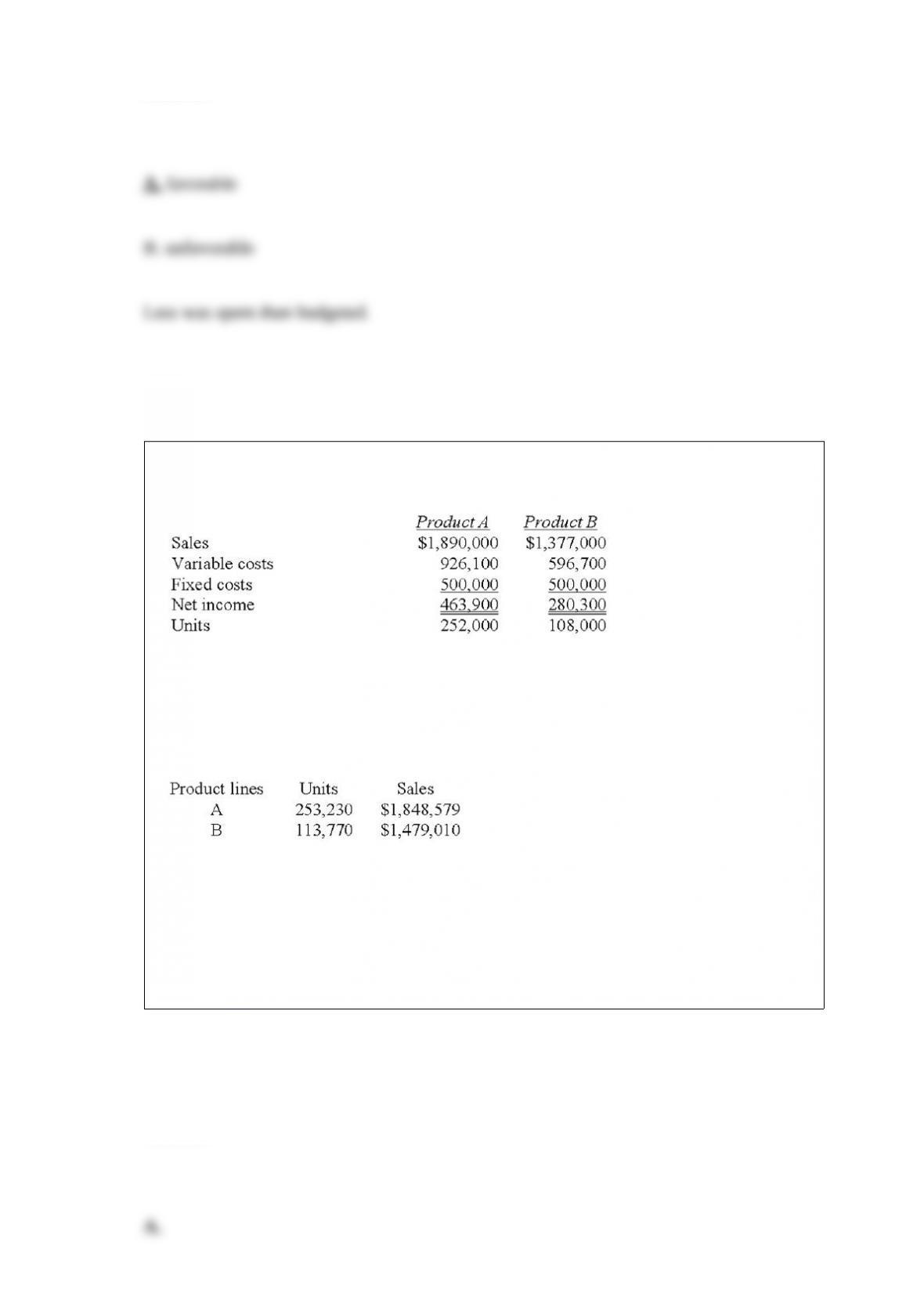
Is the activity variance for the variable manufacturing costs favorable or unfavorable?
Answer:
The next year’s budget for Green, Inc., a multi-product company, is given below:
At the end of the year, the total fixed costs and the variable costs per unit were exactly
as budgeted, but the following units per product line were sold. Green analyzes the
effects its sales variances have on the profitability of the company.
​Is the total sales mix variance favorable or unfavorable?
A. favorable.
B. unfavorable.
Answer:
Describe the difference between normal costing, actual costing, and standard costing.
Answer:
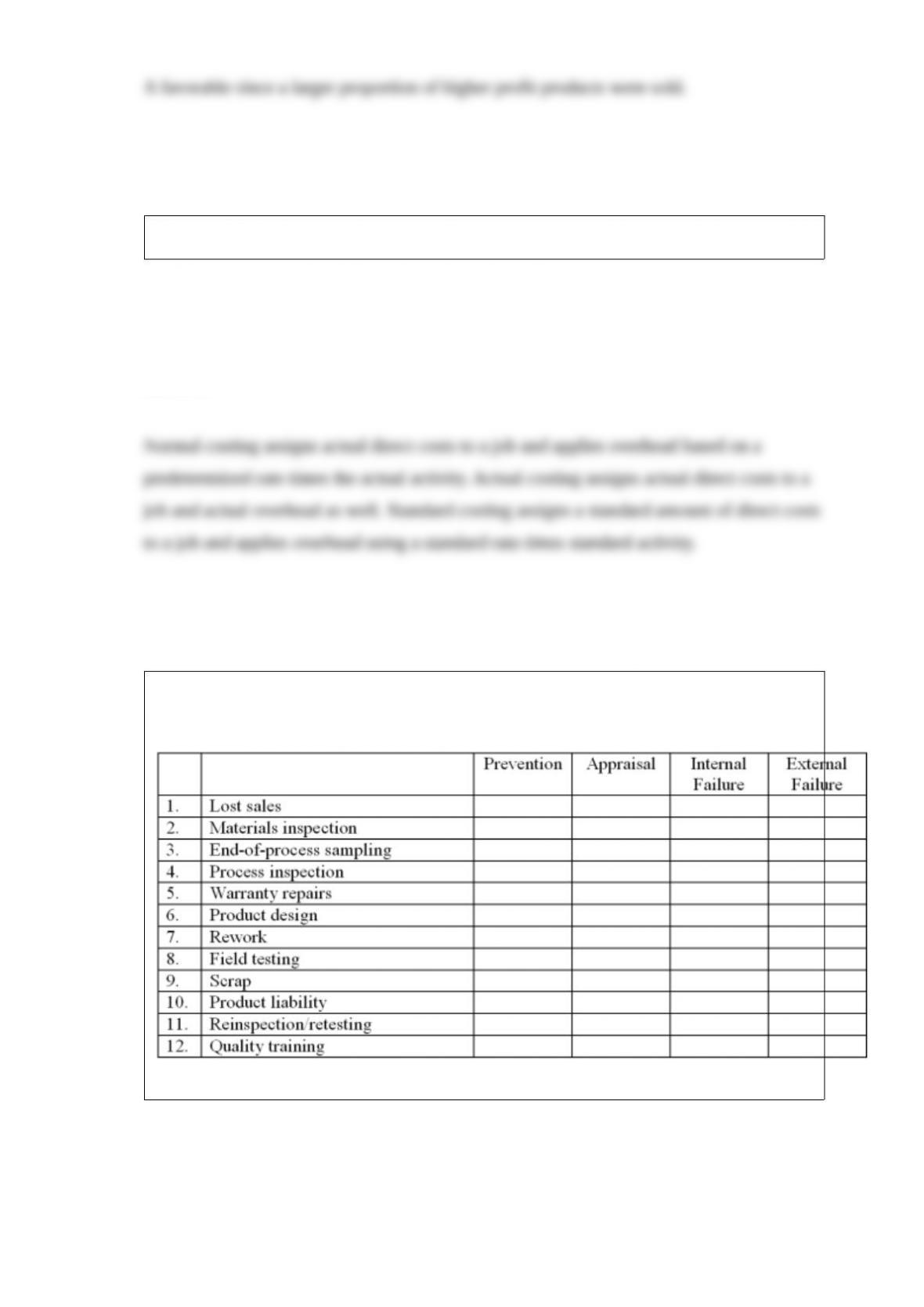
Categorize each of the following quality activities by placing an X in the appropriate
column.
Answer:
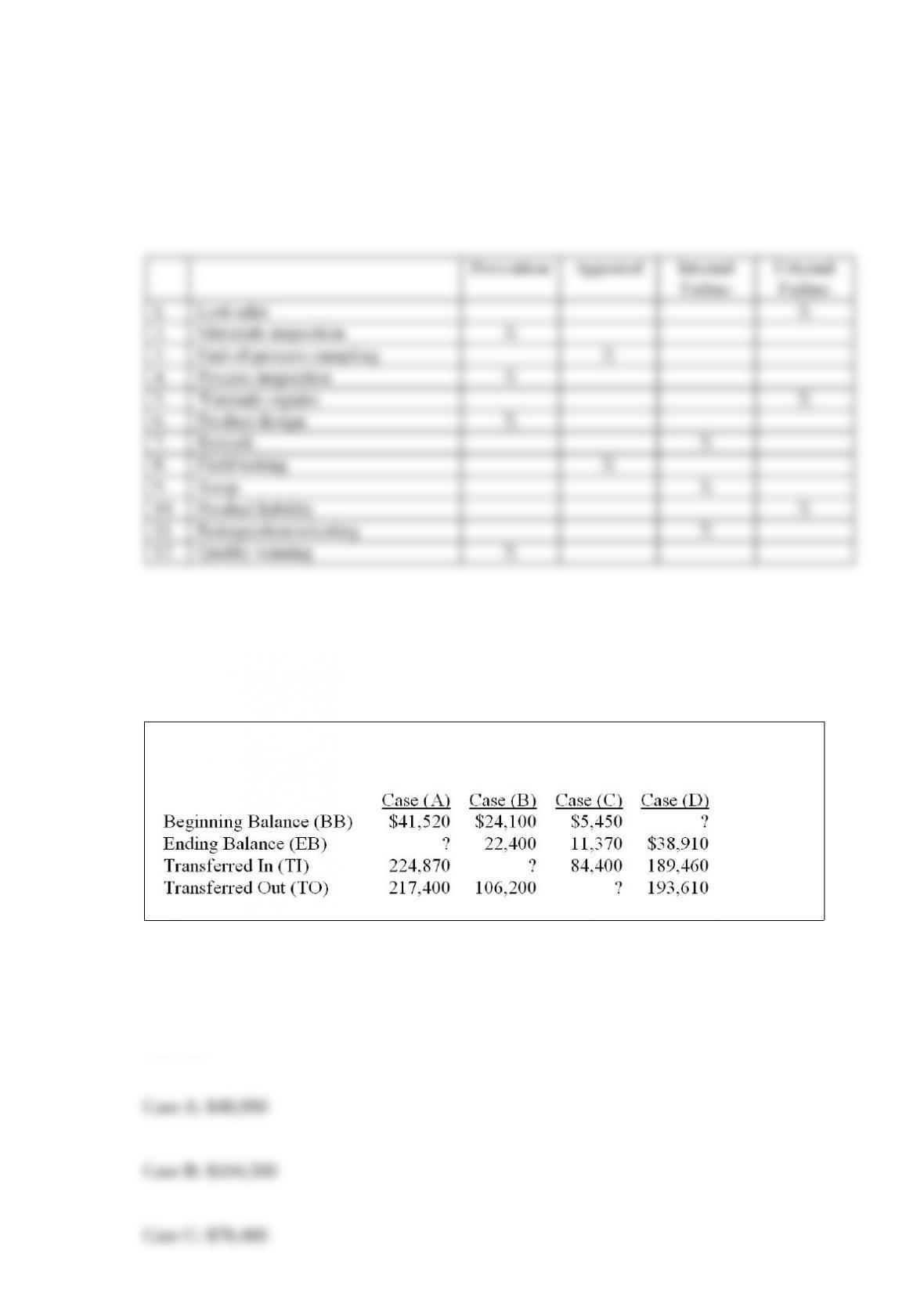
Determine the missing values from the table below:
Answer: