After net income has been determined, it is then transferred to:
A. the balance sheet.
B. the income statement.
C. the statement of cash flows.
D. the statement of retained earnings.
Answer:
In its most basic form, the earnings per share ratio is calculated as:
A. dividends paid on common stock divided by the average number of outstanding
common shares.
B. net income divided by the average number of outstanding common shares.
C. total dividends paid divided by the average number of total stock shares.
D. net income divided by average stockholders’ equity.
Answer:
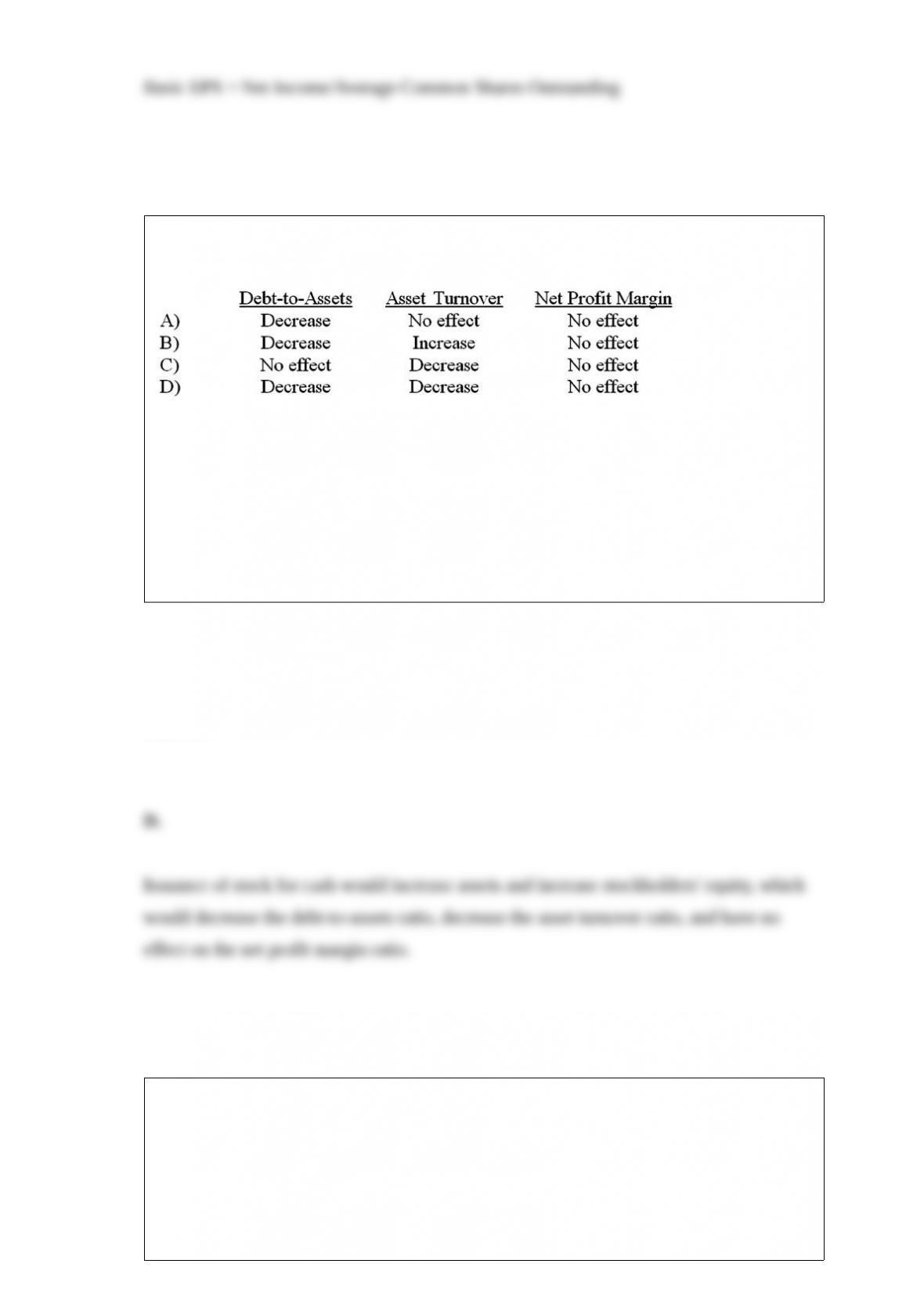
Which of the following accurately describes how the issuance of additional shares of
stock for cash would affect the ratios indicated?
A. Option A
B. Option B
C. Option C
D. Option D
Answer:
West Corporation issued a $1,000 gift certificate. What journal entry will West
Corporation record?
A. Debit Cash, credit Sales Revenue.
B. Debit Cash, credit Unearned Revenue.
C. Debit Unearned Revenue, credit Cash.
D. Debit Accounts Receivable, credit Cash.
Answer:
If total debits are not equal to total credits in an adjusted trial balance, which of the
following errors may have occurred?
A. Posting Wage Expense to Administrative Expenses.
B. Debiting Interest Payable instead of debiting Interest Expense.
C. Recording a transaction twice.
D. Posting a credit to Wages Payable as a debit.
Answer:

Match the acronym with the description that best reflects it. (There are more
descriptions than acronyms.)
_____ 1/ SEC
_____ 2/ GAAP
_____ 3/ PCAOB
_____ 4/ FASB
_____ 5/ IASB
_____ 6/ SOX
_____ 7/ AICPA
A. The international society that reviews comparative accounting practices around the
world.
B. Created in 1933, this organization regulates activities associated with the stock
market such as the reporting of financial data by publicly owned companies.
C. The U.S. agency that must approve mergers between very large publicly owned
corporations.
D. The national professional organization of accountants.
E. A set of laws established to strengthen corporate reporting in the U.S.
F. The U.S. board that approves the rules for auditing publicly owned companies.
G. The rules of accounting in the U.S.
H. The organization that establishes business laws in the U.S.
I. The U.S. agency that certifies foreign accounting firms to practice in the US.
J. The board that establishes the accounting rules that govern American publicly owned
corporations.
Answer:
A company issued $100,000 5-year, 7% bonds and received $101,137 in cash. The
market rate of interest when the bonds were issued was 6.5%. What is the amount of
interest expense to be recorded for the first annual interest period if the company uses
the effective-interest method of amortization?
A. $6,573.91
B. $7,000.00
C. $6,500.00
D. $7,079.59
Answer:
Which of the following is a liquidity ratio?
A. Inventory turnover.
B. Price earnings (P/E).
C. Net profit margin.
D. Times interest earned.
Answer:
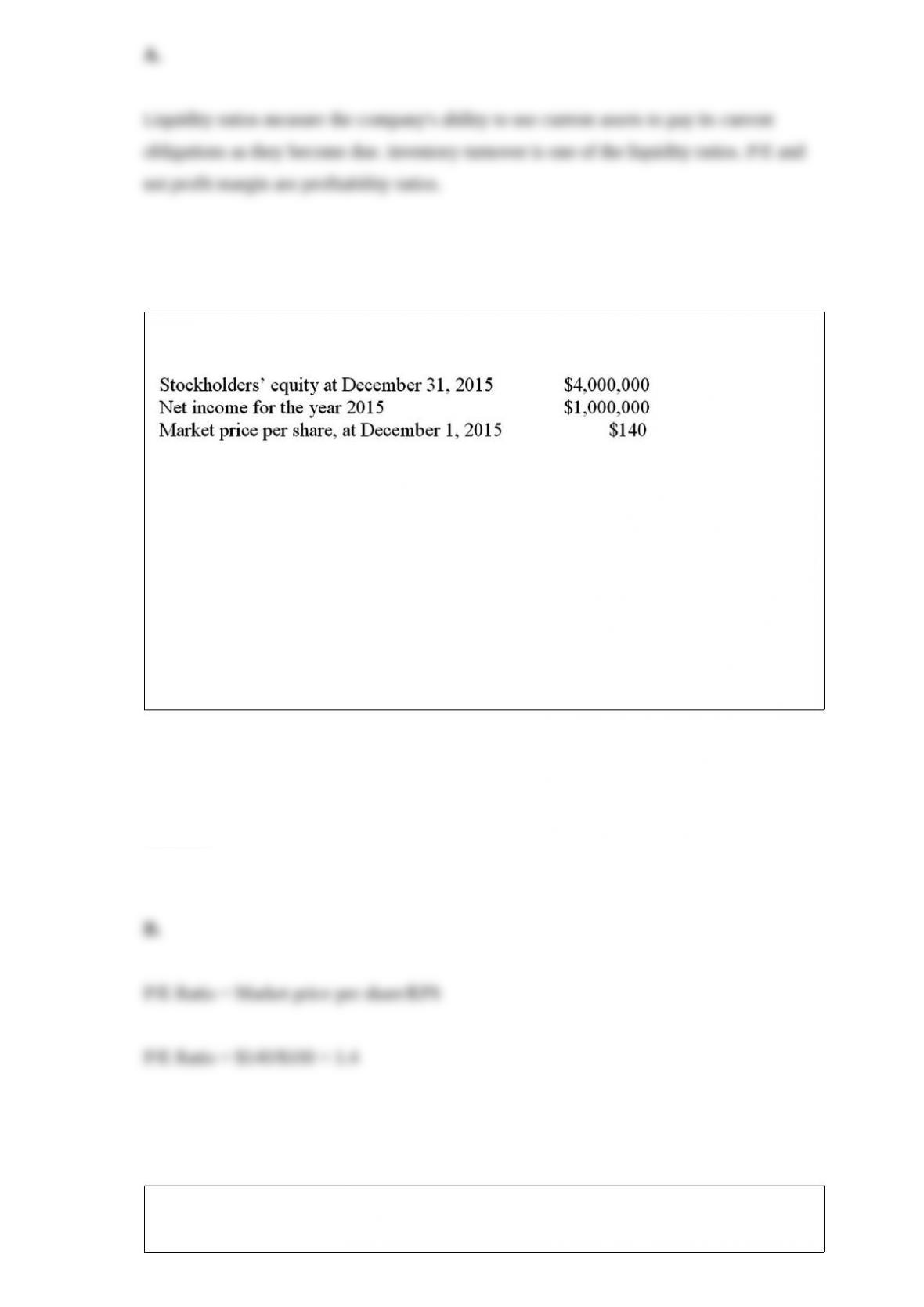
On December 31, 2014 and 2015, a company had 10,000 shares of common stock
outstanding. The following information is also available:
Use the information above to answer the following question. The price/earnings ratio at
December 31, 2015 is closest to:
A. 0.35.
B. 1.40.
C. 0.28.
D. 3.50.
Answer:
Use the information above to answer the following question. What is the amount of
cash paid for insurance?
A. $13,000
B. $12,000
C. $14,000
D. $16,000
Answer:
Each item in the statement of retained earnings can appear on another financial
statement. Match the letter of the financial statement with the item in the statement of
retained earnings.
A. Balance sheet at end of 2013
B. Statement of cash flows for 2013
C. Income statement for 2012
D. Balance sheet at end of 2012
E. Income statement for 2013
____ 1/ Retained earnings, January 1, 2013
____ 2/ Net income for 2013
____ 3/ Dividends for 2013
____ 4/ Retained earnings, December 31, 2013
Answer:
The sales revenue account has a credit balance of $367,200 at year end. After Closing
entries are made, the account will:
A. have a debit balance of $367,200.
B. have a zero balance.
C. still have a credit balance of $367,200.
D. be removed entirely from the general ledger.
Answer:
Calculate the missing value using the appropriate financial statement ratio.
A. Total liabilities are $1,055,880, while total assets are $1,257,000. Calculate the
debt-to-assets ratio.
B. The asset turnover ratio is 1.4, while sales revenue is $42,000. Assets at the
beginning of the accounting period were $25,000. Calculate assets at the end of the
accounting period.
C. The net profit margin ratio is 12% and sales revenue is $400,000. Calculate the net
income.
D. The debt-to-assets ratio is 61% and assets are $150,000. Calculate total liabilities.
E. The net profit margin ratio is 0.128 and net income is $160,000. Calculate sales
revenue.
F. Refer to the information in part E. Sales revenue increase by $250,000 and expenses
increase by $150,000. Calculate the new net profit margin ratio.
G. The asset turnover rate is 0.86 and the company invests $485,000 in new equipment
and facilities. Assume that the turnover rate remains the same. Determine the increase
in sales revenue.
Answer:
Companies are concerned about the cost of extending credit for all the following
reasons except:
A. the time delay in receiving payment.
B. the expense of the extra goods that must be produced or bought.
C. the risk of nonpayment.
D. the administrative costs associated with extending credit.
Answer:
Use the information above to answer the following question. What is the total amount
of interest on this note?
A. $900
B. $450
C. $0
D. $2,700
Answer:

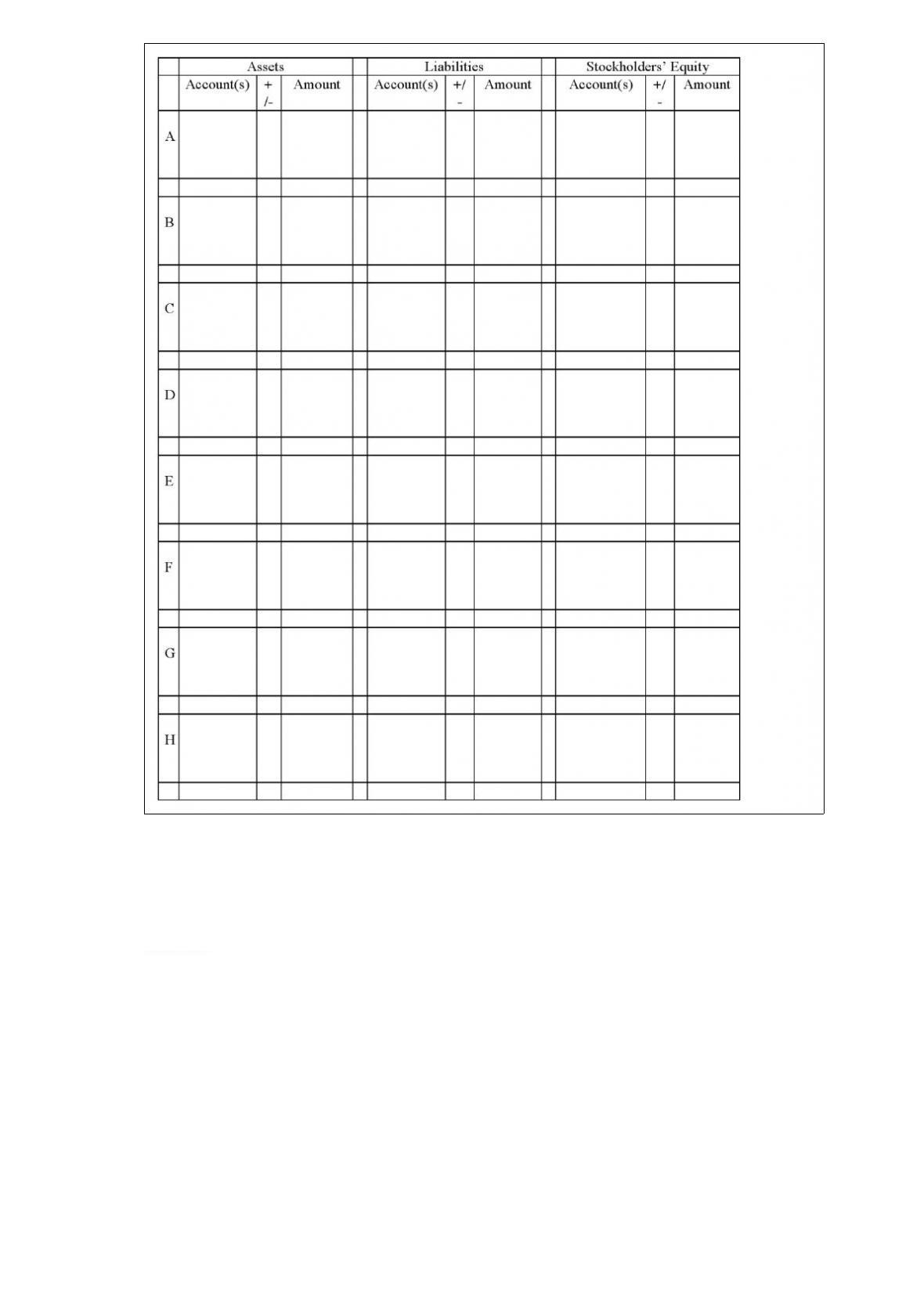
Analyze the events listed below by indicating the accounts and amounts involved in the
table below. In the column labeled “+/-“, select the sign that describes how the category
is affected. If the event should not to be recorded as a transaction, state so.
A. Borrowed $7,000,000 cash, signing a promissory note.
B. Bought a factory for $800,000, paying $200,000 in cash and signing a promissory
note for $600,000.
C. Rented equipment and issued a check for 6 months at $10,000 a month.
D. Provided $104,000 of services and billed customers.
E. Purchased $30,000 of supplies on account.
F. Received a utility bill for the current period in the amount of $1,200.
G. Raised sales prices on 200 units from $400 per unit to $440 per unit.
H. Received a 50% deposit from a customer on a $20,000 order to be filled next month.
Answer:
The unit of measure assumption means that:
A. all multinational companies use the U.S. dollar in transacting business.
B. all multinational companies prepare financial reports in U.S. dollars.
C. a multinational company based in the U.S. will translate any transactions in foreign
currency to U.S. dollars.
D. IFRS requires all multinational companies to translate transactions in various
currencies to U.S. dollars.
Answer:
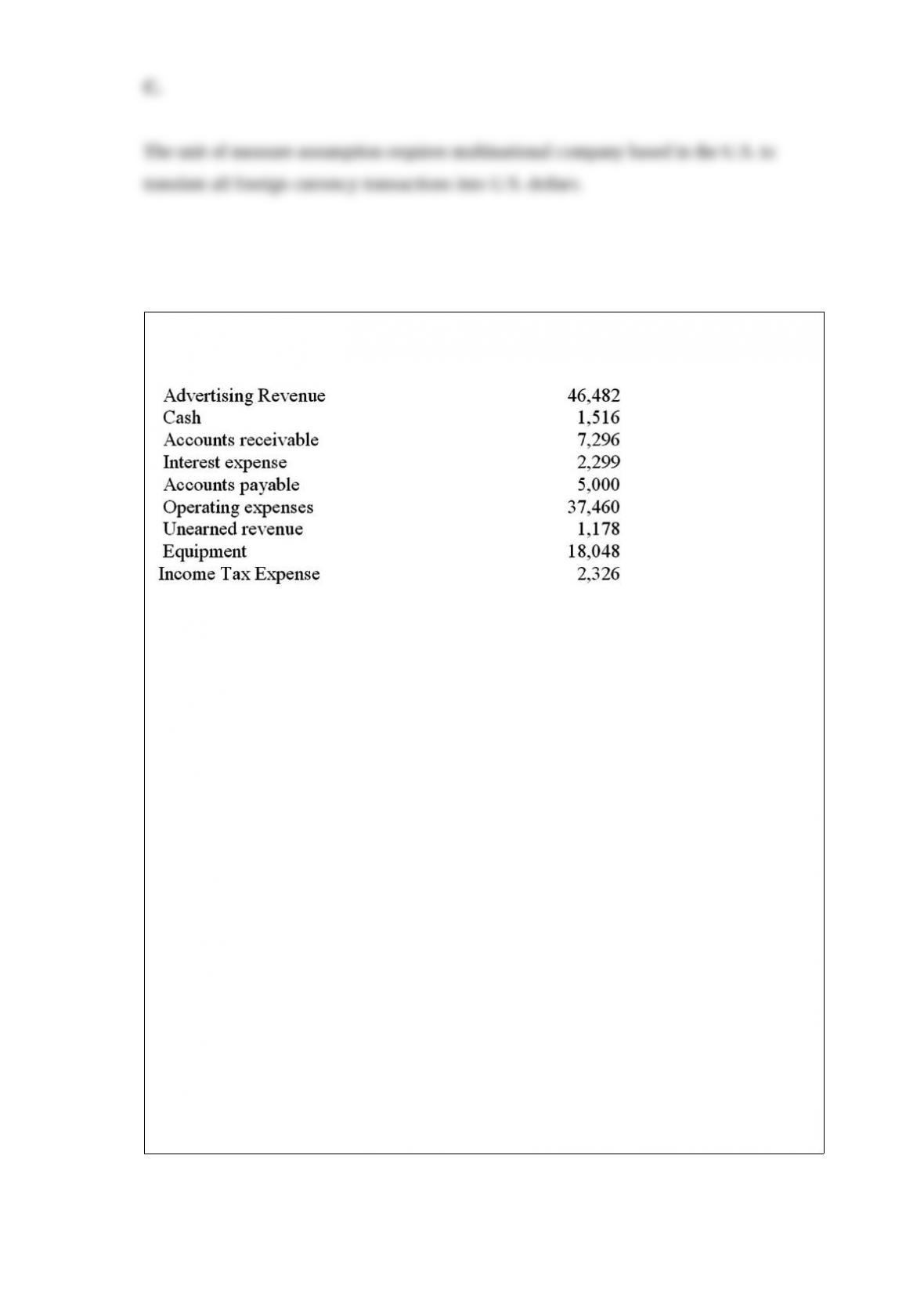
The following accounts are taken from the December 31, 2013, financial statements of
A to Z Advertising Company:
The following activities occurred in 2014:
1. Billed customers for advertising services rendered, $55,000.
2. Received cash from customers in payment of their accounts, $10,400.
3. Incurred $45,000 of operating expenses of which $39,000 was paid in cash and
$6,000 was on account and unpaid as of the end of the year.
4. Paid suppliers $5,000 on the accounts payable.
5. Received deposits from customers of $2,500 for advertising services to be performed
in 2015.
The income statement for the year ended December 31, 2014 will show
A. Total Revenue of $57,500.
B. Total Expenses of $39,000.
C. Total Revenue of $55,000.
D. Total Expenses of $50,000.
Answer:
Typically, a profitable company that pays little or no dividends:
A. is a bad investment.
B. will reinvest profits which can lead to greater growth potential.
C. will experience relatively stable stock prices over time.
D. will appeal to investors who desire distributions of profit.
Answer:
Which of the following bank reconciliation items would not result in an adjusting
journal entry in the company’s books?
A. Service charge.
B. Outstanding checks.
C. A customer’s check returned NSF.
D. Interest earned on deposits.
Answer:
The gross profit equation is:
A. (Sales + Sales returns & allowances) – Cost of goods sold = Gross profit
B. (Sales + Sales discounts) – Cost of goods sold = Gross profit
C. (Sales – Sales returns & allowances – Sales discounts) – Cost of goods sold = Gross
profit
D. (Sales – Sales returns & allowances – Sales discounts) + Cost of goods sold = Gross
profit
Answer:
Which of the following represent cash outflows from financing activities?
A. Distributing a stock dividend.
B. Paying a bond’s face value at maturity.
C. Issuing long-term bonds at a discount.
D. Paying interest on promissory notes.
Answer:
If a company’s P/E ratio is 24 and the company’s EPS is $1.50, then the company’s
stock price is:
A. $36.00.
B. $25.50.
C. $16.00.
D. $6.25.
Answer:
Bolster Soda had an accounts receivable turnover ratio of 9.9 this year and 11.0 last
year. Castor Soda had a turnover ratio of 9.3 this year and 9.3 last year. This implies
A. Castor had a better receivables turnover than Bolster did for both years.
B. Bolster had a better receivables turnover than Castor did for both years.
C. Castor has credit policies that need to be tightened.
D. Castor collected receivables more quickly than Bolster in both years.
Answer:
A company has the following paid-in capital:
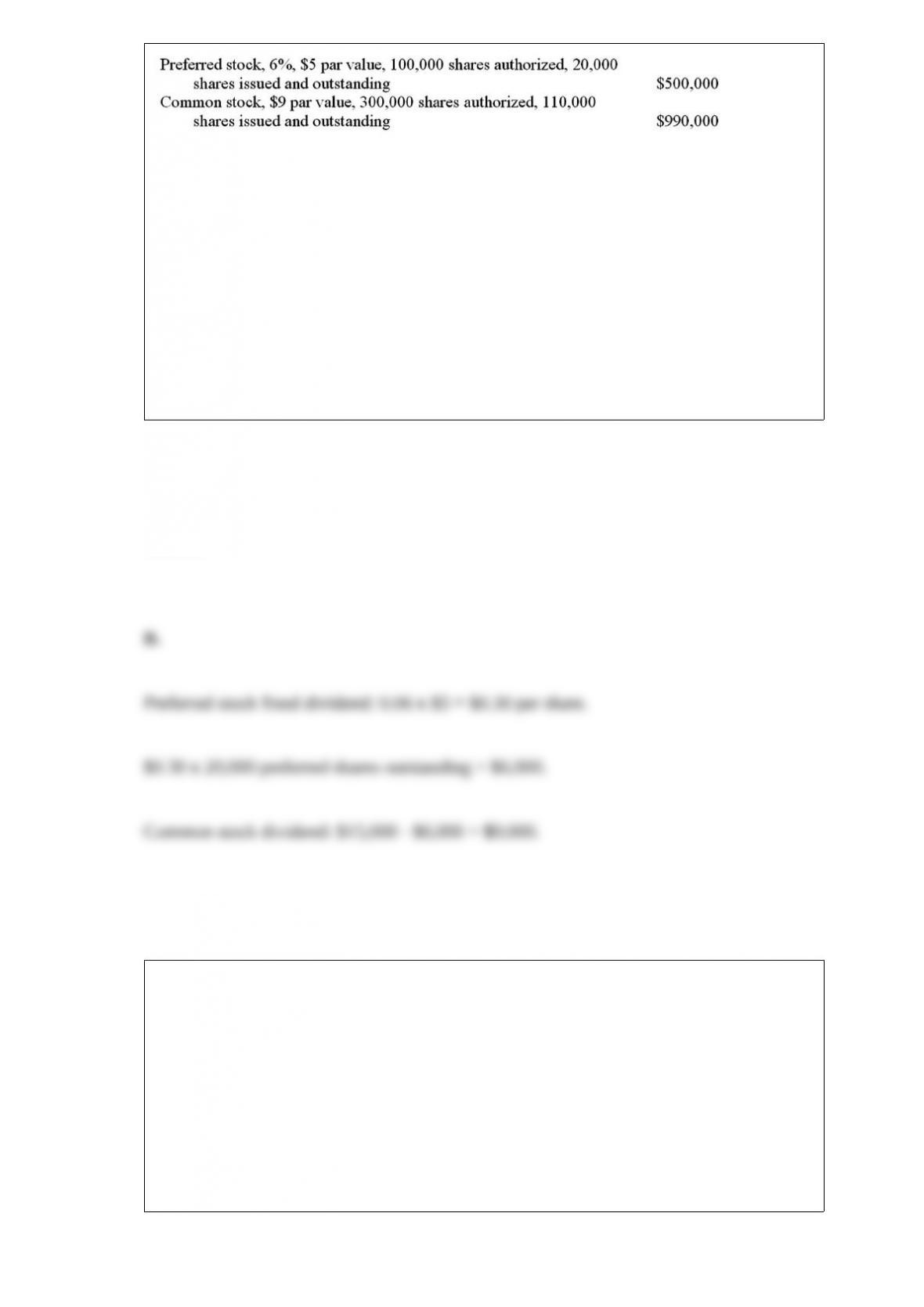
Use the information above to answer the following question. If the company pays a
$15,000 dividend, and the preferred stock is noncumulative, what is the amount the
common stockholders will receive?
A. $15,000
B. $9,000
C. $9,900
D. $0
Answer:
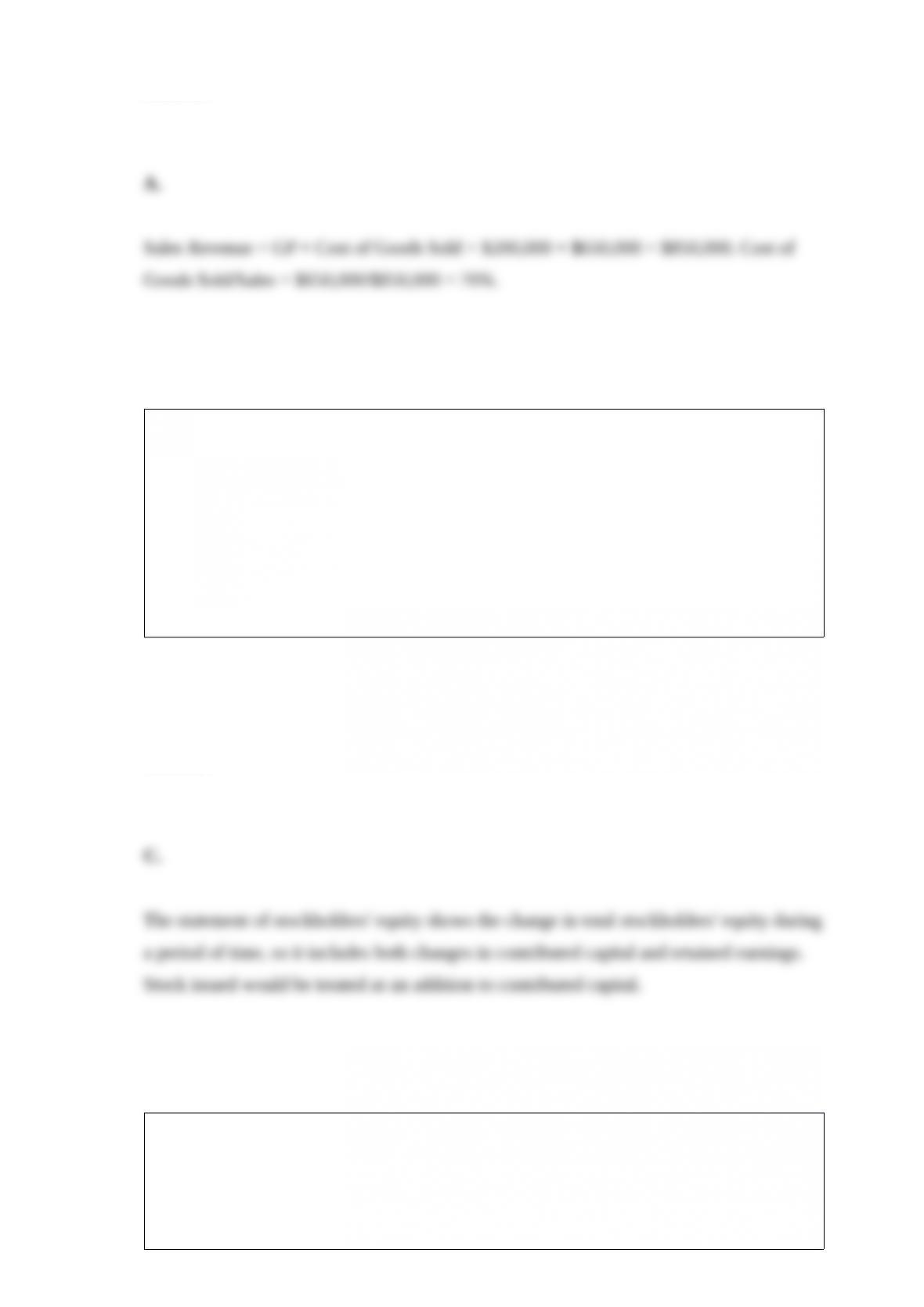
On a common size income statement for this year, what is the percentage that would be
shown for cost of goods sold?
A. 76%
B. 24%
C. 31%
D. 18%
Answer:
The Statement of stockholders’ equity
A. shows only the changes in retained earnings for the period.
B. includes a deduction for stock issued.
C. includes changes in contributed capital for the period.
D. shows only the changes in contributed capital for the period.
Answer:
A company borrows $2 million from its bank. It then uses this money to buy equipment.
How does this transaction affect the accounting equation?
A. Assets and Liabilities both rise $2 million.
B. Assets increase by $2 million and Liabilities decrease by $2 million.
C. Assets decrease by $2 million and Liabilities increase by $2 million.
D. Assets remain unchanged and Liabilities increase by $2 million.
Answer:
When auditors conclude that a company’s financial statements conform to GAAP, the
audit report is said to be:
A. validated.
B. qualified.
C. relevant.
D. unqualified.
Answer:
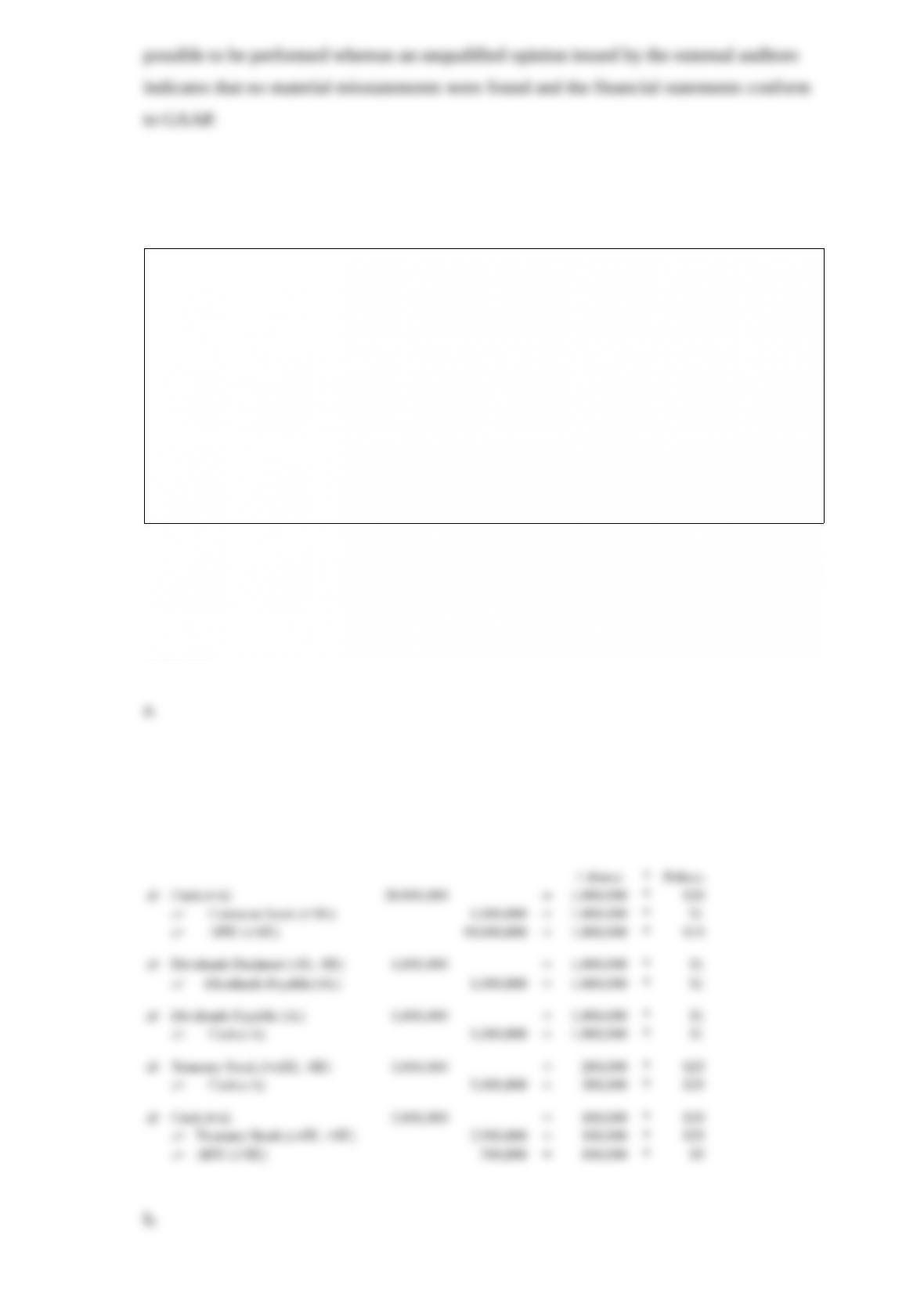
Horton Company began business on January 1, 2014 by issuing all of its 1,000,000
authorized shares of its $1 par value common stock for $20 per share. On June 30, they
declared a cash dividend of $1 per share to stockholders of record on July 31. They paid
the cash dividend on August 30. On November 1, Horton reacquired 200,000 of its own
shares of stock for $25 per share. On December 22 they resold half of these shares for
$30 per share.
a. Prepare all of the necessary journal entries to record the events described above.
b. Prepare the stockholders’ equity section of the balance sheet as of 12/31/2014
assuming that the net income for the year was $3,000,000.
Answer:
Which of the following would overstate a company’s net income?
A. Counting shipments of customers’ orders as revenue before payment has been
received.
B. Shipping goods to customers without receiving orders from those customers, and
recording the transactions as revenue.
C. Accruing liabilities for marketing expenses before they are incurred.
D. Making an accrual adjusting entry for interest earned on a bond investment.
Answer:
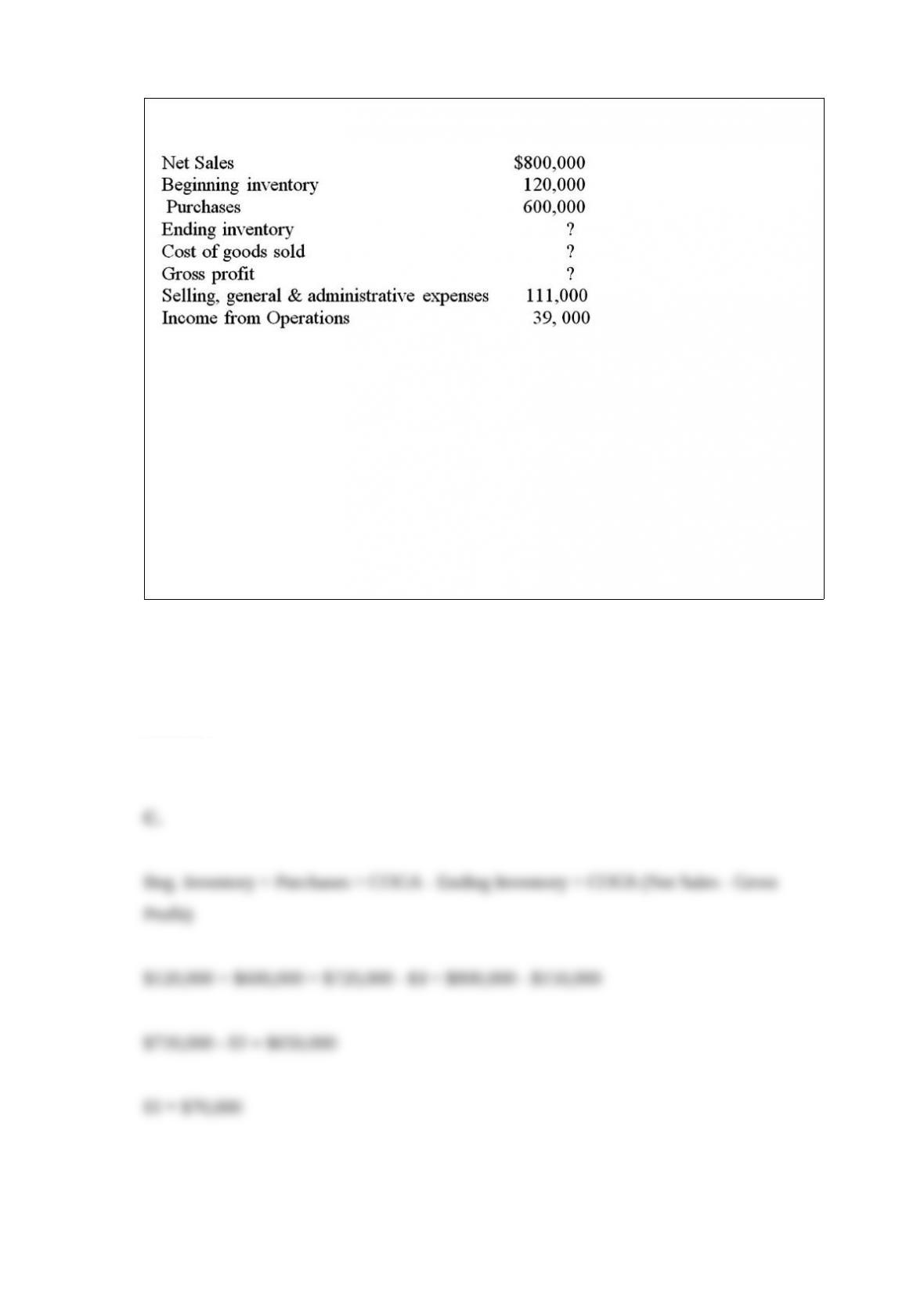
Use the information above to answer the following question. What is the amount of
ending inventory?
A. $720,000
B. $150,000
C. $70,000
D. $650,000
Answer: