
PA is working on the audit of a publicly held corporation. At what level will the auditor
likely set audit risk?
A) low
B) medium
C) high
D) very high
As part of audit planning, you have calculated accounts receivable turnover for the last
five years, and compared it to industry averages. Your client’s accounts receivable has
decreased by about 1.25 times in the current year, while the industry rate has improved.
One possible cause of this lowered accounts receivable turnover is
A) higher cost of goods sold.
B) increased bad debt expenses.
C) fictitious revenue.
D) fictitious expenses.
Which of the following internal controls would help ensure that existing payroll
transactions are recorded?

A) Time records are approved by supervisors
B) Time clock is used to record time
C) Independent preparation of payroll bank reconciliation
D) Comparison of payroll master file totals with general ledger control account
An audit procedure that is part of the audit of notes payable is the review of the
permanent audit working paper files to determine if there are restrictions on the
payment of dividends in bond indenture agreements or preferred share provisions.
Which presentation and disclosure audit assertion is this associated with?
A) valuation
B) completeness
C) existence
D) classification
There are three main types of revenue manipulations. Which of the following revenue
manipulations affects the occurrence objective?
A) recording subsequent period sales as current period sales
B) the use of “bill and holds” (goods are invoiced but not shipped)

C) understatement of bad debts
D) creation of fictitious sales that are misclassified as revenue
If inventory is the largest balance on the financial statements, a large misstatement
would be so material that the auditor should issue
A) an unqualified opinion.
B) a qualified opinion.
C) an adverse opinion.
D) a disclaimer of opinion.
Kumar is the internal auditor of Tarragon Inc. Kumar wants to put procedures in place
in order to prevent misstatements in owners’ equity and ensure proper record keeping.
Kumar suggested that management implements well-defined policies for preparing
stock certificates and recording capital stock transaction. What else should Kumar
recommend?
A) Independent internal verification of information in the records
B) Having all journal entries in the equity account reviewed by the controller
C) Perform a monthly reconciliation of shareholder’s equity

D) Reconcile the dividend payments with the bank statement
What is the size of most public accounting firms in Canada?
A) fewer than 25 employees
B) between 25 and 49 employees
C) between 50 and 75 employees
D) more than 75 employees
XYZ Brick Company decided to inflate sales by recording fictitious sales. Several
non-existent clients were created and the sales were added into the sales journal
throughout the year. The general transaction-related audit objective affected by these
actions is
A) occurrence.
B) completeness.
C) accuracy.
D) posting and summarization.

A document that describes which accounts receivable accounts are to be written off and
why is called a(n)
A) uncollectible account authorization form.
B) journal entry authorization form.
C) master file change form.
D) sales returns and allowances journal.
Communicating the findings of the audit in accordance with the CASs is a requirement
of which category of generally accepted auditing standard?
A) General
B) Examination
C) Reporting
D) Quality

Which portions of the code of professional conduct are enforceable?
A) Principles and rules
B) The rules of conduct
C) Interpretations
D) Rules and interpretations
Following are situations that an auditor might find by means of tests of controls or tests
of details of cash balances for a company with a December year end.
A) The accountant did not record or deposit a cash receipt for $50,000 that was received
on December 28. Cash is prelisted by the receptionist.
B) Cheques prepared up to January 6 were dated December 31 and recorded in the cash
disbursements journal.
C) A cheque was issued for office supplies that were never received by the client.
Required:
List a substantive audit procedure that could uncover each of the preceding situations.

The fact that a client has a material accounting departure for failure to follow ASPE
would require the accountant to disclose that fact in a separate reservation paragraph,
when the accountant is performing
A) a compilation.
B) a review and an audit.
C) either a compilation or a review.
D) neither a compilation nor a review, only an audit.
The existence of advanced automated systems affects the audit process. Which of the
following characteristics is an indicator of the presence of an advanced automated
information system?
A) electronic data interchange systems for purchase orders, sales invoices and payments
B) use of packaged software to process sales both locally and across Canada
C) use of customer relationship management systems to manage sales information
D) numerically-controlled equipment used in the manufacturing process

Fraud risk factors are examples of factors that increase the risk of fraud. Which of the
following is an example of a management “opportunities” risk factor?
A) The company has lost a major account and income is falling.
B) Two major competitors have gone bankrupt as margins decline in the industry.
C) The chief executive officer owns forty percent of the outstanding share capital.
D) New accounting standards provide three different methods for valuing financial
instruments.
Which of the following audit tests is usually the least costly to perform?
A) analytical procedures
B) tests of controls
C) tests of balances
D) confirmations
There are many elements of quality control at the firm level. Which element does
“quality control procedures should be developed, documented, implemented and
communicated” belong to?

A) leadership and responsibilities within the firm
B) general ethical requirements
C) general human resource policies
D) engagement quality control review
An example of judgmental sampling is
A) block sampling.
B) simple random sample selection.
C) systematic sample selection.
D) proportionate-to-size sample selection.
A common inventory observation procedure is to record in the working papers for
subsequent follow-up the last shipping document number used at year-end. The audit
objective being achieved by this procedure is
A) inventory as recorded exists.
B) existing inventory is counted and tagged.

C) information is obtained to make sure sales and inventory purchases are recorded in
the proper period.
D) tags are accounted for to make sure none is missing.
What is the first step that the auditor takes when auditing the valuation of inventory?
A) conduct analytical review, comparing gross margin for the current year to the prior
year
B) do an industry analysis to determine whether there is a potential for
technology-induced obsolescence
C) ask the client about the level of obsolete inventory that was on hand and counted
during the inventory count
D) establish clearly the valuation method used and how the calculations are being
performed
The major balance sheet account in the acquisition and payment cycle is
A) accounts payable.
B) purchases.
C) merchandise inventory.

D) common stock.
If the auditor does not obtain a cut-off statement directly from the bank for testing, an
alternative procedure that the auditor can use is to
A) account for a continuity of cheques that covers the year end.
B) reconcile cash paid to the cash disbursements journal for the last month of the year.
C) reconcile cash received to the cash receipts journal for the last month of the year.
D) prove the bank statement for the period after the year end.
A reason for a not-for-profit organization to be audited is
A) complying with the laws requiring them to be audited.
B) meeting requirements of lenders or funding sources.
C) having a professional accountant perform their bookkeeping.
D) ensuring that their financial statement do not contain errors.

Caroline is performing the audit of the capital acquisition and repayment cycle. She is
currently auditing the payments of interest made during the year. The proper
documentation that Caroline should use as supporting evidence of the payment is
A) a copy of the note.
B) a bank reconciliation.
C) documentation of her inquiries with management.
D) the notes payable sub-ledger.
Winston Chang, PA conducted the audit of Manra Manufacturing Ltd., a small company
that produces a variety of machined parts for the automotive and computer industry.
The audit showed that the company produced a small profit after paying the owners of
the company a high salary. Manra was purchased by a competitor, Cheblay. Cheblay
had hoped to produce efficiencies by combining the two companies and was unable to
do so. Cheblay sued Chang because it relied upon the financial statements when
purchasing the company’s shares, claiming that the machines, which were about fifteen
years old, had been overvalued. The machines were recorded at cost, which was below
net realizable value. What is the auditor’s best defence?
A) contributory negligence
B) absence of negligence
C) duty of care
D) absence of liability

Paul is in the process of performing procedures to obtain the necessary understanding of
the client’s internal controls. As part of this process, Paul received from the client
completed narratives, flowcharts and internal control questionnaires. Paul can use this
information from the client
A) if the entity level controls and tone at the top were found to be effective.
B) if there has not been any significant change in the internal controls since the prior
year.
C) as long as any subsequent reliance on controls is adequately substantiated with
testing.
D) since it was prepared by management who are unbiased.
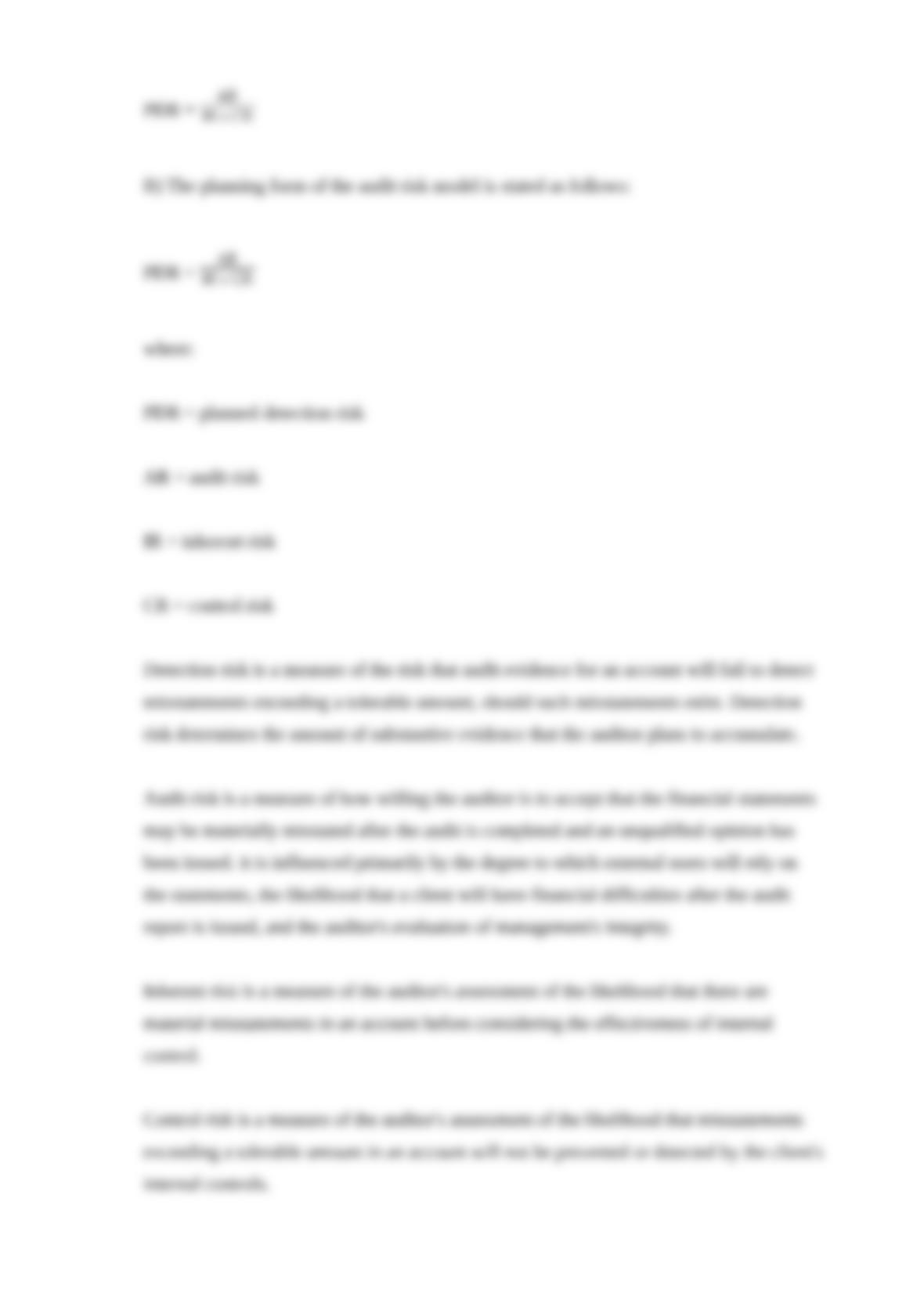
A) Explain how auditors use the audit risk model when planning an audit.
B) Describe the audit risk model and each of its components.

When reading the corporate minutes, the auditor extracted the approved annual salary
for the President, the Chief Executive Officer and other senior executives. What audit
step would the auditor likely conduct with this information?
A) trace the payroll amount to each individual officer’s payroll record
B) check that the payroll has been recorded into the correct bank account
C) verify that payroll cheques have two signatures for all large amounts
D) ensure that all overtime is approved and adequately documented
George had a conversation with the accounting personnel and documented information
about how the accounting systems function. He has also placed copies of accounting
forms in his files. George is performing which task?
A) accounting procedures
B) evidence gathering
C) tax audit
D) audit report preparation
You are the audit senior responsible for a large photofinishing centre and camera store.
The store uses automated cash registers tied to inventory (also known as point of sale
devices). The point of sale devices take advantage of automated procedures and
controls that can be programmed, to reduce errors and improve controls over
completeness of transactions.
Required:
Provide examples of interdependent controls that should be used to complement the
programmed controls.
Describe the purpose of
i) a forecast
ii) a projection, and
iii) prospective financial statements
Identify the reporting standards for compilation engagements.
Discuss the four characteristics of the capital acquisition and repayment cycle that make
it unique from other cycles.
Outline the audit procedures that would be performed when testing electronic receipts
and payments.

Klein Corporation has reported a loss for the 6th year in a row. Klein also has a large
bank loan due in the coming year, bringing its current ratio to .60. Further, due to the
economic crisis, Klein had to increase its bad debt expense by 4% and also saw its
largest client, Forest Prairie filing for bankruptcy. Forest Prairie’s purchases made up
18% of the total sales of Klein in the past year. Forest Prairie also had an unpaid
balance to Klein at year end.
In trying to reduce expenses, Klein has reduced the employee training from 5 days to 1
day. During the year, an employee was seriously injured in the production process when
his arm was caught in a press. The employee has filed a lawsuit against Klein for
$1,000,000 as he claims that he was not properly trained to use the equipment. The
legal proceeding for this case should begin in the next fiscal year. Since Klein has never
been involved in such as lawsuit before, the legal counsel indicated that they were not
able to estimate the amount and likelihood that Klein would have to pay.
Required: Evaluate the going concern situation at Klein and indicate what the auditor
would be required to do under CAS 570.
Jane is a sole practitioner operating out of a local office. She is part of a regional group
of firms, and occasionally does a small audit, with the assistance of one staff person.
Using automated working paper software, she runs a standard set of analytical review
calculations for each audit, then puts them in the working paper file. She does not look
at the analytical review process again.
Since most of her audit clients have no internal controls, she then calculates materiality,
and conducts a substantive audit. She prefers to do more substantive testing rather than
having to do all kinds of work with internal controls.
Required:
What is wrong with Jane’s audit approach?
State the specific balance-related audit objectives applicable to notes payable and
interest and, for each objective, identify one common test of details of balances.

Your audit client is a large retail chain with its own credit card, with annual sales of
about $100 million. On December 31, there were approximately 40,000 open accounts
with total receivables of approximately $18.5 million. Very few customer balances
exceed $1,000. The company’s general office maintains the accounts receivable records.
The large volume of transactions processed by the company has necessitated extensive
segregation of duties and frequent balancing of data during processing. Accordingly, the
company’s general and system controls are considered to be very good. A complete
record of each customer’s account is stored on a relational database and includes the
following information:
Description of field contents
Type of account (personal, corporate) Customer account number
Customer name and address Credit limit (code for 8 credit levels)
Status code (Active, inactive, bad debt) Number of transactions this month
Current month’s charges Current month’s payments
Total Outstanding Balance Aged balance over 30 days
Aged balance over 60 days Aged balance over 90 days
Aged balance over 120 days Year account opened
Year last active Total purchases this year to date
Total returns this year to date Number of months active
Total purchases last year Number of months active last year
Source transactions are store purchase invoices, payments, and adjustments. Daily, all
the orders are received and entered into the computer and processed against the
customer master file. Each account is updated and automatically analyzed to determine
whether the transactions just processed have created a condition that should be brought
to the attention of the authorization or collection sections. Exception reports are
automatically printed and forwarded to these groups.
The company sends monthly statements to customers on a cyclical basis. About 2,000
statements are mailed each billing day. As the accounts are updated, the day’s
transactions are accumulated and added to the starting control figure for each cycle. The
new control figures are balanced with the sum of all the individual accounts in the cycle
(accumulated as each account is processed). In addition, a detailed transaction and cycle
control report is prepared, providing an audit trail in customer account number
sequence.
Required:
Describe the audit procedures you would perform in your year end audit work of
accounts receivable for this company. For each audit test, state the relevant audit
assertion(s). Be sure to include different types of tests as necessary (e.g. manual, or
using computer assisted audit techniques), and clearly identify those tests that can be
completed using CAATs.
Julia is in the process of auditing the legal liability section of the financial statements.
The controller indicated that he did not want her to contact their external lawyers and he
is refusing to grant her access to the detail of the legal expense for the year and any
legal invoices.
What should Julia do in this situation? Indicate the steps, in the proper order, that
should be taken.
Identify and explain the three determinants of the persuasiveness of evidence.

PA has been recently appointed auditor of Foible Ltd., a company that sells high cost
knickknacks to third world countries. To facilitate the rapid preparation of the financial
statements, management had the physical inventory counted in October, rather than at
the December year end. During the inventory count, PA noticed that several of the
boxes were labelled with receiving documents from a competitor. PA was told that the
new warehouse supervisor worked part time at the competitor, and must have picked up
the wrong boxes.
Several employees have sued Foible Ltd. for wrongful dismissal, claiming that they
were promised a job that would last at least one year, with low cost accommodations as
well. They are suing for the balance of the year’s wages and claiming that they were
brought into the country under false pretenses. These employees are all from an eastern
European country. The law firm has responded in the legal letter that this suit is without
merit.
During the year Foible obtained legal services from a firm in which the Chairman of the
Board of the company is a partner. Fees and disbursements for these services for the
year was $125,000, a material amount.
During the audit, employees often spoke in a foreign language among themselves
before responding to PA, then one employee would respond after some often heated
discussion.
Subsequent to the year end, the warehouse supervisor was arrested on criminal charges
of theft, and Foible charged with selling stolen goods. PA was charged as an accomplice
to money laundering, as all of the management for Foible were members of a criminal
group laundering money from eastern Europe.
Required:
Discuss the actions that PA could have taken during the engagement to prevent these
charges.
State five specific balance-related audit objectives for physical inventory observation
and, for each objective, describe one common test of details of balances related to that
objective.
Describe the two objectives that are most important in auditing accumulated
amortization. Explain why these objectives are important.
State the six specific transactions-related audit objectives as related to payroll, and for
each objective, state one common test of controls that can be used to test the objective.
Describe the three types of tests that need to be performed by the auditor when auditing
a client’s data conversion process.