The petty cash payments record indicates classified expenditures as follows:
Automobile Expense, $20; Supplies Expense, $12; Postage Expense, $6; and
Miscellaneous Expense, $5. The transaction would include
a. debiting Automobile Expense.
b. crediting Supplies Expense.
c. debiting Cash.
d. crediting Accounts Payable.
The flow of financial data through the accounting information system does NOT
include
a. analyzing transactions.
b. journalizing and posting transactions.
c. preparing a trial balance.
d. paying an account payable.
Once the total of a special column has been posted, what is written under the total of the
column in the journal?
a. a check mark
b. the account number

c. the abbreviation “CJ”
d. the date
Check stubs and carbon copies of checks provide information about
a. cash payments.
b. cash receipts.
c. sales of goods or services.
d. purchases of goods or services.
When assets are recorded at original value, they are recorded under the
a. historical cost principle.
b. original principle.
c. current principle.
d. value principle.

Match the terms with the definitions.
a. accountant
b. accounting
c. accounting clerk
d. analyzing
e. auditing
f. bookkeeper
g. budgeting
h. Certified Public Accountant
i. classifying
j. controller
k. corporation
l. cost accounting
m. financial accounting
n. generally accepted accounting principles
o. internal auditing
p. interpreting
q. manufacturing business
r. merchandising business
s. para-accountant
t. partnership
u. recording
v. reporting
w. service business
x. sole proprietorship

y. summarizing
z. tax accounting
1> Looking at events that have taken place and thinking about how they affect the
business.
2> Records, sorts, and files accounting information.
3> A business that buys products to sell.
4> Reviewing the operating and accounting control procedures adopted by management
to make sure the controls are adequate and being followed; assuring that accurate and
timely information is provided.
5> Deciding the meaning and importance of the information in various reports.
6> Procedures and guidelines developed by the Financial Accounting Standards Board
to be followed in the accounting and reporting process.
7> Includes preparing various reports and financial statements and analyzing operating,
investing, and financing decisions.
8> Determining the cost of producing specific products or providing services and
analyzing for cost effectiveness.
9> A type of ownership structure in which stockholders own the business. The owners’
risk is usually limited to their initial investment and they usually have very little
influence on the business decisions.
10> Sorting and grouping similar items together rather than merely keeping a simple,
diary-like record of numerous events.
11> The process in which accountants help managers develop a financial plan.
12> Reviewing and testing to be certain that proper accounting policies and practices
have been followed.
13> A system of gathering financial information about a business and reporting this
information to users.
14> A type of ownership structure in which one person owns the business.
15> A business that provides a service.
16> Bringing various items of information together to determine a result.
17> Entering financial information about events affecting the company into the
accounting system.

18> A type of ownership structure in which more than one person owns the business.
19> Telling the results of the financial information.
20> A business that makes products to sell.
21> Focusing on tax planning, preparing tax returns, and dealing with the Internal
Revenue Service and other governmental agencies.
22> Generally supervises the work of accounting clerks, helps with daily accounting
work, and summarizes accounting information.
Corrections in accounts should NOT be
a. traceable.
b. initialed.
c. ruled.
d. covered completely.
Match the terms with the definitions.
a. account form of balance sheet
b. accounting cycle
c. classified balance sheet

d. closing process
e. current assets
f. current liabilities
g. Income Summary
h. long-term liabilities
i. operating cycle
j. permanent accounts
k. post-closing trial balance
l. property, plant, and equipment
m. report form of balance sheet
n. temporary accounts 1>The period of time required to purchase supplies and services
and convert them back into cash.
2>Prepared after posting the closing entries to prove the equality of the debit and credit
balances in the general ledger accounts.
3>A balance sheet with separate categories for current assets; property, plant, and
equipment; current liabilities; and long-term liabilities.
4>A balance sheet in which the assets are on the left and the liabilities and the owner’s
equity sections are on the right.
5>Accounts that accumulate information across accounting periods; all accounts
reported on the balance sheet.
6>A balance sheet in which the liabilities and the owner’s equity sections are shown
below the assets section.
7>The steps involved in accounting for all of the business activities during an
accounting period.
8>Assets that are expected to serve the business for many years.
9>Obligations that are due within either one year or the normal operating cycle of the
business, whichever is longer, and that are to be paid out of current assets.
10>Cash and assets that will be converted into cash or consumed within either one year
or the normal operating cycle of the business, whichever is longer.
11>Obligations that are not expected to be paid within a year and do not require the use
of current assets.

12>A temporary account used in the closing process to summarize the effects of all
revenue and expense accounts.
13>Accounts that do not accumulate information across accounting periods but are
closed, such as the drawing account and all income statement accounts.
14>The process of giving zero balances to the temporary accounts so that they can
accumulate information for the next accounting period.
Joel Trump is paid one and one-half times the regular hourly rate for all hours worked
in excess of 40 hours per week and double time for work on Sunday. Trump’s regular
rate is $8 per hour. During the week ended October 10, he worked 9 hours each day
from Monday through Friday, 6 hours on Saturday, and 4 hours on Sunday. Trump’s
total earnings for the week ended October 10 are
a. $110.
b. $320.
c. $430.
d. $516.
When posting an adjusting entry to the general ledger, write
a. “adjusting” in the Posting Reference column.
b. “adjusting” in the Item column.
c. “ledger” in the general ledger.

d. “balance” in the work sheet.
A journal with special and general columns is called a
a. general journal.
b. combination journal.
c. two-column journal.
d. business journal.
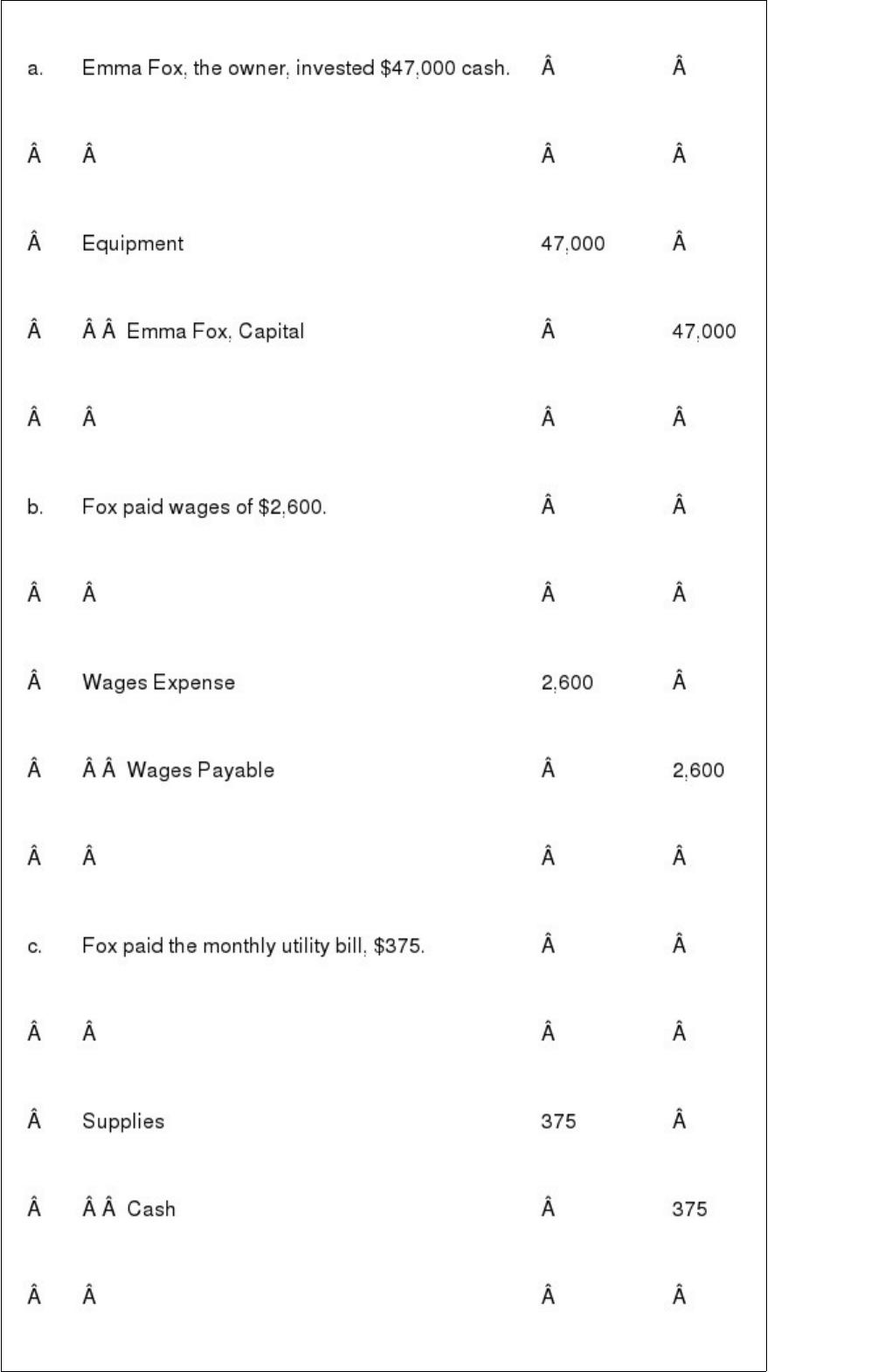
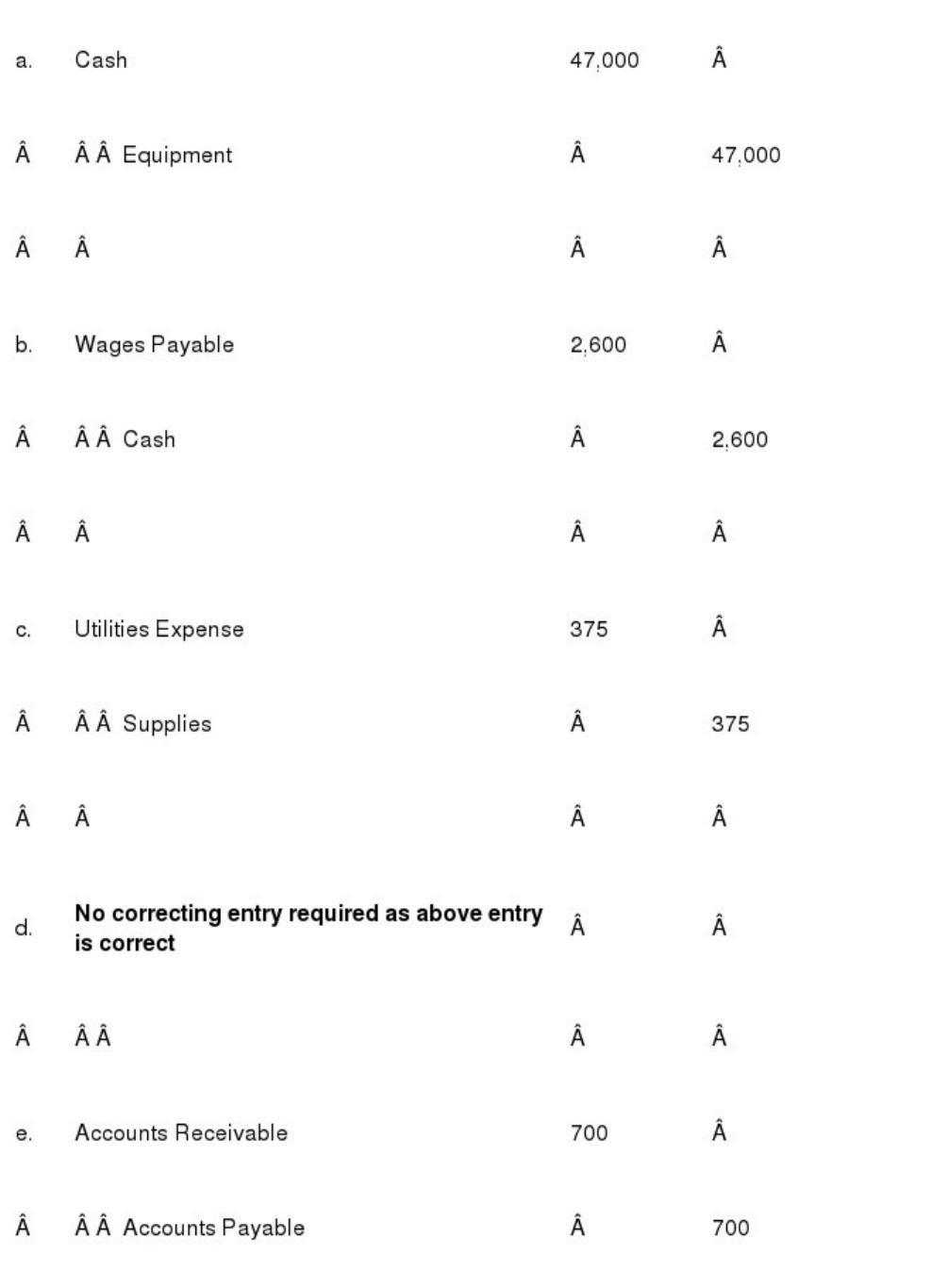
Transactions and journal entries are shown below. Read the transaction and determine if
the correct journal entry has been made. If a correction is necessary, prepare a
correcting entry.

(Appendix) Business transactions can be classified as
a. operating, investing, and accounting.
b. operating, financing, and lending.
c. operating, investing, and financing.
d. operating, lending, and borrowing.
The adjusting entry for the depreciation of office equipment for the period includes
a. debiting Depreciation Expense-Office Equipment and crediting Office Equipment.
b. debiting Office Equipment and crediting Accumulated Depreciation-Office
Equipment.
c. debiting Depreciation Expense-Office Equipment and crediting Accumulated
Depreciation-Office Equipment.
d. debiting Office Equipment and crediting Depreciation Expense-Office Equipment.
Federal income tax that is withheld each pay period from the employee’s earnings is
NOT based on the
a. total earnings of the employee.
b. marital status of the employee.
c. number of withholding allowances claimed by the employee.
d. number of vacation days.

Accounting for revenue when no entry of revenue is made in the accounts until cash is
received for the services performed is called
a. matching basis revenue.
b. cash basis expense.
c. service basis accounting.
d. modified cash basis.
The journal entry to close the income summary account (showing a profit) includes
a. debiting the drawing account and crediting Income Summary.
b. debiting Income Summary and crediting the drawing account.
c. debiting the owner’s capital account and crediting Income Summary.
d. debiting Income Summary and crediting the owner’s capital account.
Anthony Pescador owns Sundance Florist. He does his banking at United Credit Union
(UCU) in Myrtle Beach, South Carolina. The amounts in his general ledger for payroll
taxes and the employee’s withholding of Social Security, Medicare, and federal income
tax as of April 15 of the current year show the following: Social Security tax payable
(employer and employee), $3,412; Medicare tax payable (employer and employee),
$816; FUTA tax payable, $180; SUTA tax payable, $1,256; and Employee income tax
payable, $9,82 Journalize the payment of the Form 941 deposit to UCU and the
payment of the SUTA tax to the State of South Carolina as of April 15, 20–.
To journalize the payment of Social Security taxes to the IRS, the correct entry would
be
a. debit Social Security Tax Payable and credit IRS.
b. debit Social Security Tax Payable and credit Social Security Payable.
c. debit Social Security Tax Payable and credit Cash.
d. debit Social Security Tax Payable and credit Payroll Taxes Expense.
To establish a change fund, Cash should be credited and Change Fund should be
debited.
Organize a chart of accounts, using correct headings from the list of account titles
below:
Accounts Payable

Accounts Receivable
Building
Cash
Equipment
Insurance Expense
Prepaid Insurance
Rent Expense
Service Fees
Dunlop, Capital
Dunlop, Drawing
Supplies
Wage Expense
Wages Payable
Professional service business enterprises include attorneys, physicians, dentists, public
accountants, artists, and educators.
Whether the wage-bracket method or some other method is used in computing the
amount of tax to be withheld, the sum of the taxes withheld from an employee’s wages
is only an approximation of what the employee’s actual taxes will be for the year.
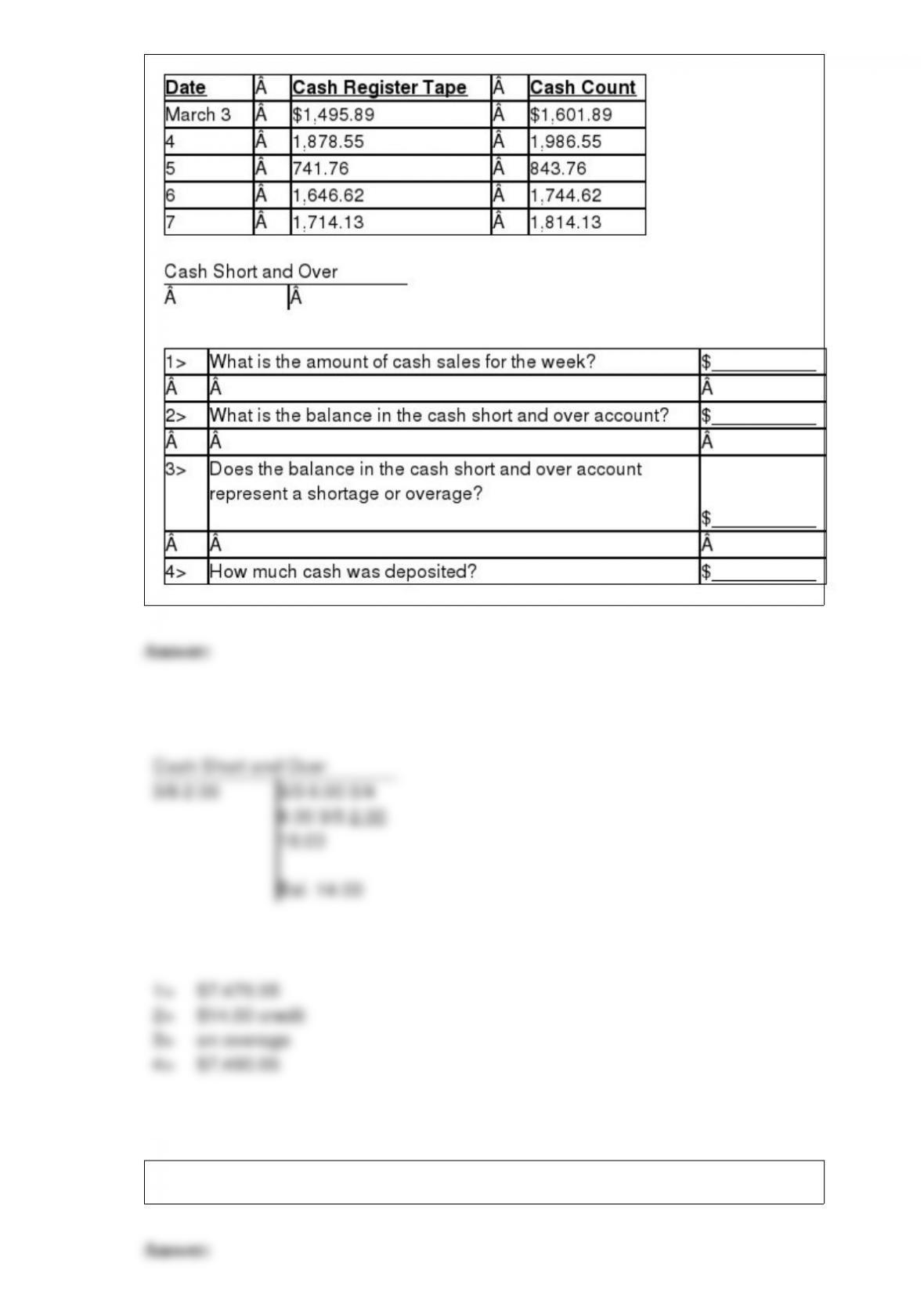
Post the differences between the cash count and the cash register tape to the Cash Short
and Over T account. Assume a change fund of $100.
The EFTPS is an electronic funds transfer system for making federal tax deposits.
The amounts in the financial statements must agree with the ledger account balances.
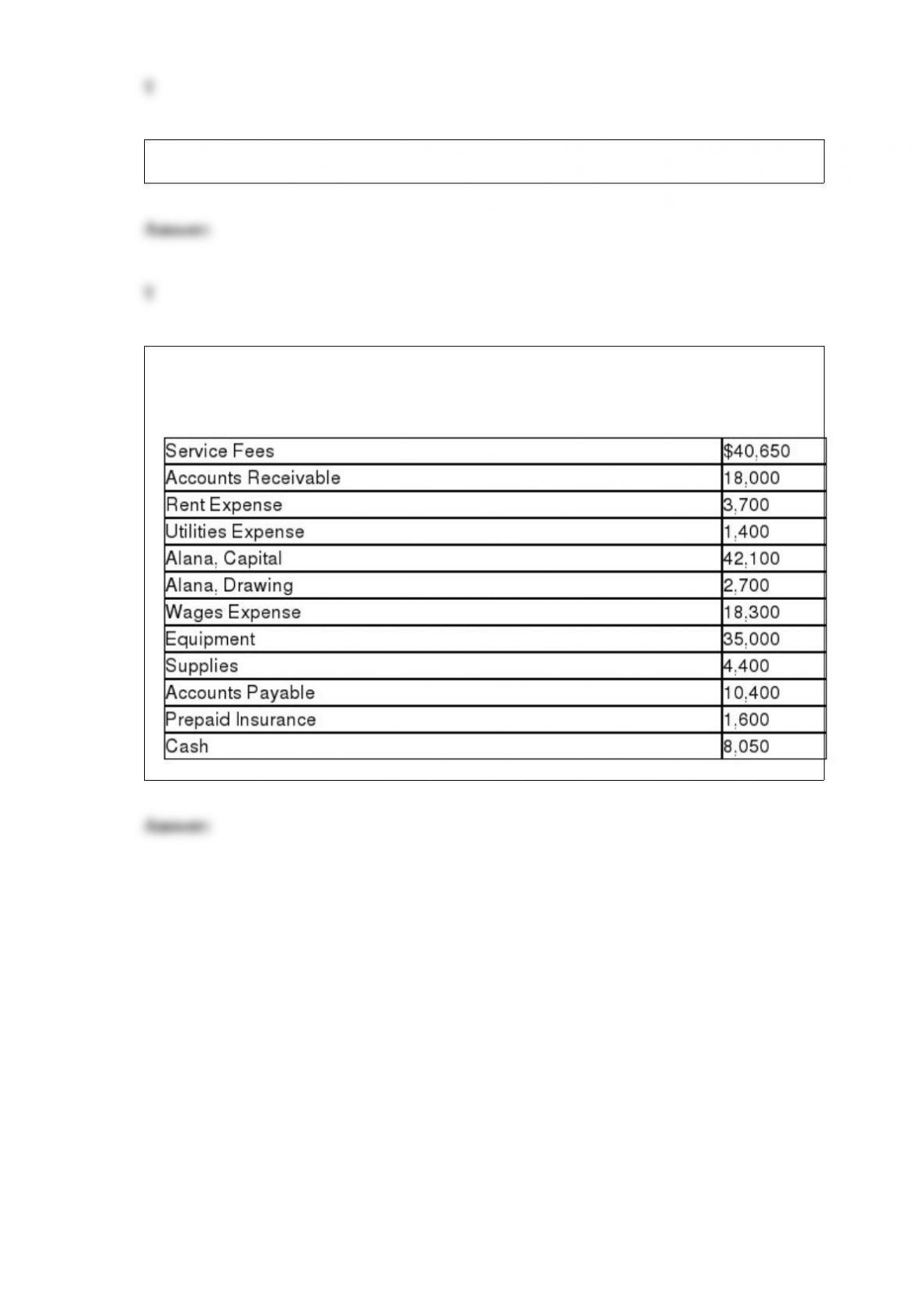
The accounts below all have normal balances. Prepare a trial balance for Alana’s Florist
Shop as of September 30, 20–.